
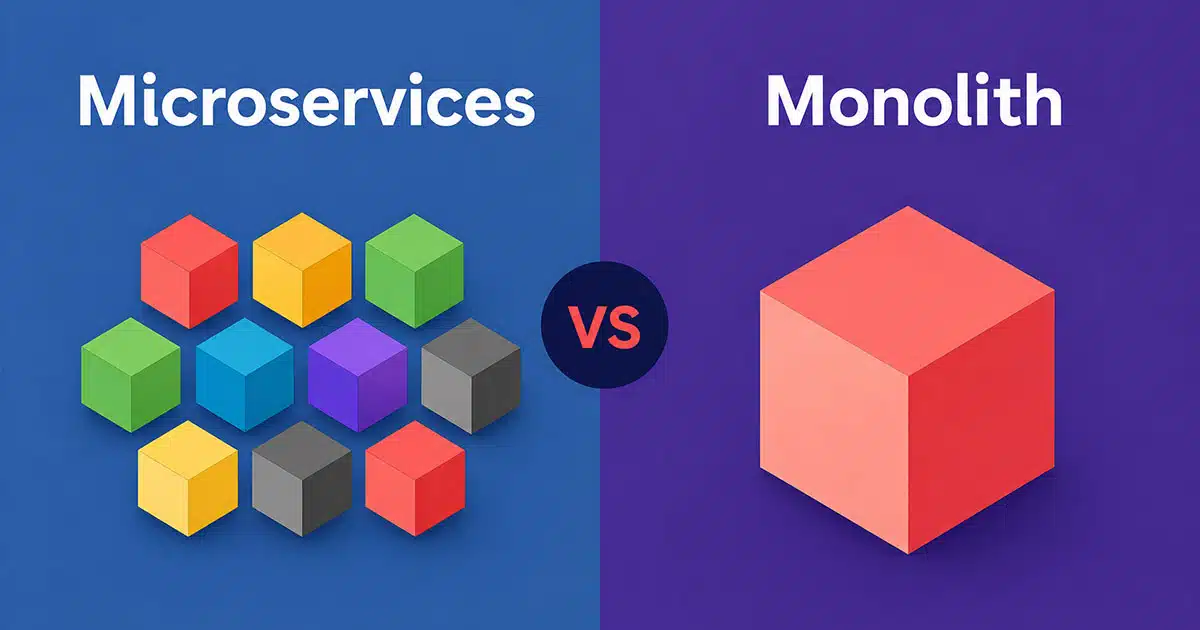
Choosing the right foundation often defines how far a SaaS product can grow. The debate around microservices vs monolith architecture continues to shape modern product decisions, especially for teams planning long-term scale. Each model represents a distinct approach to software architecture, influencing how teams build, deploy, and evolve applications over time.
Early-stage products often prioritize speed and simplicity, while growing platforms demand flexibility and resilience. These needs directly affect software development workflows, infrastructure choices, and team collaboration. From a software engineering perspective, architectural decisions also impact maintenance effort, release velocity, and system reliability. Understanding how these two approaches differ helps SaaS teams align technical choices with business goals, growth plans, and operational realities before complexity becomes difficult to reverse.
What Is Microservices Architecture?
Microservices architecture is a software design approach where applications are built as a collection of independent services rather than a single unit. Each service focuses on a specific function, which supports faster microservices development and easier updates. In microservices applications, multiple microservices operate together while remaining isolated from one another.
These independent services run as independently deployable services, allowing teams to release changes without affecting the entire system. A cloud-based microservices architecture commonly supports this model by enabling scalable infrastructure. Built on distributed systems and distributed architectures, microservices rely on loose coupling to improve resilience, flexibility, and long term scalability for growing SaaS products.
What Is Monolith Architecture?
Monolith architecture is a software design approach where the entire application is built and deployed as a single unit. In monolithic architecture, all components such as user interface, business logic, and data access, remain closely connected. Monolithic architecture software follows a traditional software development model that emphasizes simplicity and centralized control.
Monolithic applications run as one cohesive codebase, which makes development and deployment straightforward during early stages. These monolithic systems are tightly coupled, meaning changes in one area often affect the whole system. While monolith applications simplify initial setup, scaling or modifying a single unit becomes challenging as complexity increases.
Comparison Table: Monolithic vs Microservices Architecture
| Dimension | Monolithic Architecture | Microservices Architecture |
| Architectural Style | Single application built and deployed as one unit | Application composed of multiple independent services |
| Code Structure | One shared codebase for all features | Separate codebases for individual services |
| Deployment | Entire system deployed together | Each service deployed independently |
| Scalability | Scales the entire application at once | Scales individual services based on demand |
| Development Model | Centralized development approach | Decentralized, team-based development |
| Release Frequency | Slower releases as system grows | Faster and frequent releases |
| Fault Isolation | Failures affect the whole system | Failures isolated to specific services |
| Technology Choice | Limited technology flexibility | Different technologies per service |
| Data Management | Shared database across the system | Service-specific data ownership |
| Maintenance Effort | Easier initially, harder over time | More complex initially, easier at scale |
| Testing | Simpler test setup | Requires advanced testing strategies |
| Monitoring | Basic monitoring sufficient | Requires distributed monitoring tools |
| Best Use Case | Small or early-stage applications | Large, complex, and scalable systems |
| Key Differences | Simplicity and speed early on | Flexibility and resilience long term |
Key Differences Between Microservices And Monolith
Architectural decisions influence scalability, speed, and resilience in SaaS products. Comparing microservices and monolith models reveals how structure, deployment, and ownership affect growth, maintenance, and long-term business outcomes.
Structure Of The System
Monolith architecture organizes the entire application as a single unit. All modules operate together inside the entire monolith, sharing resources and dependencies. Changes in one area often ripple across the whole system, increasing coordination effort.
Microservices divide functionality into smaller units. Instead of one entire system, teams manage independent components that work together. Clear separation allows evolution without forcing changes across all the services at once.
Deployment And Release Impact
Deployments in a monolith require redeploying the entire application. Even small updates demand full testing and release cycles, which slows delivery and raises operational risk.
Microservices support independent deployments. Teams release updates without touching unrelated services, enabling faster iteration and safer rollouts. Release scope stays limited to what actually changes.
Failure Scope And Stability
Failures inside monolith environments affect the whole system. A defect in one module can disrupt unrelated features, causing widespread downtime and customer impact.
Microservices isolate failures. When one service encounters issues, others remain operational. Fault containment improves reliability and protects user experience during partial outages.
Business Logic Organization
Monolithic systems centralize business logic in shared layers. Over time, dependencies increase and changes become risky because logic intertwines across features.
Microservices allow each service to maintain its own business logic. Ownership stays clear, boundaries remain explicit, and teams update logic without unintended side effects elsewhere.
Scalability And Resource Use
Scaling monoliths requires duplicating the entire system, even when only one feature needs more capacity. Resource usage often becomes inefficient as traffic patterns vary.
Microservices scale by service. Teams allocate resources precisely to high-demand components, supporting new business capabilities without inflating infrastructure costs across the whole system.
Development Ownership And Speed
Monolithic development relies on shared codebases. Coordination overhead increases as teams grow, slowing development speed and complicating collaboration.
Microservices enable independent development. Teams work in parallel on individual services, accelerating delivery and reducing bottlenecks. Faster experimentation becomes achievable without cross-team dependency.
Evolution And Long-Term Fit
Monolith architecture suits early products with limited scope and simple requirements. Over time, adapting the entire application to new demands becomes increasingly complex.
Microservices align with evolving products. Distributed designs support changing requirements, growing teams, and expanding domains while preserving flexibility and operational control.
Understanding these differences helps SaaS teams choose an approach that matches current needs and future scale without unnecessary tradeoffs.
Pros & Cons Of Microservices Architecture
Microservices architecture offers flexibility and scalability, but it also introduces operational challenges. Understanding both sides helps SaaS teams decide whether this approach fits their product stage and organizational maturity.
Pros Of Microservices Architecture
Independent Scalability: Each service scales on demand without scaling the entire system. This approach improves performance efficiency and cost control for growing products.
Faster And Safer Deployments: Teams deploy services independently, which reduces release risk. Updates ship faster without waiting for full system coordination.
Clear Service Ownership: Well-defined service boundaries support team autonomy. Teams manage their own services, roadmaps, and priorities with minimal dependency.
Better Fault Isolation: Failures stay contained within a service. Issues do not automatically impact the entire platform, which improves reliability and uptime.
Technology Flexibility: Different services can use different tools or languages. Teams choose the best technology for specific problems without system-wide constraints.
Cons Of Microservices Architecture
Higher Operational Complexity: Managing multiple services increases infrastructure, monitoring, and deployment complexity. Tooling and expertise become mandatory rather than optional.
Challenging Debugging And Testing: Distributed systems make tracing issues harder. Testing across services requires advanced strategies and environments.
Increased Infrastructure Cost: Running many services often costs more than a single application. Resource overhead grows with scale and traffic.
Steeper Learning Curve: Teams need experience with distributed systems, deployment automation, and observability. Without maturity, complexity overwhelms productivity.
Data Consistency Challenges: Each service owns its data, which complicates transactions and reporting. Poor design leads to synchronization issues.
Microservices architecture excels for large, evolving SaaS platforms with strong engineering discipline. For smaller or early-stage teams, the added complexity may outweigh the benefits until scale truly demands it.
Pros & Cons Of Monolith Architecture
Monolith architecture remains a popular choice for many SaaS products, especially during early stages. It offers simplicity and speed but also introduces limitations as systems grow and requirements become more complex.
Pros Of Monolith Architecture
Simple Development And Deployment: Monolith architecture packages the entire application into a single deployable unit. This simplicity makes development straightforward and reduces setup complexity. Teams build, test, and deploy one codebase, which speeds up early delivery.
Faster Initial Development: Centralized code allows teams to move quickly. Fewer moving parts mean fewer integration concerns, making monoliths ideal for MVPs and early-stage products.
Easier Testing And Debugging: Testing remains simpler because everything runs in one environment. Debugging issues requires less tooling compared to distributed systems, helping teams resolve problems faster.
Lower Operational Overhead: Infrastructure needs remain minimal. Teams avoid managing service communication, orchestration, and distributed monitoring during early growth phases.
Cons Of Monolith Architecture
Limited Scalability: Scaling requires replicating the entire application. This approach wastes resources when only one component needs additional capacity.
Tight Coupling And Complexity Growth: As features increase, the codebase becomes harder to manage. Changes in one area affect others, increasing regression risk.
Slower Releases Over Time: Release cycles slow as coordination increases. Small changes require full testing and deployment, reducing agility.
Risk Of Large Failures: A single issue can bring down the entire application. Fault isolation remains weak compared to distributed designs.
Monolith architecture works well for small teams and early products, but long-term scalability often demands architectural evolution.
When SaaS Teams Should Choose Monolith Architecture
Early architectural decisions shape delivery speed and operational clarity. For many SaaS teams, a monolithic approach offers practical advantages during initial stages, especially when simplicity and execution matter more than scale.
Early Stage Product Development
A monolithic approach works well during early product development when requirements remain limited. Building one service with a clear single function allows teams to focus on core value instead of infrastructure concerns. The primary advantage lies in reduced complexity, which keeps progress steady and predictable.
Monolithic architecture pros become clear at this stage. Teams work with fewer components, fewer dependencies, and a shared understanding of the entire system. This setup reduces coordination overhead and allows rapid iteration on product ideas.
Small Engineering Teams
Small teams benefit from a shared code base where everyone understands the system. Collaboration remains easier because developers do not manage multiple services or communication layers. Knowledge stays centralized, which reduces onboarding friction.
With one service powering the server-side application, debugging and testing remain straightforward. Teams avoid distributed tooling and focus on feature delivery instead of system orchestration or service coordination.
Need For Faster Development Cycles
Speed often determines success for early SaaS products. Monolithic systems support faster development cycles by simplifying builds, tests, and deployments. Teams release updates quickly without managing service dependencies.
Higher development speed comes from fewer integration points and less operational overhead. Changes apply to the whole system at once, which works well when feature scope remains manageable and controlled.
Limited System Complexity
When products offer focused functionality, monoliths provide a clean and effective solution. A single code base reduces architectural decisions and keeps technical debt visible and manageable.
For SaaS products with clear boundaries and stable requirements, a monolithic design supports clarity and efficiency. The simplicity of one service allows teams to deliver value quickly while postponing complexity until scale truly demands change.
When Microservices Become The Right Choice For SaaS
As SaaS products mature, architectural needs change. Microservices excel when scale, speed, and flexibility become essential for continued growth and innovation.
Rapid Product Growth And Scaling Needs
Microservices excel when a product grows beyond a single team or workload pattern. Different features demand different levels of scale, and independent deployments allow teams to release changes without coordinating across the entire system. This separation prevents bottlenecks and supports steady expansion.
As traffic increases, teams adjust resources at the service level. Scaling happens where demand exists, rather than across the whole platform.
Continuous Delivery And Deployment Requirements
Modern SaaS products rely on continuous integration to keep development moving smoothly. Microservices support continuous deployment and continuous delivery by isolating changes to specific services. Teams release improvements frequently without waiting for system-wide approval.
This approach reduces risk and shortens feedback loops. Faster releases help teams respond to market changes and customer needs quickly.
Need For Clear Ownership And Boundaries
Growing organizations require defined service boundaries. Microservices assign responsibility to teams based on function, reducing overlap and confusion. Ownership becomes clear, and accountability improves.
Clear boundaries also improve code quality. Teams focus on their domain without affecting unrelated areas, which increases long-term maintainability.
Expanding Business Capabilities
As products introduce new business capabilities, flexibility becomes critical. Microservices allow teams to add features without disrupting existing functionality. Technology flexibility supports experimentation and future growth.
This model fits SaaS platforms evolving into complex ecosystems. Microservices provide the foundation needed to innovate while maintaining operational stability.
How Gain HQ Support Product Teams Managing Microservices And Monolith Architecture
Product teams face coordination challenges as systems grow. Gain HQ helps teams maintain clarity, visibility, and control while supporting modern and traditional architectures across planning, execution, and delivery workflows.
Centralized Visibility Across Services And Systems
Gain HQ supports teams managing multiple services by providing a unified view of work across architectures. Whether teams handle individual services or a single unit, product visibility stays consistent. This approach helps teams understand how individual components and each software component contribute to delivery goals.
Clear oversight allows teams to coordinate specific services without losing sight of other services or dependencies tied to the entire system. This clarity reduces confusion during planning and execution.
Better Monitoring And Operational Awareness
As systems evolve, observability becomes essential. Gain HQ complements monitoring tools by helping teams track ownership, progress, and outcomes tied to architectural work. A central logging system supports awareness when issues span across teams and workflows.
Clear visibility improves fault isolation by helping teams identify where problems originate and how they affect delivery priorities, timelines, and customer impact.
Structured Support For Architecture Evolution
Transitioning from legacy systems requires careful planning. Gain HQ supports the migration process by aligning product work with technical milestones. Teams define a clear migration strategy while maintaining delivery momentum.
This structure helps teams manage risk when separating a single unit into scalable services. Product leaders maintain alignment as systems evolve without disrupting ongoing development.
Flexible Collaboration For Growing And Small Teams
Gain HQ adapts to both small teams and larger organizations. Teams track work tied to new features, coordinate data exchange needs, and manage dependencies without architectural bias.
Whether teams support monolith or microservices, Gain HQ provides structure that scales with growth. Product teams maintain alignment, reduce friction, and deliver value consistently as systems and organizations evolve.
FAQs
How Monolithic And Microservices Architecture Affect The Development Process
Monolithic and microservices architectures shape the development process in different ways. Monoliths follow a centralized workflow where changes move through one pipeline, while microservices allow parallel development across teams with independent release cycles.
Which Architecture Better Supports Core Functionality
Core functionality often develops faster in a monolithic setup because everything lives in one place. Microservices separate core features into services, which improves flexibility but requires stronger coordination to maintain consistency.
Does Programming Language Choice Matter In Architecture Decisions
Yes. Monolithic systems usually rely on a single programming language across the application. Microservices allow teams to select different languages per service, which supports flexibility but increases operational complexity.
How Technology Stack Differs Between Monolith And Microservices
A monolith typically uses one shared technology stack for the entire application. Microservices introduce multiple stacks, enabling optimization per service but requiring expertise across tools, frameworks, and infrastructure.
Which Architecture Handles Complex Applications Better
Complex applications often benefit from microservices because functionality splits into manageable services. Monoliths handle complexity early on, but as features grow, tightly connected components become harder to maintain and scale.