
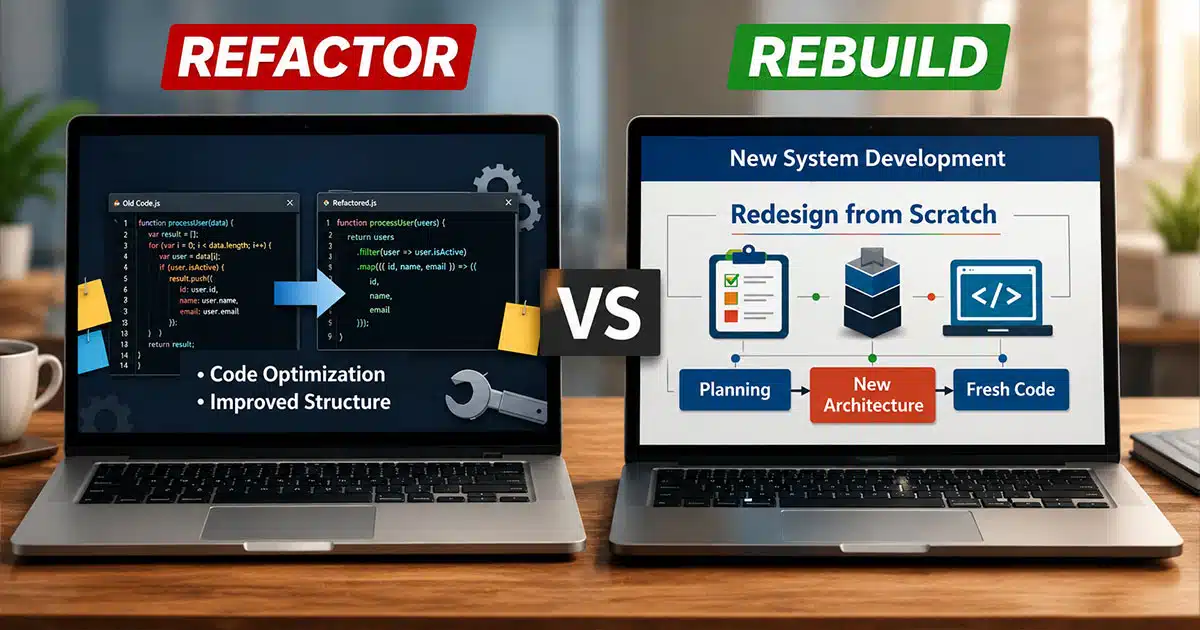
Almost every digital product eventually hits a crossroads. The software that once felt nimble and modern starts to feel heavy. Features take longer to ship. Bugs appear in unexpected places. Your development team spends more time fighting the codebase than building new things.
When you reach this point, two paths emerge: refactor what you have, or rebuild from scratch. This decision shapes your roadmap, your budget, and your competitive position for years to come. Getting it wrong can cost months of engineering effort and significant market opportunity.
This comprehensive guide walks through both options in plain language. You will learn when each approach makes sense, what trade offs are involved, and how to make a decision that aligns with your business goals.
What Is Refactoring?
Refactoring involves restructuring your existing code to improve internal qualities like readability, maintainability, and developer productivity without changing what the software actually does. Martin Fowler formalized this practice in his 1999 book, documenting over 70 specific refactoring techniques that teams still use today.
In practical terms, refactoring targets code smells such as duplicated logic, overly complex methods, or poorly organized code structure. A typical refactoring effort might touch 10 to 20 percent of the codebase in a given cycle, applying patterns like Extract Method to break down large functions or Replace Temporary Variable to clarify logic.
| Good Signs For Refactoring | Red Flags Even If You Choose Refactoring |
|---|---|
| Core architecture is sound, just messy | No existing test coverage to catch regressions |
| Technology stack is still supported | Original developers have all left with no documentation |
| Product-market fit is established | Performance problems are architectural, not code-level |
| Team knows the codebase well | Dependencies on deprecated third-party services |
| Continuous delivery pipeline exists | Business model is changing significantly |
Refactoring enables continuous delivery of new features while you improve the system. Teams can reserve 10 to 30 percent of their capacity each sprint for cleanup work, paying down debt incrementally rather than letting it accumulate. Studies suggest this approach can improve developer productivity by 20 to 50 percent over time.
What Is Rebuilding?
Rebuilding means starting over with a new software system. You redesign the entire system, often choosing a different software architecture pattern such as microservices, a modular monolith, or serverless infrastructure. The existing code is largely set aside as you create new code that replaces it.
A rebuild typically replaces 80 percent or more of your codebase. The timeline stretches from 6 to 24 months for most established products. Teams leverage modern technologies like containerization with Docker and Kubernetes, or serverless architectures on platforms like AWS Lambda. These modern software architecture patterns enable horizontal scaling that older monolithic systems struggle to achieve.
| Strategic Upsides Of Rebuilding | Organizational Risks You Must Plan For |
|---|---|
| Clean slate for modern software architecture | Long delivery timelines, often 2-3x initial estimates |
| Better performance and scalability potential | Feature freeze or slowdown during transition |
| Freedom to choose optimal technology stack | Maintaining two systems simultaneously |
| Opportunity to eliminate all technical debt | Loss of embedded business logic in old code |
| Attract talent excited by modern tools | Team fatigue from extended rebuild projects |
Industry data suggests that only about 30 percent of rebuild projects succeed in meeting their original goals. The 70 percent that struggle often do so because teams underestimate how much institutional knowledge lives in the existing software.
Key Difference Of Refactor Vs Rebuild
Refactor vs rebuild shapes software modernization strategies. Both approaches help teams develop stronger architectural design, improve performance, and manage complex systems, but each involves distinct risks, costs, and decision making priorities.
Scope Of Structural Change
Refactoring focuses on improving internal software design while preserving the first software architecture. Engineers optimize code structure, remove redundancies, and strengthen quality attributes such as maintainability, reliability, and flexibility. Such improvements often follow established architectural patterns to ensure consistency and stability within complex environments. Changes typically occur inside the engine room of the system, where developers refine logic without altering external behavior.
Rebuilding takes a broader approach by redesigning the entire architectural design from the ground up. Teams develop new systems using modern architectural patterns that better support scalability, security, and operational efficiency. This strategy becomes necessary when existing complex systems can no longer adapt to business demands. A rebuild replaces outdated software design elements and establishes a foundation for good architecture that supports future growth.
Risk And Stability Factors
Refactoring presents less risk because teams develop improvements incrementally while maintaining system functionality. Small updates allow engineers to evaluate performance changes in real time and minimize disruption. Decision making remains flexible since adjustments can occur at any stage without affecting the overall system structure. This gradual process reduces potential pitfalls and helps organizations maintain operational continuity.
Rebuilding introduces higher uncertainty because it requires full system replacement. Migration challenges, integration issues, and compatibility risks can affect stability during implementation. Complex environments often increase the difficulty of managing these transitions. However, rebuilding can reduce long term risks by eliminating structural weaknesses and establishing a strong first software architecture aligned with modern architectural design standards.
Cost And Resource Impact
Refactoring typically requires lower upfront investment since it focuses on targeted improvements within existing software design. Organizations can allocate resources gradually, allowing teams develop enhancements without disrupting ongoing operations. Incremental upgrades also reduce the financial burden associated with large scale infrastructure changes.
Rebuilding demands significant initial resources because teams must redesign the architectural design, implement new technologies, and conduct extensive testing. Although the upfront cost remains high, long term savings may occur through improved performance, reduced maintenance requirements, and elimination of legacy constraints. Proper decision making helps organizations balance the trade offs involved between immediate expenses and future benefits.
Performance And Scalability Outcomes
Refactoring can improve performance by optimizing workflows, reducing system load, and enhancing internal logic. Engineers strengthen quality attributes such as efficiency and reliability while maintaining the existing architectural patterns. Incremental improvements help complex systems operate more smoothly within their current structural limitations.
Rebuilding enables deeper performance transformation by introducing modern architectural design frameworks. New systems can support distributed processing, cloud scalability, and advanced automation capabilities. By redesigning the engine room of the application, organizations establish good architecture that supports long term scalability within complex environments.
Long Term Strategic Value
Refactoring offers strong long term value when existing systems still align with business objectives. Continuous improvements help maintain software design quality, reduce technical debt, and enhance operational efficiency. Teams develop better workflows while preserving the stability of the first software architecture.
Rebuilding provides greater strategic advantages when systems face structural limitations. A complete redesign allows organizations to adopt modern architectural patterns, address scalability challenges, and improve performance significantly. Careful decision making ensures the selected approach balances the trade offs involved while minimizing potential pitfalls and supporting sustainable growth.
Refactor vs Rebuild: Side-by-Side Comparison
The following table compares refactoring and rebuilding across dimensions that matter most to decision-makers. These are concrete ranges that a CFO or COO can follow without deep technical background.
| Dimension | Refactoring | Rebuilding |
|---|---|---|
| Code Change Scope | Often touches 10-30% of codebase per cycle | Replaces 70-100% of codebase over project duration |
| Typical Timeline | 2-6 week cycles, with multi-month programs | 6-24 months for established products |
| Cost Profile | Lower upfront, 20-50% of rebuild cost | Higher upfront investment |
| Risk Level | Low to moderate, incremental approach | High risk with potential for significant failure |
| Customer Impact | Minimal disruption if done well | May require migration, retraining, or downtime |
| Architecture Impact | Preserves fundamental structure | Full redesign possible |
| Team Continuity | Works with existing knowledge | May require new skills in modern technologies |
| Feature Delivery | Continues alongside improvements | Often pauses or slows during transition |
Refactoring tends to win when your existing system has good bones and the problems are more about accumulated mess than fundamental organization. If your software architects can point to specific areas that need cleanup rather than systemic failures, refactoring is often the less risky path. It preserves business logic and institutional knowledge that can be impossible to recreate.
Rebuilding becomes unavoidable when the underlying technology stack has reached end-of-life, when the current system behavior cannot meet non functional requirements no matter how much you tune it, or when a strategic business pivot demands capabilities that the existing architecture cannot support. If your enterprise architects are saying that incremental changes will never get you where you need to go, it may be time for a complete rebuild.
The decision rarely feels obvious in the moment. Most situations involve trade offs where both options have merit. The next sections will help you think through triggers and frameworks for making this choice.
Common Triggers: Signs Your Current System Needs Serious Attention
Problems with software systems rarely appear overnight. They accumulate over months or years, showing up first as business pain before anyone recognizes them as technical issues.
On the business side, you might notice that sales cycles are stretching longer because prospects ask for features that are difficult to add. Customer churn may increase due to reliability issues or a dated user experience. Support ticket volumes climb as users encounter more friction. These signals often precede any technical conversation about refactoring or rebuilding.
Technical indicators follow a pattern of their own. Release cycles that used to run weekly stretch to monthly or quarterly. Failed deployments become more common, and engineers start avoiding certain modules because making changes there tends to break other things. The software development life cycle gets slower and more painful with each passing quarter.
The financial picture tells part of the story too. Maintenance costs rise as you spend more effort just keeping the lights on. Meanwhile, the opportunity cost grows because your development team cannot ship the new features that would drive growth. Studies suggest that 80 percent of software budgets go toward maintenance rather than new development. When this ratio feels unsustainable, something has to change.
Warning signs that demand attention:
- Lead time for changes has doubled or tripled over the past year
- Engineers estimate simple features as complex because of ripple effects
- Third-party integrations break frequently due to brittle connection points
- Onboarding new developers takes months rather than weeks
- Performance issues appear that tuning and caching cannot solve
Any of these signs suggests your current system needs serious attention. The question is whether that attention should take the form of structured refactoring or a broader rebuild.
Refactor vs Rebuild: A Simple Decision Framework
When leadership teams need to make this decision, a simple framework helps structure the conversation. Consider these six factors and rate each as low, medium, or high for your situation.
Time Pressure: How urgently does the business need new capabilities? High pressure often favors refactoring because rebuilds take longer. Low pressure creates space for more ambitious changes.
Technical Debt Depth: Is the debt scattered across the codebase or concentrated in the software architecture sdesign itself? Surface-level debt often yields to refactoring. Architectural debt may require rebuilding.
Strategic Change Level: How different will the product be in two years? Incremental evolution favors refactoring. Fundamental shifts in business requirements may justify rebuilding.
Team Expertise: Does your development team know the existing system deeply? Strong institutional knowledge makes refactoring more effective. If that knowledge has left with departed engineers, rebuilding might actually be easier.
Budget Availability: Can you fund a multi-year initiative or do you need quick wins? Constrained budgets usually favor refactoring. Larger investments can support either path.
Risk Tolerance: What happens if the project runs over time or fails to deliver? Low tolerance points toward incremental refactoring. Organizations willing to accept high risk for high reward might consider rebuilding.
| Profile | Typical Decision |
|---|---|
| Fast-moving startup with high growth pressure, limited budget | Refactor for speed while building new services in parallel |
| Established mid-market vendor with stable customers, modest technical debt | Structured refactoring program over 12-18 months |
| Enterprise with end-of-life technology and budget for transformation | Planned rebuild with strangler-fig migration approach |
| Company pivoting business model significantly | Rebuild focused on new business capabilities |
Many organizations find that a hybrid approach works best. The strangler-fig pattern, for instance, lets you build new services or modules around the legacy core while cutting pieces away over time. This gives you the benefits of rebuilding in critical areas while maintaining stability elsewhere.
Strategic thinking about this decision matters more than technical preferences. The right architectural solution depends on your business strategy, not just what software architects consider elegant.
Practical Migration Strategies
In real projects, the answer is rarely pure refactor or pure rebuild. Most teams use phased strategies that combine elements of both approaches over time.
The strangler-fig pattern deserves special attention. Named after the strangler fig tree that gradually envelops its host, this approach involves building new services or modules around your legacy software. As each new component proves stable, you route traffic to it and eventually retire the corresponding piece of the old system. Twitter used this pattern successfully between 2006 and 2010, maintaining service continuity while fundamentally transforming their architecture.
Another practical approach is to plan incremental refactors around specific business capabilities rather than working file by file. Focus on distinct functional areas like onboarding, billing, or reporting. Each capability becomes a self-contained modernization project. This approach gives you natural stopping points, clearer progress metrics, and the flexibility to adjust your strategy as you learn.
A sample 12-18 month roadmap might look like this:
Months 1-3: Establish comprehensive test coverage and characterization tests. Without this safety net, any significant changes carry high risk of regressions. A healthcare company learned this lesson when rushed refactoring without tests led to months of extra effort fixing bugs.
Months 4-6: Refactor highest-pain modules that block feature delivery. Target the areas your development team complains about most.
Months 7-12: Begin rebuilding isolated components using domain driven design principles. Deploy new services alongside old ones using strangler-fig approach.
Months 13-18: Accelerate migration based on lessons learned. Retire legacy components as their replacements prove stable.
Practical guidelines for managing risk during modernization:
- Always maintain the ability to roll back quickly
- Avoid “big bang” cutover dates that force all-or-nothing commitments
- Keep one team focused on maintaining the existing system while others modernize
- Communicate progress in business value terms, not just technical metrics
The enterprise architecture team should stay closely involved throughout any migration. They can help ensure that architectural decisions align with long-term technology strategy and that architectural characteristics like fault tolerance and scalability receive appropriate attention.
How GainHQ Supports Teams Choosing Between Refactor And Rebuild
GainHQ supports teams in the software industry by providing clear insights into whether refactoring or rebuilding delivers better cost efficiency and long term value. The platform analyzes the internal structure of the existing system, detects accumulating technical debt, and highlights risks tied to legacy monolithic architecture or outdated programming languages. Such visibility helps leaders evaluate how current choices may impact future changes and scalability.
GainHQ also enables close collaboration between stakeholders, engineers, and architects when assessing distributed systems complexity and modernization priorities. By mapping existing functionality, performance constraints, and architectural limitations, the platform helps organizations decide whether to optimize a monolithic application or move toward a more flexible system design.
FAQs
How Long Does A Typical Refactor Or Rebuild Take?
Targeted refactoring efforts typically run in 2 to 6 week cycles, with several cycles often combined into a 6 to 12 month modernization roadmap. Each cycle focuses on a specific area of the codebase, delivering measurable improvements before moving on.
Is It Ever Safe To Pause All New Features And Focus Only On Refactoring?
Short stabilization periods of 1 to 3 months can be valuable when reliability or performance issues are actively harming customers. These focused efforts can address the most urgent technical debt and create breathing room.
How Do I Explain A Rebuild To Non-Technical Stakeholders And The Board?
Frame the rebuild as a capital investment with expected payback rather than a technical exercise. Talk about what the investment enables: faster delivery of new capabilities, lower incident costs, access to new markets, or ability to pursue revenue streams that the current system cannot support.
Can Refactoring Remove All Technical Debt, Or Will We Eventually Need A Rebuild Anyway?
Disciplined refactoring can keep many software systems healthy for a decade or more. If the core software architecture is sound and the technology stack remains supported, incremental improvements can extend the useful life of a system far beyond what teams initially expect.
How Should We Measure Success After Choosing Refactor Or Rebuild?
Track practical metrics that connect technical work to business outcomes. Lead time for changes shows how quickly teams can deliver value. Deployment frequency reveals how confidently you can ship. Incident frequency and duration measure reliability. Customer satisfaction scores capture user perception.