
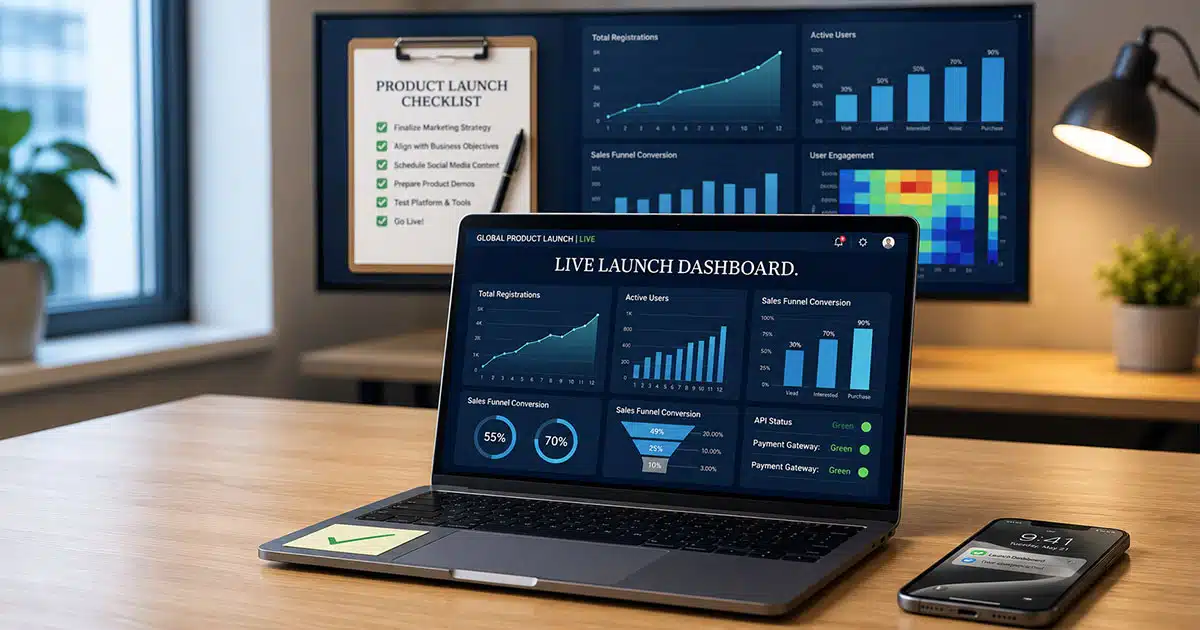
A strong product launch checklist helps teams stay aligned, avoid delays, and move with clarity from planning to execution. Every successful launch depends on clear priorities, defined ownership, and coordinated effort across multiple teams. Without structure, even well-prepared plans can fall apart during critical moments.
A reliable product launch plan supports a successful product launch by connecting strategy, timelines, and execution steps in one place. It ensures teams stay focused during the pre launch phase, where preparation, validation, and alignment matter most. Identifying different customer segments early also helps refine messaging and improve engagement across the target audience.
With the right checklist, teams can reduce confusion, manage risks better, and increase the chances of a successful launch while maintaining consistency across every stage of the launch process.
What Is A Product Launch Checklist
A product launch checklist is a structured framework that turns your product launch strategy into specific, dated, and assignable tasks for cross functional teams. The checklist ensures organizational alignment, reduces execution risks, and creates accountability across product, engineering, marketing, sales, and customer support.
Typical components include product readiness and quality assurance, go to market strategy and positioning, marketing assets and marketing campaigns, sales and support enablement, systems operations and launch coordination, monitoring workflows, and post launch optimization cycles. Unlike a lengthy strategy deck that explains the reasoning behind decisions, a launch checklist answers who does what, when, and how.
Launch checklists should be tiered by launch type. A full rebrand with pricing changes and analyst briefings in Q3 2026 requires comprehensive activation across all phases. A minor UI improvement might compress the timeline to four weeks. One SaaS company learned this lesson when a pricing update was missed in their product readiness phase. The oversight caused customer confusion and billing errors that took weeks to resolve. A checklist with explicit pricing validation across product, finance, and operations would have caught this gap before launch day.
7 Practical Product Launch Checklist For Efficient Launches
This section breaks the launch process into seven practical checklists, each mapped to a phase and suggested timeframe. Every checklist covers goals, key actions, and typical owners so a product manager or marketing lead can draft their own version quickly.
1. Market Research And Customer Insight Checklist
Start this work three to six months before the target launch date for substantial products. Thorough market research validates that you are solving real problems for the right target audience.
Define one or two primary customer personas with concrete traits. Go beyond job titles to include company size ranges, annual budget allocations, career stage, recurring customer pain points, and preferred communication channels. A useful persona might read: mid market software companies with 50 to 500 employees, marketing operations teams with $50,000 to $150,000 annual budget for tools.
Conduct market research through five to ten structured customer or prospect interviews before locking product scope and messaging. Ask open ended questions about how they currently solve the problem, what frustrations arise, and which key features would be most valuable. Use a Lean Startup MVP approach to validated learning so discovery work directly shapes product decisions. Capture competitive pricing and positioning from three to five direct competitors in a shared workspace.
Review 12 months of product usage data, support tickets, and churn reasons to validate the problem and feature priority. This quantitative validation often reveals surprises about actual feature adoption versus assumed usage, especially where SaaS UX issues are driving churn and retention problems.
Document findings in a concise Insight Summary that will inform positioning, messaging, and sales strategy in later phases. This synthesis ensures product, marketing, and sales teams interpret research consistently.
2. Product Readiness And Quality Checklist
Focus on confirming build completeness, quality, and risk management four to eight weeks before launch. This phase determines whether your product meets the standard your target customers expect.
Create a clear ready for launch criteria document that spells out which categories of bugs are acceptable and which block release. Address functional completeness, performance under expected traffic, security and data privacy, user experience quality, and system stability.
Run a beta or pilot phase of two to four weeks with 20 to 50 representative users. Define success metrics including activation rate, error rate, feature adoption, and time to value. Apply disciplined MVP feature prioritization techniques as you gather user feedback systematically to distinguish technical issues from communication gaps.
Complete security and compliance checks where relevant. For EU users, verify data handling practices align with GDPR requirements. Update privacy statements to reflect actual data practices. Many teams defer security reviews until after launch, creating expensive rework.
Assign owners from product and engineering teams to update product specifications, release notes, and API documentation. Align these changes with a clear technical roadmap that supports the launch strategy. Schedule a go no go meeting at least seven days before the target launch date. This buffer allows time to address critical issues without last minute scrambles.
3. Go To Market Strategy And Positioning Checklist
Connect insights from the research phase to positioning and messaging decisions. A strong go to market strategy translates customer understanding into compelling product positioning that resonates with potential customers.
Craft a one sentence positioning statement that clearly states target user, problem, and differentiated benefit. For example: For mid market marketing operations teams managing multiple channels, this platform eliminates data silos and reduces campaign execution time by 40 percent compared to point tools.
Create a messaging framework with one primary benefit, two or three secondary benefits, and proof points such as key metrics or case studies. Drawing on real SaaS launch case studies with measurable results can strengthen proof points. This hierarchy ensures competitive differentiation across all customer segments.
Confirm pricing strategies, upgrade paths, discount rules, and billing impact with finance and operations. Model the impact on existing customers if introducing new pricing structures. Many companies discover hidden billing logic issues only after launch.
Choose a launch type based on risk and impact. Options include a big announcement with PR and analyst outreach, a quiet rollout to existing customers, or a beta expansion from a pilot cohort. Anchor these choices in an end to end SaaS product development and launch strategy. Set concrete key performance indicators for the first 30 and 90 days, including target signups, demos booked, activation rate, and revenue goals.
4. Marketing Assets And Campaign Planning Checklist
Translate go to market plans into tangible assets scheduled across channels in a content calendar. This phase operationalizes your launch strategy into deliverables with clear owners and deadlines.
Core launch materials include a launch blog post, a landing page, email sequences, a product overview deck, and a short demo video. Draw inspiration from GainHQ’s blog on SaaS and digital product strategy when shaping topics and narratives. Assign a single owner to each asset. Schedule deadlines working backward from the launch date: final copy two weeks before launch, design handoff 10 days before, and stakeholder sign-off seven days before.
Select two or three distribution channels rather than trying everything at once. For B2B products, focus on email to existing relationships, LinkedIn activity, and customer webinars. For consumer products, consider social media channels where your target market congregates.
Establish campaign tracking before assets go live. Create unique UTM parameters for each campaign asset and channel. Define custom events in analytics tools for key actions. Build dashboards displaying real time data on traffic sources, signup volume, and success metrics.
Create a review workflow specifying which key stakeholders must approve copy, visuals, and legally sensitive statements. Centralized feedback collection prevents conflicting comments from different reviewers.
5. Sales, Support, And Customer Success Enablement Checklist
Internal enablement deserves the same rigor as external promotion, especially for B2B products where sales conversations influence purchasing decisions. Prepare sales teams and customer success teams two to four weeks before launch.
Create sales collateral including a concise one pager explaining target users, key benefits, pricing, objection handling points, and competitive differentiation. For early stage products, include lessons from launching a production ready MVP in 90 days to give sales concrete stories. This document should be scannable for quick reference during customer calls.
Run at least one live training session for sales teams and one for support and sales teams within two weeks of launch. Cover product features, positioning, pricing logic, common customer questions, and demo access. Customer success managers need similar training to support expansion opportunities.
Update CRM fields, playbooks, email templates, and support documentation so teams can log customer feedback using consistent messaging from day one. Where workflows are fragmented across tools, consider lessons from a software build versus buy case for a custom core platform when designing internal systems. Prepare training materials that enable new users of internal systems to get up to speed quickly.
If you work with reseller partners, send a launch kit with copy, banners, and example emails one week before public announcement. Set up clear escalation paths for issues discovered by the customer support team during the first launch week.
6. Systems, Operations, And Launch Day Coordination Checklist
Ensure infrastructure, billing, analytics, and workflows are ready for increased traffic and attention. Launch readiness on the technical side prevents embarrassing failures when customers arrive.
Complete technical checks including capacity verification, synthetics monitoring for critical user flows, and failover testing. Many teams assume failover capabilities exist but discover during production incidents that backup systems do not work as intended.
Verify billing systems calculate charges correctly, apply appropriate tax logic for each geography, and handle promotional codes. Engage tech consulting services to review complex integrations and compliance risks if internal expertise is limited. Test order workflows in staging and production environments. A SaaS company once discovered tax handling issues two days before launch, triggering emergency legal reviews and a one week delay.
Create a written launch day runbook listing who is on call, communication channels, and decision making rules if something goes wrong. Establish a central command channel or virtual war room for live status updates and quick approvals.
Confirm backup plans such as rolling back features, disabling promotions, or throttling API access if critical errors appear during the first hours. Document contingency procedures before you need them.
7. Post Launch Review And Continuous Improvement Checklist
The launch is just the beginning. Extend monitoring and feedback collection across the first 30 to 90 days, not just the first 24 hours. This phase determines whether you achieve customer satisfaction and sustainable growth.
Monitor key metrics daily during the first week: signup volume, activation rate, error rates, API response times, and customer support volume. Shift to weekly reviews for the next three to four weeks, comparing actual metrics against projections.
Gather feedback through customer interviews with early adopters, NPS surveys, support ticket analysis, and sales notes. Gather customer feedback systematically by coding themes so patterns emerge. Customer facing teams have rich observational data that often goes unanalyzed.
Conduct a lightweight post mortem two to four weeks after launch. Document what worked, what failed, and what to change. Include cross functional participants from product, engineering, marketing, sales, and support to capture diverse perspectives.
Convert insights into a revised launch playbook. Update your new product launch checklist based on lessons learned, similar to how post MVP development focuses on continuous, data driven improvement. Refine messaging based on actual customer responses. Celebrate wins and acknowledge team contributions to reinforce healthy habits for future launches.
How To Adapt The Checklist For Different Launch Types
Not every launch needs the same level of effort. Teams should scale checklist depth according to risk and impact. A major new product release with public PR, analyst briefings, and pricing changes uses every item in detail. A modest feature improvement uses a simplified version focusing on product readiness and targeted communication.
Match Effort To Each Launch Tier
Tier One launches include global product releases, major rebrands, and new market entries. These require four to six months of pre launch preparation and activate all seven checklists comprehensively. Use a strategic SaaS product roadmap to connect these efforts to long term goals. Budget allocation typically represents 0.5 to 1.5 percent of annual marketing spend.
Tier Two launches cover significant feature additions or regional rollouts. The new product launch plan compresses to two to three months. Market research might involve three to five interviews rather than fifteen. Marketing focuses on email and landing pages rather than multi channel campaigns.
Tier Three launches include UI improvements, bug fixes, or internal tools. Execute in four to six weeks with a minimal new product launch checklist focused on product quality, release notes, and team communication. Document tier rules once, then reference them in every launch brief to keep multiple teams on the same page.
Plan Based On Team Size And Available Resources
Lean startup teams must prioritize ruthlessly. One person might own both product and marketing checklist components. Focus on high leverage activities: clear product positioning, a strong landing page, basic analytics, and one well delivered sales training session.
Small teams should maintain the same seven phase structure but merge or simplify all the tasks to keep the document usable. Use templates for repeated tasks like email sequences to reduce workload across launches, and borrow patterns from a structured startup software development process guide. Acknowledge trade offs explicitly in the new product launch plan so everyone knows what will not be done this time.
Work With External Partners And Agencies
When companies use PR agencies, creative studios, or reseller partners, alignment with the internal checklist matters. Misalignment frequently results in disjointed campaigns where agency copy does not match sales enablement materials, similar to how misfit off the shelf tools can fragment workflows before custom software transforms operations across a business.
Create a shared launch calendar that agencies can access and update with their own milestones. Establish clear approval processes with specific review windows for copy and creative assets. Include service level expectations in contracts for launch critical items. External teams should receive the same positioning documents and messaging hierarchy as internal teams.
Handle Dependencies And Cross Team Risks
Typical dependencies include engineering completion dates, legal sign offs, compliance reviews, payment processor integration, and external partnership readiness. Factor in UI/UX design for SaaS products as a critical dependency so interface changes are ready in time for launch. Add explicit dependency lines in the launch plan so everyone sees what tasks block others.
Hold short weekly cross functional check ins during the final six weeks before launch. Use risk registers listing potential issues, likelihood, impact, and mitigation owners. This proactive view helps avoid common surprises like missing store approvals or untested payment flows.
Evaluate Success Across Different Launch Types
Different launches require different success metrics, but they should always be set before execution. Group metrics into awareness, engagement, and revenue or retention categories.
Use baseline numbers from previous quarters or similar past launches to inform goal setting. Present post launch results in a concise dashboard accessible to key stakeholders. Include a reflection on whether the chosen checklist depth matched the actual risk and launch performance.
Common Mistakes To Avoid When Using A Launch Checklist
Checklists only help when they are realistic, regularly updated, and truly used as a decision tool. Teams often overestimate capacity and create overly ambitious task lists. Ignoring dependencies causes last-minute rushes. A good product launch checklist must be specific, time-bound, and connected to clear goals.
Avoid Low-Value Tasks In The Checklist
Some teams add every minor action, creating a long document nobody reads end to end. Focus on tasks that change outcomes: final QA, key messages, system checks. Limit the core checklist to 15 to 25 line items per phase. Keep a separate nice-to-have list that can be dropped if capacity shrinks. Prune regularly before each weekly planning session.
Keeping the checklist focused improves clarity during execution. Teams move faster when priorities are obvious. A shorter list also reduces confusion during high-pressure moments and makes it easier to track progress without missing critical steps that directly impact launch success.
Set Clear Owners And Deadlines
Tasks without owners or dates are effectively wishes. Every checklist item needs a single directly responsible person, even if collaborators support them. Set realistic due dates that account for reviews, approvals, and integration work. Review ownership conflicts openly when one person is responsible for too many critical items.
Clear ownership builds accountability across teams. Work moves faster when responsibility is defined early. Deadlines also create momentum and reduce delays, especially when multiple teams depend on each other to complete tasks before the launch timeline reaches critical stages.
Maintain Strong Internal Communication
Launch plans sometimes live only with product and marketing leads, leaving engineering teams and customer success unprepared. Share a simple launch snapshot with all departments including objectives, dates, and risks. Use short internal announcements or standups to keep the plan visible. Invite feedback from customer facing teams earlier since they often spot missing considerations.
Better communication keeps everyone aligned on expectations. Teams avoid surprises and stay prepared for changes. Early visibility also improves collaboration, allowing different departments to contribute effectively instead of reacting late when adjustments become harder to implement.
Allow Enough Time For Reviews And Approvals
Legal, brand, and leadership reviews take longer than expected, especially in regulated industries. Book review windows in calendars as soon as draft dates are known. Clarify up front who has final sign off on product, pricing, and public statements. Build small buffers into deadlines to handle late edits without moving the launch date.
Planning review time reduces last minute pressure. Teams avoid rushed approvals that lead to mistakes. Clear timelines also help stakeholders stay committed, ensuring decisions are made on time without slowing down the overall launch schedule or creating unnecessary bottlenecks.
Update The Checklist After Each Launch
Teams sometimes treat the checklist as a one time artifact instead of a living playbook. Schedule a short session after every major launch to update what should change. Remove steps that proved unnecessary and add new ones for overlooked risks. Maintain version history so teams know which version to follow. Nominate an owner responsible for keeping the master free product launch template accurate over time.
Regular updates keep the checklist relevant and practical. Each launch becomes a learning opportunity. Over time, the checklist evolves into a reliable framework that reflects real challenges and helps teams execute future launches with greater confidence and fewer unexpected issues.
How GainHQ Improves Product Launch Execution
A structured, visible launch plan requires centralized coordination across multiple teams, parallel workstreams, and numerous approval points. GainHQ addresses these friction points through approval workflows, content scheduling, and collaboration features.
Marketing and product teams can turn each of the seven checklists into repeatable workflows and templates inside GainHQ. The market research phase becomes a project collecting competitive data, interview notes, and insight summaries in one accessible location.
GainHQ calendars map launch phases, deadlines, and content pieces across social media, email, and blog channels in one place. Visual representation helps prevent bottlenecks where multiple workstreams collide unexpectedly.
Approval workflows eliminate last minute asset chaos by keeping comments, versions, and sign offs together. Rather than scattered email threads with conflicting feedback, stakeholders annotate specific passages and approval is recorded as a discrete event.
Centralizing briefs, messaging docs, and campaign assets in GainHQ keeps all launch stakeholders aligned without juggling multiple tools. Sales, support, and customer success teams access the same product positioning that marketing uses, ensuring customer satisfaction through consistent messaging.
If you need a free product launch checklist to get started, download our template and adapt it to your product launch plan. Teams looking for a complete platform can explore how GainHQ turns checklists into coordinated action.
Frequently Asked Questions
How Early Should We Start Building A Product Launch Checklist
For a significant SaaS or digital product launch, start structuring the checklist three to six months before the target launch date. Smaller feature launches can use a four to six week horizon. The most important step is defining the launch tier and rough scope first, then layering in detailed tasks as plans solidify.
Who Should Own The Product Launch Checklist In A Growing Company
Ownership typically sits with a product marketing manager or, if that role does not exist, the product manager partnering closely with marketing. While many people contribute, one person must be accountable for keeping the checklist current and driving decisions. This prevents accountability gaps where tasks fall through the cracks.
How Detailed Should A Product Launch Checklist Be For A Small Team
Small teams should keep the checklist concise by focusing on a few high leverage tasks per phase: core research, positioning, one primary campaign, and a simple post launch review. Use the same seven phase structure but merge or simplify tasks so the document remains usable day to day.
Can The Same Checklist Work For Both Physical And Digital Products
The high level phases and many tasks are similar, but physical products require added logistics steps like inventory planning, packaging compliance, and shipping coordination. Teams selling both types should create a shared core checklist with additional physical specific and digital specific sections where needed.
How Often Should We Review And Update Our Product Launch Checklist
Revisit the checklist after every major launch, ideally within two to four weeks, to capture lessons while they are fresh. Conduct a broader refresh at least once a year to reflect changes in team structure, tools, and market conditions. A checklist that has not been updated becomes a liability rather than an asset.