Enterprise AI software is no longer a future idea. It is already shaping how companies work, compete, and grow. From smarter decisions to faster operations, AI is changing the rules of business. Companies that adopt it early often move ahead, while others struggle to keep up.
But not every solution delivers real value. Many businesses feel confused about where to start, what to choose, and how to scale. That is where clarity matters.
This guide breaks down enterprise AI software in a simple way. You will learn how it works, why it matters, and how to choose the right solution for your business.
What Is Enterprise AI Software
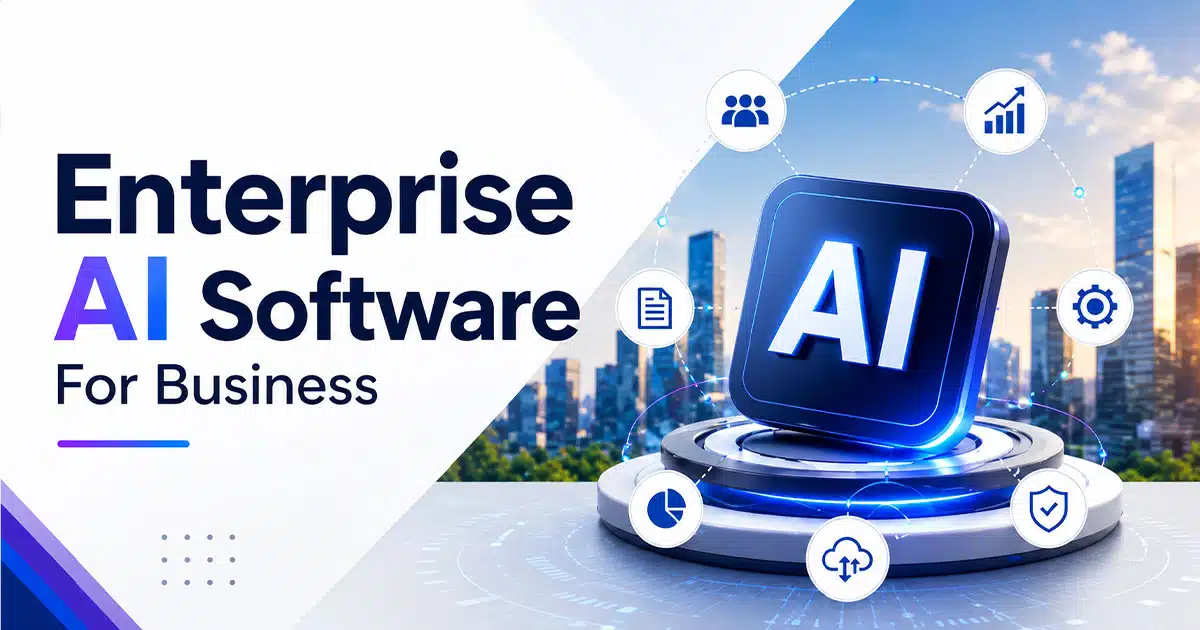
Enterprise AI software refers to advanced enterprise AI solutions built for large organizations. It combines AI systems, machine learning models, and generative AI models to improve business operations, building on the same foundations as broader artificial intelligence software. These tools connect with existing enterprise systems and multiple data sources to support various business functions. From customer interactions to process automation, enterprise AI software helps teams make faster and smarter decisions.
Modern enterprise AI platforms like Google Cloud, Microsoft Azure, and Amazon Web Services offer scalable AI capabilities. They support natural language processing, AI-powered workflows, and help create AI agents or AI assistants. Businesses can also build custom AI models and deploy AI solutions safely with strong enterprise-grade security and data security.
At its core, enterprise AI software reduces repetitive tasks, improves customer experience, and boosts operational efficiency. It supports digital transformation, enables continuous learning, and allows global enterprises to scale with confidence through AI software development. A clear AI strategy helps achieve enterprise wide ai adoption.
Key Features Of An Enterprise AI Software Platform
Enterprise AI software platforms offer more than basic automation. They bring together AI systems, data, and workflows into one unified AI platform. Strong features help global enterprises scale faster, improve business operations, and ensure security and compliance across all business functions.
Scalable AI Models And Infrastructure
Enterprise AI platforms rely on powerful machine learning models and large language models. These models support enterprise AI applications across various business functions and reflect broader software development trends. A report shows over 65% of global enterprises now use AI models to improve operational efficiency and decision-making.
Cloud providers like Google Cloud and Amazon Web Services offer scalable AI infrastructure, forming the backbone of AI infrastructure for intelligent applications. Businesses can deploy AI solutions and scale ai agents without heavy hardware investment. This flexibility supports long-term AI strategy and growth.
Deep Integration With Business Systems
Enterprise AI software must connect with existing enterprise systems and business systems. Strong integration ensures smooth data flow across platforms. It helps unify data sources and supports AI-driven workflows across departments.
Studies show nearly 70% of companies struggle without deep integration. Platforms like Microsoft Azure support easy integration with CRM, ERP, and other AI tools. This improves workflow automation and reduces manual effort across business processes.
Advanced Security And Compliance Controls
Enterprise AI solutions handle sensitive data. Strong enterprise security and enterprise-grade security are critical. Security features protect data privacy, support risk management, and ensure compliance with global standards.
Reports suggest over 60% of enterprises consider data security their top concern in AI adoption. Enterprise AI platforms offer secure environments to deploy AI safely. They also support monitoring, audit logs, and governance for better control.
AI-Powered Automation And Agents
Enterprise AI software supports AI-powered workflows and AI automation compared to traditional automation. It helps automate repetitive tasks and improve customer interactions. Businesses can also create AI agents and AI assistants to handle support tasks and internal workflows.
Recent data shows automation can reduce operational costs by up to 30%. Agentic AI and generative AI capabilities allow companies to scale AI operations and improve customer experience without increasing human agents.
Low Code AI Development And Accessibility
Modern enterprise AI platforms offer low-code tools for faster AI development. Non-technical users can build and deploy AI solutions without great technical skills, particularly as AI in SaaS brings new benefits and challenges. This expands enterprise-wide AI adoption across teams.
Platforms like Microsoft Azure and Google Cloud provide AI Studio and AI tools for easy development. This approach reduces dependency on data scientists and speeds up AI-powered innovation across business models.
Benefits Of Enterprise AI Software For Modern Businesses
Enterprise AI software helps companies move faster and work smarter. It improves decisions, reduces manual work, and unlocks new value from data. Strong AI capabilities support growth, efficiency, and better outcomes across core business functions.
Faster And Smarter Decision Making
Enterprise AI uses machine learning models and large language models to analyze huge data sources, much like predictive analytics software. It turns raw data into clear insights for business operations. Leaders can act faster with real-time signals instead of guesswork.
Recent studies show over 75% of enterprises use AI for decision support. AI platforms from Google Cloud and Microsoft Azure provide AI search and analytics tools. These tools improve accuracy and support strong AI strategy across business systems.
Higher Operational Efficiency And Automation
AI-powered workflows reduce repetitive tasks and manual effort. Enterprise AI software supports process automation across HRM, CRM, and finance. Teams save time and focus on high-value work.
Reports show AI-driven workflows can reduce operational costs by up to 30%. AI tools and AI agents help automate routine tasks in support teams and internal processes, especially in AI-driven automation within SaaS platforms. This leads to better workflow automation and improved productivity.
Improved Customer Experience And Engagement
Enterprise AI applications improve customer interactions across channels. AI assistants and generative AI solutions handle queries faster and with better accuracy. Natural language processing helps systems understand customer needs.
Around 70% of customers expect fast and personalized responses. AI-powered systems deliver better customer experience through real-time support. Companies can scale customer service without adding more human agents.
Scalable Growth Across Business Functions
Enterprise AI platforms support growth across various business functions. Businesses can deploy AI solutions and scale AI agents as demand increases, provided they invest in scalable software architecture for high-growth products. Cloud platforms like Amazon Web Services make scaling easier.
Data shows over 65% of global enterprises invest in AI for scalability. AI software supports digital transformation and helps manage growing data and complex business processes. This ensures long-term success.
Stronger Risk Management And Data Security
Enterprise AI solutions include advanced security and compliance features. They protect sensitive data and support risk management across enterprise systems, drawing on SaaS security architecture best practices. Enterprise-grade security ensures safe AI operations.
Surveys show over 60% of companies see data security as a top AI concern. Platforms like Microsoft Azure offer secure environments to deploy AI safely. This builds trust and supports enterprise-wide AI adoption.
Real World Use Cases Of Enterprise AI Software Across Industries
Enterprise AI software shows real value across industries. It powers smarter systems, faster workflows, and better outcomes. Companies use AI solutions to solve real problems in daily operations, customer service, and decision-making at scale.
AI In Healthcare Operations
Enterprise AI software helps hospitals improve care and reduce costs. AI systems analyze patient data, medical records, and data sources to support faster diagnosis, similar to how teams integrate AI into SaaS products to enhance workflows. Machine learning models also help detect risks early and improve treatment plans.
Reports show over 50% of healthcare providers now use enterprise AI applications. AI-powered workflows reduce manual tasks and improve patient management. Generative AI solutions also assist doctors with documentation and natural language processing tasks.
AI In Financial Services
Banks and fintech companies use enterprise AI platforms for fraud detection and risk management. AI models analyze transactions in real time and flag suspicious activity. This improves security and protects sensitive data.
Studies suggest AI reduces fraud losses by up to 40% in financial institutions. AI-driven workflows also improve customer interactions through AI assistants. Platforms like Microsoft Azure support secure AI operations with enterprise-grade security.
AI In Retail And E-commerce
Retail businesses use enterprise AI software to improve customer experience and sales. AI tools track customer behavior, recommend products, and optimize pricing strategies, similar to AI features that increased engagement by 34% in a B2B SaaS case study. This helps increase conversions and revenue.
Data shows over 70% of retailers use AI for personalization. Generative AI models and AI search improve product discovery. AI-powered workflows also support inventory management and demand forecasting across business operations.
AI In Manufacturing And Supply Chain
Manufacturers use enterprise AI solutions to optimize production and reduce downtime. AI systems monitor machines, predict failures, and improve efficiency. This leads to better operational efficiency and lower costs.
Reports show predictive maintenance can reduce downtime by up to 30%. AI technology also improves supply chain planning and logistics, reflecting broader custom software development trends shaping the future. Platforms like Amazon Web Services support scalable AI operations for global enterprises.
AI In Customer Support And Service
Enterprise AI software transforms customer support with AI assistants and AI agents. These systems handle queries, resolve issues, and improve response time. Natural language processing helps deliver accurate answers.
Studies show AI can handle up to 80% of routine support queries. AI-powered workflows reduce workload on human agents. Companies use enterprise AI platforms like Google Cloud to scale support operations and improve customer experience.
Challenges And Risks In Enterprise AI Software Implementation
Enterprise AI software offers strong value, but it also brings real challenges. Companies must manage risk, data, and systems carefully. Without the right approach, AI projects can fail to deliver results or create new problems.
Data Quality And Data Security Issues
Enterprise AI depends on clean and reliable data sources. Poor data quality leads to weak AI models and wrong outputs. Many companies still struggle with fragmented business systems and unstructured data.
Reports show nearly 60% of AI projects fail due to poor data quality. Sensitive data also raises concerns about data security and privacy, making ethical AI software increasingly important. Strong enterprise security and enterprise-grade security are essential to protect data and ensure safe AI operations.
Integration With Existing Systems
Enterprise AI software must connect with existing enterprise systems and business processes. Many companies face issues when integrating AI with legacy systems. This slows down AI adoption and limits performance.
Studies show over 70% of enterprises face integration challenges. Platforms like Microsoft Azure and Google Cloud support deep integration. Still, companies need clear planning and strong architecture for smooth AI deployment.
High Costs And Unclear ROI
Enterprise AI solutions require investment in AI development, infrastructure, and talent. Costs can increase quickly without a clear AI strategy. Many businesses struggle to measure returns in early stages.
Research shows about 50% of companies fail to achieve expected ROI from AI projects. Pricing model complexity also adds confusion. Businesses must align AI solutions with real business needs and measurable outcomes.
Skill Gaps And Talent Shortage
Enterprise AI projects need skilled data scientists, engineers, and AI experts. Many companies lack the right talent to build and manage AI systems. This slows down AI operations and limits innovation.
Reports show over 65% of enterprises face AI skill gaps. Low-code AI tools help non-technical users adopt AI faster. Platforms like Amazon Web Services offer tools to simplify AI development and reduce dependency on experts.
Governance And Compliance Risks
Enterprise AI software must follow strict security and compliance standards. Poor governance can lead to bias, errors, and legal risks. AI systems must remain transparent and accountable.
Studies show over 55% of companies worry about AI governance. Risk management becomes critical as AI systems scale, especially for organizations that need a robust AI governance framework for SaaS platforms. Businesses must deploy AI safely, monitor performance, and ensure compliance across all enterprise AI applications.
How To Choose The Right Enterprise AI Software For Your Business
Choosing the right enterprise AI software shapes long-term success. A strong fit improves business operations, reduces risk, and supports growth. The right platform should match your AI strategy, data needs, and business goals.
Align With Business Goals And Use Cases
Start with clear business needs. Enterprise AI should support real business functions, not just trends. Identify where AI solutions can improve efficiency, customer experience, or revenue.
Reports show over 70% of successful AI projects align with clear use cases. Focus on enterprise AI applications that solve real problems. This ensures better adoption and measurable impact across business processes.
Evaluate AI Capabilities And Features
Not all enterprise AI platforms offer the same AI capabilities. Check support for machine learning, generative AI, and natural language processing, and use an AI model selection guide for startups and teams to align models with your needs. Strong AI tools should handle multiple data sources and complex workflows.
Platforms like Google Cloud and Microsoft Azure provide advanced AI features. Look for custom AI models, AI agents, and AI-powered workflows. These features help scale enterprise-wide AI adoption.
Check Integration With Existing Systems
Enterprise AI software must connect with current enterprise systems and business systems. Poor integration leads to data silos and workflow issues. Deep integration ensures smooth AI operations.
Studies show over 65% of companies prioritize integration when choosing AI software. A strong AI platform should support CRM, ERP, and other tools. This improves workflow automation and supports efficient business operations.
Assess Security And Compliance Standards
Enterprise AI solutions must protect sensitive data and meet compliance requirements. Strong enterprise security and data security are critical for risk management.
Surveys show over 60% of enterprises rank security as a top factor. Platforms like Amazon Web Services offer enterprise-grade security. This helps deploy AI safely and maintain trust across systems.
Review Scalability And Pricing Model
Enterprise AI software should grow with your business. Scalable AI systems support future expansion and increasing data volumes. Flexible pricing model options help manage costs.
Reports show over 68% of enterprises focus on scalability before adoption. Choose a platform that supports AI development, scaling AI agents, and evolving business models. This ensures long-term value and operational efficiency.
Future Trends In Enterprise AI Solution And What To Expect
Enterprise AI software continues to evolve fast. New AI capabilities, tools, and platforms reshape how businesses operate. Companies that follow these trends can stay competitive, improve efficiency, and unlock more value from their AI investments.
Rise Of Generative AI And Large Language Models
Generative AI and large language models are becoming core parts of enterprise AI platforms. They power content creation, AI assistants, and advanced customer interactions, with many generative AI applications explained through examples. Businesses now use generative AI solutions to improve workflows and decision-making.
Recent reports show over 60% of enterprises plan to invest in generative AI. Platforms like Google Cloud and Microsoft Azure offer strong generative AI capabilities. These tools help build custom AI models and support enterprise-wide AI adoption.
Growth Of Agentic AI And AI Agents
Agentic AI is changing how enterprise AI systems operate. AI agents can act, learn, and complete tasks with minimal human input. Businesses can create AI agents to manage workflows, handle support, and automate decisions.
Studies suggest AI agents could automate up to 30% of business processes by 2030. Enterprise AI software now focuses on scaling AI agents across business functions, often following an LLM integration strategy for SaaS platforms. This improves AI-driven workflows and reduces reliance on human agents.
Expansion Of Low-Code AI Development
Low-code platforms make AI development easier for non-technical users. Enterprise AI tools now offer simple interfaces for building AI models and workflows. This reduces the need for large teams of data scientists.
Reports show low-code AI adoption is growing by over 25% annually. Platforms like Amazon Web Services provide AI studio tools for faster deployment, aligning with the future of SaaS development in a cloud-first world. This helps businesses deploy AI solutions quickly and improve operational efficiency.
Stronger Focus On Security And Compliance
Security and compliance are becoming more important in enterprise AI. Companies must protect sensitive data and meet strict regulations. Enterprise-grade security ensures safe AI operations across systems.
Surveys show over 65% of enterprises increase spending on AI security. Platforms like Microsoft Azure support secure AI environments. Businesses focus on risk management and deploy AI safely across enterprise systems.
AI-Driven Automation Across Business Functions
AI-driven workflows continue to expand across various business functions. Enterprise AI software now supports workflow automation, process automation, and smart decision systems. This improves efficiency and reduces costs.
Data shows AI can improve productivity by up to 40% in some industries. AI-powered workflows help automate repetitive tasks and improve business operations by using smarter software tools to simplify day-to-day work. Companies use enterprise AI platforms to drive full digital transformation.
Final Thoughts
Enterprise AI software is now a key part of modern business. It supports AI operations, improves business processes, and unlocks value from your own data. With the right enterprise AI solution, companies can build smarter business models and adapt faster to change.
Many platforms now offer AI Studio, AI search, and advanced AI tools. Options like Microsoft Azure AI, and Amazon Web Services AWS AI help teams deploy AI solutions with ease. Even non-technical users can use low-code tools to create AI agents and improve workflows.
The goal is simple. Use enterprise-grade AI to solve real problems and meet business needs. A clear plan helps you choose the best enterprise AI and scale with confidence.
FAQs
What Makes Enterprise AI Software Different From Regular AI Tools?
Enterprise AI software supports large-scale business operations and complex enterprise systems. It focuses on security, scalability, and deep integration. Unlike basic AI tools, it handles sensitive data and supports multiple business functions with enterprise-grade AI capabilities.
Can Enterprise AI Work With Existing Business Systems?
Yes, enterprise AI solutions are built for deep integration with existing business systems like CRM and ERP. Around 78% of companies still face integration challenges, but modern AI platforms solve this with flexible APIs and unified data sources.
Is Enterprise AI Software Secure For Sensitive Data?
Yes, most enterprise AI platforms include enterprise security and compliance features. They protect sensitive data with strict controls and risk management tools. Reports show 43% of leaders see data security as a top concern, which drives better safeguards.
How Long Does Enterprise AI Implementation Take?
Enterprise AI implementation varies based on business needs and AI strategy. Many companies start with pilot AI applications, but only about 23% scale successfully across operations. Full enterprise-wide AI adoption often takes months or years.
Can Non-Technical Users Use Enterprise AI Platforms?
Yes, modern AI platforms offer low-code tools for non-technical users. Teams can build AI-powered workflows, create AI agents, and manage AI operations without deep technical skills. This helps expand AI adoption across support teams and business functions.