LLM integration helps software products use large language models inside everyday workflows. Modern SaaS platforms rely on AI to automate tasks, improve support, and generate insights from data. LLM integration connects your product with powerful AI models so users receive faster answers, smarter automation, and better experiences.
Product teams often struggle with model selection, API connections, latency, and data security. A clear integration approach solves those challenges. With the right architecture and tools, teams add AI features without complex infrastructure. LLM integration now plays a central role in building intelligent SaaS platforms that scale with user needs.
What Is LLM Integration
LLM integration connects large language models with existing systems such as web apps, a crm system, and internal tools. An application sends user inputs or text data through api calls to an llm service. The system sends prompts in natural language and receives responses from the model. Most llm providers such as OpenAI’s GPT, Anthropic’s Claude, Google’s Gemini, and Meta’s LLaMA offer llm apis that make this process simple. Developers use an api key, manage api interactions, and define the request body so the model returns llm outputs in a desired format like json format.
Many businesses integrate llm usage with structured data, unstructured data, and a knowledge base. Techniques like retrieval augmented generation improve information retrieval and improve accuracy. Prompt engineering, multiple prompts, and fine-tuning help determine the llm’s response and produce optimal results.
LLM integration also supports AI agents, code generation, and complex workflows across various tools. Businesses use integrating LMS to enhance decision-making, reduce costs, and improve operational efficiency, and many leaders now treat AI-driven automation in SaaS as a core lever for transforming how their platforms operate. Proper access controls, rate limiting, and clear expectations also help protect data privacy and maintain reliable performance across models.
Key Benefits Of LLM Integration For SaaS Platforms
LLM integration adds powerful artificial intelligence capabilities to modern SaaS platforms. Large language models help applications understand natural language, automate complex workflows, and analyze large volumes of data. Product teams use llm apis and various tools to improve operational efficiency, deliver smarter features, and build a stronger competitive edge, extending the broader benefits of AI in SaaS across their products.
Smarter Automation Across Workflows
LLM integration helps SaaS products automate tasks that previously required manual effort. Applications send user inputs through api calls to language models. The system receives responses that help perform tasks such as text generation, code generation, or content analysis.
AI-powered automation improves operational efficiency across web apps and internal tools. Teams also combine llm outputs with structured data and unstructured data. This approach supports complex workflows and reduces repetitive work across business systems, especially when teams understand the trade-offs between AI automation and traditional automation.
Better Insights From Data
Large language models process huge volumes of text data and context from a knowledge base. SaaS products use llm usage to analyze previous interactions, support tickets, and customer conversations. The system then generates useful insights for teams.
Data analysis becomes easier with information retrieval methods such as retrieval augmented generation. Models use context from structured data and other models to improve accuracy. Many businesses rely on LLM-powered insights to enhance decision-making and identify new opportunities.
Improved Customer Experiences
LLM integration allows SaaS platforms to deliver faster and more relevant responses. AI agents use natural language to understand questions from users and generate helpful answers, which can directly boost engagement as shown in SaaS case studies where AI features increased engagement by 34%. The system sends prompts and receives responses that follow a desired format.
Customer support tools often combine LLM APIs with crm system data and knowledge base articles. The model reads context and produces clear answers. Accurate llm outputs help businesses respond faster and maintain better service quality.
Flexible AI Features Across Systems
SaaS teams connect llm service platforms with existing systems such as Microsoft Dynamics, Power Automate, and other business tools. Api requests allow applications to communicate with models through secure api interactions.
Developers also use prompt engineering and multiple prompts to define clear expectations. This process helps determine the llm’s response and produce optimal results. Flexible integration also supports ai agents and automation across various tools.
Scalable AI Capabilities For Growth
LLM providers offer scalable models that support growing SaaS platforms. Businesses choose between cloud-based services or self-hosted models depending on data privacy needs. Access controls and rate limiting help maintain stable performance and align with broader SaaS scalability strategies for sustainable growth.
Proper integration also allows model updates without large infrastructure changes. SaaS teams test examples, refine prompts, and adjust the request body for better output. A well-designed architecture helps reduce costs and maintain a long-term competitive edge.
Core Components Of A Reliable LLM Integration Architecture
A reliable LLM integration architecture connects large language models with business systems, data sources, and application workflows. Each layer must support security, scalability, and performance, following principles similar to scalable software architecture for high-growth products. Clear structure ensures stable llm usage, accurate outputs, and smooth communication between models, data, and existing systems.
LLM APIs And Model Access
LLM APIs form the main gateway between applications and language models. A system sends prompts through api requests and receives responses from the model. Developers use an api key and a structured request body to control each llm call.
Most llm providers such as OpenAI’s GPT, Google’s Gemini, Anthropic’s Claude, and Meta’s LLaMA, provide scalable llm service platforms. According to Gartner, over 80% of enterprise AI deployments now rely on api based model access. Proper api interactions help manage rate limiting, track usage, and maintain stable performance across web apps.
Data Layer And Knowledge Sources
Data plays a critical role in reliable llm integration. Systems combine structured data from a crm system with unstructured data such as support tickets, documents, and text data. A centralized knowledge base improves context for language models.
Retrieval augmented generation improves information retrieval by connecting models to real business data. McKinsey reports that AI systems with contextual data can improve response accuracy by up to 40%. Strong data architecture also helps improve accuracy and deliver useful llm outputs for business decisions.
Prompt Design And Response Control
Prompt engineering helps define how the model processes user inputs and produces output. Developers design prompts that set clear expectations for the llm’s response. Multiple prompts often guide models through complex workflows.
Applications also specify the desired format of outputs such as json format for structured processing. Clear prompts reduce errors and improve consistency. Teams often test several examples to determine the best prompt structure for optimal results.
Security And Access Management
Security remains a critical part of llm integration architecture. Systems must protect sensitive data through strict access controls and data privacy policies. API keys, authentication layers, and request validation help secure api calls.
Many organizations also monitor llm usage and enforce rate limiting to prevent misuse. According to IBM security research, nearly 70% of enterprises consider data privacy the biggest concern when adopting generative ai. A secure design protects business data and maintains user trust.
Application Layer And Workflow Integration
The application layer connects models with real business workflows. Web apps, ai agents, and automation tools send prompts to language models and process the responses. Systems then use the output to perform tasks such as text generation or code generation.
Platforms often connect llm services with tools like Microsoft Dynamics, Power Automate, and other models. Integration across existing systems improves operational efficiency and enhances decision-making. Many businesses use llm powered automation to handle complex workflows and deliver faster results.
Common LLM Integration Methods Used In Modern Applications
Modern applications use several methods to connect large language models with business tools and workflows. Each integration method focuses on performance, accuracy, and scalability. Product teams choose different approaches based on data sources, system architecture, and application needs, and these choices work best when aligned with best practices of SaaS architecture.
API Based Model Integration
API based integration remains the most common way to connect language models with web apps and business systems. Developers send prompts through api requests and receive responses from the model. Each llm call uses an api key and a structured request body.
Most llm providers such as OpenAI’s GPT, Google’s Gemini, Anthropic’s Claude, and Meta’s LLaMA, offer reliable LLM APIs. According to Stack Overflow developer research, more than 70% of AI developers rely on API based artificial intelligence services. This method provides cost-effective access to powerful models without heavy infrastructure.
Retrieval Augmented Generation
Retrieval augmented generation improves the accuracy of llm outputs by connecting models to external data sources. The system retrieves relevant information from a knowledge base and sends it to the model as context. The model then produces responses based on real business data.
This method works well with unstructured data such as documents, emails, and support tickets. Studies from Stanford AI research show that retrieval augmented generation can improve accuracy by up to 35%. Many SaaS platforms use this method for information retrieval and customer support automation.
Embedded AI Agents In Applications
AI agents allow applications to automate complex workflows through natural language interaction. The agent receives user inputs, sends prompts to language models, and processes the output to perform tasks. Systems may use multiple prompts and various tools to complete each step, similar to how many artificial intelligence software applications orchestrate tasks across different tools.
Many businesses use llm powered agents for internal automation and customer support. Gartner predicts that by 2027 more than 50% of enterprise applications will include AI agents. Agents can enhance decision-making, automate repetitive tasks, and improve operational efficiency.
Fine-Tuned Domain Models
Fine-tuning allows organizations to customize models with domain-specific data. Teams train models using structured data and text data related to their business processes. The goal is to improve accuracy and produce more relevant responses, fitting into a broader AI software development strategy for smarter, adaptive digital products.
Fine-tuned models often support code generation, customer support answers, or specialized knowledge queries. Research from OpenAI shows that fine-tuned models can improve response relevance by more than 20% in domain-specific tasks. Businesses often combine fine-tuning with prompt engineering for optimal results.
Workflow Automation Integrations
Workflow automation connects llm services with business platforms such as Microsoft Dynamics, CRM systems, and Power Automate. Applications send prompts through api interactions and process the model output within operational systems to create smarter software tools that simplify day-to-day work for teams.
This method supports tasks such as report generation, support ticket analysis, and automated responses. McKinsey estimates that generative ai could automate up to 30% of current business tasks by 2030. LLM integration with automation tools helps reduce costs and improve business productivity.
Step-by-Step Process For Successful LLM Integration
A clear process helps teams implement llm integration without breaking existing systems. Each step focuses on architecture, data flow, and model behavior. Proper planning improves accuracy, protects data privacy, and ensures stable llm usage across web apps and internal tools.
Step 1: Define Business Goals And Use Cases
A successful llm integration starts with clear business goals. Teams define how large language models will support the business. Common use cases include text generation, code generation, support automation, and information retrieval.
Many businesses first analyze previous interactions, support tickets, and user inputs. This process helps determine where artificial intelligence can perform tasks efficiently. According to McKinsey, generative ai can automate up to 30% of work activities. Clear expectations help guide the integration architecture and avoid unnecessary llm calls.
Step 2: Select The Right LLM Provider
The next step focuses on choosing the right llm providers. Popular models include OpenAI’s GPT, Google’s Gemini, Anthropic’s Claude, and Meta’s LLaMA. Each provider offers different capabilities for natural language processing and generative ai tasks.
Most llm providers offer llm apis that support simple api interactions. Developers access the model with an api key and send prompts through api requests. According to Stanford AI research, model selection can influence response quality by more than 25%. The right choice helps achieve optimal results and cost effective deployment.
Step 3: Build Data And Knowledge Integration
Reliable llm outputs require strong data integration. Applications connect structured data from a crm system with unstructured data such as documents, text data, and knowledge base articles. This process improves context for language models.
Retrieval augmented generation helps models access accurate information during each llm call. The system retrieves relevant data and adds it to the request body before sending prompts. Research from MIT shows that contextual retrieval systems can improve response accuracy by nearly 40%.
Step 4: Design Prompts And Response Structure
Prompt engineering plays a key role in controlling the llm’s response. Developers design prompts that define the task, context, and expected output. Multiple prompts often guide models through complex workflows.
Teams also define the desired format of responses. Many applications require structured output, such as JSON format for easier processing. Clear prompts reduce errors and improve accuracy. Well-structured examples help models understand user requests and produce reliable responses.
Step 5: Monitor Performance And Optimize Usage
Performance monitoring ensures stable llm usage in production environments. Teams track api requests, response quality, and rate limiting to avoid service disruptions. Monitoring tools also help analyze model outputs and detect errors, similar to broader SaaS performance optimization best practices.
Regular model updates and prompt adjustments improve long-term performance. Developers also review llm calls to reduce costs and improve operational efficiency. According to Deloitte AI adoption research, organizations that monitor AI systems closely report 20–30% higher productivity gains. Continuous optimization helps maintain a strong competitive edge and aligns LLM initiatives with the future of SaaS development in a cloud-first world.
Security And Performance Factors In LLM Integration
Security and performance play a major role in reliable llm integration. Large language models process large volumes of data and interact with many systems. Strong architecture protects data privacy, controls llm usage, and ensures stable performance across applications and complex workflows.
Data Privacy And Access Control
Data privacy is a top concern when businesses integrate large language models. Applications often process sensitive text data, customer records, and crm system information. Strict access controls help prevent unauthorized data exposure.
Organizations use role based permissions, encrypted api interactions, and secure api keys. IBM security research shows that nearly 70% of enterprises consider data privacy the biggest barrier to generative ai adoption. Clear policies protect business data and maintain trust when applications send prompts and receive responses from llm services.
API Security And Rate Limiting
API security protects communication between applications and llm providers. Each llm call requires secure api requests with authentication tokens and request validation. Proper security prevents misuse of llm apis.
Rate limiting also controls the number of api calls sent to language models. This method protects infrastructure and prevents service interruptions. According to Cloudflare research, rate limiting can reduce abusive traffic by over 60%. A secure api layer ensures stable api interactions across web apps and business tools.
Performance Optimization And Latency Control
Performance plays a critical role in user experience. Slow responses from language models can affect complex workflows and automation systems. Applications must optimize api calls and reduce latency during llm usage.
Teams often cache previous interactions or knowledge base results to reduce repeated requests. Efficient request body design and prompt engineering also improve response speed. According to Google Cloud AI benchmarks, optimized inference pipelines can reduce response latency by nearly 40%.
Monitoring And Model Reliability
Continuous monitoring ensures reliable llm outputs across production environments. Monitoring tools track api requests, response quality, and model performance. Systems also review llm outputs to detect inaccurate responses.
Regular model updates from llm providers such as OpenAI’s GPT, Google’s Gemini, and Anthropic’s Claude improve performance over time. Deloitte research shows that organizations with active AI monitoring report 30% better operational efficiency. Reliable monitoring helps businesses maintain stable artificial intelligence systems and consistent results.
LLM Integration Use Cases Across SaaS Products
LLM integration unlocks many practical use cases across SaaS platforms. Large language models help products process natural language, analyze data, and automate business workflows. SaaS teams integrate llm services to enhance user experiences, improve productivity, and deliver smarter software capabilities, topics covered extensively across the GainHQ blog on software and SaaS.
Customer Support Automation
Customer support platforms use llm integration to answer user questions faster. Systems analyze user inputs, support tickets, and previous interactions. The application sends prompts through llm apis and receives responses that match knowledge base content.
Many SaaS companies combine retrieval augmented generation with unstructured data from help centers and documentation. This approach improves information retrieval and response quality. According to Gartner, AI driven support tools can resolve up to 70% of common customer queries without human intervention.
Content And Text Generation
Many SaaS platforms use language models for automated text generation. Applications process user inputs and generate articles, reports, summaries, or email responses. Developers send prompts through api calls and receive responses from the model.
Generative ai also supports marketing platforms, document tools, and collaboration apps. According to McKinsey research, generative ai can increase content production efficiency by nearly 40%. LLM powered writing tools help businesses reduce costs and maintain consistent output across web apps.
Developer Tools And Code Assistance
Developer platforms integrate llm services to assist with code generation and debugging. Applications send prompts with programming context and receive responses that produce code snippets or technical explanations. Developers then review the output before deployment.
Tools built with large language models can analyze text data from repositories and documentation. GitHub research shows that AI code assistants can improve developer productivity by up to 55%. LLM integration also supports faster software development and better decision making during product development.
Business Intelligence And Data Insights
SaaS analytics platforms use llm integration to convert complex data into natural language insights. Systems combine structured data from crm systems with unstructured data from reports and conversations. The model processes context and generates easy-to-understand summaries, extending the value of scalable SaaS tools that power global business growth.
Language models also help teams ask questions in natural language instead of complex queries. According to Deloitte AI research, AI-driven analytics tools can improve decision speed by nearly 25%. Businesses use llm powered insights to enhance decision-making and gain a competitive edge, especially when paired with a structured SaaS product development roadmap.
How GainHQ Supports LLM Integration For SaaS Platforms
GainHQ helps SaaS teams build scalable systems that connect artificial intelligence with real business workflows. The platform focuses on custom software development, strong integrations, and future-ready architecture, supported by strategic tech consulting services that help modern businesses grow. Teams combine data, optimize integrations, and manage SaaS applications in one ecosystem to improve automation and performance, similar to the transformations described in how custom software transformed companies.
GainHQ supports llm integration by helping teams connect large language models with existing systems, web apps, and business tools. Developers use LLM APIs, api calls, and structured request body formats to send prompts and receive responses from models like OpenAI’s GPT, Google’s Gemini, and Anthropic’s Claude.
The platform also helps businesses manage structured data, unstructured data, and knowledge base systems for better information retrieval while pairing AI capabilities with thoughtful UI/UX design services for SaaS products. This architecture improves llm outputs, supports ai agents, and enhances decision-making. Combined with robust SaaS design systems for scalable products, the result is cost-effective automation, improved operational efficiency, and a stronger competitive edge for modern SaaS products.
FAQs
Can LLM Integration Work With Legacy SaaS Systems Without Major Infrastructure Changes?
Yes. LLM integration often works with legacy SaaS platforms through llm apis and secure api calls. Developers connect existing systems, crm systems, or web apps using api requests and structured request body formats without rebuilding the entire infrastructure.
Does LLM Integration Require Self-Hosted Models For Better Data Privacy?
No. Many businesses use cloud based llm providers such as OpenAI’s GPT, Anthropic’s Claude, or Google’s Gemini with strong access controls and encryption. Proper api interactions and data privacy policies protect sensitive data even without self hosted models.
Can LLM Integration Help SaaS Platforms Build AI Agents For Automation?
Yes. LLM integration supports AI agents that process user inputs, send prompts, and perform tasks across various tools. These agents use natural language, llm outputs, and context from a knowledge base to automate complex workflows.
Is Retrieval Augmented Generation Necessary For Accurate LLM Outputs?
No. Retrieval augmented generation improves information retrieval but it is not always required. Some applications rely on prompt engineering, structured data, and previous interactions to guide the llm’s response and produce useful output.
What Factors Determine The Cost Of LLM Integration In SaaS Platforms?
Cost usually depends on llm usage, number of api calls, model choice, and data volume. Businesses also consider rate limiting, model updates, and prompt design. Efficient architecture helps reduce costs while maintaining strong performance.
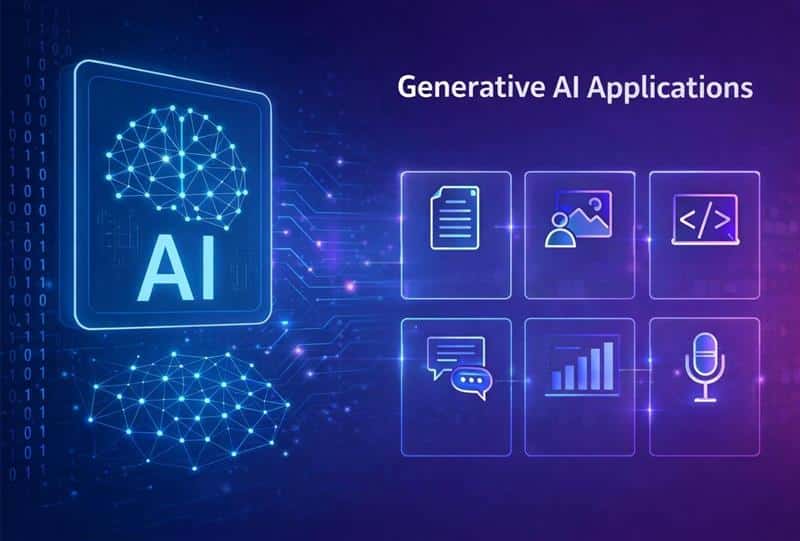
Generative artificial intelligence has transformed how businesses create content, build products, and engage customers. From writing marketing copy to generating realistic images, these tools now handle tasks that once required hours of human effort. Current data shows 23% of companies already scale AI agents, while projections indicate 40% of enterprise applications will incorporate task-specific AI capabilities by late 2026.
The technology works across multiple formats, including text generation, image generation, audio synthesis, code generation, and video production. Organizations in e-commerce, education, healthcare, and software development now treat generative AI as a strategic asset. Understanding how generative AI works and where it applies helps businesses make informed decisions about adoption, investment, and integration into existing workflows.
What Is Generative AI Applications
Generative AI applications are systems that create new content by learning patterns from vast datasets. Unlike traditional software that follows fixed rules, generative AI models produce original text, images, audio, code, and videos based on user prompts. These tools use neural networks trained on billions of examples to predict and synthesize outputs that mimic human creativity.
Common generative AI examples include ChatGPT for text, DALL-E 3 for images, and GitHub Copilot for software code. The technology powers marketing automation, customer support chatbots, product design workflows, and data analysis tasks. With 21% of specialists using these tools for creative writing and 7% for coding, adoption continues growing across industries. Businesses integrate generative AI solutions into CRMs, content management systems, and analytics platforms to improve efficiency and scale operations.
How Generative AI Technology Works
Generative AI operates through neural networks trained on massive datasets to predict and synthesize novel content. The core process involves probabilistic modeling where input data prompts outputs that mimic learned distributions, similar to broader categories of artificial intelligence software and its uses.
Machine Learning Models Behind Generative AI
Several machine learning models power modern generative AI systems. Transformer-based models like GPT-4, Google Gemini, and Meta LLaMA use hundreds of billions of parameters to generate human-quality text. Diffusion models drive image generators like DALL-E 3 and Midjourney by adding then removing noise iteratively to create high-fidelity visuals. Generative adversarial networks GANs pit a generator against a discriminator to produce realistic images and videos. Variational autoencoders VAEs enable sampling from a latent space to create variations of existing content. Multimodal models combine text, image, and audio processing in single systems. Cloud optimizations through AWS Inferentia and Google TPU v5 enable scalability for millions of inference requests daily.
Role Of Large Language Models
Large language models process sequential data using self-attention mechanisms in transformers. LLMs excel at text generation, translation, summarization, and code writing tasks. By 2026, many generative AI models will underpin chatbots, virtual assistants, and business intelligence tools that answer natural language processing queries on complex data. The GPT series generates articles, conversations, and software development code from simple prompts. Google Gemini integrates into Workspace applications for drafting documents and creating illustrations. Current statistics show 15% of specialist use focuses on work tasks while 17% involves search inquiries. Leveraging large language models allows businesses to automate repetitive tasks like email drafting, report generation, and customer response handling.
Training Data And Pattern Recognition
Training uses petabytes of internet-scale data including text, images, and audio files. Models recognize patterns through token prediction, learning syntax, semantics, and stylistic elements. Synthetic data generation demand grows in 2026 for privacy-compliant training scenarios. Vertical AI fine-tuning uses proprietary data like legal documents, medical records, or financial reports. Bias arises from skewed training data, making diverse sources essential for accurate outputs and for building ethical AI software that is secure and trustworthy. The process involves pre-training on unlabeled data followed by supervised fine tuning on labeled data specific to business needs. Quality of input data directly affects output accuracy and usefulness for real applications.
Content Generation Process
Content generation begins when an input prompt gets tokenized into embeddings. Deep learning models process these embeddings through layers that compute attention scores and probabilities. Autoregressive decoding generates tokens sequentially while techniques like beam search enhance output diversity. For generating realistic images, diffusion models add then remove noise through iterative steps. Multimodal generation conditions outputs on mixed inputs, combining text descriptions with visual references through CLIP embeddings. Real-time generative AI applications like e-commerce chatbots handle thousands of customer queries through optimized inference pipelines. The entire process from prompt to final output typically completes within seconds for text and minutes for complex image or video generation.
Continuous Model Improvement
Deep generative models improve through reinforcement learning from human feedback where user preferences refine output quality. Federated learning allows model updates without centralizing sensitive data in one location. Current trends show modular AI mixing multiple gen ai models like ChatGPT, Claude, and Gemini for enterprise deployments. Test-driven prompt engineering and synthetic data loops accelerate improvement cycles. Regular updates increase parameter counts and improve output fidelity. Midjourney, for example, continuously refines its style customization based on user feedback and new training data. Organizations implement fine tuning processes to align foundation models with specific business terminology, brand voice, and compliance requirements.
Types Of Generative AI Applications Across Industries
Generative AI spans text, image, audio, code, and video applications tailored to specific industry needs. Healthcare, finance, retail, entertainment, and software development all benefit from these tools.
Text Generation Applications
Text generation powers content creation, natural language processing chatbots, legal contract drafting, and personalized education materials. Generative AI can create blog posts, email campaigns, research reports, and product descriptions in minutes. In finance, automated systems draft market analyses and investment summaries. Educational platforms generate custom lesson plans based on student progress. Translation capabilities support global businesses operating across multiple markets. Summarization features condense lengthy documents into actionable insights. Statistics show 21% of specialists use generative AI for creative writing tasks, making text generation the most popular application category.
Image And Design Generation Tools
DALL-E 3, Midjourney, and Stable Diffusion create art, logos, advertisements, and storyboards from text descriptions. Marketing teams use these gen ai tools for product visuals and social media content. Gaming companies generate textures and environmental assets. Fashion designers explore clothing concepts before physical production. Virtual fitting rooms in retail allow customers to visualize products. Film production teams create pre-production storyboards and concept art at scale. Generating realistic images that match brand guidelines helps businesses maintain visual consistency across campaigns while reducing photography and design costs.
Audio And Voice Generation Systems
Audio generation platforms like MusicLM and Jukebox compose original music scores and background tracks. Text-to-speech systems power virtual assistants and create professional narration for videos. Game developers generate character voices and atmospheric sounds. By 2026, synthetic voices will become nearly indistinguishable from human speech. Podcast creators use AI to draft audio content and generate voice variations. Customer support systems employ voice generation for automated responses in multiple languages. Accessibility applications convert written content into audio for visually impaired users.
Code Generation Platforms
Code generation platforms create software code from natural language descriptions. Developers use these AI tools to generate functions, write tests, and refactor existing codebases. Statistics show 7% of specialist use focuses on coding tasks. Domain-specific tools assist with drug discovery by generating molecular structures. AI software development assistants integrate directly into programming environments for real-time suggestions. Natural language interfaces allow non-programmers to query databases without knowing SQL. Teams report significantly faster development cycles when using code generation features, though human review remains essential for production deployments.
Video And Media Creation Tools
Video generation tools create effects, characters, and automated editing for entertainment and marketing. Script-to-video platforms turn text into short marketing clips and training content. VR simulations use generative techniques for immersive environments. Film studios reduce VFX costs through AI-assisted production. Automated editing features select best takes, add subtitles, and create highlight reels. Content creators generate data visualizations and animated explainers. These tools enrich storytelling capabilities while reducing production timelines from weeks to days.
Real World Examples Of Generative AI Applications
Real-world implementations demonstrate measurable impact across content production, visual design, customer interaction, software engineering, and marketing operations.
AI Content Writing Platforms
Jasper and Copy.ai produce blog posts, advertising copy, emails, and social media content from structured briefs. Marketers generate 50 tagline variants instantly for A/B testing campaigns. E-commerce teams create product descriptions translated for global markets in hours rather than weeks. These platforms integrate with content management systems for streamlined publishing workflows. Brand voice customization ensures consistent messaging across all content types. SEO keyword integration helps content rank in search results. Organizations report 40-60% faster first draft completion when using AI writers compared to traditional methods.
AI Image Generation Tools
DALL-E 3 through ChatGPT and Midjourney power advertising visuals, social media posts, and logo concepts. Startups input their mission statement and receive dozens of branding ideas within minutes. Design agencies use these tools to explore visual directions before committing to full production. Product mockups help e-commerce stores visualize items before manufacturing. Architecture firms generate building concept renders for client presentations. The workflow typically involves generating multiple options, selecting promising directions, then refining in traditional design software for final production.
AI Chatbots And Virtual Assistants
AI powered chatbots using GPT and Gemini handle complex customer queries with personalized support around the clock. Integration in customer support systems reduces human workload for routine inquiries. Android assistants understand visual context from device cameras. Banks and telecommunications companies deflect significant percentages of routine calls through intelligent triage. Modern assistants search knowledge bases, trigger workflow automation, and summarize conversation history. Multilingual capabilities improve customer engagement for global businesses while reducing wait times and increasing satisfaction scores.
AI Software Development Assistants
GitHub Copilot generates code snippets, complete functions, and test cases from natural language prompts. Business intelligence tools answer data analysis queries without requiring SQL knowledge. Development teams report faster task completion when using AI coding assistants. Legacy code migration becomes more manageable with AI-assisted refactoring suggestions. New engineers onboard faster with AI tools that explain complex codebases. Quality assurance teams use code generation for creating comprehensive test suites. Despite productivity gains, high-performing teams maintain human code review and security scanning for all AI generated content.
AI Marketing Automation Tools
Marketing automation platforms combine generative content creation with audience segmentation and campaign analytics. Personalized emails adjust messaging based on customer data and purchase history. Dynamic advertising copy varies by segment and channel. Landing page variants get created and tested simultaneously. Real-time support on e-commerce sites provides instant product recommendations. Campaign performance data feeds back into content optimization. Organizations using these tools achieve higher conversion rates through hyper-personalized messaging that resonates with individual customer preferences.
Key Benefits Of Generative AI Applications For Businesses
Generative AI tools deliver speed improvements, cost efficiency, personalization capabilities, and scalable automation for organizations across all industries, especially when businesses understand the distinctions between AI automation and traditional automation. Current data shows 92% of companies plan increased investment.
Faster Content Creation
Teams move from brief to draft in minutes across text, image, and video formats using generative AI. Marketers produce 50 tagline options instantly for testing. Product descriptions, blog articles, and email campaigns get created in seconds rather than hours. Go-to-market speed improves for campaign launches and product announcements. Documentation teams generate user guides and help articles rapidly. Quality depends on clear prompts, thorough human editing, and established brand guidelines. Organizations report 30-50% reduction in time spent on initial content drafting across departments.
Improved Operational Efficiency
Generative AI improves business processes in customer service, HR, finance, and IT through automated responses and document summarization. AI triage systems route support tickets to appropriate teams. Meeting transcripts get summarized into action items automatically. Standard operating procedures get drafted from existing process documentation. Employees shift from repetitive tasks to higher-value analysis and relationship building, supported by smarter software tools that simplify day-to-day work. Data science teams use natural language interfaces to query complex data without writing code. Early adopters report measurable reductions in average handling time and internal request backlogs.
Cost Reduction Across Business Functions
Reduced content production time and lower outsourcing costs translate to direct savings. Legal teams draft contracts faster with AI assistance. Healthcare organizations streamline diagnostic documentation. Aviation companies create training simulations at lower costs. Video production expenses decrease through AI-assisted editing. Savings maximize when generative ai systems integrate into end-to-end workflows rather than isolated experiments. Organizations should plan for offsetting costs including infrastructure, licensing fees, and change management investments required for successful deployment.
Personalized Customer Experiences
Hyper-personalization becomes achievable through AI generated emails, product recommendations, and support responses tailored to individual preferences. Generative AI services adapt tone, language, and content types based on customer data and behavioral patterns. Voice-matching assistants adjust communication styles to match user preferences. Retailers see increased conversion rates and average order values. Subscription services improve retention through personalized content delivery. Privacy-aware data pipelines and clear consent management remain essential for responsible personalization at scale.
Scalable Automation Capabilities
Cloud infrastructure using TPUs handles millions of inference requests as businesses grow. Organizations expand content production, support operations, and analytics capabilities without proportional headcount increases. Automated FAQ generation and knowledge article creation support expansion into new markets. By end of 2026, 40% of enterprise applications will include AI agents managing routine tasks autonomously. Governance frameworks ensure automation stays monitored, reliable, and compliant with industry regulations. Scalable automation lets small teams deliver enterprise-level output volumes across channels.
Challenges And Limitations Of Generative AI Applications
Responsible generative AI adoption requires addressing bias, ethical concerns, infrastructure costs, security vulnerabilities, and training data dependencies through proper governance frameworks.
Data Quality And Bias Issues
Generative models inherit patterns from biased or outdated training data, producing skewed or inappropriate outputs. Studies document cases where image and text generators reinforced gender and racial stereotypes. Fake data or low-quality sources compromise model reliability. Mitigation strategies include curated datasets, systematic bias testing, red-teaming exercises, and diverse human reviewers. Regulatory bodies in Europe and the United States increasingly require fairness assessments and non-discrimination compliance. Many generative AI companies now publish bias evaluations and implement guardrails to reduce problematic outputs.
Ethical And Copyright Concerns
Using copyrighted material in training datasets creates legal exposure when outputs resemble protected works. High-profile lawsuits in 2023 and 2024 involved authors, artists, and music rights holders challenging AI training practices. Practical steps include selecting model providers with clear licensing terms and using commercial-safe generation modes. Legal review becomes essential for sensitive use cases. Transparency practices like watermarking and content labeling help users identify AI generated content. Organizations should establish clear policies about disclosure and attribution when publishing AI-assisted work.
High Infrastructure And Computing Costs
Training and serving large foundation models demands significant compute resources including specialized GPUs and substantial energy consumption. Enterprise cost structures typically include per-token or per-image usage fees plus integration and monitoring overhead. Smaller on-premise or edge models offer lower costs but reduced capabilities. Cost control strategies include careful model selection, response caching, request batching, and prioritizing high-value use cases, all of which must fit into a future proof tech stack for scalable growth. Organizations should calculate total cost of ownership including infrastructure, licensing, integration effort, and ongoing maintenance before committing to large-scale deployment.
Security And Privacy Risks
Data leakage through prompts exposes sensitive data to model providers. Prompt injection attacks through untrusted content can manipulate model behavior. Retrieval augmented generation systems require careful access controls to prevent unauthorized data exposure. Safeguards include input filtering, role-based access control, encryption, and strict data retention policies. Compliance requirements under GDPR, CCPA, and HIPAA apply to customer data processed by AI systems. Regular security assessments and vendor due diligence protect against emerging threats, aligning with broader SaaS security best practices for 2026.
Dependence On Training Data
Generative AI systems only generalize from patterns present in their training data up to specific cutoff dates. New data requirements mean models may provide outdated information about recent events, products, or regulations. Niche domains with limited training examples produce less reliable outputs. Retrieval augmented generation grounds outputs in fresh, authoritative sources from company knowledge bases. Ongoing data curation, periodic model updates, and targeted fine tuning keep systems aligned with current business realities and industry developments.
How Generative AI Improves Business Innovation
Generative AI shifts organizations from incremental optimization toward faster experimentation, accelerated product development, and data driven strategic decisions across all business functions, particularly within AI-driven automation in SaaS platforms.
AI Driven Product Development
Product teams use generative models to draft feature concepts, UX copy, user stories, and design variants rapidly. Dozens of interface options get generated and tested before committing development resources. Technical product design benefits from generative suggestions for parameter optimization. Drug discovery accelerates through AI-generated molecular structures and compound variations. Fashion designers explore clothing concepts digitally before physical sampling. Human-led prioritization ensures promising AI-generated ideas get validated before full development investment, especially when supported by strategic AI software development for smarter digital products.
AI Assisted Market Research
AI algorithms summarize survey responses, customer reviews, and social media discussions into actionable themes. Sentiment analysis identifies emerging trends and competitive positioning opportunities. Synthetic personas generated from historical sales and behavioral data support demand forecasting. Analysts prepare competitive landscape reports faster using AI-assisted synthesis. Voice-of-customer insights get extracted from large unstructured datasets, which should be complemented by UX research best practices for 2026. Real customer validation remains essential since synthetic analysis cannot replace direct market feedback.
Automated Content And Design Workflows
Workflows generate multi-format assets from single briefs including email copy, web banners, social posts, and sales presentations. Design systems produce brand-consistent variants locked to component libraries and style guidelines. Project management integration updates task status as content moves through approval stages. Small teams achieve enterprise-level content volume through automation. Campaign consistency improves when all assets originate from unified generative workflows rather than disconnected manual processes, a topic explored frequently on the GainHQ blog about software and digital transformation.
Faster Experimentation And Prototyping
Generative AI acts as a rapid prototyping engine for copy, interfaces, conversations, and working code. Companies increase the number of experiments conducted each quarter through AI-assisted asset creation. Faster hypothesis testing improves product-market fit while reducing risk from large failed launches. A/B testing scales when content variants get generated automatically. Programming languages and frameworks get explored through quick prototype generation. Success depends on disciplined experimentation frameworks with clear success metrics and decision criteria.
Data Driven Business Decision Making
Generative AI summarizes analytics dashboards, financial statements, and research documents into executive narratives. Scenario generation supports pricing decisions, inventory planning, and marketing mix optimization. Natural language querying of data warehouses enables non-technical leaders to explore insights directly without analyst support. Generating data visualizations helps communicate findings across organizational levels. Clear provenance and source linking ensure accountability for AI-assisted strategic decisions. Human review remains essential for major commitments based on AI-generated analysis.
Why Businesses Are Investing In Generative AI Technology
Investment in generative AI connects to automation demand, competitive positioning, workforce productivity, digital product enhancement, and long-term innovation opportunities. Current surveys show 92% of companies increasing spending as more organizations pursue strategic AI software development initiatives.
Growing Demand For AI Automation
Pressure increases to automate knowledge work tasks like drafting, analysis, and customer response handling. Talent shortages drive organizations toward tools that amplify existing workforce capabilities. By 2026, 40% of enterprise applications will incorporate AI agents handling routine operations. Generative AI uniquely addresses unstructured tasks that rules-based automation cannot manage effectively. Demand spikes continue in customer support, marketing content production, and software engineering. Organizations implementing automation report improved response times and consistent quality across high-volume operations.
Competitive Advantage Through AI Adoption
Early adopters use generative AI to ship features faster, personalize customer experiences more deeply, and lower acquisition costs. Companies gain market share through faster iteration and responsiveness to customer feedback. Competitive advantage depends on proprietary data, domain expertise, and integration quality rather than just tool access. Vertical AI solutions fine-tuned on industry-specific data outperform generic alternatives. Laggards face structural disadvantages as AI-native competitors capture market position. Organizations should evaluate competitive dynamics when prioritizing AI investment decisions, especially in the rapidly evolving landscape of AI in SaaS, its benefits, challenges, and future trends.
Productivity Improvements Across Teams
Cross-functional productivity gains span sales scripting, HR documentation, legal drafting, data analysis, and engineering tasks. Knowledge workers save significant time using generative copilots for routine work. Productivity improvements start with individual tasks then expand as processes get redesigned around AI capabilities. Training programs, updated workflows, and change management convert time savings into tangible business outcomes. Organizations report productivity increases of 15-30% for teams actively using gen ai tools compared to manual processes.
Expansion Of AI Powered Digital Products
SaaS companies, financial firms, and retailers embed generative features directly into their products. AI drafting inside productivity suites, conversational search in applications, and AI design tools increase user engagement, as shown in case studies where AI features increased engagement by 34%. Customers perceive higher product value from AI-enhanced experiences. New monetization models emerge including tiered AI access and usage-based pricing structures. Product differentiation increasingly depends on AI capability integration. Organizations evaluate how generative features can enhance existing offerings and create new revenue streams.
Long Term Innovation Opportunities
Looking toward 2025 and beyond, AI-native products, automated research workflows, and new creative formats present innovation frontiers. Investments in data infrastructure, platform capabilities, and talent development create optionality for future breakthroughs. Regulatory developments including the EU AI Act shape long-term strategy requirements. Conversational AI systems anticipating customer needs before explicit requests represent emerging opportunities. Leaders balance short-term ROI projects with exploratory initiatives and capability building for sustained competitive advantage.
How GainHQ Supports AI Driven Business Growth
GainHQ platform at gainhq.com integrates generative AI capabilities for analytics, content automation, and personalization at scale. Organizations using GainHQ report 30-50% efficiency gains in content workflows based on internal metrics. The platform enables faster insights extraction from complex data sources, custom marketing campaign generation, and operational scaling across business functions. GainHQ supports vertical AI deployment with risk-managed models and comprehensive ROI tracking for AI investments, complementing broader custom software development services. Tools for synthetic data generation reduce training costs while maintaining data privacy compliance. Retrieval augmented generation capabilities ground outputs in authoritative company knowledge bases. By 2026, GainHQ powers hyper-personalized customer experiences that drive revenue growth through AI-optimized decisions across marketing, sales, and service operations.
Frequently Asked Questions
How Do Generative AI Applications Create New Content
Generative AI works by learning statistical patterns from billions of training examples through deep neural networks. When users provide prompts, models predict the most likely next tokens, pixels, or audio segments based on learned patterns. Outputs represent new combinations consistent with training data rather than direct copies. Two neural networks or transformer architectures process input through multiple layers to generate coherent responses. Business tools often combine base models with retrieval from knowledge bases and post-processing rules to align outputs with company policies and brand guidelines.
What Factors Affect The Accuracy Of Generative AI
Accuracy depends on training data quality, domain coverage, data recency, model architecture, and prompt clarity. Larger models with more parameters generally produce better outputs for complex tasks. Domain-specific fine tuning improves reliability for specialized applications. Retrieval augmented generation grounds responses in verified documents rather than relying solely on model memory. Temperature and sampling parameters affect output variability. Regular evaluation using benchmark tasks and expert review helps identify accuracy issues in production deployments.
How Can Businesses Measure ROI From Generative AI Tools
Measure time saved per task, increased throughput for campaigns or features, quality improvements, and revenue changes. Track cost reductions from reduced outsourcing and faster production cycles. Start with tightly scoped pilots including baseline measurements and control groups when possible. Monitor employee satisfaction and reduced burnout as softer benefits. Calculate cost per output including API fees, integration effort, and review time. Compare conversion rates and engagement metrics before and after AI implementation.
What Data Is Required To Train Generative AI Models
Base models require massive generic datasets while businesses supply domain-specific documents for fine tuning or retrieval. High-quality labeled data produces better results than raw volume alone. Data governance requirements include labeling, cleaning, de-identification, and access controls. Customer data use requires consent and compliance with privacy regulations. Synthetic data generation creates training examples without exposing real user information. Many successful deployments use tens of thousands of carefully selected examples rather than attempting to train on everything available.
How Do Companies Manage Risks When Using Generative AI
Establish clear acceptable-use policies defining permitted and prohibited applications. Implement human-in-the-loop review for high-stakes outputs. Deploy technical guardrails including input filtering and output validation. Conduct vendor risk assessments before integrating third-party models. Monitor for bias, hallucinations, data leakage, and performance drift over time. Form cross-functional AI governance groups including legal, security, compliance, and business stakeholders. Regular audits and policy updates address emerging risks as technology and regulations evolve.
Technical roadmap planning plays a central role in modern product development. Product teams rely on structured planning to align technology initiatives with broader business objectives and long term business strategy. A well designed technology roadmap helps organizations prioritize technical improvements, manage technical debt, and guide development efforts with a clear strategic direction.
Research shows that companies with strong roadmap processes achieve higher product delivery success and improved coordination across cross functional teams. Product managers, engineering teams, and key stakeholders use technical roadmaps as a strategic blueprint that connects product strategy with the organization’s strategic objectives.
Technical roadmap planning also helps teams identify key milestones, track progress, and coordinate technology investments. When product development roadmaps align with strategic goals, organizations maintain stakeholder alignment and ensure development teams focus on initiatives that support long term growth and innovation.
What Is Technical Roadmap Planning
Technical roadmap planning is the development process of creating a time-bound strategic plan that maps technology initiatives to specific quarters or milestones. Unlike a product roadmap that focuses on user-facing features, a technology roadmap concentrates on infrastructure, architecture, security, and the systems that support product development.
Research shows that organizations with documented technology strategies are 2.5 times more likely to complete critical projects on schedule. This roadmap serves as a strategic tool that connects engineering work to broader business objectives, helping development teams understand why certain technical improvements matter now instead of later.
Technical Roadmap Planning In Strategic Product Development
Aligning product vision with technical strategy is where most growing companies struggle. Product teams push for new features while engineering teams want time for technical improvements. Without a shared understanding, both sides become frustrated.
Aligning Product Vision With Technical Strategy
Your product strategy depends on technical foundations that customers never see. When product managers plan major initiatives for the next year, they need to know whether existing systems can support those plans. A technical roadmap creates stakeholder alignment by showing how infrastructure work enables product features. For example, if your product vision includes supporting enterprise customers by Q4 2025, your technical roadmap might show database scaling work in Q2 and security certifications in Q3. This strategic direction becomes clear to internal teams and external stakeholders alike.
Organizations that align technical work with business strategy report 34% faster time to market for new capabilities. The roadmap becomes the document where product teams and engineering teams negotiate priorities based on what will ultimately deliver the most customer benefits.
Prioritizing Features Based On Business Impact
Not every technical initiative deserves space on your roadmap. Prioritization requires looking at how each project supports the organization’s strategic objectives. High-impact work that addresses critical gaps takes precedence over nice-to-have improvements.
Consider using frameworks like impact versus effort scoring. If upgrading your authentication system would reduce customer onboarding time by 40% and enable single sign-on for enterprise deals worth $2M in annual revenue, that work clearly supports business goals. Compare that against a code refactor that improves developer experience but has no direct customer satisfaction impact. Both matter, but the roadmap focuses on strategic objectives first.
Balancing Innovation And Technical Stability
Every roadmap must balance moving forward with maintaining what already works. Companies that ignore technical debt eventually pay for it through slower release cycles and more incidents. Research from McKinsey suggests that technical debt can consume up to 40% of engineering capacity if left unmanaged.
A practical approach reserves 20 to 30 percent of engineering capacity each quarter for stability work. This includes refactoring, observability improvements, and paying down technical debt. In some cases, teams must weigh refactor vs rebuild for software modernization as part of this work. The roadmap makes this allocation visible so product teams understand that continuous improvement in the platform enables faster feature delivery over time.
Cross Team Collaboration Between Product And Engineering
Technical roadmaps require cross functional teams working together. Product management, security, data, and operations each bring different priorities that must be incorporated. Regular quarterly reviews with key stakeholders keep everyone on the same page.
When cross functional collaboration works well, the roadmap reflects real constraints and opportunities. Engineering teams understand customer feedback that drives feature requests. Product teams understand why certain technical initiatives must happen before new product features can ship, including when custom software transformations reshape company workflows. This shared understanding prevents the frustration that comes from feeling like other teams do not value your priorities.
Long Term Planning For Scalable Product Architecture
Technical roadmaps typically span 1 to 3 years because major efforts like cloud migrations, future-proofing your technology stack for scalable growth, or platform redesigns take time. Breaking these into key milestones makes progress visible and keeps teams motivated.
For example, a migration from monolith to scalable software architecture for high-growth products might show pilot services in Q2 2025, core platform migration in Q3-Q4, and legacy decommissioning in Q1 2026. Near-term quarters stay detailed while later quarters remain more thematic. This flexibility acknowledges that technological advancements and market trends might shift priorities.
Continuous Roadmap Evaluation And Iteration
An outdated roadmap does more harm than good. Treat your technical roadmap as a living document that teams review at least quarterly. When business needs shift or new information emerges, update the roadmap and communicate changes.
Keep a change log so stakeholders informed about why priorities shifted. This transparency builds trust with leadership and helps agile teams understand how their sprint work connects to the broader strategic vision.
Data And Product Insights Behind Roadmap Decisions
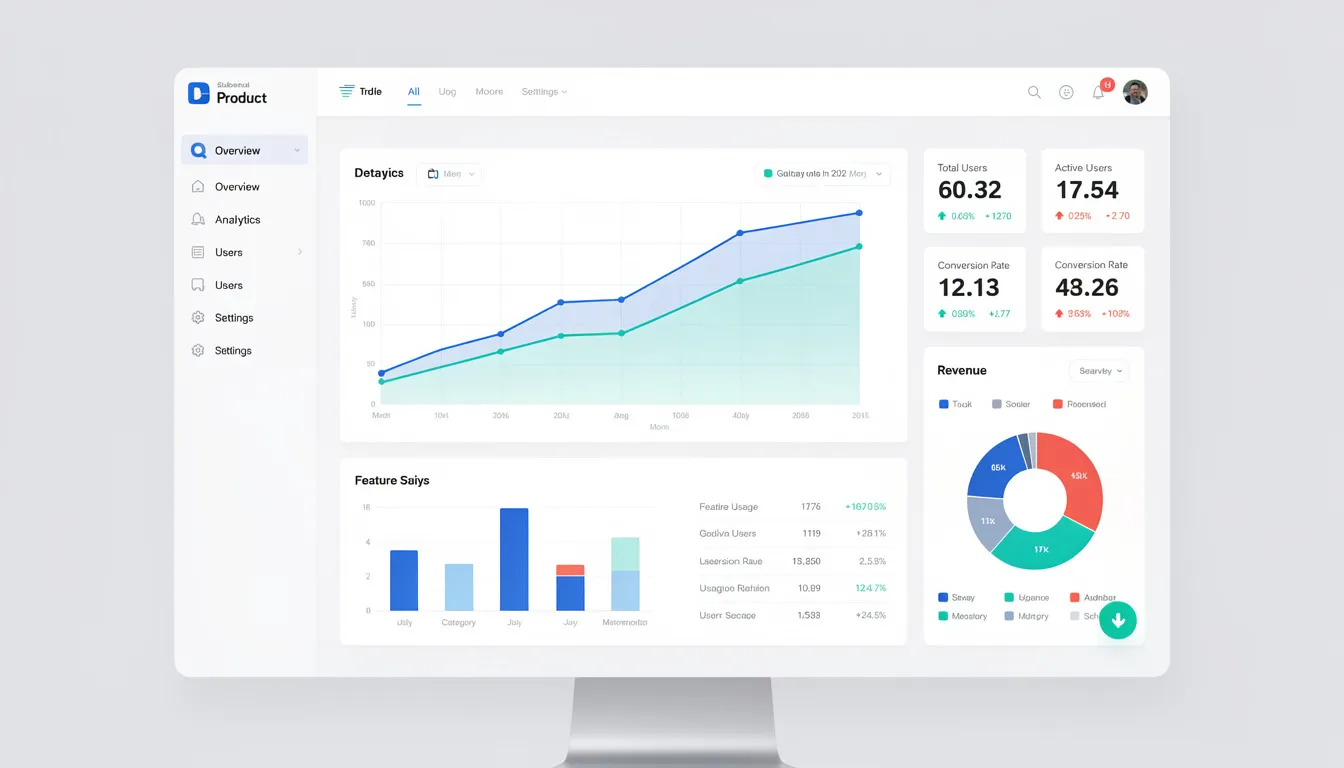
Reliable product data guides strong roadmap decisions. Product leaders analyze usage patterns, customer signals, and adoption metrics before shaping long term product priorities. These insights help product managers and engineering teams focus development efforts on initiatives that support measurable product growth.
Product Usage Analytics For Planning
Product usage analytics provide valuable signals for roadmap planning. Product teams monitor how customers interact with product features, which tools they use frequently, and where friction appears across the user journey. These insights support informed decisions about which features deserve additional development attention, especially when combined with predictive analytics software for growth-focused forecasting.
An internal roadmap often relies on these insights to guide technical improvements and development priorities. When organizations analyze feature usage and engagement metrics, product managers gain a clearer understanding of where development resources should focus, especially during post-MVP development phases focused on growth.
Customer Feedback And Market Signals
Customer feedback offers direct insight into product expectations and market demand. Product teams gather feedback through surveys, product reviews, and support conversations to understand user needs. User feedback often highlights usability challenges, missing capabilities, and opportunities for product improvement.
Market signals also influence roadmap priorities. Competitive movements, emerging technologies, and evolving user expectations shape product development direction. For early-stage products, understanding what an MVP is in software development helps teams interpret these signals without overbuilding. Product teams often combine customer feedback with an external roadmap that communicates upcoming initiatives and product improvements to customers and partners.
Performance Metrics And Adoption Trends
Performance metrics help organizations evaluate whether product development initiatives deliver measurable results. Product leaders analyze engagement rates, retention patterns, and adoption trends to understand the impact of product changes.
Adoption data also helps teams identify features that fail to gain traction. When certain capabilities show low usage, product managers can reassess development priorities or refine the product roadmap. Monitoring adoption metrics helps teams track progress and refine development strategies.
Data Driven Feature Prioritization
Feature prioritization requires clear data signals. Product managers evaluate performance metrics, product usage patterns, and customer insights before deciding which features deserve development focus. Established methods such as MVP feature prioritization to build the right product and a structured roadmap template often help teams organize these priorities and align development plans with strategic goals.
Data driven prioritization ensures development teams allocate time and resources to initiatives that generate measurable value. Product teams that rely on strong data insights often deliver improvements that strengthen customer satisfaction and product adoption.
Insights From Product Intelligence Platforms
Product intelligence platforms combine multiple data sources to create deeper product insights. These systems analyze customer behavior, feature usage, and engagement signals across the product ecosystem, enabling initiatives like AI-driven features that increased engagement by 34%. The result is a unified view of how users interact with the platform.
Insights from these systems often influence both internal roadmap planning and external roadmap communication. Product leaders rely on these platforms to identify emerging product opportunities and respond quickly to changing customer expectations. When organizations combine analytics, customer feedback, and behavioral insights, roadmap decisions become more strategic and more aligned with real user needs.
Strategic Challenges In Technical Roadmap Planning
Every team faces obstacles when building and executing technical roadmaps. Understanding common challenges helps you prepare for them and build more resilient plans.
Managing Technical Debt While Building New Features
Technical debt accumulates when teams take shortcuts to meet short-term goals. This debt compounds over time, creating increasing friction in development velocity. A 2022 Stripe study found that developers spend an average of 33% of their time dealing with technical debt and maintenance.
Your roadmap should explicitly include debt reduction work. Express this in business terms that executives understand. For example, reducing deployment time from 45 minutes to 10 minutes saves 100 engineering hours monthly and accelerates feature delivery.
Balancing Short Term Releases And Long Term Goals
Business pressure for immediate features can override technical roadmap priorities if not managed carefully. Product teams respond to customer demands and competitive pressure while engineering teams see the long-term risks of neglecting platform health, especially in critical phases of post-MVP development for growth strategy.
The roadmap becomes the mechanism for having these conversations openly. When stakeholders can see how short-term decisions affect long-term capability, they make better trade-offs.
Aligning Engineering Capacity With Product Plans
Resource constraints limit what any roadmap can achieve. A detailed plan means nothing if your team lacks capacity to execute. Before committing to major initiatives, assess whether budget and team bandwidth support those plans.
Many teams discover they have committed to more work than they can deliver, especially when hidden obligations from technical debt in software teams consume capacity. The roadmap review process should include realistic capacity planning to avoid this trap.
Adapting Roadmaps To Market Changes
Markets shift faster than most planning cycles. A roadmap built in Q1 might not align with priorities that emerged by Q3. Strategic choices such as the build vs buy software decision for businesses can also reshape priorities. Build flexibility into your roadmap by using time horizons like short-term, mid-term, and long-term rather than rigid dates.
When external factors require changes, update the roadmap transparently and gather feedback from affected teams.
Maintaining Clear Stakeholder Communication
Different audiences need different views of the same roadmap. Executives want outcomes, risk reduction, and budget alignment. Engineers want sequencing, dependencies, and implementation details. Customer-facing teams want to know what they can promise clients.
Creating multiple versions of your roadmap for different audiences prevents confusion and ensures everyone gets the information they need.
Role Of Product Analytics In Roadmap Development
Product analytics plays a major role in modern roadmap planning. Product teams rely on behavioral insights and performance data to guide technology roadmapping and product strategy. Reliable analytics, including more advanced predictive analytics software for growth-focused forecasting, provides a clear path between product vision, agile development, and long term strategic goals.
Product Usage Patterns And Behavioral Insights
Product analytics platforms reveal how users interact with different features across a product environment. Behavioral signals highlight engagement levels, adoption patterns, and friction points that affect customer experience.
Product managers treat analytics systems as a valuable tool for identifying opportunities within product usage data. Insights from user interactions help product teams refine development priorities and strengthen roadmap planning with stronger product intelligence.
Agile Development And Roadmap Alignment
Agile development benefits significantly from product analytics insights. Agile teams review usage signals and engagement metrics during sprint planning cycles to refine product priorities.
Product analytics helps maintain a clear path between short term development efforts and long term roadmap goals. Data insights guide agile teams as they adjust priorities and ensure development efforts remain aligned with product strategy.
Technology Roadmapping And Strategic Planning
Technology roadmapping requires a strong connection between product performance and technical strategy. For many teams, this now includes evaluating how AI software development for smarter digital products can influence performance and differentiation. Product analytics provides data signals that reveal how technical improvements influence adoption and engagement.
Product managers rely on analytics to guide technology roadmapping decisions. Performance insights help teams evaluate which initiatives deserve investment and which improvements support strategic product growth.
Product Initiatives And Development Coordination
Complex roadmap initiatives often involve multiple development teams. Product analytics helps teams break initiatives into smaller development efforts that align with engineering capacity and technical priorities, and many organizations lean on tech consulting services that help modern businesses grow to facilitate this alignment.
An implementation team benefits from analytics insights because development priorities become clearer. Data driven coordination improves communication across product managers, engineering teams, and internal teams responsible for product delivery.
Strategic Visibility For Product Teams
Product analytics provides long term visibility into roadmap performance. Product teams track adoption metrics and engagement signals to understand how development initiatives influence product success.
Analytics insights also support continuous roadmap improvements. Product teams review performance data regularly to refine priorities and maintain alignment with broader product goals. Reliable insights ensure roadmap strategies remain connected with real product performance.
Best Practices For Building A Scalable Technical Roadmap
Building a roadmap that scales with your organization requires intentional practices. These approaches help teams avoid common pitfalls and maintain roadmaps that remain useful over time, much like the disciplined choices described in a startup tech stack guide for high-growth teams.
Defining Clear Product Goals
Start every roadmap cycle by defining what you want to achieve. Vague goals lead to vague roadmaps. Instead of “improve performance,” specify “reduce average page load time from 1.6 seconds to under 1.0 seconds by Q3 2025,” especially for complex initiatives like SaaS product development from build to scale.
Clear goals give development efforts direction and make success measurable. They also help prioritize product features based on which initiatives contribute most to those goals and shape choices like how to choose a tech stack for growth.
Establishing Transparent Planning Processes
Document how roadmap decisions get made. Who participates in planning? What criteria determine priority? How do teams raise new initiatives for consideration?
Transparent processes build trust with agile teams and prevent the perception that roadmap decisions happen arbitrarily. When people understand the complicated process behind prioritization, they accept trade-offs more readily.
Building Flexible And Adaptive Roadmaps
Rigid roadmaps break when reality changes. Build flexibility into your planning by using time horizons instead of fixed dates. Keep near-term quarters detailed while allowing later quarters to remain thematic.
This approach acknowledges that project planning involves unknowns. Teams can commit confidently to upcoming work while remaining open to adjusting later phases based on learnings.
Aligning Product And Engineering Leadership
Product and engineering leaders must present a unified front on roadmap priorities. When these leaders disagree publicly, teams become confused about what matters. Regular alignment meetings between product and engineering leadership prevent this dysfunction.
The roadmap should reflect genuine agreement, not compromise that nobody supports. If leaders cannot agree, the conflict needs resolution before the roadmap gets communicated.
Continuous Roadmap Review And Optimization
Schedule quarterly roadmap reviews to assess progress and adjust plans. Did completed initiatives deliver expected impact? Have new priorities emerged that deserve attention? Should any planned work be deprioritized or removed?
This continuous improvement approach keeps your roadmap relevant and prevents it from becoming an artifact that nobody references, mirroring the discipline needed to maintain a SaaS product roadmap that can build, prioritize, and scale.
How GainHQ Helps Product Teams Plan Technical Roadmaps
Modern product organizations rely on structured planning to guide complex development priorities. Platforms that combine product intelligence with roadmap software help teams translate product strategy into actionable execution while maintaining strong strategic alignment across teams.
Product Intelligence For Smarter Roadmap Planning
GainHQ provides advanced product intelligence that helps product managers understand how users interact with product features. Product teams analyze behavioral signals, feature usage, and adoption patterns to shape roadmap priorities.
Insights generated through the platform support stronger strategic thinking across product leadership. Instead of relying on assumptions, teams rely on real product data to guide planning decisions and refine development priorities.
Roadmap Software That Connects Product Data
Many product teams rely on product roadmap software to organize development initiatives and track progress. GainHQ strengthens this process by connecting roadmap software with real product intelligence.
Product managers gain visibility into which features drive engagement and which capabilities require improvement. This data connection helps teams maintain alignment between product vision and roadmap priorities.
Stronger Strategic Alignment Across Teams
Roadmap planning often involves coordination across product managers, engineering teams, and business leaders. GainHQ helps teams maintain strategic alignment by providing shared visibility into product performance and user behavior.
When internal teams rely on the same data insights, collaboration improves. Product teams remain focused on development priorities that support long term product growth and strategic product goals.
Clearer Product Decisions And Technology Adoption
Technology adoption decisions often require careful evaluation of product impact and user demand. GainHQ helps organizations analyze adoption signals, user behavior, and feature engagement across their product ecosystem.
Product leaders use these insights to guide roadmap priorities and refine technology investments. With reliable product intelligence, teams develop stronger roadmaps that support innovation, efficiency, and measurable product outcomes, often choosing flexible custom software solutions over generic tools to execute on those plans.
FAQs
How Product Analytics Improves Technical Roadmap Prioritization
Product analytics reveals which features customers use most and where they experience friction. This data helps teams prioritize technical improvements that directly impact user experience rather than optimizing systems that customers rarely touch.
What Data Signals Matter Most In Technical Roadmap Planning
Focus on performance metrics like response times and error rates, customer behavior patterns, support ticket trends, and system capacity utilization. These signals indicate where technical investment will have the greatest business impact.
How SaaS Teams Balance Technical Debt And Roadmap Innovation
Successful SaaS teams allocate 20 to 30 percent of engineering capacity to technical debt and platform work each quarter. This prevents debt from accumulating while still allowing progress on new capabilities.
Product intelligence platforms aggregate data from multiple sources into actionable insights. They help teams move beyond gut feelings to make roadmap decisions based on actual customer behavior and system performance.
How Cross Functional Alignment Shapes Technical Roadmap Success
Cross functional alignment ensures that roadmaps reflect real constraints and opportunities from product, engineering, security, and operations perspectives. Teams that align regularly deliver roadmaps that the entire organization supports and can execute.
Enterprise resource planning erp systems built 10 to 20 years ago served their purpose well. They provided stability and structure for finance, operations, and supply chain management. But those same systems now struggle to keep pace with how modern enterprises operate. Cloud based platforms, automation tools, and real time analytics have redefined what businesses expect from their core software.
ERP modernization addresses this gap by transforming outdated systems into strategic assets. This article explores what modernization means for enterprises, the benefits of erp modernization for digital transformation, common challenges, and how organizations can optimize business processes through a modern erp approach.
What ERP Modernization Means For Modern Enterprises
ERP modernization is a strategic initiative to replace or replatform legacy erp from the 1990s through 2010s with modern cloud based systems. The goal extends beyond software replacement. Modern enterprises require real time financial consolidation, global compliance management, and integrated supply chain planning across multiple entities and countries.
A minor ERP upgrade involves patches within the same platform. Full modernization means re-architecting processes, integrations, and user experience around a new system. Consider a mid-market manufacturer replacing a 2008 on-premises ERP with cloud erp in 2024. The new system now supports e-commerce channels, remote workforce access, and global suppliers through a unified platform.
Benefits Of ERP Modernization For Digital Transformation
ERP modernization serves as the transactional and analytical backbone for broader digital transformation efforts. The benefits of erp modernization should be measured in concrete terms. Cycle time reductions, faster close processes, improved inventory turns, and higher employee adoption all provide trackable value over 12 to 24 months. A distribution company cutting order-to-cash from 18 to 8 days after modernizing erp systems and integrating CRM with warehouse solutions demonstrates what is possible. The following sections break down specific advantages.
Real Time Data Visibility Improves Decision Making
Modern cloud erp centralizes transactions from finance, supply chain, projects, and HR into a single data model that updates in real time. Decision makers in 2025 expect live dashboards showing cash position, open orders, production capacity, and margin by product or customer. Static monthly reports no longer suffice. Modern platforms offer built-in analytics, role-based dashboards, and self-service reporting tools. This reduces reliance on spreadsheets and IT-built reports. Organizations can monitor key metrics including days sales outstanding, forecast accuracy, and inventory turns when business data is unified in one place.
Faster Business Processes Reduce Operational Delays
Legacy erp often requires manual steps, duplicate data entry, and email-based approvals. These create delays across order-to-cash, procure-to-pay, and record-to-report cycles. Modern erp systems use workflow automation, configurable approval rules, and digital documents to cut processing times significantly. Purchase order approvals can drop from days to hours. Month-end close shortens by several days. On-time supplier payments improve. Organizations now target 3-day closes or same-day order confirmation through erp software that eliminates operational bottlenecks.
Stronger Integration Across Enterprise Systems
Modern erp solutions provide open APIs, event streams, and integration tools that connect CRM, e-commerce, warehouse management, and payroll systems. Tight integration eliminates data silos, reduces manual reconciliation, and keeps customer, product, and supplier data consistent across applications. This supports omnichannel experiences. Online orders from platforms like Shopify synchronize directly into ERP for fulfillment. Integration strategy should be part of the modernization roadmap from the start, with clear standards for interfaces and data ownership.
Greater Scalability Supports Business Growth
Cloud based erp scales compute and storage resources automatically. Seasonal peaks, acquisitions, and international expansion no longer require hardware purchases. Adding new legal entities, currencies, tax rules, and languages becomes faster. Mid-market companies can pursue cross-border growth more feasibly. Modern platforms allow organizations to introduce new lines of business or subscription models without rewriting core code. A company expanding from single-country operations to multi-region presence over three years benefits from scalability and flexibility that legacy systems cannot provide.
Better User Experience Increases Adoption
Older systems often feature complex, desktop-only interfaces requiring extensive training. Modern erp delivers intuitive, web-based, and mobile-friendly experiences. Better user experience reduces errors and speeds onboarding for new hires. This matters in industries with high turnover or seasonal workers. Consumer-grade interfaces, personalized dashboards, and guided workflows encourage higher adoption among non-technical users. Field sales teams and plant supervisors engage more readily. The results include fewer help desk tickets, reduced workarounds, and more complete transactional data.
Enhanced Compliance And Risk Management Controls
Modern erp embeds controls for financial compliance including SOX, IFRS, and revenue recognition standards. Industry regulations for FDA, ISO, and GDPR requirements integrate where relevant. Security enhancements include role-based access, audit trails, segregation of duties, and encryption. Cloud erp providers maintain compliance certificates like SOC 1, SOC 2, and ISO 27001. This reduces the burden on internal IT teams. Automated controls and centralized logs simplify internal and external audits compared with legacy solutions that lack these capabilities.
Advanced Analytics Enable Strategic Planning
Modern erp platforms integrate embedded analytics, data warehouses, and machine learning capabilities. Enterprises use these tools for demand forecasting, scenario planning, profitability analysis, and predictive maintenance. Organizations pair erp data with external data sources including market data and customer behavior for more accurate planning. A manufacturer might use ERP-driven analytics to plan production for the next quarter based on real time order trends and inventory levels. Data driven decision making becomes standard practice rather than exception.
How Legacy ERP Systems Slow Down Digital Transformation
ERP implementations from 10 to 20 years ago prioritized stability over rapid change. That approach worked well in predictable operating environments, but modern business needs now demand speed, flexibility, and real time data access. Legacy ERP systems were not designed for this level of agility. As a result, organizations struggle to modernize processes, launch digital initiatives, and respond quickly to market shifts. Over the long term, these limitations create operational bottlenecks that slow transformation efforts across departments.
Technical Debt And Customization Constraints
Legacy ERP systems accumulate heavy customization over years of use. Each modification solves a specific business problem at the time but creates technical dependencies that make future upgrades complex. ERP systems often rely on outdated architecture that cannot easily adapt to changing requirements.
This technical debt affects critical business functions such as finance reporting, procurement workflows, and supply chain planning. Even small changes require extensive testing and manual configuration. Over time, the cost and effort needed to maintain these customizations divert resources away from innovation projects that could improve efficiency and competitiveness.
Data Fragmentation And Limited Visibility
Data fragmentation remains one of the biggest barriers to digital transformation. Information stored across multiple legacy ERP systems, standalone tools, and spreadsheets prevents organizations from gaining clear insights. When business data exists in silos, leadership cannot make informed decisions quickly.
This challenge affects multiple operational areas. For example, customer service teams may lack real time order history, while finance teams may struggle to consolidate data for reporting. Without centralized data access, organizations miss opportunities to use analytics and automation effectively.
Integration Limitations With Modern Platforms
Legacy ERP platforms also face major integration challenges. Many older systems lack modern APIs, making it difficult to connect with new cloud applications, partner platforms, and digital channels. ERP systems often require custom coding for integrations, which increases costs and delays project timelines.
These limitations affect digital initiatives such as e commerce expansion, real time inventory tracking, and automated procurement workflows. Businesses attempting to integrate modern tools with outdated systems frequently encounter delays that disrupt operations and reduce competitiveness.
Security And Compliance Risks
Outdated ERP software also introduces security vulnerabilities. Vendors typically stop providing automatic updates for older versions, leaving systems exposed to cyber threats and compliance risks. This lack of support becomes especially concerning when ERP systems manage sensitive financial data, employee records, and operational transactions.
Organizations must invest heavily in manual security controls to compensate for these gaps. Even then, maintaining compliance with evolving regulations becomes difficult without modern security features.
Real World Business Impact
The long term impact of legacy ERP limitations becomes visible during digital transformation initiatives. Consider a company attempting to launch a new omnichannel sales platform. Without modern ERP capabilities, providing real time inventory visibility across channels becomes impossible.
As a result, the project stalls, operational efficiency declines, and competitors gain advantage. This example highlights how outdated systems can prevent organizations from meeting evolving business needs and achieving digital transformation goals.
ERP Modernization Challenges Enterprises Must Address
Benefits are compelling, but modernization involves real risks that require explicit management.
Cost, Scope, And Business Case Clarity
ERP modernization projects range from six-figure investments for mid-market companies to multi-million programs for large enterprises over 18 to 24 months. Scope creep emerges when requirements remain vague or every legacy customization gets automatically requested. Build a detailed business case tied to measurable outcomes including headcount avoidance, IT cost reduction, and working capital improvements. Phase scope and prioritize high-ROI capabilities to manage budget effectively.
Data Migration And Data Quality Risks
Legacy erp databases contain years of inconsistent, duplicate, or incomplete master data. Migration requires data cleansing and standardization, not just technical transfer. Business users must define what should be archived, transformed, or retired. Rehearsal migrations, validation rules, and cutover plans prevent data loss at go-live. Profile master data months in advance using data governance tools to enforce standards.
Change Management And User Adoption
Employees know legacy screens and workarounds deeply. They may resist new workflows if benefits are not clearly communicated. Structured change management includes stakeholder mapping, communication plans, and leadership sponsorship across finance, operations, and HR. Role-based training, hands-on labs, and super-user networks build local champions. Support during the first 3 to 6 months after go-live helps users handle real-world scenarios.
Integration And Coexistence With Other Systems
Integrating modern erp into existing applications like legacy CRM, manufacturing execution systems, and custom portals presents complexity. Enterprises need a coexistence period where old and new systems run in parallel. Clear interface designs and data ownership decisions are essential. Integration platforms, APIs, and event-driven architectures simplify connections. Govern and standardize interfaces to avoid creating new integration problems.
ERP Modernization And Business Process Optimization
Modernization provides the ideal moment to re-examine core processes rather than replicating every legacy step. Modern erp platforms embed industry best practices for procure-to-pay, order-to-cash, and record-to-report. Workshops with process owners should design future-state workflows before configuration starts.
Aligning ERP Design With Target Operating Model
Clarify your desired operating model for the next two to three years. Define shared services, centers of excellence, and responsibilities between local and central teams. ERP configuration must support this model through centralized AP processing or standardized chart of accounts across entities. Mapping key value streams ensures erp workflows reflect desired handoffs and service levels.
Using Automation To Eliminate Manual Work
Modern erp offers workflow automation, robotic process automation add-ons, and rules engines for repetitive tasks. Quantify current manual work through time studies or process mining before design. Set clear automation targets. High-impact areas include three-way match in AP, automatic revenue recognition, and alerts for stock-outs. Automation frees employees to focus on analysis and exception handling rather than routine processing.
Standardization Versus Necessary Localization
Global standard processes conflict with local tax, compliance, and market requirements. Well-governed ERP design uses a global template with controlled local extensions. Standardize purchasing categories globally while allowing country-specific VAT rules. Design authority boards keep solutions coherent over time and prevent fragmentation.
How GainHQ Helps Enterprises Operationalize ERP Modernization
GainHQ serves as a partner helping enterprises move from strategy to execution in ERP modernization.
Assessment, Roadmap, And Business Case Development
Gain starts with a structured assessment of current ERP, integrations, customizations, and data quality over several weeks. Working with finance, operations, and IT leaders, GainHQ defines modernization priorities, phasing, and success metrics. GainHQ supports building a board-ready business case with quantified benefits, estimated costs, and 12 to 36 month milestones. Outcomes include identifying which modules to move first based on value and risk.
Implementation, Integration, And Change Management Support
GainHQ provides implementation guidance including solution design, configuration oversight, and vendor coordination. GainHQ helps with integration architecture, choosing tools, defining APIs, and planning coexistence with legacy applications. Change management support covers training strategies and communication plans to drive adoption. Iterative delivery, pilot rollouts, and post-go-live health checks stabilize the new erp environment.
Continuous Optimization And Value Realization
GainHQ helps clients measure benefits after go-live by tracking KPIs like close duration, order cycle times, and user satisfaction. GainHQ works with clients to prioritize enhancements, including new automation scenarios, additional analytics, or expanding ERP to new regions. Ongoing support keeps ERP aligned with strategic goals and regulatory changes. Clients often increase ROI over 18 months by adding process mining and targeted automation on top of the modern erp core.
FAQs
How Long Does ERP Modernization Typically Take
Mid-market projects take roughly 9 to 18 months from planning to stabilization. Large global programs span 24 to 36 months. Assessment runs 4 to 8 weeks, design takes 2 to 4 months, build and test covers 4 to 9 months, and deployment with hypercare adds 2 to 3 months. Phased rollouts extend calendar duration but reduce risk.
What Industries Benefit Most From ERP Modernization
Manufacturing, distribution, retail, and logistics see large gains due to complex supply chain and inventory needs. Professional services, healthcare, and public sector benefit from better project management, workforce management, and compliance. Regulated industries gain from stronger audit trails and security controls.
How Does ERP Modernization Affect Organizational Structure
Modernization enables moves toward shared service centers by standardizing processes and data. New roles emerge including ERP product owners, data stewards, and automation specialists. Responsibilities shift from local spreadsheets to centralized workflows. Plan structural changes deliberately rather than treating them as side effects.
What Skills Are Needed To Manage Modern ERP Systems
Organizations need functional process expertise, cloud erp configuration knowledge, data and integration skills, and analytics capabilities. Business analysts, integration developers, and data engineers become more critical. Non-IT staff need stronger data literacy and comfort with self-service tools. Continuous learning and vendor certifications help maintain the right skill mix.
How Can Businesses Measure ERP Modernization ROI
Calculate ROI across IT cost savings, productivity gains, risk reduction, and margin improvements. Define baseline metrics before the project including days to close, inventory accuracy, and order cycle time. Track benefits over 2 to 3 years following go-live. Qualitative benefits like improved customer experience and employee satisfaction complement quantitative analysis.
Enterprises planning large scale migration in 2026 focus on more than moving systems. Leaders aim to modernize cloud infrastructure, strengthen operational resilience, and unlock new cloud capabilities that support long term innovation. A clear migration strategy helps organizations reduce risks while ensuring that business operations continue without disruption during transition phases.
Modern strategies also emphasize adopting cloud native features such as automation, scalability, and real time monitoring to improve system performance. Selecting the right cloud service provider plays a critical role because reliability, security standards, and service flexibility directly affect migration outcomes. Enterprises that align technology choices with operational priorities are better positioned to achieve sustainable growth and maintain competitive advantage in rapidly evolving digital environments.
What Cloud Migration Means For Modern Enterprises
Cloud migration for modern enterprises involves moving applications, data, and workloads from traditional infrastructure into a scalable cloud environment that supports flexibility, resilience, and long term growth. Organizations no longer treat migration as a simple infrastructure upgrade. It has become a core part of digital transformation strategies that improve operational efficiency and enable faster innovation.
A successful cloud migration requires a clear and successful cloud migration strategy that aligns technical execution with business goals. Enterprises must prioritize data security throughout the transition to protect sensitive information and meet compliance requirements. Maintaining business continuity is equally critical, since service disruptions during migration can impact customer experience, revenue stability, and overall organizational performance.
7 Cloud Migration Strategies for Enterprises In 2026
Enterprises in 2026 approach cloud migration as a structured transformation rather than a simple technology upgrade. Organizations evaluate business priorities, existing it infrastructure, and long-term scalability goals before choosing an appropriate migration strategy. Selecting the right path helps reduce risks, improve cost management, and address common cloud migration challenges such as downtime, performance issues, and operational complexity.
Rehost Strategy For Quick Infrastructure Transition
Rehosting, often called lift and shift, focuses on moving workloads from on premises infrastructure directly into cloud platforms with minimal changes. Enterprises commonly use this strategy to migrate virtual machines and legacy systems quickly from existing data center environments. This approach supports faster data migration and helps organizations begin their cloud journey without significant development effort. It is particularly effective for businesses that want immediate cost savings while maintaining familiar operating system configurations and stable performance.
Replatform Strategy For Performance Optimization
Replatforming involves making limited modifications to applications while moving them to cloud platforms. Enterprises may upgrade databases, adjust middleware, or optimize configurations to improve performance without changing core architecture. This strategy allows organizations to use advanced cloud resources and cloud native services while maintaining application stability. It also helps teams manage cost management goals by reducing infrastructure overhead and improving operational efficiency.
Refactor Strategy For Cloud Native Transformation
Refactoring focuses on redesigning applications to fully leverage cloud native capabilities. Organizations adopting this strategy prioritize implementing cloud native features such as microservices architecture, containerization, and automated scaling. By transforming legacy systems into cloud native solutions, enterprises can improve agility, enhance performance, and strengthen security and compliance frameworks. This approach requires higher investment but delivers long term operational flexibility and innovation readiness.
Repurchase Strategy For SaaS Based Replacement
Repurchasing involves replacing traditional software with modern SaaS solutions provided by major cloud providers. Instead of migrating existing applications, organizations adopt ready made cloud native services delivered through subscription models. This approach simplifies maintenance, reduces operational complexity, and enables faster adoption of advanced cloud capabilities. It also allows teams to focus on business operations rather than infrastructure management.
Retire Strategy For Eliminating Legacy Systems
Retiring focuses on identifying outdated or unused applications that no longer support business objectives. Removing these systems reduces unnecessary data migration efforts and lowers infrastructure costs. Enterprises often discover that a portion of legacy workloads can be eliminated, which simplifies migration planning and reduces long-term cost management challenges.
Retain Strategy For Hybrid Environment Needs
Retaining involves keeping certain applications within existing environments while migrating others to the cloud. Organizations choose this strategy when sensitive workloads require strict security and compliance controls or when technical limitations prevent full migration. Hybrid setups enable enterprises to maintain stability while gradually expanding cloud capabilities and managing feedback and performance data during transition phases.
Relocate Strategy For Large Scale Data Center Moves
Relocating focuses on moving entire workloads from traditional data center environments to modern cloud infrastructure using specialized migration tools. This approach often involves transferring large volumes of virtual machines, storage systems, and enterprise workloads across cloud platforms such as Google Cloud Platform. Enterprises adopting a cloud-first strategy use relocation to accelerate large scale transformation while ensuring minimal disruption to ongoing business operations.
Each strategy supports different stages of the cloud journey. Organizations often combine multiple approaches to create a balanced migration roadmap that aligns with technical readiness, operational priorities, and long term growth objectives.
Common Risks Enterprises Face During Cloud Migration
Cloud migration offers significant benefits, but enterprises often encounter operational, technical, and strategic risks during the transition. Understanding these challenges early helps organizations build a detailed migration plan that protects sensitive data, ensures stability, and supports long term performance goals.
Data Security And Compliance Exposure
One of the biggest security risks during migration involves protecting sensitive data while transferring systems between environments. Enterprises must ensure encryption, access controls, and compliance monitoring remain active throughout the process. Without strong governance, data leaks or unauthorized access can occur during migrating workloads across different cloud solutions and platforms such as microsoft azure.
Downtime And Business Disruption
Service interruptions are a common cloud migration concern, especially when organizations fail to prepare fallback strategies. Unexpected outages during migrating workloads can interrupt business operations and affect customer experience. Maintaining business continuity requires redundancy planning, real time monitoring, and staged migration schedules that reduce operational disruptions.
Poor Planning And Strategy Gaps
A weak or incomplete migration strategy increases the likelihood of project delays and cost overruns. Enterprises that lack a detailed migration plan often struggle to coordinate teams, manage dependencies, and allocate resources effectively. Clear timelines, risk assessments, and workload prioritization help organizations reduce common cloud migration challenges.
Compatibility And Performance Issues
Legacy systems may not function efficiently in new cloud environments. Some applications require configuration changes or modernization to improve performance after migration. Without proper testing, organizations may experience slower response times, integration failures, or unstable system behavior after moving to cloud solutions.
Cost Overruns And Resource Mismanagement
Cloud adoption does not automatically guarantee savings. Poor workload planning and inefficient resource allocation can lead to unexpected expenses. Enterprises must track usage patterns, optimize configurations, and use managed services carefully to avoid overspending during migration.
Skill Gaps And Operational Complexity
Migration introduces new tools, processes, and operational requirements. Teams without cloud expertise may struggle to manage infrastructure, security policies, and system integrations. Investing in training and partnering with managed services providers helps enterprises overcome operational challenges while ensuring smoother migration execution.
Best Practices For Successful Enterprise Cloud Migration
A well structured migration approach helps enterprises reduce risks, control cloud costs, and maximize long term value from their cloud investment. Organizations that focus on planning, governance, and continuous improvement achieve better performance outcomes while maintaining stability throughout the transition.
Assess Cloud Readiness Before Migration
Enterprises must evaluate cloud readiness before starting migration initiatives. This includes analyzing current it infrastructure, enterprise data dependencies, and application complexity. Identifying critical workloads early helps organizations prioritize migration phases and allocate resources effectively. A readiness assessment also helps teams estimate cloud usage patterns and determine realistic timelines, which reduces operational surprises during the migration process.
Build Strong Security And Governance Frameworks
Security planning plays a central role in enterprise migration success. Organizations must implement strong security measures, including encryption, monitoring tools, and strict access controls to protect sensitive enterprise data. Clear governance frameworks ensure compliance with industry standards and maintain accountability across teams. Enterprises that prioritize security planning reduce risks and build confidence among stakeholders throughout migration efforts.
Develop Reliable Disaster Recovery Strategies
Migration introduces potential system disruptions, so disaster recovery planning is essential. Enterprises must establish backup systems, failover mechanisms, and incident response workflows before migrating critical workloads. Reliable disaster recovery processes ensure cloud operations remain stable even during unexpected failures. This preparation also helps organizations maintain service continuity and minimize downtime during transition phases.
Optimize Costs And Resource Utilization
Cost management remains a major priority during enterprise migration. Monitoring cloud usage regularly helps organizations identify inefficiencies and prevent unnecessary spending. Effective cloud optimization strategies such as right sizing resources, automating workload scaling, and eliminating unused services help control cloud costs while improving system performance. Continuous financial tracking ensures that cloud investment delivers measurable value over time.
Establish Continuous Monitoring And Improvement
Migration does not end after workloads move to the cloud. Enterprises must maintain ongoing monitoring, performance tracking, and process improvements. Strong cloud operations frameworks provide visibility into system health, user activity, and infrastructure efficiency. Continuous evaluation allows organizations to refine strategies, improve resource allocation, and ensure long term scalability as business needs evolve.
Governance And Risk Management In Large Scale Cloud Programs
Large scale cloud programs introduce operational, financial, and compliance risks that require structured governance frameworks. Clear policies, defined ownership, and continuous oversight help enterprises maintain control while ensuring cloud initiatives align with business objectives and regulatory expectations.
Establish Clear Governance Frameworks And Roles
Strong governance begins with defining responsibilities across leadership, IT teams, and business stakeholders. Enterprises create structured decision models that outline who approves migrations, monitors performance, and manages risks. Clear governance frameworks reduce confusion during complex cloud initiatives and ensure accountability throughout the migration lifecycle. Organizations that assign dedicated governance teams experience fewer delays because decisions follow predefined approval workflows rather than ad hoc processes.
Manage Security And Compliance Risks Proactively
Security and compliance represent major concerns during cloud transformation. Enterprises must define policies for data protection, identity management, and regulatory adherence before migration begins. Proactive risk management includes continuous monitoring, automated compliance checks, and regular security audits. Organizations that embed security into governance processes rather than treating it as a technical afterthought significantly reduce breach risks and maintain stronger operational resilience.
Control Financial Risks Through Cloud Cost Governance
Cloud environments can introduce unexpected expenses without structured financial oversight. Effective governance includes cost monitoring policies, budget forecasting, and usage tracking to prevent overspending. Enterprises that implement cost governance frameworks align cloud investments with business value and avoid uncontrolled resource consumption. Clear financial accountability ensures cloud initiatives remain sustainable while supporting long term strategic goals.
Maintain Operational Visibility And Decision Transparency
Large scale migration programs require continuous visibility into progress, risks, and performance outcomes. Governance models should include centralized reporting, standardized metrics, and regular review cycles. Transparent decision making helps leaders identify risks early, adjust strategies quickly, and maintain alignment between technical execution and business priorities. Organizations with strong operational visibility achieve smoother migration outcomes and stronger stakeholder confidence.
How Gain HQ Helps Enterprises Operationalize Cloud Migration
Gain HQ helps enterprises turn cloud migration strategy into coordinated, executable operations rather than isolated technical projects. The platform provides centralized visibility across migration tasks, risks, dependencies, and stakeholder responsibilities, ensuring teams stay aligned throughout complex transformation programs.
Organizations use Gain HQ to map migration phases into structured workflows, track progress against milestones, and manage cross functional collaboration between IT, security, finance, and business teams. Real time reporting highlights bottlenecks, resource gaps, and risk indicators so leaders can make faster, data driven decisions.
By combining governance tracking, performance insights, and operational coordination, Gain HQ enables enterprises to maintain control during migration while improving efficiency, reducing disruptions, and accelerating overall cloud adoption outcomes.
Frequently Asked Questions
How Long Does A Typical Cloud Migration Take
The cloud migration process timeline depends on the number of existing applications, system complexity, and overall business objectives. Small organizations may complete migrating to the cloud within three to six months, while large enterprises often require twelve to twenty four months for a successful migration. A clear cloud migration plan helps teams minimize disruption, manage resource allocation effectively, and align the migration strategy with operational priorities to ensure smoother transitions.
Should We Use A Single Cloud Provider Or Adopt Multi Cloud From The Start
Most organizations begin their cloud adoption journey with one cloud provider to simplify management and reduce technical complexity. Choosing the right cloud provider allows teams to focus on building expertise while maintaining a stable preferred cloud architecture. Over time, companies may expand into public cloud services or adopt additional platforms such as aws cloud to improve flexibility and avoid long term vendor dependency.
How Do We Keep Our Support Teams From Being Overwhelmed During Migration
Support teams manage migration stress better when organizations follow an effective cloud migration strategy that includes clear communication and structured workflows. Using cloud migration tools, defining support processes, and planning resource allocation help reduce ticket overload. These steps ensure teams maintain service quality while the cloud migration process continues across systems.
What Metrics Should We Track To Judge Migration Success
Organizations evaluate a successful migration by tracking performance, cost efficiency, and operational improvements. Metrics often include cloud computing usage trends, infrastructure performance gains, and reductions in operational disruptions. Monitoring feedback alongside measurable outcomes helps ensure that the migration strategy delivers long term value.
Do We Need To Rewrite All Legacy Applications To Benefit From The Cloud
Most companies do not fully rebuild systems during their cloud migration journey. Instead, they apply different cloud migration approaches based on technical needs and business objectives. Many existing applications move through rehosting or replatforming strategies, while critical systems may adopt cloud technology enhancements to improve scalability and efficiency.
Technology decisions shape how companies compete, grow, and serve customers in an evolving market. A well-designed future proof tech stack does more than solve today’s problems. It positions your business to adapt as the technology landscape shifts over the coming years.
PwC’s 27th Annual Global CEO Survey reveals that 45% of CEOs question whether their organizations will remain viable over the next decade without significant changes. This statistic highlights the urgency of making smart technology choices now rather than waiting until outdated tech creates roadblocks.
The focus of this guide is practical. You will learn what defines a future proof tech stack, why it matters for your business, and how to build one step by step. Whether you are starting a new project or modernizing legacy systems, these principles apply.
What A Future Proof Tech Stack Really Means
A future proof tech stack is not about buying software you never have to change. Instead, it describes a combination of technologies, frameworks, and tools designed to remain relevant, maintainable, and adaptable for three to five years or longer.
The right tech stack supports growth without requiring complete re-architecture when your user base expands or business needs evolve. It minimizes technical debt, integrates smoothly with new tools, and gives your teams room to innovate.
Key traits include cloud-first infrastructure, open APIs for integration, modular components that can be updated independently, and strong community support for talent availability. Stacks built before 2015 often struggle with modern integration demands because they lack these foundations.
Companies invest in future ready technology because the cost of stagnation has become too high to ignore. Disconnected systems, manual workarounds, and outdated tools create friction that slows operations and frustrates teams. Research shows that organizations with rigid legacy systems face rising maintenance costs and lose agility when market conditions change.
Faster Adaptation To Market Changes
Markets shift quickly, and businesses that cannot adapt risk losing customers to more agile competitors. A scalable stack built on modular architecture allows teams to add features, enter new markets, or respond to customer feedback without months of development work.
Predictive analytics and AI tools require clean, connected data to function properly. Organizations with fragmented technology struggle to implement these capabilities because their core data sits in silos. Building adaptability into your stack today prepares you for innovations coming in the next decade.
Stronger Scalability For Business Growth
Growth creates pressure on every system in your organization. A stack that supports growth handles increased traffic, larger data volumes, and more users without performance degradation.
Cloud native infrastructure provides the elasticity to scale resources up or down based on demand. This approach eliminates the need to overprovision hardware and reduces wasted time on infrastructure management. Teams can focus on higher value work instead of firefighting capacity issues.
Lower Long Term Technology Costs
Short term thinking on technology often leads to higher long term costs. Companies that choose tools without considering integration, maintenance, and scalability end up paying more through unused licenses, manual work to connect systems, and expensive migrations.
Consolidating overlapping tools and standardizing on fewer platforms reduces vendor management overhead. Organizations report significant cost savings when they eliminate redundant software and streamline operations.
Better Security And Risk Management
Security risks multiply with every disconnected system and outdated software in your environment. Unpatched applications create security vulnerabilities that attackers exploit. Fragmented stacks make it harder to implement consistent security policies and monitor for threats.
A future proof approach includes DevSecOps practices, automated security testing, and built-in compliance controls. Zero trust security models are becoming standard, with verification required at every layer rather than just the perimeter.
Improved Developer Productivity And Efficiency
Developers lose productivity when they work with outdated systems, poor documentation, and brittle integrations. Modern stacks with clear APIs, standardized coding practices, and automation toolchains let teams build faster.
Studies show that AI tools like GitHub Copilot accelerate coding tasks significantly. However, these tools work best when the underlying architecture is clean and well-structured. Investing in developer experience pays dividends through faster delivery and better software quality.
Core Characteristics Of A Future Proof Tech Stack
Understanding the traits that define future-ready technology helps you evaluate your current systems and make better decisions about new investments. These characteristics work together to create a foundation that evolves with your business.
Modular And Flexible Architecture Design
Modular architecture separates your system into independent components that can be updated, replaced, or scaled without affecting other parts. This design reduces the risk of changes and supports continuous innovation.
Containerization technologies like Kubernetes make it easier to deploy and manage modular applications. Organizations using these approaches report faster release cycles and reduced downtime during updates. The flexibility to mix elements from different technologies, such as Python for AI workloads and Node.js for real-time features, becomes possible through well-defined service boundaries.
Strong Integration And Interoperability Capabilities
Integration capabilities determine how easily your stack connects with other systems, partners, and services. Open APIs, webhooks, and event-driven interfaces enable data flow between applications without custom development for each connection.
A tech stack with weak integration forces teams to build manual workarounds or accept data silos. Look for platforms that support REST or GraphQL APIs, SSO authentication, and clear documentation for developers.
Cloud Native And Scalable Infrastructure
Cloud native design means building applications specifically for cloud environments rather than simply moving traditional software to cloud servers. This approach uses microservices, containers, and managed services to achieve elasticity and resilience.
Analysts predict that over 80% of enterprise workloads will run on cloud native infrastructure by 2030. Serverless computing and multi-cloud strategies provide additional flexibility, helping organizations avoid vendor lock-in while optimizing costs.
Automation Driven Development Processes
Automation reduces manual effort across the software lifecycle. CI/CD pipelines automate testing and deployment. Infrastructure as code manages environments consistently. Automated monitoring detects issues before they impact users.
Teams that embrace automation spend less time on repetitive tasks and more time on innovation. The efficiency gains compound over time as automated processes handle growing workloads without proportional increases in effort.
High Performance And Reliability Standards
Performance and reliability directly affect customer experience and customer trust. Slow applications frustrate users, while outages damage your reputation. Future proof stacks include monitoring, alerting, and redundancy built into the design.
AI-powered observability tools detect anomalies early, cutting downtime and incident response costs. Clear SLAs from vendors and internal performance standards help maintain quality as systems grow.
Support For Continuous Innovation And Updates
Technology evolves constantly, and your stack must accommodate updates without major disruptions. This means choosing technologies with active development communities, regular security patches, and clear upgrade paths.
Long term support versions of frameworks and platforms provide stability while ensuring you receive critical updates. Avoid technologies that vendors have announced end-of-life for, as these create future migration headaches.
Architecture Principles That Enable Future Ready Systems
Sound architecture principles guide the design decisions that make your technology adaptable. These principles have proven their value across organizations of different sizes and industries.
Microservices Based System Design
Microservices architecture breaks applications into small, focused services that communicate through APIs. Each service handles a specific business capability and can be developed, deployed, and scaled independently.
This approach contrasts with monolithic applications where all functionality lives in a single codebase. Microservices require more operational sophistication but offer significant advantages for larger teams and complex products. Start with a modular monolith if your team is small, then extract services as needed.
API First Development Strategy
API first development treats interfaces as products, designing them before implementation. This strategy ensures consistency across services and makes integration with external systems straightforward.
Well-designed APIs reduce friction for developers and partners who need to integrate with your platform. They also enable mobile applications, third-party integrations, and future interfaces you have not yet imagined.
Event Driven Architecture Approach
Event driven architecture uses events to trigger and communicate between services. When something significant happens, such as a new order or status change, the system publishes an event that other services can react to.
This approach decouples services, making systems more resilient and scalable. Services do not need to know about each other directly, reducing dependencies and simplifying changes.
Decoupled And Layered System Structure
Layered architecture separates concerns into distinct tiers: presentation, business logic, and data access. Each layer has clear responsibilities and communicates through defined interfaces.
Decoupling these layers allows you to change the user interface without modifying business logic, or swap database technologies without rewriting application code. This separation supports team autonomy and reduces the blast radius of changes.
Built In Scalability And Fault Tolerance
Scalability and fault tolerance should be architectural concerns from the start, not afterthoughts. Design systems to handle failures gracefully through redundancy, circuit breakers, and graceful degradation.
Cloud platforms provide building blocks for resilient systems, including load balancers, auto-scaling groups, and managed databases with automatic failover. Use these services to build reliability into your foundation.
Key Components Of A Modern Future Proof Tech Stack
A complete technology stack spans multiple layers, from infrastructure through application code to security. Understanding each component helps you make informed decisions about where to invest.
Cloud Platforms And Infrastructure Services
Major cloud platforms provide the foundation for modern applications. AWS, Google Cloud, and Azure offer compute, storage, networking, and managed services that handle infrastructure concerns so your team can focus on business logic.
Choosing a cloud platform involves tradeoffs between features, pricing, and ecosystem. Many organizations adopt multi-cloud strategies to avoid dependency on a single vendor, though this adds operational complexity.
Modern Backend Development Frameworks
Backend frameworks handle server-side logic, data processing, and API implementation. Popular choices include Django and FastAPI for Python, Spring Boot for Java, Express.js for Node.js, and Rust frameworks for performance-critical workloads.
Select frameworks based on team expertise, performance requirements, and ecosystem strength. Widely adopted frameworks with large communities ensure you can find talent and resources when needed.
Flexible Frontend Technologies
Frontend technologies shape user interactions with your application. React, Vue, and Angular dominate the web application landscape, each with different philosophies and tradeoffs.
Component-based architectures enable reuse and consistency across applications. Modern frontend tooling, including build systems, testing frameworks, and design systems, improves developer productivity and code quality.
Scalable Database And Data Management Tools
Data management choices affect performance, scalability, and flexibility throughout your application lifecycle. Relational databases like PostgreSQL handle structured data with strong consistency guarantees. NoSQL options like MongoDB provide flexibility for document-oriented workloads.
Consider your data access patterns, consistency requirements, and scaling needs when selecting databases. Many applications use multiple database technologies, each suited to specific use cases.
DevOps And Automation Toolchains
DevOps practices bring development and operations together through automation, collaboration, and continuous improvement. Essential tools include version control systems, CI/CD platforms, container orchestration, and infrastructure management.
Investment in DevOps tooling pays off through faster deployments, fewer errors, and better visibility into system health. Teams that embrace these practices deliver more reliably and recover from incidents faster.
Security And Compliance Technologies
Security tools protect your applications and data from threats while helping you meet compliance requirements. This category includes identity management, vulnerability scanning, encryption, and audit logging.
Integrate security throughout your development process rather than treating it as a final checkpoint. Automated security testing in CI/CD pipelines catches issues early when they are cheaper to fix.
Step By Step Framework To Build A Future Proof Tech Stack
Building a future ready technology foundation requires a structured approach. This framework guides you through assessment, planning, implementation, and continuous improvement.
Assess Current Technology Landscape First
Start by documenting your existing technology landscape. Identify every tool, platform, and system your organization uses, including shadow IT that teams may have adopted without formal approval.
For each system, capture key information: who owns it, what data it holds, which other systems it connects with, and how it supports daily operations. This inventory reveals overlaps, gaps, and integration pain points that inform your modernization priorities.
Define Long Term Business And Technical Goals
Technology decisions should align with business strategy. Define what success looks like for your organization over the next three to five years. Consider growth targets, market expansion, product evolution, and operational efficiency improvements.
Translate these business goals into technical requirements. A goal to expand into new regions might require multi-language support and data residency compliance. A goal to reduce operational costs might prioritize automation and consolidation.
Choose Scalable And Flexible Technologies
Evaluate technologies against your requirements using consistent criteria. Consider scalability limits, integration capabilities, community support, security posture, and total cost of ownership including licensing, infrastructure, and maintenance.
Favor technologies with broad adoption, active development, and clear roadmaps. Avoid niche tools that may lose support or make hiring difficult. When possible, pilot technologies in limited scope before committing to organization-wide adoption.
Implement Automation And Continuous Delivery
Automation accelerates delivery and reduces errors across development, testing, deployment, and operations. Start with CI/CD pipelines that automatically build, test, and deploy code changes.
Add automated infrastructure management, security scanning, and monitoring as your practices mature. Each automation investment frees team capacity for higher value work and reduces the risk of manual mistakes.
Monitor Performance And Optimize Regularly
Continuous monitoring provides visibility into system health, performance, and usage patterns. Track metrics that matter for your business, including response times, error rates, and resource utilization.
Use this data to identify optimization opportunities and capacity planning needs. Regular business review of technology performance ensures your stack continues to serve business objectives as conditions change.
Common Mistakes That Prevent Tech Stack Future Readiness
Awareness of common pitfalls helps you avoid costly mistakes during technology selection and implementation. These patterns appear across organizations of all sizes.
Choosing Tools Without Long Term Planning
Short term thinking leads to fragmented stacks filled with point solutions that do not work well together. Each tool may solve an immediate problem but creates integration headaches and data silos over time.
Before adopting new technology, consider how it fits your overall architecture. Evaluate integration requirements, migration paths, and vendor stability. A few minutes of planning prevents hours of future troubleshooting.
Ignoring Scalability Requirements Early
Systems designed for current scale often fail when business grows. Retrofitting scalability into an application built without it requires significant rework or complete rebuilds.
Design for your expected scale over the next three to five years, with clear paths to grow beyond that. Cloud native patterns and modular architecture provide scalability options without over-engineering for unlikely scenarios.
Over Reliance On Legacy Technologies
Familiarity with existing tools creates inertia that prevents necessary modernization. Teams continue using legacy systems because they know them, even when better alternatives exist.
Evaluate your stack honestly against current options. If legacy systems create significant technical debt, security exposure, or operational burden, plan migrations before these issues become critical.
Lack Of Documentation And Standardization
Undocumented systems become dangerous dependencies on individuals who understand them. When those people leave, institutional knowledge disappears and maintenance becomes guesswork.
Invest in documentation, coding standards, and architectural decision records. These artifacts enable onboarding, troubleshooting, and future evolution by anyone on your team.
Poor Alignment Between Business And Technology
Technology teams sometimes make decisions based on technical elegance rather than business value. This misalignment wastes resources on capabilities nobody needs while neglecting areas that affect customers.
Include business stakeholders in technology decisions. Frame technical investments in terms of business outcomes: revenue impact, cost reduction, risk mitigation, or customer experience improvement.
How GainHQ Helps Teams Build A Future Proof Tech Stack
GainHQ helps teams build a future proof tech stack by aligning technology decisions with digital transformation priorities and long term business goals. The platform provides visibility into systems, integrations, and performance gaps so organizations can choose the latest tools that match future needs and evolving needs. Such clarity helps companies reduce risks, strengthen security posture, and maintain a secure operational environment.
GainHQ also supports sustainable growth by helping leaders evaluate scalability, cost efficiency, and readiness for change. Teams can identify opportunities to stay ahead of market shifts while ensuring technology investments deliver competitive advantage and long term success. Insights, benchmarks, and more articles within the GainHQ ecosystem help organizations across the world make smarter modernization decisions.
FAQs
What Makes A Tech Stack Truly Future Proof
A truly future proof tech stack combines modularity, strong integration capabilities, and scalability with active community support and clear upgrade paths. No technology lasts forever, so future proofing focuses on controlled evolution rather than permanence. The goal is minimizing disruption and cost when changes become necessary. Look for open APIs, cloud native architecture, and vendors with demonstrated commitment to long term support.
How Often Should A Company Update Its Tech Stack
Most organizations benefit from quarterly light reviews and annual comprehensive audits of their technology landscape. Major updates typically happen every two to four years for core systems. The right cadence depends on your growth rate, industry changes, and security requirements. Do not wait for problems to force updates. Proactive modernization costs less than emergency migrations.
Which Role Does Cloud Play In Future Proof Tech Stacks
Cloud infrastructure provides the foundation for scalability, resilience, and operational efficiency in modern stacks. Cloud platforms offer managed services that handle infrastructure concerns, freeing teams to focus on business logic. They enable elastic scaling, geographic distribution, and disaster recovery without massive capital investment. Over 80% of enterprise workloads are expected to run on cloud native infrastructure by the end of the decade.
Can Small Businesses Build A Future Proof Tech Stack
Small businesses often see the biggest proportional gains from future proof practices because modest improvements free significant time and reduce dependency on key individuals. Start simple: choose a few well-integrated platforms rather than many disconnected tools. Document your workflows and data flows. Build on cloud services that scale with you. You do not need enterprise budgets to make smart technology choices.
How Does Automation Support Future-Ready Technology Systems
Automation reduces manual effort across development, deployment, and operations. CI/CD pipelines catch errors early and deliver changes faster. Automated monitoring detects issues before they impact customers. Infrastructure automation ensures consistent environments. These practices compound over time, allowing small teams to manage systems that would otherwise require much larger headcount. Automation also creates the structured processes that AI tools need to add value.
Used by Google Analytics to determine which links on a page are being clicked
30 seconds
_ga_
ID used to identify users
2 years
_gid
ID used to identify users for 24 hours after last activity
24 hours
_gat
Used to monitor number of Google Analytics server requests when using Google Tag Manager
1 minute
_gac_
Contains information related to marketing campaigns of the user. These are shared with Google AdWords / Google Ads when the Google Ads and Google Analytics accounts are linked together.
90 days
__utma
ID used to identify users and sessions
2 years after last activity
__utmt
Used to monitor number of Google Analytics server requests
10 minutes
__utmb
Used to distinguish new sessions and visits. This cookie is set when the GA.js javascript library is loaded and there is no existing __utmb cookie. The cookie is updated every time data is sent to the Google Analytics server.
30 minutes after last activity
__utmc
Used only with old Urchin versions of Google Analytics and not with GA.js. Was used to distinguish between new sessions and visits at the end of a session.
End of session (browser)
__utmz
Contains information about the traffic source or campaign that directed user to the website. The cookie is set when the GA.js javascript is loaded and updated when data is sent to the Google Anaytics server
6 months after last activity
__utmv
Contains custom information set by the web developer via the _setCustomVar method in Google Analytics. This cookie is updated every time new data is sent to the Google Analytics server.
2 years after last activity
__utmx
Used to determine whether a user is included in an A / B or Multivariate test.
18 months
PostHog is used to collect anonymous usage statistics and product interaction data to help improve website performance and user experience.
Used by PostHog to store anonymous analytics and track user interactions.
1 year
Functional cookies enable additional features such as live chat and personalized interactions. Some features may not work properly if these cookies are disabled.
Enables live chat functionality and session continuity.
Name
Description
Duration
chat_session_id
Maintains the user’s chat session during interactions with live chat.