
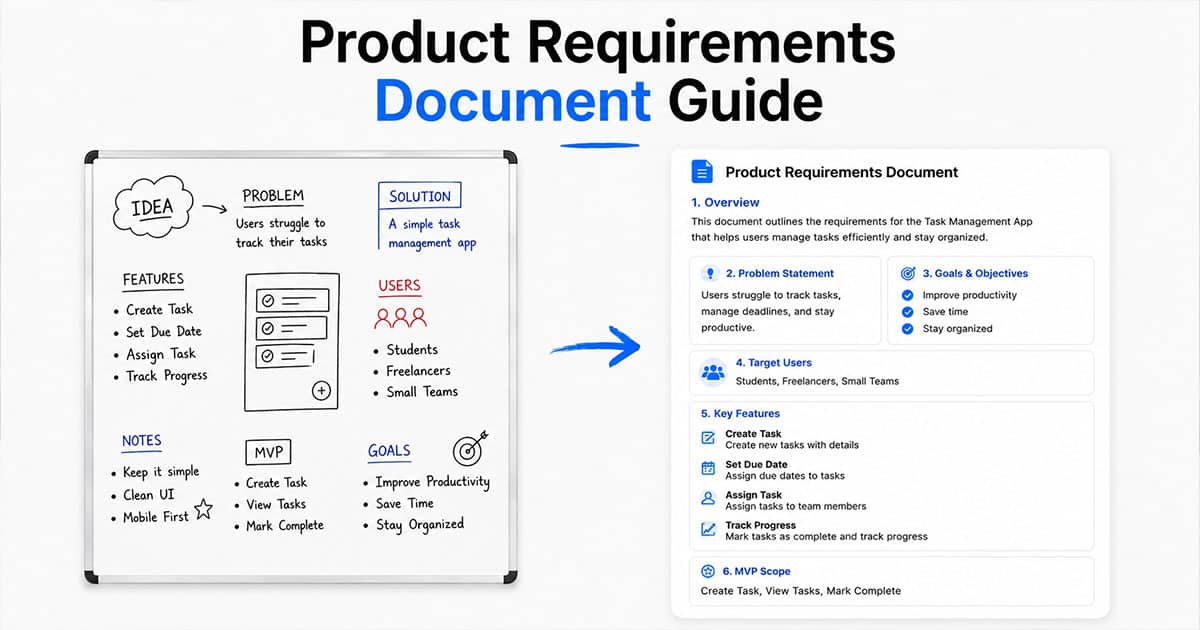
A clear product requirements document plays a critical role in aligning teams and ensuring smooth execution across the product lifecycle. Without proper structure, teams struggle to stay on the same page, leading to confusion, missed expectations, and significant delays. Writing PRDs requires a deep understanding of user needs, business goals, and technical feasibility. It also involves translating ideas into functional specifications that guide development and decision-making.
Cross-functional teams rely on a well-defined PRD to collaborate effectively and avoid miscommunication. A structured approach helps product managers define scope, prioritize features, and maintain clarity throughout the process. When done right, a PRD becomes a foundation for building a successful product that meets customer expectations and delivers measurable business value.
What Is A Product Requirements Document
A product requirements document (PRD) outlines a product’s requirements from the user’s perspective, focusing on what the product should do rather than how it will be built. The document describes the purpose, project scope, key features, user experience expectations, constraints, and success criteria for a specific product release or feature set.
A PRD defines the “what” and “why” of a product, while technical specifications address “how” the engineers will implement it. This separation gives your design and engineering teams flexibility to find optimal solutions while staying aligned with the desired outcome. In most SaaS and digital product environments, product managers own the PRD but co-write it with engineering, design, marketing, and operations stakeholders.
Why does this matter? The Standish Group’s CHAOS reports consistently identify unclear requirements as a top factor in project failure. Over 30 percent of surveyed projects cite ambiguous specs as contributing to delays or cancellations. A well-structured PRD serves as a single source of truth for the development team, ensuring that everyone understands the scope and purpose of the product before development begins.
Consider a Q3 2026 release of a new approvals workflow in a content collaboration app. Without a PRD, engineering might build features that marketing never requested while design works on flows that conflict with technical constraints. The PRD gives the entire team the same mental model before any code is written, reducing the kind of misalignment that can inflate development time by 50 percent according to PMI data.
Key Components Of A Modern PRD
While formats differ across organizations, high performing product teams tend to cover the same 8 to 10 key components in every PRD for consistency and easier review. Think of this section as a practical checklist that you can follow when opening a blank document.
Purpose, Problem Statement, And Business Context
Every PRD starts with why the initiative exists. When writing a PRD, it is important to include a problem statement that outlines the specific challenges the product addresses and explains why they matter. This section should clarify the business context, what business objective the initiative supports (such as increasing activation by 10 percent in H2 2026), and which problem it solves for target users.
Include both qualitative inputs like user feedback from customer interviews and support tickets, alongside quantitative data such as conversion rates, churn, or NPS scores. For example, you might note that “onboarding drop-offs at step 3 affect 42 percent of new accounts” to size the problem concretely.
A crisp problem statement might read: “Marketing teams collaborating with external agencies take an average of 7 days to approve content, blocking time-sensitive campaigns.” This business case context helps engineers and designers challenge solutions while staying aligned with the outcome.
User personas and target segments belong here as well. Document primary and secondary personas including role, company size, geography, and key goals. For instance, a target audience description might read: “Marketing Operations Manager at a mid-market B2C company in North America responsible for coordinating content approvals across 5 brands.” Detailed persona decks can live elsewhere, with the PRD linking to them while keeping a concise summary focused on what matters to this specific release.
Scope, Out Of Scope, And Constraints
Clearly distinguish what is included in the current product release versus what is intentionally deferred. Documenting constraints early reduces the risk of scope creep, which PMI Pulse of the Profession reports connect with 52 percent of project overruns in 2023 surveys.
Explicit constraints might include statements like “no changes to billing flows in this iteration” or “support for English and Spanish only in the first launch.” Technical requirements, regulatory compliance needs, or privacy constraints such as data residency rules also belong in this section.
Functional And Non Functional Requirements
Functional requirements describe user-facing behaviors in plain language. A product requirements document typically includes sections such as project specifics, team goals, background and strategic fit, assumptions, user stories, user interaction and design, questions, and what the team is not doing.
User stories in a PRD articulate requirements from the user’s perspective, typically formatted as “As a [user type], I want [action] so that [benefit].” For example: “As a marketing manager, I want to receive an email and in-app notification when a new asset is ready for review so that I can approve content quickly.”
Acceptance criteria in a PRD provide a checklist of testable conditions that must be met before the feature can be released. Group related requirements into flows such as “submit content,” “review content,” and “approve or request changes” rather than listing isolated items.
Non functional requirements in a PRD address technical constraints, including security, performance metrics, and compliance standards. This includes aspects like page loads under 2 seconds at the 95th percentile, 99.9 percent monthly uptime targets, WCAG 2.1 AA accessibility standards, and mobile apps responsiveness.
User Experience, Flows, And Edge Cases
The PRD outlines how users will interact with the product by linking to design files in tools like Figma and summarizing critical UX flows in text. Key components of a PRD include a clear problem statement, target persona definitions, functional requirements, user stories, acceptance criteria, non-functional requirements, and UX/design links.
Document the “happy path” such as a three-step flow to request, review, and approve content. Also capture error states like expired approval links or conflicts when two approvers respond at the same time. Quality assurance teams and developers derive test cases directly from this section.
An example acceptance criterion: “When the last required approver clicks Approve, the asset status changes to Approved within 3 seconds and notifies the requester.”
Success Metrics, Analytics, And Release Criteria
Success metrics in a PRD are specific, measurable goals to determine if the product is successful, often using Key Performance Indicators (KPIs). Focus on measurable outcomes such as “Reduce average approval cycle time from 7 days to 3 days within 60 days of launch.”
Include analytics implementation details at a high level, noting key events or funnels to track in tools like Mixpanel or Amplitude. Release criteria should combine quality gates (defect severity thresholds, performance baselines) and business criteria (adoption across three pilot teams) before a general availability launch. The evaluation plan helps teams decide whether to roll out, hold, or iterate.
How To Write A PRD Step By Step
This section turns the components into a repeatable workflow your product team can follow for every release. The steps work for modern Agile teams operating in one to four week sprints, where the PRD must be useful without becoming a heavy upfront development process.
Align Stakeholders And Define The Outcome
Kick off with a working session that includes product, design, engineering, and at least one representative from marketing, sales, or customer success. The goal is to align stakeholders on a one-sentence outcome statement such as: “By September 30, 2026, we want 60 percent of agency projects in GainHQ to use the new multi step approval workflow.”
Review existing data together including user research highlights, support trends, and key KPIs from analytics tools. This alignment grounds the entire project requirements in a shared definition of success and reduces rework later.
Research Users And Map The Problem
Conduct practical research activities: interview 5 to 10 target users, review at least 3 months of support tickets, and analyze recent cohort behavior in the product. These activities help you identify gaps in current solutions and customer needs.
An example insight might be: “40 percent of delayed campaigns in Q1 2026 were caused by unclear ownership in the approval process.” Summarize findings concisely in the PRD with links to detailed research reports. Involve engineers and designers in at least some research sessions to improve empathy and shared understanding across different teams.
Define Scope, Prioritize Features, And Plan Iterations
Split the work into a first release and follow-up releases. For example, plan a “Minimum Lovable Product” in Q3 2026 followed by enhancements in Q4 2026. Use a simple prioritization approach such as RICE or MoSCoW and follow disciplined MVP feature prioritization to determine required functionality.
First iteration scope might include: “Support single approval flows for up to 5 approvers.” Postponed items for multiple releases could include “Conditional approvals based on budget thresholds.” User story mapping helps transform raw ideas into concrete work that fits within capacity.
Capture Requirements, Edge Cases, And Dependencies
Move from ideas into structured requirements using consistent phrasing, numbering, or tagging so they can be referenced in tickets and test cases. The features and functionalities section of a PRD outlines what each feature does, how it works, and why it is important, often including user stories and acceptance criteria.
Document dependencies clearly: “Requires email template updates from marketing by August 15, 2026” or “Relies on authentication service upgrade completed in Sprint 18.” Add a short assumptions paragraph covering browser support matrix or expected usage volume at launch. Capture unknowns and open questions so they can be resolved before or during early sprints.
Define Validation Plan, Analytics, And Rollout
Specify what “good” looks like post launch with hypotheses and performance metrics to confirm value. A concrete example: a 4-week beta with 10 existing customers, tracking adoption, qualitative feedback, and approval cycle times.
Outline the release plan strategy: start with internal teams, then 10 percent of eligible customers, then general availability based on potential risks and complexity. The rollout should include key milestones and a clear release date, ideally grounded in a realistic software development timeline.
Review, Iterate, And Maintain Version History
Use a lightweight review process with a comment period of 2 to 3 days where engineering, design, and stakeholders provide feedback directly in the PRD. Apply version control with a date and version label at the top: “Version 1.3, updated May 5, 2026, approved by Engineering Lead and Design Lead.”
A PRD is a living document that should be updated whenever major scope, timeline, or metric decisions change and stay aligned with your broader technical roadmap planning. Do not treat requirements documents as fixed contracts that cannot evolve as the team learns more detail about customer needs.
Agile Product Requirements Documents In Practice
Agile teams adapt PRDs to shorter planning cycles while still benefiting from clear requirements and shared context. In an agile environment, PRDs are dynamic and evolve throughout the development process, incorporating stakeholder input and team feedback, aligning naturally with DevOps best practices for modern teams. These documents are often lighter and more modular, with sections directly linked to epics, user stories, and tasks in tools like Jira or Azure DevOps.
Using PRDs Alongside Backlogs And Roadmaps
PRDs fit among roadmaps, OKRs, and sprint backlogs as complementary artifacts, especially when paired with a well-structured SaaS product roadmap. A 2026 H2 roadmap item “Faster Approvals For Campaign Assets” links to a PRD that then feeds epics and stories for each sprint.
The PRD is the narrative glue that keeps individual backlog items tied back to the original user problem and business requirements. Teams can reference PRD requirement IDs directly in user stories for simple traceability across multiple teams.
Collaborative PRD Writing With Distributed Teams
Distributed teams collaborate asynchronously using time-boxed comment windows, clear owners for each section, and recorded walkthroughs for other teams across time zones. Design adds wireframe links, engineering adds technical notes, and customer success attaches real customer quotes from informed decisions.
Explicit documentation standards compensate for fewer in-person whiteboard sessions. A dedicated requirements management tool helps keep conversations tied to the latest PRD version and supports the entire project.
Keeping Agile PRDs Lean But Useful
The goal is providing enough detail to unblock design, development, and quality assurance without predicting every nuance upfront. Practical rules: if an engineer or designer cannot confidently start work, the PRD is too light. If you repeat the same information in three places, it is too heavy.
Agile PRDs often resemble task boards rather than traditional documents, allowing developers more flexibility in achieving goals. Trim by removing outdated alternatives, moving deep technical detail into separate detailed design docs, and linking instead of copying content.
Example Agile PRD Flow For A Feature Release
Agile PRDs emphasize collaboration among team members, encouraging participation from developers and designers in the requirements gathering process. Consider this timeline:
Phase | Timing | PRD Status |
|---|---|---|
Discovery Sprint | May 2026 | Lean outline with problem statement and personas |
Build Sprints | June-July 2026 | Detailed requirements added as research spikes complete |
Phased Rollout | August 2026 | Release criteria and metrics finalized |
Best Practices And Common Pitfalls
Good PRDs are as much about habits and culture as templates. A PRD enhances communication among team members by reducing miscommunication and minimizing the risk of costly misunderstandings, as it consolidates all relevant information in one document, supporting a disciplined startup software development process.
Prioritize Clarity Over Volume
Write in plain language. Avoid ambiguous terms such as “quick,” “simple,” or “user friendly” without definitions. Use short, active sentences to describe behaviors. A well-structured PRD should include sections for purpose, features, user personas, and release criteria, ensuring that all stakeholders have a clear understanding of the product’s goals and requirements.
Long, dense paragraphs without structure can hide important decisions and make it less likely that busy stakeholders will read carefully.
Keep The PRD Current And Reflective Of Reality
Stale PRDs that no longer match what is being built lead to defects and misaligned expectations across the product team. Establish simple triggers for updates: major scope changes, new constraints, or post launch learnings that affect future work.
Maintain a change log section so readers can quickly understand what has changed since the last review and make informed decisions.
Include The Right Stakeholders At The Right Time
Involve engineering, design, customer support, marketing, and sales early enough that they can shape the problem and requirements. A simple RACI approach clarifies who owns the PRD, who approves, and who contributes to specific sections.
For example, include support leads when defining error messages and incident flows. Product owners and marketing can contribute success metrics tied to campaign performance.
Use Data To Support Decisions, Not To Overwhelm
Use a few high-impact data points tied directly to the problem and desired outcome. Reference that onboarding completion improved from 60 percent to 75 percent after a previous PRD-led initiative. Link to dashboards and reports for those who need a comprehensive overview.
Avoid Turning The PRD Into A Contract
Not all PRDs should be treated as rigid contracts that cannot change. Position the PRD as a living agreement on goals, constraints, and user value that evolves as the team learns during discovery and delivery.
A team might adjust scope mid-cycle after discovering a simpler solution that still meets the original outcome. This flexible but disciplined approach helps teams react to new information without losing alignment with product management goals.
Real World Product Requirements Document Example
This example walks through a “Multi Step Content Approval Workflow” inside GainHQ planned for release in October 2026, similar in spirit to how one startup launched an MVP in 90 days.
Example Summary And Context
Project: Multi Step Content Approval Workflow
Target Release: October 2026
Target Audience: Marketing teams with external agencies
Problem: Slow approvals blocking time-sensitive campaigns
Marketing teams collaborating with agencies currently take an average of 7 days to approve content. The business problem is clear: delayed approvals cause missed campaign windows and frustrated clients.
Example Requirements And Flows
The PRD captures specific features with testable statements:
- Primary happy path: Creator submits asset, approvers review in sequence, asset is approved
- Edge case: Approver on vacation can delegate review to another team member
- Integration: Status updates sync with other systems within 3 seconds of final approval
The PRD links these flows to Figma mocks and breaks them into user stories for sprint planning. Dependencies appear directly beneath requirements for easy reference.
Example Metrics And Rollout Plan
Metric | Target |
|---|---|
Average approval time | Reduce from 7 days to 3 days |
Early adoption rate | 70 percent of pilot customers |
Post-rollout NPS | Minimum score of 40 |
Final Discussion
A well-structured product requirements document ensures that every stakeholder stays on the same page throughout the product lifecycle. It connects strategy with execution by guiding the product development process from initial idea to final release. When supported by a marketing requirements document and ongoing learning from resources like the GainHQ product and engineering blog, teams gain clarity on positioning, audience, and go-to-market alignment.
A written product requirements document reduces ambiguity, improves collaboration, and helps teams make informed decisions at every stage. It also acts as a single source of truth for priorities, features, and timelines. Consistent documentation prevents miscommunication and keeps progress aligned with business goals. Ultimately, a strong PRD enables teams to deliver products efficiently, minimize risks, and maintain focus on building solutions that create real value for users and stakeholders, echoing patterns seen in successful SaaS launch case studies.
Frequently Asked Questions
How Long Should A Product Requirements Document Be
Length depends on complexity. Small enhancements might fit on a single page while large new products may span several pages. Focus on clarity and usefulness instead of word count. Any section that does not influence design, development, or go to market decisions can likely be shortened or moved to an appendix.
Who Should Own The PRD And Who Contributes
A product manager usually owns the PRD and is responsible for keeping it updated. Engineering, design, data, marketing, and support teams should actively contribute to relevant sections. A simple RACI breakdown clarifies who writes, who reviews, and who approves before development begins.
When Is The Right Time To Create Or Update A PRD
Start a PRD once a problem or opportunity is validated enough to plan a release, after earlier validation stages such as MVP vs prototype vs POC have clarified risks, typically before detailed design or sprint planning. Update whenever major decisions change scope, timelines, or success metrics. Review key milestones such as discovery completion, beta start, and general availability.
How Does A PRD Differ From Roadmaps, MRDs, And BRDs
Market Requirements Documents (MRDs) identify market opportunities to meet customer needs, while PRDs explain how a product will meet those needs, focusing on the product’s features and functionalities. Business Requirements Documents (BRDs) focus on business goals like revenue impact and operational efficiency, outlining high-level capabilities expected from a solution, while PRDs guide day-to-day decisions on scope and user experience. Roadmaps show timing and sequencing of initiatives and tie into budget planning such as MVP development cost breakdowns.
What If My Team Thinks PRDs Are Too Heavyweight
Resistance often comes from painful past experiences with overly detailed documents. A modern PRD can instead be a concise, collaborative outline focused on purpose, scope, and success metrics. Start with a lean template covering the most critical sections that reflects emerging MVP development trends for startups. Expand detail only where the team experiences recurring confusion or rework in the software development process.