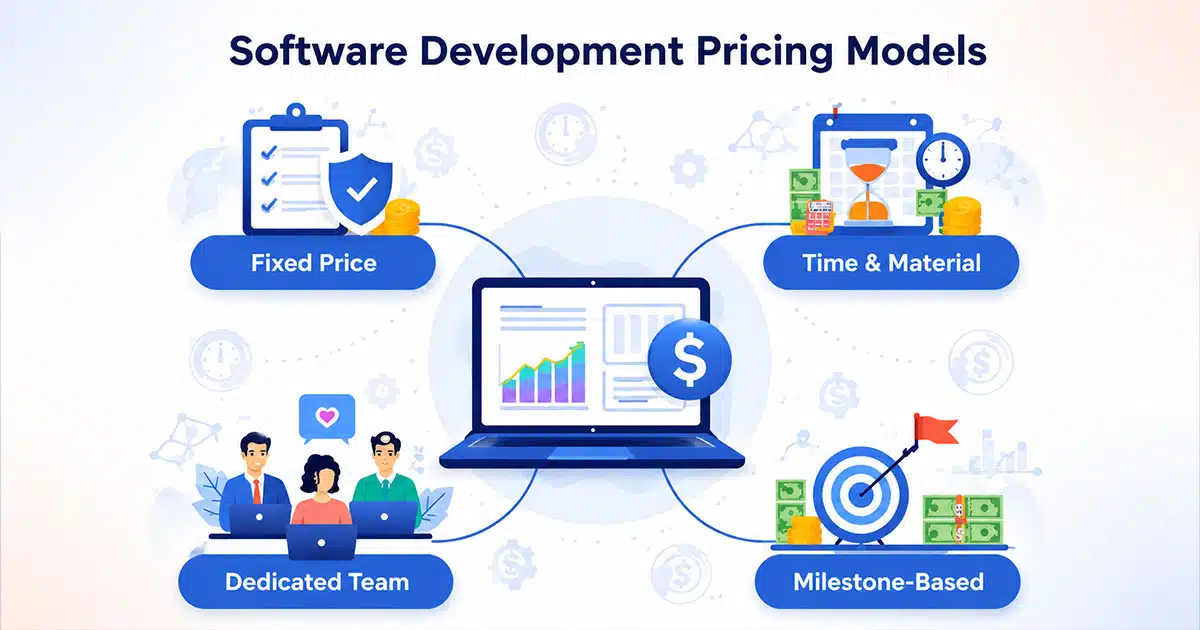
Software development pricing models shape how businesses plan budgets, control risk, and ensure project success. From a fixed price model with a well defined scope to a flexible time and material model, each pricing model affects project costs, financial risk, and the overall software development process. Many software companies rely on common pricing models such as fixed price contracts, a dedicated team model, or a time and materials contract for complex projects.
Choosing the right pricing model depends on project requirements, development costs, and customer perceived value. Some clients pay through subscription pricing model options, per user pricing, or usage based pricing, especially in SaaS pricing models. Others prefer a hybrid pricing model or mixed pricing model to balance predictable costs with flexibility. A clear pricing strategy helps a development company align project scope, manage hidden costs, and deliver custom software development efficiently.
What Is A Software Development Pricing Model
A software development pricing model defines how clients pay for a software project. It outlines the structure of software development pricing, payment terms, and risk allocation. Software development pricing models help a software company set clear expectations before work begins. A pricing model also connects project scope, development costs, and overall project management. Clear software development contracts reduce hidden costs and financial risk.
Common pricing models include the fixed price model, time and material model, and dedicated team model. A fixed price approach works best with a well-defined scope. A time and materials contract suits complex projects with changing requirements. A dedicated team pricing model supports long-term custom software development. Choosing the right pricing model ensures project success and better cost control.
Fixed Price Model For Software Development
A fixed price model sets a total cost before software development begins. The service provider agrees to deliver the full software project at that fixed price, no matter the actual development costs. Fixed price contracts transfer most financial risk to the vendor. Many businesses choose this pricing model for predictable costs and clear software development contracts.
When To Use Fixed Price Model
A fixed price approach works best for small or mid-sized software development projects. Stable requirements and clear documentation are key factors. Projects with completed designs or limited feature updates suit this development pricing model.
Fixed price contracts fit website builds, system upgrades, and short-term custom software development. Public organizations and startups often prefer this pricing strategy for budget certainty. A clear scope helps ensure project success.
Pros And Cons Of Fixed Price Model
The biggest benefit is predictable costs. Clients pay a flat rate pricing amount agreed in advance. Project management becomes easier because budgets stay fixed. Financial risk shifts to the development company.
Limitations also exist. Flexibility remains low once the contract is signed. Any change in project requirements leads to extra charges. Vendors may add risk margins to protect profit. That can increase overall development pricing.
Common Pitfalls To Avoid
Scope freeze creates problems when new ideas appear. Change requests can slow progress and raise costs. Poor estimation may affect quality and timelines.
Clear communication, accurate documentation, and realistic expectations reduce hidden costs. A strong partnership between client and service provider supports project success under the fixed price model.
Time And Material Pricing Model
A time and materials contract bills clients for actual hours worked and materials used during software development projects. You pay for the trip rather than a predetermined destination. The billing structure has hourly rates for each team member, actual hours worked billed weekly or monthly, and material costs with markup.
How Time And Material Pricing Works
The time and material model operates on straightforward principles. Both parties agree on project goals without detailing every specification upfront. Hourly rates vary by role: senior developers, project managers and specialists each have different rates. Materials carry markup between 15% and 35% on actual costs.
Contractors track hours worked and material expenses. They provide detailed invoices to clients. Payment occurs periodically, often monthly. This ensures ongoing cash flow for contractors while allowing you to monitor costs. Modern T&M contracts frequently have a not-to-exceed clause that caps total costs. This provides budget limits while maintaining flexibility as project requirements evolve.
The contractor and client establish rates and terms before work begins. This has labor rates for each category, material billing and markup percentages, billing frequency and documentation requirements. As work progresses, contractors track labor hours using timesheets or time tracking software like JIRA or Redmine. Each entry documents who worked, tasks completed and applicable labor category.
Detailed invoices show hours worked by each role, hourly rates with total labor costs, itemized material costs with markup and supporting documentation. The client reviews invoices and verifies hours and materials, then approves payment. This transparency builds trust but requires accurate recordkeeping.
Benefits And Drawbacks
Flexibility stands as the biggest advantage. You can adjust requirements, incorporate user feedback, swap features and change direction to get the exact product you want. Projects adapt when scope evolves without complex contract renegotiations. Time and materials contracts offer flexibility, allowing easy changes to project scope and direction.
Work begins faster because negotiations focus on agreeing to rates for labor and materials rather than detailing work specifics. Projects can start within two weeks, beating fixed price agreements that need extensive planning. Development teams can begin building while details for later phases remain undefined.
Transparency emerges through detailed reporting. Contractors provide information about work performed continuously, keeping you closely informed on project status. Detailed invoices show exact time worked and materials used. This enables clear visibility into fund allocation. You can prioritize tasks based on changing business needs and market demands. This enables agile development where teams adapt to evolving requirements.
This model offers predictability and security for contractors. They know exactly the profit margin for each unit of work performed without concerns over scope arguments. Margins are lower under time and materials contracts but more predictable than fixed price contracts.
Budget uncertainty presents the biggest disadvantage. Final project costs may exceed original estimates, with T&M projects averaging 10-25% over original projections. Without upfront total cost, you face financial risk if project scope sprawls. This uncertainty complicates financial planning, especially for businesses with tight budgets.
The model demands active client involvement. You must review progress and time reports regularly, make continuous prioritization decisions and ensure efficient resource use. Detailed cost tracking places heavy administrative burden on both parties. Without efficient systems, managing these details becomes time-consuming and error-prone.
Best Use Cases For T&M Model
Time and materials contracts excel when project scope remains unclear or fully undefined upfront. They suit complex projects requiring flexibility, such as custom software development. Projects exploring new technologies, solutions without clear precedents or complex integrations with multiple systems work well with this approach.
This model aligns perfectly with agile development methodologies. Scrum or Kanban-based processes, projects prioritizing regular releases and development focused on delivering maximum value rather than predefined features benefit from T&M flexibility. Long-term partnerships where trust exists and projects evolving into maintenance phases also favor this structure.
Choose time and materials when requirements may change throughout the project timeline, you want flexibility to modify scope or change features during development, or technical uncertainty demands creative problem-solving.
Dedicated Team Pricing Model
Long-term software development projects need consistent expertise without the overhead of building an in-house team. The dedicated team model addresses this need through a partnership where remote developers work exclusively on your product or project. These professionals integrate fully into your workflow and follow your processes, culture and goals.
What Makes Dedicated Teams Different
Dedicated teams become an extension of your company rather than temporary contractors. They arrange with your vision and roadmap, which makes them suitable for long-term collaboration. This engagement model operates on a simple principle: fixed budget with flexible scope.
The team dedicates 100% of their time to your particular project. No switching between multiple clients. No divided attention. This exclusive focus leads to shorter turnaround times and higher quality work. Team members gain deeper understanding of your business model, challenges and goals. As a result, they look at the bigger picture and suggest solutions outside the project specification you started with.
You create project roadmaps together as sprints. Through agile working methods and constant communication, you stay on top of latest developments and know exactly what you're paying for. The development partner handles recruitment, onboarding, operational needs, team scaling and performance management.
Cost Structure And Payment Terms
The dedicated team pricing model uses monthly or quarterly payments. Your budget is derived from the number of team members you use each month. The invoice covers developer salaries plus a service fee per team member.
Regional location affects SaaS development costs substantially. Eastern Europe ranges from USD 35.00 to USD 60.00 per hour. South Asia, which has India and Pakistan, charges USD 25.00 to USD 45.00 per hour. Western Europe costs USD 60.00 to USD 100.00 per hour. North America commands USD 80.00 to USD 150.00 per hour.
Hiring a dedicated team in Ukraine with one developer costs USD 5300.00, where USD 3500.00 is the developer's salary and USD 1800.00 is the service fee. Building an offshore dedicated team can save up to USD 6220.00, or 54%.
The cost structure has salaries and benefits, infrastructure and tools, recruitment and onboarding, management overhead, and training to keep the team arranged with your future-proof technology stack. Service fees decrease as team size increases. The fee averages USD 1000.00 per team member for a five-member team.
When This Model Works Best
Startups building an MVP or scaling toward Series A funding benefit from dedicated teams. You move fast without over-hiring locally. SaaS platforms evolve constantly and need support for new features, integrations and ongoing maintenance while keeping costs predictable.
The team extension approach integrates remote developers naturally into your workflows when your in-house developers are overloaded. Enterprises upgrading outdated systems gain fresh expertise while ensuring smooth transition and stability.
This model excels for gross projects lasting a long time with ambiguous requirements and scope that changes due to complexity. It suits projects that need a variety of skills and expertise: designers, developers, DevOps, growth analysts and QAs. You can scale resources so you ramp up to meet demand or scale down during lean periods.
Other Software Pricing Models To Consider
Beyond the three main software development pricing models, several alternatives are a great way to get unique advantages for specific situations. These pricing models for software address different business needs and project structures.
Milestone-Based Pricing
Payments occur at predefined stages of the project. Each milestone represents completed work that has been approved. Complex long-term projects with clear stages or deliverables suit this pricing model.
Both parties manage risks more effectively when they break payments into milestones. Clients pay only for work completed to their satisfaction. Vendors maintain healthier cash flow and stay incentivized to meet deadlines and quality standards. The approach prevents scope creep because all payments and deliverables are agreed upon upfront. Clients become less likely to request changes outside defined milestones.
Milestone pricing transforms vendors from mere software providers into success partners with skin in the game. Companies with value-based pricing models experience 25% higher net revenue retention compared to seat-based or usage-based models alone. The model keeps vendors accountable for delivering meaningful business outcomes.
You need a deep understanding of customer processes and success metrics to define appropriate, measurable milestones. Milestone triggers can create less predictable revenue timing compared to subscription pricing models.
Value-Based Pricing Model
Value-based pricing sets prices according to the value customers see rather than production costs or competitor pricing. This pricing strategy emphasizes benefits and positive outcomes buyers gain from the product.
The model focuses on ROI that a SaaS business generates for users. You deliver value if your software helps users save or make more money than they spend working with you. Brand loyalty develops when you deliver consistent value over time. Loyal customers have greater lifetime value and continue subscribing, which results in greater profit margins due to lack of customer churn.
Customers become willing to pay higher prices as they develop brand loyalty. Customers begin valuing service over savings and pay a premium for quality products with service backing it up.
Product prices become harder to set. You need to spend time and energy understanding how customers view your product's value when you use value-based pricing. There's room for error when first setting prices with a value-based pricing strategy. The customer's perception might not always reflect your internal assessment and force you into a lower price.
Subscription And Retainer Models
A retainer subscription is an agreement where clients pay in advance for future work. This business model has become popular among professional services firms. The model offers predictable recurring revenue and promotes long-term client relationships.
Retainer pricing is different from subscription pricing. Retainer arrangements feature reserved capacity for as-needed work and dedicated personnel commitments. Subscription models involve standardized service packages, regular deliverables on set schedules and defined service levels.
Retainer pricing stabilizes fluctuating revenue and makes revenue forecasting more accurate. You can focus on client needs and deliver high-quality work rather than spend time looking for new clients. Clients rest assured knowing you have dedicated hours available.
Hybrid Pricing Approaches
Hybrid pricing merges multiple pricing structures into one. The model involves charging customers a fixed recurring fee and a variable charge based on usage or another value driver. 22% of SaaS businesses adopted hybrid models that mix subscriptions and usage-based fees in 2024.
A project management platform might charge USD 100.00 per month for core product access, USD 15.00 per additional user beyond the first 10 and USD 0.50 per gigabyte of storage beyond the first 100. Small teams staying within the base plan pay the flat fee. Larger teams with heavy storage use might pay four or five times that.
The fixed portion provides predictable recurring revenue and gives businesses a solid foundation for financial planning. The variable component adds flexibility and lets revenue grow with customer usage. Hybrid models tend to minimize churn because customers feel in control of what they pay.
Key Factors To Consider When Choosing A Pricing Model
Your software development pricing model choice depends on several interconnected factors. Selecting the right pricing model requires you to evaluate your project against specific criteria that determine which approach delivers optimal results.
Project Scope And Complexity
Project scope includes all aspects of your software development initiative, from original requirements to final deliverables. A clearly defined scope has detailed specifications, functionalities, and system architecture problems that are the foundations of accurate cost estimation. The larger your software project is, the more human resources and time it requires. This directly affects what clients pay for development.
Complex projects that require state-of-the-art technologies or innovative solutions tend to have higher development costs. Specialized skills and increased development time drive these costs up. High complexity and uncertainty often require time and materials or agile pricing approaches. Well-defined scopes suit fixed price contracts better.
Budget And Timeline Constraints
Budget expectations shape your pricing model selection by a lot. If you want to maintain control over monthly expenses, think over pricing models like fixed price or dedicated teams that offer more predictable costs. Models like time and material or milestone-based pricing may result in variable monthly payments.
Expected duration influences the choice. Fixed price contracts work best for short-term projects. Time and material and dedicated team models suit medium to long-term engagements better. Projects lasting from two to three months with ambiguous requirements favor flexible pricing models.
Level Of Control Required
Your desired involvement level determines model appropriateness. Fixed price models require less client involvement. Time and material and milestone models demand more active participation from clients. The phenomenal level of control in dedicated team pricing lets you personally view team members, increase or decrease team size, and assign tasks.
Team Size And Resources
Project size determines the appropriate software development pricing model. Time and material or milestone-based pricing may be enough for small projects that need only a few developers. Larger projects that require full teams with quality assurance specialists, designers, and project managers need dedicated team approaches.
Human resources' impact extends beyond team size. The specialty and seniority level of team members determine your expenses, not just team size alone.
Risk Tolerance
Different models allocate risk differently between buyer and vendor. Fixed price contracts move execution risks to the development company. Time and material models place cost risk with clients who directly bear budget changes tied to hours worked. Understanding your risk capacity helps match the pricing model to your comfort level with uncertainty.
How To Choose The Right Software Development Pricing Strategy
Choosing the right pricing strategy shapes your project costs, risk level, and long-term success. Software development pricing models must align with project scope, budget limits, and business goals. Clear evaluation of key factors reduces financial risk and improves project success rates.
Align Model With Project Scope
Project scope defines the best pricing model. A fixed price model suits a well-defined scope with stable requirements. Fixed price contracts protect clients from cost overruns and offer predictable costs. Standish Group reports that nearly 50 percent of projects face scope changes. Stable requirements reduce that risk.
Time and material model works better for complex projects. Flexible pricing models allow adjustments as needs evolve. Hybrid pricing model can balance certainty and adaptability where partial clarity exists.
Evaluate Complexity And Risk
Complex projects require flexible development pricing models. A time and materials contract supports agile workflows and frequent releases. Agile teams often prefer material pricing model because requirements shift during the software development process.
Fixed price approach increases vendor risk. Vendors may add contingency margins of 20 to 30 percent to cover hidden costs. Higher margins can raise total development costs for clients. Risk assessment protects both parties.
Review Budget Certainty Needs
Budget certainty drives many decisions. Fixed price pricing model ensures flat rate pricing and strong cost control. Clients pay a predetermined amount, which simplifies financial planning.
Cost-based pricing and value-based pricing may suit enterprise software pricing strategies. Where customer perceived value is high, value-based pricing can justify higher development pricing. SaaS pricing models often use subscription pricing model or tiered pricing for predictable recurring revenue.
Consider Team Structure
Team setup influences pricing strategy. The dedicated team model gives control over the development process and workload. Dedicated team pricing model works well for long-term custom software development.
A dedicated development team can scale as project requirements grow. Businesses without a strong in house team often choose this model. Clear communication reduces project management challenges and ensures project success.
Assess Vendor Capability
Vendor expertise matters more than reputation alone. Review technical skills, past software development projects, and estimation accuracy. Poor estimation increases hidden costs and delays.
Project Management Institute data shows that weak project management leads to significant budget loss globally. Strong service provider processes reduce financial risk. Transparent software development contracts build trust and clarity.
Plan For Long Term Growth
Short-term goals differ from long-term strategy. Fixed price contracts suit short engagements with limited scope. Long partnerships benefit from time and material model or hybrid pricing.
Growth often changes project requirements. Flexible pricing models adapt to the latest market trends, competitor pricing, and actual usage. Per-user pricing and usage-based pricing support SaaS expansion. The right pricing model supports scalability and sustainable project success.
Common Mistakes To Avoid When Selecting Pricing Models
Selecting software development pricing models involves avoiding several critical errors that derail projects and inflate costs.
Choosing Based On Price Alone
Companies outsource to cut costs, with 59% prioritizing budget efficiency. Choosing the cheapest software development pricing option backfires though. Low rates signal inexperience or inadequate project understanding. Development companies offering cheap services often lack the complexity awareness your project needs. The lowest fixed price may seem attractive, but you sacrifice quality and expertise.
Ignoring Hidden Costs
Original quotes focus on visible expenses. Hidden costs surface later throughout the development process. Fixed price contracts appear safe, but rigid scope control transforms affordable plans into expensive undertakings. Communication gaps and language barriers increase total costs through additional reviews and rework. Offshore development may reduce hourly rates, yet misunderstandings affect quality and performance to a high degree.
Lack Of Flexibility In Contracts
Software development contracts require flexibility. Rigid pricing models depend on detailed requirements, but gaps appear after development starts. Vendors treat extra requests as change orders and increase total project costs. Business value suffers when inflexible agreements result in delayed features.
Poor Communication With Vendors
Poor communication destroys projects. 57% of IT projects fail due to communication issues. Outsourced IT projects exceed budgets 62% of the time, with miscommunication causing timeline extensions that affect 70% of projects.
Why GainHQ Helps You Choose The Right Software Development Pricing Models
GainHQ helps businesses compare different pricing models with clarity and confidence. Every software project has unique project requirements, budget limits, and growth goals. GainHQ analyzes your project scope, development costs, and financial risk before suggesting the right pricing model. Clear evaluation of fixed price model, time and material model, or dedicated team model ensures balanced software development pricing and better project management outcomes.
GainHQ focuses on transparency in software development contracts and long term value. Expert consultants assess key factors such as complexity, team structure, and hidden costs. Whether you need predictable costs through a fixed price approach or flexible pricing models for complex projects, GainHQ aligns development pricing models with your business strategy. The result is lower risk, optimized project costs, and higher project success.
FAQs
Which Software Development Pricing Model Reduces Financial Risk The Most?
Yes, the fixed price model reduces financial risk for clients because total project costs are agreed upfront. Fixed price contracts transfer execution risk to the development company. However, flexibility becomes limited if project requirements change.
Can Software Development Pricing Models Affect Product Quality?
Yes, software development pricing models can influence quality outcomes. A strict fixed price approach may pressure vendors to protect margins. Flexible pricing models like time and material model allow better adaptation and quality control.
Is A Dedicated Team Model More Cost Effective Than Hiring An In House Team?
Yes, the dedicated team model often lowers overhead compared to building an in-house team. You avoid recruitment, infrastructure, and long-term employment costs. Dedicated team pricing model offers scalability with controlled development pricing.
Do SaaS Pricing Models Work For Custom Software Development Projects?
No, SaaS pricing models like subscription pricing model or per-user pricing mainly apply to product monetization. Custom software development usually relies on fixed price, time and materials contract, or hybrid pricing structures.
How Do Market Trends Influence Software Pricing Strategy?
Market trends, competitor pricing, and customer perceived value shape software pricing strategy. Businesses review actual usage, demand shifts, and pricing tiers to refine development pricing models. Data-driven pricing experiments improve long-term revenue stability.
What Role Does Customer Feedback Play In Pricing Decisions?
Customer feedback reveals perceived value and willingness to pay. Companies adjust value-based pricing or usage-based pricing after analyzing feedback. Strong feedback loops help optimize software pricing and reduce churn.
Are Hybrid Pricing Models Suitable For Enterprise Software Projects?
Yes, hybrid pricing models combine predictable costs with flexibility. Enterprises often use a mixed pricing model that blends fixed price elements with time and material billing. Hybrid pricing supports complex projects with evolving scope.