Time and Material vs Fixed Price for Software Projects
by GainHQ Editorial Team | Feb 18, 2026 | Software Development Insights | Editorial policy
Table of Contents
- What Is a Fixed Price Contract?
- What Is a Time and Material Contract?
- Which Costs More: Fixed Price or T&M?
- Hybrid Models Between Fixed Price and T&M
- How to Choose: Six Questions
- Clauses to Ask For in Each Model
- Can Agile Work With a Fixed Price?
- Does AI-Assisted Development Change the Choice?
- How GainHQ Approaches This
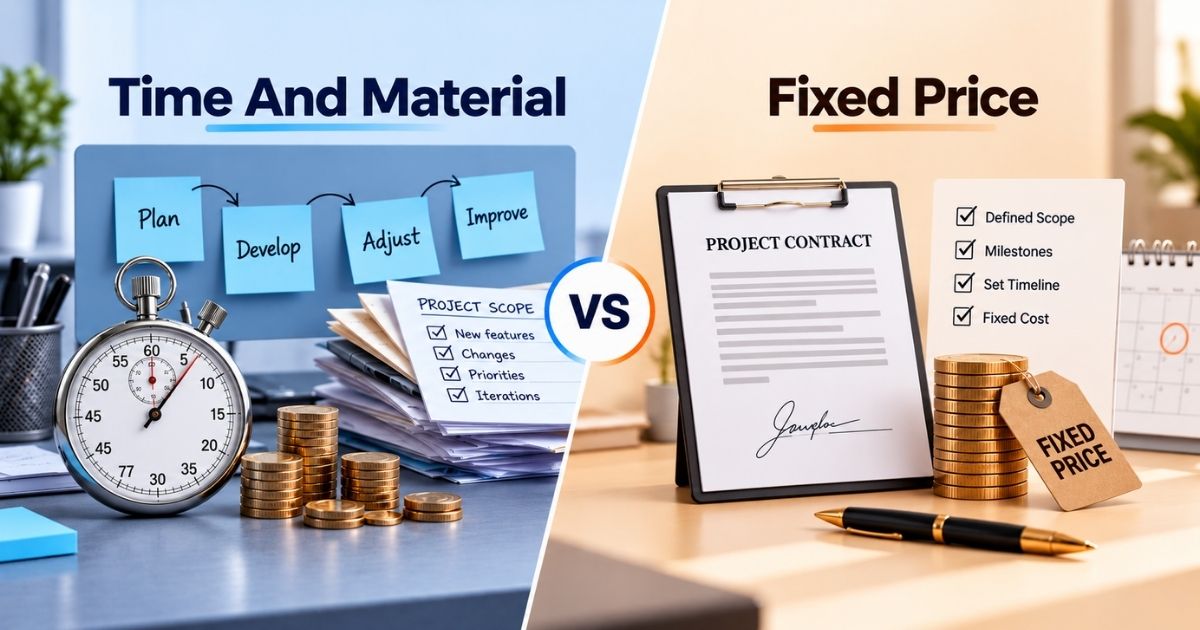
Quick answer: choose a fixed price contract when the scope is small, stable and fully specified, because the vendor carries the cost risk and you know the total up front. Choose time and material (T&M) when requirements will change or can't be estimated with confidence, because you pay for actual effort and can re-prioritise as you learn. For most custom software, a hybrid works best: a short paid discovery or T&M phase with a spending cap, then fixed price for the parts that are now well defined.
| Fixed price | Time and material | |
|---|---|---|
| How you pay | One agreed total, usually in milestone payments | Agreed hourly or daily rates for the effort actually spent |
| Scope | Defined in detail before work starts | Can change sprint by sprint |
| Change requests | Formal change order, new price and date | Re-prioritise the backlog; cost follows effort |
| Who carries cost risk | Mostly the vendor | Mostly the client (limited by a cap, if agreed) |
| Budget certainty | High, if the scope holds | Lower; needs active budget tracking |
| Time to start | Slower: needs full specification first | Faster: can start with a prioritised backlog |
| Client involvement | Lower: reviews at milestones | Higher: acts as product owner |
| Vendor incentive | Finish within the price | Deliver what you prioritise, efficiently |
| Hidden cost | Risk buffer built into the quote | Overrun if scope and spend aren't managed |
| Best for | Small, repeatable, well-specified work | New products, MVPs, integrations, R&D, AI features |
What Is a Fixed Price Contract?
A fixed price contract sets one total price for an agreed scope, timeline and set of deliverables. The price does not move when the vendor's actual costs go up or down, so the vendor keeps any savings and absorbs any overrun.
The US Federal Acquisition Regulation describes the firm-fixed-price contract the same way: it "is not subject to any adjustment" for the contractor's actual costs, and it puts maximum risk and full responsibility for profit or loss on the contractor (FAR 16.202-1). That is why it gives the vendor a strong incentive to control cost.
In software, that incentive has a side effect. Because the vendor carries the risk, it prices the risk in. A fixed quote contains the estimated effort plus a contingency for everything the specification didn't anticipate. The less certain the scope, the bigger that buffer, and you pay it whether or not the risk materialises.
Estimates for large software projects are often wrong by a wide margin. A McKinsey and University of Oxford study of more than 5,400 IT projects found that large projects (over $15 million) ran on average 45% over budget and 7% over time, and delivered 56% less value than predicted (McKinsey, 2012). The data is from 2012, but it shows why vendors protect themselves when they fix a price.
Fixed price works well when:
- The work is small and the requirements are written down: user stories, acceptance criteria, designs.
- The vendor has built something very similar before.
- The scope is unlikely to change during delivery.
- You need a firm number for a budget approval or a grant.
What Is a Time and Material Contract?
A time and material contract pays the vendor for the hours or days actually worked, at rates agreed up front, plus any agreed expenses such as licences or infrastructure. There is no fixed total; the final cost depends on the effort the work really takes.
Government buyers use T&M on the same logic. Under FAR 16.601, a T&M contract may be used only when it is not possible at the time of placing the contract to estimate the extent or duration of the work, or anticipate costs, with any reasonable degree of confidence. The FAR also requires a ceiling price that the contractor exceeds at its own risk.
The trade-off is control. You can change direction every sprint, but you also carry the cost risk, so T&M needs active oversight. The US Government Accountability Office calls T&M risky for buyers "because the government bears the risk of cost overruns" and found weak justification and monitoring in many contract files (GAO-09-579). The lesson applies to private buyers too: T&M works when the client tracks spend against progress every week.
T&M works well when:
- You are building a new product or MVP and expect to learn from users.
- The work involves unknowns: legacy systems, third-party integrations, AI features, data quality.
- You want to start quickly and refine the backlog as you go.
- You have someone who can act as product owner and make weekly decisions.
Which Costs More: Fixed Price or T&M?
Neither model is cheaper by default. Fixed price costs more when the vendor's contingency turns out to be larger than the problems that actually occur. T&M costs more when scope grows without anyone reprioritising or capping spend.
What decides the final bill is how much uncertainty there is and who manages it:
- Low uncertainty: fixed price is usually efficient, because the buffer is small and change orders are rare.
- High uncertainty: a fixed quote carries a large buffer, and change orders pile up anyway. T&M with a cap and weekly budget reviews is usually cheaper overall.
- Mixed: split the work. Fix the price of the parts you can specify, run the rest on capped T&M.
Change orders are the hidden cost of fixed price. Every new idea or piece of user feedback becomes a negotiation about whether it was "in scope", which costs money and time. For the cost drivers behind any quote, see our guide to custom software development cost.
Hybrid Models Between Fixed Price and T&M
Most real contracts sit somewhere between the two pure models. These are the common hybrids and when each fits.
| Model | How it works | Best for |
|---|---|---|
| Capped T&M (not-to-exceed) | T&M billing with a ceiling the vendor can't bill past without approval | New products where you need flexibility but a hard budget limit |
| Fixed budget, flexible scope | Budget and timeline are fixed; the team re-prioritises features to fit | Product teams who accept that some features may move to a later release |
| Phased: discovery, then fixed price | A short paid discovery (often T&M) produces specs and estimates; delivery is then priced fixed | Projects that are fuzzy now but can be specified after a few weeks |
| Fixed capacity (dedicated team) | You pay a fixed monthly amount for an agreed team; you decide what they work on | Long-running products with a continuous backlog |
| Fixed price per sprint or milestone | Each sprint or release is priced and accepted separately | Agile delivery where the buyer needs fixed unit costs |
| Fixed price, level of effort | A fixed price for a stated amount of effort over a period, for work that can only be described in general terms | Research or support work with no clear end product |
Two public-sector examples show these hybrids are mainstream. The US Digital Service's TechFAR Hub states that agile software contracts are not limited to fixed price, recommends hybrids where firm-priced work and uncertain work are bought differently, and shows fixed price line items priced per sprint (TechFAR Hub). The FAR defines the fixed-price level-of-effort variant in FAR 16.207.
Fixed capacity vs fixed price: with fixed price you buy a defined output; with fixed capacity you buy a defined team for a period and steer its output yourself. Fixed capacity gives you a predictable monthly cost without freezing the scope.
Dedicated team vs T&M: a dedicated team is usually billed like T&M but for a stable, full-time team over months, rather than variable hours. You get continuity and domain knowledge; you also commit to the cost of the whole team. Compare the staffing options in hiring developers vs outsourcing.
How to Choose: Six Questions
Answer these honestly. Mostly "yes" points to fixed price; mostly "no" points to T&M or a hybrid.
- Can you write acceptance criteria for every feature today? If not, you can't fix a fair price.
- Will the scope stay the same after users see the first version? New products almost never do.
- Has the vendor built something very similar? Familiar work means a smaller risk buffer.
- Are there external unknowns? Legacy systems, third-party APIs and AI model performance are hard to estimate.
- Do you need a single number for approval? If yes, fix the discovery phase first, then fix delivery.
- Can someone on your side make product decisions every week? T&M without an engaged product owner drifts.
A simple rule of thumb: fix what you know, cap what you don't.
Clauses to Ask For in Each Model
The contract wording matters as much as the model. Ask for these:
In a fixed price contract
- A written scope with acceptance criteria per milestone, so "done" can't be argued.
- A change-control process: how changes are estimated, approved and priced.
- Milestone payments tied to accepted deliverables, not dates.
- A warranty period for defects after acceptance.
- Clear ownership of code and IP on payment.
In a T&M contract
- A not-to-exceed cap per phase or month, with notice before it is reached.
- Agreed rates per role, and who can be assigned to each role.
- Weekly or bi-weekly reports of hours by feature, so you can compare spend with progress.
- A right to re-prioritise the backlog and to pause or end the engagement with short notice.
- The same IP and handover terms as fixed price.
If you are preparing a request for proposals, our software development RFP guide shows how to ask vendors to quote in a way you can compare.
Can Agile Work With a Fixed Price?
Yes, but not with a fixed scope. Agile assumes the backlog will change as you learn, and the Agile Manifesto values "customer collaboration over contract negotiation" (agilemanifesto.org). A fixed price that also fixes every feature works against that.
Agile and fixed price fit together when the contract fixes budget, time or unit of work instead of the feature list. Common patterns are a fixed price per sprint with agreed sprint output, a fixed budget with flexible scope, or a phased contract where each release is priced once it is specified. The TechFAR Hub notes that hybrid contracts can move T&M work to fixed price once pricing history is established (TechFAR Hub).
Does AI-Assisted Development Change the Choice?
AI coding tools change the effort behind a task, but not in a way you can price in advance. In a randomised trial, METR found that experienced open-source developers took 19% longer on tasks when using early-2025 AI tools, even though they expected to be faster. Results vary by team and task, so treat promised AI savings as a reason to ask how they will show up in the quote, not as a guaranteed discount.
AI features inside the product are a different matter. Model quality depends on real data and testing, so the effort is hard to estimate. Keep AI work on capped T&M or in a separate phase, and fix the price of the conventional parts around it.
How GainHQ Approaches This
GainHQ has built and runs its own SaaS products, including Payrun (HR and payroll) and Gain.io (CRM and helpdesk), alongside client work. That experience is why we usually recommend separating what is known from what isn't: a short discovery to define scope, then a model that matches each part of the work. Pricing is always custom to the project. See our software development services or, if you are early, read how to estimate an MVP development cost.
Frequently asked questions
Is time and material more expensive than fixed price?
Not inherently. A fixed quote includes a contingency for risk, which you pay even if nothing goes wrong. T&M costs only the effort used, but can overrun if scope grows without control. With high uncertainty, capped T&M is often cheaper overall; with a small, well-specified scope, fixed price usually is.
What is a not-to-exceed clause in a T&M contract?
It is a cap on what the vendor can bill, for the whole project or each phase. Work continues on T&M rates, but the vendor needs your approval to go past the cap. US federal T&M contracts must include a ceiling price (FAR 16.601).
What is the difference between fixed capacity and fixed price?
Fixed price buys a defined output for a set total. Fixed capacity buys a defined team for a set monthly amount, and you decide what that team builds. Fixed capacity suits ongoing products; fixed price suits one-off, well-specified deliverables.
Which contract type is better for an MVP?
Usually capped T&M or a fixed budget with flexible scope, because an MVP exists to learn what users need, and the scope will change. A fixed price only fits if the MVP is small and fully specified.
Can you use a fixed price contract for agile development?
Yes, if the contract fixes budget, time or price per sprint rather than every feature. Hybrid contracts that price each sprint or release separately are common in public-sector agile work.
What happens with scope creep in a fixed price project?
Each change goes through a change order: the vendor estimates it, you approve a new price and date, and the contract is amended. Many small changes can add up to more than the original buffer, which is why fixed price suits stable scopes.
Can you switch from fixed price to time and material mid-project?
Yes, by amending the contract. A common path runs the other way: start on T&M for discovery, then move well-understood work to fixed price once it can be specified and estimated.
What is a dedicated team model compared with T&M?
A dedicated team is a stable, full-time team billed monthly, usually at T&M-style rates. It differs from ad hoc T&M in continuity and commitment: you keep the same people for months and plan their capacity like your own team.