Research shows that poor planning contributes heavily to project failures. A realistic software development timeline protects your project from costly delays and budget overruns. In fact, studies confirm that projects with detailed planning phases deliver higher on-time success rates by a lot.
Your software development timeline can range from a few months to over a year, depending on project complexity and scope. We understand that navigating the software development life cycle phases requires strategic planning and clear milestones.
In this article, we will walk you through each software development phase, compare software development methodologies, and provide realistic timeline expectations to revolutionize your development process from backlog to production reality.
What Is A Software Development Timeline
A software development timeline outlines all the tasks and key phases of a software development project. It maps the entire development process from the initial stage to the maintenance phase. The software development timeline defines the analysis phase, design phase, development phase, testing phase, and deployment. It sets realistic expectations, aligns project goals, and helps track progress across the entire project. A typical software development timeline depends on project scope, project complexity, and software development methodology such as agile methodologies or rapid application development.
A development timeline supports project planning, resource allocation, and risk management. The project manager coordinates development teams, software developers, and agile teams to meet project requirements. Each project phase includes unit testing, integration testing, system testing, performance testing, security testing, and user acceptance testing. Regular code reviews, detailed documentation, and technical documentation protect software quality and software's reliability. User research, market research, user feedback, and data migration ensure software aligns with existing systems and customer satisfaction. Rigorous testing and bug fixes support successful completion and high-quality software running smoothly.
Software Development Life Cycle Phases Overview
The software development life cycle phases give structure to your software development timeline. Knowing each phase helps you estimate realistic timelines and allocate resources for your development project.
Planning And Requirements Analysis
The first stage sets the foundation for your development process. Your project team gathers requirements from stakeholders, customers and end users to understand what the software needs to accomplish. Senior engineers and project managers conduct feasibility studies that cover technical, operational and economic aspects.
You create the Software Requirement Specification (SRS) document at this phase. This document acts as the blueprint for all subsequent development activities. Research shows that 39% of software projects fail due to poor requirements gathering and management. Fixing requirement errors costs 5-10 times more during development than during analysis. Production fixes can cost 50-100 times more.
Your team defines project scope, establishes timelines and allocates resources. Business analysts conduct stakeholder interviews, document analysis and use case development. The planning phase takes up 15-25% of your total project budget.
Design And Architecture
Your team transforms requirements into technical specifications once they are finalized. System architects create both High-Level Design (HLD) and Low-Level Design (LLD) documents. The HLD defines overall system architecture, database design and relationships between modules. The LLD covers individual component logic, API interfaces and database tables.
Your design phase addresses critical decisions about future-proof technology stack selection, component identification and integration strategy. Teams create wireframes, data flow diagrams and user interfaces to map out system functionality. UI/UX design makes the software easy-to-use and meets user expectations.
Development And Coding
This is the longest phase where actual building takes place. Developers write code based on the Design Document and follow coding standards and best practices. Your development teams use IDEs, compilers and version control systems like Git to manage code.
Key activities include coding, code reviews, unit testing and static code analysis. Regular code reviews help identify potential issues early and verify adherence to standards. Your team breaks down the project into smaller, manageable coding tasks that can be completed daily.
The output of this phase is functional software that embodies the planning, analyzing and designing efforts from earlier stages.
Testing And Quality Assurance
Quality assurance plays a critical role in any software development lifecycle. The International Software Testing Qualifications Board defines quality assurance as activities focused on providing confidence that quality requirements will be fulfilled. Testing involves executing programs to identify defects and verify that software behaves as expected.
Practice shows that software errors detected late become expensive to fix, as the cost of an error increases throughout the software development process. Testing early and often through iterative approaches proves beneficial. Automated testing boosts efficiency and increases test coverage while providing immediate feedback on code changes. It's also an important factor for development cost as well.
Deployment To Production
Your software moves to the production environment where end users can access it after rigorous testing. The deployment phase includes packaging, environment configuration and installation. Your team sets up production environments and conducts smoke testing on the live environment.
Deployment strategies vary based on project needs. Options include Big Bang, Blue-Green or Canary deployments. Your deployment process requires monitoring changes as they roll out live to users. Teams can initiate a rollback to remove changes and revert to the last known safe version when errors occur in production.
DevOps engineers and release managers handle deployment activities and minimize downtime while optimizing performance for a satisfying user experience.
Maintenance And Support
The software development life cycle doesn't end at deployment. Maintenance begins right after deployment and continues throughout the software's operational lifetime. Studies reveal that 75% of a system's lifespan cost is occupied by maintenance. Some sources indicate maintenance can cost up to two-thirds of the software process cycle.
Maintenance covers corrective, preventative, perfective and adaptive activities. Corrective maintenance addresses faults and errors. Preventative maintenance looks into the future to keep software working as long as possible. Any software becomes obsolete over time without maintenance.
Typical Software Development Timeline Breakdown
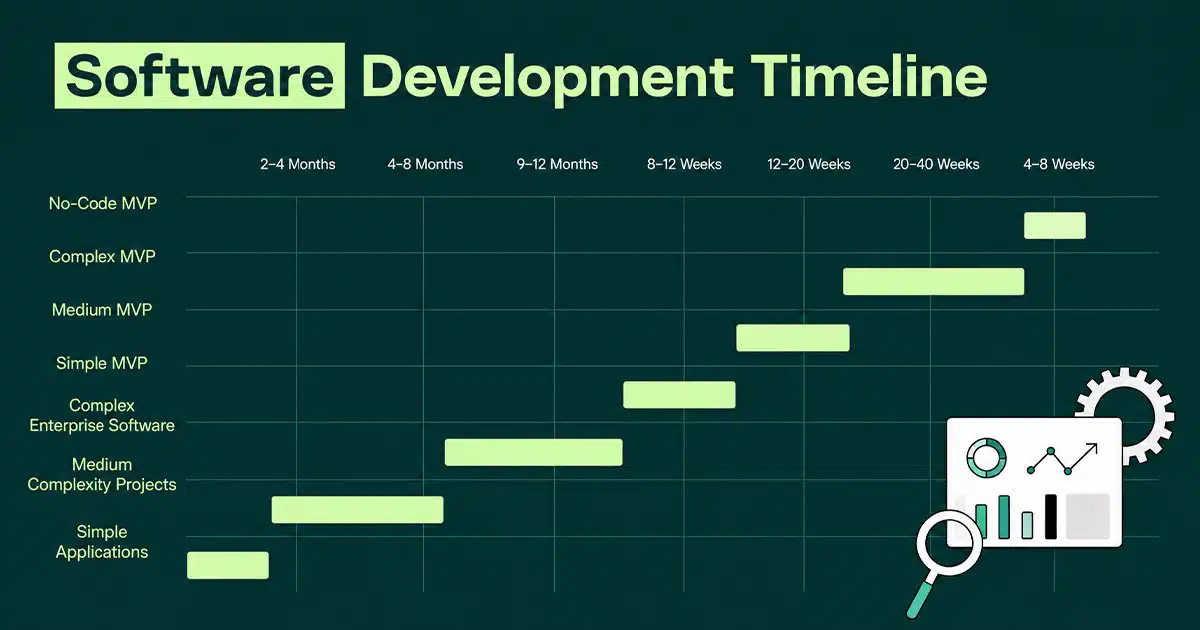
Project complexity determines how long your software development timeline will extend. Breaking down timelines by application type provides realistic expectations for project planning and resource allocation.
Simple Applications Timeline
Simple applications require 2-4 months from start to finish. These projects have basic utility tools, single-purpose applications, or straightforward mobile apps with limited screens and minimal backend requirements.
Your requirements and design phase consumes 2-4 weeks. This original stage has understanding your idea, creating wireframes, and getting stakeholder approval. Development follows with backend API creation taking 5-10 weeks and frontend work requiring another 4 weeks. Integration testing and bug fixes occupy the final week before launch.
Simple apps typically feature user authentication, basic CRUD operations, and standard UI components. Building for both iOS and Android adds 40-60% to your development timeline. React Native or Flutter reduces this overhead to 20-30%.
Medium Complexity Projects Timeline
Medium complexity projects stretch your software development timeline to 4-8 months. These applications incorporate user accounts, payment processing, and third-party API integrations.
The analysis phase extends to 1-2 weeks for detailed documentation. UI/UX and architecture design require 2-3 weeks as your team maps user journeys and technical planning. Development spans 6-8 weeks with features built in stages. Testing and optimization take another 2-3 weeks. You should expect around 3 months for completion overall.
Custom design adds 3-4 weeks to your project timeline. Each major integration increases duration by 2-3 weeks. Payment processing requires an additional 2 weeks. Real-time features like messaging extend timelines by 3-4 weeks. These additions combine to affect your whole development process substantially.
Complex Enterprise Software Timeline
Complex enterprise applications just need 7-12+ months for successful completion. Banking apps require 9-12 months. Social networks stretch to 12-18 months. Marketplace platforms need 10-15 months. Healthcare platforms with HIPAA compliance extend to 12-18 months.
Your project qualifies as complex when it has 25+ screens, both administrative and user applications, or supports multiple platforms. Integration with multiple systems like CRM or ERP increases complexity. Data migration from older systems adds substantial time.
Discovery and feasibility studies consume 1-2 months. Architecture and system design require another 1-2 months for adaptable. Development proceeds in phases over 4-8 months. Testing, security audits, and compliance verification run continuously throughout the development phase. The whole project typically spans 9-12 months.
MVP Development Timeline
MVP development service offers a faster path to market. Standard web or mobile MVPs take 3-6 months. The average MVP requires 4.5 months according to industry surveys.
Simple MVPs with focused feature sets complete in 8-12 weeks. These have 5-15 screens, single user roles, and minimal integrations. Discovery takes 1 week, design requires 1 week, development spans 4-6 weeks, testing occupies 1 week, and launch needs 1 week.
Medium complexity MVPs with multiple user roles and payment processing extend to 12-20 weeks. Complex enterprise MVPs with AI capabilities or regulatory compliance stretch to 20-40 weeks.
No-code MVPs launch in 4-8 weeks. Complex fintech or healthcare MVPs require 6-9 months once you factor in compliance reviews and security integrations.
Software Development Timeline At A Glance
| Project Type | Estimated Timeline | Key Characteristics |
|---|---|---|
| Simple Applications | 2–4 Months | Basic utility tools, single-purpose apps, limited screens, minimal backend |
| Medium Complexity Projects | 4–8 Months (Avg. 3–6 Core Build Months) | User accounts, payment processing, third-party API integrations |
| Complex Enterprise Software | 9–12+ Months (Up To 18+) | 25+ screens, admin + user panels, CRM/ERP integration, data migration |
| Simple MVP | 8–12 Weeks | 5–15 screens, single user role, minimal integrations |
| Medium MVP | 12–20 Weeks | Multiple user roles, payment integration |
| Complex MVP | 20–40 Weeks | AI features, regulatory requirements, enterprise integrations |
| No-Code MVP | 4–8 Weeks | Basic workflows, validation-focused builds |
Software Development Methodologies And Their Impact On Timelines
Choosing the right software development methodology shapes your development timeline more than any other factor. Each methodology brings distinct characteristics that accelerate or extend your project timeline based on how teams approach building software.
Agile And Scrum Methodology
Software developers realized traditional methods weren't working, and Agile emerged. They started mixing old and new ideas until they found combinations that worked. These methodologies emphasized close collaboration between development teams and business stakeholders, frequent delivery of business value, and smart ways to craft, confirm and deliver code.
Scrum is one of the most popular agile methodologies. Jeff Sutherland and Ken Schwaber developed Scrum during the early 1990s to respond to challenges of managing complex software projects. The framework helps teams organize work through values, principles and practices. Scrum encourages teams to learn through experience, self-organize while working on problems, and reflect on successes and failures to improve.
Waterfall Approach
The waterfall model performs typical software development life cycle phases in sequential order. Each phase is completed before the next starts, and the result of each phase drives subsequent phases. Waterfall is among the least iterative and flexible methodologies, as progress flows in one direction through conception, requirements analysis, design, construction, testing, deployment and maintenance.
Waterfall methodologies result in a project schedule with 20-40% of the time invested for the first two phases, 30-40% of the time to coding, and the rest dedicated to testing and implementation. Time spent early can reduce costs at later stages. A problem found early is cheaper to fix than the same bug found later by a factor of 50 to 200.
DevOps And Continuous Integration
Continuous integration is a DevOps software development practice where developers merge code changes into a central repository on a regular basis, after which automated builds and tests are run. The key goals of continuous integration are to find and address bugs quicker, improve software quality and reduce the time it takes to confirm and release new software updates.
Developers commit to a shared repository using a version control system with continuous integration. A continuous integration service builds and runs unit testing on new code changes to surface any errors right away. This helps your team be more productive by freeing developers from manual tasks and encouraging behaviors that reduce errors and bugs released to customers.
Hybrid Methodologies
Many organizations adopt hybrid approaches, combining elements from various methodologies to create customized software development processes. Flexibility and adaptability remain key considerations. The development towards hybrid software development methods addresses challenges that arise when single methodologies don't fit specific project needs.
Hybrid methodologies allow you to take the predictable planning of waterfall for certain phases while maintaining agile flexibility for others. Your project team can use waterfall for infrastructure setup and regulatory documentation while applying agile techniques for feature development. This combination provides structure where needed and speed where beneficial for your software development project.
Key Factors That Affect Your Development Timeline
A software development timeline rarely depends on one factor. Several variables shape how long your software development project takes. Clear awareness of these elements helps set realistic expectations, protect project scope, and support project success across the entire development process.
Team Size And Structure
Team size directly affects your development timeline. A study of 491 software projects found that teams with 3–7 members delivered the best outcomes. Groups of 5–9 developers reached peak productivity. Smaller teams reduce communication gaps and support faster decision making.
Large development teams often slow progress. More people increase coordination effort and project management overhead. Smaller agile teams move faster because fewer approval layers exist. Clear roles, skilled software developers, and strong collaboration help track progress and maintain software quality across every project phase.
Technology Stack Choice
Technology stack selection shapes the entire development process. Mature frameworks with strong ecosystems reduce time spent on basic setup. Teams that use familiar stacks work up to 40% faster compared to new or experimental tools.
A unified startup tech stack such as full JavaScript for frontend and backend reduces handoff delays. Strong documentation and community support speed up troubleshooting. Poor stack decisions increase technical debt and extend the development phase. The right technical architecture balances speed, scalability, and long-term maintainability for high quality software.
Third Party Integrations
Most software projects rely on third party integrations. Payment gateways, CRM systems, and analytics tools require API setup and testing. Each integration typically adds 1–2 weeks to your project timeline.
Research shows the average business uses over 300 SaaS applications. Without proper integration, data silos appear. Integration issues often surface late in the testing phase. That delay impacts the entire project. Careful planning, early API validation, and integration testing reduce timeline risks and protect software's reliability.
Regulatory And Compliance Needs
Regulated industries face longer development timelines. Finance, healthcare, and fintech projects must follow GDPR, HIPAA, or PCI standards. Security testing and compliance reviews can extend timelines by 20–35%.
Compliance requires documentation, audits, and continuous monitoring. Smaller companies struggle without dedicated compliance teams. Additional security testing, performance testing, and system testing increase workload. Risk management becomes critical. Regulatory demands affect resource allocation and can delay successful completion if not addressed early in the analysis phase.
Project Scope And Complexity
Project complexity strongly influences your software development timeline. Applications with 25+ screens, multiple user roles, and complex business logic require longer development stages. Data migration from existing systems adds more time.
Scope changes during the development phase create delays. Each added feature affects the project plan and resource allocation. Clear project requirements and defined project goals reduce uncertainty. Strong project management protects the entire project from unnecessary timeline extensions.
Testing And Quality Standards
Rigorous testing protects software quality but extends timelines. Unit testing, integration testing, system testing, security testing, and user acceptance testing all require structured effort. Skipping them risks failure after launch.
Regular code reviews improve software's reliability. Performance testing ensures software runs smoothly under load. Projects with strict quality benchmarks require more time in the testing process. However, this investment reduces bug fixes after release and supports long-term customer satisfaction.
Methodology And Workflow
Software development methodology influences pace and flexibility. Agile methodologies allow faster iterations and early user feedback. Agile techniques break work into manageable sprints and reduce risk.
Traditional models with rigid phases may slow adaptation. Rapid application development shortens cycles but requires experienced development teams. A structured development process with clear project planning and defined key phases improves alignment. Methodology choice affects the software's lifecycle and determines how efficiently teams move from analysis phase to maintenance phase.
How To Move From Development To Staging Environment
Staging environments bridge the gap between development and production in your software development timeline. This intermediate phase provides a safe testing ground where you can verify changes without risking your live application.
Stage Environment Setup
A staging environment is a test sandbox isolated from production. Your staging setup should be a near-perfect replica of your production environment. This means matching production hardware, operating systems, network configurations and resource allocation.
Infrastructure parity will give accurate testing conditions. Staging should use the same setup if production runs on AWS with specific instance types. Your configuration settings in staging arrange with production settings. The only differences should be endpoints and necessary safety measures.
Data management requires careful planning. Most teams use production data snapshots or realistic test data. You need enough volume and variety to test ground scenarios without exposing sensitive information. Many teams use data masking or synthetic data generation to achieve this balance.
Pre-Production Testing
Pre-production testing catches issues before they affect users. Alpha testing environments are used after integration testing for performance and quality assurance. This involves performing end-to-end tests in a lab or stage environment to analyze performance under various fabricated conditions.
Beta testing environments occur after alpha tests complete. This involves releasing software to select users for further feedback before full release into production environments. The goal is to get ground feedback and identify any issues before public release.
Performance And Load Testing
Load testing in staging environments presents unique challenges. No test lab can mirror the production environment completely. The purchase of duplicate production hardware for testing is too expensive and the process of cloning production data too cumbersome.
Testing environments are often nowhere near as large as production counterparts. Testing on a couple of white box servers with the same operating system and database versions does not mean the application will perform under ground loads.
Production Deployment And Launch Process
Moving your software to production requires careful execution. Your deployment strategy determines how new code reaches users and how quickly you can recover from issues.
Deployment Strategies
Blue/green deployment uses two similar production environments running different versions of your application. You deploy to the inactive environment, test it really well, and switch traffic over. This provides quick rollback by switching back to the original environment. The method maintains two environments at once and ensures no downtime. Seamless rollbacks happen should an incident occur.
Canary deployments reduce risk by releasing new versions to small user subsets first. As you gain confidence, you deploy the changes bit by bit to replace the current version in its entirety. Rolling deployments adopt a gradual rollout approach where changes expose to increasing user percentages bit by bit until fully released. This strategy reduces big-bang deployment risks since issues affect only user subsets at any given time.
Production Monitoring Setup
Application Performance Monitoring gives you a view into your application stack before issues affect users. APM monitors critical components like application dependencies and server resources. Key metrics include response time, error rate, and throughput.
Performance baselines help you spot anomalies early. Test everything really well to determine acceptable response times and error rates. Standardizing application names avoids confusion across environments. Tags such as application name and environment help with organization.
Rollback Planning
Around 70% of downtime is caused by system changes. A rollback plan documents your strategy for reverting software back to a previously known stable state when something goes wrong. Define trigger conditions including error log spikes, crash reports, or key metric drops.
Your rollback plan must include detailed step-by-step instructions for reverting changes. Assign specific names rather than teams for clarity during incidents. Establish clear rollback timeboxes for triggering decisions. Plan internal and external communications to alert stakeholders.
Common Timeline Challenges And How To Overcome Them
Development is rarely linear. Software projects encounter obstacles that extend your software development timeline beyond original estimates. Your development teams can maintain project success if they understand these challenges.
Scope Creep Management
Scope creep affects 52% of projects. This happens when features slip in without formal review and budgets balloon while timelines slide. Unclear project scope makes it simple for new features to enter unnoticed. Inadequate project planning and changing stakeholder requirements compound the problem.
You need written agreements detailing project requirements and deliverables. Designate a Product Owner to manage scope changes. Direct all changes through this owner who assesses the effect on your project timeline. Maintain regular communication with stakeholders about what scope changes mean.
Resource Constraints
Resource constraints affect 48% of projects by a lot. Limited skilled personnel, tight budgets and time limits create substantial hurdles. Insufficient resources lead to missed deadlines and project delays.
Conduct a full resource analysis during project planning. Promote T-shaped development teams with broad specialization. Use project management software to track utilization and identify bottlenecks.
Technical Debt
Technical shortcuts accumulate as messy codebases that slow future development. Teams rush delivery and create technical debt through poor code quality. This forces reactive firefighting instead of building new value.
Allocate time to refactor in each sprint. Track technical debt areas and plan resolution during less intense periods. Focus on regular code reviews to maintain cleaner codebases.
Communication Gaps
Poor communication costs companies $62.40 million on average each year. 86% of employees blame project failures on inadequate teamwork and poor communication. Misunderstandings between developers and stakeholders lead to rework and delays.
Establish clear communication channels from the start. Hold regular meetings to keep everyone arranged. Implement the Three Amigos approach with developer, tester and business analyst working together to clarify requirements.
How GainHQ Supports Your Software Development Timeline
GainHQ helps businesses plan and execute a realistic software development timeline from the start. The team begins with clear project planning, defined project requirements, and a structured project scope. That early clarity protects the entire development process and reduces scope changes later. Each software development project follows defined key phases so the development timeline stays aligned with business goals and realistic expectations.
An experienced project manager and skilled development teams track progress across every project phase. Strong resource allocation and risk management keep the software development process stable. Unit testing, integration testing, system testing, and user acceptance testing ensure high-quality software before release.
Agile methodologies, regular code reviews, and detailed documentation strengthen software quality and software reliability. GainHQ ensures software aligns with strategy while supporting long-term project success.
FAQs
Can a software development timeline change after the project starts?
Yes, a software development timeline can shift if project scope changes or new project requirements appear. Scope creep, third-party integrations, or regulatory updates often extend the development process. Strong project management and risk management reduce unexpected delays.
Is it possible to shorten a software development timeline without affecting software quality?
Yes, but only with careful resource allocation and the right software development methodology. Agile methodologies, rapid application development, and automated software testing can improve efficiency. Cutting core testing phase activities, however, will hurt software quality and software’s reliability.
Does remote collaboration affect the software development timeline?
Yes, remote development teams can impact the development timeline if communication gaps exist. Clear documentation, regular code reviews, and structured workflows keep the entire development process aligned. Modern tools help track progress across each project phase.
Can early user feedback reduce delays in a software development project?
Yes, early user feedback during development stages helps validate project goals and avoid costly rework. Feedback improves user interfaces and ensures software aligns with customer expectations. This reduces major revisions late in the testing phase.
How do budget constraints influence a typical software development timeline?
Budget limits directly affect team size, technology stack choice, and testing depth. Limited resources may extend the development phase or reduce feature scope. Clear project planning helps balance realistic expectations with successful project outcomes.