Refactor vs Rebuild: Decision Framework, Costs & Examples
by GainHQ Editorial Team | Feb 17, 2026 | Software Development Insights | Editorial policy
Table of Contents
- What Is Refactoring?
- What Is Rebuilding?
- Key Difference Of Refactor Vs Rebuild
- Refactor vs Rebuild: Side-by-Side Comparison
- Common Triggers: Signs Your Current System Needs Serious Attention
- Refactor vs Rebuild: A Simple Decision Framework
- Practical Migration Strategies
- Real-World Refactor vs Rebuild Case Studies
- Where Replatforming Fits Between Refactoring And Rebuilding
- How GainHQ Supports Teams Choosing Between Refactor And Rebuild
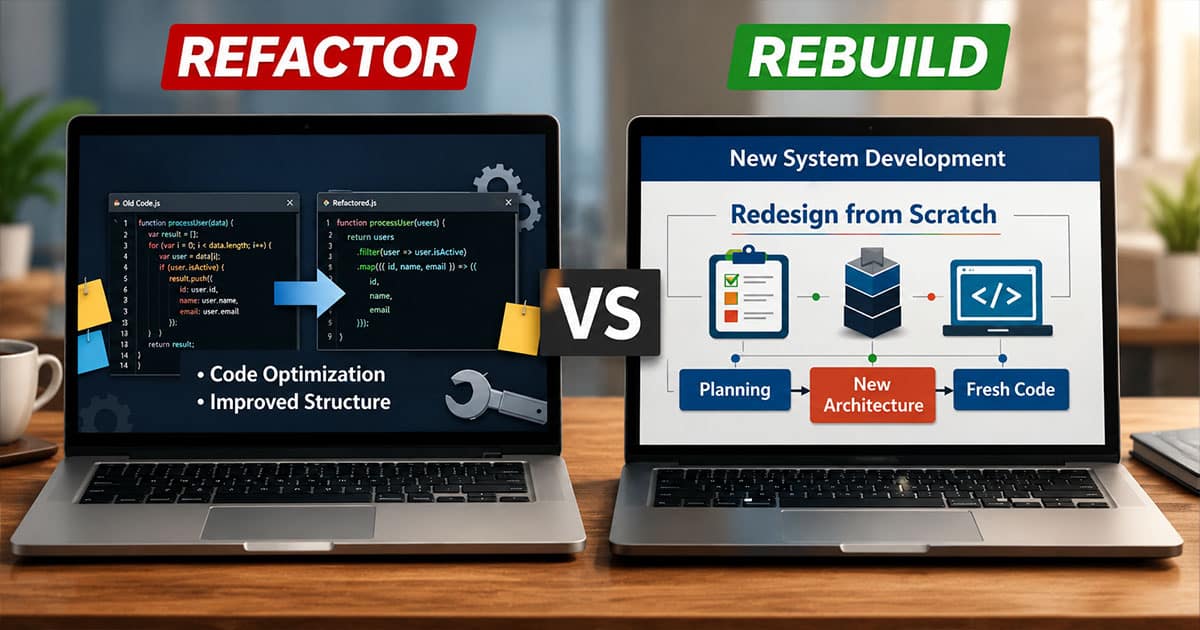
Refactor vs rebuild is a decision almost every digital product faces eventually. The software that once felt nimble starts to feel heavy. Features take longer to ship. Bugs appear in unexpected places. Your development team spends more time fighting the codebase than building new things.
When you reach this point, two paths emerge: refactor what you have, or rebuild from scratch. This decision shapes your roadmap, your budget, and your competitive position for years. Getting it wrong can cost months of engineering effort and real market opportunity.
Quick answer: Refactor when the core architecture is sound, the tech stack is still supported, and the problems are messy code rather than a broken design. Rebuild when the stack is end-of-life, the architecture cannot meet performance or scaling needs, or the business model has changed. Many teams do both, rebuilding one piece at a time with the strangler fig pattern.
This comprehensive guide walks through both options in plain language. You will learn when each approach makes sense, what trade offs are involved, and how to make a decision that aligns with your business goals.
What Is Refactoring?
Refactoring involves restructuring your existing code to improve internal qualities like readability, maintainability, and developer productivity without changing what the software actually does. Martin Fowler formalized this practice in his 1999 book, documenting over 70 specific refactoring techniques that teams still use today.
In practical terms, refactoring targets code smells such as duplicated logic, overly complex methods, or poorly organized code structure. A typical refactoring effort might touch 10 to 20 percent of the codebase in a given cycle, applying patterns like Extract Method to break down large functions or Replace Temporary Variable to clarify logic.
| Good Signs For Refactoring | Red Flags Even If You Choose Refactoring |
|---|---|
| Core architecture is sound, just messy | No existing test coverage to catch regressions |
| Technology stack is still supported | Original developers have all left with no documentation |
| Product-market fit is established | Performance problems are architectural, not code-level |
| Team knows the codebase well | Dependencies on deprecated third-party services |
| Continuous delivery pipeline exists | Business model is changing significantly |
Refactoring lets you keep shipping new features while you improve the system. Teams can reserve 10 to 30 percent of each sprint for cleanup, paying down debt in small steps instead of letting it pile up. The payoff is real: Stripe's Developer Coefficient report found developers spend 17.3 hours of a 41.1-hour week on maintenance work such as debugging and fixing bad code.
What Is Rebuilding?
Rebuilding means starting over with a new software system. You redesign the entire system, often choosing a different software architecture pattern such as microservices, a modular monolith, or serverless infrastructure. The existing code is largely set aside as you create new code that replaces it.
A rebuild typically replaces 80 percent or more of your codebase. The timeline stretches from 6 to 24 months for most established products. Teams leverage modern technologies like containerization with Docker and Kubernetes, or serverless architectures on platforms like AWS Lambda. These modern software architecture patterns enable horizontal scaling that older monolithic systems struggle to achieve.
| Strategic Upsides Of Rebuilding | Organizational Risks You Must Plan For |
|---|---|
| Clean slate for modern software architecture | Long delivery timelines, often 2-3x initial estimates |
| Better performance and scalability potential | Feature freeze or slowdown during transition |
| Freedom to choose optimal technology stack | Maintaining two systems simultaneously |
| Opportunity to eliminate all technical debt | Loss of embedded business logic in old code |
| Attract talent excited by modern tools | Team fatigue from extended rebuild projects |
Rebuilds often take longer than planned because teams underestimate how much business logic and institutional knowledge lives in the existing code. Edge cases that the old system handles quietly have to be found, documented, and rebuilt.
Key Difference Of Refactor Vs Rebuild
Refactor vs rebuild shapes software modernization strategies. Both approaches help teams develop stronger architectural design, improve performance, and manage complex systems, but each involves distinct risks, costs, and decision making priorities.
Scope Of Structural Change
Refactoring improves the internal design while keeping the current architecture. Engineers clean up code structure, remove duplication, and strengthen quality attributes such as maintainability and reliability. The changes happen inside the system, and its external behavior stays the same.
Rebuilding redesigns the architecture from the ground up. Teams build new systems with modern patterns that better support scalability, security, and operations. This becomes necessary when the existing system can no longer adapt to business demands, and it sets a cleaner foundation for future growth.
Risk And Stability Factors
Refactoring carries less risk because teams improve the system in small steps while it keeps running. Each change can be tested and measured right away, and plans can shift at any point without affecting the whole system. This keeps operations stable.
Rebuilding carries more uncertainty because it replaces the full system. Migration, integration, and compatibility problems can affect stability during the switch. Over the long run, though, a rebuild can lower risk by removing structural weaknesses the old design could not fix.
Cost And Resource Impact
Refactoring usually needs less upfront investment because it targets specific parts of the existing design. You can fund the work gradually, and teams can keep improving the system without disrupting daily operations.
Rebuilding needs significant upfront resources for new architecture, new technology, and extensive testing. The cost is high at first, but long term savings can come from better performance, lower maintenance, and freedom from legacy limits. The key is weighing immediate spend against future benefit.
Performance And Scalability Outcomes
Refactoring can improve performance by optimizing workflows, reducing system load, and cleaning up internal logic. It makes the system run more smoothly, but only within the limits of its current structure.
Rebuilding allows deeper performance gains by introducing a modern architecture. New systems can support distributed processing, cloud scaling, and more automation, which is hard to add to an older design.
Long Term Strategic Value
Refactoring offers strong long term value when the existing system still fits business goals. Steady improvements keep design quality high, reduce technical debt, and preserve the stability of what already works.
Rebuilding offers bigger strategic gains when the system has hit structural limits. A full redesign lets you adopt modern patterns, address scalability challenges, and improve performance significantly. The right choice balances these trade offs against the risks.
Refactor vs Rebuild: Side-by-Side Comparison
The following table compares refactoring and rebuilding across dimensions that matter most to decision-makers. These are concrete ranges that a CFO or COO can follow without deep technical background.
| Dimension | Refactoring | Rebuilding |
|---|---|---|
| Code Change Scope | Often touches 10-30% of codebase per cycle | Replaces 70-100% of codebase over project duration |
| Typical Timeline | 2-6 week cycles, with multi-month programs | 6-24 months for established products |
| Cost Profile | Lower upfront, 20-50% of rebuild cost | Higher upfront investment |
| Risk Level | Low to moderate, incremental approach | High risk with potential for significant failure |
| Customer Impact | Minimal disruption if done well | May require migration, retraining, or downtime |
| Architecture Impact | Preserves fundamental structure | Full redesign possible |
| Team Continuity | Works with existing knowledge | May require new skills in modern technologies |
| Feature Delivery | Continues alongside improvements | Often pauses or slows during transition |
Refactoring tends to win when your existing system has good bones and the problems are more about accumulated mess than fundamental organization. If your software architects can point to specific areas that need cleanup rather than systemic failures, refactoring is often the less risky path. It preserves business logic and institutional knowledge that can be impossible to recreate.
Rebuilding becomes unavoidable when the underlying technology stack has reached end-of-life, when the current system behavior cannot meet non functional requirements no matter how much you tune it, or when a strategic business pivot demands capabilities that the existing architecture cannot support. If your enterprise architects are saying that incremental changes will never get you where you need to go, it may be time for a complete rebuild.
The decision rarely feels obvious in the moment. Most situations involve trade offs where both options have merit. The next sections will help you think through triggers and frameworks for making this choice.
Common Triggers: Signs Your Current System Needs Serious Attention
Not sure yet how bad the problem is? Run a technical debt audit first to quantify risk and effort before committing to either path.
Problems with software systems rarely appear overnight. They accumulate over months or years, showing up first as business pain before anyone recognizes them as technical issues.
On the business side, you might notice that sales cycles are stretching longer because prospects ask for features that are difficult to add. Customer churn may increase due to reliability issues or a dated user experience. Support ticket volumes climb as users encounter more friction. These signals often precede any technical conversation about refactoring or rebuilding.
Technical indicators follow a pattern of their own. Release cycles that used to run weekly stretch to monthly or quarterly. Failed deployments become more common, and engineers start avoiding certain modules because making changes there tends to break other things. The software development life cycle gets slower and more painful with each passing quarter.
The financial picture tells part of the story too. Maintenance costs rise as more effort goes into keeping the lights on. Meanwhile, the opportunity cost grows because your team cannot ship the features that drive growth. When most of your engineering time goes to maintenance instead of new work, something has to change.
Warning signs that demand attention:
- Lead time for changes has doubled or tripled over the past year
- Engineers estimate simple features as complex because of ripple effects
- Third-party integrations break frequently due to brittle connection points
- Onboarding new developers takes months rather than weeks
- Performance issues appear that tuning and caching cannot solve
Any of these signs suggests your current system needs serious attention. The question is whether that attention should take the form of structured refactoring or a broader rebuild.
Refactor vs Rebuild: A Simple Decision Framework
When leadership teams need to make this decision, a simple framework helps structure the conversation. Consider these six factors and rate each as low, medium, or high for your situation.
Time Pressure: How urgently does the business need new capabilities? High pressure often favors refactoring because rebuilds take longer. Low pressure creates space for more ambitious changes.
Technical Debt Depth: Is the debt scattered across the codebase or built into the software architecture itself? Surface-level debt often responds to refactoring. Architectural debt may require rebuilding.
Strategic Change Level: How different will the product be in two years? Incremental evolution favors refactoring. Fundamental shifts in business requirements may justify rebuilding.
Team Expertise: Does your development team know the existing system deeply? Strong institutional knowledge makes refactoring more effective. If that knowledge has left with departed engineers, rebuilding might actually be easier.
Budget Availability: Can you fund a multi-year initiative or do you need quick wins? Constrained budgets usually favor refactoring. Larger investments can support either path.
Risk Tolerance: What happens if the project runs over time or fails to deliver? Low tolerance points toward incremental refactoring. Organizations willing to accept high risk for high reward might consider rebuilding.
| Profile | Typical Decision |
|---|---|
| Fast-moving startup with high growth pressure, limited budget | Refactor for speed while building new services in parallel |
| Established mid-market vendor with stable customers, modest technical debt | Structured refactoring program over 12-18 months |
| Enterprise with end-of-life technology and budget for transformation | Planned rebuild with strangler-fig migration approach |
| Company pivoting business model significantly | Rebuild focused on new business capabilities |
Many organizations find that a hybrid approach works best. The strangler-fig pattern, for instance, lets you build new services or modules around the legacy core while cutting pieces away over time. This gives you the benefits of rebuilding in critical areas while maintaining stability elsewhere.
Strategic thinking about this decision matters more than technical preferences. The right architectural solution depends on your business strategy, not just what software architects consider elegant.
Practical Migration Strategies
In real projects, the answer is rarely pure refactor or pure rebuild. Most teams use phased strategies that combine elements of both approaches over time.
The strangler fig pattern deserves special attention. Named after the strangler fig tree that slowly grows around its host, this approach builds new services or modules around your legacy software. As each new component proves stable, you route traffic to it and retire the matching piece of the old system. Martin Fowler popularized the pattern as a safer alternative to a big bang rewrite.
Another practical approach is to plan incremental refactors around specific business capabilities rather than working file by file. Focus on distinct functional areas like onboarding, billing, or reporting. Each capability becomes a self-contained modernization project. This approach gives you natural stopping points, clearer progress metrics, and the flexibility to adjust your strategy as you learn.
A sample 12-18 month roadmap might look like this:
Months 1-3: Build solid test coverage and characterization tests. Without this safety net, any major change carries a high risk of regressions.
Months 4-6: Refactor highest-pain modules that block feature delivery. Target the areas your development team complains about most.
Months 7-12: Begin rebuilding isolated components using domain driven design principles. Deploy new services alongside old ones using strangler-fig approach.
Months 13-18: Accelerate migration based on lessons learned. Retire legacy components as their replacements prove stable.
Practical guidelines for managing risk during modernization:
- Always maintain the ability to roll back quickly
- Avoid “big bang” cutover dates that force all-or-nothing commitments
- Keep one team focused on maintaining the existing system while others modernize
- Communicate progress in business value terms, not just technical metrics
The enterprise architecture team should stay closely involved throughout any migration. They can help ensure that architectural decisions align with long-term technology strategy and that architectural characteristics like fault tolerance and scalability receive appropriate attention.
Real-World Refactor vs Rebuild Case Studies
These three well-documented examples show when each path paid off. One company refactored a huge codebase in place, and two rebuilt their platforms to meet growth they could not handle before.
Company | Path | What They Did | Result |
|---|---|---|---|
Shopify | Refactor | Split a decade-old Rails monolith into business-domain components inside one codebase | Kept one deployment unit while making boundaries clear for 1,000+ developers |
Netflix | Rebuild | Rebuilt its platform as cloud-native microservices on AWS over seven years (2008 to 2016) | Streaming members grew eightfold and uptime approached four nines |
Walmart | Rebuild | Rebuilt its web and mobile commerce stack on the Akka platform | Web conversions up 20%, mobile orders up 98%, page load time down 36% |
Shopify: Refactoring A Monolith Into Components
Shopify runs one of the largest Ruby on Rails codebases in existence, built over more than a decade by over 1,000 developers. Instead of rewriting it or breaking it into microservices, the team chose a modular monolith. Starting in 2017, they reorganized about 6,000 Ruby classes into components based on business domains such as orders, shipping, and billing, and built a tool called Wedge to track and enforce boundaries. In their words, they wanted more modularity "without increasing the number of deployment units." Source: Shopify Engineering.
Lesson: If the architecture is basically sound and the stack is supported, a structured refactor can fix years of tangled code without the risk of a rewrite.
Netflix: Rebuilding For The Cloud
In August 2008, a major database corruption stopped Netflix from shipping DVDs for three days. The company decided to move to AWS, but it rejected a simple lift and shift. Netflix chose to rebuild "virtually all of our technology," moving from a monolithic app to hundreds of microservices and from a relational database to denormalized NoSQL. The move took seven years and finished in January 2016. By then streaming members had grown eightfold and availability was approaching four nines. Source: Netflix.
Lesson: A rebuild makes sense when the old architecture cannot support the scale the business needs, but plan for a multi-year timeline.
Walmart: Rebuilding The E-Commerce Stack
Walmart's legacy commerce backend was inflexible, relied on expensive dedicated hardware, and struggled with peak retail traffic as shopping moved to mobile. The team rebuilt its web and mobile stack on the Akka platform. Within four weeks of launch, web conversions rose 20%, mobile orders rose 98%, and page load time dropped 36%, according to the Akka customer story.
Lesson: When the platform itself limits revenue, a focused rebuild of the customer-facing stack can pay back quickly.
Where Replatforming Fits Between Refactoring And Rebuilding
Refactor versus rebuild is not always a two-way choice. Replatforming is the middle option: keep the application's core design and move it onto a newer platform, changing only what the move requires, such as a managed database or a different hosting model. It suits systems that are stable and valuable but run on aging infrastructure. It does not fix a poor architecture, so it is the wrong tool when the code itself is the problem. Many modernization projects combine approaches module by module: replatform the stable parts first to steady the foundation, then refactor or rebuild only the modules that hold the business back, such as billing or reporting. A phased plan like this spreads cost and risk over time and gives you evidence at each step. For the full comparison, see our guide to cloud migration versus replatforming.
How GainHQ Supports Teams Choosing Between Refactor And Rebuild
GainHQ is a software development agency with more than 15 years of experience and a team of 30+ engineers, designers, and product specialists. We have built and maintained 13+ products of our own, including Payrun, EasyDesk, and Gain.io, so we know what it takes to keep a codebase healthy over many years. When a client is stuck between refactoring and rebuilding, we start with a technical debt audit that maps the architecture, dependencies, test coverage, and the areas slowing delivery.
From there, we recommend the path that fits your goals and budget. That might be a structured refactoring program, a phased rebuild using the strangler fig pattern, or a mix of both. We also help teams plan related moves, such as replatforming versus rebuilding or a monolith to microservices migration, and design for changes and scalability from the start.