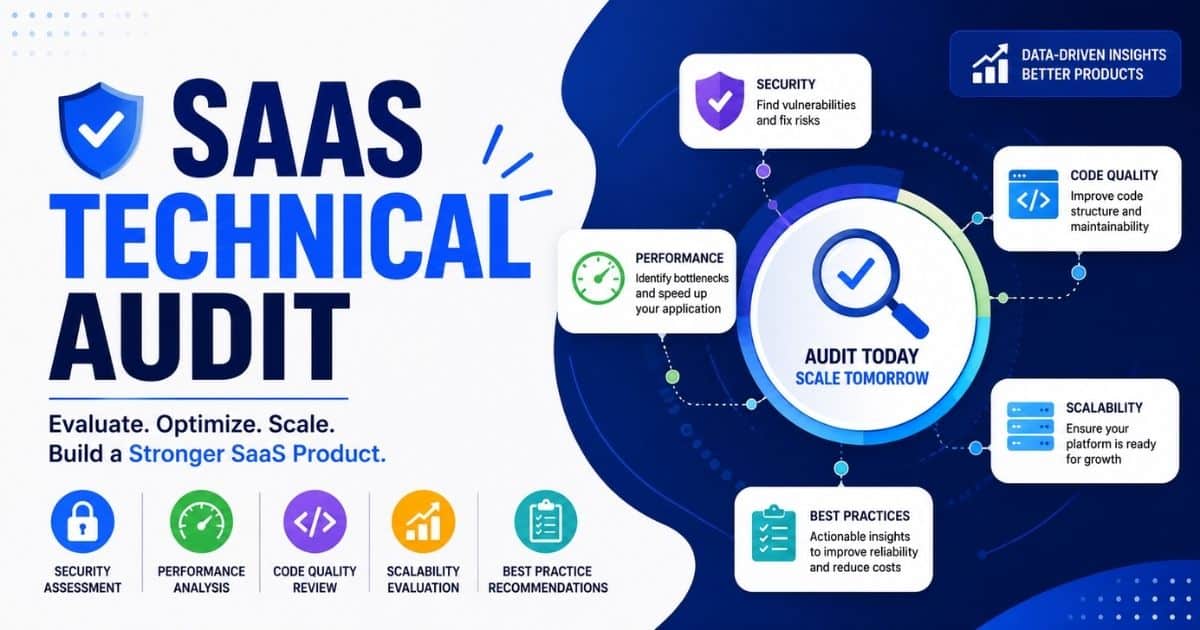
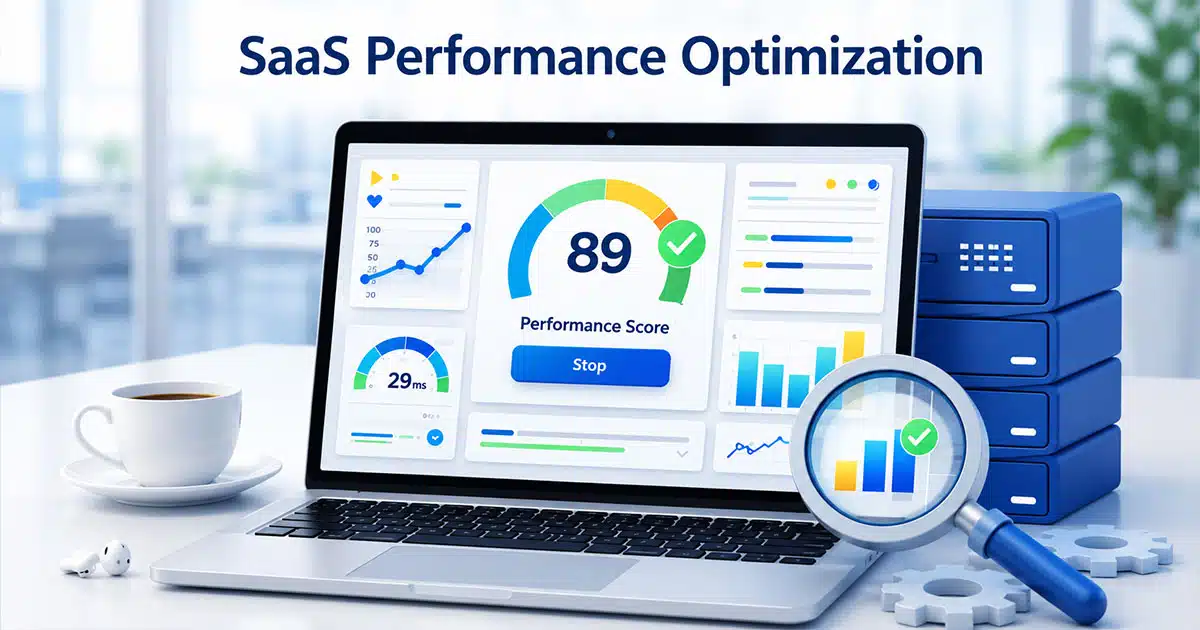
SaaS performance optimization has become a critical priority as user expectations continue to rise in 2026. Customers expect fast load times, seamless interactions, and consistent reliability across devices. Even minor performance issues can reduce engagement, increase churn, and negatively impact customer satisfaction. For SaaS businesses, performance no longer depends only on infrastructure. It now requires a strategic approach that combines system architecture, data handling, automation, and user experience optimization.
Modern SaaS platforms must focus on scalability, monitoring, and continuous improvement to stay competitive. Performance optimization also plays a direct role in operational efficiency, cost control, and long-term growth. By applying proven best practices, companies can deliver smoother experiences, support higher user volumes, and maintain stable performance while expanding their customer base.
What SaaS Performance Optimization Means
Saas optimization goes beyond fixing a slow page. It represents a continuous process of improving speed, stability, and scalability across your full tech stack. Frontend rendering, backend APIs, database efficiency, and third-party integrations all play a role in the user experience.
Consider a common scenario. Your internal CRM slows down every quarter end when sales teams run reports. Or your project management app stalls when teams upload large files. These performance issues compound over time, frustrating users and driving support tickets higher.
Performance affects trial-to-paid conversion, net revenue retention, and support volume. When saas tools feel fast and reliable, users complete workflows without friction. When they feel slow, users hesitate, abandon tasks, and eventually churn. Understanding this connection sets the foundation for everything that follows.
Why SaaS Performance Optimization Is Critical For Modern Teams
Small performance issues compound quickly. When hundreds of people run workflows every day, a 500ms delay on a common action wastes hours of collective productivity each week. These costs remain invisible until you measure them.
The User Experience Connection
Users form opinions about your product within seconds of interaction. Slow dashboards and unresponsive buttons signal low quality, regardless of your feature set. Superior performance creates user confidence that encourages deeper adoption and advocacy.
Response times under 200 milliseconds feel instant to most users. When your saas application performance hits this target for core actions, users flow through workflows without conscious awareness of the technology. This invisible excellence drives the satisfaction scores that predict retention.
Infrastructure Cost Efficiency
Performance optimization reduces infrastructure waste. Efficient queries and proper caching mean you need fewer servers to handle the same load. Teams report 30-50% cost savings by right-sizing resources and eliminating unnecessary compute.
Cloud bills on AWS, Azure, or GCP grow quickly without attention. Saas spend on infrastructure should scale with actual usage patterns, not with poor architectural choices. Optimization pays for itself through reduced operational costs.
Security And Compliance Considerations
Misconfigured services and overloaded nodes increase incident risk. When systems run at capacity, they become more vulnerable to cascading failures. Performance bottlenecks can extend breach windows by slowing incident response.
Data integrity depends on system reliability. Databases under stress may drop transactions or corrupt records. Protecting sensitive data requires maintaining headroom in your infrastructure.
Organizational Benefits
Happier users mean fewer escalations for your support team. When saas apps perform well, tickets shift from complaints about slowness to feature requests. This change frees your team to focus on growth instead of firefighting.
Release cycles become more predictable when performance is part of the culture. Teams that test performance before shipping catch regressions early. This practice reduces emergency hotfixes and weekend deployments.
The Competitive Advantage
Your competitors are optimizing too. Users compare your product against alternatives daily. Consistent performance becomes a differentiator that compounds over time as you build reputation for operational excellence.
Core Technical Pillars Of SaaS Performance Optimization
Effective optimization strategies address four practical areas: frontend, backend, database, and infrastructure. Each layer contributes to the overall experience users feel. Neglecting any one creates bottlenecks that limit your entire system.
The following sections provide practitioner-level tactics rather than abstract advice. Metrics include specific numeric ranges that mid-sized B2B teams can target. These recommendations apply to modern stacks using frameworks like React or Vue on the frontend, containerized services, and managed databases such as PostgreSQL or MySQL.
Frontend And Client-Side Performance
Users notice frontend delays first. Even when your backend APIs respond in 50ms, poor frontend rendering makes everything feel slow. Investing in client-side optimization delivers immediate, visible results.Bundling and asset optimization form your foundation. Code splitting reduces initial payload by loading only what users need for the current view. Tree shaking eliminates dead code from your bundles. Compressing assets and using HTTP/2 or HTTP/3 reduces blocking and improves parallel loading.
Content delivery networks cache static content geographically close to users. A modern CDN reduces first-byte time by 100-300 milliseconds for international users. This improvement matters especially for global teams with users across North America, Europe, and Asia. Perceived performance techniques help users feel speed even during necessary loading. Skeleton screens show structure immediately while data loads. Lazy loading defers non-critical content until users scroll. Prioritizing above-the-fold content ensures users see something useful within the first second.
Backend, API, And Service Performance
Backend performance is usually measured through P95 and P99 latency for critical endpoints. A target of 200ms at P95 means 95% of requests complete within that window. Tracking these percentiles reveals slowdowns that averages hide. Asynchronous processing handles heavy tasks without blocking user requests. Job queues and background workers process bulk imports, report generation, and notification delivery. Users receive quick confirmation while work completes behind the scenes.
Third-party API calls inside request flows introduce unpredictable latency. Limit synchronous external calls where possible. When you must call external services, implement timeouts, retries, and circuit breakers. These patterns prevent one slow dependency from cascading failures across your system. API design choices affect both server load and browser rendering time. Clear contracts and pagination prevent huge payloads that slow everything down. Returning 10,000 records when users need 50 wastes bandwidth and processing on both ends.
Database And Storage Optimization
Database queries are behind many slow screens and timeouts in saas products. Before scaling infrastructure, optimize what your database is doing. Inefficient queries account for 60-80% of performance bottlenecks in typical applications. Indexing strategies dramatically improve query speed. Adding proper indexes can cut query times by 90%. Query profiling identifies the slow operations that need attention. Avoiding N+1 query patterns in ORM usage prevents the database load that scales linearly with result sets.
Caching patterns reduce repeated work. Read-through caches serve frequently accessed data from memory instead of hitting the database. Redis yields 70-90% of reads from memory when properly configured. Short-lived caches work well for dashboard aggregates that tolerate slight staleness. Connection pooling reuses database connections, avoiding 20-50 milliseconds of overhead per new connection. Read replicas distribute query load across multiple instances. Partitioning and sharding become necessary as data volume grows beyond what a single primary instance can handle.
Infrastructure, Cloud, And Scalability
Cloud resources must be sized and managed to match real saas usage. Over-provisioning wastes money. Under-provisioning creates outages. Right-sizing requires continuous attention to actual traffic patterns. Horizontal scaling with containers or Kubernetes distributes load across multiple instances. Auto-scaling groups add capacity when utilization crosses thresholds, typically around 70%. Managed load balancers distribute traffic evenly, preventing single-server overloads.
Infrastructure as code makes performance-related changes repeatable and testable. Version-controlled configurations enable rollback when changes cause problems. This discipline prevents the configuration drift that causes mysterious performance degradation over time. Regional deployment strategies reduce latency for distributed user bases. Edge computing via CDNs processes requests closer to users. For global teams, multiple data centers ensure consistent performance regardless of where users connect from.
7 SaaS Performance Optimization Best Practices In 2026
SaaS performance optimization in 2026 demands deeper operational intelligence, not surface-level tweaks. Businesses must align infrastructure, usage behavior, and governance to maintain optimal performance while balancing costs, scalability, and long-term system resilience.
1. Build Performance Around Real Usage Behavior
Many saas solutions fail to reach optimal performance because teams optimize based on assumptions rather than real saas application usage. Studying user loads, session durations, and interaction patterns helps identify hidden performance characteristics. Monitoring performance data tied to peak activity windows reveals how different segments of users interact across saas ecosystems.
Teams that analyze usage behavior can adjust resource allocation dynamically. This approach prevents overprovisioning while ensuring consistent value during traffic spikes. Understanding how device capabilities influence response times also allows engineers to tailor experiences for diverse environments, which directly improves user satisfaction.
2. Prioritize Database Health As A Core Strategy
Database performance remains the backbone of system reliability. Slow queries, unoptimized indexing, and inefficient storage structures create bottlenecks that ripple across the entire saas ecosystem. Strong performance management requires continuous monitoring of database performance trends, not just periodic maintenance checks.
Organizations should also evaluate how data architecture supports evolving saas adoption. As systems scale, data models must accommodate growing performance data volumes without affecting responsiveness. Regular tuning and capacity forecasting help maintain optimal performance while preventing long-term degradation risks.
3. Embed Resilience Through Automated Recovery Systems
Unexpected disruptions can undermine optimal performance if recovery mechanisms are weak. Automated failover systems reduce downtime by rerouting workloads instantly when failures occur. Such systems strengthen performance management frameworks and ensure service continuity during infrastructure disruptions.
Resilience planning should extend across saas ecosystems to address risks like data breaches or hardware failures. Integrating automated workflows into recovery processes accelerates incident response while preserving operational stability. This proactive approach protects user satisfaction and supports uninterrupted business operations.
4. Manage SaaS Portfolio With Performance Governance
Uncontrolled saas portfolio expansion leads to fragmented systems and hidden performance risks. Strategic saas procurement must evaluate how new tools affect resource allocation and system compatibility. Monitoring saas licenses and usage helps identify redundant applications that drain capacity and increase saas costs.
Performance governance also requires visibility across the entire saas ecosystem. Businesses should regularly assess how integrated platforms interact and whether they contribute to consistent value. Rationalizing the portfolio strengthens performance management and prevents inefficiencies caused by overlapping saas solutions.
5. Align Development Process With Performance Objectives
Optimal performance cannot be achieved through post-deployment fixes alone. Teams must embed performance considerations into the development process from the earliest stages. Evaluating performance characteristics during design ensures that applications scale effectively as saas adoption grows.
Continuous testing should also examine how system behavior changes under varying user loads. Integrating performance monitoring into development workflows helps teams identify risks early and build more resilient saas ecosystems that sustain long-term operational efficiency.
6. Use Data-Driven Decision Making For Resource Allocation
Performance data provides critical insights for optimizing infrastructure investments. Tracking key performance indicators such as response time, throughput, and system availability allows leaders to make informed resource allocation decisions. Data-driven planning helps maintain optimal performance without excessive spending.
Analyzing trends in saas application usage also reveals which services require scaling and which can be consolidated. Strategic adjustments based on real metrics improve performance management and ensure that infrastructure supports evolving business demands.
7. Strengthen Security As A Performance Strategy
Security incidents directly impact performance by causing downtime and eroding user trust. Data breaches disrupt operations and introduce recovery overhead that affects optimal performance. Strong security frameworks must therefore be treated as integral components of performance management.
Protecting sensitive data across interconnected saas ecosystems ensures stable operations. Continuous monitoring, access controls, and compliance practices help maintain consistent value while safeguarding system reliability and long-term business resilience.
Performance Monitoring, Benchmarking, And SLAs
You cannot optimize what you do not measure. Performance monitoring must be continuous, not a periodic audit. Real user monitoring captures what customers actually experience, while synthetic monitoring tests specific scenarios consistently.
Key application metrics include request latency, error rate, saturation, uptime, and throughput. Practical targets for B2B saas applications include P95 latency under 200ms for critical APIs, error rates below 0.1%, and uptime of 99.9% or higher.
User experience metrics focus on what users perceive. Page load time, time to interactive, and task completion time for core workflows like project creation or approval flows. These metrics connect technical performance to business outcomes.
Establishing Baselines And Benchmarks
Capture a baseline over 30-60 days of normal traffic using existing monitoring tools. This baseline reveals your current state before optimization efforts begin. Without a baseline, you cannot prove improvements or detect regressions. Use that baseline to set performance budgets for pages, APIs, and key workflows. Define maximum acceptable latency for each critical path. These budgets become guardrails that prevent gradual degradation.
Compare internal metrics with public benchmarks for similar B2B saas products where possible. Industry standards recommend response times under 200ms and page loads under two seconds. These external references validate whether your targets are reasonable. Seasonal and event-based benchmarking accounts for predictable traffic patterns. Quarter-end reporting, annual planning cycles, and product launches create load spikes. Plan capacity for these events rather than being surprised by them.
Alerting, Incident Response, And Continuous Improvement
Design alerts that focus on user-impacting issues. Elevated error rates, slow logins, and rising queue times deserve immediate attention. Avoid alert fatigue by tuning thresholds to filter noise while catching real problems. Clear on-call rotations and escalation paths ensure rapid response when performance degrades. Runbooks document common scenarios and remediation steps. These processes reduce mean time to resolution and limit user impact.
Post-incident reviews focus on root causes and preventive changes rather than blame. Learning from failures improves system reliability over time. Document findings and track action items to completion. Track recurring performance incidents in a simple internal registry. Patterns emerge when you see the same service or dependency causing problems repeatedly. This registry helps prioritize architectural improvements.
How To Build Performance Into Product And Engineering Processes
Making performance a routine concern requires cultural change. One-off optimization projects deliver temporary gains. Sustainable performance comes from embedding practices into daily work.
Integrate performance tests into CI pipelines. Load tests for critical APIs should run before major releases. Automated performance testing catches regressions before they reach production.
Add performance acceptance criteria to user stories for large features. Response time targets for new dashboards create accountability during development. Design reviews should include performance considerations.
Optimizing For Real User Journeys
Map end-to-end flows like new customer onboarding or monthly reporting instead of tuning screens in isolation. Users experience journeys, not individual pages. Optimizing the complete path delivers better results than random improvements. Usage data reveals which paths users rely on most heavily. Prioritize optimization work on high-traffic journeys. A 10% improvement on a flow used daily matters more than a 50% improvement on something used monthly.
Session replay and structured event analytics show where users experience slowness or friction. These tools connect performance trends to specific user actions. Real world usage patterns often differ from what teams assume. Validate performance improvements with both metrics and qualitative user feedback. Numbers show improvement happened. Feedback confirms users noticed and valued the change.
Balancing Performance, Features, And Cost
Real budget constraints require trade-offs between perfect performance and sustainable cloud bills. Acknowledging these constraints enables honest planning and realistic expectations. Create a simple internal framework that weighs user impact, engineering effort, and cost before each major optimization. Not every improvement deserves investment. Prioritize work that moves business metrics.
Accepting slightly higher latency for noncritical operations keeps infrastructure lean. Background syncs and batch reports can tolerate delays that would frustrate interactive workflows. Different performance tiers for different use cases reduce complexity and cost. Periodic reviews of feature bloat and infrastructure waste keep your product focused and responsive. Removing unused features improves performance while simplifying maintenance. Data driven optimization decisions require ongoing attention to what your system actually does.
How GainHQ Helps Teams With SaaS Performance Optimization
GainHQ provides a saas management platform designed for teams who value speed and clarity in their operations. The platform consolidates visibility across your saas stack, helping you identify optimization opportunities before performance issues impact users.
Centralized dashboards aggregate performance metrics from multiple saas apps, benchmarking against industry standards. This visibility helps teams spot underperformers early and prioritize improvements based on business impact.
Automated alerting with custom thresholds notifies teams when degradations affect key workflows. Usage analytics identify low-adoption tools that consume resources without delivering value. This intelligence supports saas discovery and rationalization, freeing budget for performance upgrades where they matter most.
GainHQ helps teams control saas sprawl while maintaining operational efficiency. By connecting saas contracts, usage data, and cost insights in one place, the platform enables proactive scaling decisions aligned with business growth. Teams gain advanced analytics capabilities that transform raw data into actionable insights for controlling costs and optimizing performance.
Frequently Asked Questions
How Often Should A SaaS Team Review Performance Metrics?
Core metrics like latency, error rate, and uptime deserve daily attention through dashboards and alerts. Automated monitoring handles the continuous watching, so humans focus on anomalies and trends. A deeper monthly review analyzes performance trends and identifies emerging issues before they become critical. Quarterly reviews adjust benchmarks, update capacity plans, and align optimization priorities with business goals.
What Is A Reasonable Response Time Target For B2B SaaS Applications?
Most interactive B2B workflows feel smooth when critical API calls stay below 200-300ms at the P95 level. Users perceive responses under 100ms as instant. Above 500ms, delays become noticeable and frustrating. Full page loads for authenticated dashboards should stay under three seconds, with faster times for lightweight actions like modal opens or dropdown selections. First meaningful paint should happen within one second to maintain user productivity.
Do Small SaaS Teams Need Complex Performance Tooling?
Early-stage teams can start with built-in cloud metrics, simple uptime checks, and browser developer tools. These free or low-cost options provide essential visibility without overhead. Add more advanced APM and real user monitoring tools as traffic and complexity grow. The investment becomes worthwhile when debugging performance issues takes hours instead of minutes.
How Can Nontechnical Leaders Influence Performance Optimization?
Product and business leaders set expectations that shape engineering priorities. Including explicit performance requirements in roadmap discussions legitimizes optimization work alongside feature development. Protecting engineering time for technical debt reduction, refactoring, and architecture work prevents the slow degradation that accumulates without attention. Leaders who understand this trade-off enable sustainable performance.
When Is It Better To Refactor Versus Scale Infrastructure?
When profiling shows a small number of inefficient queries or algorithms causing problems, refactoring delivers better long-term value than adding servers. Fixing the root cause eliminates recurring costs and reduces complexity. Scaling infrastructure provides immediate relief for predictable seasonal spikes or sudden traffic increases. It buys time while you plan deeper fixes. However, scaling should not replace sound code and schema design.