
10 Best Practices Of SaaS architecture for Building A Secure Platforms
by Daniel Wright | Jan 13, 2026 | SaaS
Table of Contents
- What Is SaaS Architecture
- SaaS Architecture Patterns And When To Use Each One
- Key Components of SaaS Architecture
- SaaS Architecture Best Practices That Scale
- How SaaS Architecture Impacts Business Growth
- Single-Tenant vs Multi-Tenant SaaS Architecture
- Real SaaS Architecture Examples In Action
- Common SaaS Architecture Mistakes To Avoid
- How GainHQ Helps Businesses Build the Right SaaS Architecture
- FAQs
SaaS architecture is at the heart of every successful software-as-a-service product. It determines how well your SaaS app scales under pressure, how safely it handles sensitive data, and how efficiently it serves multiple customers without pushing SaaS costs out of control.
Behind every reliable SaaS platform lies an architectural foundation that quietly supports thousands, or even millions, of daily interactions. When done well, users never notice it. When done poorly, performance issues, outages, and security incidents quickly surface and stall business growth.
This guide breaks down SaaS architecture best practices, explains how different SaaS architecture models work, and highlights the key concepts SaaS architects should get right from day one to build scalable, secure, and sustainable platforms.
What Is SaaS Architecture
At a high level, SaaS architecture defines how a SaaS application is built, deployed, and delivered through the SaaS delivery model. Instead of running locally on user machines, the entire system operates on cloud infrastructure managed by a SaaS provider or cloud service provider.
This architectural approach allows a single SaaS platform to serve multiple customers while maintaining performance, security, and reliability. It also enables continuous updates, centralized management, and efficient use of computing resources across the entire system. SaaS providers can improve the product for all users at once without requiring manual installations or upgrades.
SaaS Architecture Patterns And When To Use Each One
Modern SaaS solutions rarely rely on one fixed structure. Understanding SaaS architecture means knowing how different patterns use cloud computing and cloud technologies to solve different problems at different stages of growth.
Monolithic Architecture
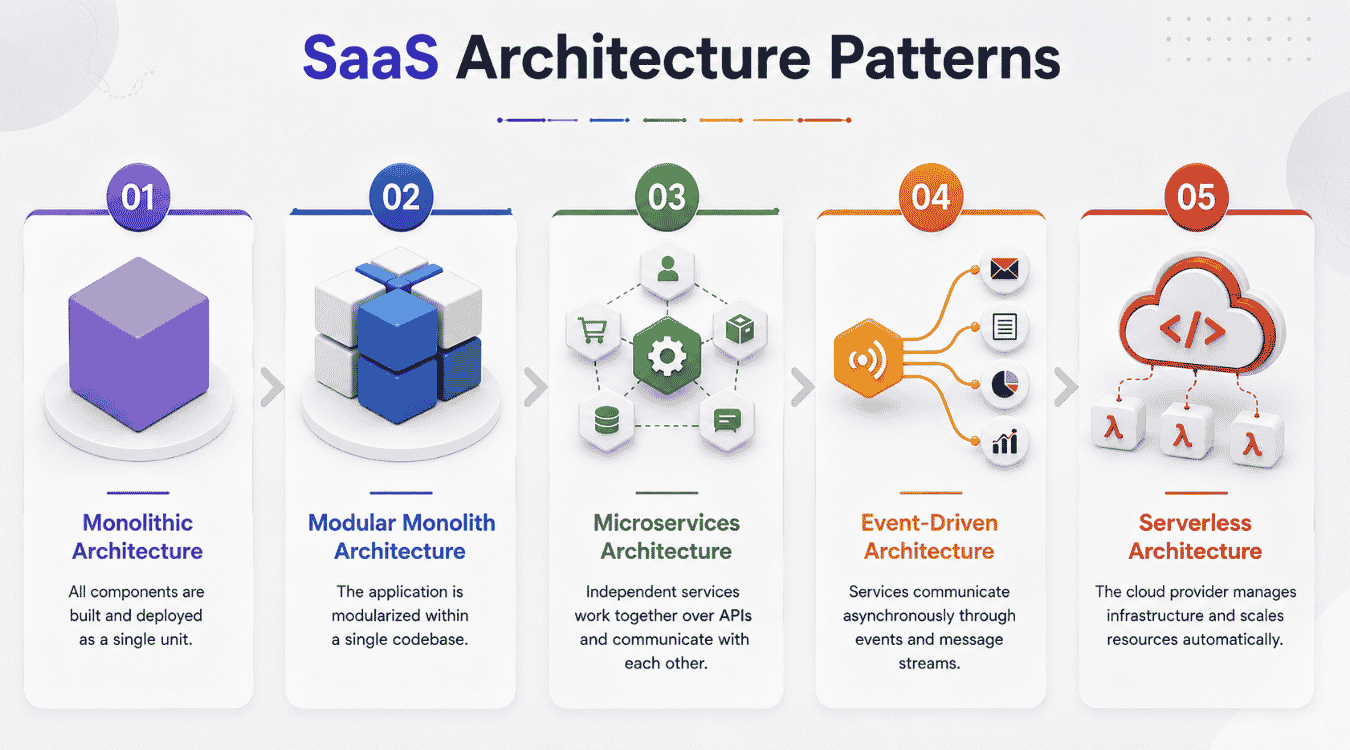
A monolithic architecture keeps the entire application in one codebase and deploys it as a single unit. Early-stage products often start here because it is simpler to build, test, and manage with a small team, especially when teams are still evaluating microservices vs monolith architecture.
As traffic grows, a single codebase can strain under load and slow down releases. Data integrity is easier to maintain in a monolith since everything shares one database, but that same structure limits how independently parts of the system can scale.
Modular Monolith Architecture
A modular monolith keeps a single deployable unit but organizes code into clearly separated internal modules. Teams get defined boundaries between features without taking on the network overhead that comes with running separate services.
This pattern works well for teams that want structure now and flexibility later. Using Infrastructure as Code to automate deployment processes keeps environments consistent as the codebase grows, making it easier to split modules into services down the line if needed.
Microservices Architecture
Microservices enhance agility and resilience by allowing independent scaling, updating, and deployment of small services. Each service owns its own logic and data, so a failure in one area does not take down the entire platform, making it one of several modern software architecture patterns for SaaS applications.
In 2026, microservices are the standard for handling complexity without risking full-system failure, especially for SaaS products supporting many tenants with different usage patterns. The tradeoff is added operational work across deployment, monitoring, and service coordination.
Event-Driven Architecture
Event-driven architecture allows asynchronous processing, enabling systems to react to events without blocking critical workflows. Instead of services calling each other directly, actions trigger events that other parts of the system pick up independently, which is especially powerful when combined with a deliberate API integration strategy for scalable business systems.
This pattern suits SaaS platforms with unpredictable or bursty activity, like notifications, billing updates, or usage tracking. It reduces tight coupling between services and keeps the system responsive even when individual components are under heavy load.
Serverless Architecture
Serverless architecture removes the need to manage servers directly, letting cloud providers handle provisioning and scaling automatically. Automated auto-scaling uses defined cloud-native rules to manage resource allocation dynamically based on traffic changes and fits into broader SaaS infrastructure.
This makes serverless a strong fit for spiky, unpredictable workloads such as scheduled jobs, webhook processing, or short-lived background tasks. Teams pay only for what they use, though cold starts and vendor constraints still need to be factored in.
How To Choose The Right Architecture Pattern
Choosing the right pattern depends on team size, compliance needs, and expected traffic rather than trends. Automating deployment processes improves accuracy and reduces human error, which matters regardless of which pattern a team picks, and benefits from principles of scalable software architecture.
Automated systems improve accuracy, reduce deployment times, and minimize human error, enabling rapid onboarding and consistent environment updates. Teams should map out growth expectations for the next 12 to 24 months before locking into a pattern that is hard to reverse later.
Key Components of SaaS Architecture
A well-structured SaaS architecture is built on several core components that work together to ensure scalability, reliability, and security. Weakness in any one area can ripple across the entire system and affect user experience, cost, and stability.
Cloud Infrastructure and Scaling
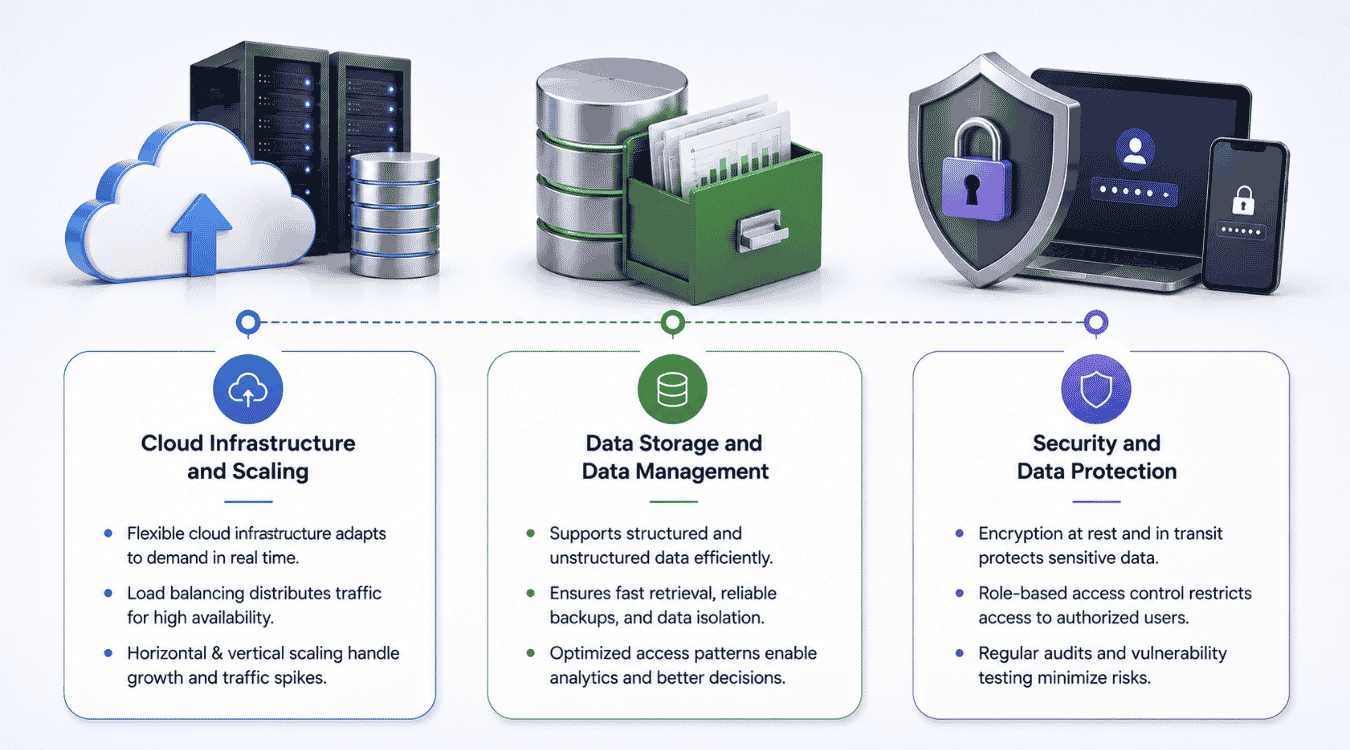
A scalable SaaS architecture depends on a flexible cloud infrastructure that can respond to changing demand. SaaS platforms typically rely on cloud service providers such as AWS, Google Cloud, or Oracle Cloud Infrastructure to dynamically allocate computing resources, following broader SaaS scalability strategies.
Load balancing distributes incoming traffic across multiple services or instances to prevent overload. Horizontal scaling allows the system to add or remove instances based on demand, while vertical scaling increases the capacity of existing resources when needed. Both approaches play a role, but horizontal scaling is especially important for handling unpredictable traffic spikes without downtime.
Continuous monitoring of key metrics such as CPU usage, memory consumption, error rates, and request latency allows teams to optimize performance proactively. Without visibility into these metrics, scaling decisions become reactive and costly.
Data Storage and Data Management
Data management sits at the core of SaaS solution architecture. SaaS applications often handle a mix of structured data, such as user records and transactions, and unstructured data, such as documents, logs, or media files.
Relational databases are commonly used for structured data that requires strong consistency and integrity, while object storage systems support large volumes of unstructured data. The challenge is designing data storage in a way that supports fast data retrieval, reliable backups, and clear data isolation across tenants.
Effective architectures implement regular backup strategies, validation checks, and consistency controls to protect against data loss. Optimized data access patterns reduce latency and prevent unnecessary load on the system.
Strong data management also enables analytics tools that help teams understand user behavior, feature adoption, and system usage patterns, which are essential for product improvement and business decision-making.
Security and Data Protection
Security must be embedded into SaaS architecture design from the beginning. Retrofitting security after launch is expensive and often incomplete, so teams should align with proven SaaS security architecture best practices.
Protecting sensitive data requires multiple layers of defense. Data encryption at rest and in transit prevents unauthorized access even if systems are compromised. Role-based access control ensures users and services access only to what they are permitted to see. Clear access management rules across internal services and third-party integrations reduce accidental exposure.
Regular security audits, vulnerability testing, and access reviews help identify risks before they escalate. SaaS platforms that overlook these fundamentals often struggle to recover trust after a security incident or data breach.
SaaS Architecture Best Practices That Scale
Scalable SaaS architecture is built through deliberate decisions that balance growth, performance, security, and cost. These best practices help SaaS teams design systems that support increasing demand, evolving user needs, and long-term business goals without creating unnecessary complexity or technical debt.
1. Design for Multi-Tenancy Early
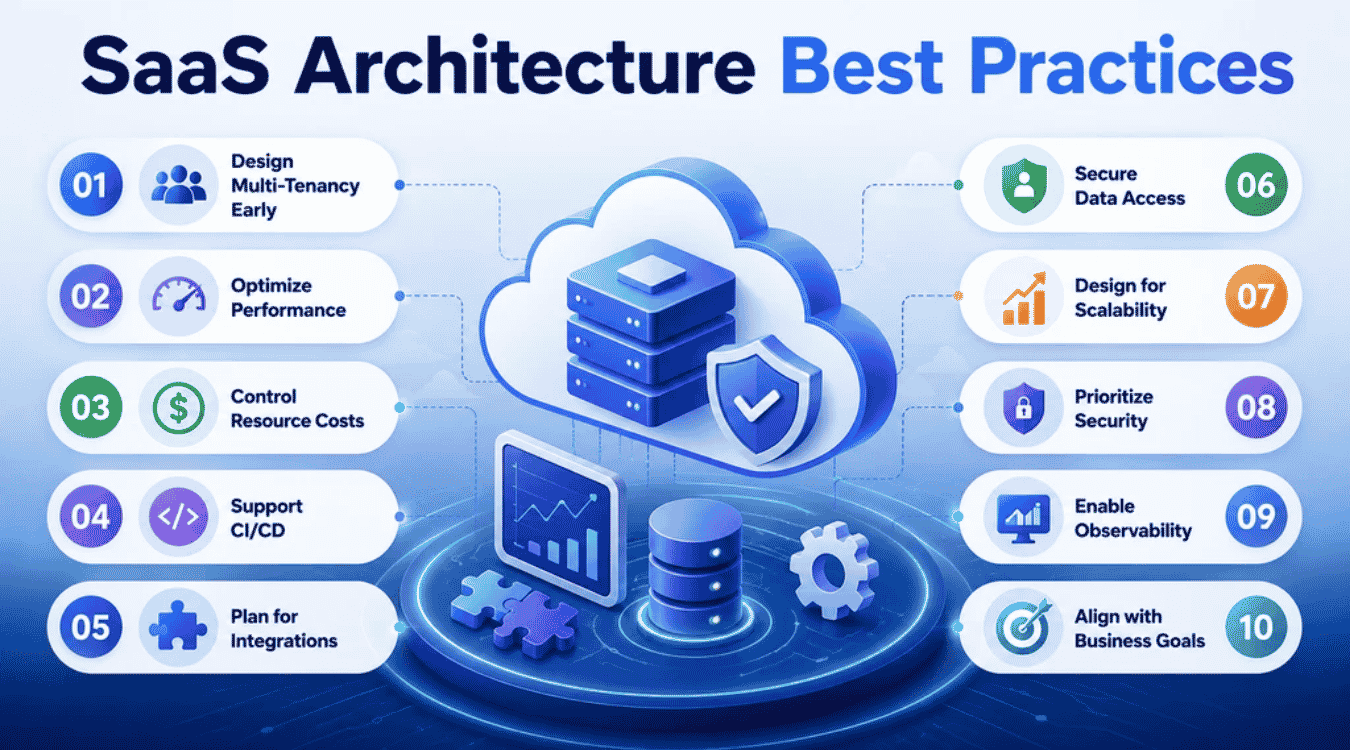
Designing multi-tenant SaaS architecture from the beginning sets a strong foundation for growth. Even if early customers are small or limited in number, multi-tenancy influences how data models, authentication, authorization, and deployment workflows are structured. Planning early allows teams to build shared services that safely support multiple tenants while maintaining proper data isolation and access control.
The benefit of early multi-tenancy design is long-term flexibility. It enables consistent onboarding, centralized updates, and efficient resource utilization as the customer base expands. Teams avoid costly rewrites that often occur when a single-tenant system must be retrofitted for multiple customers. Multi-tenancy also improves cost efficiency by sharing infrastructure across users while still delivering reliable performance. Over time, this approach supports predictable scaling and smoother feature rollouts without disrupting existing customers.
2. Optimize Performance Without Overengineering
Performance optimization should focus on real usage patterns rather than hypothetical edge cases. Many SaaS performance issues stem from uneven workload distribution instead of insufficient computing resources. Practical techniques such as load balancing, caching, connection pooling, and asynchronous processing solve most performance challenges without introducing unnecessary complexity, especially when paired with broader SaaS performance optimization best practices.
The key benefit of this approach is stability without fragility. By avoiding overengineered solutions, teams keep the system easier to maintain and debug. Monitoring key metrics like response time, request volume, and error rates provides clear insight into how the system behaves under real-world conditions. This allows teams to optimize only where it matters most. A balanced performance strategy improves user experience, reduces infrastructure waste, and ensures the platform can handle growth without becoming difficult to operate or evolve.
3. Control Resource Usage and SaaS Costs
In multi-tenant environments, inefficient resource usage can quietly increase SaaS costs if it is not actively monitored. Features that appear inexpensive at low volume may consume significant computing resources as usage grows. Tracking resource consumption by tenant, feature, and workload helps teams understand where infrastructure spend originates.
The primary benefit of this practice is financial predictability. Clear visibility into CPU usage, memory consumption, and storage costs allows teams to make informed scaling and pricing decisions. It also helps identify inefficient queries, background jobs, or services that require optimization. Over time, better resource control supports fair pricing models, healthier margins, and fewer surprises as the platform scales. Cost awareness becomes a strategic advantage rather than a reactive concern.
4. Support Continuous Integration and Deployment
Continuous integration and continuous deployment (CI/CD) are essential for modern SaaS development. Automated build pipelines, testing frameworks, and deployment workflows allow teams to ship updates frequently without increasing risk. This approach ensures that new features, bug fixes, and improvements reach users quickly and safely and works best when combined with strong software observability for SaaS teams.
The benefit of strong CI/CD practices is reduced operational friction. Automated testing catches issues early, while staged rollouts and feature flags limit the impact of changes on multiple users. Isolating services and enforcing clear boundaries ensures that failures in one area do not cascade across the entire system. Over time, CI/CD improves developer velocity, platform reliability, and customer trust by delivering consistent improvements without disrupting the user experience.
5. Plan for Integrations and Expansion
Most SaaS platforms expand beyond their original scope as customer needs to evolve. Third-party integrations, analytics tools, payment providers, and external services often become essential. Planning for integrations early ensures the architecture can support new capabilities without major redesigns and is strengthened by robust SaaS monitoring tools.
The benefit of this practice is adaptability. A flexible SaaS platform architecture allows teams to add reporting features, project management tools, or AI-driven services without tightly coupling systems together. Clear APIs, event-driven communication, and well-defined service boundaries reduce technical debt and simplify future expansion. Over time, this flexibility helps the platform remain competitive as market expectations change, while avoiding brittle integrations that slow development.
6. Build Strong Data Isolation and Access Control
Data isolation is critical in any SaaS architecture that supports multiple tenants. Even when infrastructure is shared, tenant data must remain logically separated and protected from unauthorized access. Clear access control policies, tenant-aware queries, and scoped permissions help enforce these boundaries.
The benefit of strong data isolation is trust. Customers expect their sensitive data to remain private and secure regardless of how many other users share the platform. Proper access control reduces the risk of data leaks, accidental exposure, and compliance violations. It also simplifies audits and incident responses by making data ownership and access paths explicit. Over time, strong data isolation supports regulatory requirements and reinforces confidence in the SaaS provider's ability to safeguard customer information.
7. Design for Horizontal and Vertical Scaling
Scalable SaaS architecture must support both horizontal and vertical scaling. Horizontal scaling allows the system to add more instances to handle increased load, while vertical scaling increases the capacity of individual resources. Designing for both ensures flexibility as usage patterns change and should align with foundational SaaS infrastructure components, architecture and best practices.
The benefit of this approach is resilience. Horizontal scaling helps absorb traffic spikes without downtime, while vertical scaling supports workloads that require more memory or processing power. Combined with load balancing and autoscaling policies, this strategy allows the platform to grow smoothly without performance degradation. Over time, scaling flexibility ensures the system can support business growth, seasonal demand, and new customer segments without constant architectural changes.
8. Prioritize Security as a Core Architectural Concern
Security should be embedded into SaaS architecture design rather than treated as an afterthought. Protecting sensitive data requires layered defenses, including data encryption, secure access policies, network controls, and regular security audits.
The benefit of prioritizing security early is reducing risk and faster response. Strong security foundations lower the likelihood of data breaches and limit their impact if they occur. Clear access management policies simplify compliance efforts and protect integrations with third party services. Over time, security-first architecture builds customer confidence and protects the brand from reputational damage that can be difficult to recover from after an incident.
9. Design for Observability and Monitoring
A scalable SaaS platform must be observable. Logging, metrics, and tracing provide visibility into how the system behaves across services, tenants, and regions. Without this insight, diagnosing issues becomes slow and reactive, which is why many teams run periodic SaaS technical audits to improve security, performance and scale.
The benefit of strong observability is operational clarity. Monitoring key metrics such as latency, error rates, and resource usage helps teams detect issues before users are affected. Logs and traces make it easier to debug failures and understand user behavior across workflows. Over time, observability supports proactive optimization, faster incident resolution, and better capacity planning as the platform grows.
10. Keep Architecture Aligned with Business Goals
SaaS architecture should evolve alongside the business, not independently of it. Architectural decisions that ignore product strategy, pricing models, or user needs often create friction later. Regular reviews help ensure the system continues to support business priorities.
The benefit of alignment is long-term sustainability. When architecture supports how the product is sold, used, and expanded, teams can move faster with fewer compromises. This reduces technical debt and keeps development focused on delivering value rather than fixing structural issues. Over time, architecture becomes a strategic asset that enables growth, innovation, and competitive differentiation instead of limiting them.
How SaaS Architecture Impacts Business Growth
SaaS architecture plays a critical role in how a business grows, competes, and adapts over time. The right architectural choices influence cost control, customer experience, delivery speed, and long-term scalability, directly shaping a SaaS company's ability to grow sustainably.
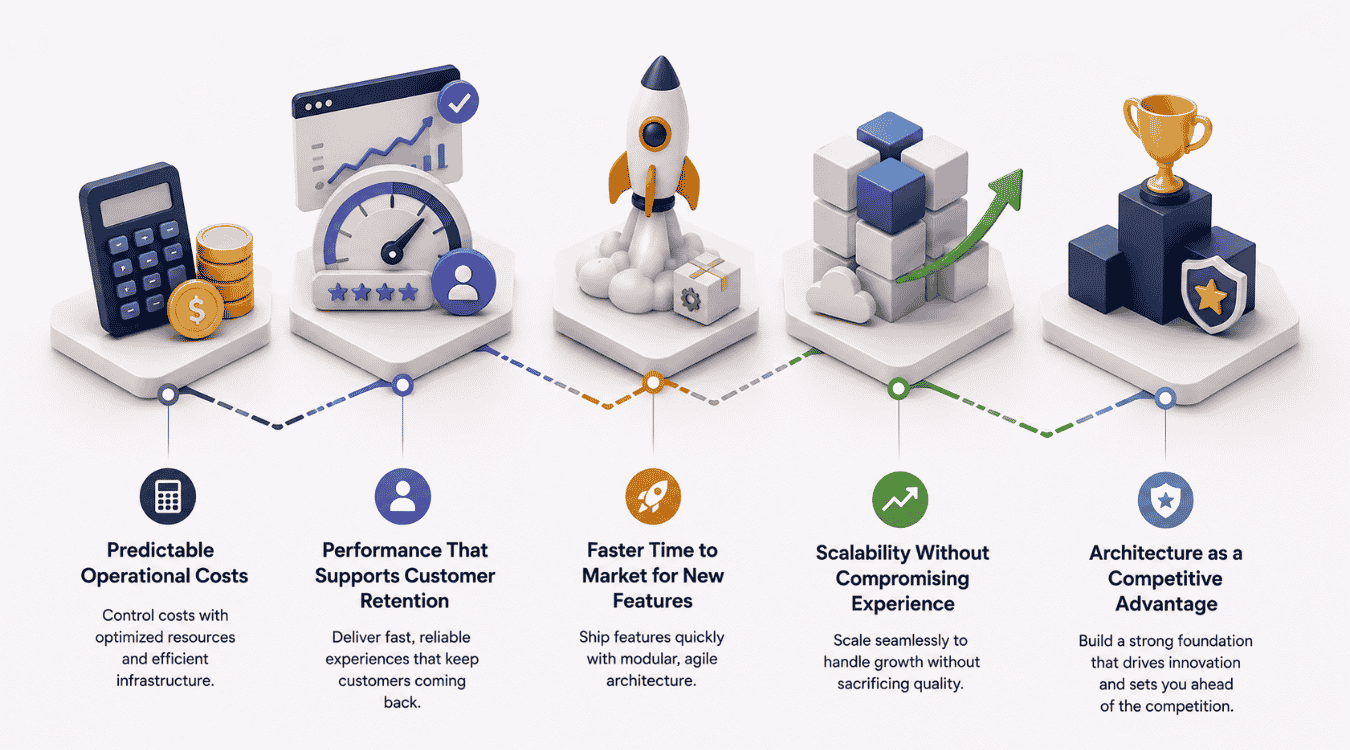
Predictable Operational Costs
Efficient architecture helps keep operational costs stable as usage grows. Shared infrastructure, automated scaling, and proactive monitoring reduce unexpected spikes in cloud spend and support predictable financial planning. Beyond cost savings, this predictability allows SaaS businesses to align infrastructure decisions with pricing models and revenue forecasts. Teams can confidently plan growth initiatives, allocate budgets for new features, and avoid last-minute cost optimizations driven by infrastructure pressure. Over time, predictable costs reduce financial risk and give leadership better visibility into margins, making it easier to scale without sacrificing profitability or stability.
Performance That Supports Customer Retention
Consistent performance builds trust. Fast load times, reliable availability, and smooth interactions directly affect user satisfaction and retention. Architecture that prioritizes reliability protects long-term revenue. When users experience frequent slowdowns or downtime, confidence in the product erodes quickly, regardless of feature quality. Strong architectural choices such as load balancing, fault tolerance, and performance monitoring help ensure consistent experiences across all tenants. This reliability reduces churn, increases product adoption, and strengthens customer relationships, turning performance into a quiet but powerful driver of retention and lifetime value.
Faster Time to Market for New Features
Modular design and strong deployment pipelines allow teams to ship improvements faster. Shorter release cycles help SaaS providers respond quickly to customer feedback and competitive pressure. Architecture that supports independent services, automated testing, and safe rollbacks reduces the fear of breaking existing functionality. As a result, teams can experiment, iterate, and refine features with confidence. Faster delivery keeps the product aligned with evolving user needs and market expectations. Over time, this agility becomes a growth engine, helping SaaS businesses stay relevant and continuously improve without slowing down development.
Scalability Without Compromising Experience
Scalable architecture ensures growth does not degrade user experience. Efficient data access, horizontal scaling, and thoughtful tenancy design allow platforms to grow without slowing down. As customer volume increases, poorly designed systems often introduce latency, errors, or uneven performance across users. A scalable foundation prevents these issues by distributing load intelligently and isolating resource-heavy workloads. This consistency reassures customers that the platform can grow alongside their own businesses. Maintaining a high-quality experience during growth strengthens brand reputation and reduces friction during onboarding, expansion, and long-term usage.
Architecture as a Competitive Advantage
The most successful SaaS providers are not those with the most complex systems, but those whose architecture aligns with product strategy and user needs. Over time, this alignment becomes a durable competitive advantage. Well-aligned architecture enables faster innovation, easier scaling, and lower operational friction compared to competitors with rigid systems. It also allows teams to adapt to market shifts, new pricing models, or emerging technologies without major disruption. As competitors struggle with technical limitations, strong architecture quietly supports differentiation, resilience, and sustained global business growth in an increasingly crowded SaaS market.
Single-Tenant vs Multi-Tenant SaaS Architecture
One of the most important SaaS architecture decisions is choosing between single-tenant architecture and multi-tenant SaaS architecture. How SaaS architecture differs at this level directly affects cost structure, scalability limits, security models, and operational complexity. This decision is rarely reversible without significant effort. Many early-stage SaaS products struggle later because tenancy was treated as an implementation detail rather than a strategic choice.
Feature | Single-Tenant Architecture | Multi-Tenant SaaS Architecture |
|---|---|---|
Infrastructure | Dedicated infrastructure for each customer | Shared infrastructure across multiple customers |
Application Instance | Separate application instance per tenant | One application instance serves multiple tenants |
Data Isolation | Physical or infrastructure-level isolation | Logical data isolation within shared infrastructure |
Security | Greater customization and isolation for security requirements | Strong security through tenant isolation and access controls |
Performance | Consistent performance with no noisy neighbor risk | Performance depends on efficient resource management |
Scalability | Scaling requires adding resources for each tenant | Scales efficiently by sharing infrastructure |
Resource Utilization | Lower efficiency due to dedicated resources | High efficiency through shared resource pools |
Cost Structure | Higher infrastructure and maintenance costs | Lower operational cost per customer |
Customization | Extensive customer-specific customization | Limited customization to maintain shared architecture |
Maintenance | Updates and patches applied separately for each tenant | Single deployment updates all tenants |
Operational Complexity | More environments to manage and maintain | Centralized operations simplify management |
Best For | Enterprises, regulated industries, and organizations with strict compliance needs | SaaS startups, SMB-focused products, and rapidly growing SaaS platforms |
Single Tenant Architecture
Single-tenant architecture provides each customer with a dedicated SaaS environment, including separate computing resources and data storage. Each customer effectively runs their own instance of the SaaS application, isolated from others at the infrastructure level.
This model prioritizes control, security, and predictable system performance. Because nothing is shared, customers are insulated from noisy neighbors and can receive custom configurations tailored to their needs. For organizations with strict compliance requirements or highly variable workloads, this isolation can be critical.
Key characteristics of single-tenant architecture include:
- Dedicated infrastructure per customer
- Strong data isolation and access control
- Predictable system performance
- Higher resource usage and operational costs
- Slower rollout of updates and new features
Multi-Tenant SaaS Architecture
Multi-tenant SaaS architecture allows multiple customers to share the same SaaS infrastructure while keeping their data logically isolated. This is the most common model for modern SaaS software because it enables scale without linear cost growth.
In a multi-tenant architecture, a single application instance serves multiple tenants. Computing resources are pooled, updates are deployed once for all users, and operational tasks are centralized. This approach dramatically improves cost efficiency and makes it easier to support rapid business growth.
Key characteristics of multi-tenant SaaS architecture include:
- Shared infrastructure across multiple tenants
- Lower SaaS costs per customer
- Efficient resource utilization
- Easier deployment of new features
- Requires careful data isolation and performance safeguards
Real SaaS Architecture Examples In Action
Best practices are easier to trust when you can see them in production. Two widely documented examples show how these principles play out at scale.
Netflix: Microservices At Massive Scale
Netflix ran as a monolith until a 2008 database outage took the site down for hours. That incident kicked off a multi-year migration to microservices, and Netflix now runs on an architecture broken into hundreds of independently deployable services, widely reported at 700 or more. Each service owns its own data and can be scaled, deployed, and rolled back independently, which is why a single bad deploy no longer takes down the whole platform. The lesson for smaller SaaS teams isn't "adopt microservices," it's the sequencing: Netflix decomposed reactively, after outages exposed monolith limits, not preemptively.
Slack: Cellular Architecture For Blast-Radius Containment
Slack's own engineering team documented its move to a cellular architecture, splitting core services into independent, self-contained cells so that a failure or overload in one cell cannot cascade into every customer's workspace at once. Instead of one shared pool of infrastructure serving all tenants, traffic is partitioned into cells, each capped at a fixed size. If a cell degrades, only the tenants assigned to it are affected. This directly addresses the "noisy neighbor" problem that hits multi-tenant SaaS platforms as they scale past a single-region, single-cluster setup.
Common SaaS Architecture Mistakes To Avoid
Even well-funded SaaS teams repeat the same architectural mistakes. Avoiding these early saves significant rework later and keeps modern SaaS solutions stable as usage grows.
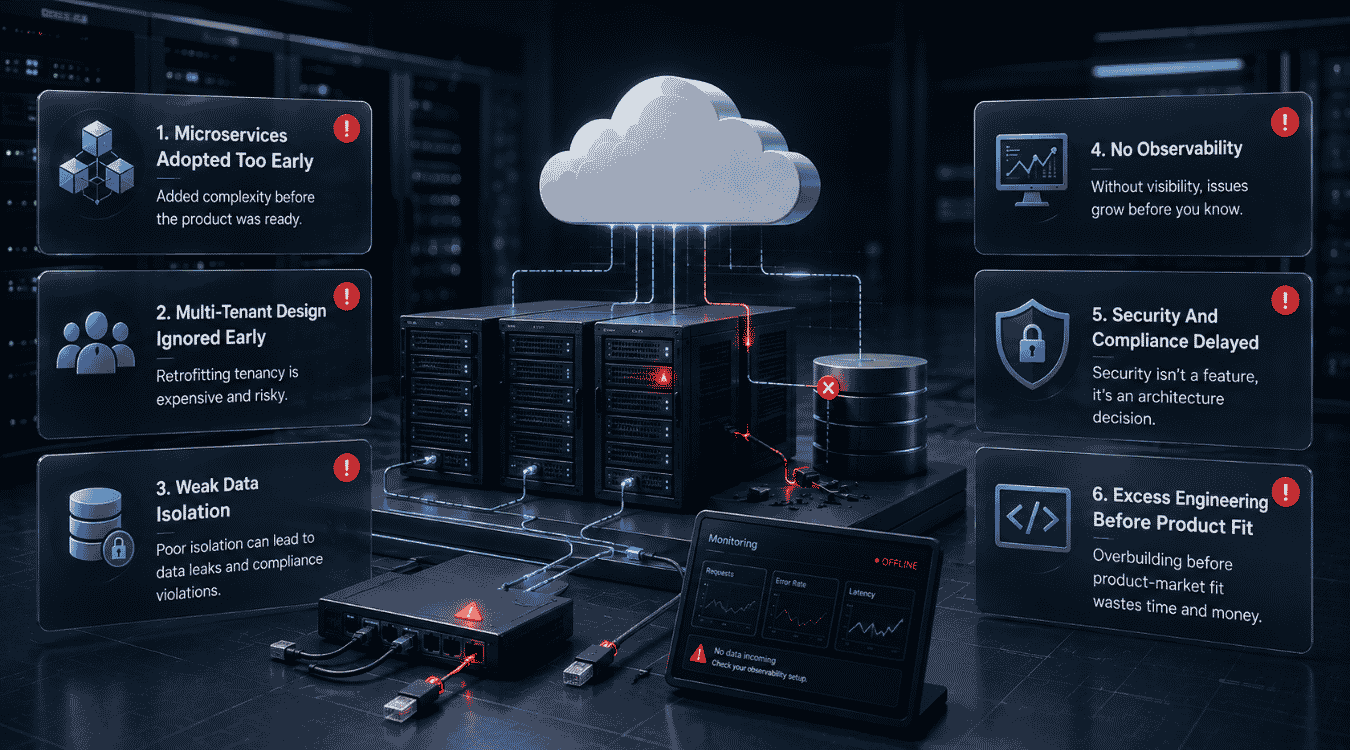
Microservices Adopted Too Early
Many teams reach for microservices before the product or team is ready for the operational load that comes with them. Standard APIs and webhooks already handle most integration needs without the coordination overhead microservices bring.
Splitting a young product into services too soon adds deployment complexity, network latency, and debugging difficulty that a small team cannot absorb. It is often better to start with clear internal boundaries and split services out only when growth actually demands it.
Multi-Tenant Design Ignored Early
Treating multi-tenancy as something to add later instead of designing for it from day one creates problems that are expensive to fix. Teams that skip this planning often scramble to add sharding or replication once performance starts to slip under real tenant load.
Customization within multi-tenant platforms is also often limited compared to single-tenant offerings, since heavy per-customer changes can threaten the integrity of the shared architecture. Planning tenancy early avoids painful rework once customers are already on the platform.
Weak Data Isolation Between Tenants
Shared infrastructure only works if tenant data stays properly separated. Data partitioning involves dividing application data to separate tenant-specific information, which directly improves both security and performance in multi-tenant systems.
Weak isolation increases the risk of data leaks between customers and complicates audits down the line. Clear boundaries around tenant data should be built into the schema and access layer from the start, not patched in after an incident.
No Observability During Scaling
Scaling infrastructure without visibility into how the system behaves is a common blind spot. Teams add servers, services, or capacity without knowing which part of the system actually needed it, wasting resources.
Integration of AI for predictive maintenance can enhance system health management, catching issues before they cause downtime. Without logging, metrics, and tracing in place, scaling decisions become guesses instead of informed responses to real usage data.
Security And Compliance Delayed
Compliance with industry standards and regulatory requirements can be especially challenging in multi-tenant SaaS environments, and pushing this work to later stages rarely goes well. Retrofitting security controls after launch takes far more effort than building them in from the start.
Delayed compliance planning also slows down enterprise sales, since larger customers often require proof of specific security and data handling standards before signing. Building these requirements into the architecture early avoids blocking growth later.
Excess Engineering Before Product Fit
Adding advanced infrastructure before validating the product wastes engineering time that could go toward improving the actual experience. The user interface is the point of interaction between users and the SaaS application, and that is often what needs attention first, not the backend, making specialized UI/UX design services for SaaS products a high-impact investment.
A focus on user-centric experiences improves product retention by simplifying interfaces for newcomers while gradually introducing advanced features. Complex architecture only pays off once real usage patterns justify the investment.
How GainHQ Helps Businesses Build the Right SaaS Architecture
Designing the right SaaS architecture starts with understanding the business behind the software. GainHQ approaches SaaS architecture and SaaS development as a strategic partnership, not a generic delivery model, mirroring the approach outlined in the SaaS development services guide.
Before making architectural decisions, the team focuses on business goals, user behavior, operational constraints, and growth plans. This discovery-first approach ensures the SaaS solution architecture supports real workflows and long-term objectives.
GainHQ works across the full SaaS architecture lifecycle, from early MVPs to mature platforms serving multiple customers. Whether the solution requires a multi-tenant SaaS architecture, a single-tenant setup, or a hybrid model, the focus remains on performance, security, and cost efficiency, aligning closely with end-to-end SaaS product development.
Core areas of focus include:
- Building scalable SaaS architecture with horizontal and vertical scaling
- Designing secure data storage, data isolation, and access control models
- Optimizing resource usage to manage operational costs
- Supporting continuous integration and continuous deployment
- Creating intuitive user interface experiences across the SaaS app with reusable SaaS design systems for scalable SaaS products
By aligning SaaS infrastructure architecture with business priorities, GainHQ helps companies build platforms that evolve as needs change, without compromising performance or flexibility.
FAQs
What is SaaS architecture and why does it matter?
SaaS architecture defines how a software as a service application is built, deployed, and scaled on cloud infrastructure. It matters because it directly affects system performance, data security, operational costs, and how easily the SaaS platform can support multiple customers as it grows.
How does multi-tenant SaaS architecture differ from single-tenant architecture?
In a multi-tenant SaaS architecture, multiple tenants share the same system while keeping their data isolated. This improves cost efficiency and resource utilization. Single-tenant architecture provides dedicated resources per customer, offering stronger isolation but higher SaaS costs and operational overhead.
Which SaaS architecture model is best for scaling?
A scalable SaaS architecture typically uses a multi-tenant architecture combined with horizontal scaling, load balancing, and cloud services. This setup allows the system to handle increasing numbers of users without compromising performance.
How do SaaS providers control resource usage and operational costs?
SaaS providers monitor key metrics such as CPU usage, memory consumption, and request volume to manage computing resources efficiently. Automated scaling, cost monitoring, and efficient data management help keep operational costs predictable as usage grows.
How is data security handled in SaaS applications?
Data security in SaaS applications relies on data encryption, strict access control, secure access policies, and regular security audits. Proper data isolation between tenants is essential to protect sensitive data and prevent data breaches.
What role does cloud infrastructure play in SaaS architecture?
Cloud infrastructure provides the foundation for SaaS cloud architecture, enabling flexible scaling, reliable data storage, and high availability. A cloud service provider supplies the computing resources and services needed to support multiple users and global access, often compared against SaaS vs custom software.
How do SaaS teams measure and improve system performance?
Teams track key metrics such as response time, error rates, and throughput to understand system performance. Load balancing, caching, and optimized data retrieval help improve performance across the entire system as user demand changes, supported by dedicated SaaS monitoring tools and broader SaaS performance optimization.
When should a SaaS product revisit its architecture design?
SaaS architecture design should be revisited when adding new features, experiencing rapid business growth, increasing SaaS costs, or integrating third-party services. Regular reviews help ensure the architecture continues to support scalability, security, and evolving user needs and stays aligned with broader B2B SaaS product development.