
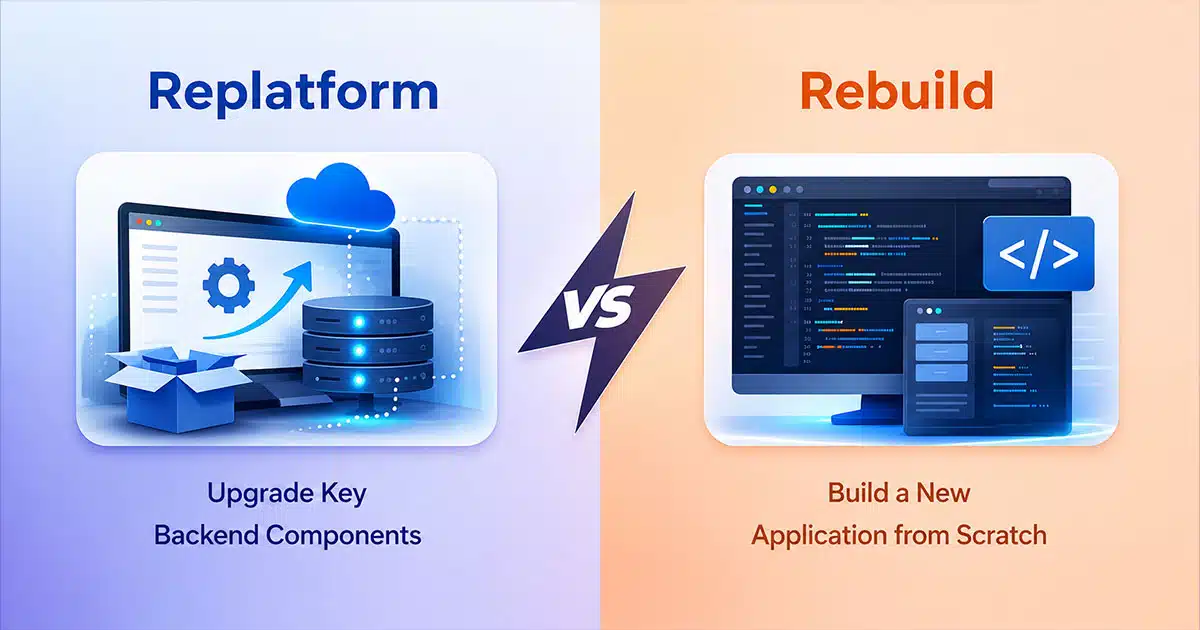
Replatform vs rebuild decisions shape how businesses prepare their technology for long term platform growth. Many organizations operate on outdated platforms that struggle to meet today's demands for speed, scalability, and reliability. As systems age, companies must decide whether to make minimal changes through replatforming or invest in completely rebuilding their applications for a fresh start.
Choosing the right path often depends on resources, risk tolerance, and strategic priorities. A new platform can unlock modern capabilities, improve performance, and reduce long term maintenance challenges. However, rebuilding an application completely can be resource intensive and requires careful planning to avoid costly delays. When approached strategically, both options help businesses cut costs over time, strengthen operational stability, and create a foundation that supports future innovation and growth.
Why Teams Struggle With Replatform Vs Rebuild Decisions
Teams often face friction when choosing between replatform and rebuild. Each path affects delivery speed, risk, and scalability. Unclear priorities, technical debt, and uncertain outcomes in the cloud environment make decisions harder.
Lack Of Clear Cloud Migration Strategy
Many teams begin cloud migration without a defined cloud migration strategy. That gap leads to confusion about whether to replatform or rebuild. A weak plan also limits how teams use cloud capabilities on a cloud platform. Without clarity, decisions become reactive instead of structured, which slows progress and increases risk across the cloud environment.
Complexity Of Legacy Systems
Legacy systems carry years of logic, integrations, and dependencies. Moving them into a cloud environment is not straightforward. Teams hesitate because cloud computing models often conflict with older architectures. Replatforming may keep the system running, but it may not fully align with modern expectations. Rebuilding seems cleaner, yet the cost and uncertainty hold teams back.
Uncertainty Around Cloud Capabilities
Many teams do not fully understand cloud capabilities before making decisions. A cloud platform offers scalability, but not every system benefits equally. Cloud native features can improve performance, yet they require architectural changes. Without clarity, teams struggle to evaluate if replatforming can meet needs or if rebuilding is required to unlock full value.
Challenges In Managing Infrastructure
A shift to a new cloud environment brings operational pressure. Teams must redesign cloud infrastructure, security, and deployment models. Even with a managed cloud service, gaps in experience can delay progress. Cloud based platforms simplify some aspects, but they still demand changes in how systems are managed and maintained.
Trade Off Between Speed And Long Term Value
Replatforming allows faster adoption of cloud computing with fewer changes. It helps teams move into a cloud environment quickly. However, rebuilding often delivers better alignment with cloud native features and long-term scalability, especially when you compare refactor vs rebuild approaches for complex systems. Teams struggle to balance immediate delivery needs with the benefits of a modern cloud infrastructure, which keeps the decision unresolved.
What Replatforming Means In Practice
Replatforming means moving an application to a new cloud platform with limited changes to its core architecture. Teams shift workloads from legacy systems into a modern cloud environment while keeping existing code largely intact, which makes smooth cloud migration planning essential to avoid disruption. The focus stays on improving performance, scalability, and resource utilization without a full rebuild.
In practice, teams adjust configurations, update dependencies, and optimize parts of the system to align with cloud capabilities. They may adopt managed services, improve deployment pipelines, and enhance reliability. Replatforming often acts as a middle path in cloud migration, where businesses gain benefits from cloud computing while avoiding the cost and risk of rebuilding from scratch.
Replatforming focuses on moving applications with targeted improvements instead of full redesign. Teams aim to modernize systems within a structured cloud environment while balancing speed, cost, and long-term scalability outcomes as part of a broader software modernization strategy.
Alignment With Cloud Platform And Services
Replatforming aligns applications with a modern cloud platform while leveraging cloud services for better scalability. Teams shift workloads into a refined cloud environment and often prepare for a new cloud platform when needed. This approach ensures systems can operate efficiently while adapting to evolving infrastructure demands without major disruption.
Optimization Without Full Code Rewrite
A core trait involves working with existing code instead of rebuilding from scratch. Teams ensure compatibility with the new environment while addressing regulatory or compliance requirements. In some cases, platforms like Salesforce Commerce Cloud are integrated to extend capabilities or complemented with custom software development services to cover unique needs. The goal is to achieve better performance while minimizing development effort and risk.
Structured Transition And Data Handling
Replatforming follows a defined replatforming process supported by strong it infrastructure. Teams plan data migration carefully to avoid inconsistencies and ensure continuity. Legacy applications and existing infrastructure are adapted to fit into a modern setup. This structured approach reduces errors and keeps operations stable during the transition.
Adoption Of Modern Infrastructure Elements
Teams enhance systems by introducing serverless computing and upgrading to new infrastructure. This shift allows better scalability and flexibility without changing core logic. A well-managed transition helps systems take advantage of modern resources while maintaining stability. Replatforming creates a bridge between traditional systems and advanced cloud setups.
Focus On Security And System Integration
Security becomes a key focus during replatforming. Teams implement security features and identity management to protect data and access. Existing systems are integrated into the new setup, ensuring consistency across the it environment. Core systems are maintained while improving reliability,
When Replatforming Is The Better Move
Replatforming fits situations where systems need improvement without full replacement. It allows teams to enhance performance and scalability inside the existing it environment while keeping risk and disruption under control.
Stable Systems That Need Gradual Improvement
Replatforming works best when core systems are reliable but require modernization. Instead of rebuilding, teams enhance existing systems and introduce new features step by step. This approach keeps operations stable while allowing steady evolution without major disruption.
Transition From Legacy Hosting Models
Organizations moving from on premises applications often choose replatforming to reduce complexity. It allows systems to shift into modern setups without rewriting everything. With added support like load balancing, applications can handle higher demand and improved reliability without structural overhaul.
Need For Better Performance And Flexibility
When systems struggle with scaling or responsiveness, replatforming offers a practical solution. Enhancing digital infrastructure and refining business operations helps improve efficiency. Teams can upgrade platform features and align systems with a current platform while gradually moving toward modern platforms, similar to how custom software transformed companies that outgrew generic tools.
Improving Control And System Efficiency
Replatforming is ideal when teams need stronger control over access and operations. Introducing access controls improves governance without affecting usability. It also helps refine how systems interact with other business elements, ensuring smoother coordination across the current system while maintaining stability.
How To Keep Replatforming Costs Under Control
Keeping replatforming costs under control requires disciplined planning and clear priorities. Start by auditing workloads to identify what truly needs change and avoid unnecessary upgrades. Focus on high-impact improvements that deliver measurable value.
Use a phased approach instead of moving everything at once. This reduces risk and spreads costs over time. Optimize resource allocation to improve efficiency and prevent overspending on infrastructure. Leveraging managed services or tech consulting services that help modern businesses grow can also lower operational overhead and maintenance effort.
Set clear budgets and track expenses throughout the process. Monitor performance after each phase to ensure expected outcomes. Avoid overengineering by keeping changes minimal and aligned with business goals. A structured approach helps control costs while still achieving modernization benefits.
What Rebuilding Really Involves
Rebuilding involves redesigning an application from the ground up to fit modern architecture and business needs. Teams replace outdated components, restructure workflows, and develop new systems aligned with current technology standards.
Unlike incremental updates, rebuilding requires rewriting core logic, redefining data models, and creating new integrations. It often includes adopting scalable architectures, improving performance, and aligning systems with evolving requirements. This process demands significant time, resources, and coordination across teams, which is why choosing the right custom software development partner becomes critical.
Rebuilding also introduces opportunities to eliminate technical debt and improve long-term flexibility. However, it carries higher risk compared to replatforming, as errors or delays can impact operations. A well-planned approach ensures the new system delivers better reliability, scalability, and future readiness.
Key Characteristics Of Rebuilding
Rebuilding replaces an existing system with a fully redesigned solution. It focuses on long-term scalability, flexibility, and alignment with evolving needs, while addressing limitations of the current platform and outdated architectures and often revisiting earlier custom vs off-the-shelf software decisions.
Full Replacement Of Current System
Rebuilding removes dependence on the current system and current platform. Teams design solutions from scratch to fit modern platforms without constraints from legacy setups. This approach allows better alignment with platform features and ensures systems can evolve without limitations tied to older architectures or other business elements.
Strong Security And Control Foundation
Security becomes a core element during rebuilding. Teams implement enhanced security and define access controls from the beginning. This ensures systems are protected while maintaining proper governance. A strong foundation helps manage risks and improves how systems interact across digital infrastructure and critical environments.
Alignment With Business Operations
Rebuilding enables systems to directly support business operations. Instead of adapting workflows, teams design systems that match real processes. This improves efficiency and coordination across other business elements. With better integration into digital infrastructure, organizations gain more control and flexibility in how systems operate.
Investment And Long Term Value
Rebuilding requires higher initial cost but offers long-term cost savings. It eliminates inefficiencies tied to outdated systems and reduces recurring fixes. By moving fully to modern platforms, organizations gain flexibility and scalability. This investment supports future growth while ensuring the system remains aligned with evolving needs and performance expectations.
When A Full Rebuild Is Worth It
A full rebuild makes sense when outdated infrastructure limits growth and stability. Systems tied to on premises infrastructure often struggle to scale, integrate, or meet modern expectations. In such cases, re architecting delivers long-term cost savings and unlocks application benefits that incremental changes cannot provide, similar to how a structured build vs buy software decision clarifies long-term trade-offs.
Rebuilding becomes critical when key risks like data loss, security gaps, or compliance certifications are involved. Teams can ensure compatibility with modern standards while creating a controlled staging environment for testing and clarifying how different software services models affect security and compliance. This reduces failure points and improves reliability.
A rebuild also enables continuous integration and supports flexible platforms that adapt to changing business elements. Platforms like Microsoft Azure integrate well with identity systems such as Active Directory, improving control and scalability and pairing well with decisions around no code vs custom development for different modules.
While a replatforming strategy may offer partial benefits, a rebuild helps organizations gain full advantage of modern architecture and performance.
Replatform Vs Rebuild: Side By Side Comparison
You need to compare both options on the dimensions that matter most: speed, cost, risk, and impact on customers. This side by side view helps you make an informed decision.
| Dimension | Replatform | Rebuild |
|---|---|---|
| Time To First Value | 2 to 4 months | 6 to 12 months |
| Total Project Duration | 3 to 9 months | 12 to 24 months |
| Impact On Existing Users | Minimal disruption | Requires adaptation period |
| Change To User Experience | Improve performance, same flows | Complete redesign possible |
| Long Term Flexibility | Limited by existing architecture | Unlimited, cloud native |
| Upfront Investment | 40 to 60% of rebuild cost | Full rebuild investment |
| Technical Debt Resolution | Partially addressed | Completely eliminated |
| Risk Level | Moderate | Higher |
Rebuilding takes longer and costs more upfront. It offers a clean slate for major product evolution and technical flexibility. New revenue streams become possible. Cloud based features and modern architectures unlock new capabilities.
Many teams overestimate the need to rebuild when a well planned replatform plus targeted refactoring can cover 70 to 80 percent of their current pain. A hybrid software modernization approach that mixes replatforming, refactoring, and selective rebuilding often delivers the best business value.
A Practical Framework To Decide Between Replatform And Rebuild
Here is a simple, repeatable checklist your product team can use in a week or two of workshops. This framework helps you move from uncertainty to clarity.
Stage 1: Assess Where You Are
Evaluate your current state with honest metrics. Look at uptime over the past 12 months. Check average response times and how they have trended. Count incident frequency and severity. Track infrastructure cost trends since at least 2021.
Identify how many features are blocked by the existing architecture. List integrations that cannot be implemented without major changes. Document security gaps and compliance issues. This assessment grounds your decision in reality rather than assumptions.
Stage 2: Clarify Where You Need To Be
Consider planned features for the next 3 to 5 years. Advanced reporting. AI assisted workflows. Mobile apps. Real time collaboration. Can your current stack support them without massive hacks, and does your SaaS product roadmap reflect the technical work required?
Think about business goals beyond features. Cost reduction. Entering new markets. Scaling to 10x your current users. Supporting enterprise customers with strict requirements. Your legacy modernization strategy must align with where the business is headed.
Stage 3: Score Replatform Vs Rebuild
Rate each option from 1 to 5 on four dimensions: business risk, technical feasibility, budget fit, and time to impact. Involve both technical and non-technical stakeholders in the scoring, and consider case studies where software build vs buy decisions shaped the modernization path.
A replatform might score high on budget fit and time to impact but lower on long term flexibility. A rebuild might score high on flexibility but lower on budget fit and speed. The scores create a framework for discussion rather than a definitive answer.
Stage 4: Plan For Hybrid Options
Consider hybrid paths. Replatform first in 2025 to stabilize the foundation. Schedule a targeted rebuild of specific modules like billing or analytics in 2026 to 2027. This phased approach balances risk tolerance with available resources.
Many successful modernization projects combine strategies. Some modules get replatformed. Critical components get rebuilt. The portfolio approach maximizes business value while managing investment efficiently.
How GainHQ Guides Businesses Through Replatform Vs Rebuild Decisions
The team at GainHQ has seen many SaaS products and internal tools struggle with the same replatform versus rebuild dilemma, regularly sharing lessons on their GainHQ blog about software modernization and cloud migration. The challenge rarely has an obvious answer. Context matters enormously.
GainHQ typically starts with a discovery process. The team reviews architecture diagrams. They look at production metrics and current website performance data. They run interviews with product owners, support teams, and a small group of users. This research reveals pain points that surface level analysis misses and feeds into broader technology consulting services recommendations.
The focus stays on connecting technical options to clear business outcomes. Reducing onboarding time. Cutting error rates in support operations. Unlocking new revenue streams. Enabling cloud adoption that supports growth. Every recommendation ties back to what matters for the business.
GainHQ can help plan phased modernization. The team designs replatforming roadmaps that control costs and reduce risk. They structure rebuilds to protect revenue while the new system gets constructed. Both paths benefit from experienced guidance through the migration process.
Think of GainHQ not as a one-off vendor but as a long term partner. The relationship extends from the first infrastructure move to continuous improvement of workflows and customer experience, similar to how ongoing technology consulting services for modern businesses ensure continuous alignment. Whether you need to replatform or rebuild, the goal remains the same: delivering cost effective solutions that serve your customers and grow your business.
Frequently Asked Questions
Is Replatforming Just “Lift And Shift” To The Cloud?
Pure lift and shift usually means copying the application from one environment to another with almost no changes. Replatforming goes further. It includes targeted optimizations like adopting managed databases, adding autoscaling capabilities, and improving deployment pipelines. Replatforming aims for genuine cloud benefits like reliability, observability, and operational efficiency. The goal is not just moving servers from one data center to another. It is transforming how your application runs to improve performance and reduce maintenance costs.
Can We Replatform Now And Rebuild Later?
Many teams follow this exact path. They replatform first to stabilize costs and reliability over 6 to 12 months. Then they plan a deeper rebuild of critical modules once they have more data and budget. Framing replatforming as buying time makes sense. It reduces risk while your organization learns more about long term product direction. You can use the stabilization period to validate assumptions about what a future rebuild should include.
How Do We Avoid Disrupting Current Customers?
Both strategies can be implemented with careful change management. Feature flags help control rollout. Beta programs let you gather feedback before broad release. Staged rollouts by region or customer segment limit blast radius. Transparent communication about maintenance windows builds trust. Early involvement of support teams and account managers helps catch customer concerns before they turn into churn. The goal is progress without surprising your users.
What Skills Does Our Team Need For Replatforming Or Rebuilding?
Replatforming requires strong DevOps, cloud architecture, and database migration skills. Teams need experience with infrastructure as code, container orchestration, and cloud native services. Rebuilding demands additional capabilities. UX design. Product discovery. Modern application architecture experience. The scope is broader because you are creating something new rather than moving something existing. Be honest about in-house capabilities. A partner like GainHQ can fill gaps in planning, implementation, or change management when internal resources are limited.
How Should We Measure Success After Modernizing?
Track clear metrics that connect to business value. Reduction in hosting and maintenance costs. Improved uptime percentages. Faster page loads and site speed. Quicker release cycles. Customer satisfaction scores and churn metrics that reflect how UX changes affect retention, as described in the role of UX in reducing SaaS churn. Measure these outcomes at three and six months after go-live. Compare results against the original business case. This comparison reveals whether replatforming or rebuilding delivered the expected value and helps guide future decisions.