
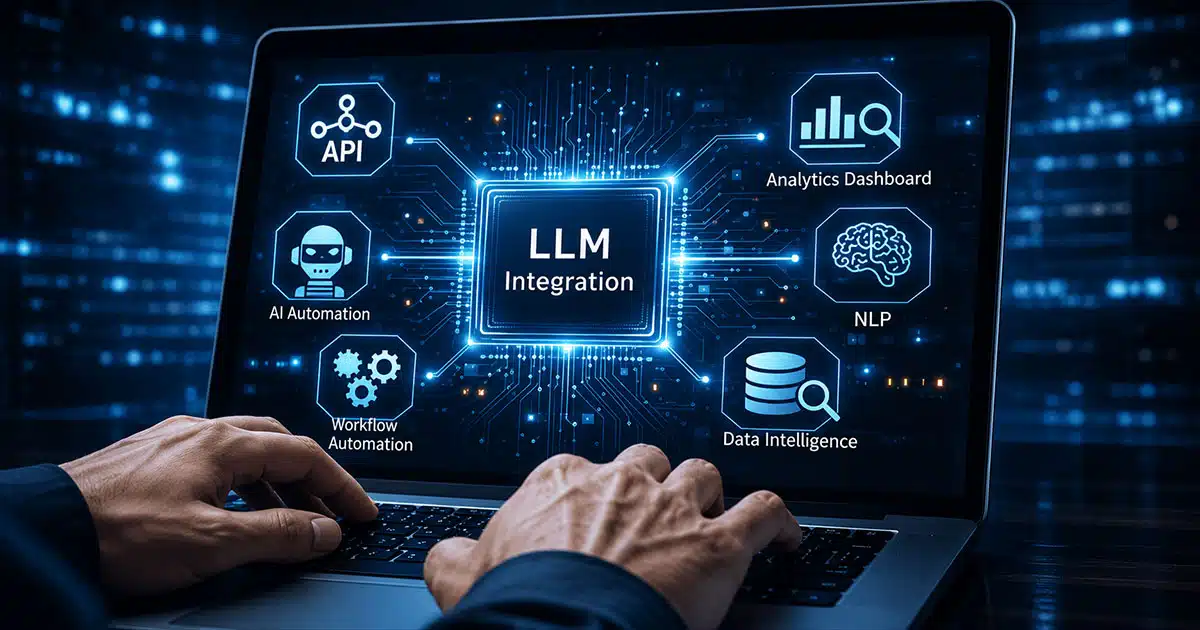
LLM integration helps software products use large language models inside everyday workflows. Modern SaaS platforms rely on AI to automate tasks, improve support, and generate insights from data. LLM integration connects your product with powerful AI models so users receive faster answers, smarter automation, and better experiences.
Product teams often struggle with model selection, API connections, latency, and data security. A clear integration approach solves those challenges. With the right architecture and tools, teams add AI features without complex infrastructure. LLM integration now plays a central role in building intelligent SaaS platforms that scale with user needs.
What Is LLM Integration
LLM integration connects large language models with existing systems such as web apps, a crm system, and internal tools. An application sends user inputs or text data through api calls to an llm service. The system sends prompts in natural language and receives responses from the model. Most llm providers such as OpenAI’s GPT, Anthropic’s Claude, Google’s Gemini, and Meta’s LLaMA offer llm apis that make this process simple. Developers use an api key, manage api interactions, and define the request body so the model returns llm outputs in a desired format like json format.
Many businesses integrate llm usage with structured data, unstructured data, and a knowledge base. Techniques like retrieval augmented generation improve information retrieval and improve accuracy. Prompt engineering, multiple prompts, and fine-tuning help determine the llm’s response and produce optimal results.
LLM integration also supports AI agents, code generation, and complex workflows across various tools. Businesses use integrating LMS to enhance decision-making, reduce costs, and improve operational efficiency, and many leaders now treat AI-driven automation in SaaS as a core lever for transforming how their platforms operate. Proper access controls, rate limiting, and clear expectations also help protect data privacy and maintain reliable performance across models.
Key Benefits Of LLM Integration For SaaS Platforms
LLM integration adds powerful artificial intelligence capabilities to modern SaaS platforms. Large language models help applications understand natural language, automate complex workflows, and analyze large volumes of data. Product teams use llm apis and various tools to improve operational efficiency, deliver smarter features, and build a stronger competitive edge, extending the broader benefits of AI in SaaS across their products.
Smarter Automation Across Workflows
LLM integration helps SaaS products automate tasks that previously required manual effort. Applications send user inputs through api calls to language models. The system receives responses that help perform tasks such as text generation, code generation, or content analysis.
AI-powered automation improves operational efficiency across web apps and internal tools. Teams also combine llm outputs with structured data and unstructured data. This approach supports complex workflows and reduces repetitive work across business systems, especially when teams understand the trade-offs between AI automation and traditional automation.
Better Insights From Data
Large language models process huge volumes of text data and context from a knowledge base. SaaS products use llm usage to analyze previous interactions, support tickets, and customer conversations. The system then generates useful insights for teams.
Data analysis becomes easier with information retrieval methods such as retrieval augmented generation. Models use context from structured data and other models to improve accuracy. Many businesses rely on LLM-powered insights to enhance decision-making and identify new opportunities.
Improved Customer Experiences
LLM integration allows SaaS platforms to deliver faster and more relevant responses. AI agents use natural language to understand questions from users and generate helpful answers, which can directly boost engagement as shown in SaaS case studies where AI features increased engagement by 34%. The system sends prompts and receives responses that follow a desired format.
Customer support tools often combine LLM APIs with crm system data and knowledge base articles. The model reads context and produces clear answers. Accurate llm outputs help businesses respond faster and maintain better service quality.
Flexible AI Features Across Systems
SaaS teams connect llm service platforms with existing systems such as Microsoft Dynamics, Power Automate, and other business tools. Api requests allow applications to communicate with models through secure api interactions.
Developers also use prompt engineering and multiple prompts to define clear expectations. This process helps determine the llm’s response and produce optimal results. Flexible integration also supports ai agents and automation across various tools.
Scalable AI Capabilities For Growth
LLM providers offer scalable models that support growing SaaS platforms. Businesses choose between cloud-based services or self-hosted models depending on data privacy needs. Access controls and rate limiting help maintain stable performance and align with broader SaaS scalability strategies for sustainable growth.
Proper integration also allows model updates without large infrastructure changes. SaaS teams test examples, refine prompts, and adjust the request body for better output. A well-designed architecture helps reduce costs and maintain a long-term competitive edge.
Core Components Of A Reliable LLM Integration Architecture
A reliable LLM integration architecture connects large language models with business systems, data sources, and application workflows. Each layer must support security, scalability, and performance, following principles similar to scalable software architecture for high-growth products. Clear structure ensures stable llm usage, accurate outputs, and smooth communication between models, data, and existing systems.
LLM APIs And Model Access
LLM APIs form the main gateway between applications and language models. A system sends prompts through api requests and receives responses from the model. Developers use an api key and a structured request body to control each llm call.
Most llm providers such as OpenAI’s GPT, Google’s Gemini, Anthropic’s Claude, and Meta’s LLaMA, provide scalable llm service platforms. According to Gartner, over 80% of enterprise AI deployments now rely on api based model access. Proper api interactions help manage rate limiting, track usage, and maintain stable performance across web apps.
Data Layer And Knowledge Sources
Data plays a critical role in reliable llm integration. Systems combine structured data from a crm system with unstructured data such as support tickets, documents, and text data. A centralized knowledge base improves context for language models.
Retrieval augmented generation improves information retrieval by connecting models to real business data. McKinsey reports that AI systems with contextual data can improve response accuracy by up to 40%. Strong data architecture also helps improve accuracy and deliver useful llm outputs for business decisions.
Prompt Design And Response Control
Prompt engineering helps define how the model processes user inputs and produces output. Developers design prompts that set clear expectations for the llm’s response. Multiple prompts often guide models through complex workflows.
Applications also specify the desired format of outputs such as json format for structured processing. Clear prompts reduce errors and improve consistency. Teams often test several examples to determine the best prompt structure for optimal results.
Security And Access Management
Security remains a critical part of llm integration architecture. Systems must protect sensitive data through strict access controls and data privacy policies. API keys, authentication layers, and request validation help secure api calls.
Many organizations also monitor llm usage and enforce rate limiting to prevent misuse. According to IBM security research, nearly 70% of enterprises consider data privacy the biggest concern when adopting generative ai. A secure design protects business data and maintains user trust.
Application Layer And Workflow Integration
The application layer connects models with real business workflows. Web apps, ai agents, and automation tools send prompts to language models and process the responses. Systems then use the output to perform tasks such as text generation or code generation.
Platforms often connect llm services with tools like Microsoft Dynamics, Power Automate, and other models. Integration across existing systems improves operational efficiency and enhances decision-making. Many businesses use llm powered automation to handle complex workflows and deliver faster results.
Common LLM Integration Methods Used In Modern Applications
Modern applications use several methods to connect large language models with business tools and workflows. Each integration method focuses on performance, accuracy, and scalability. Product teams choose different approaches based on data sources, system architecture, and application needs, and these choices work best when aligned with best practices of SaaS architecture.
API Based Model Integration
API based integration remains the most common way to connect language models with web apps and business systems. Developers send prompts through api requests and receive responses from the model. Each llm call uses an api key and a structured request body.
Most llm providers such as OpenAI’s GPT, Google’s Gemini, Anthropic’s Claude, and Meta’s LLaMA, offer reliable LLM APIs. According to Stack Overflow developer research, more than 70% of AI developers rely on API based artificial intelligence services. This method provides cost-effective access to powerful models without heavy infrastructure.
Retrieval Augmented Generation
Retrieval augmented generation improves the accuracy of llm outputs by connecting models to external data sources. The system retrieves relevant information from a knowledge base and sends it to the model as context. The model then produces responses based on real business data.
This method works well with unstructured data such as documents, emails, and support tickets. Studies from Stanford AI research show that retrieval augmented generation can improve accuracy by up to 35%. Many SaaS platforms use this method for information retrieval and customer support automation.
Embedded AI Agents In Applications
AI agents allow applications to automate complex workflows through natural language interaction. The agent receives user inputs, sends prompts to language models, and processes the output to perform tasks. Systems may use multiple prompts and various tools to complete each step, similar to how many artificial intelligence software applications orchestrate tasks across different tools.
Many businesses use llm powered agents for internal automation and customer support. Gartner predicts that by 2027 more than 50% of enterprise applications will include AI agents. Agents can enhance decision-making, automate repetitive tasks, and improve operational efficiency.
Fine-Tuned Domain Models
Fine-tuning allows organizations to customize models with domain-specific data. Teams train models using structured data and text data related to their business processes. The goal is to improve accuracy and produce more relevant responses, fitting into a broader AI software development strategy for smarter, adaptive digital products.
Fine-tuned models often support code generation, customer support answers, or specialized knowledge queries. Research from OpenAI shows that fine-tuned models can improve response relevance by more than 20% in domain-specific tasks. Businesses often combine fine-tuning with prompt engineering for optimal results.
Workflow Automation Integrations
Workflow automation connects llm services with business platforms such as Microsoft Dynamics, CRM systems, and Power Automate. Applications send prompts through api interactions and process the model output within operational systems to create smarter software tools that simplify day-to-day work for teams.
This method supports tasks such as report generation, support ticket analysis, and automated responses. McKinsey estimates that generative ai could automate up to 30% of current business tasks by 2030. LLM integration with automation tools helps reduce costs and improve business productivity.
Step-by-Step Process For Successful LLM Integration
A clear process helps teams implement llm integration without breaking existing systems. Each step focuses on architecture, data flow, and model behavior. Proper planning improves accuracy, protects data privacy, and ensures stable llm usage across web apps and internal tools.
Step 1: Define Business Goals And Use Cases
A successful llm integration starts with clear business goals. Teams define how large language models will support the business. Common use cases include text generation, code generation, support automation, and information retrieval.
Many businesses first analyze previous interactions, support tickets, and user inputs. This process helps determine where artificial intelligence can perform tasks efficiently. According to McKinsey, generative ai can automate up to 30% of work activities. Clear expectations help guide the integration architecture and avoid unnecessary llm calls.
Step 2: Select The Right LLM Provider
The next step focuses on choosing the right llm providers. Popular models include OpenAI’s GPT, Google’s Gemini, Anthropic’s Claude, and Meta’s LLaMA. Each provider offers different capabilities for natural language processing and generative ai tasks.
Most llm providers offer llm apis that support simple api interactions. Developers access the model with an api key and send prompts through api requests. According to Stanford AI research, model selection can influence response quality by more than 25%. The right choice helps achieve optimal results and cost effective deployment.
Step 3: Build Data And Knowledge Integration
Reliable llm outputs require strong data integration. Applications connect structured data from a crm system with unstructured data such as documents, text data, and knowledge base articles. This process improves context for language models.
Retrieval augmented generation helps models access accurate information during each llm call. The system retrieves relevant data and adds it to the request body before sending prompts. Research from MIT shows that contextual retrieval systems can improve response accuracy by nearly 40%.
Step 4: Design Prompts And Response Structure
Prompt engineering plays a key role in controlling the llm’s response. Developers design prompts that define the task, context, and expected output. Multiple prompts often guide models through complex workflows.
Teams also define the desired format of responses. Many applications require structured output, such as JSON format for easier processing. Clear prompts reduce errors and improve accuracy. Well-structured examples help models understand user requests and produce reliable responses.
Step 5: Monitor Performance And Optimize Usage
Performance monitoring ensures stable llm usage in production environments. Teams track api requests, response quality, and rate limiting to avoid service disruptions. Monitoring tools also help analyze model outputs and detect errors, similar to broader SaaS performance optimization best practices.
Regular model updates and prompt adjustments improve long-term performance. Developers also review llm calls to reduce costs and improve operational efficiency. According to Deloitte AI adoption research, organizations that monitor AI systems closely report 20–30% higher productivity gains. Continuous optimization helps maintain a strong competitive edge and aligns LLM initiatives with the future of SaaS development in a cloud-first world.
Security And Performance Factors In LLM Integration
Security and performance play a major role in reliable llm integration. Large language models process large volumes of data and interact with many systems. Strong architecture protects data privacy, controls llm usage, and ensures stable performance across applications and complex workflows.
Data Privacy And Access Control
Data privacy is a top concern when businesses integrate large language models. Applications often process sensitive text data, customer records, and crm system information. Strict access controls help prevent unauthorized data exposure.
Organizations use role based permissions, encrypted api interactions, and secure api keys. IBM security research shows that nearly 70% of enterprises consider data privacy the biggest barrier to generative ai adoption. Clear policies protect business data and maintain trust when applications send prompts and receive responses from llm services.
API Security And Rate Limiting
API security protects communication between applications and llm providers. Each llm call requires secure api requests with authentication tokens and request validation. Proper security prevents misuse of llm apis.
Rate limiting also controls the number of api calls sent to language models. This method protects infrastructure and prevents service interruptions. According to Cloudflare research, rate limiting can reduce abusive traffic by over 60%. A secure api layer ensures stable api interactions across web apps and business tools.
Performance Optimization And Latency Control
Performance plays a critical role in user experience. Slow responses from language models can affect complex workflows and automation systems. Applications must optimize api calls and reduce latency during llm usage.
Teams often cache previous interactions or knowledge base results to reduce repeated requests. Efficient request body design and prompt engineering also improve response speed. According to Google Cloud AI benchmarks, optimized inference pipelines can reduce response latency by nearly 40%.
Monitoring And Model Reliability
Continuous monitoring ensures reliable llm outputs across production environments. Monitoring tools track api requests, response quality, and model performance. Systems also review llm outputs to detect inaccurate responses.
Regular model updates from llm providers such as OpenAI’s GPT, Google’s Gemini, and Anthropic’s Claude improve performance over time. Deloitte research shows that organizations with active AI monitoring report 30% better operational efficiency. Reliable monitoring helps businesses maintain stable artificial intelligence systems and consistent results.
LLM Integration Use Cases Across SaaS Products
LLM integration unlocks many practical use cases across SaaS platforms. Large language models help products process natural language, analyze data, and automate business workflows. SaaS teams integrate llm services to enhance user experiences, improve productivity, and deliver smarter software capabilities, topics covered extensively across the GainHQ blog on software and SaaS.
Customer Support Automation
Customer support platforms use llm integration to answer user questions faster. Systems analyze user inputs, support tickets, and previous interactions. The application sends prompts through llm apis and receives responses that match knowledge base content.
Many SaaS companies combine retrieval augmented generation with unstructured data from help centers and documentation. This approach improves information retrieval and response quality. According to Gartner, AI driven support tools can resolve up to 70% of common customer queries without human intervention.
Content And Text Generation
Many SaaS platforms use language models for automated text generation. Applications process user inputs and generate articles, reports, summaries, or email responses. Developers send prompts through api calls and receive responses from the model.
Generative ai also supports marketing platforms, document tools, and collaboration apps. According to McKinsey research, generative ai can increase content production efficiency by nearly 40%. LLM powered writing tools help businesses reduce costs and maintain consistent output across web apps.
Developer Tools And Code Assistance
Developer platforms integrate llm services to assist with code generation and debugging. Applications send prompts with programming context and receive responses that produce code snippets or technical explanations. Developers then review the output before deployment.
Tools built with large language models can analyze text data from repositories and documentation. GitHub research shows that AI code assistants can improve developer productivity by up to 55%. LLM integration also supports faster software development and better decision making during product development.
Business Intelligence And Data Insights
SaaS analytics platforms use llm integration to convert complex data into natural language insights. Systems combine structured data from crm systems with unstructured data from reports and conversations. The model processes context and generates easy-to-understand summaries, extending the value of scalable SaaS tools that power global business growth.
Language models also help teams ask questions in natural language instead of complex queries. According to Deloitte AI research, AI-driven analytics tools can improve decision speed by nearly 25%. Businesses use llm powered insights to enhance decision-making and gain a competitive edge, especially when paired with a structured SaaS product development roadmap.
How GainHQ Supports LLM Integration For SaaS Platforms
GainHQ helps SaaS teams build scalable systems that connect artificial intelligence with real business workflows. The platform focuses on custom software development, strong integrations, and future-ready architecture, supported by strategic tech consulting services that help modern businesses grow. Teams combine data, optimize integrations, and manage SaaS applications in one ecosystem to improve automation and performance, similar to the transformations described in how custom software transformed companies.
GainHQ supports llm integration by helping teams connect large language models with existing systems, web apps, and business tools. Developers use LLM APIs, api calls, and structured request body formats to send prompts and receive responses from models like OpenAI’s GPT, Google’s Gemini, and Anthropic’s Claude.
The platform also helps businesses manage structured data, unstructured data, and knowledge base systems for better information retrieval while pairing AI capabilities with thoughtful UI/UX design services for SaaS products. This architecture improves llm outputs, supports ai agents, and enhances decision-making. Combined with robust SaaS design systems for scalable products, the result is cost-effective automation, improved operational efficiency, and a stronger competitive edge for modern SaaS products.
FAQs
Can LLM Integration Work With Legacy SaaS Systems Without Major Infrastructure Changes?
Yes. LLM integration often works with legacy SaaS platforms through llm apis and secure api calls. Developers connect existing systems, crm systems, or web apps using api requests and structured request body formats without rebuilding the entire infrastructure.
Does LLM Integration Require Self-Hosted Models For Better Data Privacy?
No. Many businesses use cloud based llm providers such as OpenAI’s GPT, Anthropic’s Claude, or Google’s Gemini with strong access controls and encryption. Proper api interactions and data privacy policies protect sensitive data even without self hosted models.
Can LLM Integration Help SaaS Platforms Build AI Agents For Automation?
Yes. LLM integration supports AI agents that process user inputs, send prompts, and perform tasks across various tools. These agents use natural language, llm outputs, and context from a knowledge base to automate complex workflows.
Is Retrieval Augmented Generation Necessary For Accurate LLM Outputs?
No. Retrieval augmented generation improves information retrieval but it is not always required. Some applications rely on prompt engineering, structured data, and previous interactions to guide the llm’s response and produce useful output.
What Factors Determine The Cost Of LLM Integration In SaaS Platforms?
Cost usually depends on llm usage, number of api calls, model choice, and data volume. Businesses also consider rate limiting, model updates, and prompt design. Efficient architecture helps reduce costs while maintaining strong performance.