
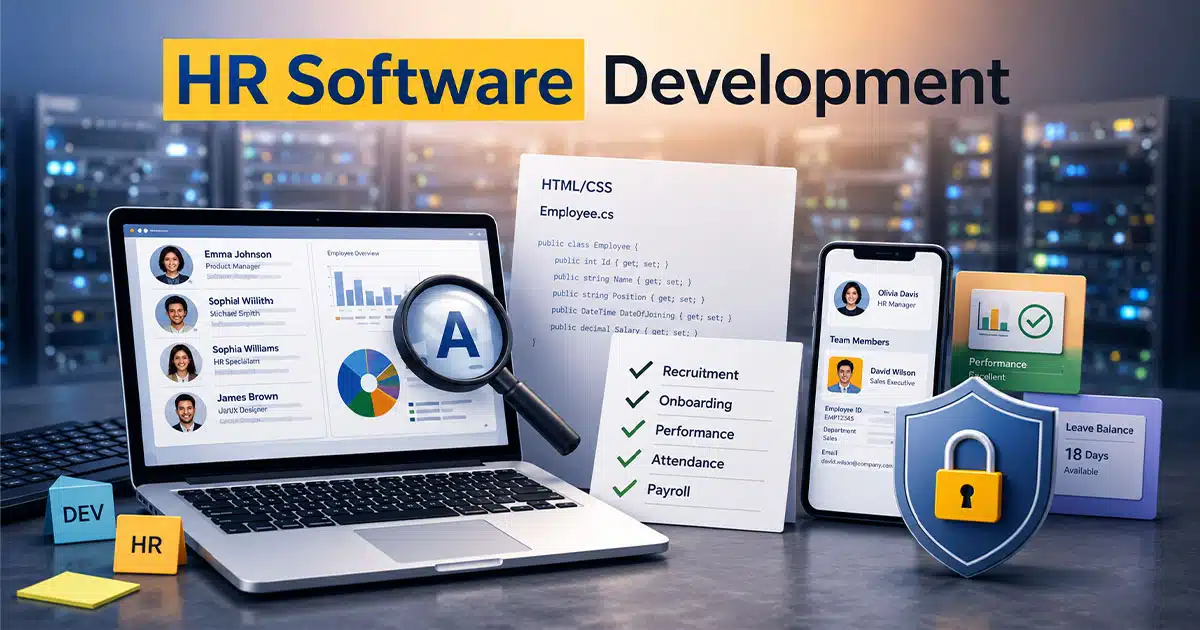
HR software has evolved far beyond basic record-keeping. Between 2020 and 2026, cloud adoption surged as remote and hybrid work became standard. Mid-sized and enterprise companies now expect hr platforms that combine self-service portals, mobile access, and seamless integrations with tools like Microsoft 365, Slack, and payroll providers.
Human resource software development today covers recruitment, employee onboarding, payroll processing, performance tracking, and workforce analytics in unified systems. Organizations dealing with complex shift work, multi-country payroll, or unique compliance requirements often find that custom hr solutions deliver better results than piecing together off-the-shelf tools.
GainHQ specializes in custom software development services and building and modernizing hr management software that fits how companies actually operate. The sections ahead cover tools, tech stack choices, core modules, the development process, costs, and emerging trends shaping hr software development through 2027, all grounded in GainHQ’s broader custom software development expertise.
What Is HR Software Development
HR software development is the process of designing, building, integrating, and maintaining digital systems that manage employees from candidate sourcing through offboarding. The goal is to replace manual spreadsheets and disconnected tools with secure, scalable applications that support hr processes across every stage.
Three terms often overlap in practice. A human resource information system primarily handles core employee data like records, payroll, and benefits administration. Think of a 200-person company using it to track salary history, store I-9 forms, and generate org charts across three office locations. A human resource management system extends beyond data storage to include talent management features like performance reviews and training logs. HCM (Human Capital Management) encompasses both and adds strategic hr analytics, turnover prediction, and diversity dashboards.
Which HR Software Modules To Give Ultimate Priority
Most hr platforms are modular. For a first release or modernization program, prioritizing the right modules determines early adoption success and long-term scalability. Core modules form the foundation for everything else.
HR And Employee Records
The core HR module stores personal data, contracts, positions, salary history, and compliance documents. In the US, records might include I-9 forms requiring E-Verify integration. UK systems often manage DBS checks and right-to-work verifications.
Role-based access control separates what hr managers, managers, and employees can see. HR views full records, managers access direct reports only, and employees use self service portals for their own profiles. Immutable audit trails log 100% of changes, supporting SOC 2 Type II and ISO 27001 audits.
Data lifecycle management enforces retention policies such as 7-year payroll storage under IRS rules or GDPR’s 6-month candidate data purge after rejection. Anonymization via tokenization protects employee data used for analytics. An intuitive people directory with search by skills or location improves collaboration across hybrid teams. Integrations with identity providers like Azure Active Directory and Okta keep employee status synchronized, deactivating access upon termination within 24 hours.
Payroll, Time, And Attendance
Payroll modules handle hours, overtime, shift differentials, and statutory holidays for both salaried and hourly workers. In the EU, systems must respect Working Time Directive limits like 48 hours weekly averaged. North American setups process FLSA overtime at 1.5x after 40 hours and night shift premiums.
Integration options include direct connections with providers like ADP or Paychex via APIs, or importing time data from biometric clocks and mobile apps with geofenced punches. Rules engines auto-update for annual tax changes like UK’s IR35 reforms or US state minimum wage increases.
A typical monthly payroll workflow involves manager approval, exception flagging for unapproved overtime, preview reports reconciling hours against budgets, and audit logs tracing every adjustment. Data accuracy requirements are strict, with targets exceeding 99.5% to avoid costly corrections. Reconciliation features can reduce payroll errors by up to 70% in well-implemented payroll systems.
Recruitment And Applicant Tracking
An applicant tracking module covers job requisition approval with budget checks, multi-channel job posting to LinkedIn, Indeed, and niche boards, candidate pipeline management with stages like screen, interview, and offer, and feedback collection.
Modern features include interview scheduling with Google Calendar or Outlook integrations, video interviews with platforms like HireVue, and templated communication via email tools. Structured workforce data about candidates enables analytics tracking time-to-hire (industry average 42 days, target under 30), cost-per-hire ($4,200 average per SHRM), and source effectiveness.
GDPR mandates 28-day retention post-rejection with explicit consent logs for EU candidates. A smooth integration transfers hired candidates into employee records with no duplicate data entry, supporting faster employee onboarding from the hiring process through day one.
Onboarding, Offboarding, And Employee Experience
Digital onboarding checklists assign tasks to IT, facilities, and managers. New employees complete pre-boarding portals for tax forms like W-4s, direct deposit setup, and benefits enrollment with options like 401k auto-enroll at 3%. IT provisioning tickets through ServiceNow and equipment allocation via asset tags happen before day one.
Tasks include NDA e-signatures through DocuSign and manager introductions. Offboarding workflows revoke MFA access in Okta, schedule exit interviews via survey tools, facilitate knowledge transfer to shared drives, and compute final pay with accrued PTO payout (California mandates full payout).
Self service features let employees update profiles, access encrypted payslips, and submit request tickets. Organizations report 60% reductions in HR support tickets after implementing self service portals. Impact on new hires includes two-week productivity ramps compared to four-week baselines, reducing administrative burden on hr teams significantly.
Performance, Learning, And People Analytics
Performance management options range from continuous feedback tools and quarterly check-ins to OKR alignment integrated with project management platforms. Biannual reviews in June and December with calibrated ratings on a 1-5 scale support compensation management decisions.
A learning management area tracks mandatory training like annual OSHA refreshers, manages course catalogs with 500+ options via SCORM standards, and issues digital certificates. Talent development programs link employee performance data to upskilling recommendations.
People analytics dashboards display turnover by department (global average 18.4% per Deloitte 2025), diversity metrics against 40% representation goals, and absence management patterns with 5% threshold alerts. Privacy protections aggregate data using k-anonymity with a minimum of 5 to protect individuals in small teams. Analytics inform strategic decisions like workforce planning and skills investments, yielding retention improvements of 15% or more.
How To Choose The Right Tools And Tech Stack
The tech stack directly affects scalability, integration capabilities, and development speed of hr platforms. Choices vary between building a SaaS HR product versus an internal hr management system for a single enterprise.
Frontend And Web Technologies
Modern hr platforms typically use React 18 with TypeScript, Vue 3 with Composition API, or Angular 17 with signals. Strong type systems help manage complex HR forms with validation libraries like Zod, reducing bugs by roughly 30%.
UI patterns especially helpful for HR users include data grids like AG-Grid for editable employee tables, timeline views for lifecycle visualization, and responsive layouts for managers using tablets. Design systems such as Material-UI or Ant Design accelerate development while maintaining consistent user experience.
Accessibility requirements matter for large organizations and public sector employers. WCAG 2.2 AA compliance requires contrast ratios of 4.5:1 and full keyboard navigation. Server-side rendering with frameworks like Next.js improves performance for global teams, achieving Lighthouse scores above 95 and latency under 200ms.
Backend Frameworks And Architectures
Backend choices for enterprise-grade hr platforms include Node.js with NestJS, Java with Spring Boot 3, or .NET 8. Each supports ACID transactions for payroll data integrity and complex workflow engines for approval chains.
REST and GraphQL APIs expose hr functionality to portals, mobile apps, and third-party tools. Apollo Federation enables multi-service GraphQL architectures for larger platforms. Microservices make sense for multi-country payroll or white-labeled SaaS offerings, while modular monoliths work well for simpler use cases under 100k users.
Database choices include PostgreSQL 16 with row-level security for PII protection and SQL Server with Always Encrypted columns. Elasticsearch 8.12 provides fuzzy search on resume databases with 95% recall. Queue systems like RabbitMQ handle background jobs for bulk document generation and nightly integrations processing 10k+ batch operations.
Cloud Platforms, DevOps, And Environments
Typical hosting uses AWS EKS with RDS Multi-AZ for high availability, Azure AKS with SQL Hyperscale for geo-replication, or GCP GKE with AlloyDB. Reserved instances can achieve 95% cost savings compared to on-demand pricing.
Containerization with Docker multi-stage builds and Kubernetes orchestration supports scalable multi-tenant hr cloud deployments. CI/CD pipelines using GitHub Actions or GitLab CI automate testing, security scans with SonarQube (zero vulnerability policy), and deployments via ArgoCD GitOps practices.
Environment separation between development, staging, and production is essential. Feature flags through LaunchDarkly enable risk-controlled releases with rollback under one minute. Observability tools like Prometheus and Grafana track SLOs targeting 99.9% API availability, while New Relic APM traces payroll latencies under 500ms.
Security, Compliance, And Data Protection
Security controls required for hr systems include TLS 1.3 encryption in transit, AES-256 encryption at rest with KMS-managed keys, role-based access control with JWT and OAuth2, and immutable audit logs stored in S3 Glacier for 7-year retention.
Relevant regulations include GDPR Article 32 pseudonymization requirements in the EU, CCPA opt-out APIs in California, and certifications like SOC 2 Type II or ISO 27001. Automated compliance controls through platforms like Vanta reduce audit preparation time.
Secure coding practices cover OWASP Top 10 with quarterly ZAP scans and annual penetration testing. Data residency options partition EU employee data in EU-West-1 regions and US data in US regions. Incident response playbooks with PagerDuty alerts target mean time to resolution under 15 minutes following NIST IR 800-61 communication standards.
Integrations And Ecosystem Tools
HR software typically integrates with payroll providers (ADP, Paychex), accounting systems (NetSuite, QuickBooks), ERPs (SAP S/4HANA via OData), and collaboration tools (Slack notifications, Microsoft Teams).
Common integration patterns include direct REST APIs, middleware orchestration through MuleSoft or Azure Logic Apps, and scheduled flat file exchanges via SFTP. Identity integration with SSO and SCIM 2.0 enables automatic user provisioning and deprovisioning through Okta or Azure AD.
Webhook support and public APIs allow customers to extend the platform or connect niche tools. Example scenario: Friday 5PM RabbitMQ queue pushes weekly hours to Paychex with reconciliation emails on discrepancies exceeding 1%, handling over 1M transactions monthly in enterprise deployments.
End-to-End HR Software Development Workflow
Structured workflows reduce risk and ensure hr software reflects real organizational policies and regional regulations. Each phase should involve HR leaders, IT, and sometimes legal and finance to cover compliance and budget constraints.
Discovery, Requirements, And Product Vision
Initial workshops map current processes like recruitment, onboarding, payroll closing, and annual reviews. HR stakeholders identify pain points such as 60-day time-to-hire with manual Excel tracking or inconsistent leave policies across regions.
User personas include HR generalists handling 50 tickets weekly, payroll specialists processing multi-currency payments, hiring managers needing mobile views, and employees seeking self service access. Regulatory requirements, data retention needs, and reporting obligations are documented early.
Tools include Miro process maps and Jira backlogs with MoSCoW prioritization for MVP features, supported by disciplined MVP feature prioritization practices that keep early releases focused. Alignment on measurable goals matters, such as reducing time-to-hire by 20% or cutting manual payroll adjustments by half within the first year.
UX And UI Design For HR Users
UX designers translate requirements into wireframes and clickable Figma prototypes that hr teams test before development starts. Complex HR forms are simplified into step-by-step wizard flows with React Hook Form and Yup validation schemas.
Separate but consistent experiences serve HR administrators, managers, and employees. Mobile-first PWA designs support frontline workers checking shift schedules on shared devices. User testing sessions with 10 or more real HR staff reveal terminology issues like confusion between “position” and “role.”
Style guides and design tokens via Tokens Studio ensure future modules look and behave consistently. Prototype testing targets NPS scores above 8 before development commitment.
Agile Development And Iterative Delivery
Development organizes into two-week sprints, each delivering working increments like leave request workflows or candidate pipeline views, benefitting from the same agile and offshore software development advantages that many SaaS teams use to improve speed and flexibility. Daily collaboration happens through Jira boards, standups, and pull requests via GitHub with 80% test coverage requirements using Jest and Cypress.
Coding standards, peer reviews, and automated tests maintain quality as the platform grows. Early iterations go live to pilot groups with HR-only access via Vercel preview environments before broader rollout.
Feedback loops guide UI changes at roughly 15% per iteration, avoiding big-bang releases that overwhelm users. Velocity tracking ensures core HR modules complete in sprint one before moving to payroll in sprint six.
Testing, Compliance Checks, And UAT
Multiple testing levels include unit tests (90% Jest coverage), integration tests (Postman payroll chains), performance tests (k6 with 10k concurrent users), and security tests (Snyk dependency scans).
Test data management uses Faker-generated synthetic records with proper anonymization to avoid exposing real employee information. User acceptance testing involves HR teams running end-to-end scenarios like hire-to-payroll flows with 95% pass rates expected.
Checklists for regulatory compliance involve signoff from HR, legal, and data protection officers. GDPR Data Protection Impact Assessments complete before launch. Defect triage prioritizes P0 payroll and compliance issues for immediate resolution.
Deployment, Training, And Change Management
Go-live strategies include phased rollouts by country, department, or module to minimize disruption. HR deploys in Q1, managers in Q2, with full employee access following.
Training materials include Loom video walkthroughs, quick reference guides, and Intercom in-app help tailored to different user roles. Data migration from legacy HR tools uses Talend ETL with 99% match validation and dry-run UAT before cutover.
Communication plans inform employees about launch dates, workflow changes, and support channels. Post-launch hypercare periods of four weeks maintain P1 issue SLAs under one hour, with backlog improvements prioritized based on user feedback.
Cost, Timeline, And Risk Factors In HR Software Projects
HR software costs in 2026 commonly range from tens of thousands to low millions of USD depending on scope, scale, and geography. Transparent estimation and structured risk management help HR leaders secure budget approval.
Key Cost Drivers In HR Software Development
Major factors include number of modules (core HR plus five additional modules increases scope significantly), complexity of payroll rules (20% of budget for multi-country), number of integrations (15% for ADP certification), required availability levels (99.99% uptime adds $50k annually), and security certifications.
Tech stack choice, hosting model, and development team geography influence rates. Offshore teams average $50/hour versus US rates around $150/hour. Long-term operational costs including cloud infrastructure and support add roughly 20% to total cost of ownership.
Custom mid-market hr systems serving 1,000 users across five modules typically start around $250k and can reach $2M, aligning with broader custom software development cost benchmarks for similar-scale projects. Poor early requirements gathering commonly leads to scope creep averaging 30% cost overruns per Standish Group data, which is why disciplined software development budget planning is critical from the outset.
Timeline Expectations And Phasing
Realistic durations include three to four months for a focused MVP covering core HR and simple absence management, and nine to twelve months for broader multi-module platforms with complex payroll and talent acquisition features.
Parallel workstreams across backend, frontend, and integrations can reduce timelines by 20% when managed well. Factors that slow projects include complex data migration from legacy SAP systems (adding two months), multi-country compliance requirements, and limited stakeholder availability.
Phasing suggestions include launching employee self service later after core HR stabilizes. Early pilots and beta rollouts reduce delays caused by late-discovered usability issues.
Common Risks And How To Mitigate Them
Frequent risks include underestimated data migration (5% data error rates without dry runs), unclear ownership of HR policies, and integration failures with legacy payroll systems (10% fail initial POCs), alongside broader hidden costs in software development that can surface late in the project if not anticipated.
User adoption challenges emerge when moving from email and spreadsheets to structured automated workflows. Research suggests 40% of users initially resist new systems without proper change management.
Risk mitigation techniques include thorough discovery phases, proof-of-concept builds for tricky integrations, and robust testing with real data samples. Governance practices like steering committees, regular demos, and decision logs prevent misalignment between technical teams and hr department leadership.
Build Versus Customize Versus Buy Decisions
Building custom HR products makes sense for unique industry workflows like pharmaceutical trial management, productizing HR for external clients, or strict data residency requirements, especially when weighing custom vs off-the-shelf software trade-offs and making a custom software vs SaaS decision at the portfolio level.
Customizing existing platforms or using modular tools with strong APIs (roughly 60% of firms choose Rippling or similar platforms with extensions) offers cost-effective alternatives. Hybrid approaches start with a core platform and commission custom modules for specific business processes.
Evaluating vendor roadmaps, exit strategies, and data portability protects long-term investments. Real-world experiences, such as a case where custom software won over a build-vs-buy decision, show how the right mix of bespoke and existing tools can unlock significant value. GainHQ supports all three scenarios, from greenfield builds to platform extensions.
ROI, Business Case, And Measurement
Business cases quantify time saved (HR 30% reduction at $80k average salary), error reduction, employee retention improvements (10% turnover drop saves $500k in recruiting), and compliance audit efficiency.
Concrete metrics include reduction in payroll adjustments per month, faster offer approvals tracked in days, and fewer missed compliance deadlines. Ongoing KPI tracking after go-live uses built-in hr analytics dashboards.
Intangible benefits include better employee experience and stronger employer brand, with employee NPS improvements averaging 15 points. ROI timelines typically span 18 to 36 months depending on scale, with 24-month payback common for mid-market implementations.
Trends Shaping HR Software Development In 2026
Technology and workforce changes between 2020 and 2026 reshaped expectations for hr platforms, mirroring broader software development trends for 2026 such as AI, cloud-native design, and DevSecOps. HR product roadmaps must account for current shifts to remain relevant through 2027 and beyond, especially for teams leading SaaS product development from build to scale.
AI, Automation, And Intelligent Workflows
Practical AI use cases in hrm software development include resume parsing achieving 95% accuracy, smart candidate matching based on skills matrices, and learning path suggestions based on role and workforce performance data.
Managing bias, transparency, and fairness requires attention to emerging regulations like the EU AI Act’s high-risk HR oversight requirements. Bias audits using tools like Fairlearn help validate model outputs, while real-world initiatives, such as AI features that increased engagement by 34%, show how thoughtfully applied AI can improve hr user experiences without overwhelming teams.
Rule-based workflow automation handles approval chains, reminders, and escalations effectively for hr tasks. Decision support tools with human veto options maintain oversight for sensitive actions like terminations. Logging and explanation features support auditability of AI-assisted HR decisions.
Employee Experience, Self Service, And Mobile First
Employees expect consumer-grade usability in HR tools, particularly on smartphones and tablets. Common self service scenarios include updating personal data, submitting leave requests, downloading payslips, and checking shift schedules for remote employees.
Design considerations for frontline workers address intermittent connectivity and shared devices. Push notifications via Firebase, in-app messaging, and chatbots support everyday interactions for employee engagement.
Accessibility features and multi-language support serve global workforces. Flutter adoption for cross-platform mobile PWAs has reached 60% among hr software vendors building new mobile experiences.
Data Driven HR And People Analytics
HR teams increasingly provide insights to executives on workforce trends, skills gaps, and predictive turnover using hr data aggregated across systems. Well-designed hr software provides curated dashboards, drill-downs, and exports to BI tools like Power BI or Tableau.
Predictive models flag attrition risks using XGBoost on 50+ features with 85% accuracy or identify hiring bottlenecks before they impact business goals. Data privacy and responsible usage require careful access controls.
Decisions guided by analytics include adjusting recruitment channels based on source ROI, revising performance cycles based on feedback patterns, and prioritizing talent development investments. Process transparency and data quality governance make analytics trustworthy.
Hybrid Work, Global Teams, And Compliance Complexity
Distributed and hybrid workforces require features like remote onboarding with e-signatures via Adobe Sign, digital document management, and timezone-aware interview scheduling.
Managing co-existing regulations across regions presents challenges. EU Working Time Directives, individual US state overtime rules, and UK IR35 reforms require modular compliance engines with configurable policies and location-based rule sets.
Localization of currencies, date formats, languages, and public holidays serves global teams. HR software documents policies and ensures consistent application across remote employees, maintaining quality control and compliance.
Platform Ecosystems And Extensibility
HR has shifted from standalone systems to platforms with marketplaces, modular add-ons, and public APIs. Customers expect to connect specialized tools like background check services, benefits management providers, or niche learning content.
Architectural decisions enabling extensibility include event-driven designs with Kafka events and plugin frameworks. Zapier integrations offer 8,000+ automation connections for various hr processes.
Versioning and backwards compatibility considerations protect investments for long-lived HR products. Modern hr solutions build extensibility into core architecture to support evolving business needs over multiple years.
Why Choose Custom HR Software For Your Business
Custom HR systems give businesses flexibility, control, and scalability across hr operations. From payroll management to employee management, custom hr software development aligns software solutions with business needs, supporting the entire employee lifecycle efficiently and delivering the broader benefits of custom software development seen across industries where custom software has transformed companies by replacing fragmented tools.
Align With Unique Business Needs
Off-the-shelf tools often limit how a human resource department operates. A tailored hr software solution adapts to internal workflows, compliance requirements, and team structures, illustrating how flexible custom software solutions outperform rigid, generic tools for complex hr environments. Custom hr software development allows organizations to design an hrm system that reflects real business processes, not generic assumptions. This approach supports better employee management, simplifies onboarding processes, and ensures that every function aligns with strategic goals. As businesses grow, a flexible system evolves without requiring constant tool switching.
Improve Efficiency Across HR Operations
Developing hr software enables automation of repetitive administrative tasks, reducing manual effort and errors. From payroll management to employee benefits tracking, a customized system streamlines daily work. Efficient hr operations improve accuracy in employee data handling and reduce processing delays. Teams can focus on strategic activities like talent development instead of routine updates. Integrated software solutions also connect workforce management functions, creating a smoother operational flow across departments.
Enhance Employee Experience And Lifecycle Management
A well-designed hr software solution supports the entire employee lifecycle, from hiring to exit. Structured onboarding processes help new employees adapt quickly, while centralized systems improve access to employee benefits and records. Better employee management leads to improved engagement and retention. When systems are tailored, employees interact with tools that are intuitive and aligned with company culture, making daily interactions more efficient and transparent.
Gain Long-Term Scalability And Control
Custom hr software development provides long-term value by offering full control over features, updates, and integrations. Unlike rigid platforms, a tailored hrm system scales with business expansion and changing workforce management needs. Companies can add modules, refine processes, and maintain consistency without disruption. This control reduces dependency on external vendors and ensures that hr operations remain aligned with evolving business objectives.
How GainHQ Delivers HR Software Development Projects
GainHQ partners with organizations to build, modernize, and extend hr platforms that match real workflows and compliance requirements, often as part of broader software modernization initiatives that replace legacy HR tools with scalable architectures. The approach spans discovery through long-term support, aligning technology choices with HR strategy and regulatory environments and following a structured custom software development process from requirements to continuous improvement.
Capabilities include building new HR products using React and NestJS for SaaS deployments, modernizing legacy .NET systems to cloud architectures, and extending existing platforms via custom modules. Discovery phases typically represent 10% of project budgets, ensuring requirements clarity before development begins.
Typical client profiles include growing SaaS HR vendors seeking development team augmentation, 500 to 5,000 employee organizations needing custom workflows for unique hr responsibilities, and multi-country employers requiring localized payroll and compliance engines—often after using guidance on how to choose a custom software development partner to evaluate vendors. Many clients first engage with GainHQ through educational resources like the GainHQ software development blog, then progress into structured delivery engagements.
GainHQ’s software engineers bring experience from 100+ projects, applying PMBOK governance and structured risk mitigation throughout engagements. Contact GainHQ for a structured assessment or project discussion to explore how custom hr software can support your workforce goals.
FAQs
How Long Does It Typically Take To Build A Custom HR System
A focused MVP covering core HR and absence management typically takes three to five months, including four weeks of discovery and two weeks of pilot testing. Broader multi-module platforms with payroll, recruitment, and analytics require nine to twelve months. Multi-country deployments with complex compliance add additional time for rules configuration and testing.
Can We Start With A Small HR Module And Expand Later
Yes. Modular hexagonal architectures and API-first designs allow organizations to begin with narrow scope like talent acquisition or tracking time spent on projects. Additional modules for payroll, performance, or learning features integrate in later phases. A recruitment module might complete in sprint one, with payroll following in sprint six.
How Do You Handle Data Migration From Legacy HR Tools
Yes. Modular hexagonal architectures and API-first designs allow organizations to begin with narrow scope like talent acquisition or tracking time spent on projects. Additional modules for payroll, performance, or learning features integrate in later phases. A recruitment module might complete in sprint one, with payroll following in sprint six.
What Kind Of Ongoing Support Is Needed After Go Live
Typical support includes L1 chat available 24/7, L2 engineering response within four hours, quarterly security patches, and annual regulatory updates for SOC renewals and compliance changes. Incremental enhancements based on usage analytics and quarterly NPS surveys maintain alignment with evolving business needs. The support team monitors system health and addresses issues proactively.
How Do We Ensure User Adoption Among HR Teams And Managers
Adoption strategies include co-designing with 20% of target users during UX phases, providing training covering 80% of workflows, establishing champions in each department, and collecting feedback through quarterly surveys and usage analytics targeting over 70% feature adoption. Gradual rollouts by department reduce overwhelm and allow the company’s knowledge base to build organically among early adopters.