Freelance Vs Agency Development- Complete Comparison Guide
by Rhea Collins | Apr 19, 2026 | Software Development Insights
Table of Contents
- What Is Freelance Development
- What Is Agency Development
- Key Differences Between Freelance And Agency Development
- Cost And Pricing Model
- Skill Set And Expertise
- Communication And Collaboration
- Project Management Approach
- Scalability And Resource Availability
- Quality And Reliability
- Pros And Cons Of Freelance Development
- Pros And Cons Of Agency Development
- Which Projects Suit Freelance And Agency Development
- How To Choose Between Freelance And Agency Development
- Why Choose GainHQ For Development Projects
- Frequently Asked Questions
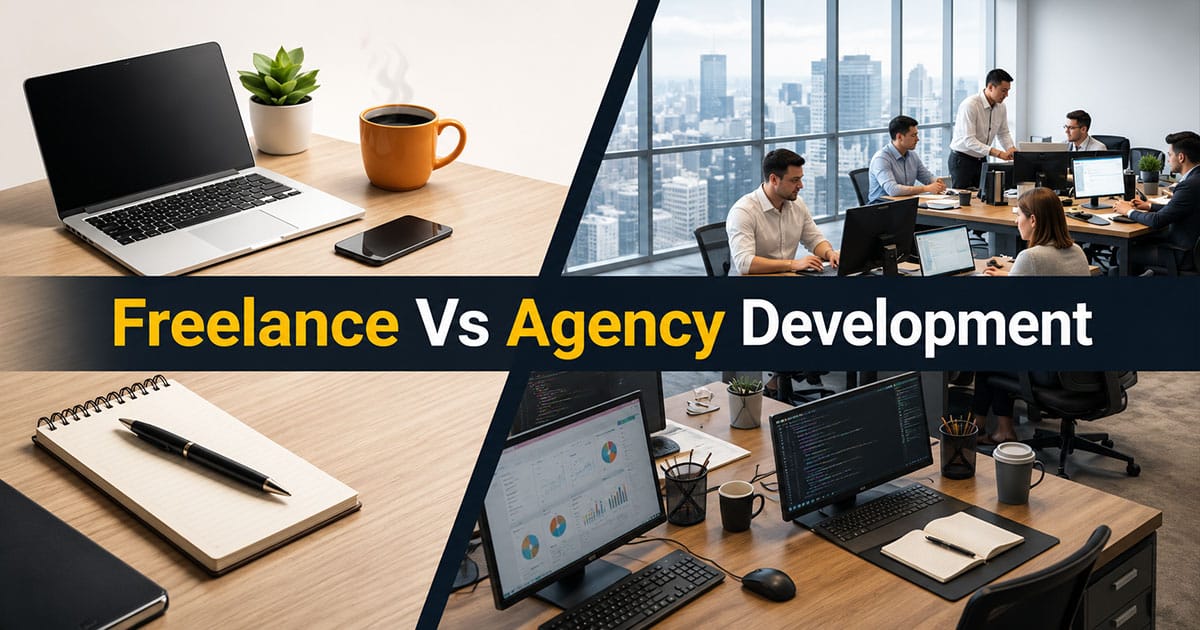
Choosing between freelance vs agency development remains one of the most important decisions for founders, small business owners, and product teams in 2026. The answer shapes your budget, timeline, and ultimately the quality of your web apps, SaaS platforms, mobile applications, and internal tools.
Both models serve different problems rather than one being universally superior. Freelancers work independently and offer cost-effective solutions for focused tasks. Web development agencies bring multiple team members under one roof with structured workflows and broader expertise. The guide ahead compares cost, skill set, communication, project management, scalability, and quality to help you decide.
Expect practical examples throughout. A $10k landing page has different requirements than a $250k SaaS build, and the comparison points differ accordingly.
What Is Freelance Development
Freelance development refers to an independent professional working project-by-project or on an hourly basis without permanent organizational ties. Most freelancers operate as solo practitioners, handling their own time tracking, billing, and client relations.
Common freelance developer profiles include:
- Solo full-stack developers working across frontend and backend
- Frontend specialists focused on React, Vue, or Angular
- Backend and API experts building server infrastructure
- Mobile app developers specializing in React Native or Flutter
- DevOps contractors managing deployment pipelines
Typical engagement formats in 2026 include Upwork and TopTal contracts, direct referrals, part-time retainers, and short-term gigs lasting 2 to 12 weeks. Many freelancers juggle multiple clients simultaneously, which impacts availability and focus.
A practical example: hiring a freelance React developer in New York at ~$90/hour to build a marketing site for a product launch. Direct communication with the developer enables quick decisions, and the engagement wraps in 3 to 4 weeks.
What Is Agency Development
An agency development provider is an organization that supplies a coordinated team: project managers, UX/UI designers, frontend and backend developers, QA specialists, and sometimes DevOps engineers and business analysts.
Agencies range from boutique operations with 5 to 15 developers handling $30k to $150k projects, to larger firms with 50+ developers managing $250k or higher enterprise builds.
Typical service scope includes:
- Discovery workshops to define requirements and architecture
- Iterative development sprints, usually 2-week cycles
- Formal quality assurance and testing phases
- Deployment and post-launch support
Consider a B2B SaaS platform built over 6 to 9 months by a software development agency. Weekly sprints deliver incremental progress. A project manager oversees communication, and monthly invoices keep budgeting predictable. Agencies work through structured processes that reduce single points of failure.
Key Differences Between Freelance And Agency Development
Before examining each factor in detail, a synthesis of the core differences helps frame the decision. Freelancers operate as single points of accountability where all decisions, code, and communication flow through one person. Agencies distribute accountability across roles and processes.
Factor | Freelance Development | Agency Development |
|---|---|---|
Cost | $50 to $150/hour | $100 to $250/hour |
Team Size | Single practitioner | 5 to 20+ specialists |
Risk Profile | Single-person risk (illness, availability) | Organizational risk (staff turnover, process overhead) |
Speed for Small Tasks | Fast, minimal overhead | Slower, requires formal scoping |
Expertise Breadth | Deep in one or two areas | Multi-disciplinary coverage |
Redundancy | None, work pauses if unavailable | Team can reassign members |
Long-Term Fit | Episodic needs (2 to 8 weeks) | Multi-year product roadmaps |
Project Minimum | No formal minimum | Often $15k to $25k+ |
Cost And Pricing Model
Cost is the most visible factor but not the only one. Understanding pricing structures helps avoid surprises.
Freelance pricing structures:
- Hourly rates: $50 to $150 per hour depending on geography, stack, and seniority
- Daily rates: Often 6 to 8 hours billed daily for retainers
- Fixed-price milestones: Common for discrete deliverables like “build a landing page for $3k to $8k”
Agency pricing structures:
- Blended hourly rates: $100 to $250 per hour for combined team output
- Per-sprint billing: $5k to $20k per 2-week sprint
- Monthly retainers: $10k to $30k per month for ongoing development
- Fixed-fee scopes: Rarely under $15k to $25k due to discovery and overhead costs
Hidden costs to consider: Choosing between different software development pricing models also shapes where unexpected expenses show up over the life of a project.
- With freelancers, you play de facto product owner and project manager, which consumes internal time
- With agencies, change request fees and extended discovery phases can add expense
- Coordinating multiple freelancers creates integration risk and management overhead
Budget scenario: A custom marketing website might cost $3k to $8k with a freelancer over 3 to 4 weeks, versus $15k to $30k with an agency over 6 to 8 weeks including UX/UI, development, QA, and web design; broader custom software development cost estimates will scale from there as complexity increases.
Skill Set And Expertise
Both freelancers and agencies can deliver high quality work. The difference lies in depth versus breadth.
Freelancers focus on one or two areas of specialized expertise. A Shopify expert, Laravel backend specialist, or React Native developer brings deep knowledge within their domain. However, they typically lack surrounding roles like UX research, quality control, or DevOps automation.
Agencies offer multi-disciplinary teams. UX researchers, UI designers, frontend and backend developers, QA engineers, and sometimes product strategists work under one roof. Agencies handle complex architectures, multi-system integrations, and regulated compliance requirements like HIPAA or GDPR, so knowing how to choose a custom software development partner becomes critical when stakes are high.
Example favoring freelancers: A startup needs to optimize a PostgreSQL database causing slow reports. A specialized freelancer DBA finds inefficient queries, adds indexes, and reduces query time by 60%. An agency might take longer to onboard into the specific problem.
Example favoring agencies: A B2B company needs Salesforce integration, a mobile app for field teams, a complex approval workflow, and GDPR compliance. An agency coordinates UX, design, backend, mobile, and compliance work in parallel. A single freelancer cannot deliver this breadth.
Communication And Collaboration
Communication style often matters more than raw coding speed for project success.
Freelancer communication:
- Direct 1:1 communication via Slack, Teams, or email enables direct collaboration
- Decisions happen fast without hierarchy
- Time zone misalignment can create delays if hiring globally
- Freelancers managing different clients may have varying response times
Agency communication:
- Account managers or project managers serve as primary contacts
- Structured meetings include weekly standups and sprint reviews
- Documented decisions reduce ambiguity
- Communication layers may slow tiny requests
For global hiring, Eastern Europe offers a 5 to 8 hour offset from US clients. Latin America provides 0 to 3 hour offsets. Both models work globally, but agencies typically handle time zone coordination through their PM infrastructure.
Common collaboration tools include GitHub for code, Jira or Linear for task tracking, Figma for design, and Slack for daily communication. Freelancers often use lighter tooling while agencies enforce structured workflows, especially in offshore software development engagements where time zones and culture add complexity.
Project Management Approach
Project management is often the real differentiator between freelance and agency development.
Freelancers may self-manage smaller tasks but typically need the client to prioritize backlog, define scope, and coordinate with other vendors. Without internal technical knowledge or product leadership, clients risk scope creep and unclear success metrics.
Agencies typically follow formal processes: discovery phase lasting 2 to 3 weeks, requirements documentation, sprint planning, weekly demos, retrospectives, and formal change control. Many agencies adopt Scrum or Kanban formally.
Your role differs by model. With freelancers, expect more hands-on coordination and daily decision-making. Agencies reduce management burden but require structured input at key milestones like sprint reviews and scope changes.
Scalability And Resource Availability
Scaling means adding capacity quickly when product scope grows or timelines shift.
Freelancers are constrained by personal bandwidth, typically 20 to 40 billable hours per week. Ramping up requires either extending hours, which risks burnout, or bringing in other contractors, which creates coordination complexity.
Agencies offer scalability advantages. They can add developers, QA engineers, or designers within days or weeks assuming bench capacity. Parallel work streams allow faster delivery for bigger projects, mirroring the principles used when scaling engineering teams for growth.
Concrete scenario: A startup secures Series A funding and needs to double development speed before a Q4 2026 launch. A freelancer either extends hours or onboards a second contractor, and the client now manages two people. An agency adds another developer to the sprint within days using established processes.
Risk management also differs. Agencies can reassign team members without stopping work. A freelancer’s illness or unavailability pauses the project entirely.
Quality And Reliability
Quality varies widely across both models. Reputation, references, and process matter most.
Evaluating freelancer quality:
- Request code samples, live product links, and GitHub activity
- Check client reviews and references for similar tech stacks
- Assess consistency through a small paid pilot project
- Quality can be excellent but depends on one person’s discipline
Agency quality assurance: Robust QA often sits alongside consistent UX, sometimes supported by formal SaaS design systems that keep large products coherent as they grow.
- Formal QA processes include automated tests and code reviews
- Staging environments and documented deployment checklists reduce production issues
- Service-level agreements define response times and bug resolution timelines
- Contractual guarantees provide accountability
Reliability concerns include deadlines, post-launch support, and handling production bugs. The risk of a freelancer going offline mid-project is real. Mitigation strategies include milestone-based payments via escrow, regular code pushes to a repository you control, and maintained documentation.
Pros And Cons Of Freelance Development
The freelance model offers distinct advantages and limitations depending on project requirements.
Pros | Cons |
|---|---|
Lower cost at $50 to $150/hour | Limited capacity, single person |
High flexibility for scope changes | Single point of failure |
Direct communication with developer | Variable reliability |
Speed for small projects and one off tasks | Less formal QA |
Niche expertise in specialized areas | Client must manage scope and priorities |
Low commitment, easy to try multiple freelancers | Challenging to coordinate multiple freelancers |
Creative freedom in approach | Legal and compliance concerns harder to standardize |
Pros And Cons Of Agency Development
Agencies suit businesses seeking a long-term partner with structured delivery and built-in redundancy.
Pros | Cons |
|---|---|
Complete team under one roof | Higher cost at $100 to $250/hour |
Mature structured processes | Longer onboarding and discovery |
Project management built-in | Communication layers may slow small requests |
Easier scaling with bench capacity | Less flexibility for one off projects |
Stronger QA and testing infrastructure | Minimum engagement thresholds often $10k+ |
Continuity when staff change | May prioritize larger clients |
Better alignment with multi-year roadmaps | Process overhead for simple jobs |
Which Projects Suit Freelance And Agency Development
Choosing between a freelance web developer and an agency depends on project complexity, business goals, and workflow preferences. From simple tasks to large-scale software project execution, the right fit impacts outcomes significantly.
Small Projects And One-Off Tasks
Freelancers suit one-off tasks like minor website fixes, landing pages, or basic web development updates. A freelance web developer can deliver quickly with direct communication and flexible execution. Small business owners and teams running their own businesses often prefer this model for cost efficiency and faster turnaround. Freelancers work independently, making them ideal when project scope is limited and requirements are clearly defined.
Projects Requiring Flexibility And Speed
Projects that demand quick iteration and adaptability benefit from freelancers. Many freelancers manage their own schedule, allowing faster adjustments and immediate execution. This model supports better work life balance for both clients and developers, especially in short-term engagements. Freelancers can pivot quickly without structured delays, making them effective for dynamic and evolving requirements.
Creative And Niche Projects
Niche projects that require specialized expertise often align well with freelancers. Whether it involves a unique marketing strategy or creative web design, freelancers bring focused skills. Their ability to work closely with clients helps refine ideas quickly. This setup works well when the project demands innovation, experimentation, or a personalized approach without involving multiple stakeholders.
Large-Scale And Complex Projects
High project complexity often requires agencies. A software project involving multiple systems, integrations, or ongoing development needs structured workflows and coordinated teams. Agencies operate with defined processes, making them suitable for long-term and larger projects. They ensure consistency, quality control, and scalability, which individual freelancers may find difficult to manage alone, particularly when building flexible custom software solutions that must evolve with the business.
Marketing And Growth-Focused Projects
Projects tied to growth, branding, or campaigns often fit agencies better. A marketing agency provides strategic direction, execution, and performance tracking under one system. When businesses aim to scale, agencies align development with broader marketing strategy goals, often supported by strategic tech consulting services. This approach ensures consistency across channels and supports long-term business growth beyond isolated project delivery.
How To Choose Between Freelance And Agency Development
The right choice depends on specific project parameters. Use the following framework to match your situation, similar to how you might weigh hiring developers vs outsourcing when deciding on a broader resourcing strategy.
Small Projects And Quick Tasks
Freelancers excel here. Clear scope like “build a landing page” or “fix this bug” combined with low budgets and rapid execution favor the freelance model. Agency minimum engagement thresholds often exclude projects under $10k to $15k.
Freelancers often act as their own boss, enabling faster decisions and direct involvement in execution. Key factors like speed and simplicity matter here. With fewer layers, clients coordinate communication easily and move from idea to delivery without delays.
Long-Term Product Development
Agencies provide better support. Multi-year roadmaps require team stability, continuity, and evolving scope management. Switching freelancers repeatedly introduces friction, consistency risk, and knowledge loss, whereas a structured agency can guide full SaaS product development from build to scale.
Agencies build structured career path roles within teams, ensuring continuity across projects. Dedicated project managers coordinate communication while specialists handle execution. This setup keeps key factors like consistency, scalability, and long-term alignment under control throughout the product lifecycle.
Complex And Multi-Disciplinary Projects
Agencies become necessary when projects require UX, design, backend, frontend, mobile, QA, and compliance expertise working together. A single freelancer cannot deliver across these disciplines, and coordinating multiple freelancers creates integration challenges.
Agencies manage multiple specialists through unified workflows, reducing coordination gaps. They handle content creation, development, and testing together, ensuring alignment. This approach helps potential clients avoid fragmentation while maintaining quality across complex deliverables and interconnected systems, which is especially important for scalable SaaS application development.
Budget-Constrained Projects
Freelancers offer cost efficiency for limited budgets between $5k and $25k. Project based pricing helps control costs. Agencies rarely bid below $15k to $25k due to overhead, though boutique agencies might flex for smaller engagements.
For budget-focused decisions, key factors include flexibility and resource allocation. Freelancers provide direct involvement without overhead costs. Businesses can allocate savings toward content marketing, SaaS development budgets, or growth initiatives, maximizing value while maintaining essential development progress within financial limits.
Scaling And High-Growth Projects
Agencies can ramp capacity quickly. When a startup suddenly needs to double velocity or add a second product team, agencies staff up within weeks using established onboarding processes. Freelancers create coordination complexity when scaled beyond one or two people.
Agencies streamline scaling by coordinating communication across teams and maintaining structured workflows. They reduce dependency on individual contributors and ensure consistent output. This model supports potential clients aiming for rapid expansion while maintaining stability, quality, and predictable delivery timelines, often underpinned by deliberate SaaS scalability strategies.
Why Choose GainHQ For Development Projects
GainHQ delivers custom software development services with structured, scalable delivery tailored to each unique business need. Instead of juggling multiple freelancers or managing other projects internally, teams get a dedicated partner focused on execution and results. GainHQ balances flexibility with reliability, allowing businesses to scale without working long hours or sacrificing quality.
Clients benefit from working one-on-one with experts while still accessing a full team when needed. This hybrid approach ensures faster delivery without coordination issues common in remote work setups. GainHQ follows strict industry standards, ensuring consistency, security, and performance across every project.
By reducing time spent managing resources and aligning development with business goals, GainHQ enables companies to handle more projects efficiently while maintaining high-quality outcomes, similar to the transformations seen in many of its custom software case studies.
Frequently Asked Questions
Can I Use Both Freelancers And An Agency On The Same Project?
Yes, a hybrid approach can work when roles are clearly defined. Agencies can handle core architecture, project management, and quality assurance, while freelancers contribute to specialized or short-term tasks. Clear ownership, documentation, and communication are essential to avoid overlap, delays, or integration issues, much like balancing in-house vs outsourcing software development across a broader portfolio.
How Do Contracts And IP Ownership Differ Between Freelancers And Agencies?
Freelancer contracts vary widely and may require careful review to ensure intellectual property transfer. Agencies usually provide structured agreements with defined IP ownership, confidentiality clauses, and liability coverage. Businesses should always confirm that final deliverables and source code are fully owned after project completion.
What Happens If My Freelancer Or Agency Disappears Mid-Project?
With freelancers, this risk can be higher due to limited backup resources. Agencies reduce this risk by having multiple team members who can step in if needed. To protect your project, maintain proper documentation, access to code repositories, and milestone-based payments.
How Long Does It Usually Take To Start A Project With A Freelancer Vs An Agency?
Freelancers can often start quickly, sometimes within days, due to fewer formalities. Agencies typically require onboarding, discovery sessions, and planning, which may take one to three weeks. However, this structured start often leads to smoother execution and fewer issues later, as shown in many build vs buy custom software case studies where deeper discovery avoided costly misalignment.
How Can I Evaluate Technical Quality If I Am Not A Developer?
Focus on past work, client reviews, and case studies. Ask for code samples or product demos if possible. Agencies may provide standardized processes and QA practices, while freelancers rely more on individual expertise. Clear communication and small test tasks can also help validate quality before full commitment, and educational resources like the GainHQ software development blog can further sharpen your evaluation criteria.