Product discovery has shifted from a one-time upfront step to a continuous capability embedded in modern product teams. The contrast is clear: Slack’s 2023 AI launch achieved rapid 50 percent beta adoption through tight discovery loops, while Microsoft’s Tay failed within 24 hours due to poor pre-launch insight. Leaders like Marty Cagan and Teresa Torres advocate ongoing discovery, with empowered teams and weekly customer touchpoints replacing outdated waterfall approaches. Data supports the shift.
Productboard reports over 40 percent feature adoption with weekly user engagement versus 18 percent with quarterly cycles, while SVPG finds continuous discovery cuts time-to-market by 30 percent and churn by 25 percent. This article breaks down discovery phases, workflows, research methods, metrics, pitfalls, tools, and practical implementation guidance for product teams.
What Is Product Discovery
Product discovery is the investigative process of deeply understanding customer needs, validating opportunities, and de-risking potential solutions before committing significant resources to building. Discovery answers the question of whether you are building the right thing, while delivery focuses on building the thing right.
Discovery differs fundamentally from delivery in its purpose and methods. While delivery teams execute on validated plans with speed and quality, the discovery process probes viability through research, experimentation, and customer feedback. Product teams use discovery to evaluate whether a solution addresses a real market need and whether users will actually adopt it.
Discovery supports product strategy by informing prioritization and roadmap decisions. For example, a team might evaluate a new onboarding flow by analyzing product analytics showing 60 percent drop-off rates. Those insights lead to targeted experiments that could boost activation by 15 percent. Roadmaps shift from feature lists to outcome-based sequences when grounded in discovery evidence. A senior product manager uses discovery findings to justify why certain initiatives matter more than others, connecting user feedback to business objectives.
Product Discovery Phases: Step By Step
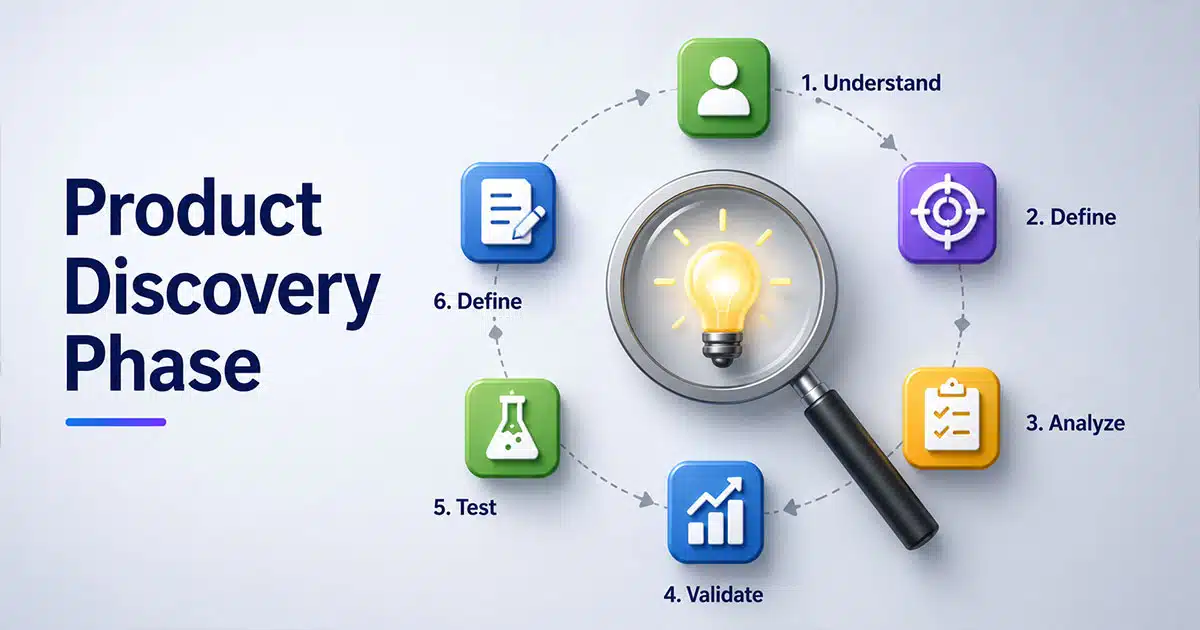
Effective product discovery typically moves through recurring phases closely related to product discovery frameworks like the Double Diamond model or continuous discovery loops. The Double Diamond structures discovery into divergent and convergent thinking phases: Discover for broad exploration, Define for focus, Develop for ideation, and Deliver for validation.
This article focuses on six pragmatic phases: Align, Explore, Synthesize, Ideate, Test, and Decide. These phases are iterative rather than strictly linear. Teams loop back based on learnings, running weekly cycles or returning to earlier phases when new information emerges.
Phase 1: Alignment On Outcomes And Constraints
Alignment establishes shared understanding of business goals, target user segments, time and budget constraints, and success metrics before research begins. Without alignment, teams risk pursuing opportunities that do not connect to what the business needs.
Concrete outcome metrics make this phase tangible. Aim for goals like “increase weekly active users by 15 percent in Q3 2026” or “reduce onboarding time by 20 percent.” Spotify’s squad model uses alignment sessions that yield 40 percent faster prioritization according to internal case studies.
Typical activities include stakeholder interviews, reviewing company OKRs, analyzing existing product analytics, and mapping out assumptions. Capture everything in a lightweight one-page discovery brief that team members can reference throughout the cycle.
Involve engineering, design, and go-to-market teams in this alignment. A 2023 Nielsen Norman Group study shows diverse teams surface 2.5 times more unique insights. Timebox alignment to two or three days and revisit it at each major discovery milestone to prevent scope drift. The Standish Group CHAOS Report 2023 notes 35 percent of projects fail from poor alignment.
Phase 2: Problem Exploration And User Research
This discovery phase immerses teams in user contexts through qualitative and quantitative research methods. The goal is understanding jobs to be done, pain points, and the circumstances surrounding user problems.
Common methods include customer interviews, diary studies, product analytics reviews, and customer support ticket analysis. For example, interviewing new users within their first seven days post-signup often reveals setup barriers that surveys miss entirely.
Nielsen Norman Group norms recommend five to twelve in-depth interviews per key segment to reach basic pattern recognition. Research shows 80 percent of usability issues emerge in the first five sessions. This makes user research efficient when done correctly.
Avoid biases by recruiting beyond friendly promoters. Aim for 30 percent detractors in your participant mix. Record 90 percent of sessions when possible and triangulate interview data with behavioral analytics. Interviews predict actual behavior only 60 percent of the time according to 2022 NN/g research, so combining methods matters.
Phase 3: Synthesis, Framing, And Prioritization Of Opportunities
Teams move from raw data to clear opportunity areas by clustering insights, mapping pain points, and crafting testable problem statements. Vague problems lead to vague solutions.
Collaborative workshops help group observations into themes and align on which problems are most critical. Use the opportunity solution tree framework developed by Teresa Torres to connect desired outcomes to specific opportunities and potential solutions.
Well-framed opportunities are specific and testable. Instead of “improve onboarding,” frame it as “trial users fail 70 percent of workspace setups within 15 minutes.” Productboard notes teams using opportunity trees achieve 50 percent better alignment on top problems.
Prioritization requires explicit trade-offs. Consider business value (revenue potential), user severity, and feasibility risk when choosing which opportunities move forward to ideation. Not every problem deserves a solution right now.
Phase 4: Ideation And Concept Development
Ideation is structured creativity. Teams generate many solution ideas, sketch concepts, and select a small set to prototype. This phase emphasizes divergent and convergent thinking in rapid succession.
Practical techniques include design studios, Crazy 8s (eight sketches in eight minutes from Google Ventures), and co-creation sessions with real users. Keep sessions short and focused on the framed opportunities from Phase 3.
Capture good ideas in low-fidelity formats first. Hand sketches, simple wireframes, and quick user flows minimize sunk cost and encourage bold thinking. Teams that start with high-fidelity designs often anchor on early concepts rather than exploring the solution space.
Use simple prioritization frameworks like RICE (Reach, Impact, Confidence, Effort), a value/effort matrix, or structured MVP feature prioritization methods to select two or three concepts for testing. Cross-functional participation matters here. Engineers joining ideation surface 40 percent of infeasible ideas early according to Atlassian, preventing wasted effort on concepts that cannot be built.
Phase 5: Prototyping And User Validation
Prototyping transforms top concepts into testable representations. These might be clickable prototypes in Figma, Wizard-of-Oz experiences with manual simulations, or lightweight minimum viable product (MVP) versions in software development.
Match fidelity to risk. High-risk product bets warrant richer prototypes, while incremental improvements can be validated with simpler experiments or copy changes. Usability testing with five to eight participants per round uncovers 85 percent of major issues according to Nielsen Norman Group research.
Validation methods include moderated usability tests, unmoderated testing platforms like UserTesting, A/B tests through tools like Optimizely, concierge tests where you manually deliver the service, and choosing appropriately between POCs, prototypes, and MVPs. Each method suits different questions and confidence levels.
Measure task completion rates, time on task, prototype NPS scores above 7, and qualitative confidence ratings during validation. For statistical rigor in experiments, aim for 95 percent confidence with minimum samples of 100 to 300 for SaaS contexts. Run at least two or three iteration rounds for high-impact features.
Phase 6: Decision Making, Roadmapping, And Handover
This phase turns validated learning into clear product decisions, technical roadmap updates aligned with product strategy, and handover to delivery teams. The goal is minimal ambiguity about what happens next.
Document key learnings, decision rationales, and explicit statements about what will be shipped, what will be parked, and what hypotheses remain open. Short decision reviews with key stakeholders help agree on scope and key metrics before moving to delivery.
Avoid watermelon metrics where everything looks green externally but red internally. Tie decisions back to the outcome metrics defined in Phase 1. Artifacts like lean business cases or one-page product briefs help engineering and design plan solution delivery efficiently.
Decisions should feed back into your understanding of constraints and outcomes, closing the loop and informing the next discovery cycle. Atlassian emphasizes bi-directional links between discovery and delivery that reduce handover friction by 50 percent.
How To Design A Repeatable Product Discovery Workflow
While phases describe what happens, the workflow describes how teams manage cadence, ownership, and rituals around discovery. A repeatable workflow prevents discovery from becoming sporadic.
Design a workflow that runs in parallel to delivery work. This avoids feast-or-famine discovery cycles that only happen before big projects. Continuous discovery means always having fresh user insights informing decisions, much like a structured startup software development process that embeds learning into every phase.
Embedding Discovery Into Weekly And Quarterly Rhythms
High-performing teams run at least one customer touchpoint per week. Teresa Torres recommends one interview per product trio (product manager, designer, engineer) weekly to maintain continuous product discovery habits.
A concrete weekly cadence might look like this: Monday analytics review and opportunity prioritization, Wednesday customer interviews with five to eight participants across segments, Friday synthesis and next-step planning. This rhythm builds discovery into normal operations rather than treating it as special project work.
Quarterly planning should incorporate discovery outcomes instead of treating roadmaps as fixed wishlists. Dynamic product discovery means insights from one quarter inform priorities for the next. Use recurring calendar blocks and shared agendas to turn discovery from ad hoc activity into a stable habit.
Defining Roles And Collaboration Patterns
While the product manager often orchestrates discovery, designers, engineers, data analysts, and customer facing teams should actively participate. Discovery benefits from diverse perspectives.
Collaboration patterns vary by organization. Common approaches include PM plus designer co-leading interviews, engineers joining every second session to understand user context, and support teams feeding patterns from tickets. Sales teams often hold valuable insights about why deals close or fall through.
Address common questions like “who owns product discovery?” and “who speaks to customers?” with pragmatic working agreements per squad. A product discovery coach might help establish these norms in larger organizations. Document simple agreements to avoid confusion and re-negotiation every cycle.
Connecting Discovery To Delivery Without Losing Context
The risk of throwing insights over the wall means delivery teams only see tickets without the reasoning behind them. This disconnect leads to misinterpretation and rework, similar to how fragmented tools in a build-vs-buy custom software decision case study created operational inefficiencies before being addressed holistically.
Practical handover practices include sharing highlight reels of user sessions, concise problem briefs, and key experiment learnings with the full delivery team. Keep discovery artifacts linked to user stories or tasks in your issue tracking system.
Involve delivery teams early in discovery so by the time features are prioritized, context is already well understood. Engineers who observe user testing understand the problem differently than those who only read requirements.
Scaling Discovery Across Multiple Teams
Multiple squads running discovery independently risk duplicated work and conflicting insights about shared user segments. Coordination becomes essential as organizations grow.
Approaches for scaling include shared opportunity backlogs, centralized insight repositories, and regular cross-team discovery reviews. Quarterly cross-squad demos where teams present top insights, experiments, and engineering team scaling strategies (not just shipped features) build organizational learning.
Consistent tagging or taxonomy for insights makes them searchable and aggregable across the organization. Without taxonomy, valuable feedback gets buried and teams repeat research others have already completed.
Governance, Ethics, And Compliance In Discovery
Responsible discovery respects privacy laws like GDPR in the EU and CCPA in California along with internal data policies. User trust depends on ethical research practices.
Guidelines for handling user data during research include clear consent processes, anonymization of PII, secure storage, and limited access to recordings and notes. Sensitive domains like healthcare or finance require extra care and review.
Create a lightweight research ethics checklist that product teams follow before starting any new discovery initiative, drawing on ongoing guidance from resources like the GainHQ blog on software and product practices. This protects both users and the organization.
Research Methods And Tools Across Discovery Phases
Each discovery phase benefits from specific research tools and methods. Picking the right ones accelerates learning while managing cost. Mix quantitative and qualitative research to avoid relying on single evidence types.
Customer Interviews And Contextual Inquiry
Semi-structured interviews and contextual inquiry serve as core methods for Phase 2 exploration and Phase 5 validation. They reveal the “why” behind user behavior that analytics cannot capture.
Plan sessions by recruiting five to twelve participants per segment, creating an interview guide focused on recent behavior (not hypothetical opinions), and preparing open questions. Avoid leading prompts and probe with “why” questions to uncover deeper motivations.
Analyze interviews quickly by tagging notes, pulling out themes, and recording highlight clips. Jobs to be done frameworks help structure what you learn about user motivations and desired outcomes.
Surveys And Quantitative Feedback
Surveys validate problem prevalence and measure satisfaction across larger samples after qualitative discovery establishes the right questions to ask. They provide quantitative data to complement interview insights.
Best practices include targeting specific cohorts, keeping surveys short, and mixing closed-ended items with a few open questions. Standard product metrics like CSAT and NPS serve specific purposes but do not replace deeper market research.
Run surveys after experiments to quantify whether new workflows significantly reduce friction. Typeform research shows 15 percent lift in response quality when including open-ended questions.
Product Analytics And Behavioral Data
Analytics platforms reveal what users actually do inside the product, complementing self-reported customer feedback. Funnels, retention curves, and cohort comparisons expose where problems exist.
Standard analyses include feature adoption funnels and cohort comparisons. For example, discovering that only 25 percent of trial users complete a core action within 48 hours prompts deeper qualitative investigation.
Instrument events correctly with a clear tracking plan. Noisy data and misinterpretation lead to wrong conclusions about user behavior and business viability risk.
Usability Testing And Prototype Evaluation
Usability tests validate whether real users can successfully understand and complete tasks with a proposed solution. They reduce usability risk before full development investment.
Moderated approaches let you probe deeper on confusing moments. Unmoderated approaches scale better for larger samples. Five to eight participants per round quickly uncover major issues. Write realistic tasks that reflect actual use cases.
Run tests iteratively with at least two rounds for high-impact features. Store findings, videos, and resolved issues centrally to avoid repeating the same mistakes.
Experiments, A/B Tests, And Feature Flags
Experiments validate behavioral impact at scale during the overlap between discovery and delivery. They answer whether changes actually improve outcomes and complement Lean Startup MVP practices focused on validated learning.
A/B testing basics include control versus variant comparisons, appropriate sample sizes, statistical significance, and avoiding “peeking” at results too early. Run tests for minimum two weeks to capture natural behavior variation.
Feature flags enable safe rollouts, holdback groups, and quick rollbacks. Pair experimental quantitative data with qualitative follow-ups to understand the reasoning behind observed behavior changes. A viable solution proves itself through both numbers and user explanations.
Metrics, Decisions, And Reducing Risk In Discovery
Discovery fundamentally reduces uncertainty. Metrics help quantify learning and risk reduction over time. Without measurement, teams cannot tell whether discovery efforts improve decisions.
Defining Clear Success Criteria Per Discovery Initiative
Each discovery project should begin and end with documented success criteria. For example, “validate that at least 60 percent of target interviewees experience this pain weekly” or “achieve a 20 percent improvement in task completion on the prototype.”
Make criteria explicit before running tests to prevent confirmation bias and shifting goalposts. Separate learning goals (understanding) from performance goals (optimization), especially early in discovery.
Outcome Metrics That Guide Discovery Priorities
Outcome metrics typically include activation rate, time-to-value, retention, expansion revenue, and support contact rate. These signals reveal where discovery should focus next.
Low activation points to onboarding discovery. High churn in specific cohorts suggests product market fit problems in that segment. Balance short-term conversion metrics with long-term engagement indicators. Connect quarterly discovery backlogs to specific business objectives and OKRs.
Discovery Health Metrics And Learning Velocity
Measure discovery itself: number of user conversations per week, experiments run per quarter, and time from idea valuable to validated learning. Realistic benchmarks include at least one customer touchpoint per product trio weekly.
Track a small, meaningful set of process metrics that teams can influence. Leaders should use these metrics to support and coach teams, not to police or penalize them.
Decision Frameworks To Reduce Bias
Structured decision frameworks like RAPID or simple decision records reduce individual biases and make reasoning transparent. Document context, options considered, evidence, chosen path, and follow-up checks.
Pre-mortems help anticipate how decisions might fail. Revisit major decisions after launch to evaluate whether expected impact occurred. Recording decisions supports new team members and avoids re-litigating past debates.
Using Data Responsibly Without Overfitting
Avoid overfitting decisions to limited data. Very small A/B tests or feedback from a narrow group of vocal power users can mislead. Combine multiple evidence forms: qualitative insights, quantitative metrics, and market analysis.
Document uncertainty levels and assumptions. Treat discovery outcomes as confidence intervals rather than binary truths. Short-term experiments might indicate positive effects while longer-term retention data tells a different story.
Common Product Discovery Pitfalls And How To Avoid Them
Even experienced teams fall into predictable traps that weaken discovery outcomes. Recognizing these patterns early prevents wasted effort and misguided product decisions.
Jumping To Solutions Before Understanding Problems
Teams often start with a feature idea and search for user data to justify it. Telltale signs include fixed solution roadmaps, minimal problem framing, and stakeholders dictating features rather than outcomes.
Corrective steps include enforcing problem statements, mandating at least a handful of user conversations before committing, and using opportunity trees. CB Insights 2023 data shows 35 percent of startups fail due to solution-first thinking without validating ideas against real market need.
Relying On Anecdotes Instead Of Representative Evidence
Overweighting a single high-profile customer’s feedback as if it represents all users leads to misaligned priorities. The “last call effect” means the most recent conversation dominates planning discussions.
Counter this by segmenting users, tracking who feedback comes from, and comparing individual input to broader analytics and survey data. Visualize feedback volume and themes to prevent dominant anecdotes from overshadowing broader patterns.
Running Discovery As A One-Off Project
Some organizations treat discovery as a large upfront phase before big builds, then stop talking to users. This creates slow adaptation to market trends, outdated assumptions, and large bets with high failure costs.
McKinsey reports 70 percent of products fail due to poor market fit, often from skipped or inadequate discovery. Shift to continuous discovery habits: weekly conversations, lightweight experiments, and rolling opportunity backlogs, and connect these to a clear post-MVP development strategy for sustainable growth. The development process improves when user insights flow continuously.
Overcomplicating Frameworks And Processes
Over-designed frameworks become bureaucratic, discouraging teams in fast-paced environments. Symptoms include excessive templates, long approval chains, and large workshops producing documents but little learning.
Simplify by focusing on core practices: regular user conversations, clear problem framing, and small experiments. Regularly prune processes that do not improve learning outcomes. Tailor frameworks to team size and product maturity.
Ignoring Internal Knowledge And Historical Learnings
Many teams redo market research that colleagues have already run because previous insights were not documented. This repetition wastes time and money while missing opportunities to build on existing understanding.
Maintain a shared research and insight repository with tags, ownership, and summaries. Make repositories usable with concise titles, clear dates, and explicit recommendations. Learn faster by building on what already exists, just as organizations do when they invest in transformative custom software tailored to their workflows.
Tools And Systems To Support Product Discovery Phases
The right tools make discovery easier, faster, and more visible across the company. Process and mindset matter most, but good systems reduce friction.
Centralized Feedback And Insight Repositories
Consolidating feedback from support, sales, in-app surveys, and review sites into a single repository is foundational. Tagging by product area, segment, and theme allows teams to spot patterns and separate good ideas from noise.
Set simple standards for recording insights: source, date, impact assessment, and links to related experiments. Answer questions like “What do mid-market customers say about our onboarding?” in minutes rather than hours.
Research Operations And Participant Management
Structured research operations recruit participants, schedule sessions, and manage incentives without burning out internal teams. Use research panels, in-product prompts, and CRM-based recruiting that comply with privacy regulations.
Track participation history to avoid over-contacting the same users. Templates for consent forms, interview guides, and follow-up communications reduce setup time for each study.
Analytics, Dashboards, And Monitoring
Analytics and monitoring tools provide real-time and historical data informing where to focus discovery. Design concise dashboards around discovery-relevant metrics like funnel drop-offs, feature adoption, and error trends.
Annotate dashboards with discovery activities or notable changes. Periodic dashboard reviews should feed into the opportunity backlog by highlighting problems worth investigating.
Collaboration, Documentation, And Knowledge Sharing
Asynchronous collaboration tools help distributed teams share discovery plans, notes, and outcomes. Maintain a discovery home page per team with links to current opportunities, research plans, and open questions.
Record short video or written summaries after each major discovery phase. Consistent naming conventions and folder structures keep artifacts navigable over time. Focus groups and synthesis sessions benefit from clear documentation.
Security, Privacy, And Compliance Features
Systems storing user research data, recordings, and customer feedback must support strong security controls. Essential capabilities include access control, encryption, secure sharing options, and configurable data retention policies.
Audit logs track who accessed or modified sensitive materials. Regional considerations like data residency matter for companies operating internationally. Continuous integration of security practices protects both users and organizational trust.
How GainHQ Supports Effective Product Discovery Phases
GainHQ strengthens the product discovery process by aligning insights with product management and the entire product development lifecycle. It helps teams identify market opportunities through structured inputs, feeding directly into the product management process and product development process. Teams can map possible solutions, organize solution exploration, and move validated concepts into product delivery with clarity, similar to the structured approach in GainHQ’s successful SaaS launch case studies.
The platform connects discovery with agile development, ensuring delivery systems remain informed by real evidence. It improves coordination across stakeholders, making the delivery process more predictable and efficient. By linking insights to execution, GainHQ reduces gaps between planning and shipping, enabling outcomes like a startup launching a production-ready MVP in 90 days.
With clear visibility into workflows, teams transition faster toward a final solution while maintaining alignment with business goals. The result is stronger outcomes, better prioritization, and a more consistent approach to modern product discovery.
Frequently Asked Questions
How Long Should A Product Discovery Phase Typically Take?
Timelines vary by problem size. Many teams run focused discovery cycles of two to six weeks for a specific opportunity while maintaining ongoing weekly research in the background. Large strategic bets like entering a new market may require multi-month discovery with staged checkpoints. Smaller feature improvements can be validated within a couple of sprints. The key is matching effort to risk level.
Who Should Be Involved In Each Discovery Phase?
A core trio of product manager, designer, and engineer should stay consistently involved across phases to ensure balanced perspectives. Pull in specialists like data analysts, marketing, sales teams, and support staff as needed. These specialists add value during alignment, research phases, and go-to-market planning. Business stakeholders provide context on feasibility risk and value risk that shapes prioritization.
How Do Product Discovery Phases Change In Early-Stage Startups Versus Large Enterprises?
Early-stage startups run leaner, faster cycles with more qualitative research and fewer formal processes. The focus is on validating core problem-solution fit and identifying essential features quickly. Larger organizations need more coordination, governance, and alignment across teams but can adopt the same core phases. The process scales through shared repositories and cross-team reviews. Enterprises benefit from dedicated research operations to keep discovery efficient.
How Can We Balance Product Discovery With Delivery Deadlines?
Adopt a dual-track approach where discovery and delivery run in parallel. Teams research next-quarter opportunities while building currently validated ones. Plan buffer time for discovery inside roadmaps instead of treating it as optional pre-work. Start with small commitments like weekly user conversations and a single experiment per quarter, then scale as business strategy and team capacity allow.
What Is The Best Way To Get Stakeholder Buy-In For Discovery Work?
Present discovery as risk reduction and faster learning. Use concrete data like Gartner 2024 findings that 45 percent of products fail to achieve market fit without adequate discovery. Share short, visual summaries connecting user stories to business metrics. Show how successful product discovery emphasizes rapid experimentation and validating ideas before committing resources. Evidence of designing solutions grounded in real user needs speaks louder than theoretical arguments about process value.