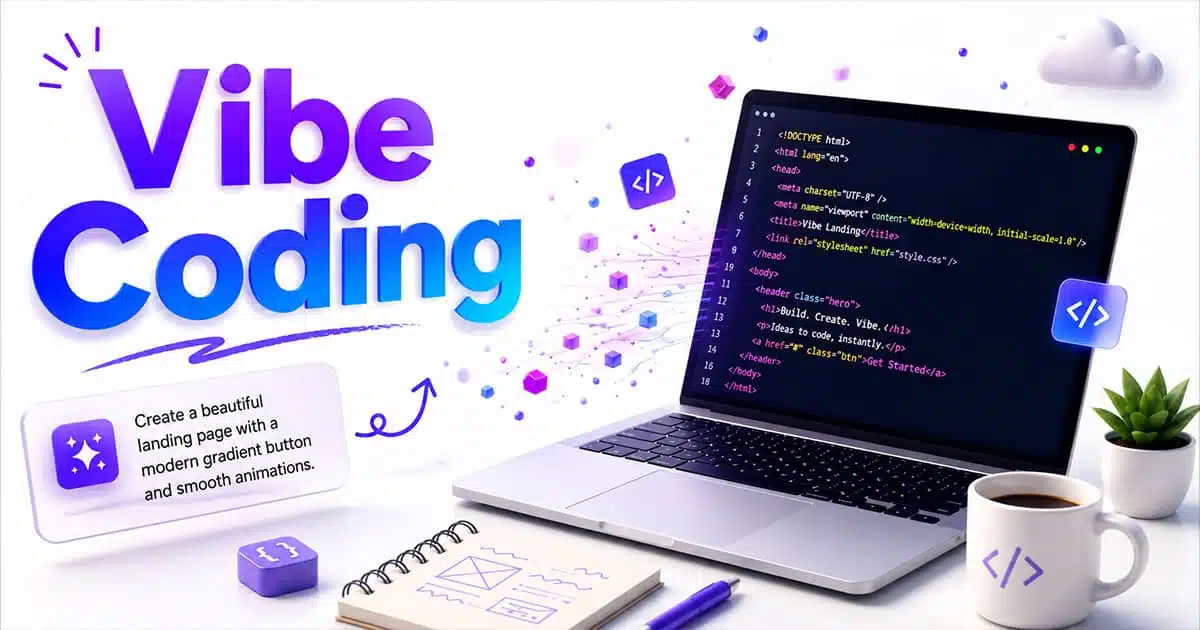
Software development is changing fast. Developers no longer spend hours writing every line of code manually. AI tools can now generate code, fix errors, and even build full applications from simple prompts. That shift introduced a new term into the tech world called vibe coding.
Vibe coding is more than a trend. Startups, indie hackers, SaaS teams, and even non-developers now use AI to build products faster than ever before. But speed also creates new challenges. Code quality, security, scalability, and developer skills still matter.
This guide breaks down everything about vibe coding. You will learn how it works, why it became popular, its biggest benefits, major risks, and how businesses use it in real projects today.
What Is Vibe Coding And Why Is Everyone Talking About It
Vibe coding is a new coding approach where developers use AI tools and natural language prompts to generate code instead of writing code manually. People now create apps, fix error messages, and build functional code with a single prompt. Tools like GitHub Copilot, Cursor Composer, and Replit Agent have changed the vibe coding experience completely. Many non-coders also use generative AI for app creation, rapid prototyping, and throwaway weekend projects.
Developers talk about vibe coding because it feels like a paradigm shift in software development. Instead of manually writing actual code, users can copy-paste stuff, add follow-up prompts, and let large language models handle the heavy work. Some experienced developers embrace exponentials and forget that the code even exists during the vibe coding process. Still, code quality, unit tests, API keys, and coding standards remain important as projects grow and real-world applications become more complex.
How Vibe Coding Works With AI Tools And LLMs
Modern vibe coding depends on AI tools and large language models. Developers now use plain English prompts to create apps, fix bugs, and generate code faster. Tools like GitHub Copilot, Cursor, and Replit Agent changed how software development works for both experienced developers and non-coders.
AI Models Understand Natural Language
Large language models read natural language prompts and convert them into actual code. Developers no longer need to write every function manually. A single prompt can create a login page, API connection, or new feature in seconds.
Modern AI tools also understand existing code and project structure. GitHub says Copilot can generate full functions and suggest code directly inside the editor. Around 68% of developers now use GitHub Copilot or similar AI tools regularly.
Prompts Drive The Coding Process
Vibe coding starts with a text box. Developers describe the idea in plain English. The AI agent then generates functional code based on the request. Follow-up prompts help fix error messages, adjust layouts, or improve code quality.
Many developers use a copy-paste workflow during rapid prototyping. They test stuff, run stuff, and ask the AI to fix random changes quickly. GitHub Copilot users complete tasks up to 55% faster according to recent studies. Over 20 million developers used Copilot by mid 2025.
Human Review Still Matters
AI-generated code can speed up app development, but human review still matters. Large language models sometimes forget context, create security risks, or break coding standards. Unit tests and code reviews remain critical when projects grow larger.
Security reports also show growing risks around exposed API keys and weak code validation. GitGuardian found more than 29 million leaked secrets on GitHub during 2025, partly linked to AI-assisted coding workflows. Experienced developers still need to dig deeper and review the actual code before deployment.
Difference Between Vibe Coding And Traditional Software Development
Vibe coding changes how developers create software. AI tools now generate code from natural language prompts, while traditional software development depends on manually writing code line by line. Both approaches can build functional apps, but speed, workflow, and developer roles differ significantly.
Feature | Vibe Coding | Traditional Software Development |
|---|---|---|
Coding Method | Uses AI tools and natural language prompts | Uses manual coding and detailed programming logic |
Speed | Faster for rapid prototyping and MVPs | Slower but more controlled workflow |
Developer Role | Focuses more on prompts, testing, and feedback | Focuses on writing and managing actual code |
Learning Curve | Easier for non coders and beginners | Requires strong technical background |
Code Generation | AI generates functional code automatically | Developers write every function manually |
Error Handling | AI helps fix error messages quickly | Developers debug issues manually |
Flexibility | Works well for small apps and quick experiments | Better for complex enterprise systems |
Code Quality | Quality may vary without review | More consistent with coding standards |
Security Control | Higher risk of hidden vulnerabilities | Stronger manual security validation |
Workflow Style | Prompt based and conversational | Structured and engineering focused |
Unit Testing | Often added after AI generated code | Usually planned during development |
Existing Code Support | AI reads and updates existing code | Developers handle updates directly |
Best Use Case | Rapid app creation and throwaway weekend projects | Large scale software engineering projects |
Human Oversight | Requires review from experienced developers | Built around direct developer control |
Productivity | Higher developer productivity for repetitive tasks | Better long term maintainability |
Why Vibe Coding Became A Massive Trend In 2025 And 2026
Vibe coding became one of the biggest software development trends. Faster AI tools, better large language models, and rising demand for rapid app creation changed how developers build products. Startups, freelancers, and even non-coders now use AI to generate code faster than ever.
AI Tools Made Development Faster
Modern AI tools reduced the time needed for writing code manually. Developers can now create functional code with simple natural language prompts. A single prompt can build layouts, APIs, dashboards, or even complete app workflows within minutes.
Developer productivity increased sharply after tools like GitHub Copilot, Cursor, and Replit Agent became mainstream. Microsoft reported that GitHub Copilot users finished coding tasks up to 55% faster. More than 77,000 organizations adopted Copilot by early 2026. Faster prototyping helped startups launch MVPs with smaller teams and lower development costs.
Non-Coders Entered Software Creation
Vibe coding also became popular because non-coders could finally build apps without a deep technical background. Users now describe ideas in plain English, paste stuff into a text box, and let AI agents generate actual code automatically.
Large language models lowered the barrier to software engineering. Small business owners, marketers, and creators now build internal tools and side projects without learning complex programming languages first. Stack Overflow surveys show AI adoption among developers crossed 76% in 2025. Many users embrace exponentials and forget that the code even exists during simple workflows. Still, experienced developers remain critical for code quality, unit tests, security reviews, and scalable app development.
Best AI Tools Developers Use For Vibe Coding
Modern vibe coding depends heavily on AI-powered development tools. Developers now use AI agents, code assistants, and large language models to generate code, fix bugs, and build apps faster. Some tools focus on rapid prototyping, while others improve developer productivity inside existing workflows.
1. GitHub Copilot
GitHub Copilot remains one of the most popular AI tools for vibe coding. It works directly inside code editors and suggests actual code in real time. Developers can create functions, fix error messages, and write unit tests with simple prompts.
Microsoft reported that over 20 million developers used Copilot by 2025. Many teams now use it for software development, app creation, and repetitive coding tasks. Copilot also supports multiple programming languages and understands existing code structure well. Experienced developers often use it to speed up workflows without losing control over code quality.
2. Cursor
Cursor became a favorite tool for developers who prefer conversational coding. Cursor Composer allows users to describe features in plain English and generate functional code quickly. The tool can also explain code, rewrite sections, and fix random changes automatically.
Many vibe coding users like Cursor because it feels natural and fast. Developers can copy-paste stuff, add follow-up prompts, and test ideas without manually writing every line. Cursor also supports live preview and direct project editing. That workflow helps startups build MVPs and throwaway weekend projects much faster than traditional software engineering methods.
3. Replit Agent
Replit Agent focuses heavily on non-coders and rapid app development. Users simply explain the project idea in a text box, and the AI agent creates the app structure automatically. The platform handles hosting, deployment, and backend setup inside one workspace.
Replit reported millions of AI-generated projects across its platform by early 2026. Many creators now use it to build internal tools, dashboards, and business apps without a deep technical background. The platform also supports real-time collaboration and quick fixes for functional code. Small teams often choose Replit Agent for fast prototyping and idea validation.
4. ChatGPT
ChatGPT became a major part of the vibe coding process because of its strong natural language capabilities. Developers use it to generate code snippets, debug issues, create APIs, and explain complex concepts quickly. Many users also rely on it for brainstorming new features and fixing broken workflows.
ChatGPT supports many programming languages and works well with existing codebases. Developers often paste stuff directly into the chat and ask for fixes or improvements. The tool also helps teams dig deeper into security issues, coding standards, and code optimization. Its conversational workflow makes software development easier for both beginners and experienced developers.
5. Claude
Claude gained attention because of its strong reasoning and large context window. Many developers use Claude for long projects, large code files, and detailed software engineering tasks. The tool performs well when projects grow beyond simple rapid prototyping.
Claude also helps developers review actual code carefully instead of only generating snippets. Teams use it to analyze code quality, detect logic problems, and improve architecture decisions. Many vibe coding users pair Claude with Cursor or GitHub Copilot during app development. That combination helps balance fast code generation with stronger comprehension and project stability.
Step-by-Step Vibe Coding Workflow
Modern vibe coding follows a fast and conversational workflow. Developers use AI tools, natural language prompts, and live feedback to build apps quickly. Most projects move through four simple stages, from idea generation to testing and code refinement.
Step 1: Describe The Project Idea
Every vibe coding workflow starts with a simple prompt. Developers explain the app idea in plain English inside a text box. The AI tool then generates the first version of the project structure, layouts, or backend logic automatically.
Many developers now skip manually writing boilerplate code for small projects. AI agents can create dashboards, forms, APIs, and authentication systems within minutes. Surveys from Stack Overflow show over 76% of developers used AI tools during software development in 2025. Fast project setup became one of the biggest reasons behind the rise of vibe coding.
Step 2: Generate And Review Code
After the first prompt, the AI begins to generate code based on the request. Developers review the actual code, run stuff locally, and check whether the app works correctly. Most AI tools also explain functions and suggest fixes for error messages.
Follow-up prompts help developers adjust features or improve layouts quickly. Many teams use copy-paste workflows during rapid prototyping. Tools like Cursor Composer and GitHub Copilot also understand existing code and update files automatically. That process improves developer productivity, especially for repetitive software engineering tasks.
Step 3: Test Features And Fix Problems
Functional code does not always mean production-ready code. Developers still need to test features, review security issues, and validate app behavior carefully. Unit tests help detect bugs before deployment and reduce random changes inside large projects.
Security checks became more important as AI-generated code usage increased. GitGuardian reported more than 29 million leaked secrets on GitHub during 2025. Many leaks involved exposed API keys and weak authentication setups. Experienced developers usually dig deeper into the codebase to maintain coding standards and improve code quality before launch.
Step 4: Refine And Expand The App
Most vibe coding projects continue through multiple prompt cycles. Developers add new features, optimize performance, and refine user experience with additional instructions. Large language models can also update existing code without rewriting the entire project manually.
Many startups now use vibe coding for MVP development and internal tools because the workflow feels faster and more flexible. Teams can test business ideas quickly without large engineering resources, especially when they understand what an MVP is in software development. Still, projects often require human oversight as the code grows more complex. Long-term scalability, architecture decisions, and software maintenance still depend heavily on experienced developers.
How To Write Effective Prompts For Vibe Coding
Prompt quality directly affects the vibe coding experience. Clear prompts help AI tools generate cleaner code, better layouts, and fewer errors. Developers who write detailed instructions usually get faster results, stronger code quality, and smoother app development workflows.
Use Clear Project Goals
Strong prompts start with a clear goal. Developers should explain what the app does, who will use it, and which features matter most. Simple natural language works better than vague instructions or random ideas.
AI tools perform best when prompts include context and expected outcomes. For example, asking for “a dashboard with user login and payment tracking” produces better functional code than generic requests. Many experienced developers now treat prompt writing as a core software engineering skill because it improves developer productivity and reduces unnecessary revisions.
Add Technical Details
Specific technical details help large language models generate more accurate code. Developers should mention programming languages, frameworks, database choices, APIs, and design preferences whenever possible. That approach reduces confusion and improves code consistency.
Modern AI agents can also understand existing code structures during vibe coding workflows. Developers often include authentication methods, API keys, responsive layouts, or unit test requirements inside prompts. A 2025 GitHub survey showed that developers using detailed prompts completed coding tasks significantly faster than users relying on short instructions alone.
Break Large Tasks Into Smaller Steps
Large prompts often create messy results. Smaller requests usually produce cleaner and more reliable code. Many developers now divide projects into separate features instead of asking AI tools to build entire apps at once.
For example, teams may first create the login system, then add dashboards, payment systems, and notifications later. That method improves code quality and reduces random changes across the project. Smaller prompt cycles also make it easier to fix error messages and review actual code carefully before deployment.
Use Follow-Up Prompts
First outputs are rarely perfect. Follow-up prompts help developers refine layouts, improve logic, and fix broken features quickly. Most vibe coding workflows depend heavily on back-and-forth conversations with AI tools.
Developers often copy-paste code sections into tools like Cursor Composer or ChatGPT and request improvements in plain English. Follow-up prompts also help AI agents maintain project context as the code grows larger. Many startups use this rapid prototyping workflow to test product ideas faster without manually writing every feature from scratch.
Review And Test Every Output
AI-generated code still needs human review. Developers should test every feature, validate security rules, and check coding standards before launch. Functional code can still contain hidden bugs or weak architecture decisions.
Security experts continue to warn about risks linked to unchecked AI-generated code. GitGuardian reported over 29 million leaked secrets on GitHub during 2025, including exposed API keys and authentication tokens. Experienced developers usually dig deeper into outputs, review unit tests carefully, and optimize existing code before production deployment.
Benefits Of Vibe Coding For Startups, SaaS, And Developers
Vibe coding changed how startups, SaaS companies, and developers build software products. AI tools now reduce manual work, speed up app creation, and simplify rapid prototyping as part of a broader wave of AI in SaaS. Small teams can launch products faster without large engineering budgets or complex development workflows.
Faster Product Development
Vibe coding helps teams build apps much faster than traditional software development methods. Developers can use natural language prompts to generate code, create dashboards, build APIs, and launch MVPs within days instead of months by following modern AI software development practices.
That speed matters heavily for startups and SaaS businesses. Faster releases allow teams to test ideas quickly and collect user feedback earlier. Microsoft reported that developers using GitHub Copilot completed coding tasks up to 55% faster. Many startups now rely on AI agents and large language models to accelerate product launches and improve developer productivity.
Lower Development Costs
Startups often struggle with limited budgets and small engineering teams. Vibe coding reduces the need for large development resources during early-stage app creation and fits naturally into a lean startup software development process. Non-coders can also build internal tools and prototypes without a deep technical background.
AI tools now handle repetitive software engineering tasks like boilerplate code, UI layouts, and database setup automatically. That workflow reduces time spent manually writing basic functions. Small SaaS teams can validate ideas faster before hiring full-scale development teams. Lower development costs also help businesses reduce financial risks during rapid prototyping and product experimentation.
Better Workflow Flexibility
Vibe coding creates a more flexible development process. Developers can update existing code, test new features, and fix error messages quickly through follow-up prompts. Many teams now use conversational workflows instead of rigid coding processes, often blending no-code and custom development approaches.
That flexibility improves collaboration between developers, founders, marketers, and product teams. People can explain ideas in plain English without understanding complex programming languages fully. AI generated code also supports faster iteration cycles during software development. Still, experienced developers remain important for code quality, unit tests, scalability planning, and long term system architecture decisions.
Risks And Limitations Of Vibe Coding
Vibe coding speeds up software development, but it also creates serious risks. AI-generated code can contain hidden bugs, weak security, and poor architecture decisions. Fast app creation may look impressive at first, yet long-term maintenance often becomes difficult without proper oversight.
Weak Code Quality
AI tools can generate functional code quickly, but the output is not always reliable. Large language models sometimes create messy logic, duplicate functions, or outdated programming patterns. Many developers notice random changes inside projects after multiple follow-up prompts.
Poor code quality becomes a bigger issue as the code grows larger. Teams may struggle to maintain existing code when structure and documentation stay inconsistent. Experienced developers usually spend extra time reviewing actual code and refactoring AI-generated sections. Without strong coding standards, vibe coding projects can become difficult to scale and manage over time.
Security Problems
Security remains one of the biggest concerns in vibe coding workflows. AI agents can accidentally expose API keys, generate insecure authentication systems, or create unsafe database queries. Small mistakes may lead to serious data leaks and compliance problems without a strong AI governance framework for SaaS platforms.
Recent security reports show how serious the issue has become. GitGuardian found more than 29 million leaked secrets on GitHub during 2025. Many security experts believe rapid AI-assisted software development increased that risk significantly. Developers still need manual reviews, unit tests, and vulnerability scanning before deploying production apps or SaaS platforms.
Limited Technical Understanding
Many non-coders now build apps with AI tools and natural language prompts. That accessibility feels exciting, but limited technical background often creates hidden problems. Users may launch projects without fully understanding architecture, scalability, or security risks.
AI tools can explain concepts, but they cannot replace deep software engineering knowledge completely. Some developers rely too heavily on copy-paste workflows without reviewing how the code even exists underneath. Problems become harder to fix later when the app grows more complex. Human comprehension still matters heavily during long-term product development and maintenance.
Poor Long-Term Scalability
Vibe coding works well for rapid prototyping and throwaway weekend projects. Larger systems, however, require stable architecture, performance optimization, and structured workflows aligned with emerging custom software development trends. AI-generated projects often struggle when businesses add new features or handle higher traffic volumes.
Many startups move fast during early app development but face technical debt later. Existing codebases can become difficult to update after too many AI generated modifications. Developers may also spend extra time fixing broken dependencies and inconsistent logic. Strong engineering practices remain critical for scalable SaaS products, enterprise systems, and real world applications that require long term stability in a cloud-first future of SaaS development.
Security And Code Quality Challenges In AI Generated Code
AI-generated code helps developers build apps faster, but speed often creates hidden risks. Many vibe coding projects face security flaws, unstable architecture, and inconsistent coding standards, especially when they lack robust AI infrastructure for intelligent applications. Human review still plays a major role in safe and scalable software development workflows.
Security Vulnerabilities Grow Quickly
AI tools can generate functional code within seconds, but security checks often remain weak. Large language models sometimes create unsafe authentication flows, insecure API requests, or exposed API keys inside applications. Many non-coders may not notice those issues during rapid app development.
Security researchers continue to report major risks around AI-assisted coding workflows. GitGuardian detected more than 29 million leaked secrets on GitHub during 2025. Some reports also showed developers accidentally copy-paste sensitive credentials into public repositories while using AI tools. Experienced developers still need manual testing, vulnerability scans, and proper access controls before launching production apps or SaaS platforms.
Code Quality Becomes Hard To Maintain
AI-generated code may work at first, but long-term maintenance often becomes difficult. Many vibe coding projects contain duplicate logic, random changes, inconsistent naming structures, and poor documentation. That problem grows faster as projects scale and new features are added.
Developers also face challenges when AI agents modify existing code without full project comprehension. Unit tests sometimes fail after follow-up prompts because the AI changes unrelated functions unexpectedly. Stack Overflow surveys from 2025 showed many developers still question the reliability of AI-generated code for large software engineering projects. Human oversight remains critical for code quality, scalability, and stable long-term development.
Why Human Developers Still Needed In Vibe Coding
Vibe coding changed software development workflows, but human developers remain essential. AI tools can generate code quickly, yet they still lack deep comprehension, business judgment, and real engineering decision-making. Successful projects still depend heavily on experienced developers and human oversight.
Humans Understand Business Logic Better
AI tools can create functional code, but they often struggle with complex business requirements. Developers understand customer needs, user behavior, and long-term product goals better than large language models. Human judgment still matters during app development and software engineering planning.
Many SaaS platforms require custom workflows, compliance rules, and detailed architecture decisions. AI agents may generate working features, but they cannot fully understand business context like experienced developers can. Teams still rely on human collaboration to align product strategy, scalability, and AI-driven automation in SaaS with customer expectations and the final software solution.
Code Reviews Need Human Judgment
AI-generated code can contain hidden bugs, security risks, or weak logic structures. Human developers review actual code carefully and detect problems that AI tools may overlook. That process becomes more important as the code grows larger and more complex.
Security reports continue to show rising risks in AI-assisted development. GitGuardian detected over 29 million leaked secrets on GitHub during 2025. Developers still need to validate API keys, review authentication systems, and maintain coding standards manually. Unit tests and peer reviews also remain critical for stable and secure software development workflows.
Architecture Decisions Require Experience
Large language models work well for rapid prototyping and repetitive coding tasks. Long-term architecture planning, however, still depends heavily on technical experience. Developers make decisions around databases, scalability, infrastructure, and performance optimization that AI tools cannot fully manage alone.
Poor architecture often creates technical debt later. Many vibe coding projects start fast but become difficult to maintain after multiple follow-up prompts and random changes. Experienced developers usually dig deeper into system design before adding new features or scaling production applications. A strong technical background still separates stable products from unstable ones.
Creativity And Problem Solving Still Matter
Software development is not only about writing code. Developers solve unexpected problems, improve workflows, and create better user experiences. AI tools can assist with suggestions, but human creativity still drives innovation and product direction.
Many real-world applications involve unique edge cases that AI models cannot predict correctly. Developers also adapt faster during changing business conditions and customer feedback cycles. Stack Overflow surveys from 2025 showed that many engineers still trust human expertise more than fully automated AI-generated workflows for critical production systems. Human developers remain the core decision-makers behind successful software products.
Best Practices For Successful Vibe Coding Projects
Vibe coding can speed up software development, but strong workflows still matter. Teams that combine AI tools with proper testing, clear prompts, and human review usually build more stable apps. Successful projects depend on a balance between automation, code quality, and engineering discipline.
Use Clear And Structured Prompts
Clear prompts improve the quality of AI-generated code significantly. Developers should explain project goals, features, frameworks, and expected outputs in simple natural language. Specific instructions reduce confusion and help AI tools generate cleaner functional code.
Many experienced developers now treat prompt writing as an important software engineering skill. Smaller and focused prompts also work better than long requests covering entire applications. Teams often use follow-up prompts to refine layouts, fix error messages, and improve workflows gradually. Better prompt structure usually leads to stronger developer productivity and fewer random changes.
Review Every Code Output
AI tools can generate code quickly, but developers should never trust outputs blindly. Human review remains critical for code quality, security validation, and long-term scalability. Functional code may still contain hidden vulnerabilities or poor architecture decisions.
GitGuardian reported more than 29 million leaked secrets on GitHub during 2025. Many leaks involved exposed API keys and weak authentication systems generated during AI-assisted workflows. Developers should always review existing code carefully before deployment. Code reviews, peer feedback, and manual testing help maintain stable software development standards across growing projects.
Maintain Strong Testing Workflows
Unit tests and performance checks remain essential in vibe coding projects. AI-generated features may break older functions unexpectedly, especially after multiple follow-up prompts. Strong testing workflows help developers detect issues early and reduce future maintenance problems.
Many SaaS teams now combine AI coding tools with automated testing pipelines. Developers often validate APIs, database logic, and security permissions before launch as part of a broader integrate AI into SaaS products strategy. Consistent testing also improves customer experience and application stability. As projects grow larger, proper testing becomes more important than fast code generation alone.
Keep Human Oversight Active
AI tools work best as assistants, not replacements for developers. Experienced developers still guide architecture decisions, optimize performance, and solve complex business problems. Human oversight helps teams avoid weak workflows and unstable project structures.
Large language models can accelerate rapid prototyping and app creation, but they still lack deep comprehension and strategic thinking. Developers understand scalability, customer needs, and long-term maintenance better than AI agents. Many successful startups now combine vibe coding speed with strong engineering practices to build secure and scalable real-world applications.
Real World Examples Of Vibe Coding Applications
Vibe coding already affects real software development workflows across multiple industries. Startups, SaaS companies, freelancers, and non-coders now use AI tools to create apps faster. Many teams rely on large language models for rapid prototyping, automation, and internal product development.
Startup MVP Development
Startups use vibe coding heavily for MVP development and idea validation. Founders can describe app requirements in plain English and let AI tools generate functional code quickly. That workflow helps teams launch products without large engineering departments.
Many early-stage SaaS companies now build dashboards, user authentication systems, and payment flows through AI-assisted coding. Small teams also use GitHub Copilot and Cursor Composer to reduce manually writing repetitive code while still following Lean Startup MVP principles. Faster development cycles allow startups to collect customer feedback earlier and improve products before investing heavily in full-scale software engineering teams.
Internal Business Tools
Businesses often use vibe coding to create internal tools for operations and workflow management. Teams build inventory systems, employee dashboards, reporting apps, and smarter software tools to simplify day-to-day work much faster with AI-generated code.
Non-coders also participate more actively in app creation today. Marketing teams, HR departments, and operations managers can explain requirements directly through natural language prompts. Replit Agent and ChatGPT help businesses reduce development bottlenecks and speed up internal software projects. Many companies now prefer fast, low-cost internal solutions instead of waiting months for traditional development workflows.
Rapid Prototyping Projects
Rapid prototyping became one of the biggest real-world applications of vibe coding. Developers can test product ideas, UI concepts, and workflows within hours instead of weeks, aligning closely with emerging MVP development trends for startups. AI tools simplify app development during early experimentation stages.
Many developers create throwaway weekend projects to validate ideas quickly before building production-ready systems. Teams often copy-paste prompts, adjust layouts, and fix error messages through follow-up conversations with AI agents. Faster prototyping also improves developer productivity because teams spend less time on boilerplate setup and repetitive coding tasks.
Customer Support Automation
Many SaaS companies now use vibe coding for customer support automation projects. Developers create chatbots, ticket systems, AI assistants, and self-service portals much faster with large language models and existing APIs, especially when they follow a clear LLM integration strategy for SaaS platforms.
AI-generated code helps support teams launch automation tools without large software engineering investments. Businesses also integrate natural language workflows into help desks and CRM platforms. Faster deployment allows companies to improve customer response times and reduce manual support workloads. Human oversight still remains important for security, code quality, and customer data protection.
Personal Productivity Apps
Freelancers and solo creators use vibe coding to build personal productivity tools quickly. Many people create note apps, task managers, budgeting systems, and scheduling tools without a deep technical background.
AI agents simplify software development for independent creators who only need functional code for personal use cases. Developers can also customize existing code faster through conversational prompts instead of manually writing every feature. Stack Overflow surveys from 2025 showed strong growth in AI-assisted development adoption among solo developers and independent software creators.
Can Non-Developers Build Apps With Vibe Coding
Yes, non-developers can now build apps with vibe coding. AI tools and large language models allow users to describe ideas in plain English and generate functional code automatically. Many beginners already use vibe coding for internal tools, MVPs, and small business applications.
AI Tools Lower The Entry Barrier
Modern AI tools removed many traditional barriers in software development. Non-coders no longer need deep knowledge of programming languages to create basic apps and workflows, tapping into a fast-growing ecosystem of artificial intelligence software and tools. A simple text box and clear prompts can now generate dashboards, forms, and automation systems.
Tools like ChatGPT, Replit Agent, and Cursor help users create apps faster through conversational workflows. Many platforms also provide live preview, deployment support, and error fixes automatically. Stack Overflow surveys from 2025 showed that AI adoption among non-professional developers increased rapidly as vibe coding became more accessible worldwide.
Plain English Replaces Complex Code
Natural language prompts changed how app creation works for beginners. Users can explain features in plain English instead of manually writing every line of actual code. AI agents then generate code based on those instructions automatically.
Many small business owners now build scheduling systems, CRM tools, and reporting dashboards without a technical background. Follow-up prompts also help users refine layouts, fix error messages, and improve workflows quickly. That process feels easier because people focus more on the idea and less on complex software engineering syntax or framework setup.
Rapid Prototyping Helps Beginners
Vibe coding works especially well for rapid prototyping and small projects. Non-developers can test product ideas quickly before hiring full engineering teams, especially when they apply disciplined MVP feature prioritization. Many users create throwaway weekend projects to validate business concepts or automate repetitive work.
AI-generated code also helps beginners learn software development gradually through experimentation. Users can review existing code, ask questions, and understand how features work step by step. Faster testing cycles allow startups and creators to launch MVPs with lower development costs and fewer technical bottlenecks.
Technical Limits Still Exist
Non-developers can build apps with AI tools, but technical limitations still exist. Large projects often require deeper comprehension of databases, APIs, security rules, and application architecture. AI-generated code may also contain hidden bugs or weak coding standards.
Problems become harder to fix when the code grows larger or more complex. Many users rely too heavily on copy-paste workflows without understanding how the system works underneath. Experienced developers still play a major role in scalability planning, code quality reviews, and production-level software engineering decisions.
Human Guidance Improves Results
Best results usually come from combining vibe coding with human expertise. Non-coders can create functional apps faster when developers review the outputs and improve architecture decisions. Human oversight also helps maintain security, testing quality, and long-term stability.
Many startups now use hybrid workflows where founders handle rapid app creation while developers refine existing code later. That balance improves developer productivity without sacrificing scalability or reliability. Vibe coding makes software development more accessible, but experienced developers still remain essential for serious real-world applications.
Future Of Software Engineering After Vibe Coding
Vibe coding already reshapes modern software engineering workflows. AI tools now handle repetitive coding tasks, generate functional code, and speed up app development dramatically. Future software teams will likely combine human expertise with AI-assisted workflows and global agile and offshore software development benefits instead of relying only on manual coding methods.
Developers Will Focus More On Strategy
Software engineers will spend less time manually writing repetitive code in the future. AI tools already automate boilerplate setup, API creation, debugging, and basic frontend tasks. Developers will focus more on product strategy, architecture, and problem-solving.
Many companies now expect engineers to guide AI workflows instead of only writing code line by line. Prompt design, system planning, and business logic will become more valuable skills. GitHub research also showed strong productivity gains among developers using AI coding assistants regularly during software development projects.
AI-Assisted Development Will Become Standard
AI-assisted workflows will likely become normal across the software industry. Many engineering teams already use large language models for rapid prototyping, code reviews, and feature generation. Tools like GitHub Copilot and Cursor continue to expand quickly across global development teams.
Microsoft reported that more than 77,000 organizations adopted GitHub Copilot by early 2026. Faster development cycles help businesses launch products more efficiently. Many startups now combine AI-generated code with human oversight to improve developer productivity while reducing repetitive engineering tasks.
Human Expertise Will Stay Critical
AI tools can generate actual code quickly, but human developers still remain essential. Large systems require scalability planning, security validation, and long-term architecture decisions that AI agents cannot fully manage alone.
Experienced developers also understand customer behavior, compliance requirements, and real-world business challenges better than AI models. Human review becomes even more important as code grows larger and more complex. Strong technical background and deep comprehension will continue to separate stable software products from risky and poorly structured applications.
Software Jobs Will Evolve
Vibe coding may change software engineering job roles, but it will not eliminate developers completely. Many engineers will shift toward AI supervision, workflow optimization, security management, and product architecture responsibilities.
New roles may also emerge around prompt engineering, AI quality review, and automated system monitoring. Stack Overflow surveys from 2025 showed that most developers view AI as a productivity tool rather than a replacement for human expertise. Developers who adapt to AI-assisted workflows will likely gain stronger career opportunities in the coming years.
Faster Innovation Will Shape The Industry
Vibe coding allows businesses to test and launch ideas much faster than traditional software development methods. Smaller teams can now create apps, validate concepts, and improve products rapidly through conversational AI workflows.
That speed may increase innovation across startups, SaaS companies, and independent creator communities. Non-coders can also participate more actively in app creation and automation projects. Still, long-term success will depend on balancing AI-generated speed with strong engineering practices, code quality standards, and secure software development processes.
Is Vibe Coding Replacing Traditional Programmers
Vibe coding changes how developers build software, but it does not fully replace traditional programmers. AI tools can generate code and speed up workflows, yet human expertise still drives architecture, security, scalability, and complex software engineering decisions across real-world applications.
AI Handles Repetitive Coding Tasks
Modern AI tools perform well with repetitive software development work. Developers now use large language models to create boilerplate code, build APIs, fix error messages, and generate functional code much faster than before.
That shift improves developer productivity significantly. GitHub reported that developers using Copilot completed tasks up to 55% faster during coding experiments. Many companies now automate smaller coding workflows through AI agents and natural language prompts. Traditional programmers spend less time manually writing routine code and more time solving larger technical problems.
Complex Projects Still Need Developers
Large software systems still require experienced developers and a deep technical background. AI-generated code may work for rapid prototyping or small apps, but enterprise systems need stable architecture, security controls, and long-term maintenance planning.
Many vibe coding projects struggle when the code grows more complex over time. Existing codebases often require human review to maintain coding standards and scalability. Developers also handle business logic, infrastructure planning, and performance optimization more effectively than AI tools. Human comprehension remains critical for reliable software engineering across production-level applications.
Developer Roles Are Changing Instead
Vibe coding changes developer roles more than it replaces programmers completely. Future engineers will likely supervise AI workflows, review code quality, and guide product architecture instead of writing every function manually.
New software engineering skills now include prompt design, AI collaboration, and automated testing management. Stack Overflow surveys from 2025 showed most developers still view AI as a productivity assistant rather than a full replacement for programmers. Developers who adapt to AI-assisted workflows will likely stay highly valuable as software development continues to evolve.
Final Thoughts
Vibe coding changed how people approach software development. Developers, startups, and even non-coders now use AI tools and large language models to generate code faster than traditional workflows. Simple natural language prompts can create functional code, automate repetitive tasks, and speed up rapid prototyping. Tools like GitHub Copilot, Cursor Composer, and Replit Agent have already improved developer productivity across app development projects.
Still, vibe coding is not magic. AI-generated code can create security risks, random changes, and code quality problems when teams skip reviews and unit tests. Experienced developers still matter for software engineering, scalability, architecture, and long-term maintenance. Human oversight remains critical as the code grows larger and more complex.
Vibe coding will likely stay part of the future. The smartest teams will combine AI speed with strong engineering practices and real technical comprehension.
FAQs
Can Vibe Coding Help Freelancers Deliver Projects Faster?
Yes, vibe coding can help freelancers complete software development projects much faster. AI tools reduce repetitive coding work, speed up rapid prototyping, and help developers generate functional code through natural language prompts.
Do Companies Trust AI-Generated Code For Production Apps?
No, many companies still avoid fully trusting AI-generated code without human review. Businesses often use experienced developers to check code quality, security risks, unit tests, and scalability before production deployment.
Can Vibe Coding Increase Technical Debt Over Time?
Yes, vibe coding can increase technical debt when teams rely too heavily on copy-paste workflows and skip proper architecture planning. Studies found AI-assisted projects often create more duplicated code and maintenance problems over time.
Which Industries Use Vibe Coding The Most?
Startups, SaaS companies, marketing teams, e-commerce businesses, and internal operations departments use vibe coding heavily today. Many organizations use AI tools for automation, app creation, customer support systems, and rapid software development workflows.
Does Vibe Coding Help People Learn Software Development Faster?
Yes, many beginners use vibe coding to understand software development concepts faster. AI agents explain existing code, fix error messages, and guide users through app development workflows in a more conversational and interactive way.