How Vertical AI Changes Industry-Specific Operations
by Daniel Wright | May 6, 2026 | Technology & Innovation
Table of Contents
- What Is Vertical AI
- How Vertical AI Works Inside Industry-Specific Workflows
- Vertical AI Vs Horizontal AI: Key Differences
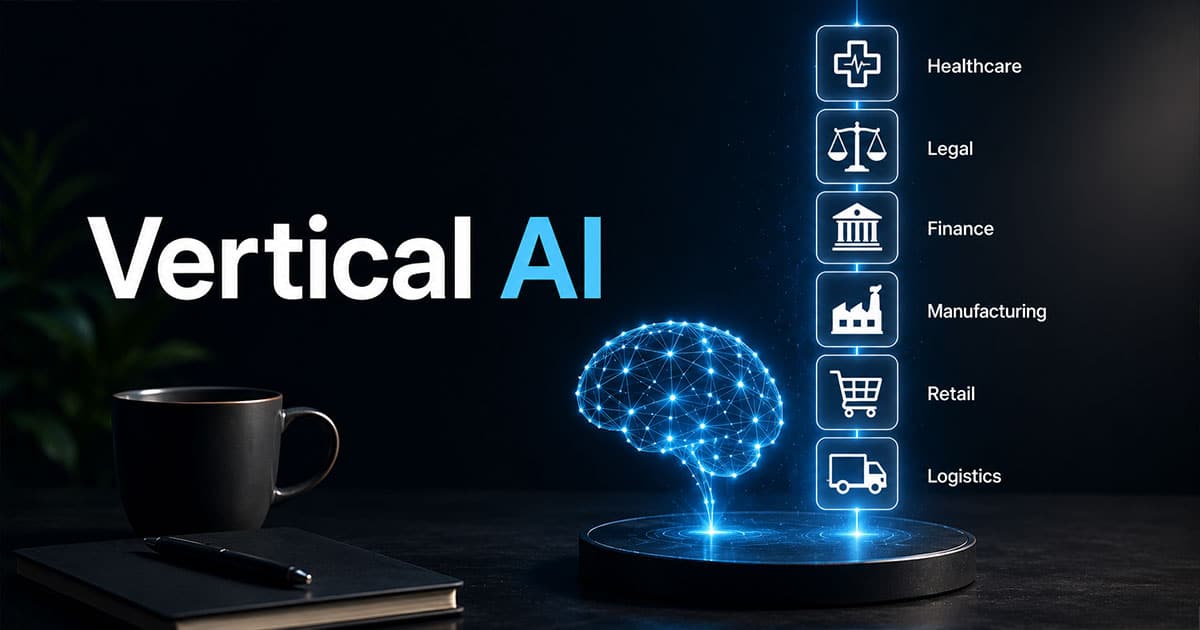
- Top Vertical AI Use Cases Across Major Industries
- Benefits Of Vertical AI For Enterprise Growth And Automation
- Challenges Businesses Face When Adopting Vertical AI
- Vertical AI Market Trends And Future Growth Opportunities
- How To Choose The Right Vertical AI Solution For Your Business
- Final Thoughts
- FAQs
Businesses no longer want AI tools that only give generic answers. Teams now need systems that understand their industry, workflows, customers, and daily challenges. That is where vertical AI changes the game. From healthcare and finance to ecommerce and legal services, companies now use industry-specific AI to save time, reduce costs, and make faster decisions.
Vertical AI is not just another tech trend. It is quickly becoming a major competitive advantage for modern businesses. Companies that adopt it early can automate complex tasks, improve accuracy, and deliver better customer experiences. In this guide, you will learn how vertical AI works, where businesses use it, its biggest benefits, key challenges, and what the future of this technology looks like.
What Is Vertical AI
Vertical AI refers to artificial intelligence built for specific industries and business functions. Unlike horizontal AI platforms or general-purpose AI systems, vertical AI systems focus on a narrow scope and solve complex problems with deep domain expertise. Vertical AI companies train machine learning models and large language models on domain-specific data, structured data, unstructured data, maintenance logs, past interactions, and other relevant data from a target industry. That makes vertical AI applications more accurate for legal services, customer relationship management, fraud detection, supply chain operations, and professional services.
Vertical AI agents and AI assistants work inside existing workflows, existing tools, legacy systems, and existing software. Strong workflow integration helps businesses automate tasks, improve decision-making, and meet regulatory compliance requirements in regulated industries, especially when teams understand the differences between AI automation and traditional automation. Vertical software companies now use generative AI applications, predictive models, and AI automation to create specialized systems with a competitive edge. Deep understanding of customer relationships, labor budgets, risk management, and domain-specific knowledge gives businesses a major competitive advantage and builds customer trust across industry-specific business models.
How Vertical AI Works Inside Industry-Specific Workflows
Vertical AI works best when it connects directly with daily business operations. Modern companies no longer want standalone AI tools with generic outputs. They need industry-specific systems that understand workflows, business rules, customer behavior, and operational challenges. That shift explains why vertical AI adoption continues to rise across healthcare, finance, retail, legal services, and logistics.
Industry Data Creates Better AI Results
Vertical AI systems depend heavily on domain-specific data. Unlike general-purpose AI systems, vertical AI solutions train machine learning models with relevant data from specific industries. That includes customer records, maintenance logs, legal research files, supply chain reports, and transaction history. Deep domain knowledge helps AI agents produce more accurate outputs.
A 2025 McKinsey report found that companies using domain-specific AI models improved operational accuracy by up to 35%. Vertical AI companies also combine structured data and unstructured data to improve complex problem-solving. That creates smarter predictive models and stronger informed decision-making across business workflows.
Workflow Integration Improves Daily Operations
Workflow integration is one of the biggest reasons businesses adopt vertical AI applications. AI assistants and vertical agents connect with existing software, existing systems, and legacy systems without forcing teams to rebuild operations from scratch. That reduces friction and improves team adoption.
Businesses now use AI automation inside customer relationship management platforms, legal services software, and vertical SaaS products. Deloitte reported in 2025 that over 62% of enterprises prioritize AI solutions that work with existing workflows. Strong integration also improves customer relationships and reduces manual work across professional services and regulated industries.
AI Agents Handle Specialized Tasks
Vertical AI agents focus on narrow-scope tasks inside a target industry. Unlike horizontal AI platforms, these specialized systems understand industry terminology, compliance rules, and business models. Law firms now use vertical AI for legal research, contract analysis, and risk management. Healthcare providers use AI-trained systems for diagnostics and patient data analysis.
Gartner predicts that by 2027, more than 50% of enterprise AI deployments will rely on domain-specific AI agents. Deep understanding of industry workflows helps vertical AI applications solve complex problems faster. Businesses gain a competitive edge because AI capabilities align closely with operational needs.
Compliance Shapes Vertical AI Development
Regulatory requirements play a major role in how vertical AI companies build AI technology. Regulated industries like finance, healthcare, and legal services require strong data governance and customer trust. Generic AI systems often struggle with compliance because they lack deep domain expertise.
Vertical AI solutions use domain-specific knowledge and industry rules to support safer decision-making. Fraud detection systems in banking now analyze new data in real time while following strict compliance standards. PwC reported that 71% of business leaders see regulatory compliance as a key factor in AI investments. Specialized systems reduce operational risks and improve long-term reliability.
Continuous Learning Improves AI Performance
Vertical AI applications improve over time because they learn from past interactions and new data. AI-trained systems analyze customer behavior, labor budgets, operational trends, and workflow patterns to deliver better outputs. That creates stronger AI capabilities across industry-specific operations.
Next-generation vertical AI systems now support predictive models for supply chain forecasting, customer support, and financial planning. Many vertical software companies also rely on robust AI infrastructure and combine generative AI with machine learning models to improve automation quality. Businesses that adopt this vertical approach often gain a stronger competitive advantage and higher market value within their target industry.
Vertical AI Vs Horizontal AI: Key Differences
Businesses now use AI in very different ways. Some prefer broad AI platforms that work across multiple industries, while others choose domain specific systems built for specialized tasks. Vertical AI and horizontal AI both offer value, but their capabilities, accuracy, and business impact differ in several important areas.
Feature | Vertical AI | Horizontal AI |
|---|---|---|
Focus Area | Built for specific industries and niche workflows | Designed for broad use across many industries |
Data Type | Uses domain-specific data and relevant industry datasets | Uses general-purpose and large-scale public data |
Accuracy | Higher accuracy for specialized tasks | Better for generic business tasks |
Domain Expertise | Strong deep domain knowledge | Limited industry understanding |
Workflow Integration | Fits existing workflows and industry-specific software | Requires more customization |
AI Agents | Uses vertical AI agents trained for narrow scope operations | Uses general AI assistants for broad tasks |
Compliance Support | Better for regulated industries and regulatory compliance | Limited compliance specialization |
Problem Solving | Handles complex problem-solving in specialized systems | Best for common automation tasks |
Customer Experience | Delivers more personalized outputs for customer relationships | Produces broader and less tailored outputs |
Competitive Advantage | Creates stronger competitive edge in target industry | Offers flexibility across business models |
Existing Systems | Connects easily with vertical SaaS and legacy systems | May need extra integration work |
AI Training | AI trained with unique data and industry terminology | Trained on wide public datasets |
Market Use | Common in professional services, finance, healthcare, and law firms | Popular for general business productivity |
Long-Term Value | Strong for industry-specific growth and operational efficiency | Strong for broad scalability and general AI use |
Top Vertical AI Use Cases Across Major Industries
Vertical AI is no longer limited to experimental projects. Businesses now use industry-specific artificial intelligence software to automate workflows, improve accuracy, and reduce operational costs. From healthcare and finance to retail and legal services, vertical AI applications continue to reshape how companies handle complex tasks and customer expectations.
Healthcare Diagnosis And Patient Care
Healthcare organizations use vertical AI systems to analyze medical records, lab reports, scans, and patient histories. AI agents help doctors detect diseases faster and support informed decision-making. Hospitals also use predictive models to reduce emergency room wait times and improve treatment planning.
A 2025 report from Accenture found that AI automation could save the healthcare industry more than $360 billion annually in the United States alone. Vertical AI companies train machine learning models with domain-specific data and regulatory requirements. Deep domain expertise improves diagnostic accuracy and helps providers manage complex data across healthcare workflows.
Financial Fraud Detection And Risk Analysis
Banks and financial institutions rely heavily on vertical AI applications for fraud detection and risk management. AI assistants monitor transactions in real time and flag suspicious behavior before financial damage grows. Domain-specific knowledge allows AI systems to detect unusual patterns that traditional software often misses.
JPMorgan reported that AI-driven fraud detection tools reduced false fraud alerts by nearly 30% in 2025. Financial companies also use vertical agents for loan approvals, customer relationship management, and compliance monitoring. Strong workflow integration with existing systems helps businesses maintain customer trust while improving operational efficiency in regulated industries.
Retail Personalization And Inventory Control
Retail businesses use vertical AI solutions to improve customer relationships and optimize supply chain operations. AI-trained systems analyze customer behavior, purchase history, and market trends to recommend products with better accuracy, similar to how targeted AI features in SaaS products increased user engagement by 34%. Personalized shopping experiences often increase conversion rates and customer loyalty.
Retail Dive reported in 2025 that retailers using AI personalization tools saw up to 20% higher online revenue growth. Vertical SaaS platforms also use predictive models for inventory forecasting and labor budgets. Existing software and legacy systems now connect with AI capabilities to automate stock management and reduce operational waste.
Legal Research And Contract Analysis
Law firms now depend on vertical AI agents for legal research, document review, and contract analysis. Large language models trained on legal services data help lawyers review cases much faster than traditional methods. AI technology also identifies compliance risks and highlights missing clauses in contracts.
Thomson Reuters reported that AI tools can reduce legal research time by nearly 50% for professional services teams. Vertical software companies build specialized systems with deep understanding of legal terminology and regulatory compliance. Narrow focus and domain expertise help legal professionals solve complex problems without replacing human judgment.
Manufacturing And Supply Chain Optimization
Manufacturing companies use vertical AI applications to monitor equipment, predict failures, and improve production workflows. AI systems analyze maintenance logs, sensor reports, and operational data to reduce downtime. Faster insights help teams improve decision-making across factories and logistics operations.
McKinsey estimates that AI-powered predictive maintenance can reduce maintenance costs by up to 25% and lower equipment downtime by 50%. Vertical AI solutions also improve supply chain forecasting by analyzing new data from suppliers, shipping networks, and customer demand, supporting broader enterprise scalability. Businesses gain a strong competitive advantage when AI automation supports real-time operational planning.
Benefits Of Vertical AI For Enterprise Growth And Automation
Businesses now expect more than basic automation from AI tools. They want systems that understand industry workflows, customer behavior, and operational goals. Vertical AI delivers that advantage by combining domain expertise, workflow integration, and AI automation to improve productivity, reduce costs, and support faster enterprise growth.
Higher Accuracy In Specialized Tasks
Vertical AI systems perform better because they rely on domain-specific knowledge and relevant data from specific industries. Unlike general-purpose AI systems, vertical AI applications understand industry terminology, compliance rules, and business models. That improves decision-making and reduces operational errors.
IBM reported in 2025 that businesses using domain-specific AI models achieved up to 40% higher task accuracy compared to broad AI tools. Financial services companies now use AI agents for fraud detection, while law firms rely on AI assistants for legal research. Deep domain expertise gives businesses a clear competitive edge in complex workflows.
Faster Workflow Automation
AI automation becomes more effective when systems fit naturally into existing workflows. Vertical AI solutions connect with existing software, vertical SaaS platforms, and legacy systems without major disruption. Teams can automate repetitive tasks across customer relationship management, supply chain operations, and professional services.
A Deloitte survey from 2025 found that companies using workflow-focused AI reduced manual process time by nearly 35%. Vertical AI agents also improve operational speed because they focus on narrow-scope tasks, acting as smarter software tools to simplify day-to-day work. Faster workflows help businesses increase productivity while lowering labor costs and operational delays.
Better Customer Experiences
Customer expectations continue to rise across every target industry. Vertical AI applications help businesses personalize services, predict customer needs, and strengthen customer relationships. AI-trained systems analyze past interactions, structured data, and unstructured data to deliver more accurate recommendations and support.
Salesforce reported in 2025 that 73% of customers expect businesses to understand their unique needs. Retail companies now use predictive models to recommend products, while healthcare providers personalize patient support with AI capabilities. Better customer experiences often lead to stronger customer trust, higher retention rates, and increased revenue growth.
Stronger Compliance And Risk Control
Regulated industries face strict regulatory requirements and constant operational risks. Vertical AI companies build specialized systems that align with industry-specific compliance standards. That makes risk management more reliable across finance, healthcare, insurance, and legal services.
PwC reported that over 68% of executives now prioritize AI investments that improve compliance and operational transparency. Vertical AI systems monitor complex data in real time and flag unusual activity before problems grow, aligning closely with the principles of ethical AI software. Businesses also reduce legal and financial risks because AI solutions follow domain-specific rules and internal policies more accurately.
Long-Term Competitive Advantage
Vertical AI creates long-term business value because it improves continuously with new data and market insights. AI technology learns from customer behavior, workflow patterns, maintenance logs, and operational trends. That allows businesses to adapt faster than competitors using generic automation tools.
McKinsey estimates that companies with advanced AI capabilities could increase cash flow by more than 20% over the next five years. Vertical software companies now build next-generation AI applications designed for industry-specific growth. Businesses that adopt a vertical approach early often gain stronger market position, better scalability, and a lasting competitive advantage.
Challenges Businesses Face When Adopting Vertical AI
Vertical AI offers major advantages, but adoption is not always simple. Many businesses struggle with data quality, workflow integration, compliance demands, and rising AI investments. Industry-specific AI systems require careful planning and AI software development practices because operational risks increase when implementation lacks the right strategy or domain expertise.
Poor Data Quality Limits AI Performance
Vertical AI systems depend heavily on high-quality domain-specific data. Many businesses still store information across disconnected existing systems, legacy systems, and outdated databases. Incomplete records and inconsistent formats often reduce AI accuracy and slow automation results.
Gartner reported in 2025 that poor data quality costs organizations an average of $12.9 million annually. AI-trained models also struggle when structured data and unstructured data lack consistency. Vertical AI companies need relevant data from past interactions, workflows, and customer relationships to improve decision-making and predictive models across specific industries.
Workflow Integration Creates Operational Friction
Many companies face challenges when vertical AI applications connect with existing software and daily operations. Older infrastructure often lacks compatibility with modern AI technology. Businesses may need expensive upgrades before workflow integration becomes reliable.
Deloitte found that 57% of enterprises still struggle to integrate AI capabilities into existing workflows. Customer relationship management systems, supply chain software, and vertical SaaS platforms often operate separately. Without proper integration, even when teams try to integrate AI into SaaS products, AI automation can create extra manual work instead of improving productivity. Operational delays also reduce customer trust and employee adoption.
Compliance Rules Increase Complexity
Regulated industries face strict regulatory requirements when deploying vertical AI solutions. Healthcare providers, financial institutions, and law firms must protect sensitive customer data while maintaining compliance standards. General-purpose AI systems often lack the deep understanding needed for industry-specific regulations.
PwC reported in 2025 that compliance concerns remain one of the top barriers to enterprise AI adoption. Businesses also face legal risks if AI agents produce inaccurate outputs or mishandle confidential information, underscoring the need for a structured AI governance framework for SaaS platforms. Risk management becomes more difficult when AI applications process complex data across multiple business models and operational environments.
High Costs Slow AI Adoption
AI investments often require significant upfront spending. Businesses must pay for infrastructure upgrades, machine learning models, domain expertise, and workflow customization. Smaller companies may struggle to justify costs without clear short-term returns.
McKinsey estimates that enterprise AI implementation costs can exceed millions of dollars for large-scale deployments. Vertical software companies also charge premium pricing for specialized systems with deep domain knowledge. Maintenance, model training, and security updates create additional long-term expenses, especially when planning robust SaaS scalability strategies. Budget limitations often delay next-generation AI adoption across many target industries.
Talent Gaps Reduce Implementation Success
Successful vertical AI deployment requires technical skills and industry knowledge at the same time. Many organizations lack professionals with deep domain expertise and AI engineering experience. That talent gap slows implementation and increases operational risks.
IBM reported in 2025 that more than 40% of companies face shortages in AI-related skills. Businesses need teams that understand machine learning models, legal services requirements, fraud detection systems, and customer workflows, along with how to follow an effective AI model selection guide. Without experienced professionals, vertical AI agents and AI assistants may fail to solve complex problems effectively. Limited expertise also weakens long-term competitive advantage.
Vertical AI Market Trends And Future Growth Opportunities
Vertical AI continues to expand across nearly every major industry. Businesses now want AI systems built for specific workflows, regulations, and operational goals instead of generic automation tools. Strong market demand, rising AI investments, and faster enterprise adoption continue to create new growth opportunities for AI in SaaS and vertical AI companies worldwide.
Industry-specific AI Adoption Continues To Rise
Businesses across healthcare, finance, retail, manufacturing, and legal services now prioritize industry-specific AI solutions. Companies want vertical AI systems that understand domain-specific knowledge, customer relationships, and operational challenges. That shift continues to increase demand for specialized systems with deep domain expertise.
Grand View Research estimated in 2025 that the global vertical AI market could surpass $100 billion before 2030. Vertical AI applications also attract businesses because they integrate better with existing workflows and existing systems. Many enterprises now see domain-specific AI as a long-term competitive advantage instead of an experimental technology investment.
AI Agents Become Core Business Tools
AI agents and AI assistants are rapidly becoming part of daily operations. Businesses now use vertical AI agents for customer support, fraud detection, legal research, and supply chain forecasting. Narrow focus and workflow integration allow these tools to solve complex problems more accurately than horizontal AI platforms.
Gartner predicts that by 2028, one-third of enterprise software applications will include autonomous AI capabilities. Vertical software companies continue to develop next-generation AI automation tools powered by LLM integration strategies for SaaS platforms and predictive models. Businesses also expect AI capabilities to improve operational speed, reduce manual work, and support better decision-making across target industries.
Regulated Industries Drive Market Expansion
Regulated industries continue to create major growth opportunities for vertical AI companies. Financial services, healthcare providers, and law firms need AI solutions that support regulatory compliance, risk management, and customer trust. Generic AI systems often fail because they lack deep understanding of industry rules and complex data environments.
PwC reported in 2025 that over 70% of executives in regulated industries plan to increase AI investments within two years. Vertical AI applications also help organizations analyze structured data and unstructured data more securely. Businesses now prefer AI-trained systems that align closely with operational policies and compliance standards.
Generative AI Expands Vertical Solutions
Generative AI continues to reshape vertical AI development across specific industries. Businesses now combine machine learning models with generative AI to automate reports, customer communication, legal documents, and operational planning. AI technology also improves workflow efficiency inside customer relationship management and professional services platforms.
McKinsey estimates that generative AI could add up to $4.4 trillion annually to the global economy. Vertical AI solutions now use domain-specific data and past interactions to deliver more accurate outputs. Existing software platforms also continue to adopt AI capabilities faster because businesses expect smarter automation and personalized experiences from industry-specific software.
New Startups Increase Market Competition
Vertical AI startups continue to attract massive investor attention. Venture capital firms now prioritize vertical approach business models because specialized AI often delivers faster enterprise value than broad automation tools, particularly in AI-driven automation in SaaS. Smaller companies also focus on narrow scope markets with strong customer demand and scalable growth potential.
CB Insights reported in 2025 that vertical AI startups secured billions in funding across healthcare, finance, and logistics sectors. Many vertical SaaS companies now compete by offering workflow integration, deep domain knowledge, and industry-specific automation features that reflect broader custom software development trends shaping the future. Growing market size and increasing demand for relevant data solutions continue to create strong future opportunities across multiple industries.
How To Choose The Right Vertical AI Solution For Your Business
Choosing the right vertical AI solution requires more than checking features and pricing. Businesses need systems that match industry workflows, compliance needs, and long-term growth goals. A strong AI platform should improve automation, support decision-making, and fit naturally into daily operations without creating unnecessary complexity.
Industry Expertise Matters Most
Strong domain expertise should be one of the first things businesses evaluate. Vertical AI companies that understand specific industries usually deliver better results than general AI vendors. Industry-specific knowledge improves workflow accuracy, customer relationships, and operational efficiency.
Gartner reported in 2025 that businesses using domain-focused AI solutions achieved higher adoption rates and faster ROI. Companies should review how AI agents handle industry terminology, regulatory requirements, and complex problem-solving. Deep understanding of legal services, healthcare, finance, or supply chain operations often separates strong vertical AI applications from generic automation tools.
Workflow Integration Reduces Friction
A vertical AI solution should connect smoothly with existing systems and existing workflows. Businesses often rely on customer relationship management software, vertical SaaS platforms, and legacy systems that cannot be replaced overnight. Poor workflow integration usually increases operational delays and employee frustration.
Deloitte found in 2025 that integration challenges remain one of the top reasons enterprise AI projects fail. Businesses should evaluate API support, compatibility with existing software, and automation flexibility before adoption. AI capabilities work best when teams can use AI assistants and vertical agents without major process changes or expensive infrastructure rebuilds.
Data Security And Compliance Come First
Regulated industries require strong security and regulatory compliance support. Businesses should confirm that vertical AI systems protect structured data, unstructured data, and customer information properly. Weak compliance controls can damage customer trust and increase legal risks.
IBM reported that the average global data breach cost reached $4.9 million in 2025. Vertical AI solutions built for healthcare, financial services, and law firms usually include stronger compliance frameworks and risk management tools. Businesses should also review how AI-trained systems process domain-specific data, past interactions, and sensitive operational records across multiple business models.
Scalability Supports Long-Term Growth
A strong AI solution should support future business growth without major system changes. Many companies start with narrow scope automation projects but later expand AI applications across departments and operational workflows. Scalable systems help businesses avoid expensive migrations later.
McKinsey estimates that AI investments deliver the highest value when companies scale automation gradually across operations. Businesses should assess whether vertical AI platforms can handle new data, larger workloads, and growing customer demands and whether they sit on a scalable software architecture for high-growth products. Next-generation AI technology should also support predictive models, workflow automation, and advanced decision-making as market conditions evolve.
Vendor Support Impacts Success
Reliable vendor support plays a major role in long-term AI success. Businesses often need guidance during implementation, workflow customization, and operational updates. Vertical software companies with strong support teams usually reduce deployment risks and improve adoption rates.
PwC reported that companies with dedicated AI support partners complete enterprise deployments faster and with fewer operational issues. Businesses should evaluate onboarding quality, training resources, and response times before choosing a provider, giving careful thought to how they choose a custom software development partner. Strong partnerships also help organizations maintain competitive advantage as AI technology, customer expectations, and industry-specific requirements continue to change.
Final Thoughts
Vertical AI is quickly becoming a major part of modern business strategy. Companies no longer want generic AI tools that only handle broad tasks. They want industry-specific solutions that understand workflows, customer behavior, compliance rules, and operational challenges, while still aligning with the latest software development trends for 2026. That demand continues to push vertical AI adoption across healthcare, finance, retail, manufacturing, legal services, and many other sectors.
Businesses that choose the right vertical AI systems can improve automation, reduce operational costs, strengthen customer relationships, and make faster decisions with better accuracy. At the same time, successful adoption depends on strong workflow integration, high-quality domain-specific data, and reliable vendor support. Companies that invest early and build the right AI strategy will likely gain a stronger competitive edge as next-generation AI technology continues to evolve.
FAQs
Can Small Businesses Use Vertical AI Effectively?
Yes, small businesses can benefit from vertical AI solutions without huge infrastructure costs. Many vertical SaaS platforms now offer affordable AI automation tools for customer relationship management, supply chain management, and operational workflows. Cloud-based AI systems also reduce setup complexity for growing companies.
Does Vertical AI Replace Human Employees?
No, vertical AI works best when it supports employees instead of replacing them. AI agents and AI assistants automate repetitive tasks, improve decision-making, and help teams solve complex problems faster. Human expertise still matters for strategy, customer relationships, and regulatory compliance.
How Long Does Vertical AI Implementation Usually Take?
Implementation timelines depend on workflow integration, existing systems, and data quality. Smaller vertical AI applications may launch within weeks, while enterprise AI solutions for regulated industries often take several months. Businesses with clean domain-specific data usually see faster deployment and better adoption rates.
Can Vertical AI Work With Legacy Systems?
Yes, many vertical AI companies now design AI technology that connects with legacy systems and existing software. Strong workflow integration helps businesses improve automation without replacing all operational tools. API support and cloud infrastructure also simplify integration across industry-specific environments.
Why Are Investors Focusing More On Vertical AI Companies?
Vertical AI companies attract strong AI investments because specialized systems often deliver faster business value than horizontal AI platforms. Businesses want AI-trained tools with deep domain expertise, narrow focus, and domain-specific knowledge. Market demand for industry-specific automation and predictive models also continues to grow rapidly