
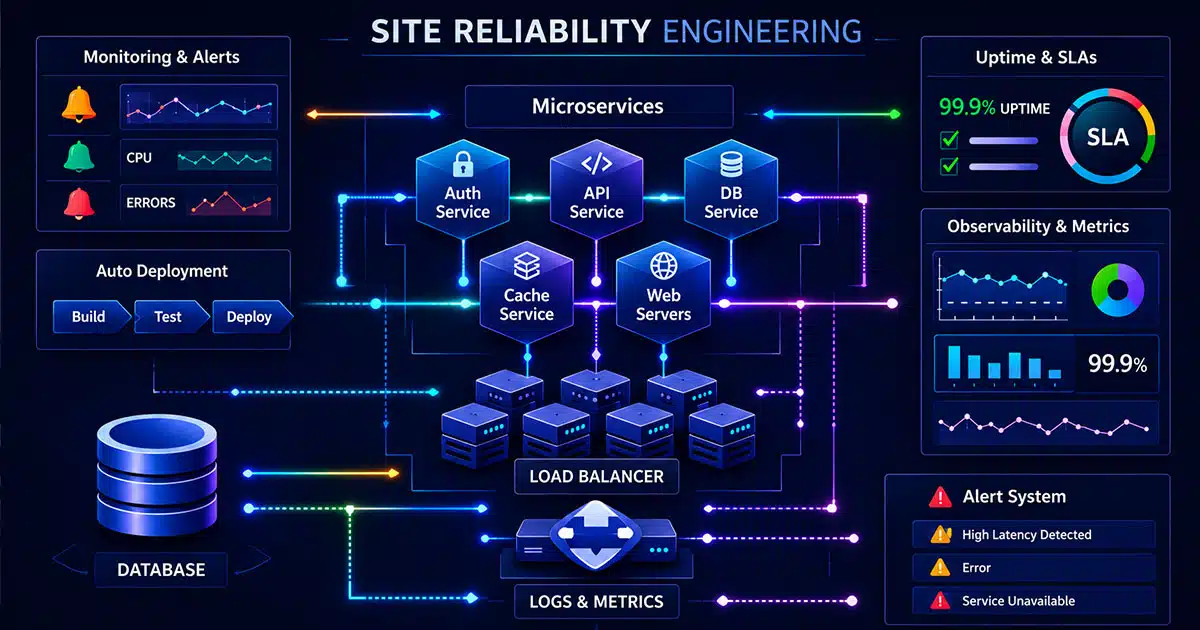
Downtime costs businesses $5,600 per minute on average. Then 42% of SaaS users switch platforms due to reliability issues. Site Reliability Engineering SaaS frameworks address this challenge by treating reliability as an engineering problem rather than an operational one.
We combine development and operations expertise to build flexible software systems that maintain uptime through service level objectives and error budgets. In this article, we will explore what site reliability engineering means for SaaS platforms, the role of a site reliability engineer, site reliability engineering best practices, and how our site reliability engineering services help you implement proven SRE practices.
What Is Site Reliability Engineering For SaaS Applications
Site reliability engineering SaaS focuses on keeping a SaaS platform stable, scalable, and reliable while the software grows. Site reliability engineering (SRE) connects software development with operations teams so both sides work toward the same reliability goals. SRE teams define service level objectives (SLOs) and track service level indicators (SLIs) to measure software reliability, system health, and overall performance metrics. Clear service level agreements (SLAs) help development teams maintain consistent service for every customer.
In modern software systems, site reliability engineering SRE introduces reliability principles across the software development lifecycle. Teams monitor production environments, manage error budgets, and rely on monitoring tools such as Azure Monitor to detect issues early. Strong SRE practices reduce manual tasks, automate repetitive tasks, and create feedback loops between development and operations teams.
As SaaS platforms scale, SRE strategies support scalable software systems, better incident response, and faster delivery pipeline updates for new features. Automation, key metrics, and reliable infrastructure help maintain uptime, improve performance, reduce costs, and ensure optimal service across cloud applications by aligning with broader SaaS scalability strategies for sustainable growth.
Why SaaS Companies Need An SRE Framework
Financial losses from system failures go way beyond immediate revenue disruption. The average cost of downtime has climbed to $9,000 per minute across all industries. This figure represents more than lost transactions for SaaS companies. It has idle employee payroll, emergency remediation costs, and long-term reputational damage that persists after systems recover.
The Cost Of Downtime In SaaS Businesses
Downtime costs scale with company size and complexity. Research shows that 90% of mid-size and large companies lose over $300,000 per hour during outages. The effect intensifies further for enterprise organizations. So 41% report hourly losses between $1 million and $5 million.
Smaller SaaS providers face severe consequences. Downtime costs range from $137 to $427 per minute for businesses with 20-100 employees. A two-hour outage at $50,000 in lost revenue might represent an entire quarter's profit margin. The business cost isn't just immediate but threatens future viability.
Ground incidents show these financial effects clearly. Apple lost about $25 million during a 12-hour outage. Facebook's 14-hour downtime cost nearly $90 million. Delta suffered $150 million in losses over five hours. These examples show how minutes translate into massive financial damage quickly.
Customer Retention And Revenue Protection
Reliability influences whether customers renew subscriptions or switch providers. Gross Revenue Retention should sit at 90% or higher for healthy SaaS businesses, with top performers exceeding 95%. Research shows that improving retention by just 5% can increase profits by 25% or more, especially when combined with strong UX that reduces SaaS churn and improves retention.
More than half of enterprise buyers reevaluate their renewal decisions after recurring downtime incidents. This behavior underscores how reliability concerns override other factors like features or pricing. Trust becomes the deciding factor, and downtime erodes that trust faster than service credits can repair it.
Enterprise SLA Requirements For Scalable Systems
Enterprise customers just need contractual guarantees for system availability. The old rule states that each additional 'nine' of availability costs ten times more than the previous one. Moving from 99.9% to 99.99% uptime requires investment in redundant infrastructure and monitoring solutions that are grounded in best practices of SaaS architecture.
Multi-tenant architecture complicates SLA management for SaaS platforms. One tenant's heavy usage can affect others when resources are shared across customers. SLA-based tiering allows businesses to offer different service levels that arrange with customer needs and willingness to pay. This flexibility supports both enterprise clients requiring premium reliability and smaller customers accepting standard service.
Missed SLAs carry financial consequences. Service providers must compensate customers through credits against future fees or direct refunds. Customers gain termination rights for egregious violations and can exit contracts without penalty.
Competitive Advantage Through Reliability
Reliability has become a main differentiator in crowded SaaS markets. Consumer research indicates that 78% of people stick with brands that meet their expectations consistently, even when competitors offer newer or flashier alternatives. This loyalty stems from risk aversion. Customers value stability over novelty after experiencing uncertainty.
Reliable SaaS platforms attract premium clients and command higher contract values. Companies known for consistent uptime build stronger customer relationships that generate repeat business and referrals. Poor reliability pushes users toward competitors offering more dependable service. Trust compounds over time through each successful login, on-time delivery, and helpful support interaction, supported by thoughtful UI/UX design services for SaaS products.
Core Components Of The SRE Framework For SaaS
Building reliable SaaS platforms requires structured components that work together as an integrated framework. These elements revolutionize reliability from an abstract goal into measurable targets that guide development and operations teams through daily decisions.
Service Level Indicators (SLIs) For User Experience
Service level indicators are quantitative measurements that capture specific aspects of service performance from a user's viewpoint. The four golden signals are the foundations of monitoring that works: latency, traffic, errors, and saturation. Latency measures how long requests take to complete. Traffic tracks the load placed on your system. Errors count failed requests. Saturation indicates how full your service runs.
SLIs should relate directly to customer happiness. Your SLIs should reflect that degradation at the time users experience problems. The equation is straightforward: divide good events by total valid events, then multiply by 100 to express as a percentage. To name just one example, if 9,990 of 10,000 HTTP requests succeed, your availability SLI sits at 99.9%.
Service Level Objectives (SLOs) And Target Setting
Service level objectives define target values for SLIs over specific time periods. An SLO might state that 99% of API requests must complete within 300 milliseconds over a rolling 30-day window. These targets balance ambition with realism.
The industry expresses high availability using "nines." Three nines equals 99.9% uptime. Four nines reaches 99.99%. Each additional nine costs roughly ten times more than the previous one in infrastructure and engineering resources.
Setting 100% reliability as a target is unrealistic and counterproductive. Everything fails eventually. Setting overly aggressive SLOs locks teams into heroic efforts without room for planned maintenance or system changes that just need to happen. Start with historical data to establish baselines, then set targets slightly better than current performance.
Service Level Agreements (SLAs) And Customer Commitments
Service level agreements are contractual promises to customers that include financial consequences at the time targets are missed. SLAs typically contain multiple SLOs and specify remedies like service credits or subscription extensions.
Your internal SLO should be stricter than your external SLA. This buffer provides room to detect problems and fix them before violating customer contracts. Target 99.95% availability internally while promising 99.9% in your SLA, to cite an instance.
Error Budgets And Risk Management
Error budgets represent acceptable unreliability. A 99.9% SLO creates a 0.1% error budget. This translates to roughly 43 minutes of allowable downtime on a monthly basis.
Burn rate measures how quickly you consume error budget. A burn rate above 1 means you'll exhaust your budget before the measurement window ends. Teams should halt feature releases and focus exclusively on stability work at the time error budgets deplete.
Monitoring And Observability Systems
Monitoring answers what's broken. Observability explains why. The difference matters for complex distributed systems where traditional monitoring alone proves insufficient, especially when teams pursue continuous SaaS performance optimization best practices.
Observability relies on three data types: metrics for time-series numbers, logs for detailed event records, and traces to track requests across services. SRE teams just need unified visibility to jump from failing metrics to related traces to specific log entries quickly.
Automation And Self-Healing Infrastructure
Self-healing infrastructure detects and resolves issues without human intervention automatically. Automated remediation scripts restart services, reallocate resources, or roll back deployments at the time monitoring detects degraded performance.
Automation reduces operational toil. SRE teams spend less time on repetitive manual tasks and more time improving system resilience. This move from reactive firefighting to proactive reliability engineering separates successful SaaS platforms from those plagued by constant outages.
Site Reliability Engineering Best Practices For Scalability
Scaling SaaS platforms demands architectural decisions that prioritize resilience among growth. Site reliability engineering best practices provide repeatable processes to handle increased traffic without sacrificing system health.
Multi-Cloud Architecture And Redundancy
Multi-cloud strategies distribute workloads across multiple cloud providers and eliminate single points of failure. Automated failover redirects traffic to backup systems running on different infrastructure at the time one provider experiences an outage. This redundancy reduces downtime risk and protects revenue during provider-specific incidents, which is central to the future of SaaS development in a cloud-first world.
Applications that run across providers like AWS and Azure prevent vendor lock-in. SRE teams learn flexibility and can select optimal services for specific tasks. One provider might offer superior database performance while another excels at content delivery.
Automated Deployment And Rollback Strategies
Automated testing during deployments catches problems before they reach production systems. Automated rollback reverts to the previous stable version within seconds at the time tests fail. Manual rollbacks under pressure are slow and prone to human error.
Recovery time separates effective rollback strategies. The fastest approach uses blue-green deployments where two production environments run at the same time. Traffic switches instantly between versions through load balancer updates. Rollback becomes a configuration change rather than a redeployment.
Capacity Planning For Growth
Forecasting future resource needs prevents performance issues during traffic spikes. Capacity planning analyzes historical data and predicts when infrastructure requires scaling. SRE teams allocate resources before demand increases rather than reacting to outages.
Cloud applications benefit from elastic scaling that adjusts compute and storage on its own. Cost optimization balances resource availability against budget constraints. Overprovisioning wastes money. Underprovisioning creates bottlenecks that degrade user experience.
Incident Response And Blameless Postmortems
Blameless postmortems treat failures as learning opportunities rather than occasions for punishment. SRE teams document what happened, the effect, actions taken and mechanisms at the time incidents occur. The goal focuses on preventing recurrence through systemic improvements that can directly inform a company’s longer-term SaaS product roadmap in 2026.
Postmortems assume everyone acted with good intentions based on available information. This psychological safety encourages honest discussion about what went wrong. Teams identify process gaps and technical weaknesses without fear of reprisal. Effective postmortems generate applicable follow-up items tracked to completion and create feedback loops that strengthen reliability over time.
The Role Of A Site Reliability Engineer In SaaS
Site reliability engineers occupy a unique position bridging software engineering and operations. Their daily work combines coding automation tools with maintaining production systems at scale.
Core Responsibilities And Daily Tasks
Site reliability engineers spend roughly half their time on operational work including emergency incident response, change management, and IT infrastructure management. The other half focuses on development tasks such as building new automation capabilities and improving observability.
System health monitoring ranks as a top priority. SREs track service level indicators, analyze availability metrics, and watch for performance issues before users notice them. They break down root causes, coordinate responses, and implement fixes at the time incidents occur. They document problems and solutions in postmortems that create feedback loops for continuous improvement once they resolve issues.
Required Skills And Technical Expertise
Python, Go, or Java programming proficiency are the foundations. Strong Linux system administration knowledge is a must, as most cloud applications run on Linux infrastructure. Experience with AWS, Azure, or Google Cloud Platform matters for managing services in cloud environments and implementing scalable software architecture for high-growth products.
Monitoring tools like Prometheus, Grafana, and Datadog help SREs collect and interpret performance metrics. CI/CD pipeline expertise supports rapid software delivery. Communication skills help with collaboration across development and operations teams, especially when they adopt modern DevOps best practices in 2026.
Site Reliability Engineering Salary Expectations
The average annual pay for a site reliability engineer in the United States reaches $152,939. Salaries range from $116,500 at the 25th percentile to $179,000 at the 75th percentile. Top earners make $222,000 annually. Location affects compensation by a lot. San Francisco pays $194,350 on average, while Palo Alto offers $190,909.
Building An Effective SRE Team
Your first SRE needs resilience and flexibility to balance velocity against reliability goals. They must understand the service's current problems and required toil at first. Implementing these tools becomes their engineering priority if SLOs don't exist. Avoid renaming operations teams to SRE without applying actual sre practices, and be ready to invest in the kind of custom software that transforms companies when off-the-shelf tools no longer fit reliability goals.
Tools And Technologies For SRE Implementation
The right tooling transforms site reliability engineering from theory into operational practice. SRE teams rely on specialized software to monitor performance metrics, automate infrastructure, manage incidents, and test system resilience, often working alongside scalable SaaS tools that power global business growth.
Monitoring Solutions (Prometheus, Grafana, Datadog)
Prometheus excels at collecting time-series data from applications and infrastructure. Its query language PromQL filters and combines metrics to analyze them. Grafana transforms raw data into visual dashboards that track system health. Its drag-and-drop interface creates custom views tailored to monitoring needs. Datadog provides unified observability across metrics and logs in one platform. AI-powered insights identify anomalies before they escalate into outages.
Infrastructure As Code (Terraform, Kubernetes)
Terraform enables teams to define infrastructure using declarative code. It supports AWS, Azure, Google Cloud Platform, and Kubernetes through a large provider ecosystem. Kubernetes coordinates containers at scale with automated rollouts, rollbacks, and self-healing capabilities. Both tools reduce human error by version-controlled code that replaces manual configuration and fit naturally into well-planned cloud migration strategies for growing teams.
Incident Management Platforms
Xurrent IMR automates alert routing and runbook execution during incidents. PagerDuty handles on-call scheduling and escalation policies. Rootly integrates with Slack for live collaboration and provides post-incident analytics.
Chaos Engineering Tools
Gremlin injects failures into production systems to verify resilience. Chaos Mesh targets Kubernetes environments with pod, network, and I/O fault injection. LitmusChaos integrates chaos testing into CI/CD pipelines, supporting both SaaS performance optimization best practices and better planning around the SaaS development cost guide for businesses.
Use Cases Of Site Reliability Engineering SaaS
Site reliability engineering SaaS helps modern platforms stay reliable as products scale and customer demand grows. SRE teams apply reliability principles, automation, and monitoring tools to improve system health, reduce outages, and maintain consistent performance across complex cloud applications and production systems, all of which depend on resilient scalable software architecture for high-growth products.
Improve SaaS Platform Reliability
Site reliability engineering SaaS helps teams maintain strong software reliability across large SaaS platforms. SRE teams define service level objectives and service level indicators to measure system health and performance. Google reports that organizations that adopt structured SRE practices reduce major incidents by nearly 30 percent, especially when they embed ongoing SaaS performance optimization best practices.
Development teams and operations teams work together to apply reliability principles across software systems. Monitoring tools and automation detect performance issues before they affect customers. Strong feedback loops help teams quickly resolve software problems and maintain optimal performance in production environments.
Support Scalable Software Systems
Rapid growth creates pressure on software systems and infrastructure. Site reliability engineering supports scalable software systems by focusing on repeatable processes and automation. According to the 2023 Accelerate State of DevOps report, elite DevOps teams deploy code 973 times more frequently than low-performing teams, a capability that depends on robust SaaS scalability strategies for sustainable SaaS growth.
SRE strategies guide architectural decisions that allow SaaS platforms to scale without affecting reliability. Development and operations teams monitor key metrics such as latency, success rate, and error budgets. Reliable infrastructure and monitoring solutions ensure consistent service across large cloud applications and align closely with future-focused SaaS product development to build, launch, and scale successfully.
Strengthen Incident Response
Site reliability engineering improves incident response across SaaS production systems. SRE teams rely on monitoring tools such as Azure Monitor and other data platforms to detect issues early. Faster detection reduces downtime and protects system health.
Clear incident response processes help teams respond to software problems quickly. Automation removes manual tasks and reduces human error during critical events. Reliable SRE practices allow development teams to restore service faster and maintain uptime across customer-facing platforms.
Improve Delivery Pipeline Stability
Modern SaaS products release new features frequently. Site reliability engineering helps stabilize the delivery pipeline across the software development lifecycle. DevOps teams use build testing, monitoring solutions, and automated processes to maintain reliability during rapid releases as part of disciplined SaaS product development to build, launch, and scale.
Error budgets guide development teams when balancing reliability and innovation. Teams release updates without risking production systems or service level agreements. Reliable feedback loops between development and operations teams improve software quality and reduce performance issues after deployment.
Reduce Infrastructure And Operations Costs
Site reliability engineering also supports cost optimization for SaaS businesses. Automation reduces repetitive tasks and lowers the need for constant manual intervention. Google research shows that automation in operations can reduce operational workload by more than 40 percent, which directly influences overall SaaS development cost planning for businesses.
SRE strategies focus on efficient infrastructure usage and performance metrics. Teams track key metrics such as resource usage, system load, and service performance. Strong reliability engineering practices reduce downtime, protect business revenue, and deliver stable service for every customer while maximizing the benefits of modern software services like SaaS, PaaS, and IaaS.
How GainHQ Supports Site Reliability Engineering For SaaS Platforms
GainHQ helps SaaS companies implement site reliability engineering SaaS practices across modern cloud applications. Development teams and operations teams work together to build scalable software systems with strong reliability principles. GainHQ supports the software development lifecycle with automation, monitoring tools, and structured DevOps processes, sharing ongoing insights through the GainHQ blog on software and SaaS topics. Teams track service level indicators, service level objectives, and key performance metrics to maintain software reliability and system health across production systems.
SRE teams also use GainHQ to reduce manual tasks and repetitive operations through automation and reliable workflows. Monitoring solutions detect performance issues early and support faster incident response. Clear feedback loops help development and operations teams improve architectural decisions and infrastructure stability, backed by Gain Solutions’ broader custom software development services.
With better monitoring, performance metrics, and reliable infrastructure, SaaS platforms maintain uptime, improve service performance, and deliver stable experiences for every customer.
FAQs
Can Small SaaS Startups Benefit From Site Reliability Engineering SaaS Practices?
Yes. Site reliability engineering SaaS practices help small SaaS teams build reliable software systems early. Clear service level objectives, monitoring tools, and automation reduce manual tasks, improve system health, and prevent performance issues as the SaaS platform grows, especially when paired with scalable SaaS tools that power global business growth.
Does Site Reliability Engineering SRE Replace Traditional DevOps Processes?
No. Site reliability engineering SRE complements DevOps processes rather than replacing them. SRE teams apply reliability principles, error budgets, and service level indicators to strengthen the software development lifecycle while development and operations teams maintain fast delivery pipelines.
What Metrics Define Success In Site Reliability Engineering For SaaS Platforms?
Key metrics include service level indicators such as latency, availability, success rate, and error rate. SRE teams also track error budgets, system health metrics, and infrastructure performance data to maintain uptime and optimal performance in cloud applications.
Can Automation Improve Reliability In SaaS Production Systems?
Yes. Automation removes repetitive tasks and reduces human error in production environments. SRE practices use monitoring tools, automated incident response, and infrastructure automation to detect issues faster and maintain software reliability across scalable SaaS systems.
Is Site Reliability Engineering Important For Security And Compliance In SaaS?
Yes. Reliability engineering improves security and stability across SaaS platforms. Monitoring systems, performance metrics, and structured incident response help teams detect risks early while protecting customer data, infrastructure, and service reliability, and should be paired with dedicated SaaS security best practices for 2026.