Software Development Life Cycle Phases And Its Business Impact
by Rhea Collins | Jun 10, 2026 | Software Development Insights
Table of Contents
- What Is The Software Development Life Cycle
- How SDLC Relates To Development Models
- Role Of Stakeholders Across The Life Cycle
- Economic Impact Of A Structured Development Lifecycle
- Key Phases Of The Software Development Life Cycle
- Software Development Life Cycle Models And Their Impact
- Business Impact Of Each Phase In The Development Life Cycle
- Security And Compliance Across The Development Lifecycle
- Common Barriers In SDLC Implementation
- Best Practices To Strengthen Your Development Lifecycle
- GainHQ And The Software Development Life Cycle
- Frequently Asked Questions
Every software development project carries risk. Budgets slip, timelines stretch, and features miss the mark when teams lack a structured process for delivering results. The software development life cycle provides exactly that structure, connecting business goals to technical execution through clearly defined phases.
For founders, product leaders, and engineering managers, understanding the development life cycle sdlc is not optional. It is the foundation for making informed decisions about scope, staffing, and investment at every stage of software creation. Whether a team follows a waterfall model or embraces rapid development cycles, the underlying phases remain consistent.
This article walks through each phase, examines popular software development models, and explains the measurable business impact that a disciplined development process delivers. The goal is practical clarity for decision-makers who need to produce software that meets real business needs.
What Is The Software Development Life Cycle
The software development life cycle is a structured process that guides how software is planned, built, tested, released, and maintained over time. SDLC provides a structured workflow for development teams, ensuring that every stage of a software development project receives the attention it needs. Rather than treating software creation as a single event, the life cycle breaks work into distinct phases where specific activities, deliverables, and decisions take place.
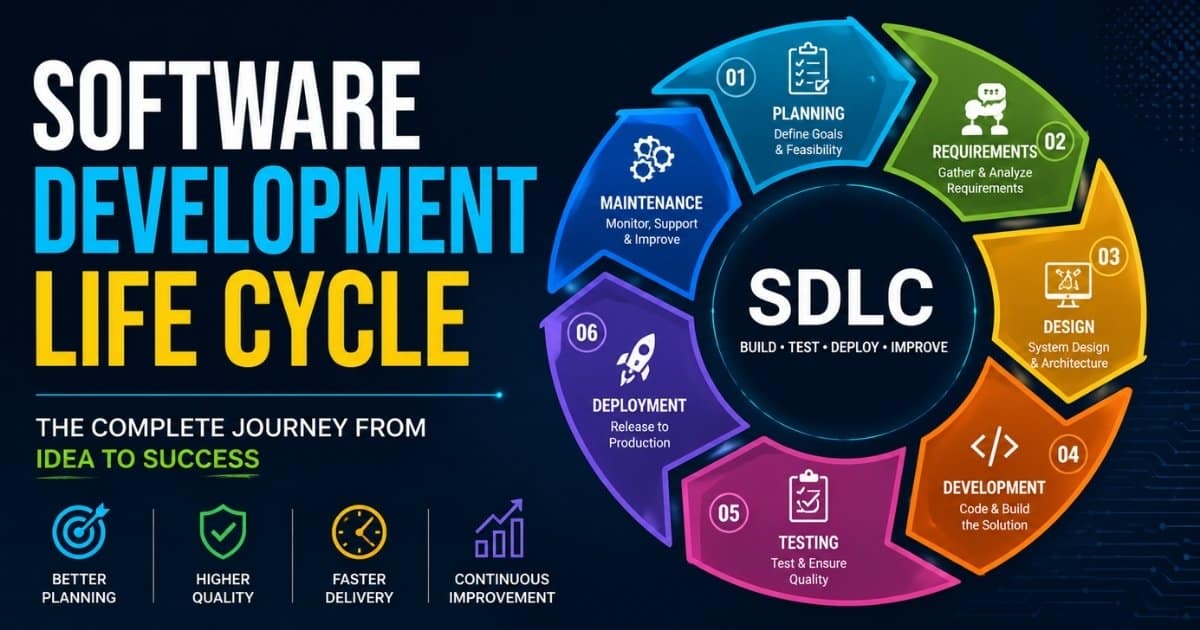
The SDLC consists of seven key phases: planning, analysis, design, development, testing, deployment, and maintenance. Each phase produces artifacts and outcomes that feed into the next, creating a repeatable and measurable software development process. Project managers, software engineers, business analysts, and operations teams all play defined roles at different points in the cycle.
What separates SDLC from generic project management is its focus on software-specific concerns like code quality, system architecture, security vulnerabilities, and operational reliability. A structured development lifecycle gives non-technical stakeholders a clear view of tradeoffs between scope, timeline, and quality. Organizations that follow a formal sdlc process consistently report better delivery outcomes, with Standish Group data showing that projects with strong upfront planning and requirement definition are far less likely to be cancelled or challenged.
How SDLC Relates To Development Models
Across waterfall, agile, and iterative approaches, the same core phases appear in every software development methodology. The difference lies in sequencing and feedback frequency, and choosing between agile vs waterfall software development for custom projects depends heavily on requirement stability, risk profile, and stakeholder expectations. Linear models like the waterfall model complete each phase before the next begins.
The agile model reorganizes phases into time-boxed sprints with incremental releases and feedback-driven planning. The iterative model falls between, repeating cycles that include architecture and analysis work in each loop.
Many organizations blend models in large portfolios, applying waterfall governance at the program level while development teams deliver with agile practices.
Role Of Stakeholders Across The Life Cycle
Responsibilities shift as a software development project moves through phases. Product managers define strategic direction during planning. Business analysts gather detailed project requirements in the analysis phase. Architects own the design phase decisions. Software developers handle the development phase. QA engineers lead the testing phase. Operations teams manage the deployment phase and production environment.
For a mid-sized SaaS product launched in 2023, stakeholder mapping might include an executive sponsor overseeing budget, a product owner managing the backlog, and cross-functional squads delivering features. Consistent involvement during the planning phase and analysis phase reduces misaligned expectations.
Executive sponsors and steering committees at key decision gates, such as design signoff and go-live approval, ensure the entire project stays on track.
Economic Impact Of A Structured Development Lifecycle
Maintenance often consumes over 60 to 80 percent of total software cost over its life cycle, making early-phase decisions critical for long-term economics. Industry benchmarks often estimate that a critical bug fixed in production can cost an order of magnitude more than one caught during unit testing or the analysis phase. One study found that post-release failures require two times or more effort compared to defects found before release, so robust software development budget planning must account for quality assurance and long-term maintenance rather than only initial build costs.
Better forecasting of scope and capacity helps CFOs and PMOs plan budgets with less variance. Standish CHAOS data shows that approximately 50 percent of large projects are challenged due to overruns, largely tied to poor upfront planning and requirement definition. A disciplined development process directly reduces these financial risks.
Key Phases Of The Software Development Life Cycle
The SDLC is commonly described as seven stages: planning, analysis, design, development, testing, deployment, and maintenance. Each phase has both technical outputs and business outcomes. In agile and iterative model contexts, these key phases often overlap or repeat, but all still occur in some form.
Planning Phase
The planning phase establishes project goals and scope for the development life cycle. Organizations define business goals such as revenue targets, regulatory deadlines, or cost-saving objectives during this stage. Stakeholders define project requirements during the planning phase, and the output typically includes a business case, initial product roadmap, and high-level release milestones. Planning produces an initial software requirement specification (SRS) document that captures early assumptions.
The planning phase also involves identifying potential risks and allocating resources across the project timeline. Effective planning helps prevent technical issues and unexpected costs. Strong planning is associated with lower probability of cancellation. Standish CHAOS data confirms that cancelled projects are frequently linked to insufficient requirements clarity and lack of executive sponsorship. Project managers play a critical role here, aligning business analysts, software engineers, and executive sponsors around a shared understanding of what the software development project must achieve.
Analysis Phase
The analysis phase gathers and reviews project requirements in detail, converting broad business ideas into specific functional and non-functional needs. Requirements Analysis identifies user expectations from software, covering performance, security, usability, and compliance constraints. Typical activities include stakeholder interviews, process mapping, user journey analysis, and data modelling workshops.
The analysis phase results in a Requirements Specification Document, along with user stories, acceptance criteria, and a prioritized backlog. Stakeholders provide input during the Requirements Analysis phase to ensure alignment between business needs and technical direction. Requirements Analysis helps distinguish essential features from desirable ones, which prevents scope creep. A thorough analysis reduces the likelihood of costly misunderstandings. Reports from PMI and McKinsey between 2019 and 2023 repeatedly identify incomplete requirements and scope creep among the top causes of project failure in complex software development projects.
Design Phase
The design phase defines the project's architecture, translating requirements into technical blueprints. Design includes outlining user interfaces and database design, along with API contracts, component boundaries, and integration patterns. A Software Design Document (SDD) is created during design, serving as the primary reference for the development phase. Prototyping tools help visualize user interfaces in design, enabling early validation with stakeholders and laying the groundwork for a cohesive SaaS design system for scalable products.
High-level architecture decisions, such as choosing between monolithic and microservices approaches, happen here, and understanding microservices vs monolith architecture is crucial for aligning design with product growth plans. Cross-cutting concerns like scalability, observability, and security patterns are also decided. Design patterns provide reusable solutions to common problems, reducing risk and accelerating delivery. For example, Danske Bank evaluated microservices for its foreign-exchange backend in 2021 and 2022, choosing to refactor its monolith to improve scalability and deployment independence. Well-documented design shortens onboarding for new software developers and simplifies future enhancements across the life cycle.
Development Phase
The development phase is where writing code and configuration happen, guided by the approved design. Developers write code based on design specifications, and coding is guided by documents like the Software Design Document (SDD). Coding involves using programming languages like Java or C++ depending on the platform and stack. Code reviews help identify bugs and maintain quality standards, while static analysis and peer review further lower defect density.
Modern practices include trunk-based development, pair programming, and automated build pipelines using development tools like GitHub Actions, Jenkins, or Azure DevOps, all of which align closely with DevOps best practices for modern teams. Version control systems ensure that every change is tracked and auditable. Generative AI tools can assist in writing code efficiently, helping software development teams accelerate routine tasks. A B2B SaaS team in 2023 might deliver customer portal features in two-week sprints, with one sprint focused on the reporting module and another on authentication, enabling partial features to be usable early.
Testing Phase
The testing phase reviews code to eliminate bugs and ensure functionality before major releases. Testing identifies bugs before software deployment, and it spans a spectrum of techniques. Unit testing, integration testing, and system testing are common types, each validating different layers of software components. The V-model includes a corresponding testing phase for each development stage, connecting requirements to validation activities.
Testing can account for nearly 33 percent of system development costs, reflecting its importance. Continuous testing occurs throughout the entire software development process, not just at a single gate. Automated testing tools can streamline the testing process, enabling development teams to sustain software quality in rapid development cycles. Security testing and performance testing round out the effort, and many teams rely on specialized SaaS monitoring tools to improve performance and user experience once systems are under real-world load. Business impacts include fewer production outages, lower incident response costs, and improved customer satisfaction.
Deployment Phase
The deployment phase releases the software to the production environment. Deployment involves releasing software to the production environment, whether on-premises, in public cloud (AWS, Azure, GCP), or in hybrid setups. Deployment strategies may include beta releases for limited users, blue-green deployments, canary releases, or phased rollouts. Gradual rollouts help monitor performance during deployment and limit risk.
A retail company in 2022 used canary deployments during the holiday shopping season to minimize checkout disruptions, rolling new code to 5 percent of users first before full release. Deployment requires careful monitoring to ensure system stability, and rollback plans are essential. User manuals and training sessions may accompany software deployment, especially for enterprise products. Observability through logs, metrics, and tracing supports both development and operations teams in catching issues early, especially when they are operating on scalable software architecture for high-growth products.
Maintenance Phase
The maintenance phase involves ongoing updates and optimizations post-deployment. Maintenance includes ongoing updates and optimizations post-deployment, covering bug fixes, enhancements, performance tuning, and security patches, and many SaaS teams follow SaaS performance optimization best practices to keep applications responsive as usage grows. Maintenance tasks involve fixing bugs and implementing patches as the production environment evolves. Industry analyses frequently estimate maintenance to account for 70 to 80 percent of total cost over a system's lifetime, reinforcing the business case for strong early-phase decisions.
Continuous maintenance ensures software remains functional and relevant. Software maintenance adapts to changing user needs and feedback, with production monitoring, user analytics, and support tickets feeding back into the planning and analysis phases. In DevOps, maintenance is an ongoing activity, not a distinct phase. A SaaS company in 2023 shifted from quarterly patching to monthly releases in response to increasing security advisories, reducing risk exposure. Teams that maintain software proactively preserve the software's functionality and protect long-term business value, especially as they adapt to the future of SaaS development in a cloud-first world.
Software Development Life Cycle Models And Their Impact
Different SDLC models organize the key phases in various ways to optimize for risk, speed, and predictability. Model choice depends on factors like requirement stability, regulatory context, team experience, and the complexity of large and complex projects.
Waterfall Model
The Waterfall model is linear and sequential, completing each phase with a formal sign-off before the next begins. Traditional software development in regulated environments often relies on waterfall because of its predictability and audit-friendly documentation. Government procurement, safety-critical systems, and core banking replacements are common use cases.
Benefits include traceability and clear documentation. Drawbacks include slow response to changing requirements and late visibility into problems. In 2024, a regulated banking replacement with rigid oversight might still choose waterfall to satisfy auditors and regulators, but project leaders still need realistic software development timeline planning to avoid damaging delays. Risk management happens upstream through detailed planning and analysis rather than frequent iteration.
Agile Model
The agile model emphasizes iterative development and customer feedback, splitting work into short sprints of two to four weeks with frequent releases. Frameworks like Scrum (with roles like Product Owner and Scrum Master) and Kanban reshape the ordering of phases but do not remove them. Surveys between 2020 and 2023 show growing adoption of agile practices across industries.
Business outcomes include faster user feedback, improved stakeholder engagement, and better alignment with evolving needs. Agile still benefits from an overarching SDLC view to align sprint work with long-term architecture and compliance. Rapid application development thrives in agile environments where software development teams can iterate quickly on customer-facing products, especially when leveraging agile and offshore software development benefits to extend capacity.
Iterative Model
The iterative model repeats full or partial cycles, each delivering a working baseline refined over time. Unlike agile, iterations may be longer, with more emphasis on architectural refinements each cycle. A large analytics platform might start with a minimal reporting core, then expand to machine learning features across several iterations.
The iterative model reduces upfront risk by validating assumptions early while preserving a structured life cycle. For complex projects with significant architectural uncertainty, this approach balances flexibility with sustainability and pairs well with a staged monolith to microservices migration guide when modernizing legacy systems.
Spiral And Risk-Driven Models
The spiral model focuses on risk management and iterative development, cycling through planning, risk analysis, engineering, and evaluation. Each loop targets the highest-risk elements first, making it suitable for high-uncertainty domains like defense, healthcare, and IoT.
A digital health platform piloted with small patient groups between 2021 and 2025 before broader rollout is a practical example. The tradeoff involves higher planning overhead against significantly reduced probability of major failures late in the project. Risk assessment at every loop ensures that critical concerns like security flaws or performance gaps are addressed before they compound.
DevOps And Continuous Delivery Approaches
DevOps integrates development, testing, and operations to support continuous integration and continuous deployment. Lean aims to reduce waste in the software development process, and DevOps embodies that principle by compressing phases into rapid, automated cycles, closely aligning with several emerging software development trends shaping 2026. Development and operations teams collaborate continuously rather than handing off work between silos.
Organizations with mature DevOps practices often achieve shorter lead times and lower change failure rates, as documented in Accelerate State of DevOps reports from 2020 to 2024. DevOps does not remove phases but repeats them rapidly, enabling multiple deployments per day or week.
Business Impact Of Each Phase In The Development Life Cycle
SDLC phases are not just technical steps. Each phase acts as a lever for revenue growth, cost management, and risk control. Organizations with balanced investment across planning, development, and maintenance typically outperform those skewed heavily toward late-phase firefighting. Leaders can use this mapping to prioritize investments and staffing across the development lifecycle.
Strategic Alignment During Planning And Analysis
Clear business cases, value hypotheses, and stakeholder alignment in planning and analysis directly influence return on investment. A software development project that validated customer needs through discovery interviews and prototypes in early 2023 avoided a costly pivot that would have consumed months of engineering time. Misalignment leads to stalled projects, duplicated systems, and low adoption. Transparent prioritization frameworks reduce wasted effort on low-value features across the development life cycle.
Architectural Decisions In The Design Phase
Choosing scalable architectures, such as cloud-native and microservices, versus less flexible monoliths has significant financial implications. A mid-sized FinTech company that migrated to microservices achieved a 400 percent increase in throughput and reduced infrastructure costs by approximately 35 percent. Poor early design can force expensive re-platforming within three years. Decisions about data models and integration patterns, including whether to embrace an API-first architecture for scalable systems, affect vendor lock-in, licensing costs, and how quickly new features reach the market.
Productivity And Quality In The Development Phase
Development practices such as modular code, automated builds, and code reviews influence defect rates, onboarding speed, and release frequency. High-performing software development teams deploy more frequently with lower failure rates. Investment in developer experience and development tools reduces burnout and attrition, both of which carry significant replacement costs. Structured branching strategies and reusable software components reduce redundancy across product lines, helping teams produce software more efficiently and support long-term SaaS scalability strategies for sustainable growth.
Risk Reduction In The Testing And Deployment Phases
Systematic testing reduces the likelihood of high-severity incidents that cause downtime, revenue loss, or reputational damage. Facebook's 2021 outage, caused by a maintenance error and poor rollback processes, resulted in losses estimated at over 60 million dollars. Controlled deployment tactics, feature flags, and rollback mechanisms lower exposure for each release. Outages also affect regulatory reporting and contractual service-level agreements, compounding the business cost of inadequate testing.
Long Term Value Realization In The Maintenance Phase
Timely maintenance directly connects to customer retention, support ticket volume, and operational efficiency. Technical debt accumulated during rapid growth can erode margins if not addressed through structured refactoring, and many organizations underestimate these obligations as part of the broader hidden costs in software development. A SaaS product that invested in regular performance tuning and UX improvements between 2022 and 2024 handled user growth without linear infrastructure cost increases. Unpatched security vulnerabilities can lead to data breaches and regulatory fines, making proactive maintenance a business necessity for any team that needs to fix bugs before they become crises.
Security And Compliance Across The Development Lifecycle
Security can no longer be isolated to a single phase. It must span the entire software development lifecycle, from the first planning conversation through ongoing maintenance. Proactive security investment is consistently cheaper than reactive breach response.
Threat Modelling During Planning And Design
Identifying assets, adversaries, and attack surfaces early allows teams to embed countermeasures into system architecture rather than bolting them on later. An online banking portal must protect account data, transaction processes, and authentication flows. Structured threat modelling during the design phase influences choices such as encryption standards, network segmentation, and logging. Common frameworks like STRIDE or attack trees help business readers understand risk without deep technical expertise.
Secure Coding And Dependencies In The Development Phase
Secure coding practices, code review checklists, and training help prevent common security vulnerabilities like injection or cross-site scripting. Many modern breaches exploit known vulnerabilities in third-party libraries rather than custom code. Software composition analysis tools help teams manage open source dependencies. Development pipelines can automatically scan for vulnerable packages and outdated software components, keeping code quality high.
Testing For Security And Compliance Before Deployment
Security testing techniques include static application security testing (SAST), dynamic testing (DAST), and penetration testing. Compliance checklists and policy-as-code controls play a central role in regulated industries. A financial services firm might run regular penetration tests before major releases to satisfy regulatory and internal risk requirements. Continuous security testing supports agile and DevOps environments without becoming a bottleneck in the SDLC process.
Operational Security During Deployment And Maintenance
Secure configuration, secrets management, and environment hardening are critical during the deployment phase. Ongoing practices such as log monitoring, anomaly detection, and incident response drills protect the production environment. The Log4Shell vulnerability in 2021 forced responsible organizations to rapidly patch, monitor, and sometimes roll back affected systems. Recovery time objectives (RTO) and recovery point objectives (RPO) must be defined and tested regularly to ensure operational resilience.
Governance, Risk, And Compliance Integration
Organizations formalize SDLC controls as part of governance, risk management, and compliance (GRC) frameworks. Approvals, segregation of duties, and mandatory artifacts like design reviews, test evidence, and change records form the backbone of audit readiness. A publicly traded company might align SDLC evidence with reporting obligations in annual filings, demonstrating due diligence in its software development process to auditors and regulators.
Common Barriers In SDLC Implementation
Simply adopting phase names or development tools is not enough. Misapplication of SDLC can still lead to project failure, and many postmortems from recent years cite poor requirements, inadequate stakeholder engagement, and rushed testing as root causes.
Checklist Driven Rather Than Outcome Driven SDLC
Teams sometimes treat SDLC as a compliance checkbox exercise, focusing on templates rather than genuine risk analysis. Documents get created that nobody reads, producing a false sense of security about project health. A product can pass all formal gates yet still fail because user value was never validated. Shifting emphasis toward measurable outcomes like adoption, performance, and business KPIs keeps the structured process meaningful.
Poor Requirements And Scope Management
Unclear software specifications lead to constant changes, last-minute escalations, and dissatisfaction. Scope creep can turn a six-month project into a multi-year effort when prioritization is absent. Techniques like progressive elaboration and change control boards help keep scope manageable. Even agile approaches need discipline in backlog management and definition of done to handle complex software development projects successfully.
Underinvestment In Testing And Quality Assurance
Cutting testing time is a common response to schedule pressure, but it often produces bigger delays later. Facebook's 2021 outage demonstrated how a maintenance error combined with inadequate audit tools can cost over 60 million dollars. The long-tail impact of poor software quality includes persistent support load, workarounds, and user frustration. Risk-based testing, where the most critical journeys receive extra attention, delivers the highest return.
Ignoring Security Until Late In The Life Cycle
Postponing security to pre-release or post-release phases results in costly redesigns or dangerous exceptions. OWASP guidance stresses early integration of security requirements. A patchwork security fix added after the design phase is finalized can degrade performance or user experience. Including security acceptance criteria in user stories and design reviews prevents security flaws from compounding.
Lack Of Feedback Loops And Continuous Improvement
Many teams fail to use retrospectives, metrics, and user feedback to refine their SDLC over time. Static processes become misaligned with new technologies, architectures, or team structures. An organization that systematically addressed bottlenecks identified in retrospectives improved delivery lead time measurably. Simple metrics like cycle time, deployment frequency, and change failure rate provide starting points for continuous improvement.
Best Practices To Strengthen Your Development Lifecycle
Successful software development requires more than following a template. The practices below reflect common patterns observed in high-performing digital and software companies, tailored for teams that want to make their development process more effective and responsive.
Align Product Strategy With SDLC Phases
Roadmaps and portfolio management should connect upcoming initiatives with SDLC milestones like design reviews and release windows. A simple mapping between strategic objectives and current SDLC efforts exposes gaps or duplication, and a disciplined SaaS product roadmap for 2026 can make these dependencies explicit. One company coordinated major marketing campaigns with deployment and stabilization periods to maximize launch impact. Involving finance and operations early in planning helps project managers agree on budgets and capacity for developing software at scale.
Invest In Automation Across The Life Cycle
Automating builds, tests, deployments, and security scans improves consistency and speed. High-performing teams in widely cited DevOps reports rely on automation to achieve daily or hourly releases. A team in 2023 reduced manual release time from days to hours through pipeline automation, which is especially impactful in end-to-end SaaS product development from build to scale. Automation also supports auditability by producing consistent logs and artifacts across the entire project.
Adopt Metrics And Observability For Decision Making
Collecting and analyzing data across the SDLC, including lead time, defect trends, and customer usage analytics, enables informed decisions. Feature usage data once guided a team to simplify rather than expand a product area, saving months of engineering effort. Observability tools for logs, metrics, and traces support development and operations teams in maintaining high quality software. Metrics should drive learning, not punitive comparisons between individuals.
Balance Governance With Autonomy
The tension between centralized control and team-level independence is real in large organizations. Lightweight standards, reusable templates, and guardrails allow teams to move quickly without bypassing critical checks. One company standardized deployment pipelines and security gates while allowing teams to choose their own languages or frameworks. Clear decision rights and escalation paths reduce bottlenecks during the software development life cycle.
Build A Learning Culture Around The SDLC
Blameless post-incident reviews, cross-team demos, and communities of practice accelerate organizational learning. A production incident at one company led to systemic improvements in test coverage and monitoring after a thorough review. Leadership support for experimentation acknowledges that some failures are part of innovation. Regular training and knowledge sharing keep SDLC practices aligned with emerging methods and help software engineers grow in their roles.
GainHQ And The Software Development Life Cycle
GainHQ is a platform designed to support teams through the entire software development life cycle, from planning through maintenance. The platform helps with requirement management, sprint and release planning, test tracking, and change governance, giving project managers and software development teams a single source of truth for every phase, while the GainHQ blog on software development and digital transformation extends this support with ongoing education and thought leadership.
GainHQ's reporting and dashboards link engineering activity with business metrics, making SDLC outcomes visible to non-technical stakeholders. The platform integrates with common developer tools such as version control systems, CI/CD platforms, and ticketing systems to reduce manual coordination work. For teams looking to adopt a structured development lifecycle without adding unnecessary overhead, GainHQ provides the foundation for delivering high-quality software at scale.
Frequently Asked Questions
How Many Phases Should Our SDLC Have In Practice?
Most organizations use six or seven recognizable phases. Names and boundaries can vary without losing effectiveness. The important factor is coverage of planning, analysis, design, development, testing, deployment, and maintenance activities, even if some are combined. Choosing terminology that matches company culture while keeping alignment with industry norms helps teams adopt the process naturally.
Can Small Startups Benefit From A Formal Development Lifecycle?
Even small teams benefit from a lightweight SDLC, especially for clarity, software quality, and knowledge transfer as they grow. A minimal set of practices for startups might include regular planning sessions, basic documentation, automated testing, and post-release reviews, which aligns closely with a structured startup software development process guide. Formality can increase over time as complexity and stakeholder expectations grow, making the path to successful software development smoother.
How Do We Choose Between Waterfall, Agile, And Hybrid Models?
Project characteristics such as requirement stability, regulatory pressure, and integration complexity matter more than personal preference. Agile or hybrid approaches work well for customer-facing products with evolving needs, while more structured models suit infrastructure or compliance-heavy software projects. Periodic reviews based on actual outcomes and team feedback help refine the chosen software development methodology over time.
What Metrics Should Executives Track To Judge SDLC Health?
Useful metrics include lead time from idea to production, change failure rate, incident frequency, and adoption or retention figures tied to major releases. Combining technical indicators with business KPIs provides a more comprehensive view of SDLC effectiveness. Tools like GainHQ can centralize these metrics for leadership dashboards, helping executives track progress across the development lifecycle.
How Often Should We Update Or Redesign Our SDLC Process?
SDLC should evolve gradually as technology, team structure, and business strategy change, rather than being redesigned from scratch every year. Scheduled retrospectives, for example, quarterly or biannual, help identify pain points and propose incremental adjustments. Involving cross-functional stakeholders in these discussions avoids optimizing for a single team at the expense of the wider organization.