
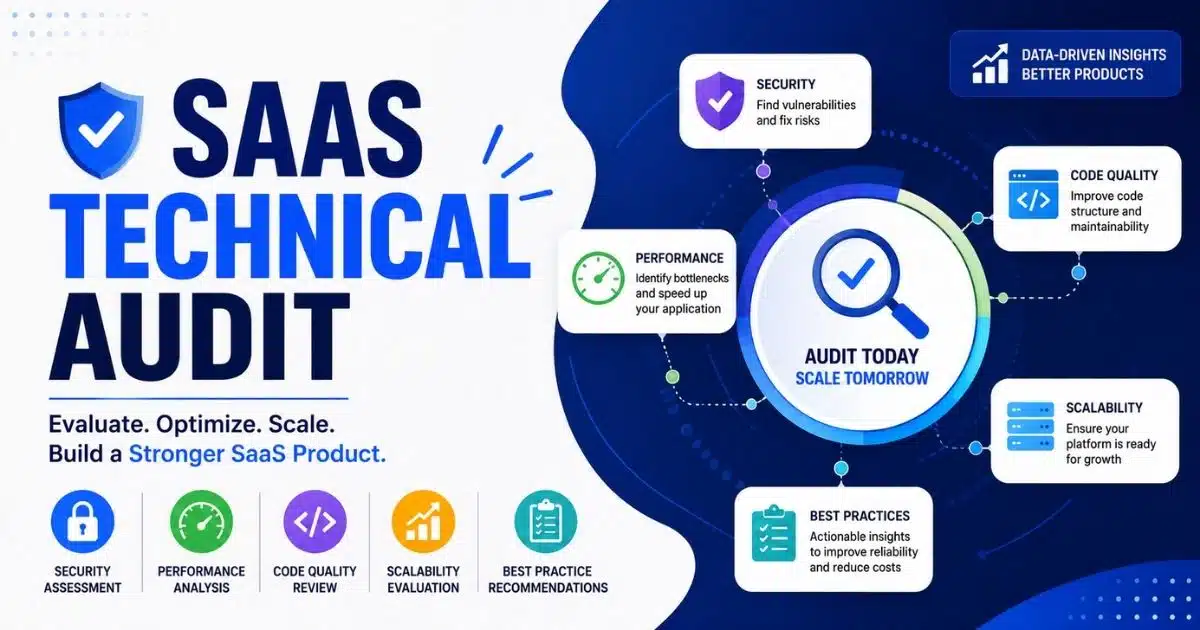
A technical audit for a Software as a Service application is a comprehensive review of the technology stack, covering everything from architecture decisions and security controls to front-end performance and analytics accuracy. For any growing saas business, the technical side of the product deserves the same disciplined attention as sales pipelines and marketing funnels.
A SaaS technical audit identifies vulnerabilities, scalability bottlenecks, and compliance gaps that silently accumulate as teams ship features and onboard customers. Without regular audits, these issues compound into costly incidents, lost deals, and eroded trust. The guide below walks through every stage of the process so product teams and engineering leaders can build a repeatable system for technical health.
What Is A SaaS Technical Audit
A saas technical audit is a point-in-time, structured assessment of a saas product's codebase, infrastructure, third-party integrations, and data flows. A comprehensive technical audit evaluates software architecture, code quality, and infrastructure to determine where the product stands today relative to where it needs to be. A technical audit evaluates security practices, performance, and scalability in a unified review rather than treating each area in isolation.
What separates a saas audit from a generic IT audit is the focus on multi-tenant architectures, subscription models, continuous deployment pipelines, and uptime SLAs. Generic IT audits often stop at licensing and regulatory compliance. SaaS audits must account for how tenant data is isolated, how billing flows work, how deployment frequency affects stability, and how users experience the product under real-world conditions.
SaaS audits can be internal or external. Internal auditors may be senior IT managers or corporate auditors who know the system deeply. External auditors can be from government agencies or third-party firms that bring objectivity and specialized expertise. Manual audits involve interviews and security scans, while automated audits use software for continuous monitoring. Most organizations benefit from combining both approaches. The audit typically covers four key components: security and data protection, performance and core web vitals, reliability and scalability, and observability and analytics.
Why SaaS Companies Benefit From Regular Technical Audits
Many saas companies operate in reactive mode, addressing technical problems only after they cause customer-facing incidents or compliance failures. Scheduled audits shift the culture toward proactive risk management, and the financial case for doing so is strong.
The risk reduction alone justifies the investment. According to the 2024 IBM Cost of a Data Breach Report, the average global cost of a data breach reached US$4.88 million, up roughly 10% from the previous year. Approximately 40% of those breaches involved data stored across multiple environments, and misconfigurations can cost around NZD 7.59 million in breaches. Enhanced security protects customer data and prevents data breaches, which is why regular audits directly reduce financial exposure. Over 132 countries have implemented data protection regulations, making compliance a requirement rather than an option for any saas business operating across borders.
Beyond risk, audits unlock growth. Cost optimization helps reduce hosting and licensing expenses through audits, particularly when technical audits identify unused, redundant user accounts to reduce costs. SaaS companies often use monthly subscription revenue models, and even small improvements in performance or conversion rates compound quickly across thousands of subscribers. SaaS financial reports differ from traditional companies' reports, and saas companies typically face challenges with deferred revenue recognition, making accurate technical and financial tracking even more essential. Faster feature delivery, improved organic traffic from technical SEO improvements, and higher conversion rates once core web vitals are optimized all contribute to sustainable growth.
Enterprise customers increasingly expect evidence of regular saas audit activities. Procurement teams ask for security questionnaires, SOC 2 reports, and documented incident response plans before signing contracts. Running regular audits positions your company to answer these requests confidently.
How To Conduct A SaaS Technical Audit - Step By Step

The following 7 stages form a practical playbook. Each stage builds on the previous one, moving from planning through execution to remediation and measurement.
1. Set Scope Objectives And Success Metrics
Every effective audit starts with clear boundaries. Define clear audit goals and scope before starting, whether the audit covers a single saas product, a specific region, or all production-facing services. Establish clear objectives and scope when conducting a technical audit so that the team knows exactly what falls inside the review and what does not.
Choose 3 to 5 measurable objectives. Examples include reducing mean time to recovery by 30%, cutting 404 errors by half, or achieving 99.9% uptime over the next quarter. Include security, performance, and saas seo audit goals within the same scope rather than treating SEO as a separate initiative. Audit the product against relevant regulations depending on the target market, and map objectives to compliance or business drivers such as SOC 2 Type II readiness, ISO 27001 certification, or upcoming fundraising due diligence.
2. Assemble a Cross-Functional Audit Team
Select an independent audit team with diverse expertise. Typical roles include a tech lead or solutions architect, a security engineer, an SRE or DevOps specialist, a data or analytics specialist, and a product manager. Independence matters: involving people who did not build the audited module keeps findings objective and catches assumptions that builders overlook.
Include at least one representative from customer success or support. Frontline teams bring practical insights from production incidents, support tickets, and customer complaints that purely technical reviews often miss. For larger saas applications, appointing an audit owner and using a RACI matrix keeps tasks accountable and time-boxed. Employees across departments should understand their role in the process.
3. Map Architecture And Data Flows
Create or update current-state diagrams for infrastructure, microservices, databases, third-party APIs, and external saas integrations. Document all infrastructure components, libraries, and APIs during the audit. Well-documented architecture eases integration with third-party tools and gives auditors a reliable reference point.
Map data flows from signup through activation, billing, product usage, and account closure, with special attention to personal data and data protection controls. Highlight multi-tenant design details such as tenant isolation mechanisms, schema design, and use of shared vs dedicated resources. Microsoft's multi-tenant architecture guidance provides a solid reference for evaluating isolation, data management, and resource grouping.
Maintain detailed visibility of SaaS assets to avoid blind spots. Identify all applications in use, including shadow IT applications. Research consistently shows that 35% more assets are often found than tracked in SaaS companies, and only 28% of organizations believe their asset inventory exceeds 75% completion. Maintain a detailed asset inventory to avoid blind spots, as undiscovered shadow apps and legacy endpoints are common sources of risk.
4. Evaluate Security And Compliance Posture
Cover authentication and authorization patterns thoroughly: password policies, SSO and SAML configurations, and role-based access controls for internal and external users. Review how access controls are structured across environments, and ensure software usage complies with license agreements and regulations.
Verify customer data is encrypted both at rest and in transit. Review key management practices, secrets management through tools like HashiCorp Vault or cloud KMS, and backup encryption. Perform vulnerability tests as part of the security evaluation, and run penetration testing and vulnerability scans quarterly for production environments. Map vulnerabilities to specific compliance requirements such as SOC 2, GDPR, or HIPAA.
Review logging of security events, alert thresholds, and incident response playbooks. Confirm that the team can identify issues quickly through centralized monitoring and that incident response timelines meet regulatory expectations.
5. Assess Reliability Scalability And Performance
Review uptime history, SLOs, SLAs, load balancing setup, database replication, and use of queues for background processing. Proactive testing uncovers vulnerabilities and weaknesses in systems before they reach customers. Use historic traffic patterns, such as quarter-end reporting spikes or seasonal peaks, to stress test capacity and autoscaling rules.
Measure core web vitals using tools like Google Lighthouse, PageSpeed Insights, google search console, and Real User Monitoring. Core Web Vitals are a confirmed ranking factor for all pages, making them relevant to both engineering and marketing. Connect performance metrics to real business outcomes like signup conversion, churn, and support ticket volume. SaaS audits should be conducted at least annually, with focused performance reviews after major releases.
6. Review Observability Analytics And Tooling
Verify that metrics, logs, and traces are collected consistently across services. Audit logs should be stored for at least six months to support investigations and compliance reporting. Evaluate dashboards and alerts in tools such as Datadog, Prometheus, Grafana, or equivalent solutions to ensure they track core flows and error budgets effectively.
Check the configuration of google analytics and google search console to validate correct event tracking, conversions, and search coverage for saas marketing pages. Confirm that analytics implementation supports acquisition, activation, engagement, and retention metrics. Observability improvements lead to faster investigations, better auditability, and more reliable reporting for both internal and external stakeholders.
7. Prioritize Remediation And Implement Changes
Rank findings by impact and effort. High-risk vulnerabilities, data protection gaps, and revenue-affecting issues come first. Document findings and create a compliance plan for approval after the audit. Most fixes in SaaS audits should be completed within three months to maintain momentum and demonstrate accountability.
Build fixes into regular sprint planning so that audit activities align with product teams and do not become side projects. Assign owners, set deadlines, and define success metrics for each remediation item. Schedule a follow-up mini audit 60 to 90 days after major remediation to verify improvements, update architecture diagrams, and communicate progress to stakeholders.
Key Components Of A SaaS Technical Audit Framework

A repeatable framework helps saas companies run consistent audits across products and over time, turning a one-off exercise into an evolving system that improves with each cycle.
Application And Code Quality
Review language and framework choices, modularity, test coverage, and the use of static code analysis tools for security and maintainability. Customize the audit checklist for specific SaaS architecture needs rather than applying a generic template. Evaluate continuous integration pipelines, code review standards, and dependency management policies.
Outdated open-source packages remain one of the most common attack vectors. Keeping third-party libraries current reduces exposure significantly. Map architecture decisions to the product roadmap to avoid over-engineering in areas that may change soon or brittle implementations that block future releases.
Cloud Infrastructure And Environment Management
Check infrastructure-as-code definitions, environment parity between staging and production, and isolation of test data from live data. Review configuration baselines against CIS Benchmarks or cloud provider security best practices for AWS, Azure, or Google Cloud. Verify automated data backups occur at regular intervals for disaster recovery, and confirm that backup restoration has been tested within the past quarter.
Evaluate reserved instances, right-sizing opportunities, and spot instance usage. These affect both reliability and cost for saas products. Document environment provisioning workflows to reduce manual, error-prone steps that lead to configuration drift.
Data Architecture And Protection Controls
Assess schema design, indexing, archival strategies, and multi-region replication for critical saas business data. Apply privacy-by-design principles such as data minimization, pseudonymization, and retention policies mapped to GDPR or CCPA. Explicitly state which datasets qualify as personal data, financial data, or proprietary customer data for clearer protection rules.
Review backup frequency, restore testing, and recovery time objectives. Audit results should feed directly into disaster recovery improvements, not sit in a static report. Confidentiality of customer data depends on well-defined controls at every layer.
Integration Surfaces And External SaaS Dependencies
Catalog all public APIs, webhooks, marketplace integrations, and embedded widgets. Assess all APIs, SDKs, and integrations during the audit process. Match each application with a business owner and verify contract terms to ensure clear ownership and accountability. Identify contracts expiring within 90 days to review renewals and costs before they auto-renew at unfavorable terms.
Evaluate API authentication methods, rate limiting, error handling, and versioning policies. Technical audits help uncover unauthorized apps and identify unused licenses, which directly reduces cost. Abandoned or legacy integrations often become attack paths or operational liabilities and should be disabled or removed.
User Experience Accessibility And Technical SEO
Connect UX audits with technical checks such as core web vitals, mobile responsiveness, and accessibility standards like WCAG 2.1. SaaS platforms face unique technical SEO challenges like dynamic dashboards, where content changes frequently and is often behind authentication. HTTPS is a confirmed Google ranking signal for SaaS platforms, so confirm that all public-facing pages enforce TLS.
A saas seo audit looks at crawlability, indexation, URL structure, and JavaScript rendering for marketing and self-service documentation pages. Use structured data markup for product, FAQ, and documentation pages to improve visibility in search results. Consider localization and multi-language support where relevant, especially for global saas companies serving users across regions.
Security Governance And Data Protection In SaaS Products

Security and data protection are central to any saas audit, not isolated add-ons that get reviewed separately.
Security Policies Standards And Ownership
Document security policies covering acceptable use, data classification, incident response, and vendor risk management. Assign clear ownership for each policy with defined review cycles, often annually or ahead of compliance renewals. Link policies to training for engineers and product teams with tracked completion rates, so that employees understand their responsibilities.
Map each policy to regulatory or certification clauses. This step simplifies external assessments by giving auditors a direct path from policy to evidence.
Identity Access Management And Privilege Control
Use SSO, MFA, and centralized identity providers for staff and administrators. Conduct periodic access reviews for internal tools, production systems, and customer data stores at least quarterly. Analyze the number of users per application to identify redundancy and eliminate unnecessary accounts.
Apply the principle of least privilege and just-in-time access for sensitive operations like database queries or production deployments. Log and alert on privilege escalations and failed authentication attempts to support rapid investigations.
Data Protection Across Customer Lifecycle
Review how data is collected during signup, onboarding, and in-product usage. Confirm that consent and transparency requirements are met at each stage. Handle data exports, account deletion, and offboarding securely, ensuring that backups and archives align with retention rules.
Support data subject rights such as access, rectification, and deletion, particularly for EU and UK users. Document lawful bases for processing and international data transfer mechanisms for cross-border saas operations. Conduct audits at least once yearly for effective security management across the full customer lifecycle.
Security Monitoring Incident Response And Forensics
Build a security monitoring stack that includes intrusion detection, endpoint security, and centralized log analysis. Create and test an incident response plan that defines roles, communication paths, and timelines for customer notification. Conduct regular incident simulations or tabletop exercises to validate readiness before a real breach occurs.
Preserve logs and evidence to support forensic analysis and regulatory reporting. Organizations in the saas industry must be prepared to demonstrate how they detected, contained, and communicated incidents to affected customers and regulators.
Vendor Risk Management For SaaS Dependencies
Create and maintain a vendor inventory of all external saas tools and cloud services used in delivering the product. Check each vendor's certifications, data processing agreements, and breach notification clauses. Contracts should include provisions for right-to-audit and timely breach disclosure.
Reassess critical vendors periodically, focusing on payment processors, identity providers, and hosting platforms. Document exit plans for essential vendors to reduce lock-in and resilience risks, ensuring that your company can migrate if a vendor's posture deteriorates.
Performance Reliability And Scalability In SaaS Technical Audits
Fast, reliable saas products drive customer satisfaction, retention, and competitive differentiation. Performance issues are among the most common problems that erode trust silently over time.
Service Level Objectives And Availability History
Review defined SLOs for uptime, latency, and error rates, then compare them with historical monitoring data. Examine incident records, root cause analyses, and recurring failure patterns over the past 12 to 24 months. Conduct audits at least once yearly to keep reliability baselines current.
Differentiate between core product paths and peripheral features when setting reliability targets. Present findings in simple charts or trend lines to communicate reliability patterns to non-technical stakeholders, including leadership and investors.
Scaling Architecture And Capacity Planning
Evaluate autoscaling rules, database sharding or partitioning, queue utilization, and caching layers. Simulate peak loads with realistic traffic profiles using tools aligned with the current tech stack. Assess cross-region failover capabilities for global saas customers with latency-sensitive workloads.
Balance early optimization against cost-effective scaling that aligns with revenue growth. Over-provisioning resources wastes money, while under-provisioning risks saturation during peak traffic.
Front End Performance And Core Web Vitals
Audit Largest Contentful Paint (target under 2.5 seconds), Interaction to Next Paint (under 200 milliseconds), and Cumulative Layout Shift (under 0.1) using both lab and field data. Check JavaScript bundle sizes, third-party scripts, image formats, and caching headers that affect saas dashboards and landing pages.
Google has used page experience signals in ranking, and improving these metrics correlates with better conversion rates. Case studies from Redbus show that a 31% improvement in LCP yielded an 8% sales lift, while Nykaa improved LCP by 40% and saw 28% growth in organic traffic. Another case study documented a 45% conversion rate uplift after fixing CLS issues on a SaaS landing page. Coordinate improvements between engineering, marketing, and design teams since all three influence front-end performance.
Database Performance And Query Optimization
Review slow query logs, index usage, connection pooling, and transaction patterns in primary databases. Consider separate read replicas, analytics warehouses, or event streams for reporting-heavy saas products. The impact of noisy tenants in multi-tenant databases can degrade performance for all customers, and isolation strategies at the query or resource level can mitigate these common problems.
Periodic schema reviews should align with evolving product features and reporting needs. A query that performed well at 1,000 tenants may become a bottleneck at 10,000.
User Experience Under Load
Observe how key workflows such as login, dashboard loading, and core actions perform under simulated peak traffic. Use real user monitoring data to validate that perceived performance aligns with synthetic tests. Slow paths for high-value tenants or enterprise customers should be prioritized in remediation.
Capture qualitative feedback from support tickets and NPS surveys to complement quantitative metrics. When users report slowness, correlate those reports with monitoring data to identify issues that synthetic tests alone might miss.
SaaS SEO Analytics And Observability Within Technical Audits
SaaS technical audits increasingly include SEO and analytics because they directly impact acquisition, product decisions, and search presence.
Search Visibility And Crawl Health For SaaS Sites
A SaaS SEO audit identifies technical issues affecting search visibility across marketing, documentation pages, and support subdomains. Review index coverage, crawl errors, and sitemaps in google search console. Assess robots.txt, canonical tags, hreflang where applicable, and handling of duplicate content or parameterized URLs common in saas products.
JavaScript rendering is a common SEO issue for SaaS applications, particularly for single-page applications or React-based marketing sites. Ensure search engines can fully render and index your content. Track impressions, clicks, and queries for core product pages over time to spot issues early. Regular audits should be conducted at least quarterly for SaaS platforms to catch crawl and indexation regressions before they affect search performance.
Technical SEO Elements On SaaS Product Pages
Check title tags, meta descriptions, headings, and internal links structures for main product, pricing, and feature pages. Technical SEO is essential for effective SaaS SEO strategies, and structured data for product, organization, and FAQ blocks can increase click-through rates for high-intent queries in search results.
A complete SaaS SEO checklist covers eight key audit areas, from crawlability and indexation to site speed and structured data. Prioritize core web vitals improvements on top-of-funnel and signup-related URLs where search performance directly affects revenue. SaaS SEO audits help identify opportunities for organic growth that compound over time. A full technical SEO audit should be conducted quarterly to stay ahead of algorithm changes and technical drift.
Analytics Implementation And Event Taxonomy
Assess how google analytics, customer data platforms, or other analytics tools are implemented across web and in-app experiences. Review event naming conventions, parameters, and user properties to ensure consistent tracking of key saas funnels. Validate that acquisition, activation, engagement, and retention metrics can be calculated using existing data.
Document an analytics tracking plan that can be updated alongside product releases. Without a well-maintained event taxonomy, product teams make decisions based on incomplete or inaccurate data, which undermines the real value of experimentation and optimization.
Product Usage Dashboards And Reporting Quality
Evaluate internal dashboards that product teams use to monitor adoption, feature usage, and cohort behavior. Check data freshness, query performance, and access controls for business intelligence tools. Consistent, trusted dashboards are essential when presenting metrics to investors or board members.
Include tracking for expansion revenue, feature-level retention, and usage segmentation. When dashboards disagree with each other, teams lose trust in the data and revert to gut-based decisions.
Experimentation A B Testing And Attribution
Confirm that the saas business has reliable tools and processes for A/B testing changes to onboarding, pricing pages, or product UI. Validate attribution models for paid and organic channels, tying them back to trial starts and conversions. Avoid over-attribution to last-click channels by leveraging multi-touch analytics where possible.
Audit findings should feed into a roadmap for improving experimentation culture and measurement sophistication. Ensure that experimentation apps do not block site speed or degrade the user experience during tests. Domain authority and search presence grow faster when the company can measure what works and double down with confidence.
How To Build A Repeatable SaaS Technical Audit Rhythm

A single audit has limited value unless it evolves into a repeatable, scheduled practice integrated with product planning.
Defining Audit Calendar And Ownership
Set an annual calendar that allocates time for preparation, execution, remediation, and verification phases. SaaS audits should occur at least once a year, with targeted security and performance reviews on a quarterly basis. Assign accountable owners for each audit stream at the engineering leadership level, ensuring clear ownership across security, performance, and analytics.
Coordinate with finance and legal teams when audits intersect with external certifications or investor requests. Revisit the calendar each year based on incident history and strategic priorities.
Standardizing Checklist Templates And Tools
Create internal checklists rooted in best practices but tailored to the company's tech stack and regulatory environment. Build reusable templates for architecture diagrams, risk registers, and remediation plans. Choose a consistent set of tools for scanning, monitoring, and reporting, including vulnerability scanners, static analysis platforms, and load testing solutions.
Update checklists periodically as new regulations, technologies, or attack vectors emerge. A checklist that worked for your product 18 months ago may not cover newer aspects of your architecture or evolving compliance requirements.
Aligning Audits With Product Roadmaps
Feed audit findings into quarterly and annual product roadmaps, ensuring that technical debt and risk reduction get scheduled alongside feature work. Prioritize remediation that unlocks strategic initiatives such as entering regulated industries or landing larger enterprise segments.
Involve product managers early so that audit work is seen as value-creating rather than purely overhead. Track which roadmap items originated from audits to demonstrate tangible business impact and justify continued investment in the process.
Measuring Impact Of Technical Audits Over Time
Pick a small set of metrics to track across cycles: incident count, uptime percentage, number of open critical vulnerabilities, average page speed scores, and audit completion time. Compare these metrics before and after each audit cycle to show progress to leadership and teams.
External metrics like customer satisfaction, churn, and NPS may also improve as technical health increases. Create simple visual trend lines or scorecards that can be reviewed in quarterly business reviews to keep the audit program visible and accountable.
Embedding Continuous Improvement Culture
Use audits to encourage blameless postmortems, shared learnings, and cross-team collaboration. Recognize teams for preventive work, not only for firefighting incidents. Establish internal communities of practice for security, reliability, or analytics that evolve audit standards over time.
Review and refine the audit process itself after each cycle. Solicit feedback from participants about what worked, what slowed things down, and what should change. The audit becomes more efficient and more valuable with every iteration.
Final Discussion
A SaaS technical audit helps organizations evaluate the health, security, performance, and scalability of their software platform. The process starts by defining the audit scope, objectives, and key success metrics. Next, assemble a cross-functional team that includes engineering, security, operations, and product stakeholders. Review the system architecture, infrastructure, and data flows to identify technical risks and dependencies.
Assess security controls, compliance requirements, access management, and data protection measures. Evaluate application performance, reliability, scalability, and disaster recovery capabilities to uncover operational weaknesses. Examine monitoring tools, logging systems, analytics, and observability practices to ensure visibility into system health.
Finally, prioritize findings based on business impact and technical risk, then create a remediation roadmap with clear ownership and timelines. A structured SaaS technical audit provides actionable insights that improve platform stability, reduce risk, enhance user experience, and support long-term business growth.
FAQs
How Often Should A Growing SaaS Business Run A Full Technical Audit
Most saas companies should run a comprehensive technical audit annually, with lighter targeted reviews after major releases or incidents. SaaS audits should occur at least annually to maintain security and compliance baselines. Highly regulated or rapidly scaling saas products may benefit from semiannual audits focused on security and performance. Conduct audits at least once yearly to keep technical debt from accumulating beyond manageable levels.
Who Should Lead A SaaS Technical Audit Inside The Company
Ownership typically sits with the CTO, VP of Engineering, or a senior technical leader who is responsible for coordinating across security, DevOps, and product teams. Larger organizations may appoint a dedicated head of platform or security to oversee recurring audits and manage external certifications. The audit leader must have the authority to allocate resources, engage stakeholders, and ensure findings translate into action.
How Long Does A Typical SaaS Technical Audit Take
A realistic range is 3 to 6 weeks for a mid-sized saas product covering architecture, security, performance, and analytics. Timelines depend on codebase size, the number of integrations, documentation quality, and availability of internal subject matter experts. Products with strong existing documentation and automated tooling tend to complete audits faster.
What Is The Difference Between A Technical Audit And A Security Audit
A technical audit is broader, covering architecture, reliability, performance, observability, and other aspects such as SEO and analytics. A security audit focuses primarily on threats, vulnerabilities, and controls. Many saas companies combine both to save time but still map findings to distinct workstreams for clarity in remediation and reporting.
How Can A SaaS Startup Prepare For Its First External Audit
Start with an internal self-assessment using a checklist based on the framework outlined in this article. Document architecture, data flows, existing security policies, and roles. Organize access controls, backups, monitoring dashboards, and google analytics or product metrics ahead of time. Collect evidence of processes such as code review, CI/CD pipelines, and test coverage. Evaluate your broken links, crawl health, and analytics configuration early so that auditors do not surface issues the team could have fixed beforehand.