Choosing the right custom software development proposal can shape the success of your entire software project. A well-written proposal should clearly explain the project overview, project scope, and the proposed solution in a way that aligns with your business goals. But not every software proposal delivers real value, and that’s where careful evaluation becomes important.
You need to look beyond pricing and focus on how the software development process, technical approach, and team capabilities fit your requirements. Strong proposals provide clear documentation, realistic timelines, and a scalable software solution. Evaluating each development proposal properly helps you reduce risks, avoid costly mistakes, and select a partner who can truly support your long-term growth.
What Is A Custom Software Development Proposal
A custom software development proposal is a structured document from a vendor describing how they will design, build, test, and deliver a solution tailored to a specific organization. Unlike standard SaaS subscriptions, custom proposals address unique workflows, integrations, and data models specific to your business logic.
Typical contents include a problem statement with a detailed diagnosis of the client’s current challenges and pain points, the proposed solution and architecture, delivery approach, detailed project scope, timeline with a roadmap of project phases and estimated dates, resourcing plan, pricing model, assumptions, and legal terms. An executive summary highlights the client’s goals, proposed solutions, and the primary business value they will receive.
The Request for Information is used to collect information about the capabilities of various suppliers for comparative purposes, while the Request for Proposal prompts bids from potential vendors for specific project goals. RFIs are typically sent earlier than RFPs and support decision-making processes in the early stages. RFPs typically include details such as project goals, scope of work, budget constraints, and evaluation metrics to guide potential vendors.
Why Do You Need To Evaluate It
Evaluating a custom software development proposal is critical to reduce risk, control costs, and ensure alignment with business goals. Strong evaluation leads to better vendor decisions, clearer expectations, and long-term project success.
Understand Business Alignment And Goals
Proposals must align with business objectives, user needs, and measurable outcomes. Vendors using generic solutions instead of tailored approaches create risk of wasted budget and missed KPIs. Including measurable success metrics can help evaluate project success. Successful proposals often use the client’s own words from discovery calls to build immediate trust.
A strong software solution should clearly follow a structured proposal format while addressing real needs. Early evaluation helps determine alignment, supported by clear documentation and realistic contingency plans for long-term execution.
Reduce Project Risks And Uncertainty
Common risks include unclear scope, unrealistic timelines, and hidden costs. Evaluation helps identify red flags early, such as vague deliverables or lack of technical clarity. Poor evaluation can lead to scope creep, schedule slips, and budget overruns that accumulate over the software development process.
Reviewing risks ensures teams prepare contingency plans and identify technical obstacles before development begins. Proper documentation and structured proposal format make it easier to determine potential gaps and avoid unexpected project failures.
Ensure Technical Feasibility And Scalability
Reviewing architecture, technology stack, and scalability matters from the start, especially if you want to build a future-proof technology stack for scalable growth. Poor technical decisions at the proposal stage can increase maintenance costs exponentially over time. A monolithic architecture might appear cheaper initially but becomes difficult to scale as user volumes increase.
Evaluation should confirm whether the software solution can handle growth and integrate specialized hardware if needed. Teams must determine scalability limits early while maintaining strong documentation for future upgrades and system improvements.
Compare Vendors And Make Informed Decisions
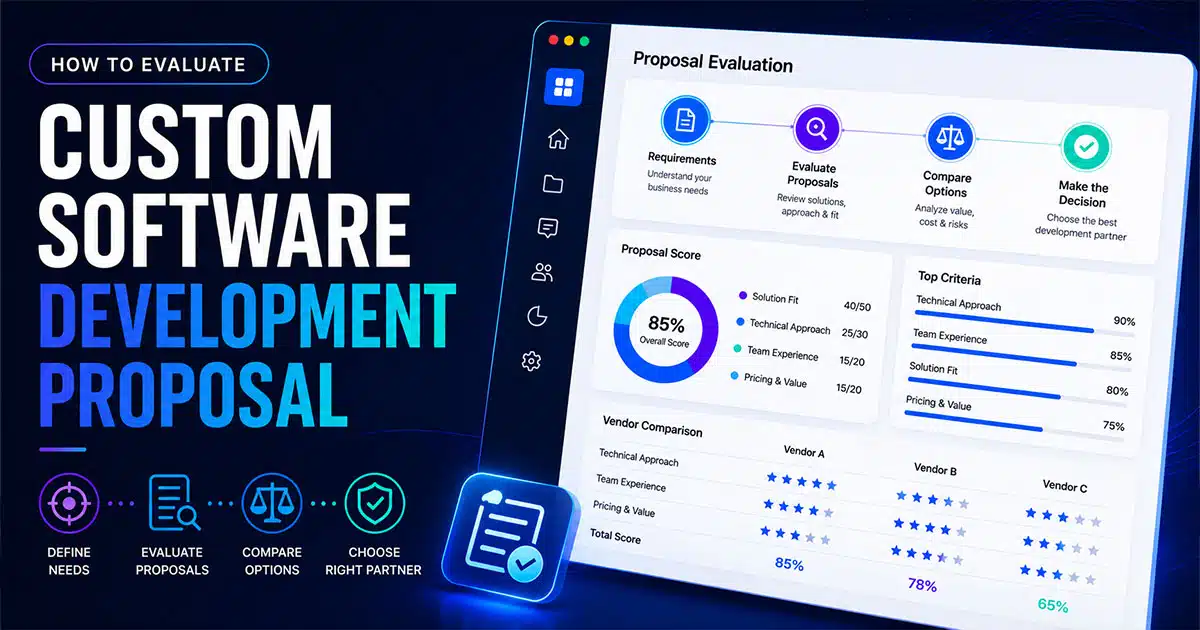
Structured evaluation enables fair comparison of competing proposals rather than relying on price alone. Organizations should consider factors like expertise, communication quality, past work, and domain knowledge. Creating a scoring matrix allows objective comparison of each software proposal side by side.
Using a consistent proposal format helps compare vendors effectively and determine strengths across multiple factors. Clear documentation and defined contingency plans ensure decision-making remains structured, reducing bias and improving final vendor selection accuracy.
Improve ROI and Long-Term Value
Clear expectations, timelines, and deliverables improve project outcomes and ROI. Proper evaluation ensures solutions support long-term business strategy rather than addressing only immediate needs. Business cases should consider full system costs over multiple years, including hosting, licensing, support, and internal staffing.
A well-evaluated software solution helps determine long-term value while avoiding technical obstacles. Strong documentation and realistic contingency plans ensure sustainability, allowing businesses to maximize returns and adapt systems as needs evolve.
How To Evaluate A Custom Software Development Proposal
This section walks through six practical evaluation dimensions. Readers can treat these dimensions as scoring categories when shortlisting vendors, with weighting adjusted based on project risk and budget.
Assess Business Alignment And Problem Understanding
Check whether the proposal accurately restates your business goals, user personas, and current pain points in specific language. The vendor should map features to measurable KPIs such as cycle time reduction, revenue lift, or error-rate reductions.
For example, when evaluating a CRM modernization proposal, a strong vendor response ties specific features to metrics like lead-to-opportunity conversion or sales rep productivity gains. Use a 1-5 scale for business alignment: 1 equals generic template language, while 5 demonstrates deep discovery and strategic alignment.
Evaluate Technical Approach, Architecture, And Stack Choices
Review the proposed architecture including application layers, data storage, API strategy, and hosting approach. Technology choices should match your existing software ecosystem, skills, and compliance needs.
Red flags include outdated frameworks, overly proprietary components increasing vendor lock-in, or generic diagrams with no reference to your environment. Emphasizing security by design and compliance with regulations like GDPR and HIPAA is critical. For high-traffic systems like customer portals, scalability patterns including load balancing and caching must be explicitly addressed, backed by deliberate tech stack choices aligned with growth.
Analyze Delivery Methodology, Governance, And Communication
Compare vendors on delivery methodology, whether Scrum, Kanban, or hybrid agile. Adopting agile methodologies allows for iterative delivery and feedback, which can outperform traditional approaches. Look for governance structures such as steering committees, sprint reviews, demos, and change-control processes.
Communication expectations should include time zones, channels, escalation paths, and dedication of a product owner or delivery manager. Clear governance prevents conflicting priorities and rework.
Compare Scope, Deliverables, And Timeline Realism
Ensure all major project requirements, integrations, and constraints from the RFP are explicitly covered. Deliverables refer to specific items the client will receive at each stage of the project. Scrutinize milestone definitions, acceptance criteria, and testing activities including unit, integration, performance, and user acceptance testing.
A timeline includes a roadmap of project phases and estimated dates or week ranges. Be wary of compressed timelines that omit discovery, iteration, or stabilization phases. Ambiguous language like “to be agreed later” often hides budgetary risks or future change requests.
Review Pricing Structure, Total Cost Of Ownership, And Risk Allocation
Common pricing models include time-and-materials, fixed price with clearly defined scope, and hybrid models with capped budgets plus change request mechanisms, all of which are explored in depth in a software development pricing models guide. Budget and pricing should include a transparent breakdown of costs related to the project.
Assess total cost of ownership for custom vs prebuilt software over multiple years, including hosting, licensing, support, enhancements, and internal staffing. Legal terms should outline payment schedules, intellectual property ownership, and termination policies. Consider value for money rather than selecting the lowest bid, and make sure the proposal reflects a thoughtful build vs buy software decision rather than defaulting to one approach.
Check Vendor Track Record, Team Composition, And Cultural Fit
Use this stage to validate that you’re choosing the right custom software development partner, not just a vendor that looks good on paper.
Validate similar project experience through case studies, references, and verifiable information. Showcasing team qualifications, case studies, and testimonials provides third-party validation of capabilities. The specific proposed team matters more than organizational headcount.
Consider cultural fit including language skills, responsiveness, and alignment with your values around security and compliance. Ask references about reliability, transparency, and post-launch support experience.
How To Prepare Organization For Proposal Evaluation
Preparation ensures objective evaluation, faster decisions, and lower risk. Cross-functional alignment, clear criteria, and governance form the foundation.
Define Goals And Success Criteria
Translate business objectives into measurable outcomes including KPIs, ROI targets, and risk tolerance. Create a checklist covering project scope clarity, must-have versus nice-to-have features, and budget guardrails. Clear criteria prevent bias and scope creep during vendor selection, and they should reflect the core benefits and process of custom software development you expect vendors to deliver.
Each project overview should align with a clear project title and reflect the client’s company priorities. Defining functionality expectations early helps teams evaluate proposals consistently across every page and avoid confusion during comparison stages.
Form Evaluation Team And Roles
Define roles across product, engineering, security, finance, and procurement. A RACI model helps establish ownership and approvals. A single decision owner prevents delays when evaluators disagree.
Team structure should reflect the client’s company needs and include stakeholders who understand functionality and compliance. In regulated sectors like a government agency, clearly defined roles ensure accountability and faster decision-making across every review stage.
Create Scoring Model And Weights
Outline a 1-5 scoring framework with weighted categories covering business fit, technical fit, delivery plan, cost, and risk. Adjust weights based on project size and criticality. Use a standardized scorecard for all vendors.
A scoring model should align with the project overview and ensure each page of the proposal is evaluated fairly. Including functionality, payment terms, and technical fit helps teams compare vendors with greater clarity and structured consistency.
Gather Requirements And Constraints
Document functional requirements, integrations, data needs, compliance requirements, and SLAs. Include constraints like timelines, budget ceilings, preferred tech stack, and security policies. A concise software development proposal template ensures consistent vendor responses.
Clear requirements help teams align with the client’s company expectations while reviewing functionality and compliance factors, and they are essential for building a realistic software development timeline into each proposal. Including payment terms and technical constraints ensures proposals meet both operational and financial expectations across every evaluation page.
Set Review Process And Timeline
Define stages including intake, clarification Q&A, technical review, demos, and final scoring. Establish timelines, communication rules, and artifact storage in a shared repository. Include a governance step for risk review and final approval.
A structured process ensures each project title and project overview is reviewed consistently. Clear timelines help teams track progress, while defined stages ensure functionality, payment terms, and compliance requirements are assessed across every proposal page.
How To Build A Structured Evaluation Framework And Scoring Model
A structured framework ensures objective comparison, reduces bias, and improves decision accuracy when you’re procuring custom software development services. Consistency, transparency, and measurable evaluation drive better outcomes.
Define Evaluation Criteria
Outline key categories such as technical fit, business alignment, cost, timeline, and risk. Separate must-have from nice-to-have requirements. Clear criteria create a fair comparison baseline across all software development projects.
Each criterion should reflect the needs of the prospective client and align proposal writing with business goals, including whether custom software development benefits like scalability and integration are clearly addressed. Keeping all requirements on the same page ensures consistency, helping decision makers evaluate proposals without confusion.
Assign Weights To Criteria
Assign importance to each category based on business priorities. Critical projects might weight scalability or security higher. The ideal software proposal outline will cover sections matched to your weighted priorities.
Weighting helps decision makers focus on what matters most for the prospective client. A consistent approach ensures every proposal writing effort stays on the same page, making comparisons easier within a single document.
Create A Scoring System
Introduce a simple 1-5 scale with clear definitions for each score. A score of 3 means the vendor meets requirements adequately, while 5 indicates significantly exceeding requirements with minimal risk. Use a standardized scorecard for all proposals.
A clear scoring system helps decision makers review each proposal writing outcome in a single document. It keeps all stakeholders on the same page and ensures the best approach is selected based on measurable criteria.
Evaluate And Compare Proposals
Score each proposal independently against defined criteria. Document strengths, weaknesses, and risks for each vendor. Using visuals and multimedia in vendor presentations can significantly boost closing rates and help differentiate proposals, just as disciplined MVP feature prioritization helps teams communicate focus and trade-offs clearly.
Each evaluation should reflect the prospective client needs and present findings in a single document. Keeping everything on the same page allows decision makers to identify the best approach and define clear next steps.
Review Results And Make Decisions
Analyze total scores and identify top candidates. Include stakeholder discussions and validation before final decisions. Use the framework to support clear, data-driven decisions about your next software project.
Final evaluation should guide decision makers toward the best approach for the prospective client. Summarizing results in a single document keeps everyone on the same page and outlines clear next steps for project execution.
Common Mistakes When Reviewing Custom Software Development Proposals
Common mistakes during proposal review lead to poor vendor selection, budget overruns, and project delays.
Cost Focus Only
Selecting based only on price often leads to poor outcomes. Hidden costs emerge through inexperienced teams, cheap technology stacks requiring workarounds, minimal testing causing production defects, and lack of post-launch support. Value assessment matters more than lowest bid.
A low-cost software product may fail to solve real business needs if the company ignores long-term impact. Proper background information and comparison in a table help evaluate true value beyond initial pricing decisions.
Technical Feasibility Ignored
Failing to review architecture creates long-term problems. A proposal for a monolithic architecture might appear simpler initially but becomes unmaintainable as the system scales. Integration and performance issues emerge when technical approaches lack scrutiny.
Ignoring feasibility risks building a software product that cannot scale with company growth, especially if the proposal does not describe how it will evolve into a future-proof technology stack for scalable growth. Teams must assess hardware requirements and develop solutions that solve real challenges instead of creating future technical debt.
Vendor Experience Overlooked
Selecting vendors based on organizational size rather than project-specific experience creates risk. A software developer with proven track record in your industry understands regulatory requirements and deployment constraints better than a generalist.
A capable company brings relevant background information and experience to develop reliable systems, often demonstrated through case studies of how custom software transformed companies. Reviewing case studies and comparing vendors in a table helps identify who can truly solve complex business challenges effectively.
Requirements Not Defined
Unclear scope creates mismatched proposals. When five vendors submit five different interpretations, comparison becomes impossible, especially if some assume no-code while others assume custom development for the same problem. Ambiguous requirements lead to post-award disputes about what deliverables are included.
Without clear direction, teams fail to develop a software product that aligns with company needs or make an informed custom software vs SaaS decision during evaluation. Including detailed background information and structured documentation helps solve confusion and ensures all vendors respond consistently.
Structured Evaluation Missing
Organizations that informally discuss proposals without a systematic framework make biased decisions. One evaluator’s strong opinion can disproportionately influence outcomes. Data-driven evaluation surfaces disagreements early and ensures crucial criteria receive attention.
A structured table allows teams to compare each software product objectively and solve evaluation gaps, similar to how a build vs buy case study where custom software won uses clear criteria to justify its outcome. This approach helps the company develop better decision processes while aligning choices with real business requirements.
Final Discussion
GainHQ applies this evaluation framework through structured discovery workshops, requirement gathering, and risk analysis. Our proposals provide clear scope breakdowns, technical architectures, delivery plans, and transparent pricing aligned with the evaluation dimensions covered in this article.
Modern collaboration and analytics tools keep stakeholders informed during evaluation and delivery phases, reducing ambiguity and surprises. A great software proposal should be detailed, brief, and results-focused, effectively combining software features with business benefits to clearly communicate value to the client.
Contact GainHQ for guidance on your next RFP or custom software project. Our approach emphasizes practical, data-driven evaluation rather than assumptions.
Frequently Asked Questions
How Many Vendor Proposals Should We Collect Before Making A Decision?
Most organizations benefit from shortlisting three to five serious vendors. Run a lighter initial qualification step, such as a Request for Information, before inviting vendors to submit full proposals. A smaller, curated shortlist allows more time for deep analysis and reference checks with each candidate.
How Long Should We Spend Evaluating Proposals Before Selecting A Vendor?
For mid-sized projects, organizations often budget three to six weeks for evaluation. Larger programs may require longer governance. Schedule structured review sessions with clear internal deadlines to avoid decision drift while keeping project timelines realistic.
Should We Pay Vendors For Discovery Or Workshops Before Signing A Full Contract?
Many organizations adopt a paid discovery or inception phase for complex projects. This approach lets both parties validate assumptions and produce more accurate scope, architecture, and estimates before committing to a large build contract. Discovery can be competitively tendered or conducted with a preferred vendor.
How Do We Handle Big Differences In Price Between Proposals?
First check whether scope, assumptions, and team compositions match. Low prices often reflect missing work or less experienced teams. Ask vendors to walk through their estimating approach in detail. If a cheaper proposal looks complete after scrutiny, mitigate risk with milestone-based payments and clear exit options.
What If We Lack Deep Technical Expertise To Judge Architectures And Stacks?
Involve internal IT leadership where possible. If needed, bring in an independent technical advisor to interpret architectural choices and risks. Non-technical stakeholders can ask structured questions about maintainability, security, and integration support using the framework in this article.