
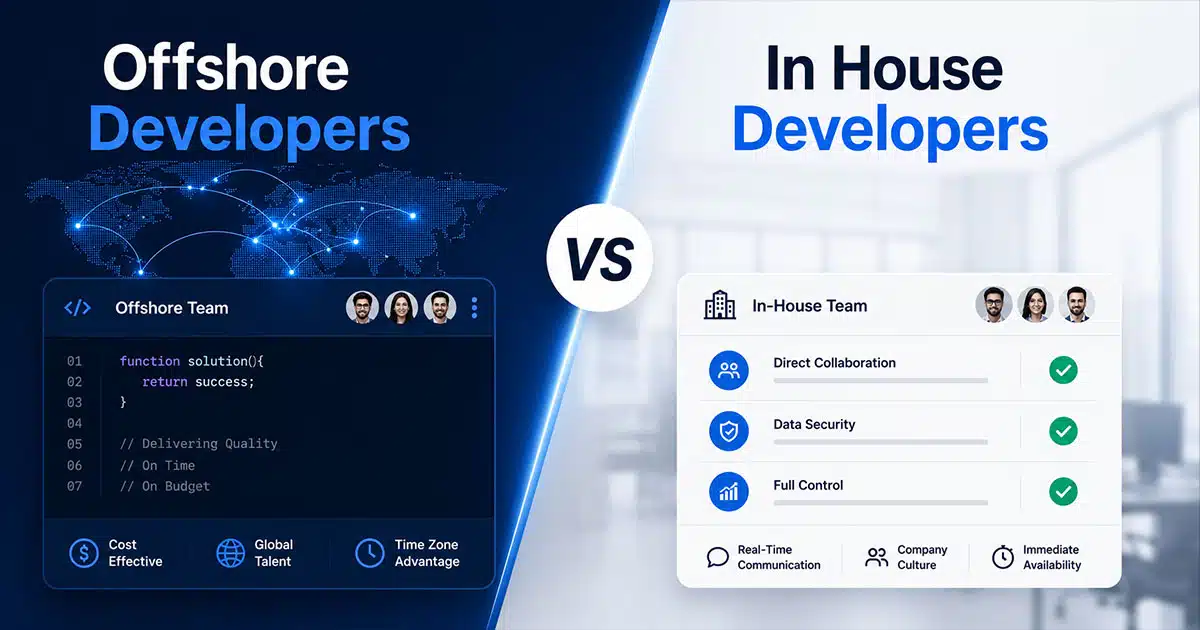
The decision between offshore and in house developers has become increasingly critical for SaaS, fintech, and e-commerce businesses in 2026. Rising local salaries in tech hubs like New York, London, and Berlin have pushed startups and SMEs to evaluate offshore hiring in regions such as Eastern Europe, Latin America, and South Asia. The demand for offshore developers is increasing as companies seek to access a diverse talent pool and specialized skills that may not be available locally, driven by the ongoing digital transformation across industries.
Offshore developers work from another country under contractual arrangements, while in house developers are salaried employees based in your primary operational location. Both models can deliver excellent results. The key lies in understanding which approach fits your specific situation. This article will help you choose the right model, avoid common pitfalls like poor vetting, and understand when a hybrid strategy makes more sense for your business.
What Are Offshore And In House Developers
Understanding the fundamental differences between offshore and in house developers helps you make informed hiring decisions. The distinction centers on employment structure and geography rather than technical capability.
Offshore software developers are skilled professionals working from foreign countries through long-term contracts, project-based engagements, or dedicated team models. They collaborate remotely via tools like Slack, Jira, and GitHub without physical relocation to your office. Countries like Ukraine, Poland, Brazil, Argentina, and Mexico are consistently recognized for producing developers with strong technical skills and professional English, making them top choices for offshore hiring.
In house developers are full-time salaried employees located in your primary country of operation. They typically work on-site or in hybrid setups near headquarters, allowing immediate face-to-face interactions and natural cultural immersion. A US-based startup might engage Polish developers at $40 per hour for a React and Node.js MVP in 8 weeks, while building a local New York engineering team would require 2 to 4 months of recruiting and significantly higher salaries.
Key Differences Between Offshore Vs In House Developers
This section covers the main comparison areas that matter most when deciding between offshore and in house developers, complementing our broader hire developers vs outsourcing guide for companies in 2026. You will find detailed analysis across cost, speed, quality, communication, security, and long-term impact, followed by a comprehensive comparison table.
The data points here reflect 2024 to 2026 salary ranges and typical hourly rates from well-known markets including the United States, Western Europe, Eastern Europe, and India. Understanding these differences helps you align your hiring strategy with your business objectives and project requirements.
Cost Structure And Total Budget Impact
In house developers in markets such as the US in 2026 often cost between $110,000 and $160,000 per year before benefits, office space, and tax overhead. The average salary for a senior software developer in the US can reach up to $180,000 annually. When you add 25% for benefits and 15% for office and administrative costs, total compensation often reaches $150,000 to $220,000 per head.
Hiring offshore developers can reduce expenses by up to 50% compared to hiring locally, especially when sourcing talent from regions with a lower cost of living such as Latin America and Eastern Europe. Hourly rates for offshore developers typically range from $35 to $65, depending on their seniority and specialization, which closely aligns with broader custom software development cost factors and pricing ranges. Equally skilled developers in Latin America typically earn $58,000 annually, while Eastern European developers earn approximately $70,500.
Hiring Speed And Talent Availability
Most companies spend 4 to 8 weeks on the hiring process for a single developer, which includes writing the job post, screening resumes, running interviews, checking references, and negotiating terms. In competitive cities like San Francisco or London, sourcing in house developers can stretch to 2 to 4 months due to limited supply, counter offers, and long notice periods.
The hiring process through offshore partners or global job boards often reduces time to hire to 2 to 4 weeks for most mainstream tech stacks. Offshore partners often provide pre-vetted, experienced talent, reducing the time and risk associated with recruitment. This speed advantage allows you to find offshore developers quickly when project timelines are tight.
Communication, Time Zones, And Collaboration
In house teams naturally benefit from shared time zones, face-to-face interactions, and spontaneous problem-solving during office or hybrid days. Your in house team can gather around a whiteboard for quick architectural decisions without scheduling across continents.
Approximately 54% of offshore projects face cultural or communication challenges, making structured processes essential. Time zone gaps create practical impacts for remote developers. US-East to India involves a 9.5 to 12.5 hour difference, while US to Ukraine spans 7 to 9 hours. Latin America offers the smallest gap for US companies, often just 1 to 3 hours.
Select offshore teams based on time zone compatibility for adequate overlap with working hours. Most development tasks work well with 2 to 4 shared hours when asynchronous communication is strong. A project manager can schedule daily standups during overlap windows while using Slack, Jira, GitHub, and Notion to maintain continuous progress.
Effective collaboration models include async-first workflows, scheduled overlap hours, and clear documentation practices. A good offshore developer should be able to manage their time effectively, prioritize tasks, and work independently, especially in a remote setting where communication is primarily online. Discipline rather than geography usually determines success.
Quality Control, Process, And Culture Fit
In house teams integrate more tightly into company culture, product vision, and long-term technical strategy through daily exposure to leadership. They absorb unwritten norms, participate in hallway conversations, and understand business context naturally.
Offshore software developers can reach comparable quality through solid development processes. Ensure Quality Assurance is integrated into the workflow, not treated as an afterthought, and demand automated testing and regular code reviews. Confirm that partners use Agile and offshore software development practices like Scrum or Kanban for transparency and iterative feedback.
Quality offshore developers are often characterized by their adaptability to different cultural contexts and their ability to align with the values and goals of the companies they work for. Validate technical depth through code tests, interviews, and portfolio reviews. Test for culture fit through behavioral interviews, trial projects, and clear value communication during onboarding.
Lack of structure and unclear ownership harms both offshore and in house quality. Technical and soft skills matter equally regardless of location. Strong product management practices remain universal requirements for project success.
Security, Compliance, And Intellectual Property
Security concerns often push regulated industries like healthcare and finance toward in house or onshore teams. Companies with HIPAA, GDPR, or PCI DSS obligations may prioritize keeping sensitive data under direct control. Legal enforcement of IP rights can be difficult in different countries, even with US-governed contracts.
Ensure compliance with international standards such as SOC 2, ISO 27001, GDPR, or HIPAA for security and data protection. Verify compliance with international standards like ISO 27001 or SOC 2 when evaluating offshore development partners. Prioritize partners with proven experience in your specific industry to understand your regulatory requirements.
Offshore teams can still support high compliance standards using strict access controls, VPNs, encrypted communication, and well-drafted NDAs and MSAs. Use role-based access to repositories, secrets management through tools like Azure Key Vault, and centralized logging regardless of team location to protect sensitive data, while planning for hidden costs in software development such as security and long-term maintenance.
Seek local legal advice on data transfer rules when working with software engineers in jurisdictions with differing privacy frameworks. IP leakage incidents dropped 40% post-2023 when companies implemented proper controls, according to Deloitte outsourcing surveys.
Long Term Scalability And Retention
In house developers might stay three to five years when provided career paths, equity, and growth opportunities. This stability builds deep domain knowledge and architectural understanding. However, scaling an in house team takes 1 to 3 months per hire and faces local talent limits.
Offshore specialists may rotate more frequently between clients, with typical engagements lasting 1 to 2 years. Offshore development teams can significantly reduce the time to market for digital solutions, allowing companies to scale their projects more efficiently and respond quickly to market demands. You can ramp offshore capacity 2x in weeks by tapping into the global pool, especially when you align hiring decisions with broader SaaS scalability strategies for sustainable growth.
Knowledge retention practices like comprehensive documentation, internal wikis, and standardized onboarding reduce dependency on any single software developer. Offshore development allows access to 24/7 operations, facilitating round-the-clock development when you structure handoffs between time zones properly.
Strategic workforce planning over multiple product cycles becomes easier when you have a clear framework for when to expand offshore capacity versus investing in in house growth.
Comparison Table Of Offshore Vs In House Developers
| Criteria | Offshore Developers | In House Developers |
|---|---|---|
| Cost Per Year (Mid-Level) | $50,000 to $100,000 (India: $25-45/hr; Ukraine: $35-60/hr) | $150,000 to $220,000 (US: $110k-160k base plus 30% overhead) |
| Hiring Time | 2 to 4 weeks via partners or job boards | 2 to 4 months including recruiting and notice periods |
| Time Zone Overlap (US) | 2 to 4 hours (India: 9.5-12.5hr gap; Ukraine: 7-9hr; LatAm: 0-3hr) | Full 8 to 10 hours shared |
| Typical Contract Type | Hourly, time and materials, fixed-price, or dedicated teams | Salaried full-time with benefits and equity |
| Security Posture | Strong with VPN, RBAC, NDAs; requires careful vendor selection | Highest control with on-site audits and native compliance |
| Culture Integration | 70 to 80% effective with structured onboarding and rituals | 95% alignment through daily exposure and events |
| Management Overhead | 15 to 25% for remote PM and tools | 5 to 10% with direct oversight |
| Scalability | High: ramp 2x in weeks, access global pool | Low: 1 to 3 months per hire, local limits |
| Niche Skills Availability | Excellent for AI, DevOps, LLM experts | Limited in SMEs; 20 to 30% harder for seniors |
| Physical Presence | None; occasional travel $5k to $10k per year | On-site or hybrid daily |
When To Choose Offshore Developers
Offshore developers deliver the strongest value proposition in specific business scenarios. Early-stage and post-product-market-fit companies that need to extend runway, ship features rapidly, and experiment without over-committing to large local payrolls benefit most from offshore development.
Success with overseas developers depends on clear requirements, a capable in house product owner or CTO, and mature project management practices. Businesses can reduce operational expenses without compromising on quality by outsourcing when they structure engagements properly, following best practices from a broader offshore software development guide for 2026.
Early Stage Startups And Tight Budgets
Pre-seed and seed startups often lack capital to hire a full in house team in 2026, especially in cities where senior engineers expect six-figure base salaries plus equity. Hiring offshore developers can reduce expenses by up to 50% compared to hiring locally, particularly in regions with a lower cost of living and favorable tax policies.
A founder can engage two or three dedicated offshore developers to build a minimum viable product in 8 to 12 weeks while keeping burn under control. Asia offers highly cost-effective, large talent pools for development, while Latin America provides minimal time zone differences for US companies, which can save up to 50% on costs.
At least one technically savvy founder or advisor should oversee architecture when the build is primarily offshore. Hiring overseas developers without technical guidance leads to 25% rework rates in poorly managed setups.
Scaling Product Delivery Without Fixed Overhead
Series A and Series B companies can ramp up offshore squads during peak roadmap periods, such as large redesigns or platform migrations, then scale down afterward. A dedicated offshore team provides flexibility that permanent hires cannot match.
Consider a business temporarily adding an offshore QA and automation team ahead of a major product launch. This burst capacity approach avoids long-term salary commitments while meeting aggressive project timelines.
Flexible engagement models and clear service level agreements are vital when using hire offshore development teams for burst capacity. Fixed Price models are best for small, well-defined projects, while Time and Materials are suitable for projects with evolving requirements, fitting neatly into broader software development pricing models such as fixed price, T&M, and dedicated teams.
Accessing Specialized Or Niche Skill Sets
Niche skills like AI integration, complex DevOps, or legacy system modernization are scarce locally but available through specialized offshore development partners. Offshore teams provide access to specialized skill sets that may be scarce or expensive in the local market, especially when your product depends on scalable software architecture for high-growth platforms.
Practical examples include hiring data engineers experienced with modern LLM tooling, cloud-native architectures, or specific tech stack requirements from talent hubs abroad. You can find senior offshore developers with expertise in Kubernetes, machine learning, or Snowflake integrations more readily through global sourcing.
Check portfolios, open-source contributions, and certifications when evaluating top offshore developers. Look for GitHub profiles with 500 or more stars as a threshold for validating strong technical expertise.
Round The Clock Development And Support
Global teams can provide 24/7 progress and incident response by handing tasks across time zones between in house and offshore programmers. A European in house team collaborating with an Asian offshore team means code is written and reviewed in alternating workdays.
Offshore development allows access to 24/7 operations, facilitating round-the-clock development. This structure can boost velocity by 30% when handover templates are clear and responsibilities are well-defined.
Strong handover notes, shift boundaries, and on-call schedules prevent confusion or duplicated effort. The remote team must understand exactly where the previous shift left off.
Short Term Projects And Proofs Of Concept
Offshore remote developers are often suitable for discrete projects like building a proof of concept, integrating a payment gateway, or creating a standalone mobile app. For these limited engagements, a full in house hire may not be economically justified, making broader outsourced software development models an attractive option.
The cost to hire an in house developer for a three-month project rarely makes financial sense when offshore software development services can deliver the same outcome at 50% lower cost.
Use clear acceptance criteria, fixed project scope statements, and milestone-based payments for short offshore initiatives. This approach limits risk while allowing you to hire offshore software talent for specific needs.
When To Choose In House Developers
In house teams usually make the most sense when software development is the company’s core strategic asset. While more expensive, in house developers provide deeper ownership, faster decision making, and closer collaboration with non-technical departments.
Highly Regulated Or Security Sensitive Industries
Companies in healthcare, banking, government, and defense may prioritize in house development because of strict data residency and auditing requirements. A bank building a core transaction platform benefits from an in house team to maintain maximum control over intellectual property and access rights.
On-site audits, secure networks, and compliance training are easier to manage with employees under one primary jurisdiction. When you need to protect sensitive data under HIPAA or handle financial transactions under PCI DSS, the security posture of an in house team provides peace of mind.
Complex, Long Term Product Roadmaps
Products expected to evolve over many years, such as enterprise SaaS platforms, benefit from stable in house ownership of architecture and domain knowledge. A B2B SaaS vendor might maintain an in house platform team for critical services while deciding later whether to add offshore feature pods, ideally following a structured SaaS product development lifecycle.
In house architects planning 5-year evolutions reduce tech debt by 40% through deep domain mastery. Long horizon planning requires engineers invested in the company’s multi-year trajectory.
Need For Real Time Cross Functional Collaboration
Situations where developers must work daily with sales, marketing, operations, or hardware teams favor in house hiring. Tech businesses in robotics, logistics, or retail tech often need physical proximity for rapid feedback cycles.
Office layout, lab access, and hardware dependencies matter when assessing whether offshore is viable. Frequent in-person workshops or customer visits require developers who can participate immediately.
Building And Protecting Company Culture
Early culture is often set by the first ten to twenty in house employees, including key software engineers and tech leaders. In house developers participate in informal rituals, company events, and whiteboard sessions that shape collaboration norms and values.
While remote offshore developers can absolutely share company values, founders commonly prefer to anchor culture with a small, tightly knit in house core team first. This foundation then guides how you integrate offshore talent later.
Leadership, Architecture, And Strategic Roles
Senior positions like CTO, VP Engineering, and principal architect are typically best filled in-house due to their direct involvement in strategy, hiring, and stakeholder conversations. A senior developer in a leadership role needs proximity to customers and executives.
These leaders can later orchestrate dedicated offshore developers more effectively when they deeply understand both the business context and the codebase history. Outsourcing allows internal staff to focus on strategic planning, marketing, and core business competencies once the leadership structure is solid.
Situations Where Offshore Has Previously Failed
Companies that tried offshore software development without success due to unclear project scope, vendor mismatch, or communication breakdowns may need to rebuild confidence. After a failed engagement, some organizations temporarily prioritize rebuilding an in-house team to regain momentum.
Structured retrospectives help distinguish between problems caused by the offshore model versus internal processes or leadership gaps. The offshore developer depends on clear direction, so failures often reflect internal readiness rather than the model itself.
How To Build A Hybrid Model That Combines Offshore and In-House Strengths
Many 2026 businesses ultimately mix in-house and offshore developers rather than choosing only one path. Approximately 60% of mid-sized SaaS companies use 30 to 50% offshore for 45% savings, while in-house teams' own strategy, according to Gartner 2025 forecasts, reflecting broader lessons from in house vs outsourcing software development comparisons.
A hybrid approach can maximize cost-effective solutions and speed while preserving strategic control and culture through in-house leadership.
Defining Clear Ownership And Team Boundaries
Assign in-house teams ownership of core domains such as architecture, security, and mission-critical services. Your software development team should control authentication, data pipelines, and core platform infrastructure.
Offshore teams can own self-contained modules like secondary microservices, front-end features, or analytics dashboards with precise specifications. RACI-style responsibility matrices clarify who decides, who executes, and who reviews across locations.
Designing Processes For Seamless Collaboration
Agile practices integrate offshore and in house squads effectively. Shared sprint planning, asynchronous standups, and common backlogs create alignment. The development process should feel unified regardless of where individual contributors sit.
Shared coding standards, branching strategies, and CI/CD pipelines prevent fragmentation. Documentation in tools like Confluence or Notion acts as a central knowledge hub accessible to your entire software development project team and should align with best practices of SaaS architecture for scalable, secure platforms.
Onboarding And Integrating Offshore Developers Into Your Culture
A structured onboarding plan should mirror what in house hires receive. Creating a clear and detailed job description is crucial in attracting skilled professionals who will be excited about your project. Product demos, company history, and introductions to key stakeholders help remote developers understand context, while sharing your SaaS design system for scalable products ensures consistent UX across in house and offshore teams.
Assign buddies or mentors from the in house team to each new offshore developer for the first few weeks. Virtual coffee chats, monthly all-hands meetings, and recognition of milestones help tech specialists feel genuinely included despite geographic distance.
Managing Performance And Quality Across Locations
Unified performance metrics should apply to both offshore and in house developers. Deployment frequency, lead time, and defect escape rate matter regardless of location and should be tied to broader SaaS scalability strategies and operational KPIs. Regular one-on-ones, code reviews, and technical retrospectives should cross team boundaries.
Asking the right questions during the interview process will help you identify the best fit for your offshore development team. Honest feedback loops and periodic satisfaction surveys across all skilled developers surface issues early before they affect project completion.
Budget Planning And Forecasting For Mixed Teams
Build a combined hiring and vendor budget capturing salaries, benefits, offshore contracts, tooling, and travel for occasional in-person meetings, using principles from a broader software development budget planning guide. A company might maintain a five-person in house core team and a rotating offshore pod of three to six developers depending on quarterly roadmap needs.
Revisit the offshore versus in house mix annually based on product maturity, revenue growth, and evolving regulatory expectations, ideally syncing these decisions with your SaaS product roadmap and prioritization process. The recruitment process should align with your long-term workforce strategy rather than reacting to immediate needs.
Final Discussion
The choice between offshore and in house developers is not about finding a universally correct answer. Your decision should reflect your specific product stage, budget constraints, security requirements, and growth trajectory. Over a decade of industry experience shows that both models can deliver excellent results when implemented thoughtfully.
Offshore software development offers compelling cost advantages and access to global expertise. Development costs drop significantly when you hire an offshore developer from Eastern Europe or Latin America and plan using a dedicated SaaS development cost guide for businesses. Meanwhile, an in-house team provides control, cultural alignment, and faster real-time collaboration that some projects demand.
The hybrid model has emerged as the dominant approach for mid-sized tech businesses in 2026. A proven track record of success comes from combining in-house leadership with offshore execution. Start by assessing your current needs, run a focused pilot with a potential offshore development partner, and scale based on results rather than assumptions. The right balance exists for every company willing to invest in clear processes and strong communication practices.
Frequently Asked Questions
How Do Time Zone Differences Actually Affect Day To Day Work
US-East to Ukraine offers 3 to 5 overlap hours, typically 11am to 3pm Eastern time matching 6pm to 10pm Kyiv time. US to India provides 2 to 3 hours of overlap, usually 9pm to 12am Eastern matching 6:30am to 9:30am IST the next day. Latin America offers the best overlap for US companies with minimal to zero time difference. A minimum of 2 to 4 shared hours is usually sufficient for most development tasks when asynchronous communication is strong through Jira updates and Loom videos.
Can Offshore Developers Replace An Entire In House Team
While some companies run fully distributed offshore engineering successfully, most retain at least a small in house leadership group including a CTO and project manager. A mostly offshore organization works when you have strong remote culture, experienced managers, and robust documentation. Companies like GitLab demonstrate that 100% distributed models are possible.
What Is The Minimum Budget To Start With Offshore Developers
Realistic monthly budget ranges for engaging one to three offshore developers in 2026 run from $5,000 to $15,000 depending on region. India typically costs $5,000 to $9,000 monthly, while Ukraine and Poland range from $8,000 to $15,000 including 10% for tooling and management overhead. Factor in approximately $2,000 for kickoff travel if face-to-face introductions are planned, and map these figures into your broader software development budget planning.
How Long Should I Test An Offshore Partnership Before Committing Long Term
A practical trial phase spans 6 to 12 weeks with clear milestones before signing longer multi-month or multi-year agreements. Budget $20,000 to $50,000 for an initial pilot project that tests the partnership thoroughly. Success signals during the pilot include 95% milestone completion rates, clean code scoring above 80% on SonarQube quality checks, and responsive Slack communication averaging under 2 hours for replies.
Is It Harder To Protect Intellectual Property With Offshore Developers
Well-written contracts, NDAs, and access controls can largely mitigate IP risks. Limit repository access through role-based permissions, avoid sharing production data, and choose partners in jurisdictions with enforceable IP laws such as EU-aligned Ukraine or Poland. IP leakage incidents dropped significantly in audited offshore firms implementing proper controls.