
Hiring the right product development company for your SaaS requires more than comparing portfolios. You need a product development agency that offers end-to-end product development services and understands your product development lifecycle from idea to launch. The right product development company should combine software with mechanical and electrical engineering when needed, especially for industries like medical device development.
A strong product development firm brings deep engineering expertise and helps create products that align with your business goals. It should also guide you through technical decisions, ensuring your solution fits real-world needs. Choosing the right partner means evaluating how well they manage complexity, support innovation, and deliver scalable solutions that evolve with your SaaS growth.
What Is A Product Development Company For SaaS
A product development company for SaaS helps businesses turn an innovative idea into a scalable digital product using a structured and efficient approach. It combines industrial design principles with technical knowledge to build solutions that meet both user and business needs. These companies often rely on agile development to iterate quickly and adapt to feedback.
A modern product development company focuses on product innovation while ensuring performance, usability, and long-term scalability. Teams may include industrial designers and specialists in electrical engineering or advanced manufacturing when projects require deeper technical integration. The goal is to move from concept to a minimum viable product efficiently, and to understand the differences between MVPs, prototypes, and POCs, allowing businesses to validate ideas, reduce risks, and accelerate time to market.
When To Hire A Product Development Company For Your SaaS
Hiring a product development company at the right time helps align project needs, accelerate delivery, and reduce costs. It ensures software products move efficiently from concept to a market ready product with structured execution.
Early Stage Product Validation
At the early stage, teams often struggle to define clear project needs and validate ideas. A product development company supports developing products through rapid prototyping and structured product management. This approach helps transform concepts into tangible software products quickly.
Using agile teams, businesses can test assumptions and refine features before full-scale development. Applying disciplined MVP feature prioritization techniques ensures early releases focus on the most impactful problems. This reduces dependency on traditional methods and improves quality control from the beginning, ensuring the product lifecycle starts with a strong foundation.
Scaling Beyond Initial Build
Once a basic version is ready, scaling becomes critical. A product development company helps refine software products into a market ready product by improving performance, usability, and scalability. Strong product management ensures features align with evolving user demands.
Companies investing heavily in growth often rely on partners with a strong track record and experience across multiple locations. Agile teams help manage complexity while maintaining quality control, ensuring the product lifecycle continues smoothly.
Complex Technical Requirements
When SaaS solutions require integration with industrial products or advanced systems, technical complexity increases. Following SaaS architecture best practices and working with a product development company with digital scientists and specialized expertise helps manage these challenges effectively.
This is especially important when developing products that extend beyond software into consumer goods or industrial products. Communication design and structured workflows ensure teams can handle complexity while maintaining consistency across the product lifecycle.
Cost Optimization And Efficiency
Managing internal teams can become expensive and inefficient over time. Understanding a detailed SaaS development cost breakdown and working with a product development company helps reduce costs by optimizing workflows and replacing traditional methods with agile teams and rapid prototyping techniques.
With better quality control and streamlined processes, businesses can avoid delays and rework. This approach ensures software products are built efficiently while maintaining high standards across every stage of the product lifecycle.
Preparing For Market Launch
Before launch, ensuring a market ready product is essential. A product development company helps finalize features, refine communication design, and align the product with user expectations, guided by a clear SaaS product roadmap. This stage focuses on delivering polished software products ready for real-world use.
Teams with a strong track record across multiple locations can support global launches and scaling strategies. By combining product management, agile teams, and digital scientists, businesses can confidently move through the final stages of the product lifecycle and achieve successful outcomes.
How To Hire A Product Development Company For Your SaaS
Hiring a product development company is a structured process: clarify goals, shortlist candidates, run due diligence, and validate with a real engagement. This section provides the practical, step-by-step approach you can follow immediately.
Define Your Product Outcomes And Constraints First
Start with a one-page brief that states target users, core problem, key user journeys, and success metrics. For B2B SaaS, metrics might include monthly recurring revenue targets, activation rate goals, or customer lifetime value benchmarks.
A well-structured design process is essential for successful product development, ensuring clear direction, efficient resource allocation, and a high-quality end product. Include concrete examples of constraints: required launch date tied to a funding milestone, budget ranges, and compliance requirements.
Distinguish between must-have features for MVP and nice-to-have items for later releases. Reviewing what an MVP is in software development can help you frame that initial scope correctly. For example, “build a project management SaaS” is too broad. “Build a project management tool for design teams with 1 to 5 person teams, focusing on design file handoff and collaboration comments, targeting $49 per month pricing, launching in Q2” provides clarity. This prep work will also be reused when aligning internal stakeholders and board members.
Shortlist Companies With Proven SaaS Experience
Focus on evaluation criteria specific to SaaS: recurring revenue models, subscription management, user onboarding flows, and analytics infrastructure. Use sources like portfolio case studies, conference talks, GitHub contributions, and client reviews on reputable platforms.
A thorough review of a company’s portfolio should focus on products that successfully made it to production and commercialization. Using criteria from a structured guide on choosing a custom software development partner helps you distinguish between agencies that ship real products and those that only deliver prototypes. Lack of experience in taking products to full-scale manufacturing can signify unreliable firm capabilities.
Red flags to watch for include agencies that only showcase static websites or one-off applications without subscription logic. Contrast specialized SaaS partners with generic body-leasing or staff-augmentation vendors. Top product development companies understand growth metrics, experimentation cadences, and scaling challenges that generic vendors miss.
Assess Product Thinking, Not Just Technical Skills
Probe for real product thinking during discovery calls by asking questions about target users, how success will be measured, and trade-offs. Example interview questions include: “If we had half the budget, what would you cut?” and “How would you prioritize features if we discovered users were activating slowly?”
Understanding the fast-paced, often lean nature of startups is important for companies that support them. Look for signs of genuine challenge and pushback from the vendor, not only agreement. A partner that always says “yes” is a red flag.
Strong product partners will talk about reducing scope to hit outcomes, rather than expanding scope to increase billing. Case studies such as launching an MVP in 90 days for a SaaS startup illustrate how disciplined scoping and validation look in practice. They should demonstrate experimentation practices like A/B testing and feature flags for data-informed decisions.
Evaluate Technical Architecture, Security, And Quality Practices
Key technical due-diligence areas include code quality, architecture patterns, DevOps maturity, observability practices, and security hygiene. Compare their approach with modern SaaS security architecture best practices, and request anonymized samples of architecture diagrams or test reports to understand their depth.
Companies should possess technical expertise and necessary equipment to produce high-quality prototypes. Validating the technical proficiency and tools of a firm ensures they have the necessary equipment and software for a project.
Common best practices to verify include automated testing, continuous integration, and monitoring with tools such as Prometheus or Datadog. Early decisions on multi-tenancy, data isolation, and API design significantly affect long-term agility. Check security hygiene: secrets management, dependency updates, and vulnerability scanning.
Check Collaboration Style And Cultural Fit
Understand how daily collaboration will work: sprint rituals, communication channels, and decision-making patterns. Ask about time zones, overlap hours, and how the partner handles urgent production incidents. Transparent project management tools are essential for effective partnership and communication.
Describe typical documentation expectations such as architecture overviews, architecture decision records, and onboarding guides. Effective communication and collaboration between you and the product development company are essential for a successful project, as they help keep you informed and involved throughout the development process.
Cultural fit should consider transparency, willingness to say “no,” and how the partner responds to changing priorities. Misaligned communication styles can derail even technically solid projects. Clear communication patterns established early prevent friction later.
Run A Small, Time-Boxed Pilot Before Committing Long-Term
Recommend a 4 to 8 week pilot project focused on a meaningful but contained feature or spike. This pilot should test collaboration, delivery quality, and problem-solving ability, not just speed. Requesting references from past clients can provide insights into a company’s ability to meet deadlines and manage unexpected issues.
Specify clear exit criteria and success metrics: delivered scope, user feedback quality, and production stability. Limit vendor lock-in by ensuring code is in your repositories and documentation is shared from day one.
The pilot outcome should directly inform whether to sign a longer retainer or project contract. This approach validates the partnership before large investments are made.
Structure Contracts Around Outcomes And Transparency
Outline contract elements that protect both sides: clear scope, milestones, IP ownership, and communication cadence. Contracts should clearly state the retention of intellectual property ownership for all code, designs, and proprietary logic created during the project.
Avoid purely hourly, unbounded engagements in favor of milestone-based or blended models with time for discovery. Include clauses about code access, documentation delivery, and rights to switch providers without losing momentum.
Clear procedures for protecting intellectual property and confidential data are essential in a collaboration. Transparent communication regarding costs, timelines, and potential risks is critical in a partnership. Regular steering reviews where progress is mapped to business goals, not just tasks completed, build trust and support future funding rounds.
Essential Capabilities To Look For In A SaaS Product Development Company
Beyond generic software development skills, SaaS products depend on a specific mix of capabilities for recurring revenue and continuous evolution. This section focuses on capabilities that directly affect scalability, customer retention, and unit economics.
Product Strategy And Metrics Literacy
Partners should understand SaaS metrics like MRR, ARR, LTV, CAC, churn rate, and Net Revenue Retention. Ask how the company has previously used these metrics to prioritize features or improve a product roadmap.
Conducting market research, competitor analysis, and feasibility studies refines initial concepts into viable business plans. For example, a partner might have observed that a product had strong signup but low activation, leading to a pivot toward onboarding optimization rather than feature expansion.
Metrics literacy helps product development teams invest engineering time where it has the highest business impact. Check if the partner proposes analytics instrumentation early in the engagement. This is a signal of product thinking.
User Experience And Onboarding Design
Strong UX is critical for SaaS adoption, especially during the first 5 to 10 minutes of a user’s journey. Investing in specialized UI/UX design services for SaaS products helps produce specific UX deliverables including personas, journey maps, wireframes, and interactive prototypes.
User research combined with design thinking approaches helps teams identify what users actually need. Incorporating accessible UX design principles ensures those experiences work well for diverse users and environments. Onboarding optimization examples include implementing checklists showing users progress toward core actions, guided tours for step-by-step feature walkthroughs, and contextual help documentation.
The average B2B SaaS trial has single-digit percent-to-paid conversion, making onboarding optimization one of the highest-leverage activities in early-stage SaaS. Partners should be comfortable iterating UX based on usage data, not only initial assumptions.
Cloud Architecture And DevOps Competence
SaaS digital products rely on robust infrastructure decisions covering hosting provider selection, managed database services, caching strategies, and deployment pipelines. Check for experience with at least one major cloud provider and typical services like managed databases and identity management.
Infrastructure as code, automated rollbacks, and containerization with Kubernetes are modern practices that enable reliability. Good DevOps practices reduce downtime and make frequent, low-risk releases possible for mobile app development and web applications alike.
Ask how the partner measures and improves reliability and performance over time. Metrics like mean time to recovery for incidents and deployment frequency indicate operational health.
Security, Compliance, And Data Protection
Even small SaaS teams must meet rising expectations for security due to frequent data breaches and regulatory scrutiny. Core practices to look for include least-privilege access, encryption at rest and in transit, comprehensive logging, regular dependency updates, and security testing.
Examples relevant to SaaS include handling multi-tenant data isolation, implementing audit logs, and designing permission models for enterprise customers. Compliance-ready features like privacy controls and data export support customers in regulated industries.
Ask to see any security certifications or standardized practices the partner follows. SOC 2, HIPAA, or ISO 27001 experience signals maturity for regulated markets.
Continuous Discovery And Experimentation
Leading SaaS teams run ongoing discovery interviews, prototype tests, and experiments instead of one-off research phases. A robust user-centered design approach for SaaS platforms supports this cycle: discover, design, deliver, measure, and iterate.
Prototyping is a critical stage in product development, allowing teams to assess aesthetics, functionality, and ergonomics before final production. Functional prototypes are built using CAD software and 3D printing to test product performance and gather user feedback before mass production.
Examples of small, data-informed experiments include changing pricing display to measure impact on conversion, testing different trial lengths, or A/B testing onboarding flow variants. Look for evidence of this experimentation mindset in case studies or blog content. Good partners propose experiments rather than only implementing fixed specifications.
Questions To Ask Before You Sign With A SaaS Product Development Company
This section provides a practical question list you can use directly in vendor interviews. The goal is to uncover how the company really works day to day, beyond sales promises.
What Outcomes Have You Delivered For Similar SaaS Products
Ask for concrete examples: user growth achieved, churn reduction, or infrastructure cost savings. Reference detailed SaaS launch case studies as a benchmark and request anonymized numbers or percentage improvements rather than only qualitative claims.
Choosing a firm with a proven track record ensures understanding of relevant market trends, regulatory landscapes, and design challenges. When choosing a product development company, it is important to consider their relevant prior experience in your specific industry or product category, as this can enhance their understanding of market needs and technical challenges.
Probe how the partner measured success and what they would do differently in hindsight. Speaking directly with reference clients validates the story. Treat vague or non-specific answers as a warning sign.
Who Will Be On Our Core Team And How Stable Is That Team
Request introductions to the actual product manager, tech lead, and designers who would work on the project. Clarify how often team members might be rotated or reassigned to other clients.
A multidisciplinary team with a clear seniority mix delivers better results. Ask how the partner balances experienced and junior contributors. Understand the escalation path if there are delivery or quality concerns.
Alignment with your internal teams’ working style should be validated early. Skilled engineers who work closely with your people produce better outcomes than isolated external teams.
What Does Your Discovery And Planning Process Look Like
A strong discovery phase reduces rework later, especially in SaaS where requirements evolve quickly. The product development process typically includes five major stages: ideation and concept development, design and prototyping, engineering or development, testing and validation, and launch and iteration.
Ask about artifacts delivered after discovery such as user flows, feature estimates, and release plans. Understand how the partner handles changing priorities and new information discovered mid-project.
Look for processes that are structured but not rigid, allowing for learning. Ask about how non-technical stakeholders are involved in planning. Product managers and designers should be aligned before coding begins.
How Do You Handle Risk, Incidents, And Production Issues
Ask for examples of past incidents and how they were diagnosed, communicated, and resolved. Understand on-call expectations, response times, and communication channels for critical issues.
Include questions about backup strategies, disaster recovery, and post-incident reviews. Mature teams learn from incidents rather than just moving on. Documentation and runbooks for incident response demonstrate operational maturity.
Clear, calm incident handling often matters more than promising zero outages, which is impossible. Align expectations with modern SaaS security best practices, where a 30-minute response time to a production outage is vastly better than 4 hours.
How Will You Transfer Knowledge And Avoid Vendor Lock-In
Long-term success requires documentation, code clarity, and training, not only working software. Ask how the partner onboards new engineers and how they would onboard your future hires into the codebase.
Access to repositories, infrastructure accounts, and documentation should be granted from the beginning. Joint architecture sessions and pair programming build internal capability and prevent dependency.
Set expectations around handover deliverables in the contract to prevent future friction. A well-documented codebase is easy to maintain and extend by your own team later.
Common Mistakes To Avoid When Hiring A Product Development Company
Many SaaS founders repeat the same avoidable hiring errors that cost time and capital. This section focuses on practical pitfalls seen across the market in recent years.
Choosing Based Solely On Hourly Rate
Focusing only on the lowest hourly cost often leads to higher total spend through rework, delays, and poor quality. A focus on value over cost is important, as cutting corners can lead to costly delays or a subpar final product.
Compare a team at $20 per hour that ships features with bugs and takes 3 months to market versus a team at $50 per hour that delivers high quality in 6 weeks. The second team delivers value faster with lower risk.
Communication effectiveness and product understanding can outweigh small rate differences. Look at total cost of delay and impact on revenue, not just invoice amounts. Transparent pricing and clear scope matter more than headline rates.
Skipping A Structured Discovery Phase
Jumping straight into development without alignment leads to scope creep and mismatched expectations. Professional design prevents expensive mistakes, such as creating a product that is impossible to manufacture at scale.
Insist on a short but focused discovery sprint of 1 to 2 weeks to validate assumptions and refine requirements. Reviewing examples like a build vs buy custom software case study can clarify where discovery should examine integration and workflow risks. Deliverables should include prioritized backlogs and technical spikes investigating risky areas.
This step usually pays for itself by catching misalignment before large investments are made. Treat discovery as a mutual evaluation phase, not only a vendor activity.
Not Involving Key Stakeholders Early
Leaving out sales, customer success, or operations from early discussions can create friction later. Involve at least one representative from each key function in vendor interviews or early workshops.
This helps surface constraints such as integration needs, support workflows, or data requirements that engineering alone might miss. Early alignment prevents internal resistance once the project is underway.
This is especially critical for established companies adding a new SaaS line of business. Market analysts and operations leaders often have actionable insights that shape the product idea early.
Assuming The Partner Will Own Strategy Without Guidance
Even the best product development partner needs clear business context, vision, and constraints from you. The risk of delegating all strategic decisions to an external company without active sponsorship is drift away from business reality.
Expect regular strategic check-ins and be available to make trade-off decisions. Simple routines like monthly roadmap reviews or quarterly vision workshops maintain alignment.
Successful partnerships feel like a joint product team rather than a one-way vendor relationship. Your product strategy needs your input to succeed.
Ignoring Process And Culture Fit Signs During Sales Calls
How a company behaves during early conversations often predicts how they will act under pressure later. Watch for responsiveness, clarity, and willingness to admit uncertainty during pre-sales.
Overpromising, vague answers, or dismissing concerns should be taken seriously. Debrief with your team after each vendor call to capture impressions while they are fresh.
Changing partners mid-build is costly, so early cultural assessment is worth the time. A partner that asks follow-up questions and admits uncertainty where appropriate is a stronger signal than one with quick answers to everything.
Why GainHQ Is A Strategic Product Development Partner For SaaS Teams
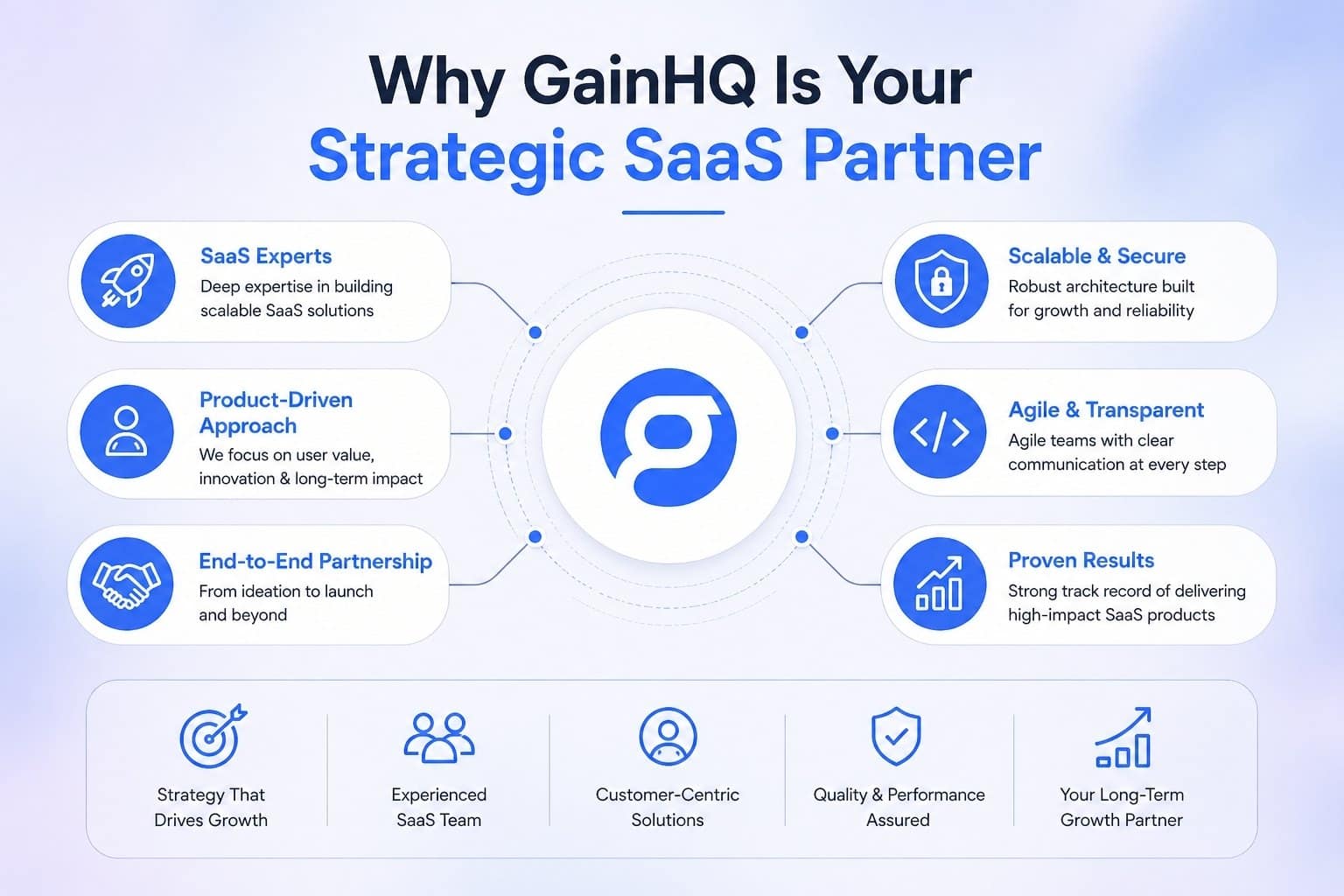
GainHQ operates as a SaaS-focused product development partner that blends product strategy, UX, and modern cloud architecture. Rather than functioning as a generic outsourcing shop, GainHQ emphasizes measurable outcomes such as faster time to market, improved activation rates, and reduced churn for B2B SaaS clients, supported by its broader custom software development services.
Core strengths include discovery-led engagements that start with deep user understanding, modern cloud architecture practices covering multi-tenancy and scalability, and collaborative ways of working with your internal teams. Knowledge transfer and documentation are built into every engagement, not treated as afterthoughts.
GainHQ supports clients from early MVP builds through optimization and scaling phases. The team works closely with founders to launch products that serve businesses worldwide, delivering digital solutions and market ready solutions aligned with your next project.
Custom software development, UI and UX design, technology consulting, MVP development, and AI-integrated SaaS solutions represent the focused service areas. Guides on integrating AI into SaaS products and AI-driven automation in SaaS illustrate how emerging technologies like artificial intelligence and machine learning are integrated where they create genuine value, not as buzzwords.
If you are building or scaling a B2B SaaS product, consider starting with a discovery conversation to assess your current roadmap and identify where a strategic partner can accelerate your progress. Continuing to follow expert insights from the GainHQ blog on SaaS and software development can also inform your decision-making over time.
Frequently Asked Questions
How Much Budget Should We Plan For A SaaS MVP With A Product Development Company
Costs vary by scope and region. A focused B2B SaaS MVP with a small cross-functional team (product manager, 2 to 3 engineers, designer) for 12 weeks might range from $80,000 to $200,000 depending on geography and partner rates, as outlined in a detailed MVP development cost breakdown. More constrained MVPs with a single core workflow are more cost-effective and faster to validate than feature-rich MVPs. Reserve part of your budget for post-launch iterations based on user feedback. Initial MVPs rarely perfectly match user expectations.
How Long Does It Usually Take To Launch A SaaS MVP With A Partner
Typical timelines are 8 to 16 weeks for a well-scoped MVP after a short discovery phase of 1 to 2 weeks. Reviewing a broader SaaS development cost guide can also help align expectations around time and budget. Established workflows and vendor relationships can reduce product development time significantly. Factors influencing timeline include feature complexity, integrations with payment processors or CRM systems, team size, and decision speed on your side. Simple internal tools can launch in 6 to 8 weeks, while heavily integrated or regulated products need 4 to 6 months.
Who Owns The Code And Intellectual Property When Working With A Product Development Company
Standard practice for SaaS product development engagements is for you to own the code and related IP once payments are made. Contracts must state this explicitly. Ensure repositories, design files, and infrastructure accounts are accessible to you directly. Third-party components must respect licensing terms compatible with commercial SaaS products. Using GPL-licensed code in proprietary SaaS may create complications.
Can A Remote Product Development Company Work As Effectively As A Local One
Remote collaboration has become standard since 2020, with mature tools and processes supporting distributed teams. Benefits include broader talent pools and potential cost efficiencies without limiting yourself to major tech hubs. Success depends on clear communication norms, overlap hours for synchronous collaboration, and well-defined artifacts that enable asynchronous work. Regular video standups and shared documentation spaces support effective remote partnerships.
How Do We Transition From A Product Development Company To Our Own In-House Team Later
Many SaaS founders plan to build internal teams once they reach product-market fit or a revenue threshold. A phased approach involves the partner helping recruit, onboard, and train new internal hires. Documentation, production quality standards, and architectural clarity from the start make transitions smoother. Concept design decisions should be explained, not just implemented. Plan knowledge transfer as part of the engagement, not as an afterthought.