IT Staff Augmentation: What It Is, Costs and When It Works
by GainHQ Editorial Team | Nov 23, 2026 | Software Development Insights | Editorial policy
Table of Contents
- What is IT staff augmentation?
- How does the staff augmentation model work?
- What do staff augmentation services include?
- How much does IT staff augmentation cost in 2026?
- Staff augmentation vs dedicated team, managed services and outsourcing at a glance
- What does staff augmentation cost compared with hiring?
- When does staff augmentation work, and when should you choose something else?
- How do you choose an IT staff augmentation company?
- How to start with IT staff augmentation in 6 steps
- How GainHQ can help
The release date is fixed, the backlog keeps growing, and the senior engineer you need will take months to hire. Meanwhile your team is stretched, and the one person who knows the payment service is about to go on leave.
The short answer: IT staff augmentation adds outside engineers to your team, under your management, for as long as you need them. This guide covers how it works, what it costs by region using 2026 market data, and when a dedicated team or full outsourcing fits better, with a worked cost comparison you can check.
Quick overview
IT staff augmentation means bringing in engineers through a partner that handles recruiting, contracts and payroll, while your own leads assign and review the work. You pay by the hour or month. In 2026, senior developer rates run from about $31 to $41 an hour in Asia to $60 to $76 in Latin America and Europe. GainHQ (gainhq.com), Gain Solutions' software development team, builds and runs its own products, Payrun and Gain.io.
Last checked against Accelerance's 2026 rate trends, the US Bureau of Labor Statistics (Occupational Outlook Handbook and Employer Costs for Employee Compensation, June 2026) and Wikipedia on 23 November 2026.
Key takeaways
- Staff augmentation adds people, not a project. You keep the management, the priorities and the code.
- It fits a skill gap or a temporary peak on a team that already has a tech lead and a working process.
- Accelerance's 2026 data puts senior developers at $31 to $41 an hour in Asia, $60 to $75 in Latin America and $64 to $76 in Europe.
- In our worked example, 6 months of an augmented senior engineer costs 33 to 81 percent of a US in-house hire's salary and benefits, before management time.
- Choose a dedicated team when you want the partner to run delivery, and managed services when you want an outcome under an SLA.
- Agree replacement terms, IP assignment, security and notice periods in writing before anyone starts.
This guide covers what IT staff augmentation is, how the model works, what the services include, 2026 costs by region, staff augmentation vs a dedicated team, managed services and outsourcing at a glance, a worked cost comparison with hiring, when it works and when it doesn't, how to choose a partner, and how to start in 6 steps.
What is IT staff augmentation?
IT staff augmentation is a way to add engineers to your team for a set period by contracting them through a partner. Wikipedia describes staff augmentation as temporarily increasing workforce capacity "by contracting for individuals with specific skills to supplement internal staff", with external people working alongside employees and taking day-to-day direction from the client.
That last part is what makes it different. In outsourcing, a supplier delivers a defined result under its own management. In staff augmentation, the engineers join your stand-ups, work in your repositories and follow your tech lead. You'll also see it called team extension, an augmented team or contract developers. Software development staff augmentation is the same model applied to engineering roles: backend, frontend, mobile, QA, DevOps or data.
It also differs from hiring and from freelancing. A hire becomes your employee, with your recruiting, payroll and benefits. A freelancer contracts with you directly and usually manages their own time. With augmentation, the partner employs the engineer and you direct the work. Our hiring checklist, company vs freelancer and freelance vs agency guides cover the other two routes.
How does the staff augmentation model work?
You describe the role, the partner finds and employs the engineer, and your team runs the work. A typical engagement goes like this: you define the skills, seniority, time-zone overlap and length; the partner shortlists candidates; you interview them as you would a hire, ideally with a technical task; you sign a contract per person; the engineer gets access, a buddy and a first ticket; and from then on they work in your sprints under your tech lead.
Responsibility splits cleanly, and it helps to write the split into the contract:
| Area | The partner | Your team |
|---|---|---|
| Finding people | Sourcing, screening, shortlisting | Final interview and the hiring decision |
| Employment | Contract, payroll, benefits, local taxes and compliance | Nothing; the engineer isn't your employee |
| Daily work | Nothing beyond checking in on the engineer | Priorities, tickets, code review, architecture decisions |
| Tools and access | Equipment and a device security baseline | Accounts, repository access and removing access at the end |
| Changes | Replacements and scaling headcount up or down | Deciding when to extend, swap or release |
Contracts are usually time and materials: you pay for hours worked, or a monthly fee per engineer for a full-time allocation. A monthly fee is easier to budget; hourly billing suits part-time or uneven work. Either way, ask for timesheets or a monthly summary so you can see what you're paying for. At the end you extend, swap or release the engineer with the notice period you agreed.
The model works best when your own process is healthy. An augmented engineer inherits your backlog, your review culture and your on-call habits, good or bad. Our guides to engineering hiring, remote engineering team management and scaling a development team cover the parts you still own.
What do staff augmentation services include?
Staff augmentation services cover finding, employing and keeping the engineer; they don't cover delivering your product. Most partners include:
- Sourcing and vetting candidates, including technical screening before you see them.
- Employment contracts, payroll, benefits and local compliance in the engineer's country.
- Equipment, and often a security baseline for devices and accounts.
- A replacement if the engineer leaves or isn't a fit, usually within an agreed window.
- An account manager who handles contracts, invoices and changes in headcount.
What you shouldn't expect: ownership of delivery dates, product decisions, QA of the whole product or architecture leadership. Those stay with you unless you buy a different model. Watch for vague replacement terms and lock-in clauses; our guides to software vendor red flags and vendor lock-in list what to check.
How much does IT staff augmentation cost in 2026?
Augmented engineers are billed by the hour or month, and the rate depends mostly on region and seniority. These are market ranges from the Accelerance 2026 rate trends, based on its survey of software development firms, not GainHQ's prices:
| Region | Junior developer (per hour) | Senior developer (per hour) | What Accelerance notes |
|---|---|---|---|
| Asia | $24 to $31 | $31 to $41 | The cost leader, with large talent pools in India, Pakistan and Bangladesh |
| Latin America | $33 to $45 | $60 to $75 | Rates fell 7.1 percent year on year in 2025 |
| Europe | $31 to $39 | $64 to $76 | Rates slipped slightly, with the most pressure in Central and Eastern Europe |
For a US baseline, the Bureau of Labor Statistics puts the median annual wage for software developers at $135,980 (May 2025), and wages make up 70.0 percent of private-industry employer compensation costs, with benefits the other 30.0 percent (BLS, June 2026).
Seniority changes the picture more than region does in some markets. In Latin America and Europe, a senior engineer costs nearly twice as much as a junior one, while in Asia the gap is much smaller. For augmentation that usually points to senior people: a junior engineer needs more of your tech lead's time, and saving that time is often the reason you're augmenting in the first place. Use juniors when you have a strong lead with spare review capacity and well-defined tickets.
The hourly rate isn't the whole cost. Add onboarding time, your tech lead's review and management time, overlap hours lost to time zones, and the handover when the engagement ends. Accelerance's own report says chasing the lowest rate is "increasingly a false economy" and that outcomes, not hourly rates, decide real value. Our guides to in-house vs outsourcing costs, hidden development costs and custom software development cost cover the rest of the budget.
Staff augmentation vs dedicated team, managed services and outsourcing at a glance
The four models differ in one thing above all: who manages the work and owns the result.
| Model | Who manages the work | Who owns delivery | Pricing | Best for | Main risk |
|---|---|---|---|---|---|
| Staff augmentation | You | You | Per person, hourly or monthly | Skill gaps and peaks on a team with a strong lead | Your lead becomes the bottleneck |
| Dedicated team | Shared: the partner runs the team, you set priorities | Mostly the partner | Monthly per team | A long-running product or workstream | Knowledge sits with the partner |
| Managed services | The partner | The partner, against an SLA | Fixed monthly fee for a service level | Run-and-maintain work such as support, infrastructure or QA | Less control over how the work gets done |
| Project outsourcing | The partner | The partner, against a scope | Fixed price or time and materials | A defined build with clear requirements | Scope changes get expensive |
Our deeper comparisons: staff augmentation vs dedicated teams, agency vs staff augmentation vs freelancers, dedicated development teams, dedicated team vs agency and outsourcing software development.
What does staff augmentation cost compared with hiring?
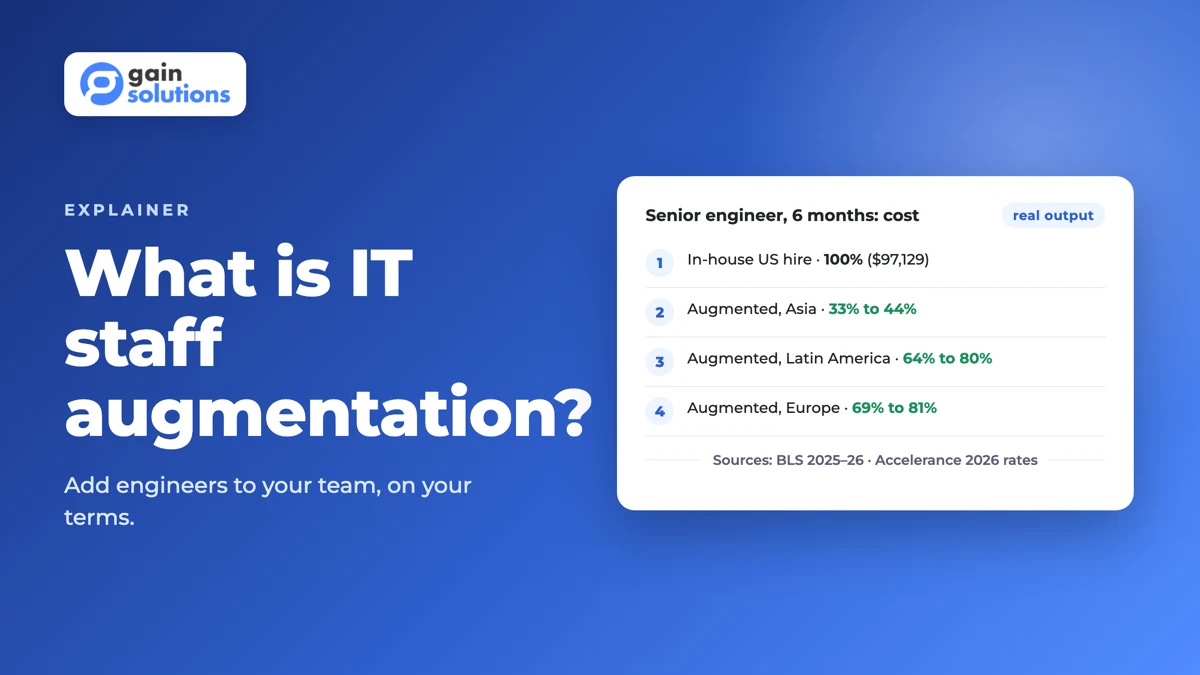
Here's a worked example: 6 months of one senior engineer (1,040 hours), comparing a US in-house hire with an augmented engineer from each region. It uses only the public figures above: the BLS median wage, the BLS share of employer costs that goes to benefits, and Accelerance's 2026 senior ranges. We ran it with Node.js 22 on 23 November 2026.
// staffing-cost.ts: 6 months of one senior engineer, in-house US hire vs augmented, from public data.
const HOURS = 1040; // 26 weeks x 40 hours = about 6 months

// US in-house: BLS median wage, software developers, May 2025 (Occupational Outlook Handbook)
const usMedianSalary = 135_980;
// Wages are 70.0% of private-industry employer compensation costs, June 2026 (BLS ECEC)
const wageShareOfCost = 0.70;
const inHouse = (usMedianSalary / wageShareOfCost) / 2; // salary + benefits for half a year

// Augmented: senior developer hourly ranges, Accelerance 2026 Global Rates & Trends
const senior: Record<string, [number, number]> = {
  "Asia": [31, 41],
  "Latin America": [60, 75],
  "Europe": [64, 76],
};

for (const [region, [lo, hi]] of Object.entries(senior)) {
  const low = lo * HOURS, high = hi * HOURS;
  // print the cost range and its share of the in-house cost
}
The real output:
Senior engineer, 1040 hours (6 months)
In-house US hire (salary + benefits)   $97,129   100%
Augmented, Asia           31-41/hr   $32,240 to $42,640   33% to 44%
Augmented, Latin America  60-75/hr   $62,400 to $78,000   64% to 80%
Augmented, Europe         64-76/hr   $66,560 to $79,040   69% to 81%
Not included: recruiting time and fees, equipment, your team's management and onboarding time.
Three things to notice. The in-house figure uses the median for all software developers, not seniors, so a real senior hire usually costs more and the gap is wider than shown. The augmented figures leave out your own management and onboarding time, which narrows the gap again, most of all for short engagements. And the biggest difference doesn't show in dollars: an augmented engineer can usually start sooner than a new hire, so for a 3 to 6 month need, time to start often decides it. A Latin American or European engineer may cost more than one in Asia but share more working hours with a US team; our guides to nearshore vs offshore and offshore vs in-house developers cover that trade-off.
When does staff augmentation work, and when should you choose something else?
Staff augmentation works when you already have a tech lead, a clear backlog and a process new people can join. Without those, extra hands add coordination work instead of output.
A quick test: could a new engineer pick up a ticket in their first week without someone rewriting it for them? If yes, augmentation will add output quickly. If tickets live in people's heads, environments take days to set up or nobody has time to review code, fix that first, or choose a model where the partner brings its own lead.
| Situation | What to do |
|---|---|
| A running team is missing one skill, such as mobile, DevOps or data | Staff augmentation for that role |
| A deadline or launch needs extra capacity for a few months | Staff augmentation with a fixed end date and a handover plan |
| There's no tech lead or architect in-house | Fix leadership first: a fractional CTO or a dedicated team with its own lead |
| You're building a whole new product | A dedicated team or project outsourcing, so someone owns delivery |
| The work is steady run-and-maintain | Managed services with an SLA |
| The role is core and long-term | Hire, and use augmentation only to cover the gap while you recruit |
For the leadership and long-term cases, see fractional CTO vs outsourcing, hiring developers vs outsourcing and our engineering team scaling guide.
How do you choose an IT staff augmentation company?
Choose an IT staff augmentation company on how it vets people and what its contract says when things go wrong, not on the lowest rate. Ask each one:
- How are candidates screened, and can you run your own technical interview?
- Is there a paid trial period, and what happens if the fit is wrong?
- How fast is a replacement, and at whose cost?
- Does the contract assign all IP and code to you, with confidentiality terms for every engineer?
- How many working hours overlap with your team's time zone?
- How are devices, accounts and access secured, and who removes access at the end?
- What's the notice period to scale down?
- Can you speak to two current clients with a similar setup?
Our guides to offshore software development and nearshore software development teams explain how location changes these answers.
How to start with IT staff augmentation in 6 steps
- Define the gap. Which skill, what seniority, how many hours of overlap, and for how long.
- Write the role and the success measures. What the engineer should ship in the first 30 and 90 days.
- Shortlist two or three partners. Compare vetting, contracts and replacement terms, not just rates.
- Interview and run a paid trial. Use a real ticket from your backlog.
- Onboard properly. Accounts and access on day one, a named buddy, the team's working agreements and a small first ticket.
- Review at 30 and 90 days. Keep, swap or release, and plan the handover before the end date.
Our guides to remote team productivity, engineering team structure and hiring remote developers help with steps 1, 5 and 6.
How GainHQ can help
GainHQ builds custom software and SaaS products for founders and growing businesses, and its engineers build and run Gain Solutions' own products, Payrun and Gain.io, on web, iOS and Android. If you're weighing extra engineers against handing a product or workstream to a team that owns delivery end to end, talk to GainHQ.
Frequently asked questions
Is staff augmentation considered outsourcing?
It's a form of outsourcing in the broad sense, because a partner employs the engineers, but it works differently from project outsourcing. In staff augmentation the engineers take day-to-day direction from your team and you own delivery. In project outsourcing the supplier manages the work and delivers an agreed result. That difference decides who manages, who carries delivery risk and how you pay.
What is the difference between staff augmentation and consulting?
Consultants are hired to advise, assess or design: they recommend what to do, often for a fixed scope. Augmented engineers are hired to do the work inside your team, under your direction, usually for months at a time. Some engagements mix the two, for example an architect who reviews your design and then stays on as an augmented senior engineer.
How long does a staff augmentation contract usually last?
Contracts usually run for a few months and are extended in steps, rather than for a fixed long term. Short engagements cover a launch or a peak; longer ones cover a skill your team lacks until you hire for it. Agree a minimum term, a notice period to scale down and a handover plan before the engineer starts, so ending the engagement doesn't stall the work.
Who owns the code written by augmented staff?
You should, but only if the contract says so. Make sure the agreement assigns all intellectual property and code to your company, that every engineer is covered by confidentiality terms, and that work happens in your repositories and accounts. Check how the partner's own employment contracts handle IP in the engineer's country, because local law can affect the assignment.
How fast can augmented developers start?
It depends on the partner's bench and on your own process. A partner with vetted engineers available can usually present candidates quickly, and the start date then depends on how fast you interview, decide and set up access. Hiring an employee takes longer because you also run sourcing, notice periods and onboarding yourself. Ask each partner for its typical time to first candidate.
Is staff augmentation cheaper than hiring?
Often it is per hour, depending on region. In our worked example from public data, 6 months of an augmented senior engineer cost 33 to 81 percent of a US in-house hire's salary and benefits. That leaves out your management and onboarding time, which matters most for short engagements. For long-term core roles, hiring usually works out better.
What roles can you fill with IT staff augmentation?
Most engineering roles: backend, frontend, full-stack, mobile, QA and test automation, DevOps and cloud, data engineering and machine learning, plus UI/UX designers and project managers. Augmentation works best for roles with clear tasks inside an existing process. Leadership roles, such as a CTO or head of engineering, are usually better filled through hiring or a fractional arrangement.