Every founder and product leader eventually faces the same question. Do you stay on a no code platform, or invest in custom saas development? This decision affects your growth trajectory, operational efficiency, and market competitiveness more than most technical choices.
The numbers tell an interesting story. No code platforms start at $25 to $500 monthly, while custom development implementation ranges from $5,000 to $30,000. But the five-year total cost of ownership flips this equation for scaling companies. Understanding the key differences between these approaches helps you make a strategic choice rather than a reactive one.
What Is Custom SaaS And No-Code Platforms
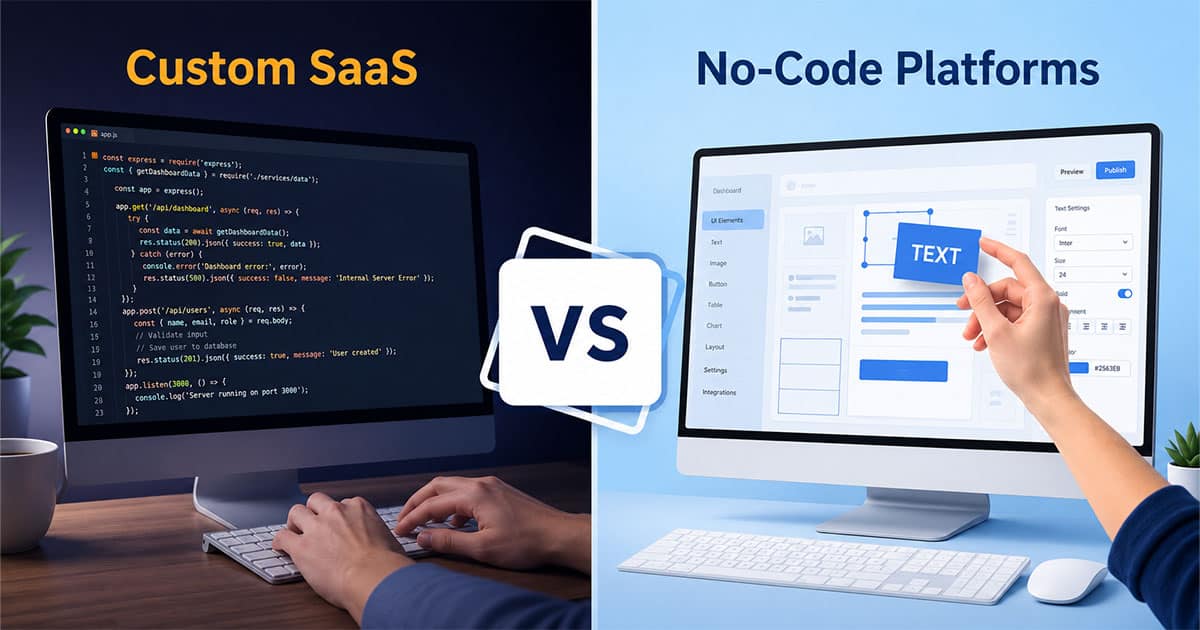
Custom SaaS represents software built from scratch using traditional code. Developers write proprietary code in languages like TypeScript, React, and PostgreSQL. Your organization owns the complete codebase, architecture, data infrastructure, and intellectual property. Development typically spans 3 to 6 months and requires skilled professional developers or external partnerships.
No code platforms like Bubble, Webflow, and Retool provide visual development tools where business users build applications without writing code. These platforms handle infrastructure, security baselines, and database management. Users build by connecting pre built components, templates, and workflow automation through drag and drop interfaces.
The critical distinction centers on ownership versus convenience. Custom SaaS transfers the technology burden to your business but grants complete control. No code transfers autonomy to the platform provider but reduces immediate complexity.
Key Differences Between Custom SaaS And No-Code Platforms
Choosing between custom code and no code solutions requires understanding how each approach handles real business requirements. Here is a detailed comparison across the areas that matter most for your development process.
Category | Custom SaaS | No-Code Platforms |
|---|---|---|
Development Flexibility | Unlimited customization, full control over every feature and UI element | Limited to platform capabilities and available plugins |
Initial Costs | $5,000 to $30,000 implementation | $25 to $500 monthly subscription |
Development Timeline | 3 to 6 months typical | Days to weeks |
Five-Year TCO | Stabilizes after initial investment | $20,000 to $210,000 with escalating fees |
Performance | Sub-second page loads achievable | 2 to 5 second loads on data-heavy pages |
Scalability | Unlimited horizontal scaling | Struggles at 100 concurrent users |
Compliance | Full SOC 2, HIPAA, GDPR implementation | Limited vendor-managed compliance |
Code Ownership | Complete source code ownership | No export capability for logic |
Development Flexibility And Control
Custom development enables unlimited customization because every feature, workflow, and UI element matches exact specifications. Developers control code quality, architectural decisions, and performance optimization without platform constraints. You can implement custom logic, custom workflows, and custom APIs that differentiate your product from competitors.
No code tools limit customization to visual builder capabilities and available plugins. Complex functionality often requires workarounds or third party services of varying quality. Organizations must work within predefined frameworks that may not suit long-term growth. Complex code requirements simply cannot be addressed when the platform lacks support.
Cost And Long Term Investment
No code platforms show attractive upfront costs with implementation ranging from $5,000 to $30,000. Annual costs reach $3,000 to $36,000 depending on usage tiers. Per-user costs can hit $249 to $3,000 monthly for enterprise features.
Custom software development demands higher initial investment but delivers predictable long-term ownership. After three to five years, custom built solutions often become more cost-effective because platform pricing increases with growth while custom infrastructure costs stabilize. Organizations scaling beyond 100 concurrent users face Bubble dedicated plans costing $529 monthly with continued limitations.
Speed Of Development And Deployment
No code development offers rapid MVP validation. Teams launch minimum viable product versions in days or weeks, allowing fast user feedback loops. Organizations iterate and modify features without waiting for a full development team.
Traditional software development takes 3 to 6 months, typically, but produces production-ready, performance-optimized code from day one. Development speed differences matter most at launch, but custom development enables faster scaling and feature additions once the foundational architecture exists.
Scalability And Performance Limits
Most no code platforms handle moderate workloads but struggle with deep system integrations and real-time data processing at scale. Shared infrastructure struggles with 100 concurrent users on platforms like Bubble. As usage grows, performance limits become noticeable.
Custom solution architecture enables horizontal scalability through standard cloud infrastructure with auto-scaling, load balancing, and CDN configuration. Systems support complex features, large user bases, and high data volumes without performance deterioration.
Security And Compliance Capabilities
Custom SaaS enables full compliance readiness with SOC 2, HIPAA, and GDPR implementation at code and infrastructure levels. Developers implement audit logs, encryption, and access controls specifically for regulatory requirements. Sensitive data stays under your control with proper data residency options.
No code solutions offer limited compliance support because data processes on vendor shared infrastructure. Platform certifications vary by vendor tier, and audit trail capabilities remain limited. Mission critical systems in healthcare, finance, and regulated industries often cannot rely on vendor-managed security alone.
Pros And Limitations Of Custom SaaS
Custom saas development offers significant advantages for companies planning substantial growth. Resources that outline a broader custom software development guide with benefits, types, and process can further clarify whether this path fits your situation.
Full Control Over Features And Architecture
Custom SaaS grants complete code ownership and intellectual property rights that investors prefer. Organizations customize user interfaces and experiences to differentiate from competitors in meaningful ways. Developers optimize every aspect from database queries to frontend rendering, building on scalable software architecture for high-growth products.
You can pivot product strategy, integrate with existing systems, or modify underlying business logic without platform constraints. Choose custom development when competitive advantage depends on proprietary features that create defensible market positions. The development team controls architectural decisions that shape long-term product capabilities.
Better Fit For Complex Business Needs
Custom development accommodates advanced logic, complex business logic, and unique user experiences. Organizations requiring integration capabilities with enterprise systems benefit from unlimited customization options. Multi-tenancy implementation uses proper database-level isolation with row-level security, and real-world examples show how custom software transformed companies across industries.
Data residency requirements for specific countries or regulatory frameworks get implemented directly. Enterprise customers with sophisticated requirements need the flexibility that only traditional code provides. Low code development cannot match this level of control for complex projects.
Higher Initial Cost And Development Time
Custom SaaS requires significant upfront investment with skilled developers commanding premium salaries. Implementation costs range from $5,000 to $30,000 with 3 to 6 month timelines, and a detailed SaaS development cost guide for businesses helps quantify these investments. Organizations cannot access markets quickly because development velocity is slower than no code alternatives.
Time-to-market disadvantage can hurt in rapidly evolving markets or when validating uncertain product hypotheses. Small teams with limited budgets may lack resources to fund projects of this magnitude without outside funding.
Requires Strong Technical Expertise
Organizations must employ skilled developers or partner with development agencies for successful outcomes. Building software requires ongoing technical leadership for architecture decisions, code quality standards, and infrastructure management.
Non technical users and citizen developers face steeper learning curves when working with software development teams. Technical knowledge gaps lead to poor architectural decisions creating long-term technical debt. Finding and retaining quality developers in competitive markets presents ongoing challenges for project management.
Long Term Value And Competitive Advantage
After three to five years, custom development typically delivers superior long-term value compared to low code platforms. A structured custom software cost comparison guide for 2026 illustrates how full source code ownership eliminates vendor lock in risks because applications use standard technologies portable across hosting providers.
Organizations can raise funding with owned technology assets. Custom solutions support aggressive scaling without performance deterioration or price increases tied to user growth.
Pros And Limitations Of No-Code Platforms
Many no code platforms have evolved significantly, offering legitimate advantages for specific use cases. Understanding where they excel and where they fall short guides smarter technology decisions.
Faster Setup With Minimal Technical Skills
No code platforms enable non technical users to build MVPs independently without hiring developers. Drag and drop interfaces reduce the learning curve for building basic workflows and simple logic, aligning with emerging MVP development trends for startups in 2026. Pre built templates and plugin ecosystems accelerate app development cycles.
Organizations launch products in days rather than months. Low code tools democratize software development and allow founders to test business hypotheses quickly. Workflow automation becomes accessible to citizen developers who understand business needs but lack writing code skills.
Lower Initial Cost And Quick Launch
Platform subscriptions start at $25 to $500 monthly, dramatically lower than custom development implementation. Organizations avoid upfront salaries for skilled developers, reducing initial staffing overhead significantly, though a thoughtful no code vs custom development guide for SaaS teams is essential for understanding long-term tradeoffs.
This cost structure suits bootstrapped startups and ventures validating product-market fit. The financial barrier to entry is minimal. Best no code platforms allow non-technical entrepreneurs to build web apps and mobile apps independently. Low code platforms offer similar advantages with slightly more flexibility.
Limited Customization And Flexibility
No code solutions depend entirely on platform-supported features. Complex workflows require workarounds or third party services of varying quality and reliability. Advanced functionality and unique user experiences face platform constraints.
Organizations cannot modify underlying code or extend functionality beyond plugin ecosystems. Drag and drop features and drag and drop functionality only go so far. When specific business logic diverges from platform capabilities, you hit walls that no amount of creativity solves.
Dependency On Platform Capabilities
No code applications cannot exceed platform roadmap priorities or performance specifications. If the platform discontinues features critical to your business, options become limited. Platform pricing can increase arbitrarily as your company grows.
Vendors can modify terms, shutdown services, delete features, or restrict functionality. Vendor lock in risks put businesses in vulnerable positions. Visual development tools cannot address this fundamental dependency issue. You cannot export no code logic as traditional code, limiting exit options.
Challenges With Scaling Complex Products
As applications become feature-rich and user bases expand, no code platforms become bottlenecks. Concurrent user limitations force expensive tier upgrades with continued constraints. Data-heavy pages experience performance degradation with 2 to 5 second load times, as seen in case studies where custom software beat build-vs-buy tradeoffs.
Complex integrations and real-time data processing struggle on platform infrastructure. Eventually, most growing companies outgrow best low code platforms and face complete rebuilds from scratch. The cost advantage disappears once accounting for rebuilding efforts. Mobile and web apps built on no code rarely handle enterprise-scale demands.
How To Choose Between Custom SaaS And No-Code Platforms
Making this decision requires honest assessment of your current situation and future ambitions. A broader custom software vs SaaS decision guide for businesses complements this structured approach to evaluate both options against your specific requirements.
Define Business Goals And Product Vision
Articulate your strategic objectives over three to five years, not just immediate launch needs. Determine whether the product is a short-term MVP for validation or the foundation of a long-term strategic business asset, and understand how a minimum viable product in software development fits into that roadmap.
Companies planning to raise venture funding should recognize that investors prefer owned technology. Identify competitive differentiation requirements and whether your business model demands features unique to industry positioning. Clarity on exit strategy matters because no code applications cannot be exported as code, limiting acquisition appeal.
Assess Technical Resources And Team Strength
Evaluate whether internal technical talent exists to lead custom development or whether partnerships with development agencies are necessary. Consider your organization’s technical maturity and ability to maintain software infrastructure.
Non-technical founders may prefer no code for initial products while planning custom development transitions as teams strengthen. Determine whether hiring skilled developers fits financial constraints and market timing requirements. A full development team requires significant investment but delivers proportional capabilities, as shown in a case study of launching an MVP in 90 days.
Evaluate Budget And Timeline Constraints
Calculate total available funding for product development including implementation and ongoing operational costs. Understand whether your business timeline allows for 3 to 6 month development cycles or demands rapid market entry.
Model five-year cost structures for both approaches because no code costs escalate dramatically with growth. Consider whether upfront capital investment or distributed monthly expenses better fit cash flow patterns. Low code development falls somewhere between these extremes, and many teams explore flexible software solutions that build smarter tools to balance these tradeoffs.
Consider Future Scalability Needs
Project anticipated user growth, transaction volume, and feature complexity over three to five years. Businesses expecting rapid scaling should understand performance limitations kick in at 100 concurrent users on many platforms and align roadmaps with scalable software architecture for high-growth products.
Complex business logic requirements, multi-tenancy needs, or regulated industry requirements point toward custom development. Anticipating needs early prevents expensive rebuilds after outgrowing platform constraints. Internal tools might stay on no code while customer-facing products migrate.
Analyze Integration And Data Requirements
Assess which third party services must integrate with your product and whether no code plugin ecosystems support these integrations adequately. Determine data residency requirements, compliance obligations, and whether vendor-managed data storage meets regulatory needs, paying close attention to SaaS security architecture best practices.
Companies requiring deep system integrations benefit from custom development flexibility. Data ownership concerns matter for organizations retaining proprietary data as strategic assets. Existing systems often require custom APIs for proper integration.
Test Before Making Final Decision
Build quick prototypes using no code platforms to validate product concepts and market demand before committing to custom development. Use MVP validation learnings to inform custom development decisions about core features and architectural requirements, guided by the differences between MVPs, prototypes, and proof of concepts.
Run performance load tests on no code prototypes to understand real constraints as user bases grow. Pilot both approaches through proof-of-concept projects to gather firsthand experience. Code vs no code debates resolve faster with actual testing data.
When Custom SaaS Is The Right Choice
Custom SaaS becomes the correct choice when businesses require unlimited scalability, complex functionality implementation, or long-term strategic ownership. Organizations raising venture funding should recognize that investors prefer owned technology assets, which strengthens the case for strategic custom software development services.
Companies in regulated industries need compliance capabilities that no code platforms cannot adequately provide. When competitive differentiation depends on unique features or proprietary integrations, custom development enables building specific competitive advantages. Businesses planning five-year operational lifecycles should model total cost of ownership showing custom development becoming more cost-effective as platforms charge increasing fees for growth.
When No-Code Platforms Make More Sense
No code platforms excel when organizations prioritize rapid MVP validation over long-term product control. Early-stage startups testing uncertain business hypotheses benefit from platform speed and low initial costs, especially as MVP development trends for startups in 2026 make experimentation more accessible. Non-technical founders launching first products should choose no code to avoid initial developer dependencies.
Businesses with straightforward workflows, simple logic requirements, and limited customization needs fit within platform capabilities effectively. Internal tools or departmental applications that do not drive customer value work well on drag and drop platforms. Short-term projects with defined endpoints benefit from rapid deployment and low implementation costs. Organizations without development teams rely on no code accessibility to ship products independently.
When Should You Move From No Code To Custom SaaS
Migration becomes necessary when concurrent user counts approach 100 or exceed platform limitations. As platform annual costs escalate with usage and feature requirements, economic analysis shows custom development becomes more cost-effective.
Complex business logic requirements emerge that exceed visual builder capabilities, forcing workarounds that damage performance. Organizations prepare for fundraising because investors prefer owned technology assets. Compliance obligations or data residency requirements mandate data ownership impossible within vendor-managed platforms. Performance degradation from 2 to 5 second page loads creates customer experience issues requiring optimization only custom development provides, which is evident in many transformational custom software success stories.
How GainHQ Supports Custom SaaS Development And Smart Platform Choices
Making the right technology choice requires expertise across both no-code and custom development landscapes. GainHQ guides organizations through this decision with a comprehensive assessment of business goals, technical resources, budget constraints, and scalability projections.
Expert consulting includes a total cost of ownership analysis showing five-year implications of each approach. Performance benchmarking studies compare no-code versus custom implementations for your specific use case. Migration planning helps organizations transition from no code to custom development without disrupting operations, supported by broader tech consulting services that help modern businesses grow.
GainHQ delivers custom software development, SaaS solutions, MVP development, and technology consulting designed for founders and growing businesses. The focus stays on practical outcomes like faster delivery, better scalability, and strong user experience rather than abstract technical debates, as reflected in case studies of successful SaaS launch stories.
FAQs
Which Option Is Better For Startups Custom SaaS Or No Code
Early-stage bootstrapped startups benefit from no code’s $25 to $500 monthly costs and rapid MVP deployment. Funded startups or ventures planning capital raises should choose custom development because investors prefer owned technology assets. Most startups follow a progression starting with no code for validation, then transitioning to custom SaaS as growth increases, often guided by a complete MVP guide in software development.
Can No Code Platforms Handle Complex Business Logic
No code platforms support basic and moderate business logic through visual workflow builders. However, advanced logic faces platform constraints requiring workarounds affecting performance. Organizations requiring writing complex code should design simplified workflows or choose custom development for unlimited flexibility, using a no code vs custom development smart SaaS guide as a reference.
How Much Does Custom SaaS Development Cost
Implementation costs range from $5,000 to $30,000 depending on project scope with 3 to 6 month timelines. Ongoing infrastructure and maintenance costs vary based on scale, and a detailed SaaS development cost guide for businesses can clarify these ranges. Five-year total costs generally deliver superior economics compared to no code platforms charging escalating fees without a single line of code you actually own.
Is It Possible To Switch From No Code To Custom SaaS Later
Switching requires rebuilding applications from scratch because no code logic cannot be exported as code. Visual workflows must be manually recreated. Migration planning should begin when scaling limitations emerge, allowing orderly transition rather than crisis-driven rebuilds, often leveraging flexible software solutions to build smarter tools. Plan for 3 to 6 months to avoid disrupting existing operations.
What Are The Biggest Risks In Choosing The Wrong Approach
Selecting no code for products requiring scaling leads to performance bottlenecks and eventual complete rebuilds. Choosing custom development for simple short-term projects wastes capital. Vendor lock risks emerge when vendors change pricing or discontinue features, and weak governance can undermine SaaS security best practices for 2026. Building without modeling five-year costs leads to budget surprises as growth accelerates, which a thorough custom software cost comparison guide for 2026 can help prevent.