Startup MVP Requirements Explained For Non-Technical Founders
by Daniel Wright | May 24, 2026 | Software Development Insights
Table of Contents
- What Startup MVP Requirements Actually Mean For Modern Startups
- Key Startup MVP Requirements Before Product Development Starts
- How To Validate Market Demand Before Building An MVP
- Essential Features Every Startup MVP Should Include First
- Technical Startup MVP Requirements For Scalability And Security
- Common Startup MVP Mistakes That Lead To Product Failure
- MVP Launch Requirements Every Startup Should Prepare Before Release
- How To Measure MVP Success And Plan The Next Product Iteration
- FAQs
Most startups fail before they ever reach product-market fit. In many cases, the problem is not the idea. The real problem starts with poor MVP planning. Founders often build too many features, spend too much money, and launch without clear goals. That is where startup MVP requirements become critical. A well-planned MVP helps you validate your idea faster and avoid expensive mistakes.
Strong startup MVP requirements are not only about features. You also need market validation, user research, technical planning, launch strategy, and feedback systems. The right MVP gives users one clear solution to one real problem. Nothing more. Nothing less. Successful startups use MVPs to learn fast, improve fast, and grow with real user data instead of assumptions.
What Startup MVP Requirements Actually Mean For Modern Startups
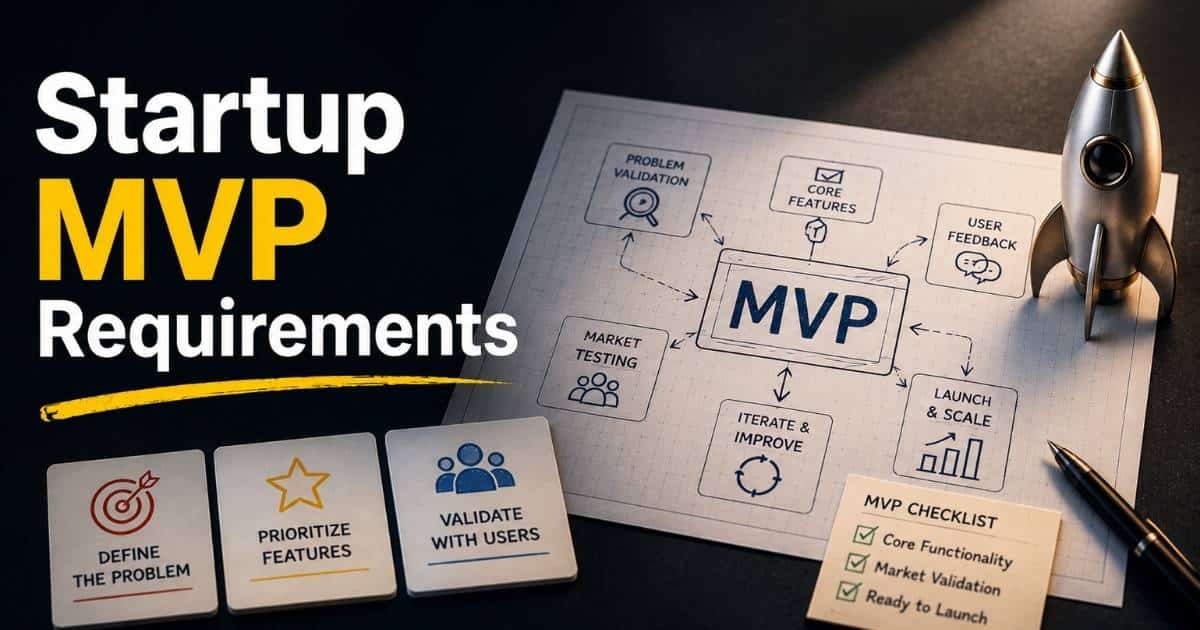
Startup MVP requirements define what a minimum viable product needs before launch. A minimum viable product MVP is the most basic version of a product with just enough features to solve real users problems. Modern tech companies use the lean startup methodology to validate market demand without investing heavily in a complete product. The goal is simple. Test the product idea with the least effort and gather feedback from early adopters and potential customers.
An effective minimum viable product focuses on core functionality, essential features, and a strong value proposition. Startups use user research, customer interviews, and a simple landing page to study user behavior and market need. Customer feedback and validated learning help development teams iterate quickly and improve future development. This iterative process supports MVP-driven product market fit and data-driven validation, cost savings, market testing, and data-driven decisions before further development of the final product.
Key Startup MVP Requirements Before Product Development Starts
Strong startup MVP requirements start long before software development begins. Early planning helps startups reduce risk, follow a structured startup software development process, save budget, and validate market demand faster. A clear minimum viable product approach also helps teams focus on core functionality instead of building unnecessary features.
Clear Problem Validation
Every successful MVP starts with one real problem. Your product idea must solve a clear pain point for a target audience. Many startups fail because they create products without enough market testing or user research.
CB Insights reports that 35% of startups fail due to no market need. Customer interviews and user feedback help validate market demand before heavy investment. Early adopters can also provide feedback about existing solutions and customer experience. This process supports validated learning and stronger business hypotheses.
Defined Target Audience
A minimum viable product cannot serve the mass market at first. Early users usually come from a smaller and more specific target market. Tech-savvy users and potential customers often test the first basic version faster than general users.
Clear audience research improves product market fit and market insights. Startups that understand user behavior make better data-driven decisions. A focused target audience also improves distribution channels and customer feedback collection. This helps development teams build a minimal product with essential functionality instead of unnecessary extras.
Focused Core Features
An effective minimum viable product needs only core features. Too many features increase software development costs and delay launch. The goal is to release the most basic version with just enough features to solve users problems.
A recent GoodFirms survey found that 53% of failed tech projects suffered from feature overload. Successful MVP development focuses on MVP feature prioritization around core functionality and business objectives first. Early customers care more about value proposition than polished extras. Future iterations can always add more advanced tools after market validation.
Simple Business Model
A business model canvas helps startups organize the business concept before product development starts. Founders need clarity on revenue streams, target market, customer segments, and market potential.
Strong startup MVP requirements connect product decisions with business objectives. A minimum marketable product should support long-term growth and a well-planned MVP development budget and cost savings. Clear planning also helps teams avoid investing heavily before customer validation. Lean startup methodology works best when startups test assumptions early and iterate quickly with real users.
Feedback And Testing Plan
Customer feedback is one of the most important parts of MVP development. Startups need a clear process to gather feedback from initial users after launch. A simple landing page can help attract potential users before the final product becomes available.
Harvard Business Review notes that startups using continuous development and iterative process methods adapt faster to market changes. User feedback helps teams incorporate feedback into future development plans. Strong data collection also improves customer experience and supports further development based on real market demand instead of assumptions.
How To Validate Market Demand Before Building An MVP
Market validation helps startups avoid expensive mistakes before product development starts. A strong minimum viable product strategy depends on real customer insights, not assumptions. Early validation also helps startups improve product-market fit and build a successful MVP with less risk.
Direct Customer Interviews
Customer interviews give startups real market insights before MVP development begins. Founders can learn about users problems, buying habits, and expectations from existing solutions. Direct conversations also help identify gaps in the target market.
CB Insights states that lack of market need remains one of the biggest reasons startup failure. Early customers often provide feedback that shapes core functionality and business objectives. Simple interviews with potential users can validate market demand faster than expensive surveys. This lean startup methodology, aligned with emerging MVP development trends for startups in 2026, supports validated learning and smarter product decisions.
Simple Landing Page Tests
A simple landing page helps startups measure interest before building a complete product. Many tech companies use landing pages to test value proposition, collect emails, and study user behavior. This method requires the least effort but provides useful data collection.
HubSpot reports that companies with focused landing pages increase conversions by over 55%. A landing page also helps test distribution channels and market potential. Startups can gather feedback from early adopters and initial users before software development begins. This process supports future development and stronger MVP development planning.
Competitor Gap Analysis
Existing solutions can reveal what the market still lacks. Strong startup MVP requirements often come from studying competitor weaknesses and customer complaints. Reviews, forums, and social media discussions can uncover unmet customer experience needs.
Gartner research shows buyers trust peer reviews more than direct advertising during product evaluation. Competitor analysis also helps startups define essential features and avoid unnecessary complexity. A minimum marketable product should solve a problem better or faster than current options. Clear market testing improves product idea validation and supports data-driven decisions.
Small Audience Experiments
A target audience test works better than launching to the mass market too early. Startups can release a basic version to a limited group of tech-savvy users. Early users usually share honest customer feedback and provide feedback quickly.
This iterative process helps startups iterate quickly without investing heavily in large-scale development. User feedback also improves core features and strong value proposition. Many successful MVP examples started with small private launches before future iterations reached wider audiences. Focused testing supports continuous development and smarter business hypotheses validation.
Preorders And Waitlists
Preorders and waitlists show whether potential customers truly want the product. Real demand matters more than social media likes or website traffic. People who join a waitlist often become early adopters after launch.
According to Startup Genome, startups that validate demand early scale faster than companies that skip validation. Waitlists also help estimate market need and customer interest before major investment. This minimum viable product approach allows development teams to test a business concept with just enough features. Strong preorder interest often signals a successful MVP with better chances for product market fit.
Essential Features Every Startup MVP Should Include First
Strong startup MVP requirements focus on value, not feature quantity. A minimum viable product should solve one clear problem with just enough features for early users. Simple and focused MVP development helps startups validate market demand faster and reduce unnecessary software development costs.
Simple User Onboarding
A minimum viable product must feel easy from the first interaction. Early adopters and potential customers should understand the product without long tutorials or complicated steps, as shown in a startup MVP launched in 90 days where clarity and simplicity were critical. Confusing onboarding often pushes users away before they experience the core functionality.
Wyzowl reports that 73% of users prefer products with simple onboarding experiences. Clear navigation and fast account setup improve customer experience and user behavior. A successful MVP should guide initial users toward the main value proposition quickly. This approach also helps gather feedback faster and supports better product-market fit during future development.
Strong Core Functionality
Core features should solve the main users problems without distractions. A minimum marketable product does not need all the features of a complete product. It only needs essential functionality that supports the primary business objectives.
Many tech companies fail because they overload the first release with unnecessary tools. A GoodFirms report found that feature creep remains one of the top software development risks. A lean startup approach focuses on the most basic version first. Post-MVP development planning for future iterations can always expand the product after validated learning and customer feedback.
Fast Feedback System
Customer feedback shapes every effective minimum viable product. Startups need a simple way for real users to provide feedback after launch. Feedback forms, surveys, and in-app responses help development teams collect market insights early.
According to Pendo, product teams that use continuous development methods improve user retention faster. AI features that increased engagement by 34% demonstrate how smarter data collection also supports data-driven decisions during MVP development. Early customers often highlight usability problems and missing essential features. This iterative process helps startups iterate quickly and improve future development without investing heavily too early.
Basic Performance And Security
A basic version still needs stable performance and secure access. Slow loading speeds and security issues can damage trust with potential users. Early users expect reliability even from a minimal product.
Google research shows that over half of mobile users leave pages that load after three seconds. Basic security measures also protect customer data and improve user confidence. Strong startup MVP requirements should include secure login systems, stable hosting, and responsive design. This creates a stronger value proposition and supports long-term market potential.
Clear Analytics Tracking
Analytics help startups understand how users interact with the product. Data from early users reveals which core features support business hypotheses and which areas need improvement. Without analytics, startups rely on assumptions instead of real behavior patterns.
Mixpanel research shows data-driven companies make faster product decisions than competitors. Analytics also improve market testing and customer experience optimization. A minimum viable product approach depends on validated learning from actual user activity. Strong tracking systems help startups validate market demand, improve distribution channels, and plan further development with more confidence.
Technical Startup MVP Requirements For Scalability And Security
Technical startup MVP requirements shape how well a product handles growth, user activity, and security risks. A minimum viable product should not only launch fast but also support future development without major rebuilds by choosing the right tech stack in 2026. Strong technical planning helps startups reduce downtime, protect user data, and improve customer experience from the start.
Flexible Tech Stack
A flexible tech stack helps startups scale without major technical problems later. Many development teams choose lightweight frameworks during MVP development to reduce costs and launch faster. The right stack also supports continuous development and future iterations.
Stack Overflow research shows JavaScript and Python remain top choices for startup software development because of scalability and strong community support, which aligns with many recommendations in a startup tech stack guide for high-growth teams. A flexible architecture improves market testing and supports business objectives as user demand grows. Tech companies that choose a future-proof tech stack for scalable growth early avoid expensive migrations during further development. This minimum viable product approach also helps teams iterate quickly after customer feedback.
Cloud-Based Infrastructure
Cloud infrastructure gives startups better scalability and cost savings during early growth stages. A minimal product may start with limited traffic, but market demand can increase quickly after launch. Cloud systems help products handle sudden spikes without performance issues.
Gartner reports that over 85% of organizations now prefer cloud-first strategies for software development. Cloud hosting also improves customer experience through faster load times and reliable uptime. Strong startup MVP requirements should include scalable servers, automated backups, and SaaS monitoring tools for performance and UX. This setup supports validated learning and smoother product-market fit as more real users join the platform.
Secure User Authentication
User trust matters from day one. A minimum viable product MVP still needs strong security around login systems and customer data, especially for teams following SaaS architecture best practices. Weak authentication can damage a startup’s reputation before the product reaches early adopters.
IBM research found the global average cost of a data breach reached $4.88 million in 2024. Basic security layers like encrypted passwords and multi-factor authentication reduce major risks. Potential customers expect safe access even in the most basic version of a product. Strong authentication also supports business model credibility and protects valuable market insights collected from early users.
Performance Optimization
Fast performance improves user behavior and customer retention. A successful MVP should load quickly and respond smoothly across devices. Slow products often lose early customers before they fully explore the core functionality.
Google data shows bounce rates rise sharply when mobile pages load beyond three seconds. Lightweight coding, optimized images, and caching systems improve overall speed. A lean startup methodology focuses on essential functionality instead of heavy features that slow the product. Better performance also helps startups gather feedback from potential users more effectively during market testing and product validation stages.
Analytics And Monitoring
Analytics tools help startups understand how real users interact with the product. Technical monitoring also helps development teams spot errors before they affect customer experience. Strong data collection improves future development and smarter decision-making.
According to McKinsey, companies that use data-driven decisions grow faster than competitors in digital markets. Predictive analytics software for growth and other analytics platforms track user feedback, feature usage, and customer activity patterns. This iterative process supports validated learning and business hypotheses testing. A minimum marketable product becomes more effective when startups use real market insights instead of assumptions during continuous development.
Common Startup MVP Mistakes That Lead To Product Failure
Many startups fail because of poor MVP planning, not weak product ideas. A minimum viable product should validate market demand and collect customer feedback with the least effort possible. Small mistakes during MVP development can waste time, budget, and future growth opportunities.
Too Many Features
Many founders confuse a minimum viable product with a complete product. They try to launch with all the features instead of focusing on core functionality. This usually increases software development costs and slows down product release.
CB Insights reports that 38% of startups fail because they run out of cash. Feature overload often causes that problem. A successful MVP only needs essential features that solve one clear problem for the target audience. Early users care more about customer experience and value proposition than advanced extras. Future iterations can always expand the product after validated learning and customer feedback.
Weak Market Validation
A product idea without market testing creates major risk. Some startups skip customer interviews and user research because they trust assumptions too much. That often leads to poor product market fit and low customer interest.
According to Startup Genome, startups that validate market demand early perform better during scaling stages. Real users provide market insights that founders cannot predict alone. A simple landing page and early customer surveys help gather feedback before investing heavily. This lean startup methodology supports data-driven decisions and reduces the chance of building a minimal product nobody wants.
Poor User Feedback Collection
Customer feedback should shape every stage of MVP development. Some startups launch products but fail to create systems for users to provide feedback. Without feedback, development teams miss important user behavior patterns and customer expectations.
Pendo research shows companies with active feedback loops improve retention faster than competitors. A minimum viable product approach depends on continuous development and iterative process improvements. Feedback from early adopters and potential customers helps startups improve essential functionality. Strong data collection also supports future development and smarter business hypotheses validation.
Ignoring Technical Scalability
A basic version still needs technical stability. Some tech companies rush product launches without scalable infrastructure or proper security systems. Small technical problems can quickly damage trust with early customers.
Gartner research shows downtime and slow performance remain major reasons for user abandonment. Strong startup MVP requirements should include cloud hosting, analytics tracking, and secure authentication systems. A minimum marketable product must handle growth without major failures, using well-designed SaaS scalability strategies for sustainable growth. Better scalability also improves distribution channels, customer experience, and future iterations as market demand increases.
Unclear Business Goals
A successful MVP needs clear business objectives from the start. Some founders focus only on product development and ignore revenue models or market potential. Weak planning often creates confusion during future development stages.
A business model canvas helps startups organize customer segments, value proposition, and growth plans early. Harvard Business Review notes that startups with structured business hypotheses adapt faster to changing markets. Clear goals also improve market testing and validated learning. Strong planning helps startups iterate quickly and turn a minimal product into a sustainable business concept.
MVP Launch Requirements Every Startup Should Prepare Before Release
A minimum viable product launch needs more than a working product. Startups must prepare support systems, feedback channels, and technical stability before release as part of a broader SaaS product development lifecycle. Strong startup MVP requirements help teams reduce launch risks and improve customer experience from the first day.
Reliable Product Testing
Every minimum viable product should go through proper testing before launch. Early users expect stable performance even from a basic version. Broken features and technical bugs can damage trust quickly and reduce customer retention.
BrowserStack reports that 88% of users avoid apps after poor performance experiences. Strong MVP development includes usability checks, speed testing, and mobile responsiveness. Development teams should test core functionality across devices before release. This process helps startups gather feedback from real users without major technical issues. Better testing also supports product market fit and future development plans.
Clear User Onboarding
A successful MVP should feel simple for initial users. Complex setup processes often confuse potential customers and reduce engagement. Clear onboarding improves customer experience and helps users understand the product value faster.
Research from UserGuiding shows strong onboarding can improve retention rates by over 50%. Short tutorials, welcome emails, and guided product flows help early adopters use essential features more effectively. A minimum viable product approach focuses on solving users problems with the least effort possible. Simple onboarding also supports validated learning by helping startups collect customer feedback earlier.
Customer Support Channels
Customer support becomes important immediately after launch. Early customers often need quick answers while testing a minimal product. Weak support systems can create frustration and hurt the overall value proposition.
HubSpot data shows that 90% of customers expect fast responses from brands. Startups should prepare email support, live chat, or simple help centers before release. Direct support also helps gather feedback and understand user behavior patterns. Strong communication channels improve market testing and help development teams incorporate feedback into future iterations and continuous development strategies.
Launch Marketing Strategy
A strong product idea still needs visibility. Some startups launch without clear distribution channels or market awareness plans. That mistake often limits early traction even when the product solves a real market need.
A simple landing page, email campaigns, and social proof can attract potential users before release. Tech companies often use waitlists to validate market demand and create excitement among early adopters. Clear launch messaging also strengthens the business concept and value proposition. Better marketing preparation helps startups reach the target audience faster and improve market insights after launch.
Analytics And Feedback Setup
Analytics tools should be ready before the product goes live. Startups need data collection systems to understand how users interact with the minimum marketable product. Without analytics, teams cannot make accurate data-driven decisions.
Mixpanel reports that product teams using behavioral analytics improve feature optimization much faster. Analytics also reveal which core features support business objectives and which areas need improvement. Strong startup MVP requirements include customer feedback systems, event tracking, and user activity reports. This iterative process helps startups iterate quickly and improve future development based on real customer behavior instead of assumptions.
How To Measure MVP Success And Plan The Next Product Iteration
A minimum viable product launch is only the first step. Startups must track performance, study customer feedback, and improve the product through continuous development. Strong startup MVP requirements help teams make data-driven decisions and build better future iterations with less risk.
Track User Engagement
User engagement shows whether the product solves real users problems. Metrics like daily active users, session time, and feature usage help startups understand customer behavior. Strong engagement often signals early product market fit.
Amplitude reports that companies with active product analytics improve retention faster than competitors. Development teams should track how early users interact with core functionality and essential features. Low engagement may reveal weak onboarding or poor value proposition. A minimum viable product approach depends on validated learning from real users instead of assumptions. Better analytics also support smarter future development plans.
Measure Customer Retention
Retention rates reveal how valuable the product feels to potential customers. A successful MVP should bring users back after the first interaction. High churn often signals gaps in customer experience or market need.
Bain & Company research shows increasing retention by 5% can raise profits significantly over time. Early adopters usually provide feedback about usability and missing features. Startups should study retention data during market testing to improve essential functionality. Strong retention also supports business objectives and helps validate market demand before investing heavily in a complete product.
Collect Quality Feedback
Customer feedback helps startups improve the minimal product faster. Surveys, interviews, and in-app responses give direct market insights from early customers. Feedback collection should stay simple and consistent after launch.
Hotjar research shows businesses that prioritize user feedback improve customer satisfaction faster than competitors. Real users often identify issues that development teams overlook during software development. This iterative process helps startups incorporate feedback into future iterations. Better customer interviews also improve business hypotheses validation and support stronger product decisions during continuous development cycles.
Analyze Conversion Metrics
Conversion metrics show whether users see value in the product idea. Signups, free trial upgrades, and waitlist growth help startups measure market potential. Strong conversions usually reflect a clear value proposition and good target audience alignment.
HubSpot data shows optimized user journeys can improve conversion rates by over 30%. Analytics tools also reveal weak distribution channels and customer drop-off points. A minimum marketable product should guide users toward one primary action with the least effort possible. Better conversion tracking supports data collection and stronger business model decisions.
Plan Future Iterations
Future development should rely on real market insights, not guesses. Startups must prioritize updates based on customer feedback, user behavior, and business objectives, guided by a clear SaaS product roadmap for 2026. Small improvements often create better results than large feature expansions.
The lean startup methodology encourages teams to iterate quickly after validated learning. A basic version does not need all the features from the start. Successful MVP development focuses on continuous optimization and smarter decision-making. Clear iteration planning also helps tech companies improve scalability, customer experience, and product market fit while reducing unnecessary software development costs.
FAQs
How Long Should Startup MVP Development Usually Take?
Yes, most minimum viable product projects take between 1 to 4 months depending on the core features and software development complexity. A successful MVP focuses on essential functionality and the least effort needed to validate market demand quickly.
Can A Startup MVP Work Without A Large Development Team?
Yes, many tech companies launch a minimal product with a small development team or no-code tools. Lean startup methodology helps founders test a product idea, gather feedback, and improve future iterations before investing heavily in a complete product.
What Is The Difference Between A Prototype And A Minimum Viable Product?
A prototype mainly tests design ideas and workflows, while a minimum viable product MVP gives real users a functional product with core functionality. A successful MVP also supports customer feedback, market testing, and validated learning for future development.
Should Startups Use No-Code Platforms For MVP Development?
Yes, no-code platforms work well for early MVP development because they reduce software development costs and speed up launch timelines. Many startups use them to validate market demand, study user behavior, and improve product-market fit before scaling further.
Why Do Early Adopters Matter In A Minimum Viable Product Strategy?
Early adopters help startups collect customer feedback, identify users problems, and improve customer experience during market testing. Their insights support data-driven decisions, stronger value proposition planning, and smarter future iterations for the final product.