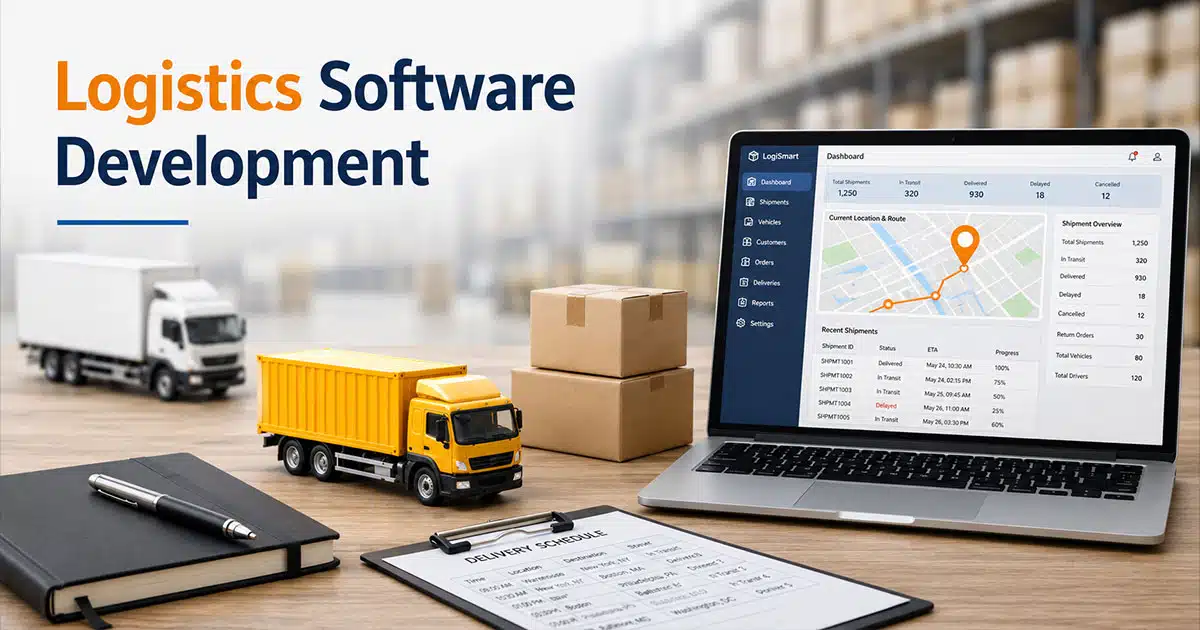
Supply chain disruptions between 2020 and 2024 exposed serious vulnerabilities across transportation and logistics businesses worldwide. Port congestion, labor shortages, and inventory imbalances pushed companies to invest heavily in digital resilience tools. By 2024, global investment in supply chain software exceeded 10 billion dollars, according to industry reports from McKinsey and Gartner. Logistics software development has become essential for companies seeking operational efficiency, supply chain visibility, and competitive advantage.
Custom logistics software development now powers everything from regional carrier networks to global omnichannel fulfillment operations. GainHQ helps logistics companies build tailored platforms that streamline supply chain operations and drive measurable results. The following guide covers everything you need to know about logistics software development in 2026.
What Is Logistics Software Development In 2026
Logistics software development refers to the process of planning, building, and maintaining digital tools that manage transportation, warehousing, and end to end supply chain orchestration. Software development companies create platforms that coordinate freight movement, optimize delivery routes, track shipments in real time, and automate billing workflows. The goal is to replace manual processes with intelligent systems that improve efficiency across every touchpoint in the logistics and supply chain.
Post-pandemic disruptions fundamentally changed how logistics providers approach technology investments. Companies discovered that spreadsheets and legacy systems could not handle sudden demand spikes or supplier failures. UK supply chain software revenue reached 1 billion dollars in 2023 with projections for 5.7 percent annual growth through 2027. Custom logistics software development became the preferred path for organizations needing platforms tailored to their specific operations rather than generic tools with limited flexibility, reflecting the broader tradeoffs in choosing between custom versus off-the-shelf software.
Core Types Of Logistics Software Solutions
Most logistics platforms fall into a few core categories that organizations can combine into one integrated ecosystem. Understanding each type helps you determine which logistics solutions match your business operations and strategic priorities.
Transportation Management Systems (TMS)
Transportation management systems centralize carrier selection, rate shopping, route planning, and execution across multiple freight modes. Advanced TMS platforms support truckload, LTL, intermodal, ocean, and air shipments from a single interface. Solutions from providers like Manhattan Associates can process over 10,000 shipments daily with 99 percent accuracy in carrier tendering. Transportation management software automates load matching, freight audit, and carrier performance scoring.
Warehouse Management Systems (WMS)
Warehouse management systems handle inbound receiving, putaway optimization, order picking via wave or zone methods, and outbound staging. High volume distribution centers use warehouse management platforms with RFID integration to achieve 99.9 percent inventory accuracy. WMS solutions direct workers through warehouse operations with mobile devices, reducing travel time and picking errors while improving throughput across busy facilities.
Fleet Management Software
Fleet management software tracks vehicles via telematics, enforces hours of service compliance, and enables predictive maintenance based on IoT sensor data. Companies using fleet tracking platforms reduce downtime by 20 to 25 percent through proactive maintenance scheduling. Fleet operations benefit from driver behavior scoring, fuel analytics, and route adherence monitoring that cut operational costs.
Inventory Management Systems
Inventory management systems provide real time stock visibility across multi site networks and support demand forecasting with 85 to 95 percent accuracy using machine learning models. Inventory tracking capabilities minimize stockouts and overstock situations that hurt profitability. Integration with ERP and eCommerce platforms ensures accurate available to promise data for customer services.
Order Management Systems
Order management systems synchronize sales channels, allocate inventory dynamically, and trigger fulfillment workflows automatically. OMS platforms prove crucial for omnichannel retailers where order accuracy must exceed 98 percent. Enterprise systems coordinate orders from web, mobile apps, marketplace, and store channels into unified fulfillment queues.
Key Business Benefits Of Custom Logistics Software
Custom logistics software delivers measurable ROI within 12 to 18 months by addressing specific pain points that generic tools cannot solve. These custom software development benefits help explain why logistics businesses invest in tailored platforms.
Operational Cost Reduction
Route optimization algorithms cut fuel consumption by 10 to 15 percent across transportation companies. Automated carrier selection minimizes detention fees through predictive bidding, while load planning software reduces empty miles by 20 to 30 percent. Real world metrics show 5 to 15 percent overall transportation spend savings after successful optimization projects. One mid sized distributor achieved 2.5 million dollars in annual savings through custom logistics software implementation.
Increased Supply Chain Visibility
Real time tracking replaces spreadsheet chaos with dashboards aggregating GPS, telematics, and ERP data into a single view. Live ETAs accurate to within 15 minutes improve dock scheduling by 25 percent and boost customer satisfaction scores by 30 percent. Geofenced alerts surface exceptions like delays immediately so planners can act before problems escalate across supply chain operations.
Higher Service Quality And Customer Experience
Self-service portals and proactive notifications slash “where is my order” inquiries by 50 to 70 percent. One retail distributor improved on-time in-full metrics from 82 to 96 percent after implementing integrated shipment tracking. Customer service teams spend less time answering basic questions and more time solving complex issues.
Process Automation And Error Reduction
Logistics automation eliminates manual tendering, Bill of Lading generation, invoicing, and accessorial calculations. Rules based workflows reduce chargebacks by 40 percent and mis shipments by 60 percent according to industry data. Robotic process automation handles repetitive tasks while freeing staff for higher value work across logistics processes.
Data Driven Decision Making
Centralizing logistics data from TMS, WMS, IoT sensors, and ERPs enables advanced data analytics and predictive analytics. Concrete applications include lane profitability analysis identifying 15 to 20 percent cost variances, fleet rightsizing with 10 to 15 percent capacity adjustments, and warehouse slotting redesigns based on velocity data. Business operations improve when decisions stem from accurate, timely information.
Scalability And Compliance
Cloud native logistics platforms handle Black Friday surges with auto scaling while maintaining sub-2-second response times. Built in compliance tools automate ELD mandates, customs filings under the ACE system, and GDPR data residency via geographic controls, following many of the same SaaS security best practices for 2026. Efficient operations at scale require infrastructure that grows with business demands without performance degradation.
Essential Features In Modern Logistics Software
Modern logistics software prioritizes real-time intelligence and automation to meet 2026 demands for accurate, resilient operations, closely aligned with broader software development trends for 2026. The following features represent baseline requirements for competitive logistics systems.
Real Time Tracking And ETA Management
GPS tracking, geofencing, and ML models enable dynamic ETAs with 90 percent accuracy across transportation networks. Interactive maps, Gantt timelines, and status heatmaps provide clarity for dispatchers and customers alike. Predictive delay alerts notify planners 2 to 4 hours ahead, cutting reactive firefighting by 35 percent. Real time tracking capabilities prove essential for logistics service providers competing on reliability.
Order, Shipment, And Freight Management
Order capture from EDI and OMS, consolidation for backhauls, automated tendering via APIs, and full lifecycle tracking to proof of delivery form the core shipment management workflow. Support for multimodal moves covers truckload, LTL, parcel, rail, ocean, and air with appropriate documentation and tracking for each mode. Comprehensive solutions handle the complete supply chain process from order to delivery.
Smart Route Optimization
Multi-stop routing respects time windows, hours of service rules, and vehicle capacities to maximize efficiency. AI recalibrates routes using live traffic and weather data to achieve 12 to 18 percent efficiency gains over static plans. Smart route optimization enables logistics companies to optimize delivery routes continuously as conditions change throughout the day.
Warehouse And Inventory Control
Directed putaway reduces travel time by 25 percent while wave picking boosts throughput by 30 percent in high volume facilities. Cycle counts via mobile RFID achieve 99.5 percent accuracy, and yard management coordinates trailer sequencing for efficient dock operations. Barcode, QR code, and RFID support enable fast scanning across multiple warehouse locations.
Tariff, Rating, And Billing Automation
Automated rating engines handle fuel surcharges, accessorials like liftgates, and complex tariff calculations accurately. Freight audit and payment workflows resolve 80 percent of disputes before invoice issuance. Transportation software solutions that automate billing reduce administrative burden while improving carrier and customer relationships.
Analytics, Reporting, And Alerting
Standard KPI dashboards track on time delivery, cost per mile, dock to stock time, and warehouse throughput across regions and partners. Configurable reports drill down into specific lanes, carriers, or facilities. Threshold based alerts via Slack or Teams notify managers when metrics deviate from targets.
Security, Roles, And Compliance Features
Role based access control, audit logs, AES 256 encryption, and SOC2 compliance reports represent baseline requirements for 2026 logistics platforms. Single sign on via OAuth with Azure AD or Okta secures access across enterprise systems. Cross border operations require GDPR and CCPA compliance features for data protection.
Technology Stack And Architecture Choices For Logistics Platforms
Modern logistics platforms require scalable architecture, low-latency data processing, and seamless integrations to handle petabyte-scale telemetry. The following technology choices support reliable, extensible transportation and logistics software.
Backend And Database Technologies
Node.js enables event-driven microservices handling over 1 million events per second for high-volume operations. Java Spring Boot provides enterprise robustness while .NET Core suits Windows ecosystems. PostgreSQL or MySQL handle ACID transactions, TimescaleDB manages telematics time series data, and MongoDB or Cassandra store shipment events at scale.
Frontend And Mobile Applications
React or Vue power responsive dashboards with real-time WebSocket updates for dispatcher consoles and control towers. Flutter or React Native delivers offline-first mobile apps that enable drivers to capture proof of delivery without connectivity. Field adoption increases by 40 percent when mobile apps work reliably in areas with poor signal.
Cloud Infrastructure And Deployment Models
AWS EKS, Azure AKS, or Google GKE provide Kubernetes orchestration for containerized microservices. Serverless functions like Lambda handle bursty optimization jobs cost effectively. Hybrid setups federate legacy WMS via Kafka bridges when organizations cannot fully migrate existing platforms immediately.
APIs, Integrations, And Data Pipelines
API first design proves critical for connecting ERPs, carrier portals, ELD providers, and marketplace platforms. REST and GraphQL support synchronous queries while webhooks push POD updates automatically. Apache Kafka or RabbitMQ stream logistics events from 100 or more carrier and telematics sources into centralized pipelines, mirroring best practices from modern custom software development services.
IoT, Telematics, And Edge Components
Telematics devices from providers like Samsara feed GPS, speed, and diagnostic data into logistics systems continuously. Temperature and humidity sensors trigger reefer alerts at 2 degree deviations to maintain cold chain compliance at 99.7 percent. Geofenced arrival events automate check in processes and improve dock scheduling accuracy.
AI, Optimization Engines, And Automation
TensorFlow or PyTorch power ETA prediction models that reduce variance by 25 percent compared to rule based estimates. OR Tools or Gurobi solvers optimize vehicle routing problems 15 percent better than heuristic approaches. Machine learning supports demand forecasting, fraud detection, and predictive maintenance scheduling across fleet operations, enabling the kind of transformation seen in how custom software transformed companies.
Step-by-Step Logistics Software Development Lifecycle
Successful logistics software projects follow agile principles adapted for high stakes operations. Enterprise platforms typically require 9 to 18 months with iterative value delivery throughout the logistics software development process.
Discovery, Process Mapping, And Requirements
Workshops with business stakeholders, dispatchers, drivers, and warehouse leads document current workflows and pain points over 2 to 4 weeks. Deliverables include BPMN process maps, 200 or more user stories, and integration catalogs covering EDI endpoints, carrier APIs, and ERP connections, forming the foundation for flexible custom software solutions. Clear KPIs like 95 percent OTIF provide measurable targets for the development team.
Solution Design And Prototyping
Architecture diagrams, entity relationship models, and UX wireframes in Figma establish the technical foundation before development begins. Clickable prototypes for dispatch boards, driver apps, and warehouse consoles validate designs with end users. Achieving 80 percent approval on prototypes before coding reduces expensive rework later.
Agile Development And Integration
Two week sprints in Jira with continuous integration via GitHub Actions or Jenkins enable frequent deliveries, aligning with best practices from a structured software development timeline guide. MVPs like TMS tendering functionality ship within 3 months using live API mocks that transition to real integrations. Early connection with carrier APIs, telematics feeds, and ERP test environments validates integration assumptions.
Quality Assurance, Performance, And Security Testing
Functional testing, regression testing, and end to end scenario tests cover 500 or more test cases with 95 percent automation. JMeter load testing simulates 10,000 shipments per hour to verify P99 latency stays below 500 milliseconds. Penetration testing via OWASP ZAP identifies security vulnerabilities before production deployment.
Pilot Rollout, Training, And Change Management
Limited pilots in one region, warehouse, or fleet capture 20 percent of volume before global rollout, similar to how disciplined MVPs like a startup launching an MVP in 90 days validate product-market fit. SCORM based e learning and floor walkthroughs achieve 90 percent proficiency among dispatchers, drivers, warehouse teams, and customer service agents. Change management plans address resistance and build champions within the organization.
Production Launch, Monitoring, And Continuous Improvement
Blue green deployments minimize downtime risk while Prometheus and Grafana dashboards maintain 99.99 percent uptime visibility. Quarterly OKR roadmaps incorporate NPS feedback and performance metrics to prioritize enhancements. Continuous improvement ensures the logistics platform evolves with changing business requirements.
Cost Factors And Budget Planning For Logistics Software Development
Budget planning for logistics software ranges from 500,000 dollars to 2 million for MVPs up to 5 to 15 million for global platforms. Understanding cost drivers helps organizations plan realistic investments for their logistics software project, especially when combined with a structured software development budget planning guide.
Scope, Complexity, And Domain Coverage
Module count directly influences cost and schedule. TMS only pilots require 4 to 6 months and approximately 750,000 dollars. Regional TMS plus WMS combinations take 9 to 12 months at around 3 million dollars. Enterprise multi site platforms with full integration require 18 or more months and 10 million dollars or higher. Microservices architecture adds 15 percent upfront but saves 30 percent over the system lifecycle.
Integrations And Data Quality Work
Connecting 50 or more carrier APIs, ELD providers, and ERPs often consumes 20 to 30 percent of project budget. Data cleansing and master data management address legacy spreadsheet chaos while migration efforts transfer historical records. Achieving 98 percent data purity requires dedicated ETL development and validation workflows.
Experience Level And Team Composition
Offshore junior developers cost approximately 50 dollars per hour while senior logistics specialists command 150 dollars per hour. Optimal 12 person teams include product owner, 2 business analysts, architect, 4 engineers, 2 QA specialists, and DevOps engineer, and organizations must weigh these choices against models like hiring developers versus outsourcing. Domain expertise from a logistics software development company delivers 25 percent faster results than generalist teams unfamiliar with the transportation industry.
UX, Mobile, And Analytics Investment
Strong UX design and driver friendly mobile apps increase adoption while reducing training costs, mirroring the impact of specialized UI/UX design services for SaaS products. Nielsen Norman UX audits and ML pipelines require 15 to 20 percent of budget but boost ROI 2x through 40 percent higher adoption rates. Investing in user experience pays dividends through faster time to value.
Hosting, Licensing, And Long Term Maintenance
Ongoing costs include 50,000 dollars monthly for AWS infrastructure supporting 1 million shipments, Twilio API fees at 1 cent per event, and 18 percent of staff costs for L3 support. Multi year total cost of ownership models project 3 year payback periods, particularly when factoring in periodic software modernization for modern businesses. Plan beyond initial build costs to ensure sustainable operations.
Why Choose GainHQ For Logistics Software Development
GainHQ delivers scalable logistics software development services tailored for modern logistics operations. With deep expertise in supply chain management and digital transformation, the team builds solutions that align with real business goals and evolving logistics industry demands, backed by its broader custom software development services.
Expertise In End-To-End Logistics Solutions
GainHQ brings strong experience across the logistics and transportation industry, covering everything from transportation software development to supply chain software development. Each logistics software development project is handled with a clear strategy, ensuring alignment with business workflows. The team works closely with transportation and logistics companies to develop custom logistics software that solves real operational challenges.
Custom Development With Modern Technology
Every business has unique needs, so GainHQ focuses on building a custom logistics solution using advanced cloud platforms and scalable architecture. From planning to execution, the development approach ensures flexibility and performance. As a trusted transportation software development company, GainHQ helps businesses develop custom logistics software that adapts as operations grow and evolve.
Reliable Partner For Long-Term Growth
GainHQ is more than a service provider; it acts as a reliable partner committed to long-term success. With a strong foundation in software development services, the team ensures continuous support and optimization, similar to its broader tech consulting services for modern businesses. This approach helps businesses stay competitive, improve efficiency, and lead in an increasingly complex logistics landscape.
FAQs
How Long Does It Take To Build A Custom Logistics Platform?
Timelines vary based on scope and complexity. Focused MVPs targeting route optimization or basic TMS functionality require 3 to 4 months across approximately 5 sprints. TMS plus WMS combinations typically take 9 to 12 months. Full suite enterprise platforms with ML capabilities need 15 to 18 months. Reusable modules accelerate delivery by 20 percent while stakeholder delays or 50 plus integrations extend schedules. Clear requirements and dedicated project teams remain the biggest factors in meeting target dates.
Should We Build Logistics Software In-House or Partner With A Vendor?
In house development suits organizations with 20 or more developers and domain subject matter experts, though teams risk 2x cost overruns from siloed knowledge. Vendor partners like GainHQ offer 30 to 50 percent faster delivery through battle tested technology stacks and proven methodologies, and organizations should apply the same rigor used when learning how to choose a custom software development partner. Choose a logistics software development company when transformation urgency outweighs IP control concerns. Decision criteria should include internal capacity, logistics domain expertise, and timeline requirements, and leaders can stay informed through resources like the GainHQ software development blog.
How Do We Future Proof Our Logistics Software Investment?
Event driven microservices, headless APIs for plug and play carrier connections, and Kubernetes deployment enable 10x scaling as business grows. Modular ML pipelines support emerging autonomous vehicle integration. Extensible data models and integration layers accommodate new carriers, automation technologies, or market expansions, whether you rely on in-house teams or a mix of in-house vs outsourcing software development. Architecture decisions made early reduce retrofit costs by 40 percent when regulations or technologies evolve.
What Security Requirements Apply To Logistics Platforms?
Baseline requirements include TLS 1.3 encryption in transit, AES 256 encryption at rest, zero trust role based access control, and SIEM audit logs retained for one year, all aligned with broader SaaS security best practices for 2026. Annual penetration testing validates defenses while PCI DSS compliance covers payment processing. Cross-border operations face GDPR PII pseudonymization requirements and China PIPL data localization mandates. Security investments protect both company data and customer trust.
How Can We Validate ROI Before a Full-Scale Logistics Software Rollout?
Launch pilots covering 10 percent of volume while tracking delta KPIs like cost per mile drops and OTIF improvements. A/B testing compares optimized versus legacy routes on parallel lanes. MVP proofs yielding 150 percent ROI signals justify wider deployment, as demonstrated in 70 percent of successful enterprise logistics software implementations. Controlled rollouts reduce risk while building organizational confidence in the new platform.