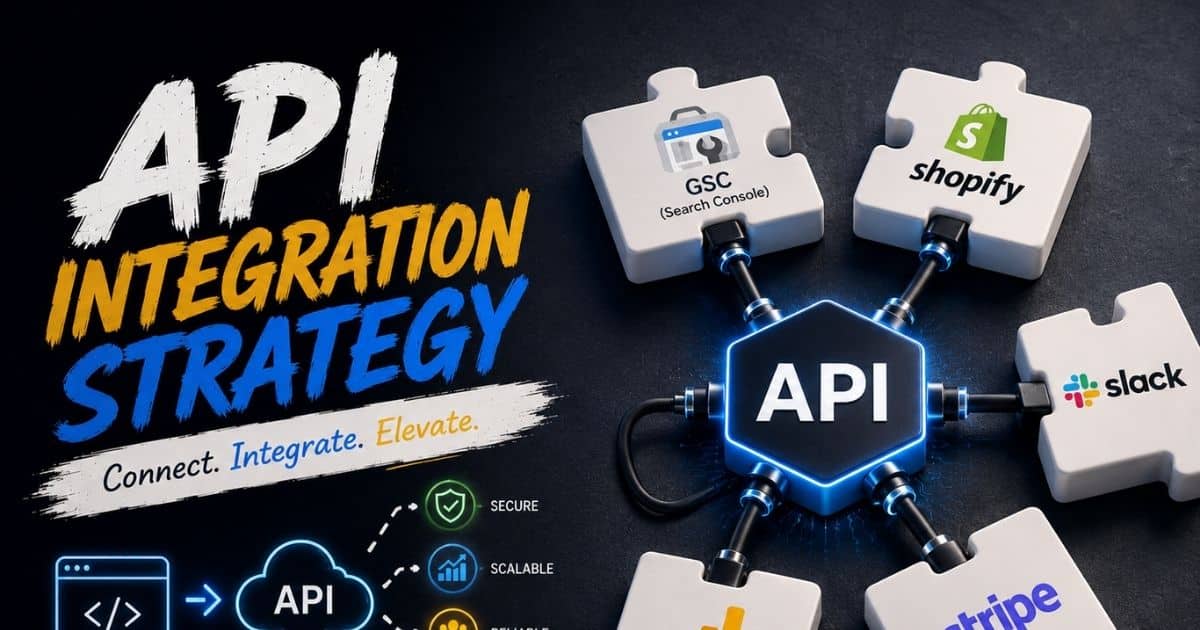
Why Every SaaS Business Needs An API Integration Strategy
by Rhea Collins | May 28, 2026 | Technology & Innovation
Table of Contents
- What Is An API Integration Strategy
- Why Every SaaS Business Needs An API Integration Strategy
- Components Of A Modern SaaS API Integration Strategy
- Aligning API Integrations With SaaS Product And Go To Market
- Implementing And Scaling API Integrations Across The SaaS Lifecycle
- Best Practices For Secure And Reliable API Based Integrations
- How GainHQ Supports Your SaaS API Integration Strategy
- Frequently Asked Questions
In 2026, successful SaaS companies win by fitting seamlessly into their customers’ existing ecosystems through robust api integrations rather than relying on standalone features. Consider how Stripe invoices now sync automatically to HubSpot for enriched customer profiles, or how product usage data flows into Snowflake for advanced analytics. Event streams push into customer data platforms like Segment to power personalized experiences in real time.
Buyers expect prebuilt connectors, secure bidirectional data flows, and reliable integration logic as baseline requirements in every RFP. AI agents, low code tools, and integration platforms amplify how quickly application programming interfaces are consumed. API integration enables real-time data exchange, which enhances operational efficiency and decision-making across business processes. This creates massive opportunities but also heightened risks from brittle custom builds.
This article outlines why every SaaS business needs a deliberate strategy, what that strategy includes, and how GainHQ can support its execution.
What Is An API Integration Strategy
API integration involves the process of connecting specific software systems like Salesforce for CRM, NetSuite for ERP, and Slack for notifications. These connections use apis to exchange data and trigger actions between two or more applications. For example, updating a Salesforce opportunity stage based on a NetSuite invoice payment or posting Slack alerts from Stripe subscription events demonstrates how apis work together.
An API integration strategy constitutes a written, evolving plan that describes which integrations your company will support, how different systems interoperate through standardized workflows, who owns each component, and how data is secured and maintained. This strategy covers both internal integrations for analytics and billing synchronization, as well as customer facing integrations embedded directly within your SaaS product UI.
Strategy documents should live in a central, version controlled space like GitHub or Notion. Teams must update them at least quarterly with specific dates and named owners. A successful API integration strategy focuses on lifecycle management, business alignment, and system resilience.
Why Every SaaS Business Needs An API Integration Strategy
Defining clear business objectives is crucial for identifying the specific problems that API integration will solve. The following six areas demonstrate how a strong strategy translates into signed contracts, lower churn, and sustainable growth.
Revenue Growth And Competitive Wins
In competitive evaluations during 2025 and 2026, prospects shortlist vendors primarily based on existing api integrations with their core tech stack. A 2025 HubSpot report found that 71% of B2B buyers disqualified options lacking connectors to top CRMs or data warehouses like BigQuery.
Real scenarios illustrate the stakes. A mid-market sales platform lost a $500K deal to a competitor offering a production-ready Snowflake integration despite having superior core features. Post-mortem analysis revealed integration gaps as the sole differentiator.
A proactive strategy identifies the top 10 systems your ideal customers use and sequences integration delivery accordingly. Monetizing premium integrations or higher API rate limits creates new pricing tiers and upsell paths. A public integration roadmap backed by real api integration solutions reassures buyers during procurement reviews, with some teams reporting 28% reductions in deal friction.
Customer Retention And Product Stickiness
Deeply embedding into a customer’s daily tools via api based integrations makes your SaaS hard to replace. By automating repetitive tasks through API integrations, businesses can streamline workflows and reduce manual data entry, leading to increased productivity.
Consider bi-directional syncs with HR systems like BambooHR or finance platforms such as Xero. These connections become core to business logic over time. Accounts with three or more live integrations show 47% lower churn rates compared to accounts with none, according to Gainsight 2026 benchmarks.
Integrated data flows reduce context switching and manual exports, improving user satisfaction and adoption. NPS scores climb by 22 points when teams eliminate CSV exports between tools. A solid strategy includes activation plans that guide new customers to connect key systems early during onboarding, correlating to higher feature adoption.
Operational Efficiency Across Teams
A central API integration strategy prevents support, success, and engineering teams from building one off scripts and fragile connections. API integration helps break down information silos, allowing businesses to share data and collaborate between different applications.
Examples include automating provisioning from the CRM, syncing subscription data into internal tools, and unifying product analytics. Without standardization, teams waste 30% of engineering time on custom automations according to a 2026 IBM Integration Report.
Using a shared integration platform reduces duplicate API integration work and speeds up new projects. Standardized patterns for retries, field mapping, and logging decrease troubleshooting time. Assigning clear internal owners for integration logic, tooling, and documentation prevents confusion and bottlenecks.
AI And Automation Readiness
Modern AI assistants rely on clean, well defined application programming interfaces to perform actions like updating records or triggering workflows. In 2026, voice and chatbot agents automate customer success tasks by chaining multiple apis in seconds, and AI-driven automation within SaaS platforms is becoming a core differentiator for operational efficiency and customer experience.
Request-Response is the most common pattern for real-time, low-latency tasks such as fetching user details. Event-Driven and Pub-Sub architectures decouple systems by having producers publish messages that subscribers consume independently, making them ideal for microservices and highlight the differences between AI automation and traditional automation when designing modern workflows.
Without a strategy, attempts to layer AI features on top of your product produce unreliable or incomplete results. Research shows 65% failure rates in agentic chains when APIs lack proper structure. OpenAPI definitions, clear schemas, and predictable rate limits are now table stakes for AI integrations, and a dedicated guide to integrating artificial intelligence into SaaS products can help teams plan these foundations correctly. Planning for these use cases upfront avoids expensive refactors later.
Risk Reduction And Data Security Assurance
Unmanaged point-to-point integrations increase exposure to data leaks, insecure tokens, and uncontrolled access. The 2025 Verizon DBIR documented 2,400 API-related incidents averaging $4.5M in damages.
A strategy sets global requirements for authentication, encryption in transit, and token rotation across all apis. Emphasize security by ensuring all data transfers are encrypted and access to APIs is protected via token-based authentication. References to GDPR and SOC 2 requirements drive the need for auditable integration workflows and access logs.
Standardized approaches to secrets storage, least privilege scopes, and vendor risk reviews make security assessments predictable. This consistency accelerates enterprise deals by reducing review times by 50% and aligns closely with SaaS security architecture best practices around secure APIs and third-party integrations.
Partner Ecosystem And Marketplace Growth
A documented strategy paves the way for building an integration marketplace or partner ecosystem. Launching a public directory featuring vetted api integrations with leading SaaS tools creates competitive advantage.
Partners extend use cases by building on well documented APIs, reducing in house engineering load by up to 30%. Joint integrations with strategic partners drive co-marketing campaigns and shared customer wins.
Clear contribution guidelines and testing standards keep third party integrations reliable. Public API sandboxes and certification programs ensure quality across the ecosystem and support a cloud-first future of SaaS development where extensibility and resilience are built in from day one.
Components Of A Modern SaaS API Integration Strategy
A strategy needs concrete building blocks rather than vague intentions. Effective API integration strategies involve a modular, staged approach to minimize risk and ensure scalability. The following components form the foundation of any mature approach and should be woven into your broader SaaS product development lifecycle from initial design through scale.
API Design And Versioning Standards
The strategy should standardize on patterns such as REST or GraphQL, naming conventions, pagination methods, and error structures. Consistent api design accelerates partner and customer adoption.
Providing high-quality documentation, including version control and usage limits, supports developer enablement for maintaining integrations. Semantic versioning for endpoints with clear deprecation timelines prevents breaking changes. Stripe maintains 99.99% uptime partly through disciplined versioning with 12-month deprecation notices.
Document required and optional fields, rate limits, and idempotency expectations for write operations. Provide sample requests and responses that reflect realistic SaaS scenarios. Designing for backward compatibility ensures existing customers remain unaffected during updates.
Choosing An Integration Platform And Tooling
An integration platform orchestrates data flows, handles retries, and centralizes monitoring, especially when paired with robust SaaS monitoring tools that improve performance and UX. There are five common types of API integration architectures: point-to-point, ESB (Enterprise Service Bus), iPaaS (Integration Platform as a Service), API gateways, and event-driven integrations, each serving different architectural needs.
Point-to-point integration connects each application directly to another, which is simple and fast to implement but can become brittle as connections multiply. iPaaS platforms offer better scalability for growing SaaS companies. Standardize on a small set of right tools for building, deploying, and managing api based integrations.
Support scheduled jobs, event driven triggers, and near real-time api data integration based on webhooks. GainHQ serves as a central place to coordinate these platform features across teams.
Data Modeling And Integration Logic
Map core entities like accounts, users, subscriptions, and events to external systems’ schemas early. An Anti-Corruption Layer manages data model conflicts between old and new systems by translating between old and new data structures.
Integration logic should live outside the main application codebase to keep business logic flexible. The Strangler Fig Pattern routes new workflows through a modern API layer while legacy functions continue underneath. API Wrappers expose capabilities of stable but outdated systems through modern API interfaces while preserving operational continuity, which is especially important when layering in AI software development for smarter digital products.
Document field mappings, data transformation rules, and conflict resolution approaches. Clear data contracts reduce surprises when integrations evolve.
Security, Compliance, And Access Control
Minimum security expectations include TLS for all traffic, OAuth 2.0 or token-based auth, and frequent key rotation. Role-based access control limits which services and users can access integration endpoints.
Batch sync is used for non-critical reporting to reduce system load, whereas real-time sync is utilized for time-sensitive workflows. Compliance obligations like GDPR data subject rights and regional data residency requirements shape integration design.
Maintain an inventory of third-party services used, including scopes, data categories, and retention periods. Create incident response runbooks specific to integration failures or suspected breaches, aligning with broader SaaS security best practices for 2026 around vendor risk and continuous monitoring.
Observability, Monitoring, And Documentation
Production integrations must have dashboards, alerts, and logs showing latency, error rates, and throughput. Monitoring tools can track API latency, error rates, and throughput as part of performance management, and pairing these with smarter software tools that simplify day-to-day work helps teams respond quickly without adding overhead.
Adopt correlation IDs or trace IDs to follow requests across multiple services. Human-readable runbooks alongside detailed documentation support each api integration.
Always create detailed documentation of each API integration to enable colleagues to understand and maintain the integrations effectively. Keep OpenAPI specs up to date with publication dates and change history clearly visible. Periodic drills help teams practice debugging simulated integration outages.
Aligning API Integrations With SaaS Product And Go To Market
Integration decisions should be driven by customer value rather than technical curiosity. The following sections show how to connect your integration roadmap to ideal customer profiles, pricing strategies, and onboarding journeys, and how to reflect those choices in a coherent SaaS product roadmap for 2026.
Prioritizing Integrations By Ideal Customer Profile
Map your ideal customer profiles to their typical tech stacks in 2026 across CRM, billing, and data tooling. Mid-market SaaS companies favor HubSpot at 35% adoption, while finance-heavy segments lean toward QuickBooks at 28%.
Use customer interviews, win-loss analysis, and support tickets to rank integration requests. Maintain a public or semi-public list of planned integrations with expected delivery quarters. Create a matrix linking segments to specific integrations. This alignment prevents engineering from spending cycles on rarely used connections and benefits from strategic tech consulting services that guide modern businesses on where integrations create the most value.
Embedding Integrations Into Onboarding And Adoption
The first 30 days are critical for connecting core systems and demonstrating integration value. Logistics companies use APIs to provide real-time tracking to their customers, enhancing visibility and control over their supply chains.
Guided setup flows should walk admins through connecting identity providers, CRMs, and billing tools. API integration is used in e-commerce to connect online stores with warehouse management systems, enabling omnichannel shopping and ensuring orders are placed only if there is sufficient inventory, mirroring how AI features increased engagement by 34% in a SaaS case study by guiding users through high-value workflows.
Use checklists and in-product prompts to encourage activating high impact api integrations early. Measure time to first integration and correlate it with expansion revenue. Accounts connecting systems within seven days show 40% higher expansion rates.
Packaging And Pricing Integration Capabilities
Common SaaS patterns include basic integrations in all plans while reserving advanced ones for higher tiers. Manufacturers utilize API integration to monitor inventory levels in real-time, ensuring they accept and process only orders that can be fulfilled based on available inventory.
API rate limits, access to event streams, and dedicated integration support can be priced as premium platform features. Transparency about integration features per plan avoids sales friction. Tie integration value to tangible outcomes like faster reporting or reduced manual work, saving time for business teams.
Supporting Customer Built Integrations
Many customers will want to build custom workflows using your APIs or their chosen integration platform. Creating internal wrapper APIs helps internal developers work against a consistent, controlled endpoint.
Publish quick start guides, SDKs, and sample projects mirroring real SaaS use cases. Encapsulating third-party API calls in dedicated functions or services allows for easier updates if the API changes. Provide sandbox environments, test data, and clear rate limit policies.
Offer architectural office hours for strategic customers building complex integrations. This support should be part of the overall integration approach rather than an afterthought, much like investing in custom software that transforms companies by aligning technology with specific workflows.
Collaborating With Sales, Success, And Partnerships
Integration decisions should include input from sales engineers, customer success, and partner managers. Establish a regular integration council that reviews pipeline and customer feedback.
Backend-for-Frontend (BFF) creates a custom API tailored for specific client types, optimizing performance for each, echoing lessons from software build vs buy decisions where custom software won. Enable go-to-market teams with up-to-date integration one-sheets, diagrams, and security summaries. Track shared metrics like integration-influenced revenue or deal cycle time.
GainHQ acts as the shared workspace where business teams track integration plans and outcomes together.
Implementing And Scaling API Integrations Across The SaaS Lifecycle
Implementation represents an ongoing lifecycle rather than a one-time project. Teams must adapt processes for net new integrations and major upgrades alike, similar to the disciplined approach shown in successful SaaS launch case studies.
Discovery And Requirements Gathering
Collect requirements from internal stakeholders, key customers, and partner API documentation. Integrating APIs into existing systems requires a strategic approach that balances modernization with stability.
Map desired workflows step by step, including triggers, data fields, and expected latency. Assess third-party API limits, authentication models, and historical reliability. Produce a concise integration brief with success criteria, risks, and affected teams. GainHQ can host and standardize these briefs across the organization.
Planning Architecture And Integration Logic
Select patterns like event-driven, scheduled syncs, or real time api call flows based on use case requirements. The Hub-and-Spoke model, or ESB, uses a central integration hub to route and transform data between endpoints.
API gateways manage incoming API calls, enforce policies, manage traffic, and monitor performance, making them essential for any public API strategy. Document sequence diagrams showing each system involved. Decide which parts live in your application, which in an integration platform, and which at the customer side.
Plan for scalability in your API integrations to accommodate unexpected increases in demand. Consider graceful degradation when external APIs become unavailable.
Building, Testing, And Hardening Integrations
Development practices include feature flags, stubbed APIs, and vendor sandbox environments. Automating tests within continuous integration/continuous deployment pipelines ensures that new changes do not break integrations.
Run automated testing for schema validation, authentication flows, and error handling scenarios. Load tests should mimic realistic data volumes and concurrency levels for the 2026 scale. Involve early design partners to exercise integrations with real workflows before general release. Log testing outcomes and link fixes to integration documentation.
Rolling Out Integrations To Customers Safely
Use phased rollout strategies, including internal use, beta customers, and then broader availability. Feature flags or allow lists control access during early stages.
Designing for failure involves implementing automatic retries, timeouts, and fallback mechanisms to maintain a good user experience during outages. Provide clear in-app messaging, release notes, and knowledge base updates when integrations go live. Capture structured feedback within the first 60 to 90 days. Ensure incident response and support playbooks are ready before launch.
Maintaining, Updating, And Retiring Integrations
Continuously monitor vendor API changes, deprecations, and new capabilities on a regular schedule. Performance monitoring can track metrics like latency and error rates to detect issues before they impact users.
Plan upgrades with backward compatibility and generous migration windows. Document procedures for sunsetting low usage integrations with communication timelines and alternatives. Track integration health metrics, including uptime, error ratios, and support tickets per month.
Best Practices For Secure And Reliable API Based Integrations
Field-tested best practices help every SaaS team pass enterprise security assessments and maintain reliable integrations.
Standardizing Authentication And Authorization
Recommend OAuth 2.0 or similar protocols for customer-facing integrations. Avoid long-lived static API keys that create security vulnerabilities.
Use scopes and roles to implement least privilege access for both users and services. Utilizing middleware or integration layers can create a layer of abstraction to reduce technical debt in legacy applications. Store secrets in vaults and enforce rotation policies with clear time frames.
Build revocation flows so customers can immediately cut off compromised integrations. Consistent patterns simplify audits and reduce integration-specific security exceptions.
Designing Resilient Error Handling And Retries
Implement retries with exponential backoff for transient network or rate limit errors. Use dead letter queues for messages that repeatedly fail.
Designing for failure involves implementing automatic retries, timeouts, and fallback mechanisms to maintain a good customer experience during outages. Expose clear error codes so integrators can respond quickly. Log enough context to reconstruct failures without capturing unnecessary sensitive data. Set alert thresholds for error spikes indicating upstream or downstream issues.
Optimizing Performance And Cost Of Integrations
Batch api call requests are supported, and efficient filtering is used to avoid unnecessary data transfers. Cache stable reference data to reduce repeated calls to external APIs.
Performance monitoring can track metrics like latency and error rates to detect issues before they impact users. Monitor integration-related infrastructure costs, including workers, queues, and data egress. Profile high-volume flows and refactor to reduce latency and resource usage. Performance improvements materially change customer perception of integration quality.
Protecting Data Privacy And Governance
Implement data minimization by only syncing fields required for specific workflows. Honor deletion requests and retention policies across all integrated systems.
Plan for scalability in your API integrations to ensure your business can grow without disruption. Tag and classify data flowing through integrations to support audits and access reviews. Reference regulatory requirements like GDPR and CCPA that affect integration design. Strong data governance reduces risk when adding new integrations.
Maintaining Detailed Documentation And Runbooks
Create integration-specific pages covering purpose, data fields, dependencies, and known limitations. Include last updated dates, version history, and links to external API docs.
Write non-technical runbooks for support teams to diagnose and escalate integration issues. Maintain a central catalog of all api integrations with status, owner, and environment details. Strong documentation accelerates the onboarding of new engineers and partner developers, contributing to digital transformation efforts and supporting high-quality UI/UX design services for SaaS products by giving designers clear system behavior to work with.
How GainHQ Supports Your SaaS API Integration Strategy
GainHQ serves as a partner focused on helping SaaS teams design, track, and execute their API integration roadmap. The platform centralizes integration briefs, diagrams, and decisions so product, engineering, and GTM teams stay aligned throughout the process.
Capabilities include mapping business logic, documenting integration logic, and standardizing best practices across teams. GainHQ helps teams maintain a living catalog of api integrations, including owners, statuses, and risk levels. Teams can create consistent workflows that implement process automation across departments.
Consider how formalizing your strategy with GainHQ can drive revenue, retention, and data security in 2026 and beyond. The platform enables teams to improve efficiency and make informed decisions about integration priorities.
Frequently Asked Questions
How Early Should A SaaS Startup Formalize Its API Integration Strategy
Even seed and Series A SaaS startups should create a light strategy once they support more than one or two integrations. Initial focus can be on a short list of target systems, basic security standards, and a simple integration roadmap covering the next year.
How Does An API Integration Strategy Differ From A General Product Roadmap
A product roadmap covers all features, while the integration strategy specifically addresses how the product connects to external systems and enables two systems to communicate. The integration strategy goes deeper into technical patterns, data models, and operational practices than most roadmaps.
What Metrics Should We Track To Measure Integration Strategy Success
Track metrics such as percentage of customers with active integrations, integration-influenced revenue, and reduction in manual data exports. Monitor integration uptime, error rates, and average time to recover from incidents. Correlate integration adoption with churn rates and expansion revenue to demonstrate business impact to stakeholders.
How Do We Handle Customers Who Use Niche Or Custom Systems?
Businesses using different software systems, including a transportation management system, often require custom connectors and rest apis for reliable data consistency. Our business teams automate tasks through flexible integrations that provide real time visibility. Even unusual requests like explore local restaurants workflows or managing editor platforms make sense with adaptable integration support.
How Often Should We Review And Update Our API Integration Strategy?
Companies should review their API integration strategy regularly to maintain data consistency, improve performance, and support changing operational needs. Business teams often automate tasks through updated rest apis and integrations across different software systems. Regular updates also improve real time visibility, especially for platforms like transportation management system environments or managing editor workflows.