
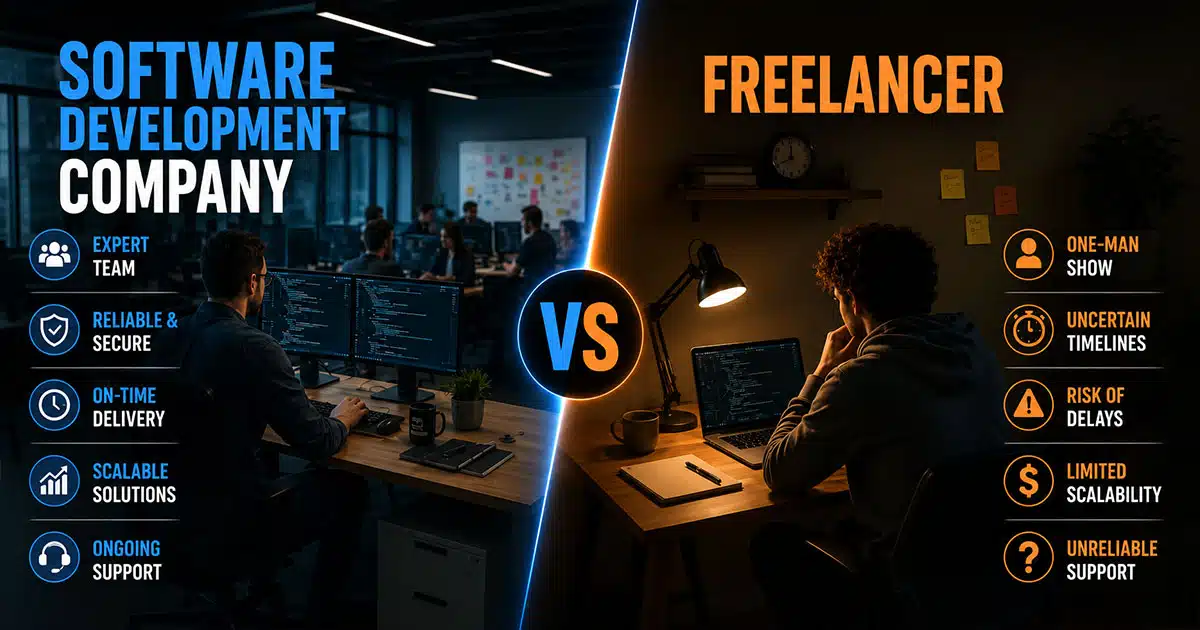
Choosing between a software development company and a freelancer affects project scalability, technical expertise, quality assurance and long term support capabilities. The right choice depends on your project complexity, budget constraints and how much structured development process control you need.
Below is a comprehensive comparison of software development company vs freelancer engagement models.
Software Development Company VS Freelancer: Key Differences
The main difference comes down to structured team approach versus individual expertise delivery.
Software development companies focus on comprehensive project management, quality assurance protocols and multi-disciplinary team coordination. Freelancers rely on individual specialized skills, direct communication and flexible engagement models.
| Factor | Software Development Company | Freelancer |
|---|---|---|
| Team Structure | Entire team with backend developer, frontend specialists, DevOps engineers, QA testers and system architects | Only person handling multiple roles or limited specialization |
| Project Management | Dedicated project managers using enterprise project management tools like Jira, Azure DevOps | Direct communication without formal hierarchy or structured processes |
| Quality Assurance | Multi-stage QA including automated testing, code reviews, security compliance testing | Basic manual testing, often limited quality control processes |
| Scalability | Ability to scale resources rapidly based on project needs | Resource limitations requiring multiple freelancers for larger projects |
| Long Term Support | Formal SLAs with ongoing maintenance agreements and extended support | Limited availability, competing priorities with several clients |
| Technical Breadth | Cross-functional expertise spanning latest technologies, cloud, DevOps, cybersecurity | Deep specialization in narrow domains, limited breadth |
| Risk Mitigation | Team redundancy prevents single point of failure during unforeseen circumstances | Project halts when individual contractors become unavailable |
| Documentation | Comprehensive architecture diagrams, code comments, institutional knowledge preservation | Often minimal documentation creating handover challenges |
| Cost Structure | Higher initial investment with predictable milestone-based payments | Lower hourly rates but potential hidden costs from rework and coordination |
| Regulatory Compliance | Established legal frameworks, insurance coverage, security compliance protocols | Variable contract enforcement, often lacks institutional safeguards |
Why Development Companies Deliver Superior Technical Outcomes
Software development companies invest significantly in continuous learning and cross-skilling programs. According to the Linux Foundation 2024 State of Tech Talent Report, 90% of organizations prioritize upskilling existing technical staff across multiple domains including cloud (55%), DevOps (51%), cybersecurity (49%) and AI/ML (43%). Technology sector companies invest approximately 2.3% of payroll into learning and development, exceeding the global industry average of 1.5%.
This institutional investment in work processes and training ensures development companies maintain technical currency across emerging frameworks and methodologies. Resources such as the GainHQ blog on software development and digital transformation further support ongoing learning. Individual freelancers must self-invest in training without continuous institutional support, creating potential knowledge gaps on complex projects requiring diverse technology stacks.
Process Maturity And Repeatable Workflows
Development companies follow repeatable workflows spanning discovery, architecture, development, QA, release and monitoring phases. This process maturity reduces technical debt and ensures maintainability from early project stages. According to industry research, approximately 50% of software budgets may be spent post-implementation fixing errors that should have been caught earlier when proper QA processes are absent.
Freelance developers often optimize for speed over maintainability, creating expedient code that becomes costly to modify or scale over time. While freelancers excel at rapid prototyping and short term tasks, complex projects requiring regulatory compliance, security compliance and enterprise integration benefit from structured company approaches and custom software development tailored to specific business needs.
Expertise And Technical Capabilities
Technical depth and breadth of knowledge represent critical factors in software development success.
| Capability | Software Development Company | Freelancer |
|---|---|---|
| Technology Stack Coverage | Full-stack teams covering frontend, backend, DevOps, security, database | Typically 2-3 specific technologies with limited breadth |
| Continuous Training | Formal skill development programs, vendor partnerships, regular upskilling | Self-directed learning without institutional support |
| Architecture Expertise | Senior architects, system designers, enterprise integration specialists | Variable architecture experience, often implementation-focused |
| Emerging Technologies | Investment in cloud, AI/ML, cybersecurity training across whole team | Selective adoption based on individual interest and time |
| Code Quality Standards | Enforced coding standards, peer reviews, automated linting | Variable quality depending on individual discipline |
| Security Practices | Dedicated security testing, compliance audits, penetration testing | Basic security awareness, often lacks specialized testing |
Software Development Company Expertise
Software development companies maintain diverse technical teams including backend developers, frontend specialists, DevOps engineers, QA testers and system architects. Each team member contributes specialized knowledge in specific technology stacks, ensuring comprehensive project coverage across all technical dimensions.
Companies invest in continuous training programs and maintain partnerships with technology vendors, keeping teams updated with latest technologies and development methodologies. The 2024 State of Tech Talent Report indicates that organizations allocate significant resources to cross-skilling employees in cloud architecture, DevOps practices and cybersecurity fundamentals, which all depend on selecting an appropriate tech stack for scalable growth in 2026. Large companies reported L&D budgets reaching USD $1,450 per employee in 2023, demonstrating substantial investment in maintaining technical currency.
Development agencies provide breadth across multiple technologies while maintaining depth through specialized roles. When a software project requires React frontend, Python backend, cloud infrastructure and automated testing, a software development agency deploys specialists in each domain rather than relying on one generalist to handle all requirements, which is why knowing how to choose a custom software development partner becomes critical for long-term success.
Freelancer Technical Specialization
Freelancers typically offer deep expertise in specific programming languages, frameworks or development niches. Their specialized skills often exceed company employees in particular domains, making them valuable for targeted technical challenges like performance optimization, UI polish or api integration tasks.
However, individual professionals may lack breadth across multiple technologies required for complex enterprise applications. Multi-technology projects often require hiring multiple freelancers, creating coordination challenges and integration risks, similar to the trade-offs explored when comparing in-house vs outsourcing software development models. When each individual contractor implements solutions differently, code consistency suffers and technical debt accumulates.
According to QA industry data, over 55% of QA teams report skilled labor shortages in automation testing, and 70% experience difficulty with tool integration. This underlines that businesses aiming to build sophisticated applications need access to entire team capabilities rather than piecing together individual freelancers who may lack complementary skills.
Project Management And Communication
Effective project coordination and communication frameworks determine software development success rates and predictable delivery timelines.
| Aspect | Software Development Company | Freelancer |
|---|---|---|
| Methodology | Agile, Scrum, DevOps with formal ceremonies | Informal or no defined methodology |
| Tracking Tools | Enterprise project management tools with real-time dashboards | Basic tracking, often email-based or simple task lists |
| Stakeholder Coordination | Account manager and product managers handling multi-party communication | Direct communication but limited stakeholder management |
| Documentation | Sprint planning documents, retrospectives, progress reports | Variable documentation quality |
| Visibility | Real-time progress tracking, sprint burndowns, milestone reporting | Periodic updates based on individual practices |
| Escalation Process | Defined escalation paths with multiple points of contact | Single point of contact with limited escalation options |
Company Project Management Structure
Software development companies implement structured project management methodologies including Agile, Scrum or DevOps practices. Dedicated project managers coordinate between technical teams, stakeholders and clients, ensuring transparent progress tracking and consistent communication flow.
Companies utilize enterprise project management tools like Jira, Azure DevOps or Monday.com, providing real-time visibility into development progress, bug tracking and sprint planning. Regular stand-up meetings, sprint reviews and retrospectives maintain consistent communication and enable early issue identification.
According to QA industry research, 87% of companies have adopted Agile or DevOps for testing cycles, demonstrating widespread process maturity in development companies. This structured approach ensures that project scope remains controlled, requirements stay aligned with business objectives, and deliverables meet quality standards consistently, while also helping reduce hidden software development costs that arise from poor processes.
The presence of dedicated project managers removes coordination burden from clients. Rather than managing multiple freelancers across different time zones and communication styles, clients interact with a single development partner who handles internal team coordination, sprint planning and resource allocation.
Freelancer Communication Approach
Freelancers offer direct communication without hierarchical barriers, enabling faster decision-making and immediate feedback implementation. This direct relationship often results in more personalized attention and flexible requirement adjustments, particularly valuable for small projects with straightforward project requirements.
However, communication effectiveness depends entirely on individual freelancer practices and may lack formal structure. For larger projects requiring multiple stakeholder coordination, product managers and account manager involvement, freelancer communication approaches often prove insufficient.
Many freelancers juggle multiple clients simultaneously, limiting their availability for extended timelines of responsiveness. When a freelancer manages several clients concurrently, response times may suffer and project attention becomes fragmented. Development companies allocate dedicated resources to ongoing projects, ensuring consistent focus without competing priorities.
Scalability And Resource Allocation
Resource flexibility and team scaling capabilities directly impact project delivery timelines and quality outcomes for businesses aiming to build sophisticated software solutions.
| Factor | Software Development Company | Freelancer |
|---|---|---|
| Team Scaling | Add or reduce team members within days based on project needs | Capacity constrained, requires hiring multiple freelancers |
| Bench Strength | Available specialists ready for rapid deployment | No bench resources, dependent on market availability |
| Workload Distribution | Balanced allocation across team preventing burnout | Single individual handling all workload |
| Specialization Access | Immediate access to QA, DevOps, security specialists | Requires separate contracts for each specialization |
| Redundancy | Team coverage during illness, vacation, turnover | Project halts during unavailability |
| Peak Capacity | Ability to handle deadline compression with additional resources | Fixed capacity cannot accommodate scope expansion |
Company Scalability Advantages
Software development companies maintain bench strength allowing rapid team scaling based on project demands. When deadlines tighten or project scope expands, companies can allocate additional developers, testers or specialists within days rather than weeks. This capability proves essential for businesses with dynamic project requirements.
Enterprise clients particularly benefit from this scalability when building complex applications requiring variable resources throughout development cycles. Initial discovery phases may need fewer developers than intensive coding sprints, while QA phases require specialized testing resources. Development companies flex resources across these phases without client involvement in hiring or contractor management, applying many of the same principles used when scaling engineering teams for sustainable growth.
The 2026 QA automation market data indicates that QA automation skills remain scarce globally, with freelance test automation engineers commanding rates around USD $72 per hour globally and USD $82 per hour in the United States. Finding multiple freelancers with complementary QA automation skills during project scaling becomes both expensive and time-consuming.
Freelancer Resource Limitations
Individual freelancers face inherent capacity constraints, limiting their ability to handle sudden scope increases or accelerated timelines. Scaling requires hiring multiple freelancers, creating management overhead and potential coordination conflicts between individual contractors with different coding standards and work processes.
Freelancers excel in maintaining consistent quality for fixed-scope projects with defined deliverables but struggle with dynamic resource requirements common in enterprise software development. When project requirements evolve mid-development, a single freelancer cannot simultaneously code new features, handle increased testing demands and manage infrastructure changes.
The challenge of coordinating many freelancers across a software project often falls on the client, consuming internal resources that could focus on business objectives rather than contractor management. This hidden management overhead represents one of the significant hidden costs when hiring freelancers for larger projects, especially as technical debt accumulates without a structured approach to managing technical debt in software teams.
Long Term Support And Maintenance
Post-deployment support and ongoing maintenance requirements vary significantly between engagement models, affecting cost effectiveness and system reliability over time.
| Support Aspect | Software Development Company | Freelancer |
|---|---|---|
| SLA Commitments | Formal agreements with response time and resolution targets | Informal arrangements without contractual guarantees |
| Dedicated Support Teams | Teams familiar with deployed applications | Single individual who may become unavailable |
| Knowledge Retention | Institutional knowledge preserved in documentation | Knowledge leaves when freelancer relationship ends |
| Bug Fix Response | Defined response times within SLA parameters | Variable based on freelancer availability and other clients |
| Security Updates | Proactive monitoring and patching | Reactive approach dependent on freelancer awareness |
| Performance Optimization | Ongoing monitoring and improvement initiatives | Usually requires new engagement for optimization work |
Company Maintenance Frameworks
Software development companies provide ongoing support through structured maintenance agreements including bug fixes, security updates, performance optimization and feature enhancements. These services typically include SLA commitments with defined response times and resolution targets, ensuring predictable support quality.
Development companies maintain dedicated support teams familiar with deployed applications, ensuring continuity when original software developers transition to new projects. This institutional knowledge prevents single-point-of-failure risks common with individual contractors. When a specific developer leaves the company, documentation and code understanding remain preserved within the organization, which is essential when planning software modernization for legacy systems.
According to industry data on SLAs in software development, formal service level agreements define expectations, performance metrics including response and resolution times, uptime guarantees and error rate thresholds. Companies offering such frameworks provide ongoing maintenance that protects client investments and ensures long term success of deployed applications.
Freelancer Support Constraints
Freelancers may offer limited post-deployment support due to capacity constraints and competing client priorities. Long term support relationships depend entirely on individual availability and may lack formal SLA structures that guarantee response times.
Knowledge transfer becomes critical when freelancers become unavailable, as replacement contractors require significant time to understand existing codebase and architecture decisions. Documentation quality from freelance development varies substantially, with some freelancers providing minimal code comments and no architecture diagrams. This creates expensive knowledge gaps when transitioning to new support resources.
Many businesses discover that extended support from the original freelancer becomes impossible as that individual takes on new ongoing projects with other clients. Unlike a software development agency maintaining relationships with multiple clients simultaneously through team structures, individual freelancers cannot guarantee long term support availability.
Project Complexity Considerations
Project complexity often determines which engagement model provides optimal results and risk mitigation for businesses aiming to build robust software solutions.
Complex projects requiring microservices architecture, cloud integration and regulatory compliance typically benefit from software development company expertise and structured approaches. Enterprise B2B applications, financial systems and healthcare software demand security compliance, integration with multiple systems and high availability requirements that development companies are better equipped to deliver.
Simple applications, prototype development or specific projects with narrow scope may suit freelancer engagement, particularly when limited budgets constrain company engagement options. Freelancers provide cost efficiency for defined tasks without ongoing maintenance requirements.
Integration requirements with existing enterprise systems favor companies with established DevOps practices and enterprise architecture experience. When a software project must connect with CRM systems, payment gateways, legacy databases and third-party APIs simultaneously, the breadth of a development agency team provides necessary expertise coverage and can be strengthened further through strategic tech consulting services for modern businesses.
Regulatory compliance requirements for sensitive data handling, HIPAA compliance or GDPR adherence require security teams and compliance specialists that development companies maintain. Such freelancers with compliance expertise exist but finding them on unreliable freelance platforms proves challenging, and they may lack supporting infrastructure for comprehensive compliance audits, similar to the trade-offs organizations face in a broader build vs buy software decision guide.
Software Development Company VS Freelancer: Which Should You Choose?
Making an informed decision between engagement models requires honest assessment of project requirements, internal capabilities and long term objectives.
Choose A Software Development Company For Complex Enterprise Applications
When your software project involves multiple integrated systems, requires security compliance for sensitive data or must scale to support thousands of users, a software development company provides necessary infrastructure. The combination of dedicated project managers, specialized software developers and quality assurance processes ensures enterprise-grade delivery standards that protect your investment.
Choose A Software Development Company For Long Term Product Development
If you are building a product requiring ongoing maintenance, regular feature additions and long term support, the continuity offered by development companies outweighs initial cost savings from freelance development. Knowledge retention within the organization ensures your application remains maintainable even as individual team members transition, and creates a stronger foundation for future software modernization initiatives when legacy constraints appear, as illustrated by examples of how custom software transformed companies.
Choose Freelancers For Specialized Tasks With Limited Scope
Freelancers excel at well-defined, specialized tasks where their deep expertise directly applies. Performance optimization, specific api integration work, UI/UX design improvements for SaaS products or fixing particular bugs represent ideal freelancer engagements. When project scope remains fixed and you have internal technical leadership to provide oversight, freelancers deliver cost effectiveness.
Choose Freelancers For Early Stage Prototypes On Tight Budget
Startups with limited budgets validating concepts through MVPs may find freelancers appropriate for initial development phases. According to industry estimates, small MVP development via freelancer costs between USD $5,000 to $12,000 compared to USD $25,000 to $50,000 through agencies. For more precise planning, founders should understand the full MVP development cost breakdown in 2026. However, planning for transition to a more structured development partner remains important if the prototype succeeds and you want to align with the latest MVP development trends for startups in 2026.
Consider Hidden Costs Before Finalizing Your Decision
The hourly rate comparison between freelancers and companies misrepresents true project costs. Agency rates include project management, quality assurance, architecture planning and team coordination that freelancer rates exclude. Industry research suggests that approximately 50% of software budgets may end up spent on fixing errors that proper QA processes would have caught earlier. Freelancer savings often evaporate through rework, coordination overhead and technical debt accumulation, reinforcing the value of flexible custom software solutions built around your workflows, as shown in a real-world software build vs buy case study where custom won.
Why Choose GainHQ For Your Software Development Needs
GainHQ stands out as a reliable partner for businesses seeking a successful outsourcing business model without the risks of freelancer vs agency confusion. Unlike an independent contractor or generic platforms, GainHQ provides structured processes, expert teams, and consistent delivery for multiple projects.
Whether you are a startup or one of many large corporations, GainHQ ensures scalability, security, and quality assurance across every software development initiative through its custom software development services and SaaS solutions. The platform removes the need for additional training by offering experienced professionals ready to execute from day one.
With a strong focus on project management, communication, and long-term support, GainHQ helps businesses achieve efficiency, reduce hidden costs, and maintain control while scaling custom software development initiatives with confidence, whether they choose to hire in-house or follow an outsourcing vs in-house development model.
Frequently Asked Questions
What Are The Hidden Costs When Hiring Software Development Companies VS Freelancers?
Software development companies include project management overhead, quality assurance processes and infrastructure costs in their pricing models. However, these costs often prevent expensive rework and maintenance issues later. Industry research indicates that up to 50% of software budgets may be spent post-implementation fixing errors that proper QA would have caught. Effective SaaS monitoring tools and practices can also mitigate post-launch risks.
How Do Intellectual Property Protection Measures Differ Between Companies And Freelancers?
Software development companies typically maintain established legal frameworks including comprehensive NDAs, intellectual property assignments and data protection protocols. Development agencies often carry professional liability insurance protecting client assets and sensitive data. Individual professionals may offer basic NDAs but generally lack institutional safeguards and insurance coverage.
What Technology Stack Expertise Should I Expect From Each Option?
Software development companies maintain teams with complementary technology stack expertise including frontend frameworks, backend systems, database technologies and DevOps tools. Companies invest in continuous training across cloud, cybersecurity and AI/ML domains. Freelancers typically offer deep expertise in 2 to 3 specific technologies but may lack breadth for full-stack enterprise development. Multi-technology projects requiring many freelancers create integration challenges and inconsistent code quality.
How Do Quality Assurance Processes Compare Between Development Models?
Software development companies implement multi-stage quality assurance including code reviews, automated testing, user acceptance testing and performance validation. According to 2026 QA industry data, 87% of companies have adopted Agile or DevOps testing cycles, and 61% perform shift-left testing catching defects early. Development companies maintain dedicated QA teams using enterprise testing tools and methodologies. Freelancers often handle testing individually, potentially lacking comprehensive quality control processes and specialized testing expertise required for enterprise applications, which is especially critical in high-stakes contexts like successful SaaS product launches.
What Happens If My Primary Developer Becomes Unavailable During The Project?
Software development companies provide team redundancy ensuring project continuity during unforeseen circumstances including illness, vacation or role changes. Company knowledge management systems preserve project documentation and code understanding across team members, enabling smooth transitions. Freelancer unavailability can halt project progress entirely, as replacement individual contractors require significant time to understand existing work and architectural decisions.