B2B SaaS product development is no longer just about building software. Businesses now expect fast performance, smooth user experience, strong security, and products that can scale without breaking. A small mistake in development can lead to poor adoption, high churn, and wasted investment. That is why building a successful SaaS product takes more than good code.
Founders, startups, and growing companies all face the same challenge. They need a product that solves real problems and stays competitive in a crowded market. From product validation to architecture, pricing, integrations, and customer retention, every decision matters.
This guide breaks down the complete B2B SaaS product development process in a simple way, from early validation to building scalable SaaS tools that power global business growth. You will understand what works, what fails, and how successful SaaS companies build products that grow for years.
What Is B2B SaaS Product Development
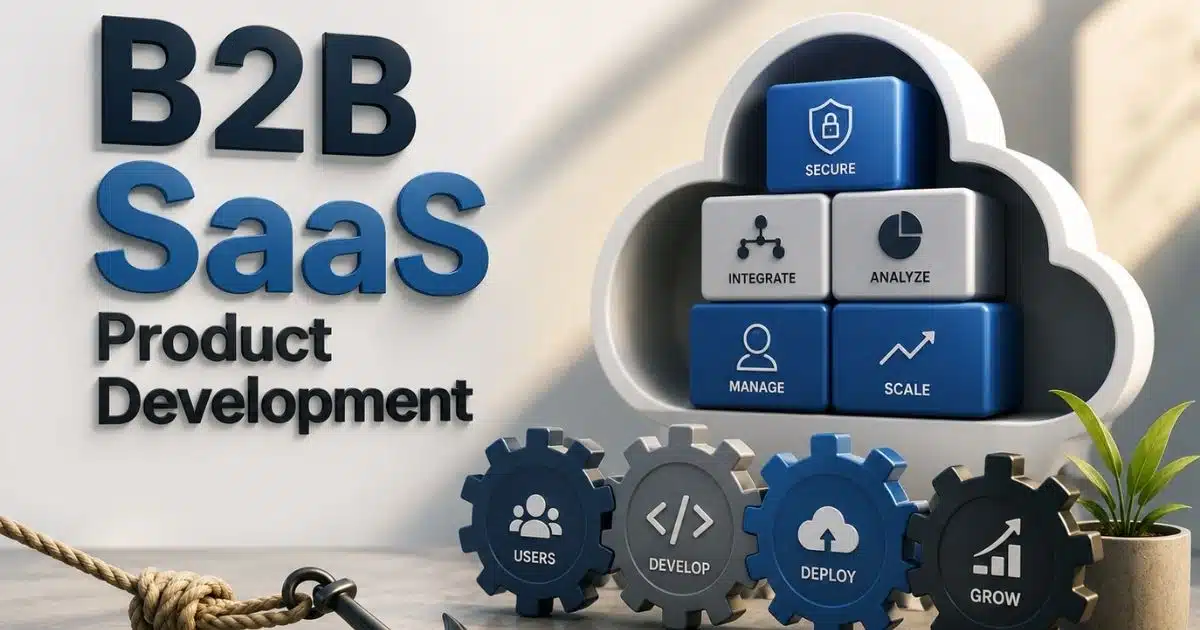
B2B SaaS product development is the process of building cloud-based software solutions for businesses. A successful B2B SaaS product solves real pain points and helps companies improve operations, customer relationship management, project management software, or enterprise resource planning. Most SaaS companies start with thorough market research to understand their target audience, customer segments, and customer needs. A strong SaaS development process also focuses on product market fit, core features, user interface, and data security.
Modern SaaS providers build scalable solutions on cloud platforms with a recurring revenue model that follow a structured SaaS product development lifecycle. Teams gather feedback, study user behavior, and improve the onboarding process over time. Customer success teams track key metrics like customer acquisition cost, customer lifetime value, net revenue retention, and customer satisfaction. Many businesses launch a minimum viable product first to attract early adopters and validate the business model before increasing development costs.
Strong B2B SaaS product development helps SaaS businesses grow paying customers, improve customer retention, and build sustainable growth in a competitive market.
Key Stages In The B2B SaaS Product Development Process
Every successful SaaS product follows a structured path. Clear planning helps SaaS companies reduce development costs, improve customer satisfaction, and achieve product-market fit faster. Each phase focuses on customer needs, scalable solutions, and long-term recurring revenue growth, which is why many teams rely on specialized SaaS development services to execute effectively.
Market Research And Validation
Strong B2B SaaS product development starts with thorough market research. Teams must understand the target market, customer behavior, and pain points before writing code. Market validation reduces risk and improves sales efficiency. Reports show that nearly 35% of startups fail because there is no real market need for the product.
Successful SaaS providers conduct market research through surveys, competitor analysis, and customer feedback. Teams also study user behavior and customer segments to identify target customers. A clear business model and pricing strategy help attract early adopters and improve customer acquisition cost from the beginning.
Minimum Viable Product Planning
A minimum viable product helps SaaS businesses launch faster with limited core features. This stage focuses on solving one major problem for potential customers instead of building a large SaaS platform too early. Early launches also help companies gather feedback from paying customers before scaling infrastructure costs.
Many SaaS companies now release MVPs within three to six months to test product market fit. Teams use customer feedback and key performance indicators to improve the product roadmap, often guided by a clear understanding of what an MVP is in software development. A focused MVP also supports sustainable growth because development costs stay under control during the early SaaS development process.
Product Design And Architecture
A strong user interface shapes customer satisfaction and customer retention. Poor design often increases churn and lowers customer lifetime value. SaaS applications must feel simple, fast, and reliable across different cloud platforms and devices, which is why many teams now embrace a user-centered design approach for SaaS platforms. Research shows users form opinions about software within seconds of first use.
Modern SaaS product development also depends on scalable software development architecture. Teams build cloud computing systems that support recurring revenue growth and larger user bases, following established best practices of SaaS architecture. Robust security measures like multi-factor authentication and data security protocols protect customer interactions and sensitive business information from threats.
Development And Product Testing
Software development teams build the SaaS product based on customer needs and product roadmap goals. Developers focus on performance, integrations, and scalable solutions that support future growth. Many SaaS providers now use agile workflows because they improve product development efforts and speed up release cycles.
Testing plays a critical role in the SaaS development process. Quality assurance teams check user behavior, software stability, and customer interactions before launch. Studies show software bugs can increase customer acquisition cost by reducing trust and create unplanned expenses that undermine even the best SaaS development cost planning for businesses. Strong testing also improves onboarding process quality and helps customer success teams support existing customers more effectively.
Launch And Growth Optimization
A successful SaaS product launch requires more than good software solutions. Sales teams and marketing efforts must work together to reach the right target audience. SaaS businesses often use tiered pricing, free trials, and pay-as-you-go models to attract potential customers in a competitive market.
Growth optimization continues after launch. Teams track key metrics like average revenue, net revenue retention, customer lifetime value, and customer retention. Customer success teams gather feedback regularly to improve the SaaS model and premium offering. Long-term success depends on adapting the product to changing customer needs and market trends.
Market Research And Product Validation Before Development
Strong market validation saves SaaS companies from costly mistakes. Early research helps businesses understand customer needs, confirm product market fit, and reduce wasted development costs. A clear validation process also improves customer acquisition, customer retention, and long-term recurring revenue potential.
Target Audience Analysis
Every SaaS business needs a clear target audience before product development starts. Different customer segments have different pain points, budgets, and expectations. SaaS providers that fail to define target customers often struggle with weak customer satisfaction and poor sales efficiency. Recent startup studies show nearly 42% of failed products missed real market demand.
Strong market research helps teams understand customer behavior and customer interactions. Businesses can study existing customers, user feedback, and industry trends to refine their SaaS model. A focused target market also helps sales teams and marketing strategy efforts attract paying customers more effectively.
Competitor Gap Research
Competitive market analysis reveals what other SaaS companies do well and where they fail. Most successful SaaS product development teams study pricing strategy, onboarding process, user interface, and customer success models before launch. This research helps businesses avoid weak product development efforts and create tailored solutions.
Modern SaaS applications compete in crowded industries like project management software and customer relationship management. Reports show over 30,000 SaaS companies now operate globally. Businesses that identify feature gaps and unmet customer needs gain stronger product-market fit and better customer lifetime value over time.
Customer Feedback Collection
Customer feedback shapes a successful SaaS product before development begins. Direct conversations with potential customers help teams understand pain points, feature expectations, and user behavior. Surveys, interviews, and beta groups also reveal what users dislike about existing software solutions in the market.
Strong feedback loops improve the SaaS development process and reduce unnecessary infrastructure costs later. Teams often gather feedback from early adopters before finalizing the product roadmap. This approach helps SaaS providers improve customer satisfaction and launch products that match real business needs instead of assumptions.
MVP Demand Testing
A minimum viable product helps SaaS businesses validate demand with limited investment. Early MVP launches focus on core features instead of full-scale software development. This strategy reduces development costs and allows teams to test customer response quickly, especially when they follow emerging MVP development trends for startups in 2026. Many SaaS companies now validate ideas within weeks instead of spending years on full builds.
Landing pages, free trials, and waitlists help attract early adopters and measure customer interest. Teams track key metrics like sign-ups, onboarding process completion, and user base growth. Strong MVP testing also improves customer acquisition cost and supports sustainable growth before scaling cloud platforms.
Pricing And Revenue Validation
Pricing strategy plays a major role in B2B SaaS product development. Poor pricing can reduce customer retention and hurt recurring revenue growth. SaaS businesses must test whether target customers prefer tiered pricing, subscription plans, or pay-as-you-go models before launch.
Modern SaaS providers often validate pricing through beta programs and customer interviews. Teams measure average revenue, customer lifetime, and net revenue retention to understand long-term profitability. Research shows SaaS companies with optimized recurring revenue models grow nearly 2x faster than businesses with weak pricing structures.
How To Build A Scalable B2B SaaS Architecture
Scalable architecture supports long term growth in every B2B SaaS product development strategy. A strong foundation improves performance, customer satisfaction, and recurring revenue stability. Modern SaaS companies also need flexible systems that handle larger user bases without raising infrastructure costs too quickly, which makes scalable software architecture for high-growth products a critical discipline, especially when planning a phased monolith to microservices migration strategy.
Cloud Infrastructure Setup
Cloud computing plays a major role in scalable SaaS product development. Most SaaS providers now rely on cloud platforms like AWS, Google Cloud, and Microsoft Azure for flexible infrastructure as the industry moves toward a cloud-first future of SaaS development. Recent reports show over 94% of enterprises use cloud services to support software solutions and digital operations.
A cloud-based SaaS platform can scale faster than traditional systems. Teams can increase storage, computing power, and database resources as customer needs grow. Flexible cloud infrastructure also reduces development costs and supports sustainable growth for SaaS businesses with expanding customer segments and paying customers.
Multi-Tenant Architecture
Multi-tenant architecture allows multiple customers to share one SaaS application while keeping data separate and secure. This SaaS model reduces infrastructure costs and improves operational efficiency. Many successful SaaS companies use this structure because it supports larger user bases without major system changes.
Strong data security remains critical in shared environments. SaaS providers often use robust security measures like multi-factor authentication and encrypted databases to protect customer interactions. Research shows businesses now rank data security among the top three priorities when selecting enterprise software solutions and SaaS applications.
Microservices And APIs
Modern SaaS product development often uses microservices architecture instead of one large system. Small independent services improve software development speed and make updates easier. Teams can improve core features without affecting the entire SaaS platform. This approach also supports better customer satisfaction and faster product development efforts, but teams must still choose carefully between microservices vs monolith architecture based on their stage and complexity, and back it up with robust SaaS monitoring tools to improve performance and UX.
APIs help SaaS businesses connect with customer relationship management systems, enterprise resource planning tools, and project management software. Strong integrations improve customer retention because users prefer connected software ecosystems. Studies show integrated SaaS solutions improve workflow efficiency by more than 30% in many industries.
Performance And Database Scaling
Database performance directly affects user behavior and customer satisfaction. Slow SaaS applications often increase churn and reduce customer lifetime value. Research shows nearly 53% of users leave platforms that take more than three seconds to load. Fast systems help SaaS companies improve customer retention and attract early adopters, which is why teams invest in systematic SaaS performance optimization best practices supported by resilient AI infrastructure for intelligent applications.
Scalable database strategies include load balancing, caching, and distributed storage systems. SaaS providers also monitor key metrics like server response time and average revenue per user to maintain performance. Strong scaling plans help businesses support recurring revenue growth without damaging the onboarding process or user experience.
Security And Compliance Standards
Security failures can destroy trust in a SaaS business. Strong data security practices protect customer feedback, financial records, and sensitive business information. SaaS companies now face stricter compliance rules because cyberattacks continue to rise globally. Reports show cybercrime damages may exceed $10 trillion annually by 2026, making robust SaaS security architecture best practices and a clear AI governance framework for SaaS platforms essential from the earliest stages of development.
Modern SaaS development processes include regular testing, access controls, and multi-factor authentication. Customer success teams also help clients understand security features during onboarding. Strong compliance standards improve customer acquisition because many target customers now prioritize secure SaaS platforms before signing long-term contracts.
Essential Features Every B2B SaaS Product Should Include
Strong features shape the success of every B2B SaaS product. Businesses now expect better security, faster workflows, and smooth customer interactions from SaaS applications. The right feature set also improves customer satisfaction, customer retention, and long-term recurring revenue growth in a competitive market, especially when guided by a clear SaaS product roadmap and a disciplined post-MVP development growth strategy that aligns features with business outcomes.
User-Friendly Dashboard
A clean user interface improves customer satisfaction and product adoption. Most target customers prefer SaaS solutions that feel simple and easy to navigate. Research shows nearly 88% of users avoid software platforms after poor user experiences. Clear layouts also help customer success teams reduce onboarding issues and support requests, which is why many teams invest in specialized UI/UX design services for SaaS products and prioritize accessible UX design that works for everyone.
Modern SaaS product development focuses heavily on usability. Dashboards should help users access reports, workflows, and customer relationship management tools without confusion. Fast navigation improves customer interactions and user behavior. A strong interface also increases customer lifetime value because satisfied users stay longer and recommend the SaaS platform to others, which is easier to achieve with a well-structured SaaS design system for scalable products.
Role-Based Access Control
Role-based permissions protect sensitive business data inside SaaS applications. Different teams need different access levels for customer information, financial records, and enterprise resource planning tools. Secure access systems also improve data security and reduce operational risks for SaaS businesses.
Most SaaS providers now include robust security measures like multi-factor authentication and audit logs. Reports show over 60% of data breaches happen because of weak access management. Strong permission controls help software solutions meet compliance standards and build trust with existing customers and potential customers, especially when they are part of broader SaaS security best practices rolled out across the organization.
Third Party Integrations
Modern businesses use multiple software solutions every day. SaaS products must connect with tools like project management software, CRM systems, payment gateways, and cloud platforms. Strong integrations improve workflow automation and reduce manual tasks for sales teams and customer success teams.
APIs now play a major role in scalable SaaS product development. Businesses prefer SaaS platforms that fit into their current business model without major disruptions. Studies show integrated SaaS solutions improve team productivity by nearly 30%. Better integrations also support customer retention and long-term recurring revenue growth.
Analytics And Reporting
Analytics tools help SaaS companies understand customer behavior and business performance. Real-time reports allow teams to track key metrics like customer acquisition cost, average revenue, customer lifetime value, and net revenue retention. Accurate data also improves marketing efforts and pricing strategy decisions.
A successful SaaS product should provide customizable dashboards and clear reporting features. Businesses use analytics to identify pain points, improve customer satisfaction, and optimize customer success strategies. Better reporting also helps product development efforts align with customer needs and sustainable growth goals.
Flexible Pricing And Billing
Pricing flexibility helps SaaS businesses attract different customer segments. Many target customers now prefer tiered pricing, pay-as-you-go plans, or premium offering options based on usage. A rigid recurring revenue model can limit customer acquisition and reduce sales efficiency.
Modern SaaS providers use automated billing systems that support subscriptions, renewals, and upgrades. Flexible pricing strategies also help attract early adopters during product launches. Research shows SaaS companies with optimized pricing models often improve recurring revenue growth by more than 20% compared to businesses with fixed plans.
Common Challenges In B2B SaaS Product Development
B2B SaaS product development comes with technical, financial, and operational challenges. Many SaaS companies struggle with scaling, customer retention, and product market fit during growth stages. Early planning and strong execution help businesses reduce risks and improve long-term recurring revenue stability.
Poor Product Market Fit
Product market fit remains one of the biggest reasons SaaS businesses fail. Many teams build software solutions without understanding customer needs or target market demand. Recent startup reports show nearly 35% of failed SaaS products collapsed because buyers did not see enough value in the offering.
Strong market research and customer feedback reduce this risk. SaaS providers must study customer behavior, pain points, and user feedback before expanding product development efforts. A minimum viable product also helps businesses attract early adopters and validate core features before increasing development costs or scaling the SaaS platform.
High Customer Acquisition Costs
Customer acquisition cost continues to rise across the SaaS industry. Competitive marketing efforts and crowded cloud computing markets make customer growth more expensive. Research shows B2B SaaS customer acquisition costs increased by more than 60% over the last five years in many software categories.
An efficient marketing strategy and customer success planning help improve sales efficiency. SaaS companies that focus on customer retention and customer satisfaction usually improve customer lifetime value over time. Strong onboarding process flows and personalized customer interactions also help convert potential customers into long-term paying customers.
Scalability And Performance Issues
Rapid growth can create serious infrastructure problems for SaaS applications. Slow systems, server downtime, and unstable cloud platforms often damage customer satisfaction. Reports show nearly 90% of users leave software products after repeated performance issues or poor user experiences.
Scalable solutions require strong software development architecture from the beginning. SaaS providers must optimize databases, APIs, and cloud infrastructure to support larger user bases. Performance monitoring also helps teams track key metrics like response time, system uptime, and net revenue retention during growth stages, forming the core of effective SaaS scalability strategies for sustainable growth, especially as teams embed AI software development to build smarter products.
Data Security And Compliance Risks
Data security challenges continue to grow in the SaaS model. Businesses now handle sensitive customer relationship management records, financial data, and enterprise resource planning information across cloud platforms. Cybersecurity studies estimate global cybercrime losses could surpass $10 trillion annually within the next few years.
Robust security measures protect customer interactions and business operations. Many SaaS companies now use multi-factor authentication, encrypted storage, and role-based permissions to reduce risks. Compliance standards also affect customer acquisition because target customers often avoid SaaS providers with weak security practices.
Customer Retention Problems
Customer retention remains a major challenge for many SaaS businesses. Users quickly leave SaaS solutions that fail to solve pain points or provide consistent value. Studies show even a 5% increase in customer retention can improve profits by up to 95% in subscription-based businesses.
Customer success teams play a major role in reducing churn. Regular customer feedback, better support, and product roadmap improvements help strengthen customer satisfaction. SaaS companies that improve user behavior analysis and onboarding process quality often achieve higher recurring revenue and stronger customer lifetime metrics, especially when they prioritize UX to reduce SaaS churn and improve retention.
Best Practices To Improve User Adoption And Customer Retention
User adoption and customer retention directly affect recurring revenue and customer lifetime value in every SaaS business. A strong retention strategy helps SaaS companies reduce churn, improve customer satisfaction, and build sustainable growth in an increasingly competitive market.
Simple Onboarding Experience
A smooth onboarding process helps target customers understand the SaaS product faster. Users often leave SaaS applications within the first few days if workflows feel confusing. Research shows nearly 63% of customers consider onboarding quality before renewing software subscriptions.
Clear product walkthroughs and guided tutorials improve customer interactions and early user behavior. SaaS providers should focus on core features instead of overwhelming new users with advanced options. Customer success teams also play an important role by helping paying customers solve problems quickly during the first stages of adoption.
Fast And Reliable Performance
Performance problems damage customer satisfaction and customer retention. Slow dashboards, system crashes, and delayed responses often frustrate users. Studies show nearly 88% of customers stop using software solutions after repeated poor experiences. Reliable cloud platforms and scalable solutions help SaaS businesses avoid these issues.
Strong software development practices improve platform stability and response times. SaaS companies should monitor key metrics like uptime, loading speed, and system errors regularly using dedicated SaaS monitoring tools that enhance performance and UX. Better performance also improves customer lifetime because satisfied users stay active longer and recommend the SaaS platform to others.
Personalized Customer Support
Personalized support creates stronger relationships between SaaS providers and customers. Businesses expect fast responses, especially when using customer relationship management or enterprise resource planning systems. Poor support often increases churn and weakens customer trust in the SaaS model.
Customer success teams should use customer feedback and user behavior data to offer tailored solutions. Quick issue resolution improves customer satisfaction and net revenue retention. Many SaaS companies now combine live chat, help centers, and onboarding support to improve customer acquisition and long-term customer retention.
Regular Product Improvements
A successful SaaS product must evolve with customer needs and market trends. Users expect modern SaaS applications to improve continuously. Reports show SaaS companies that release regular feature updates often achieve higher customer retention and stronger average revenue growth, as shown in many successful SaaS launch case studies and in AI-focused examples where AI features increased engagement by 34% through smarter personalization and workflows.
Product roadmap planning should rely on customer feedback, market research, and user feedback analysis. SaaS businesses that gather feedback consistently can identify pain points faster and improve product-market fit. Regular updates also help sales teams position the SaaS platform more effectively in a competitive market.
Data-Driven Retention Strategy
Retention strategies work better when backed by real customer data. SaaS providers must track customer acquisition cost, customer lifetime value, user base activity, and net revenue retention to understand customer behavior. Accurate analytics help businesses identify customers at risk of churn before they leave.
Modern SaaS product development relies heavily on analytics and cloud computing tools. Businesses use key performance indicators to improve pricing strategy, onboarding process quality, and customer success efforts. Strong data analysis also helps SaaS companies create sustainable growth and increase recurring revenue over time, and many teams now combine this with AI in SaaS to unlock new benefits and manage challenges using a structured LLM integration strategy for SaaS platforms.
Future Trends Shaping B2B SaaS Product Development
The B2B SaaS industry continues to evolve faster every year. New technologies, customer expectations, and market demands are changing how SaaS companies build and scale software solutions. Businesses that adapt early often improve customer retention, recurring revenue, and long-term competitive advantage.
AI-Powered SaaS Platforms
Artificial intelligence now plays a major role in SaaS product development. Many SaaS companies use AI to improve customer interactions, automate workflows, and analyze customer behavior. Recent industry reports show over 80% of SaaS businesses already invest in AI-driven automation in SaaS to improve operational efficiency.
AI tools also help customer success teams deliver tailored solutions faster. Predictive analytics improve customer acquisition, customer retention, and pricing strategy decisions. Modern SaaS applications now use AI for chatbots, data analysis, and workflow automation. This shift helps businesses improve customer satisfaction while reducing manual tasks and infrastructure costs, especially when they follow a structured approach to integrating AI into SaaS products.
Low Code And No Code Tools
Low-code platforms continue to reshape software development across the SaaS industry. Businesses now want faster product launches without long development cycles. Research shows the global low-code market could surpass $65 billion within the next few years due to growing enterprise demand.
Low-code tools help SaaS providers reduce development costs and speed up product development efforts. Teams can build dashboards, onboarding process flows, and customer relationship management systems with fewer technical resources. Faster releases also help SaaS businesses attract early adopters and respond quickly to changing customer needs, but leaders still need to choose wisely in the broader no-code vs custom development debate, often informed by real-world software build vs buy case studies.
Vertical SaaS Growth
Vertical SaaS focuses on specific industries instead of broad target markets. Many SaaS businesses now create tailored solutions for healthcare, finance, logistics, and retail sectors, often relying on custom software that transforms companies across industries. Industry-focused SaaS platforms often achieve stronger product-market fit because they solve highly specific pain points.
Reports show vertical SaaS companies often achieve higher customer lifetime value and net revenue retention than general SaaS providers. Specialized software solutions also improve customer satisfaction because target customers receive features designed for their workflows. This trend continues to grow as businesses seek more personalized SaaS applications.
Stronger Security Standards
Data security remains one of the biggest priorities in modern SaaS product development. Businesses now expect robust security measures across cloud platforms, customer interactions, and payment systems. Cybersecurity reports estimate global ransomware attacks continue to increase sharply each year across enterprise software environments.
SaaS providers now invest heavily in multi-factor authentication, encryption, and compliance systems. Strong security practices improve customer trust and support customer acquisition efforts. Existing customers also prefer SaaS platforms that protect sensitive business information without affecting user experience or software performance.
Usage-Based Pricing Models
Traditional subscription pricing no longer fits every SaaS business model. Many SaaS companies now offer pay-as-you-go or usage-based pricing structures. Customers prefer flexible payment options because they align software costs with actual business usage and growth stages.
Usage-based pricing also improves recurring revenue opportunities for SaaS providers. Businesses can attract smaller customer segments without forcing expensive long-term contracts. Research shows flexible pricing strategy models often improve customer retention and average revenue growth compared to rigid subscription-only SaaS models.
How GainHQ Helps Businesses Overcome B2B SaaS Product Development Challenges
GainHQ helps businesses build scalable and high-performance SaaS solutions for modern markets. The company focuses on product strategy, cloud-based architecture, UI/UX design, MVP development, and custom software development services. This approach helps SaaS businesses reduce development costs, improve product market fit, and launch faster.
Strong technical planning allows businesses to build scalable SaaS platforms without performance issues or unstable infrastructure. GainHQ also supports API integrations, enterprise software solutions, and secure cloud computing environments that improve customer satisfaction and customer retention, backed by strategic tech consulting services that help modern businesses grow.
The team focuses heavily on customer needs, user behavior, and long-term business growth. From onboarding process optimization to robust security measures and scalable solutions, GainHQ helps SaaS companies create products that support recurring revenue, better customer lifetime value, and sustainable growth in a competitive SaaS industry.
FAQs
What Makes B2B SaaS Product Development Different From Traditional Software Development?
B2B SaaS product development focuses on cloud computing, recurring revenue models, and scalable solutions instead of one-time software sales. SaaS applications also require continuous updates, customer feedback analysis, and long-term customer retention strategies to stay competitive.
Can A Small Business Build A Successful B2B SaaS Product?
Yes, small businesses can build a successful SaaS product with the right market research and product roadmap. Many SaaS companies start with a minimum viable product to validate customer needs before increasing development costs or expanding core features, similar to how a startup launched an MVP in 90 days with GainHQ.
Does Customer Retention Matter More Than Customer Acquisition In SaaS?
Yes, customer retention often has a bigger impact on recurring revenue and customer lifetime value than constant customer acquisition. Recent SaaS benchmarks show high-performing SaaS businesses maintain strong net revenue retention and focus heavily on customer satisfaction.
How Long Does The SaaS Development Process Usually Take?
The SaaS development process depends on the business model, software complexity, and target market. A basic SaaS platform with core features may take a few months, while enterprise software solutions with advanced integrations and robust security measures can require much longer timelines.
Will AI Change The Future Of B2B SaaS Product Development?
No, AI will not replace the SaaS industry, but it will reshape how SaaS providers build and improve software solutions. AI-powered automation, customer behavior analysis, and usage-based pricing models are already changing customer interactions and product development efforts.