If you run a SaaS business, you have probably heard both terms thrown around in meetings, pitch decks, and product roadmaps. Generative AI and predictive AI sound similar, but they solve very different problems. One creates new things. The other forecasts what might happen next. Understanding which technology fits your goals can save you months of wasted effort and thousands in misallocated budget.
This comparison breaks down the key differences, practical applications, and real challenges you will face when implementing either approach. Whether you want to automate content creation or forecast customer churn, the right choice depends on your data, your team, and your business objectives.
Generative AI Vs Predictive AI: Key Differences
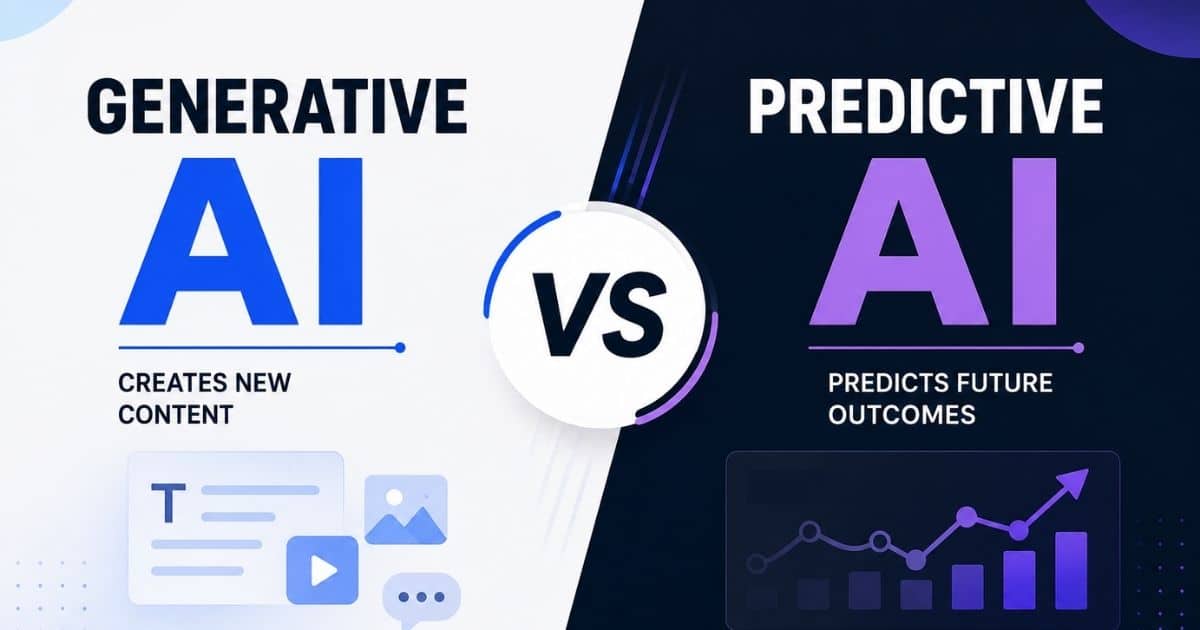
The fundamental distinction between these two AI approaches comes down to creation versus prediction. Generative AI creates novel content by using deep learning to identify complex patterns in large datasets. Predictive AI analyzes historical data to forecast future outcomes. Both rely on machine learning, but they use it for completely different purposes.
Generative AI tools learn from massive amounts of training data to produce something new. This could be text, images, code, or even synthetic data. Predictive AI models learn from past data to estimate probabilities, trends, or classifications. The output is not creative. It is analytical.
Aspect | Generative AI | Predictive AI |
|---|---|---|
Primary Purpose | Content creation and synthesis | Forecasting and trend analysis |
Core Function | Produces new text, images, code, audio | Generates predictions and probabilities |
Learning Approach | Unsupervised or self-supervised learning | Supervised learning with labeled outcomes |
Key Capability | Multimodal content generation | Accurate forecasting and classification |
Output Type | Creative and variable | Numerical and measurable |
Data Requirements And Input
Data needs vary significantly between these AI approaches. The type, volume, and quality of your existing data will determine which technology you can implement effectively.
Data Factor | Generative AI | Predictive AI |
|---|---|---|
Dataset Size | Millions to billions of examples | Thousands to millions of records |
Data Type | Unstructured (text, images, audio, video) | Structured with clear labels |
Quality Priority | Volume and variety over perfection | High quality data essential |
Update Frequency | Continuous for relevance | Regular for accuracy maintenance |
Generative AI Data Needs
Generative AI requires large datasets with millions of examples for pattern recognition. The models learn to understand style, structure, and context by processing diverse unstructured data like text, images, audio, and video. Volume matters more than perfection here. A generative model can tolerate some noise in the training data as long as the variety is sufficient.
Ongoing data collection improves model performance and keeps outputs relevant. Without fresh input data, generative models can produce content that feels dated or misaligned with current trends.
Predictive AI Data Needs
Predictive AI takes a different approach. These models work effectively with smaller, targeted datasets containing high quality historical information. The emphasis is on structured data with clear patterns and measurable outcomes. Missing values, inaccuracies, or biased samples can severely degrade forecasting performance.
Many businesses need six months to two years of clean historical data to build reliable predictive models. Regular updates maintain forecasting accuracy as customer behavior and market trends shift over time.
Algorithm Architecture And Processing
The underlying technology differs substantially between these AI types. Understanding the architecture helps you anticipate infrastructure costs and explainability challenges and plan the AI infrastructure for intelligent applications that your SaaS will need.
Technical Aspect | Generative AI | Predictive AI |
|---|---|---|
Core Architecture | Advanced neural networks and transformers | Statistical algorithms and decision trees |
Computational Load | Heavy (GPUs/TPUs required) | Moderate (standard servers sufficient) |
Explainability | Low (black box behavior) | High (traceable logic) |
Processing Style | Sampling and generation | Direct computation |
Generative AI Architecture
Generative AI relies on deep learning models using neural networks and transformer architectures. Large language models, diffusion models, and generative adversarial networks power most modern applications. These systems process data across multiple modalities simultaneously, learning to generate realistic images, natural language text, and software code.
The complexity comes with a cost. Processing requires substantial computational resources, and the decision-making process is less explainable. When a generative model produces unexpected output, tracing why it made certain choices can be difficult, which is why many teams validate ideas with smaller AI MVPs for startups before committing to full-scale generative systems.
Predictive AI Architecture
Predictive AI uses statistical algorithms and machine learning models like regression, decision trees, and time-series forecasting. The mathematical foundations are more straightforward, making it easier to understand how the model reached a particular prediction.
This greater explainability matters for business decisions. You can identify which features influenced a forecast and calculate confidence intervals. Stakeholders can trust predictions when they understand the underlying logic.
Output Capabilities And Scale
The type and scope of results differ dramatically between these technologies. Your business objectives should determine which output capabilities matter most.
Output Characteristic | Generative AI | Predictive AI |
|---|---|---|
Result Type | New content and variations | Forecasts and probability scores |
Scalability | Content creation at volume | Analysis across large data sets |
Consistency | Variable quality | Consistent and measurable |
Review Requirements | Human oversight essential | Automated validation possible |
Generative AI Outputs
Generative AI creates novel content including text, images, code, and multimedia. It can produce unlimited variations and creative combinations, scaling content creation without proportional resource increases. A marketing team can generate dozens of ad variations in minutes instead of days.
Quality varies, though. Generative AI can create content such as videos, images, audio, and text based on user prompts, but outputs require human review for accuracy and brand safety. Hallucinations and inconsistencies happen, especially with factual content.
Predictive AI Outputs
Predictive AI generates forecasts, probabilities, and actionable insights. The outputs are specific numerical predictions with confidence intervals. You can measure accuracy using established metrics and validate performance against actual outcomes, especially when you use dedicated predictive analytics software.
These models scale analysis across large datasets efficiently and deliver consistent, measurable results for decision-making. Sales forecasting, churn prediction, and demand planning all benefit from this reliability.
Implementation And Maintenance
Deployment requirements and ongoing management vary between these AI approaches. Both demand specific expertise and continuous attention.
Implementation Factor | Generative AI | Predictive AI |
|---|---|---|
Key Skills Needed | Prompt engineering, content governance | Data science, statistical validation |
Primary Concerns | Bias, hallucination, brand safety | Model drift, prediction accuracy |
Integration Focus | Content workflows and approval systems | Decision processes and dashboards |
Maintenance Cycle | Continuous fine-tuning | Periodic retraining |
Generative AI Implementation
Implementing generative AI requires prompt engineering skills and content quality management. Teams need to monitor for bias, accuracy, and ethical concerns continuously. Integration challenges arise with existing content workflows and brand guidelines.
Generative AI can support decision-making processes by summarizing meetings, generating code, and creating visual artifacts. But realizing this business value requires regular model updates to improve output quality and relevance.
Predictive AI Implementation
Predictive AI needs data science expertise for model selection and validation. By analyzing historical data, predictive AI helps organizations make informed decisions, anticipate market shifts, and mitigate risks. But this requires continuous monitoring of prediction accuracy and model drift, along with disciplined AI model selection practices.
Integration focuses on decision-making processes and business workflows. Forecasts need to reach the right stakeholders at the right time. Periodic retraining with new data maintains forecasting performance as conditions change.
Business Context And Industry Applications
Industry requirements often determine which AI technology provides better business value. Some sectors naturally lean toward one approach, while others benefit from combining both.
Industry | Primary AI Fit | Key Applications |
|---|---|---|
Marketing and Advertising | Generative AI | Content creation, personalization |
Finance | Predictive AI | Risk scoring, fraud detection |
Retail and E-commerce | Both | Demand forecasting, product descriptions |
Manufacturing | Predictive AI | Inventory management, supply chain management |
Education | Generative AI | Learning materials, assessment content |
Healthcare | Both | Diagnostic predictions, documentation |
Data-rich industries like finance, retail, and manufacturing prefer predictive AI. Predictive AI is primarily used in finance, retail, e-commerce, and manufacturing to project sales, estimate product demand, and optimize logistics.
Hybrid approaches work best for many SaaS businesses. Integrating predictive and generative AI can create a powerful synergy in marketing, where predictive AI ensures that content generated by generative AI reaches the right audience at the optimal time, illustrating many of the broader AI benefits and challenges in SaaS.
Generative AI Vs Predictive AI: Which Should You Choose
The choice depends on what you need to accomplish. If your primary challenge is scaling creative output, generative AI makes sense. If your primary challenge is understanding what will happen next, predictive AI fits better. Most growing SaaS businesses eventually need both, and a variety of generative AI applications can be combined with forecasting models to cover these needs.
Choose generative AI if you want to automate content creation, scale creative workflows, and produce personalized communications at volume. It excels at generating marketing copy, customer communications, documentation, and code assistance, especially when embedded thoughtfully into your AI software development roadmap.
Choose predictive AI if you need to forecast future outcomes, optimize operations, and make data-driven decisions. It delivers reliable insights for sales forecasting, churn prediction, and resource planning.
A hybrid workflow that combines predictive and generative AI allows businesses to leverage the strengths of both approaches. Predictive models identify the “what” and “when,” while generative models handle the “how” by creating content or solutions based on those insights. To effectively implement AI strategies, businesses must prioritize a strong data foundation, as quality data is essential for both predictive and generative AI to function optimally and yield accurate results.
How Generative And Predictive AI Help SaaS Businesses
SaaS businesses can apply both technologies across multiple functions. The key is matching each approach to the right problem instead of forcing one solution everywhere, following the same principles you would use to integrate AI into SaaS products.
Improve Customer Support Automation
Generative AI powers chatbots and virtual assistants that respond instantly to customer questions. These systems draft replies, generate knowledge base articles, and handle common inquiries without human intervention. Predictive AI helps prioritize tickets by analyzing patterns in support data to identify severity levels and churn risk. Together, they create support systems that respond faster while routing critical issues to human agents who can make a difference.
Businesses also combine predictive AI tools with Gen AI to analyze data patterns and customer insights from support conversations. Statistical analysis and statistical models help AI systems predict future outcomes and future events more accurately. A few examples include automated ticket routing, software development support, reduced data entry, and generating the desired output faster.
Personalize User Experiences
Generative AI enables dynamic content personalization. Email campaigns can be custom-written for each user segment. UI messaging adapts based on user persona. Onboarding flows generate dynamically based on customer characteristics. Predictive AI identifies which user segments are most likely to convert, churn, or engage deeply. This targeting ensures personalization efforts reach the users who will respond most positively, driving measurable gains similar to AI features that increased engagement by 34%.
Generative AI work supports hyper-personalized engagement by combining customer insights with predictive AI tools. AI systems evaluate data patterns, while statistical analysis helps predict future outcomes and future events. Gen AI also creates personalized recommendations, content variations, and onboarding experiences. A few examples include adaptive dashboards, automated emails, and accurate predictions for retention campaigns.
Increase Operational Efficiency
Generative AI automates content creation tasks that previously required significant headcount. Pricing pages, help documentation, localization, and marketing creatives can be produced faster. Predictive AI forecasts resource usage and server demand, anticipates potential downtimes, and schedules maintenance optimally. This combination reduces both content production costs and infrastructure overhead, making it a natural foundation for broader AI-driven automation in SaaS initiatives.
SaaS companies use AI systems and predictive AI tools to streamline software development and repetitive data entry processes. Statistical models identify data patterns that improve workflows and operational planning. Generative AI promises faster execution and scalable automation, often outperforming traditional automation approaches in dynamic environments. A few examples include automated reporting, maintenance scheduling, and accurate predictions for server demand and infrastructure usage.
Support Smarter Business Decisions
Generative AI simulates scenarios, generates proposals, and creates multiple strategic options for product roadmaps. Business leaders can explore possibilities without extensive manual analysis. Predictive AI produces dashboards, forecasts, and risk scores that answer specific questions about future trends. What happens if pricing increases? How will a new feature affect retention? These insights ground decision-making in data rather than intuition and complement smarter software tools that simplify day-to-day work.
Predictive AI tools support business leaders through statistical analysis, statistical models, and customer insights that predict future outcomes. Generative AI work also helps teams compare AI vs traditional planning methods by producing strategic recommendations quickly. AI systems identify data patterns and future events, while Gen AI supports faster planning with the desired output.
Enhance Product Innovation
Generative models create prototype designs, mockups, and creative variations quickly. Product teams can explore more options in less time. Some companies use generative AI to produce synthetic data for testing new features before launch. Predictive AI forecasts emerging trends, feature adoption rates, and revenue potential. Combining both technologies helps product teams build what customers will want next.
Generative AI promises faster experimentation by helping software development teams create concepts, visuals, and product variations rapidly. Predictive AI tools analyze customer insights, future events, and data patterns to deliver accurate predictions for innovation strategies. A few examples include synthetic testing environments, AI systems for feature forecasting, and Gen AI support for desired output generation.
Challenges Of Generative AI And Predictive AI
Both technologies present significant challenges that require careful planning and ongoing management. Understanding these obstacles helps you prepare realistic implementation timelines and budgets and choose the right mix of artificial intelligence software for your stack.
Data Privacy And Security Risks
Generative models trained on massive datasets may inadvertently leak proprietary or personal information. Synthetic content can violate intellectual property rights without clear attribution. Predictive models require access to user data and historical behavior, raising concerns under GDPR, CCPA, and other regulations. Both approaches demand robust data governance and responsible AI practices to protect customer information and company assets, supported by resilient SaaS security architecture best practices.
Businesses also need strict access controls, encryption standards, and continuous compliance monitoring. AI systems handling sensitive customer insights require transparent governance policies to reduce legal exposure and maintain trust across SaaS operations.
High Implementation Costs
Generative AI demands heavy compute resources, large datasets, and specialized infrastructure. Training and fine-tuning large language models requires significant investment in GPUs or cloud computing. Predictive AI costs concentrate in data collection, cleaning, labeling, and ongoing model validation. Neither technology is cheap to implement well. Organizations underestimate these expenses and face budget overruns when scaling beyond initial pilots.
Long-term infrastructure planning, skilled AI professionals, and ongoing optimization increase operational expenses further. SaaS businesses must evaluate ROI carefully before scaling Generative AI and Predictive AI initiatives across multiple departments or workflows, while also factoring in SaaS performance optimization best practices to keep AI workloads efficient.
Bias In AI Models
Generative outputs risk propagating biases present in training data. Language models can produce stereotyped or inappropriate content without proper guardrails. Predictive models can discriminate against underrepresented groups if historical data reflects past inequities. Both technologies require ongoing auditing and bias mitigation strategies to avoid harmful outcomes.
Organizations should establish ethical AI frameworks, conduct regular fairness testing, and diversify training datasets. Continuous human oversight helps reduce discriminatory outputs while improving transparency, accountability, and trust in automated decision-making systems, ideally within a broader ethical AI software approach and a formal AI governance framework for SaaS platforms.
Integration With Existing Systems
For generative AI, integration means building content review workflows, ensuring brand consistency, and connecting outputs to existing publishing systems. For predictive AI, integration involves embedding forecasts into dashboards, decision engines, and operational workflows. Neither technology drops into existing business processes without friction. The alignment work often takes longer than the initial model development.
Legacy infrastructure, disconnected databases, and incompatible software tools can slow deployment significantly. SaaS companies often require API customization, workflow redesign, and employee training to integrate AI systems successfully across operations, making solid SaaS architecture best practices and scalable SaaS growth strategies critical foundations.
Maintaining Accurate AI Outputs
Generative AI can hallucinate, producing content that sounds plausible but contains errors or outdated information. Predictive models suffer from concept drift as customer behavior and market conditions change. Both require continuous monitoring, retraining, and quality control. The work does not end at deployment. Ongoing maintenance is essential for sustained performance.
Regular testing, model retraining, and human validation help maintain reliable performance over time. SaaS businesses should monitor changing data patterns closely to prevent inaccurate predictions, misleading outputs, and declining operational efficiency.
Final Discussion
Generative AI and predictive AI serve different purposes, but most SaaS businesses will eventually use both. The technologies complement each other when deployed thoughtfully. Predictive models identify patterns and forecast what customers might do. Generative models create personalized responses to those predictions.
Start with the problem you need to solve. If content creation is your bottleneck, explore generative AI tools. If forecasting accuracy limits your planning, invest in predictive analytics. As your AI strategy matures, look for opportunities to combine both approaches for deeper understanding of your customers and more effective automation.
The organizations seeing the strongest results prioritize data quality, invest in the right expertise, and set realistic expectations about implementation timelines. Neither technology delivers instant results. But with the right foundation, both can transform how your SaaS business operates.