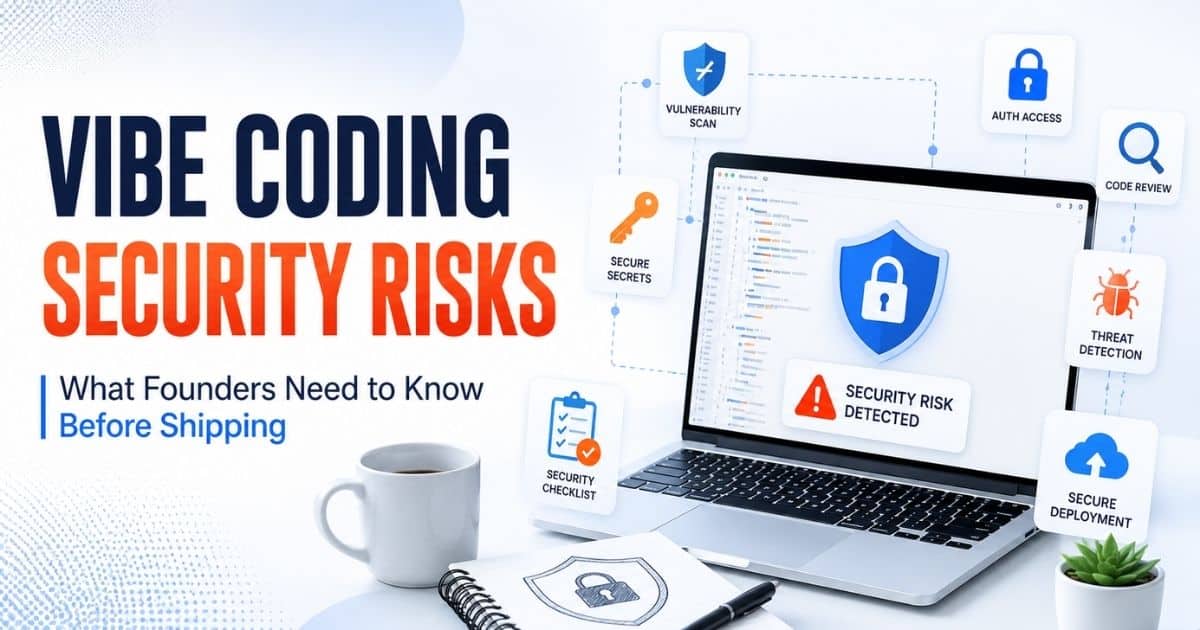
Vibe Coding Security Risks: What Founders Need To Know Before Shipping
by Rhea Collins | Jul 6, 2026 | Technology & Innovation
Table of Contents
- What Is Vibe Coding
- The Biggest Vibe Coding Security Risks Found In Applications
- What Founders Need To Know Before Shipping
- How To Ship Vibe-Coded Applications Securely
- A Production-Ready Security Checklist Before You Ship
- When Vibe Coding Is Safe And When It Is Not
- Security Best Practices Before Shipping An AI-Built Product
- How GainHQ Helps Founders Ship Secure AI Products Faster
- Frequently Asked Questions
Your app looks done. The demo runs. Users are signing up. Then someone finds a way into data that was never supposed to be visible.
This is the real story behind vibe coding security risks. AI-generated code can look clean and still hide serious flaws underneath. The model is trying to make a feature work, not make it safe. Security is not part of the prompt, so it rarely makes it into the output.
Vibe coding moves fast, and that speed is exactly the problem. A missing access check can expose sensitive data to anyone who knows where to look. A poorly handled input can open the door to arbitrary code execution. None of this shows up in a demo. It shows up after launch, usually in front of real users. Here is how AI-generated code creates these risks, what to check before you ship, and how a structured AI MVP development approach for startups can keep speed without ignoring security.
What Is Vibe Coding
Vibe coding is a software development approach where developers use AI tools to generate code from natural language prompts instead of writing every line manually. It helps teams build prototypes and applications much faster, but speed does not guarantee quality. AI-powered software development can also produce insecure code, introduce hidden security flaws, or create security vulnerabilities that are difficult to detect. Human review, testing, and security checks are still essential to ensure the final application contains secure code before it goes into production.
The Biggest Vibe Coding Security Risks Found In Applications
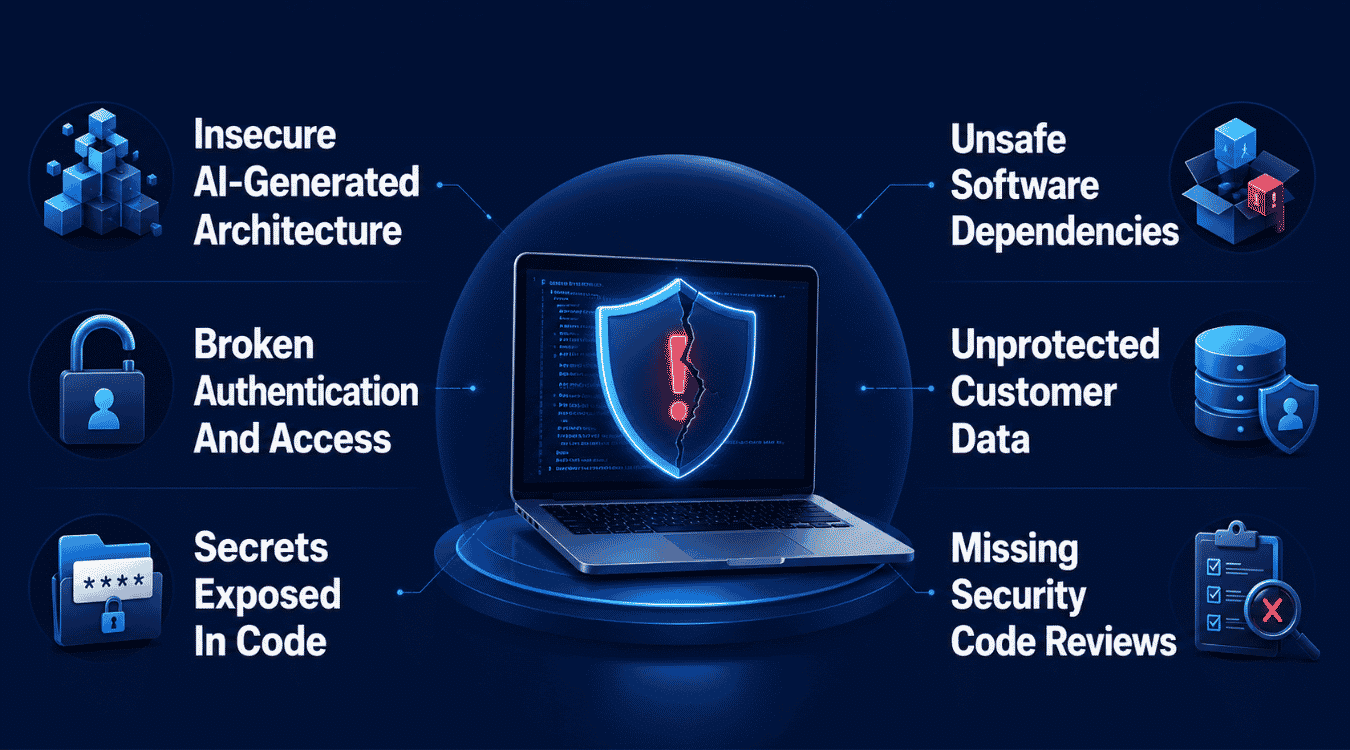
Vibe coding security has its own risk profile. AI models can generate insecure code fast, and most teams miss it until it reaches production systems. The broader GainHQ blog on software and AI development dives deeper into these kinds of tradeoffs. Here are the biggest security risks found in vibe-coded applications.
Insecure AI-Generated Architecture
AI coding tools optimize for the fastest working structure, not the safest one. Code generation tools skip planning steps that human written code usually goes through, like defining clear access boundaries and reviewing data flow between services. This is one of the core risks of vibe coding. The architecture can look clean and organized while still hiding critical vulnerabilities in how different parts of the system talk to each other, especially in complex SaaS security architecture designs. Software development teams that skip this review step often discover the problem only after something breaks in production systems, when fixing it costs far more.
Broken Authentication And Access
AI models are not good at reasoning about who should be allowed to see what. Broken authentication is one of the most common security risks found in vibe-coded apps. A login screen can work perfectly on the surface while the access rules behind it are wrong, incomplete, or missing entirely. This is where software supply chain risk meets basic security risks, since a single access gap can expose an entire system to anyone who finds it. Security teams usually catch this only through manual testing, since automated scans rarely flag logic errors like this.
Secrets Exposed In Code
AI coding tools frequently generate insecure code by hardcoding API keys, passwords, and tokens directly into source files. It sounds like a small mistake, but it remains one of the most common security risks tied to vibe coding security today. Traditional security processes usually catch this early through code reviews, but vibe-coded projects often skip that step entirely in the rush to ship. Once secrets are exposed in a public repository, attackers can use them within minutes, turning a small oversight into a full breach with real consequences for users and the business.
Unsafe Software Dependencies
Vibe coding tools often pull in packages without checking whether they are safe or even real. This creates software supply chain risk that human written code usually avoids through careful, deliberate dependency management. AI models can suggest outdated libraries, unmaintained packages, or names that do not exist at all. Without input validation on what actually gets installed, teams end up running unverified code inside their own software development pipeline, adding critical vulnerabilities before the application ever reaches a real user—a gap good SaaS monitoring and observability can sometimes surface only after the fact.
Unprotected Customer Data
Protecting sensitive data depends on rules enforced at the database level, not just inside the app's interface. AI generated code often skips this step, leaving customer records open to anyone who queries the database directly instead of through the app. This is one of the more serious risks of vibe coding, since it stays invisible in a demo and only surfaces once real users and real data are involved. Production systems handling personal or financial information need this checked thoroughly before launch, not discovered after.
Missing Security Code Reviews
Traditional security processes rely on a second set of eyes before code reaches production. Vibe coding often removes that step completely, since speed is the whole appeal. Security teams end up reviewing code after launch instead of before, right when critical vulnerabilities become far more expensive and disruptive to fix. Pairing AI coding tools with a simple manual review process closes most of this gap without slowing development down. It is the easiest fix on this list, and also the one most often skipped.
What Founders Need To Know Before Shipping
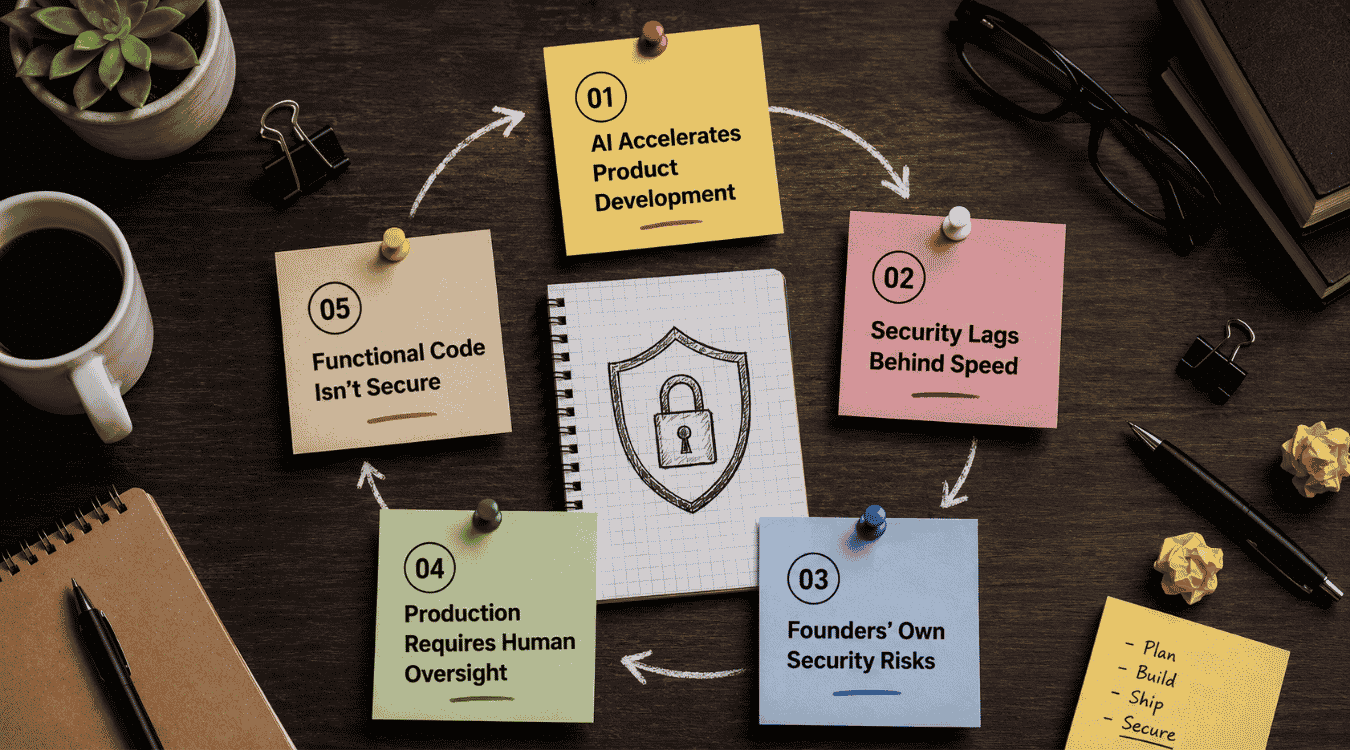
Speed got you here, but shipping safely takes a different mindset. Here is what founders need to know before their AI-built product meets real users.
AI Accelerates Product Development
AI coding has changed how fast founders can move. What used to take a dev team weeks now takes an ai agent a few hours through code generation. A single prompt can produce an entire feature, complete with a working code block ready to deploy. This speed is real, and it is genuinely useful for early product validation and aligns with emerging MVP development trends for startups in 2026. But fast code creation was never designed to slow down and check itself. The tool's only goal is a working output, not a secure one.
Security Lags Behind Speed
Every acceleration in code generation creates a gap somewhere else, and that gap is usually security. AI models are not trained to prioritize security issues the way a careful developer would. Vulnerable code can pass every functional test while still containing serious flaws underneath. This is where static code analysis matters most, since it catches patterns a human reviewer might miss at a glance and fits naturally into modern DevOps best practices for 2026. Without it, founders are shipping on trust alone, and trust is not a security control.
Founders' Own Security Risks
Founders using AI coding tools often do not realize they are personally exposed. If a code block leaks api keys or credentials, the responsibility still falls on the founder, not the tool that generated it. Model context protocol setups and other AI integrations can expose sensitive data if permissions are not scoped correctly from the start. Strategic tech consulting services can help design these integrations with security and compliance in mind. Legal and financial consequences follow the business, regardless of who or what wrote the original code. This is the part most founders learn the hard way.
Production Requires Human Oversight
Code creation through AI can get you to a working prototype fast, but production systems need a different level of scrutiny. Static code analysis tools should run before every deployment, not after something breaks. Beyond automated checks, a human still needs to read the code that handles logins, payments, or personal data. The same discipline that makes a Lean Startup-style MVP successful applies here too. AI coding tools are excellent assistants, but they are not a replacement for a second set of eyes on anything customer-facing.
Functional Code Isn't Secure
A feature working exactly as intended tells you nothing about whether it is safe. This is the core misunderstanding behind most security issues in AI-built products. Code can pass every test, load correctly, and still expose sensitive data through a missing check nobody thought to test for. The same way disciplined MVP feature prioritization forces tradeoffs, security reviews have to be deliberate, not assumed. Treat "it works" and "it's secure" as two separate questions, answered separately, every single time. One does not confirm the other, no matter how clean the output looks.
How To Ship Vibe-Coded Applications Securely
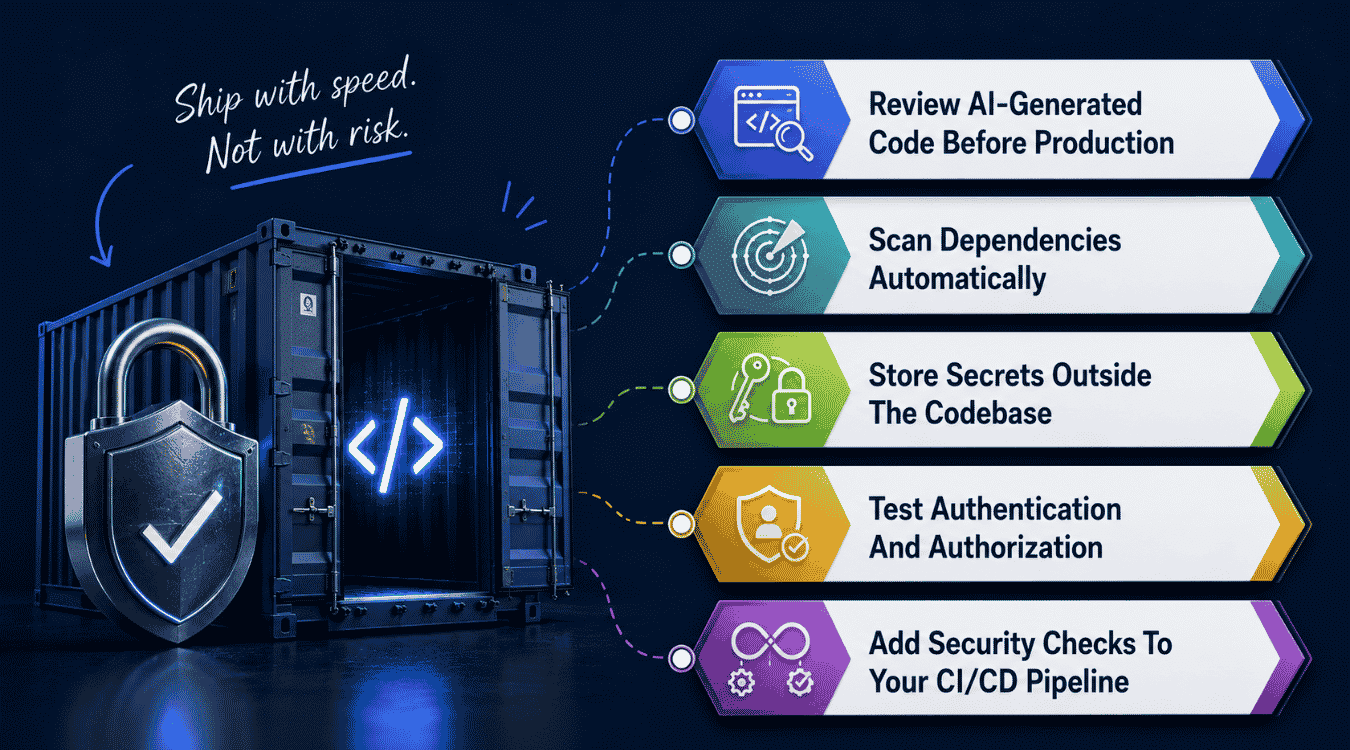
Shipping fast does not have to mean shipping broken. Here is how to ship vibe-coded applications securely without slowing down the parts that actually work, drawing on lessons from shipping a production-ready MVP in 90 days.
Review AI-Generated Code Before Production
Every code block a model produces needs a proper security review before it reaches real users. AI tools produce code quickly, and that speed is what makes vibe coding attractive to founders and vibe coders alike. But fast output does not mean safe output. A quick code review can catch obvious code patterns tied to broken access control or missing validation. Treat this step as non-negotiable, especially for anything touching payments, accounts, or personal data.
Scan Dependencies Automatically
Written code is only part of the risk. The packages it pulls in matter just as much. AI models can suggest libraries that are outdated, unmaintained, or, in rare cases, malicious code disguised as a real package. Automated dependency scanning catches this before it ever reaches production, flagging known vulnerabilities in seconds. This is one of the simplest checks vibe coders can add to their workflow, and it takes minutes to set up.
Store Secrets Outside The Codebase
Code produced by AI tools often hardcodes api keys and passwords directly into files, since nothing in the prompt told it not to. Secrets stored inside a codebase are one of the easiest things for attackers to find, especially in public repositories. Move every credential into environment variables or a dedicated secrets manager instead. This single habit removes one of the most common and preventable risks in AI-generated projects.
Test Authentication And Authorization
A login screen working is not proof that access control works. Authentication needs to be tested by actually logging in as two different users and confirming neither can see the other's data. This step catches issues that a simple code review often misses, especially around untrusted input reaching parts of the app it should never touch. Authorization should be checked at the database level too, not just inside the app's interface.
Add Security Checks To Your CI/CD Pipeline
Manual checks do not scale once a product grows, so security needs to be built into the pipeline itself. Add automated scans that run on every deployment, catching common code patterns tied to known vulnerabilities before they go live. This turns security review from a one-time event into a habit built into how the team ships, and it fits naturally alongside broader DevOps best practices. Vibe coders who set this up early spend far less time firefighting later, since problems get caught before users ever see them.
A Production-Ready Security Checklist Before You Ship
Before anything ai assisted goes live, run it through a real checklist, not a gut feeling. Generative ai speeds up rapid iteration, but a strong security posture still depends on human oversight at every stage and a clear AI governance framework for SaaS platforms where applicable. Whether you built in one programming language or five, these are the checks that matter most across ai driven coding and vibe coding workflows.
- Code Quality – Manual human review of anything AI wrote using natural language prompts, especially logic tied to permissions
- Infrastructure – Confirm cloud roles and permissions follow least privilege, not whatever the ai environments defaulted to
- Secrets Management – No api keys, tokens, or passwords stored inside the codebase itself
- Database Security – Row-level access rules enforced at the database layer, not just in the app's interface
- API Security – Input validation on every endpoint, especially ones touching untrusted input
- Authentication – Tested with two separate accounts to confirm access boundaries actually hold
- Monitoring – Logging in place to catch unusual activity early, not after a breach
- Backups – Regular, tested backups that actually restore, not just files sitting in storage
- Compliance – Data handling checked against relevant regulations for your industry
- Incident Response – A written plan for who does what if something goes wrong
- Rollback Plan – A tested way to revert quickly if a deployment breaks something
These coding practices turn a coding assistant from a fast typist into a safe one. Good habits here matter more than which model or training data produced the original code, and they matter whether you're relying on smarter AI-powered software tools or choosing between SaaS and custom software for scale.
When Vibe Coding Is Safe And When It Is Not
Not every vibe-coded project carries the same risk. A weekend prototype in a local development environment is nothing like production software handling real customer accounts. The line between safe and risky comes down to what data the app touches and who can see it.
Use Case | Risk Level | Why |
|---|---|---|
Personal prototype, no real users | Low | Source code stays local, no sensitive data involved |
Internal tool for your own team | Low to medium | Limited exposure, but still needs version control and basic review |
Public marketing site, no accounts | Low | No login system means fewer logic flaws to exploit |
App with user accounts, no payments | Medium | Authentication logic now matters, insecure logic can expose one user's data to another |
App handling payments or health data | High | A large language model writing this code still can't reason about compliance or liability |
Multi-tenant business platform | High | One access control mistake can expose every customer's data at once |
Once real users and real data are involved, treat every deployment like production software, even if it started as a quick prototype. Push everything through version control, review changes properly, and never assume that a feature working means it's safe, regardless of how fast you managed to build the initial MVP.
Security Best Practices Before Shipping An AI-Built Product
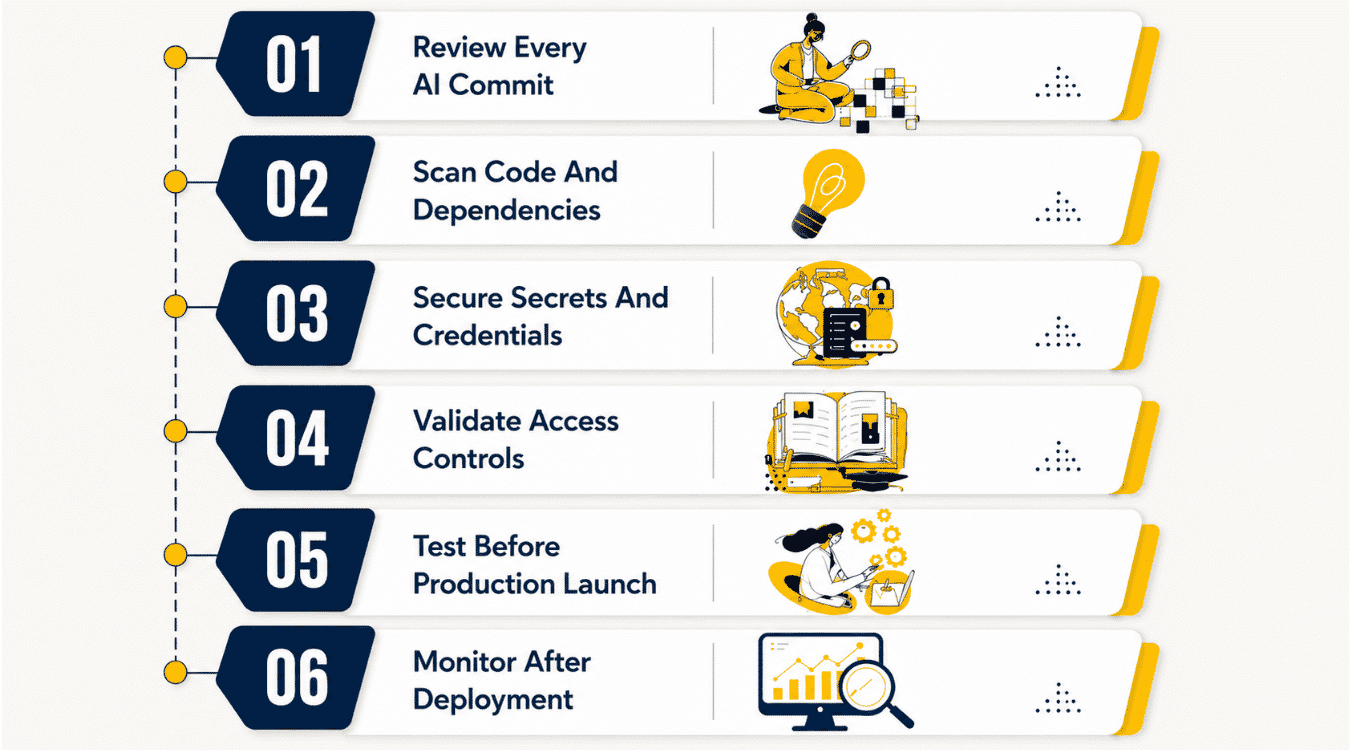
AI can build the product, but it can't ship it safely on its own. AI software development done responsibly has to pair speed with guardrails. Here are the practices that catch serious vulnerabilities before real users ever see them.
Review Every AI Commit
Every commit an AI assistant produces needs a real look, not a quick skim. Non technical users especially tend to trust output that looks clean and functional, but appearances don't reflect what's actually happening underneath. This is one of the biggest security risks of vibe coding, since founders often approve changes they don't fully understand. Set a habit of reading through what changed, even if it slows things down slightly. That small pause catches problems before they reach anyone else.
Scan Code And Dependencies
Automated scanning should run on every change, not just before a big release. AI assistants often pull in packages without checking if they're safe, maintained, or even real. A scan catches known issues in dependencies fast, before they ever touch a runtime environment. This step takes minutes to set up and keeps flagging problems long after the initial build is done. Vibe coded applications age fast, and dependencies drift out of date quicker than most teams expect.
Secure Secrets And Credentials
Secrets management should never depend on remembering to remove a hardcoded value later. Api tokens and passwords belong in environment variables or a dedicated secrets manager, never inside source files. AI tools default to whatever gets the feature working, and that often means writing credentials directly into code. Catching this early avoids one of the most common and completely preventable causes of a breach. It's a small habit that closes a large gap.
Validate Access Controls
Access rules need to be tested, not assumed. Log in as two different users and confirm neither can see data that belongs to the other. This step reveals problems that a quick read of the code often misses, since broken access control frequently looks correct on the surface. Runtime behavior tells a very different story than the code itself sometimes suggests. Testing this properly, before launch, is one of the highest-value checks on this entire list.
Test Before Production Launch
Testing needs to go beyond checking whether features work as expected. Watch how the app actually behaves under real conditions, with real accounts and real inputs. Runtime behavior can expose issues that never show up during a normal demo walkthrough, and it should feed directly into your post-MVP development strategy. This matters even more for anything handling payments, personal data, or multiple user roles. A working demo and a safe product are two different bars entirely.
Monitor After Deployment
Shipping isn't the finish line. Set up basic monitoring to catch unusual activity early, before it turns into a real incident. Watch for spikes in errors, unexpected access patterns, or requests hitting parts of the app they shouldn't reach. The right SaaS monitoring tools make these signals visible before they become outages or breaches. This gives your team a chance to respond fast instead of finding out from a user or a headline. Ongoing monitoring is what turns a one-time security review into an actual habit.
How GainHQ Helps Founders Ship Secure AI Products Faster
Founders don't need another agency writing code faster. They need someone who can look at what AI has already built and tell them what's actually safe to ship, then extend it with custom software that fits their business when off-the-shelf tools fall short. That's the gap GainHQ fills.
Rather than starting from scratch, GainHQ reviews AI-generated codebases the way a security-minded engineer would, checking access controls, exposed secrets, and logic flaws that never show up in a demo. The goal isn't to slow founders down. It's to catch what a fast build cycle skips, before it becomes a production incident—just like in their successful SaaS launch case studies.
For founders who vibe-coded their way to an MVP and now need it production-ready, GainHQ’s custom software development services act as the second set of eyes their product never had. Less rebuilding, more targeted fixes, and a clearer picture of what's actually safe to launch.
Frequently Asked Questions
Can AI-Generated Code Go Directly Into Production?
No, not without review. AI-generated code can pass every functional test and still contain serious vulnerabilities in access control, authentication, or data handling. A feature working correctly says nothing about whether it's secure. Treat AI output as a first draft that needs a human review before it reaches real users, especially for anything touching payments or personal data.
What Security Risks Come With Vibe Coding?
The most common risks are broken access control, hardcoded secrets, unsafe dependencies, and missing input validation. These issues rarely show up in a demo since the app still looks and works fine on the surface. They surface later, once real users interact with the product in ways the original prompt never accounted for.
Should Founders Review AI-Generated Code?
Yes, always, before anything reaches production. Founders don't need to read every line personally, but someone with security awareness should. This is especially true for code handling logins, payments, or customer data, where a missed check can expose an entire system rather than just one feature.
Can Vibe Coding Meet SOC 2 Or GDPR Requirements?
Not by default. SOC 2 and GDPR require documented access controls, data handling policies, and audit trails that AI tools don't generate on their own. Meeting these standards takes deliberate setup, proper reviews, and ongoing monitoring layered on top of whatever the AI initially produced.
What Security Tools Should Startups Use Before Launch?
Start with automated dependency scanning, static code analysis, and a secrets manager to keep credentials out of source files. Pair these tools with a manual review of authentication and access logic, since automated tools catch structural issues but miss behavioral ones. Testing the app as two different users is one of the simplest, highest-value checks available, especially when you're hardening an MVP in software development for real-world use.