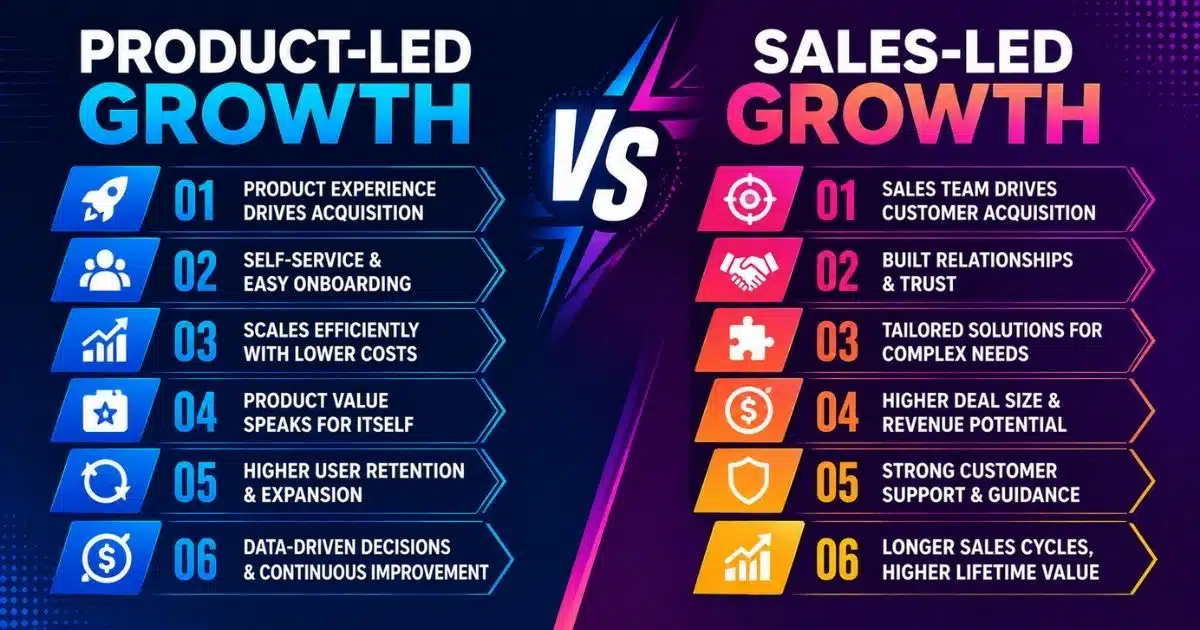
Choosing the right growth model can shape how quickly a company acquires customers, generates revenue, and scales operations. Product-Led Growth (PLG) and Sales-Led Growth (SLG) are two widely used approaches, each with distinct advantages and challenges. PLG relies on the product itself to attract, engage, and convert users through self-service experiences, free trials, and seamless onboarding.
SLG, on the other hand, depends on dedicated sales teams that guide prospects through the buying journey and close high-value deals. While both models can drive sustainable business growth, the speed and efficiency of results often depend on factors such as product complexity, target audience, customer acquisition costs, and market conditions.
Understanding the differences between PLG and SLG helps businesses choose the approach that aligns best with their growth goals and long-term strategy.
Product-Led Growth Vs Sales-Led Growth: Key Differences
The main difference comes down to what drives customer acquisition and conversion.
Product-led growth (PLG) uses the product itself as the primary driver of customer acquisition, conversion, retention and expansion. Users typically self-serve through free trials or freemium tiers, experiencing value before ever speaking with anyone on staff. The product creates "aha moments" without requiring a dedicated sales team at the early touchpoints. Today, 60% of companies use product-led growth strategies, and 91% of B2B SaaS companies above $50 million ARR have adopted some form of PLG.
Sales-led growth (SLG) relies on a dedicated sales team to guide prospects through demos, negotiations and relationship building. Sales reps, account executives and sales engineers drive prospecting and conversion through a structured sales process. This traditional business strategy remains critical for complex enterprise sales with long procurement cycles, multi-stakeholder decisions and custom integration demands.
Both approaches can generate significant business growth, but the execution, team composition and resource requirements differ at every stage.
Customer Acquisition And Conversion Rates
How customers discover and adopt your product varies dramatically between growth models. Product-Led Growth encourages users to explore the product independently through free access, trials, or freemium plans before making a purchase decision. Sales-Led Growth relies on direct engagement from sales representatives who educate prospects, address concerns, and guide them through a structured buying process.
Product-Led Growth Customer Acquisition
Product-led companies acquire customers through freemium models, free trials and viral sharing features. Users experience value before becoming paying customers, which creates higher conversion intent but typically lower initial deal sizes. A large addressable market makes product-led growth more scalable than sales teams alone could achieve, especially when enhanced by AI-driven product experiences that increase user engagement.
The product-led growth motion centers on user acquisition through organic growth channels. Viral potential enhances the effectiveness of product-led growth, as collaboration features naturally pull in new users. PLG companies often achieve higher user engagement and retention rates because users have already validated the product before committing financially.
Product-qualified leads convert at substantially higher rates than traditional marketing-qualified leads. When users hit key behavioral thresholds based on product usage, they signal genuine buying intent rather than passive interest.
Metric | Product-Led Growth | Sales-Led Growth |
|---|---|---|
Visitor to Signup (Freemium) | ~6% median | N/A (no free tier) |
Visitor to Signup (Free Trial) | 3-4% median | N/A |
Free-to-Paid Conversion (Freemium) | ~5% | N/A |
Free-to-Paid Conversion (Trial) | ~17% overall; ~48.8% with credit card required upfront | N/A |
PQL to Paid Conversion | 25-30% | N/A |
MQL to Paid Conversion | 5-10% | 5-10% |
Pipeline Win Rate | N/A | ~15-25% |
Sales-Led Growth Customer Acquisition
Sales-led companies generate leads through outbound prospecting, marketing campaigns and referrals. Sales-led growth relies on sales and marketing teams to guide prospects through discovery calls, personalized demos and proposal stages before conversion. Sales-led growth emphasizes personalized customer interactions at every stage of the sales process.
Higher initial contract values typically result from this personalized approach. Sales-led growth is effective for complex, high-value products where the average contract value ranges from $25,000 to $500,000 or more for enterprise customers. While the front-end conversion rates from MQL to SQL may be lower, each closed deal generates considerably more revenue per customer, and sales-led companies often pursue aggressive growth goals to justify these economics.
Cost Structure And Scalability Patterns
The economics of growth differ substantially between product-led and sales-led approaches. Product-Led Growth often lowers customer acquisition costs by allowing the product to drive user acquisition, activation, and expansion. Sales-Led Growth typically requires greater investment in sales teams and outreach efforts but can deliver higher contract values and stronger relationships with enterprise customers, provided the underlying platform follows sound SaaS scalability strategies.
Product-Led Growth Economics
Product-led growth typically results in lower customer acquisition costs through automated onboarding and self-service conversion. Product-led companies can significantly lower CAC through freemium models, with median CAC reported at approximately $940 per customer. PLG leads to rapid organic scalability without reliance on sales team size, as revenue scales without linear headcount increases once product-market fit is established.
Product-led growth allows for scalable revenue without proportional sales hiring. PLG firms spend 39% less on sales and marketing to achieve similar revenue growth compared to their sales-led counterparts. The benchmark for a healthy LTV-to-CAC ratio sits around 3:1, with CAC payback periods under 12 months. Payback periods exceeding 24 months signal fundamental unit economics problems.
PLG is often better suited for startups with limited sales and marketing resources, since the product itself serves as the primary growth engine, and many of these teams increasingly rely on AI-driven automation in SaaS platforms to extend reach without adding headcount.
Sales-Led Growth Economics
Sales-led growth incurs higher customer acquisition costs due to sales team expenses. In 2026, average customer acquisition cost for sales-led growth is $8,000, with CAC payback periods commonly stretching to 18 months or longer. Sales-led growth often requires proportional investment in sales personnel for scaling, including salaries, commissions, travel and legal overhead, which in turn must be balanced against disciplined SaaS development services and architecture decisions.
Sales and marketing spend as a percentage of revenue runs higher for the sales led model. Representative surveys show SLG companies allocating roughly 45% of revenue to sales and marketing, compared to approximately 28% for PLG companies. Gross margins remain strong but somewhat lower for SLG at around 72%, versus roughly 78% for PLG firms.
Metric | Product-Led Growth | Sales-Led Growth |
|---|---|---|
Median CAC | ~$940 | ~$8,400 |
CAC Payback Period | 9-12 months | 18+ months |
Sales & Marketing Spend (% of Revenue) | ~28% | ~45% |
Gross Margin | ~78% | ~72% |
Scaling Model | Usage-driven, non-linear | Headcount-driven, roughly linear |
LTV:CAC Benchmark | 3:1 or better | Varies; justified by high ACV |
Higher upfront contract values often justify these increased acquisition costs, especially for enterprise customers requiring customization and dedicated support.
Sales Cycle Length And Time To Value
The speed from initial interest to customer success varies significantly between growth models. Product-Led Growth enables users to experience value quickly through self-service onboarding and immediate product access. Sales-Led Growth often involves a longer evaluation and implementation process, but it can provide personalized guidance that helps customers achieve successful outcomes and long-term adoption.
Product-Led Sales Cycles
Product-led companies compress sales cycles by enabling immediate product access through trials or freemium tiers. Companies using PLG can see faster time to value for users, often within minutes or hours of signup. The benchmark for time to first value in successful PLG products sits at roughly 4 to 5 minutes, with broader benchmarks under 24 hours, and this can be shortened further by thoughtful LLM integration strategy for SaaS platforms.
Self-service onboarding reduces friction across the entire customer journey but may increase churn for free users who do not quickly understand product value. Products with low-cost or freemium solutions benefit from product-led growth because the barrier to entry is minimal. A PLG approach is beneficial when selling to individual end-users rather than committees, since these buyers can experience and validate value on their own.
Typical sales cycles for a pure self-serve or freemium product led growth model span 0 to 30 days from first interaction to paid conversion.
Sales-Led Sales Cycles
Sales-led growth typically involves longer sales cycles of 60 to 180 days, depending on deal complexity. Multiple stakeholders, security reviews and procurement processes extend decision timelines considerably. Human interaction throughout the process adds value for complex purchases but introduces delays at each stage.
Time to value in the sales led approach is typically measured in weeks to months. Deployment, onboarding, integration and training all extend the period before enterprise customers realize meaningful returns.
Metric | Product-Led Growth | Sales-Led Growth |
|---|---|---|
Typical Sales Cycle | 0-30 days | 30-180 days |
Time to First Value | Minutes to hours; benchmark ~4-5 minutes | Weeks to months |
Onboarding Model | Self-service, automated | Guided, often with dedicated support |
Decision Maker | Individual user or small team | Committee, procurement, multiple stakeholders |
Primary Friction Points | Product complexity, unclear UX | Procurement delays, security reviews, legal |
Revenue Growth Velocity And Expansion
How quickly companies can scale revenue depends on their chosen growth strategy and execution quality. Product-Led Growth can accelerate expansion by reaching a large number of users with minimal sales involvement and lower operational costs. Sales-Led Growth can drive substantial revenue through high-value contracts and strategic account management, particularly in enterprise and complex B2B markets, especially when supported by scalable SaaS tools that power global business growth.
Product-Led Revenue Growth
Product-led companies achieve higher revenue growth rates through viral adoption and self-service expansion. Median annual revenue growth for PLG companies reaches approximately 35%, compared to roughly 26% for non-PLG companies. PLG companies demonstrated about 50% higher revenue growth rates than sales-led counterparts while spending significantly less on sales and marketing, especially when supported by robust SaaS scalability strategies for sustainable growth.
Land-and-expand strategies work well when users can invite teammates and upgrade organically. Product-led growth leverages user bases for organic growth through viral effects. Net revenue retention often exceeds 120% for best-in-class PLG companies in enterprise segments, with typical NRR sitting between 115% and 125%. Expansion revenue from existing customers represents roughly 18% of ARR for PLG companies, with top-quartile performers exceeding 30%.
Sales-Led Revenue Growth
Sales-led companies generate predictable revenue through relationship-driven expansion and renewal processes. Account management teams and customer success manager roles focus on strategic partnerships, cross-selling, upsells and module add-ons to drive revenue growth.
Sales-led growth companies also achieve strong net revenue retention of 108% to 120%, particularly when account management and customer success functions are mature. Companies like Snowflake, Datadog and CrowdStrike have achieved net dollar retention above 120% through usage-based pricing and modular expansion, often using sales-led or hybrid models in later stages, similar to patterns seen in successful SaaS launch case studies.
Metric | Product-Led Growth | Sales-Led Growth |
|---|---|---|
Median Annual Revenue Growth | ~35% | ~26% |
Net Revenue Retention (Typical) | 105-115% (SMB/Mid-Market) | 108-120% (Enterprise) |
Net Revenue Retention (Best-in-Class) | >120% | >120% (with mature CS) |
Expansion Revenue as % of ARR | ~18%; top quartile >30% | Driven by cross-sell/upsell via account teams |
Primary Expansion Mechanism | Usage growth, seat addition, tier upgrades | Relationship-driven upsell, custom solutions |
Team Structure And Resource Allocation
Organizational design differs significantly based on whether growth comes from product or sales efforts. Product-Led Growth organizations typically invest heavily in product development, user experience, and customer success to drive adoption and retention. Sales-Led Growth companies often build larger sales, marketing, and account management teams to generate pipeline, close deals, and expand customer relationships.
Product-Led Team Structure
Product-led organizations prioritize product development, user experience design and growth engineering teams. Marketing focuses on content creation, SEO and community building rather than traditional demand generation campaigns. PLG emphasizes a seamless user experience to drive customer satisfaction, and user-centered design for SaaS platforms ensures product-led growth relies on user data to inform product improvements continuously.
Cross-functional collaboration between product, engineering and customer success drives user activation and retention improvements. Customer success interactions typically begin post-activation or during expansion rather than at initial signup. Sales functions, when they exist, are often minimal or triggered only when product usage thresholds or product qualified leads are identified. Transparent pricing aligns with a self-service model in product-led growth, reducing the need for sales calls and negotiations, and a robust SaaS design system for scalable products helps these teams deliver a consistent experience at scale.
Sales-Led Team Structure
Sales-led organizations invest heavily in sales development representatives, account executives, sales representatives and sales engineering roles. The sales led strategy requires substantial investment in people across the entire funnel, often necessitating deliberate scaling engineering team strategies for growth to keep product delivery aligned with pipeline. Marketing generates qualified leads through demand generation, paid advertising and event marketing to fill the pipeline for sales reps.
Customer engagement in SLG companies is managed through dedicated teams at each stage. A customer success manager serves retention and expansion post-sale, while sales engineers support technical evaluations before the deal closes.
Function | PLG Emphasis | SLG Emphasis |
|---|---|---|
Product & UX | Central; features, onboarding, activation loops | Important but often driven by sales feedback |
Marketing | Organic acquisition (SEO, content, viral, community) | Demand generation, paid, outbound, events |
Sales | Minimal until enterprise thresholds; triggered by PQLs | Major expense throughout the funnel |
Customer Success | Focused on expansion and retention after adoption | Integral throughout renewal, upsell, onboarding |
Headcount Scaling | Scales with usage, less linear with revenue | Scales roughly proportional to revenue growth |
Market Conditions And Product Complexity Factors
External factors often determine which growth strategy works best for specific situations.
Simple or intuitive products with broad appeal and immediate value propositions benefit most from a product-led growth strategy. Self-service products where user behavior signals readiness to buy, tools for individuals or small teams, and offerings with minimal compliance or security requirements all favor PLG. High user autonomy favors the effectiveness of a product-led growth approach. Products priced under roughly $5,000 to $10,000 ACV strongly lean toward product led growth, and self-service options with transparent pricing reduce the need for human interaction, especially when grounded in disciplined SaaS product development from build to scale.
Complex enterprise solutions requiring custom integrations, security clearances, regulatory compliance and multi-stakeholder approvals require a sales-led approach. Sales-led growth is effective for complex, high-value products where the ACV exceeds $25,000 and each deal justifies substantial sales efforts. When buyer committees expect hands-on demonstrations, personalized proposals and negotiation, a dedicated sales team becomes essential, often supported by scalable software architecture for high-growth products that can meet stringent enterprise requirements.
Hybrid models combine product-led and sales-led strategies to address different customer segments and deal sizes simultaneously. In 2026, most competitive SaaS companies use hybrid growth models. Companies like HubSpot and Slack utilize hybrid growth strategies where self-serve freemium serves as the entry point, and once usage or account size hits a threshold, a sales motion activates. Product-led sales combines product-led and sales-led strategies, focusing on converting product-qualified leads by leveraging product usage data for sales insights. In product-led sales, users experience value before sales engagement, and successful product-led sales requires alignment between product and sales teams, typically guided by a clear SaaS product roadmap for prioritization and scale. Hybrid growth models allow for efficient acquisition and maximum deal size across multiple customer segments. Hybrid models help target high-value accounts and complex implementations while maintaining efficient user acquisition at lower tiers. Understanding market readiness and competitive dynamics helps inform the optimal growth strategy choice.
Approximately 83% of B2B buyers complete most purchasing research before talking to sales, according to Forrester and McKinsey research. This structural shift gives an advantage to product led growth models and hybrid approaches that support self-education and product discovery.
Product-Led Growth Vs Sales-Led Growth: Which Should You Choose?
Choose product-led growth if your product delivers immediate value through self-service, targets a broad target audience under $10,000 ACV and can achieve viral adoption through user collaboration. PLG works best when the product is your primary growth engine, when increased customer satisfaction comes from seamless onboarding, and when your saas business can scale through organic growth and product usage expansion.
Choose a sales-led growth model if your product requires implementation support, serves enterprise customers with complex procurement, and generates deals exceeding $25,000 annually. The sales led approach remains the right fit when longer sales cycles are justified by deal size, when potential customers need human guidance to realize value, and when your saas company sells mission-critical solutions requiring trust and customization.
Consider a hybrid approach if you serve multi-segment markets. Use self-service and freemium as the entry point for lower ACV customer segments, then layer an enterprise sales layer for mid-market and enterprise accounts. Product-led sales leverages product usage data for sales insights, letting your team focus sales calls on the highest-value opportunities. However, roughly 85% of companies attempting a full PLG transformation report failure due to poor product-market fit, pricing misalignment, or lack of user validation, so the transition demands rigorous execution and a disciplined post-MVP development strategy for growth.
Both product-led and sales-led growth can drive rapid scaling when matched with the right market conditions, pricing model and execution capabilities. The most successful SaaS companies in 2026 are not choosing one model over the other. They are building deliberate, tiered GTM motions that match customer needs at every stage of the customer journey, supported by broader enterprise scalability strategies for growth that keep operations stable as demand rises.
FAQs
What Is The Main Difference Between Product-Led Growth And Sales-Led Growth?
Product-Led Growth relies on the product itself to attract, convert, and retain customers through self-service experiences. Sales-Led Growth depends on sales teams to guide prospects through demos, negotiations, and personalized interactions before closing deals.
Which Growth Model Is Better For SaaS Startups?
Product-Led Growth is often a strong choice for SaaS startups with intuitive products, lower pricing, and broad market appeal. Sales-Led Growth may be more suitable for startups selling complex solutions that require education, customization, or enterprise-level support.
Can A Company Use Both Product-Led And Sales-Led Growth?
Yes. Many SaaS companies use a hybrid approach that combines self-service product adoption with sales support for larger accounts. Hybrid models help businesses capture both small customers and enterprise opportunities.
Does Product-Led Growth Reduce Customer Acquisition Costs?
In many cases, yes. Product-Led Growth can lower customer acquisition costs by allowing users to discover product value through free trials, freemium plans, and self-service onboarding before engaging with a sales team.
When Should A Business Choose Sales-Led Growth?
Sales-Led Growth is often the best option for high-value products, enterprise software, and solutions that involve complex buying decisions, multiple stakeholders, security reviews, or custom implementation requirements.