
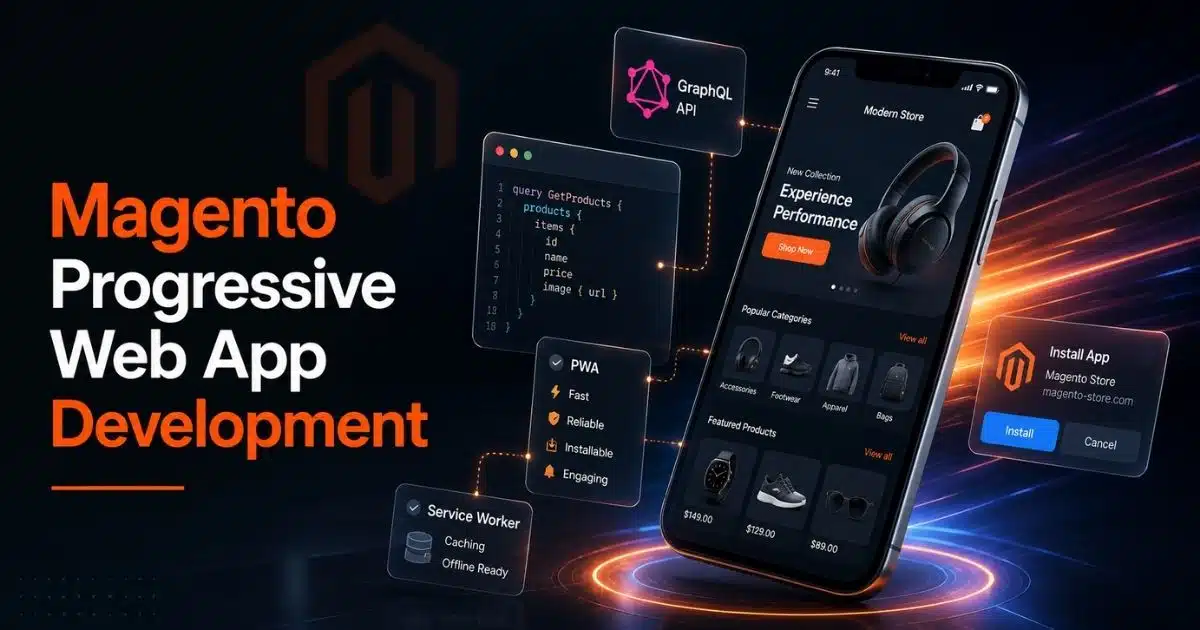
Modern online shoppers expect speed. They want pages to load fast, even on a slow internet connection. They also expect a smooth experience on every mobile device. A traditional Magento store may struggle to meet those expectations.
That is why many businesses now choose Magento Progressive Web App Development. A Magento PWA combines the flexibility of a website with the feel of a native app. Customers can enjoy faster page loads, offline browsing, and push notifications without downloading anything from an app store. Adobe's official Magento PWA Studio also gives developers a modern way to build high-performance storefronts on Adobe Commerce and Magento Open Source.
In this guide, you will learn how Magento PWA development works, its benefits, costs, best practices, and whether it is the right choice for your business.
What Is Magento Progressive Web App Development?
Magento Progressive Web App Development is the process of building a modern storefront that combines the best parts of a website and a native app. A Magento PWA runs in a web browser but feels like a mobile app. It loads quickly, works on different devices, and can support features like offline browsing, push notifications, and home screen installation. Adobe's Magento PWA Studio provides the official tools to create a PWA storefront for Adobe Commerce and Magento Open Source.
A Magento Progressive Web App uses modern technologies like React, GraphQL, service workers, and a web app manifest to deliver a faster shopping experience. It keeps the Magento backend while giving the frontend a fresh, app-like experience. As a result, online merchants can improve website performance, mobile usability, and customer engagement without building separate native applications for Android and iOS.
Why Businesses Are Moving To Magento Progressive Web App Development
Customer expectations keep rising. Shoppers want fast pages, smooth navigation, and a great mobile experience. Magento Progressive Web App Development helps businesses meet those expectations by combining the flexibility of a website with the speed and feel of a native app.
Faster Performance
Slow pages can drive shoppers away. A Magento PWA uses service workers, smart caching, and an optimized frontend to deliver faster performance, even on slower internet connections. Quick page loads create a better shopping experience and help reduce mobile bounce rates. Adobe also highlights performance as a core benefit of PWA storefronts.
An App-Like Experience Without App Store Downloads
A progressive web app works inside a browser but feels like a native app. Customers can add the store to their home screen, browse with smooth navigation, and receive push notifications without downloading anything from an app store. This makes it easier to reach users on Android and iOS devices.
Better Mobile Shopping
Modern shoppers use many devices before making a purchase. A Magento PWA storefront adapts to different screen sizes and web browsers while keeping the experience consistent. Investing in specialized UI/UX design services can further refine this experience for complex, multi-step shopping journeys. One codebase supports desktops, tablets, and mobile devices, making it easier to serve customers everywhere.
Greater Flexibility
Magento PWA development separates the frontend from the Magento backend. Developers can use Magento PWA Studio, React, and GraphQL to create a custom storefront while keeping Adobe Commerce or Magento Open Source as the commerce engine. This approach supports faster updates, easier customization, and future growth.
Stronger SEO And Long-Term Business Growth
A Magento Progressive Web App is indexable by search engines and supports modern SEO practices. Faster loading times, mobile-first design, and better Core Web Vitals can improve search visibility over time. As a result, businesses can attract more visitors while delivering a better experience to every customer.
Key Features Of Magento Progressive Web Apps

A Magento Progressive Web App combines several modern web technologies to create a fast, reliable, and flexible storefront. Each feature serves a specific purpose, from improving performance to simplifying development.
Service Workers And Smart Caching
Service workers are one of the core technologies behind every progressive web app. They store important static files in the browser cache and retrieve them when needed. As a result, customers can continue offline browsing or view previously loaded pages even with a weak internet connection. Smart caching also reduces server requests and helps pages load faster.
Web App Manifest
A web app manifest is a JSON file that tells browsers how a PWA should behave after installation. It controls the app name, icon, theme colors, and display mode. Thanks to the manifest, users can add the Magento PWA to their home screen and launch it like a native app without downloading it from an app store.
Headless Storefront Architecture
Magento PWA development follows a headless approach. The frontend runs independently from the Magento backend while communicating through GraphQL and other application programming interfaces. This architecture gives developers more freedom to build custom storefronts, deliver dynamic content faster, and update the user interface without affecting the commerce engine.
Cross-Platform Support
A Magento Progressive Web App works across modern web browsers, desktops, tablets, Android devices, and iOS devices from a single codebase. Responsive layouts automatically adjust to different screen sizes, while browser compatibility ensures customers receive a consistent shopping experience on various devices.
Magento PWA Studio
Magento PWA Studio is Adobe's official toolkit for building PWA storefronts on Adobe Commerce and Magento Open Source. It provides a complete development environment, reusable libraries, and tools to create a new project, build custom extensions, and manage ongoing maintenance. Developers can build scalable storefront projects while keeping the code organized and easy to extend.
How Magento PWA Architecture Works
Magento PWA architecture separates the storefront from the Magento backend. Each layer has a specific role, yet they work together to deliver a fast and flexible shopping experience. This modern setup also makes Magento PWA development easier to scale, maintain, and customize over time, especially when it is aligned with a future-proof technology stack.
Frontend Storefront
The frontend is the part customers interact with. It displays products, categories, search results, and the checkout experience. Developers usually build the storefront with React through Magento PWA Studio. Since the frontend is separate from the backend, teams can update the design or add new features without changing the core Magento application.
Magento Backend
The Magento backend powers the entire store. It manages products, inventory, customer accounts, orders, pricing, and business rules. Whether you use Adobe Commerce or Magento Open Source, the backend remains the central system for store operations while the PWA storefront handles customer interactions.
GraphQL API Layer
The application programming interface connects the frontend with the Magento backend. Most Magento PWA projects use GraphQL to request only the data needed for each page. This reduces unnecessary code and data transfer, helping pages load faster while supporting dynamic content across the storefront.
Service Workers And Browser Cache
Service workers manage caching and offline functionality in the browser. They store static files and selected content so users can continue browsing even when the internet connection becomes unstable. This layer also supports faster page loads by reducing repeated requests to the server.
Development And Deployment Layer
The final layer includes the development environment and tools used to build, test, and maintain the project. Magento PWA Studio provides build tools, reusable libraries, and project templates that help developers create a new storefront project and add custom extensions. This architecture also supports ongoing maintenance as business needs grow.
Popular Frameworks For Magento Progressive Web App Development
Choosing the right framework is an important part of Magento Progressive Web App Development. Every framework offers a different approach to building a PWA storefront. Your choice depends on your project goals, development team, customization needs, and long-term maintenance plans.
Magento PWA Studio
Magento PWA Studio is Adobe's official toolkit for building a Magento Progressive Web App on Adobe Commerce and Magento Open Source. It uses React, GraphQL, and modern development tools to create scalable storefronts. The toolkit also includes Buildpack, Venia, and Peregrine, which help developers start a new PWA Studio project more quickly and manage it with greater efficiency.
Vue Storefront
Vue Storefront is an open-source framework that works with Magento and many other commerce platforms. It gives developers the freedom to build a custom frontend while keeping the backend unchanged. This platform-agnostic approach makes it a good choice for businesses that want flexibility or plan to support multiple commerce systems in the future.
ScandiPWA
ScandiPWA is a React-based framework built specifically for Magento stores. It follows Magento standards and supports many native Magento features. Developers often choose ScandiPWA when they want a familiar Magento workflow while still taking advantage of a headless PWA architecture and modern frontend technologies.
Next.js
Next.js is a popular React framework that many development teams use to create custom Magento PWA solutions. It offers features such as server-side rendering, static generation, and flexible routing. Businesses that need advanced SEO, fast page delivery, and complete control over the storefront often choose this approach.
Gatsby
Gatsby is another React-based framework used for content-focused Magento storefronts. It builds static pages that load quickly and work well for blogs, landing pages, and marketing websites connected to a Magento backend. Gatsby is a strong option when performance and search visibility are top priorities.
Which Framework Should You Choose?
There is no single framework that fits every business. Magento PWA Studio is the best choice for projects that closely follow the Adobe Commerce ecosystem. Vue Storefront offers greater flexibility across different platforms, while ScandiPWA provides a Magento-focused development experience. Next.js and Gatsby are well-suited for teams that want complete control over the frontend and advanced performance optimization. The right framework depends on your business goals, technical requirements, and the experience of your developers.
Magento PWA Development Process

A successful Magento PWA project follows a clear development process from planning to launch. Each step helps build a stable, secure, and high-performing storefront. Following the right process also makes future updates, scaling, and ongoing maintenance much easier.
Step 1: Plan The Project
Every Magento PWA development project starts with planning. The development team defines business goals, customer needs, and project requirements. Many companies bring in strategic tech consulting services to guide this phase and ensure decisions support long-term growth. They also choose the right framework, such as Magento PWA Studio or Vue Storefront, and prepare the development environment before writing any code. A strong plan helps avoid delays later in the project.
Step 2: Build The Storefront
After planning, developers create the PWA storefront. They build the frontend with React and connect it to Adobe Commerce or Magento Open Source. During this stage, they also create the user interface, configure the app shell, and add features like search, product pages, and checkout.
Step 3: Connect The Magento Backend
The next step is Magento integration. Developers connect the storefront to the Magento backend through GraphQL, which acts as the application programming interface between both systems. They also configure customer accounts, product catalogs, inventory, payments, and other business features. Custom extensions are added if the project requires extra functionality.
Step 4: Test And Optimize Performance
Before launch, the team tests every part of the web app. They check browser compatibility, security, mobile responsiveness, and page speed across various devices. Developers also optimize service workers, caching, static files, and dynamic content to deliver faster performance and reliable offline functionality.
Step 5: Launch And Maintain the PWA
Once testing is complete, the new storefront goes live. After launch, developers continue to monitor performance, fix issues, improve security, and release new features. Regular updates help the Magento Progressive Web App stay fast, secure, and compatible with the latest browser and Adobe Commerce releases. Ongoing maintenance also keeps the storefront ready for future business growth.
Popular Tech Stack Of Magento PWA Development
A strong tech stack is the foundation of every Magento Progressive Web App. Each technology has a specific role, from building the user interface to handling data and improving performance. Upgrading legacy platforms through structured software modernization is often a prerequisite to getting full value from a PWA. Together, they help developers create a fast, secure, and scalable storefront.
React For the Frontend
React is the primary frontend library used in Magento PWA development. It helps developers build reusable components and create an interactive user interface. React also updates only the parts of a page that change, which improves performance and gives customers a smooth, app-like experience while browsing the storefront.
GraphQL For Data Fetching
Magento PWA uses GraphQL as its main application programming interface. Instead of loading unnecessary data, GraphQL delivers only the information a page needs. This reduces server requests, improves loading speed, and helps create a faster shopping experience across different devices.
Magento Backend And Adobe Commerce
The Magento backend powers the entire website. It manages products, orders, customers, inventory, and business rules. Adobe Commerce and Magento Open Source both work with a PWA storefront, allowing businesses to keep their existing commerce platform while modernizing the frontend.
Service Workers And Web APIs
Service workers make many PWA features possible. They cache static files, support offline functionality, and improve page speed. Along with browser APIs and a web app manifest, they also allow customers to install the web app on their home screen and continue browsing with a weak internet connection.
Build And Development Tools
Magento PWA Studio provides the tools needed to set up a development environment and create a new storefront project. It includes Buildpack for project configuration, Venia as a reference storefront, and Peregrine for reusable React logic. Together, these tools help developers build, test, and maintain PWA projects more efficiently.
Hosting And Performance Tools
A Magento PWA also relies on modern hosting and optimization tools. Content delivery networks, browser caching, HTTPS, and image optimization all help improve performance. Developers often use Lighthouse to review Core Web Vitals, identify issues, and keep the storefront fast, secure, and ready for long-term growth.
Best Practices For Magento Progressive Web App Development
Building a Magento PWA is only the first step. Long-term success depends on following proven development practices. A well-planned project delivers better performance, stronger security, easier maintenance, and a smoother shopping experience across different devices and web browsers.
Build With Performance In Mind
Performance should be a priority from the start of every PWA development process. Keep component sizes small, remove unnecessary code, and load only the resources a page needs. Use smart caching and optimize images to reduce loading time. A lightweight storefront helps customers reach products faster and improves overall website responsiveness. Adobe also recommends using Apollo caching to improve performance.
Optimize Caching And Offline Support
A progressive web application works best when it remains reliable, even with a poor internet connection. Configure service workers carefully to cache important resources and support offline functionality. Store only the files users need most, and refresh cached content when updates become available. This approach improves stability without serving outdated information.
Keep The Storefront SEO Friendly
Search visibility should be part of every Magento Progressive Web App Development project. Create clean URLs, optimize metadata, and make sure search engines can crawl important pages. Fast loading times, mobile-friendly layouts, and a well-structured storefront also help improve search performance over time. When possible, use rendering strategies that make content easy for search engines to process.
Build For Security And Easy Maintenance
Always serve the storefront over HTTPS and keep every dependency up to date. Organize code into small, reusable modules instead of large files. Use custom extensions only when they provide real value. A clean project structure makes updates easier and reduces the risk of future compatibility issues. Adobe also recommends modular development for better extensibility and maintenance.
Monitor And Improve Performance Regularly
Magento PWA development does not end after launch. Review your storefront with tools like Lighthouse to measure performance, accessibility, SEO, and best practices. Monitor third-party integrations, fix performance issues early, and continue improving the project as customer needs change. Regular reviews help keep the storefront fast, reliable, and ready for future growth.
Common Challenges In Magento Progressive Web App Development
Magento Progressive Web App Development offers many advantages, but it also comes with technical and business challenges. A successful project requires careful planning, the right tools, and experienced developers. Looking at how custom software has transformed companies can also clarify which PWA investments will create the most impact. Understanding these challenges early helps you avoid costly delays and build a reliable PWA storefront.
Extension Compatibility
Many Magento 2 stores rely on third-party extensions to add features. However, not every extension works with a Magento 2 PWA out of the box. Some extensions require custom GraphQL support or frontend updates before they can work with the new storefront. Review every extension before migration and replace or rebuild only when necessary.
Complex Frontend Development
A PWA storefront uses modern technologies like React, GraphQL, and client-side rendering. While this approach creates a fast and flexible experience, it also requires developers with specialized skills. Teams that are familiar only with traditional Magento themes may need time to learn the new development workflow and tools.
SEO During Migration
Moving from a traditional Magento website to a PWA can affect search visibility if the migration is not planned well. Broken URLs, missing redirects, or incorrect metadata may hurt rankings. A proper SEO migration plan, along with clean site structure and crawlable pages, helps protect existing search traffic. PWA Studio also supports both server-side and client-side rendering strategies to improve discoverability.
Performance And Maintenance
A Magento PWA project needs regular updates after launch. Large JavaScript bundles, poorly optimized dynamic content, or unnecessary code can slow down the storefront over time. Apply SaaS performance optimization best practices and broader SaaS scalability strategies, monitor performance with tools like Lighthouse, keep dependencies updated, and follow modular development practices to make ongoing maintenance easier.
Project Cost And Planning
Every PWA Magento project is different. Development costs depend on the number of custom features, integrations, and business requirements. The choice between building tailored tools and relying on existing products, as shown in our software build vs buy case study and detailed in our custom software cost comparison guide, also shapes the investment profile. Businesses should also plan for testing, security updates, and future improvements. Good planning from the beginning reduces limited functionality later and helps deliver a scalable storefront that supports long-term growth.
Magento PWA Vs Traditional Magento Theme Vs Native Mobile App
Choosing the right storefront approach depends on your business goals, budget, and customer needs. A traditional Magento theme, a Magento PWA, and a native mobile app each offer different strengths. Comparing them side by side makes it easier to select the best option for your store.
Feature | Traditional Magento Theme | Magento PWA | Native Mobile App |
|---|---|---|---|
User Experience | Standard website experience | App-like experience in a web browser | Full native app experience |
Installation | No installation required | Optional home screen installation | Download from the App Store or Google Play |
Performance | Depends on theme optimization | Fast loading with service workers and smart caching | Excellent performance on supported devices |
Offline Support | Not available | Supports offline browsing for cached content | Full offline support for many features |
Development | Theme-based frontend tied to Magento | Headless frontend separated from the Magento backend | Separate apps for Android and iOS |
Maintenance | Update the Magento theme | Maintain one PWA storefront for web users | Maintain separate mobile applications |
Best For | Small or simple Magento stores | Businesses that want better mobile performance and one modern storefront | Businesses that need advanced device features and deep mobile integration |
A Magento PWA offers a practical balance between a traditional website and a native app. It delivers faster performance, offline functionality, and an app-like experience without requiring customers to install an application. For many Magento store owners, it provides a modern and scalable way to improve the storefront while avoiding the cost and complexity of maintaining separate Android and iOS apps.
How Much Does Magento Progressive Web App Development Cost?
The cost of Magento Progressive Web App Development depends on your business goals and technical requirements. Project size, custom features, integrations, and long-term support all affect the final price. A simple storefront costs much less than a large enterprise solution with multiple stores and complex workflows. Adobe also notes that PWA costs vary based on development complexity and existing commerce infrastructure.
Project Type | Estimated Cost* | Timeline | Best For | Complexity |
|---|---|---|---|---|
Basic PWA Storefront | $10K–$30K | 2–4 months | Small businesses | Low |
Standard Business Store | $30K–$80K | 3–6 months | Growing online stores | Medium |
Custom PWA Storefront | $80K–$200K | 6–9 months | Mid-size and enterprise brands | High |
Multi-Store Magento PWA | $200K–$500K+ | 9–12 months | Large businesses | Very High |
Ongoing Maintenance | 15–25% of development cost per year | Ongoing | All businesses | Varies |
*Actual costs vary based on project scope, integrations, and customization.
Project Scope
The overall project scope has the biggest impact on cost. A simple Magento 2 PWA with basic product pages and checkout requires less work than a custom storefront with advanced search, customer portals, and multiple languages. More features usually mean more development time and testing, similar to how broader functionality drives up custom software development costs.
Design And Customization
A unique storefront design also affects the budget. Businesses that want custom layouts, animations, branded user interfaces, or interactive shopping experiences should expect higher development costs. Custom pwa storefront development often takes longer because every component is built to match the brand instead of using standard templates.
Integrations And Extensions
Most Magento stores connect with payment gateways, shipping providers, ERP systems, CRM platforms, and third-party services. Every additional integration increases the project scope. Some custom extensions may also need updates or replacement to work with a headless storefront architecture.
Development Team
The experience of your developers also influences the final cost. A skilled Magento PWA development team can build a secure and scalable storefront more efficiently than an inexperienced team. Thoughtful software development budget planning and choosing the right custom software development partner may cost more upfront, but it often reduces long-term maintenance and future development expenses.
Maintenance And Future Updates
Launching the storefront is only the beginning. Every project needs ongoing maintenance to stay secure, compatible, and fast. Regular updates, performance reviews, framework upgrades, and security patches help keep the website running smoothly as Adobe Commerce and Magento Open Source continue to evolve, while careful planning helps control hidden software development costs.
Is Magento Progressive Web App Development Right For Your Business?
Magento Progressive Web App Development can help many online stores, but it is not the right solution for every business. Your goals, budget, customer behavior, and growth plans should guide your decision. A clear evaluation helps you choose the best path for long-term success.
Business Size
A Magento PWA is a great choice for growing and enterprise businesses that manage large product catalogs or expect high traffic. It also works well for brands with multiple storefronts or international customers that benefit from custom software development advantages such as scalability and tighter workflow alignment. Smaller stores with simple needs may find a traditional Magento theme sufficient until their business expands.
Customer Experience
Choose a Magento PWA if mobile shopping is important to your business. A progressive web app delivers fast page loads, offline functionality, push notifications, and an app-like experience without requiring customers to install a native app. It also works smoothly across desktops, Android, and iOS devices, especially when it is part of a broader custom software development strategy.
Budget
A Magento PWA requires a higher upfront investment than a traditional Magento theme. Businesses should budget for development, testing, integrations, and future updates, and decide where they sit on the SaaS vs custom software spectrum for cost flexibility and scale and broader custom vs off-the-shelf software trade-offs. However, one PWA storefront can replace separate mobile applications, which may reduce long-term development and maintenance costs.
Growth Plans
If you plan to launch new stores, expand into new markets, or add more digital experiences, a headless architecture provides greater flexibility. Magento PWA Studio separates the storefront from the Magento backend, making future updates and feature releases easier without changing the core commerce platform, especially when combined with scalable software architecture.
Technical Resources
Building a successful Magento PWA requires experienced developers and a clear development strategy. Your team should understand React, GraphQL, modern frontend development, and ongoing maintenance. If those skills are not available in-house, working with an experienced Magento development partner or custom software development services provider can help reduce risks and deliver a scalable storefront, similar to how expert guidance supports successful SaaS product launch.
Why Choose GainHQ for Magento Progressive Web App Development
Building a Magento PWA takes more than technical skills. It requires a team that understands your business goals, customer journey, and long-term growth plans. At GainHQ, we build custom Magento Progressive Web App solutions that focus on performance, scalability, and real business value. Our team follows a product-first approach, helping businesses create fast, secure, and future-ready storefronts instead of simply delivering code.
From project planning and Magento integration to frontend development and ongoing maintenance, GainHQ supports every stage of the development process. Alongside PWA work, we also deliver custom software development services and flexible software solutions, helping you connect your storefront with the rest of your digital ecosystem and move as quickly as in our 90-day MVP launch case study. We use modern technologies, proven development practices, and agile delivery to build reliable PWA storefronts that grow with your business. Whether you are upgrading an existing Magento store or launching a new digital commerce platform, our team is ready to help you deliver an outstanding shopping experience.
Frequently Asked Questions
How Long Does It Take To Migrate An Existing Magento Store To A PWA?
The timeline depends on your store's size, custom features, and third-party integrations. A simple Magento store may take a few months, while large enterprise projects can take much longer. Proper planning, testing, and deployment help ensure a smooth migration with minimal business disruption.
Can I Keep My Existing Magento Backend After Moving To A PWA?
Yes. A Magento PWA keeps your existing Adobe Commerce or Magento Open Source backend. Products, orders, customers, and business logic continue to run in Magento, while the PWA replaces only the frontend storefront.
Do I Need To Rebuild My Magento Store From Scratch?
Not always. Most businesses keep their existing Magento backend and build a new PWA storefront on top of it. However, some custom themes, extensions, or integrations may require updates or redevelopment to work with the new architecture.
Can A Magento PWA Work With Third-Party Services?
Yes. Magento PWAs can connect with payment gateways, shipping providers, ERP systems, CRM platforms, and other business tools through APIs. The level of integration depends on the services you use and your project requirements.
How Do I Maintain A Magento PWA After Launch?
Regular maintenance includes updating dependencies, monitoring performance, fixing security issues, testing new features, and keeping the storefront compatible with the latest Adobe Commerce or Magento Open Source releases. Ongoing maintenance helps keep the store fast, secure, and reliable.
Can I Add New Features To A Magento PWA Later?
Yes. One of the biggest advantages of a headless architecture is flexibility. Developers can add new features, integrations, and custom storefront components over time without rebuilding the entire website. This makes it easier to support future business growth and changing customer needs.