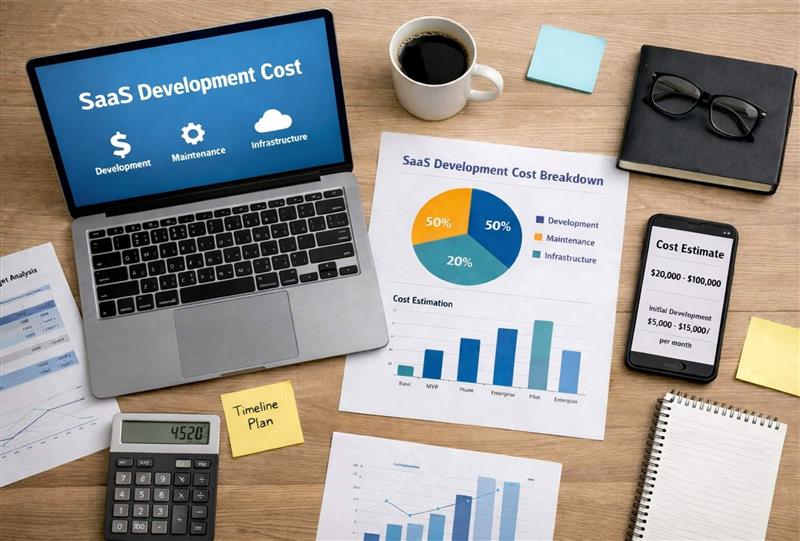
When founders ask what it costs to build a SaaS product, they often receive quotes ranging from $30,000 to well over $1 million for what sounds like the same idea. The gap feels confusing and sometimes frustrating. Two agencies look at identical requirements and return estimates that differ by hundreds of thousands of dollars.
The reality is that saas development cost depends on dozens of variables that most people overlook during early conversations. Simple internal tools can start around $30k. Early-stage B2B MVPs commonly land between $60k and $200k. Enterprise-grade products with complex features and compliance requirements often stretch from $300k to $1 million or more.
For this article, SaaS means multi-tenant, cloud-hosted, subscription-based software that users access through a browser or mobile app without owning the underlying code. This piece walks through the core cost drivers, a stage-by-stage breakdown of development expenses, and practical ways to save money without sacrificing quality. The perspective comes from GainHQ’s experience working directly with SaaS products, not from theoretical models or abstract estimates.
How Much Does It Cost To Develop A SaaS App In 2026?
The saas app development cost in 2026 falls into distinct tiers based on what you are building and who you are building it for.
A validation or prototype tier typically runs from $500 to $5,000. This covers clickable designs in tools like Figma, basic no-code experiments with platforms like Bubble or Webflow, and landing pages to test market interest. A founder validating a scheduling tool might use Figma for mockups, Bubble for a functional prototype, and Stripe test mode for payment flow validation. This tier answers one question: does anyone want this?
The minimum viable product tier ranges from $40,000 to $250,000. This is where you build a real saas product with custom code, user authentication, core business logic, and essential integrations. A B2B workflow SaaS with three user roles, role based access control, and basic analytics fits here. You get a functional product that can onboard paying customers, though the feature set stays focused on core value.
The scaling product tier starts at $250,000 and climbs to $800,000 or higher. This includes multi-tenant analytics platforms with complex permissions, SOC 2 preparation, advanced features like AI-driven insights, and integrations with enterprise systems. Development time extends significantly, and the development team typically includes senior architects alongside frontend and backend developers.
Geography and hourly rates shape these numbers substantially. Teams in Eastern Europe or Asia often charge $40 to $80 per hour. North American and Western European agencies typically bill $80 to $180 per hour. A $150,000 project with a $50/hour team looks very different from the same scope with a $150/hour team.
Early cost clarity comes from narrowing scope and defining what success looks like for your first release. Pushing rates down without adjusting scope usually leads to quality problems that cost more to fix later.
Stage By Stage Breakdown Of SaaS Development Cost
Cost becomes easier to understand when sliced into stages rather than viewed as a single number. The saas development process follows a predictable sequence, and each phase carries its own budget implications. The main stages include discovery and validation, product and UX design, core MVP development, testing and quality assurance, launch hosting and DevOps setup, and ongoing maintenance with future feature work. For a small to mid-sized SaaS, the following breakdowns reflect 2026 market conditions.
Stage-by-Stage Breakdown Of SaaS Development Cost (2026)
Stage
Key Activities
Typical Timeline
Estimated Cost
Discovery And Validation
Market research, user interviews, competitor analysis, persona definition, MVP scoping, early prototypes
1–3 weeks
$3,000 – $10,000
Product And UX Design
User flows, information architecture, wireframes, UI design, interactive prototypes, usability feedback
80–200 design hours
$8,000 – $30,000
Core MVP Development
Backend logic, database setup, API development, frontend UI, authentication, integrations with third party services
New modules, product enhancements, integrations, scalability improvements
Ongoing
$80,000 – $200,000+ annually depending on growth
Discovery And Validation
Structured discovery for a new SaaS typically takes one to three weeks. This phase covers user interviews, competitor analysis, and thorough market research. The goal is clarifying target personas, core value proposition, and the smallest viable feature set.
Budget allocation for this phase typically ranges from $3,000 to $10,000 depending on workshop depth and whether dedicated product strategists participate. Market research at this stage prevents expensive mistakes later.
Non-technical founders can take lean validation steps before hiring a full team. Clickable prototypes using Figma show potential users how the product might work. No-code experiments with tools like Webflow or Bubble test whether the core concept resonates. Landing pages can collect early signups and measure demand.
Allocating budget here saves far more than it costs. Clear discovery prevents misaligned development and reduces the risk of building features nobody uses. The development process benefits enormously from this upfront investment.
Product And UX Design
Typical outputs from this phase include user flows and information architecture, wireframes for main journeys, high-fidelity UI screens, and interactive prototypes for stakeholder and early user feedback.
Realistic effort for a focused MVP runs 80 to 200 design hours. Costs land between $8,000 and $30,000 depending on the project’s complexity and designer rates.
Strong SaaS UX pays dividends through better activation and lower churn. GainHQ helps teams avoid over-designing by focusing only on journeys that directly block monetization or core usage. Design work that does not serve these goals can wait for later iterations.
Core MVP Development Backend Frontend Integrations
Backend development covers user accounts, tenant management for multi-tenant SaaS, business logic, API layer, and database schema. This work typically represents 40 to 60 percent of total build cost on many projects. Backend developers establish the foundation that everything else relies on.
Frontend development builds responsive web UI for primary flows including signup, onboarding, dashboard, and settings. Building for both web and mobile using React Native, Flutter, or native code can double or triple this portion of the budget. Most saas projects benefit from launching web-only initially.
Integrations connect your product to payment gateways, email services, logging and analytics platforms, and single sign-on providers. Each serious integration can take from a few days to several weeks. The mvp development phase requires careful prioritization here.
Combined MVP development estimates for a focused B2B SaaS with a three to five person team run about three to six months. Costs range from $40,000 to $200,000 or more depending on team rates and feature depth. Core features should receive the majority of this investment.
Testing And Quality Assurance
Quality assurance for SaaS combines automated and manual testing approaches. Unit and integration tests protect core flows from regressions. Manual exploration testing catches edge cases that automated tests miss. Performance checks verify the system handles expected concurrent users.
Typical QA investment runs 15 to 25 percent of the total development budget for an MVP. For a $120,000 build, quality assurance might cost $18,000 to $30,000 spread across the project rather than concentrated at the end.
Quality assurance engineers play a critical role in catching issues before they reach users. Cutting QA early often creates hidden costs through production incidents, emergency fixes, and lost user trust. Code quality matters from day one.
Launch Hosting And DevOps Setup
Moving from staging to production requires setting up cloud infrastructure, domains, certificates, and monitoring. Basic CI/CD pipelines enable safer deployments. Backups and logging support incident response when problems occur.
Initial setup typically requires 40 to 120 hours of DevOps and engineering time depending on complexity. Rough cost runs $4,000 to $15,000 at typical 2026 mid-market rates.
Monthly infrastructure costs at launch vary widely. A small MVP with low usage might spend $100 to $300 per month. Active users and data volume can push this to several thousand dollars monthly as the saas platform grows.
Common tools in this space include AWS CloudWatch for monitoring, Datadog for observability, and Sentry for error tracking. Planning for these expenses from the start prevents surprises.
Ongoing Maintenance Support And Future Features
Most SaaS founders under-budget for post-launch expenses. Plan for 15 to 25 percent of initial build cost per year in ongoing maintenance alone.
Typical maintenance tasks include fixing bugs and small UX issues, updating dependencies and libraries, applying security patches, and minor refactors to improve performance. This work keeps the product stable and secure.
Active product growth through new features and modules is separate from maintenance. This often requires a standing development budget each quarter. For an MVP built for $150,000, annual maintenance might run $25,000 to $40,000, excluding major new features. With steady feature work, annual spend could reach $80,000 to $200,000 as the team and user base grow.
User feedback should guide these investments. Building observability and feedback loops early helps you make data-driven decisions about where to invest development resources.
Cost Considerations For Non Technical Founders
Founders without coding backgrounds often worry about being overcharged or locked into the wrong partner. These concerns are valid. The saas software development market includes excellent partners and problematic ones.
Validate demand before committing to custom development. Pre-sales, no-code prototypes, and landing pages can prove market interest with minimal investment. A few hundred dollars spent on validation can save tens of thousands on a product nobody wants.
Learn to read and compare development proposals effectively. Look for clear scope documents, defined milestones, explicit assumptions, and documented exclusions. Vague proposals lead to scope creep and budget overruns. A fixed price quote for a fuzzy idea is a warning sign.
Consider whether equity or cash makes more sense for your situation. A technical co-founder brings more than code. They bring strategic thinking and long-term commitment. Hiring a team costs more upfront but keeps equity intact. Neither approach is universally correct.
Own your documentation, code, and cloud accounts from day one. Work with partners who set up infrastructure in your name. This prevents lock-in and makes transitions smoother if relationships change.
By the time you sign a development contract, you should know your core user, core problem, must-have essential features, budget range, and expected first release date. GainHQ helps translate business goals into realistic roadmaps. We provide more than raw hourly rates. We offer strategic guidance throughout the saas application development journey.
Main Factors That Drive SaaS Development Cost
Most budgets are shaped less by lines of code and more by product decisions made before development starts. Understanding these factors helps you map your own project against realistic cost expectations.
The key factors include product scope and complexity, type of SaaS and domain, feature set and integrations, UI/UX design depth, team structure and location, technology stack and infrastructure, and security compliance and reliability needs. Before requesting quotes from development partners, evaluate your project against each of these areas. This prevents vague ballpark ranges and helps you compare proposals meaningfully.
Product Scope And Complexity
Complexity grows with each extra workflow, user role, and edge case. Counting screens alone does not tell the full story. A simple single-role SaaS that tracks tasks and sends email alerts sits at the lower end. A role-based B2B platform with admins, managers, and end-users, each with different dashboards and permissions, requires significantly more development work. A real-time collaboration tool with live editing and comments pushes complexity even higher.
The estimated cost ranges reflect this progression. A basic internal tool typically costs $30,000 to $80,000. A standard B2B SaaS MVP lands between $60,000 and $200,000. Highly complex, data-heavy systems reach $250,000 to $700,000 or more.
The value of carving out a strict MVP cannot be overstated. Put “nice to have” features into a later phase. This approach keeps initial development costs under control while still delivering something customers can use and pay for. Building a saas product works best when you resist the urge to include everything in version one.
Type Of SaaS Product And Domain
Domain changes the effort required even when feature lists look similar on paper. HR tools operate differently than healthcare platforms, finance applications, or education software.
Horizontal SaaS products like project management tools or CRMs often need broader feature sets but lighter domain-specific rules. Vertical SaaS products built for a niche industry usually require deep custom logic and integrations specific to that field.
Regulated domains increase costs substantially. Healthcare software under HIPAA, fintech products under PSD2, or education platforms handling minors’ data require audits, detailed logging, and compliance documentation. A saas application in these spaces might add 20 to 40 percent to the baseline budget just for compliance-related work.
When evaluating the cost of developing a saas product, factor in the regulatory environment your customers operate within. This affects not just initial development but ongoing maintenance and feature additions.
Feature Set And Integrations
Each major feature cluster impacts cost differently. Authentication systems, billing and subscription management, reporting dashboards, messaging, notifications, file storage, and collaboration tools each require dedicated development time.
Third party integrations can save time compared to building everything from scratch. However, they still require discovery and design work, API implementation, testing, and long-term maintenance. Payment gateways like Stripe or Paddle typically take a few days to a week for basic integration. Email services through SendGrid or AWS SES add similar effort. Single sign-on with identity providers like Okta or Microsoft Entra ID can stretch into two weeks or more for enterprise-grade implementation.
Third party services reduce development time for non-differentiating features, but they add ongoing licensing fees and dependency management. Start with a minimum viable feature set, then layer in more integrations once there is early revenue or traction. This approach keeps initial saas implementation costs manageable.
UI UX Design Depth
Users of SaaS products now expect polished dashboards, responsive design, and frictionless onboarding similar to tools launched after 2020. The days of shipping ugly but functional software are largely over, especially in competitive markets.
Design effort falls into roughly three levels. Basic design provides a functional layout with limited branding and simple onboarding. This suits internal tools or early validation. Product-led growth oriented design adds clear empty states, in-app tours, and thoughtful information hierarchy. This level helps users succeed without hand-holding. Enterprise-grade design involves complex custom dashboards, design systems, accessibility research, and localization work.
Realistic cost ranges for ui ux design span from $8,000 to $20,000 for a lean MVP design cycle. More extensive research with multiple stakeholder workshops can push costs to $40,000 to $70,000 or higher.
Strong SaaS UX pays for itself through better activation and lower churn once the product is live. GainHQ helps teams avoid over-designing by focusing only on journeys that directly support monetization or core usage.
Team Structure And Location
Founders in 2026 face several options for building their development team. Hiring an in house team provides control but requires significant upfront investment and management overhead. Working with a specialized SaaS agency or product studio offers expertise and process. Assembling freelancers provides flexibility but introduces coordination challenges. Many successful projects mix in-house product leadership with an external dev team.
Global rate bands in 2026 look roughly like this. Offshore or nearshore teams typically charge $30 to $60 per hour. Mid-market agencies in Europe or the US bill $60 to $120 per hour. Top-tier consultancies and senior architects command $120 to $180 or more per hour.
The choice impacts more than total cost. Communication overhead, product guidance quality, time zone overlap, and strategic advice all vary by model. A partner who can advise on saas product development strategy provides more value than one who simply writes code to specification.
Team location affects both development expenses and the quality of collaboration. Consider what level of guidance and ownership you need from your partner when making this decision.
Technology Stack And Infrastructure
Common stacks in 2026 include frontend frameworks like React, Vue, or modern meta-frameworks. Backend options include Node.js, .NET, Java, or Python. Databases range from PostgreSQL and MySQL for relational data to MongoDB for flexible schemas. Cloud services typically run on AWS, Azure, or Google Cloud.
Mature, well-documented stacks cut implementation time because developers can leverage existing libraries and community knowledge. Exotic or niche technology choices often raise costs because specialists are harder to find and command premium rates.
Infrastructure costs differ dramatically based on architecture decisions. A small single-tenant system using a basic VPS might run $50 to $100 per month. A multi-tenant SaaS on AWS with auto-scaling, managed database, and CDN can cost several hundred dollars monthly at launch, growing to thousands as active users and data storage needs increase.
Early architecture choices affect long-term costs in ways that are hard to reverse. Scaling, monitoring, backups, and disaster recovery all depend on decisions made during initial development. The tech stack you choose today shapes your software development costs for years to come.
Security Compliance And Reliability
Even simple saas apps must handle secure authentication, proper password storage, encrypted traffic via HTTPS, and basic audit logs. These are table stakes in 2026.
Higher-end requirements include data encryption at rest, field-level encryption for sensitive information, role based access control across multiple tenants, and region-based data residency to keep EU user data in EU servers.
Compliance preparation for standards like GDPR, SOC 2, HIPAA, or PCI-DSS adds tens of thousands of dollars beyond core development. Reaching formal certifications often requires months of process work, security reviews, and monitoring tool implementation.
Investing in security upfront avoids later costs from data breaches, downtime, and forced re-architecture. Cutting corners here creates hidden costs that surface at the worst possible moments. Protecting user data is not optional for any serious saas business.
How To Reduce SaaS Development Cost Without Sacrificing Quality
Reducing SaaS development cost requires strategic planning, disciplined feature prioritization, and smart technology decisions. Businesses that balance cost control with product value can achieve sustainable growth without compromising performance or user experience.
Start With Focused SaaS MVP Development
The most effective way to reduce development costs is by beginning with focused SaaS MVP development. Instead of building a full scale product immediately, teams should identify core features that directly support activation, retention, and billing. A clear understanding of SaaS product development cost helps founders prioritize functionality that delivers measurable value. In the global SaaS market, companies that launch lean MVPs often reach profitability faster because they avoid unnecessary early investments. Minimizing initial costs allows a SaaS company to validate ideas quickly and allocate resources more efficiently.
Use Proven Technologies And Programming Languages
Selecting mature programming languages and stable frameworks significantly reduces risk and development time. Well established technologies offer better documentation, larger developer communities, and easier hiring options. This approach helps teams avoid costly delays caused by experimental tools. Strong technology choices also simplify user management systems, security implementation, and scalability planning. Companies that invest in reliable infrastructure early typically experience fewer technical issues and lower long term maintenance expenses.
Leverage Third Party Tools And Services
Building every feature internally often increases SaaS product development cost unnecessarily. Leveraging third party services for authentication, analytics, payment processing, and communication tools can dramatically reduce development costs. These services provide enterprise level functionality without requiring extensive engineering effort. Integrating reliable external solutions allows development teams to focus on core product differentiation rather than reinventing standard capabilities.
Adopt Agile Development Methodologies And Phased Delivery
Agile development methodologies support incremental delivery and continuous improvement. Instead of committing large budgets upfront, teams can release features in stages, evaluate performance, and refine priorities based on real user feedback. This phased approach helps maintain healthy cash flow by spreading investments over time. A detailed breakdown of development milestones also provides better financial visibility and reduces the risk of overspending.
Invest In Early Research And Data-Driven Decisions
Strong product discovery plays a critical role in reducing unnecessary expenses. Conducting market research, analyzing customer needs, and gathering user feedback before development prevents teams from building unwanted features. Early investment in analytics, monitoring tools, and feedback systems helps teams make informed decisions throughout the product lifecycle. By treating SaaS development as an iterative process, businesses can optimize spending while maintaining high product quality and long-term competitiveness.
Working With GainHQ On Your SaaS Budget
GainHQ approaches early conversations differently than most agencies. Before jumping into estimates, we clarify goals, constraints, and success metrics. Understanding what success looks like for your specific situation helps us provide relevant guidance rather than generic ranges.
We help founders translate ideas into phased roadmaps with clear milestones and budget bands. Developing a saas product works best when both sides understand what each phase delivers and costs. This transparency prevents surprises and builds trust throughout the project.
Our emphasis stays on predictable long-term ownership cost, not just a cheap first release. The cost to build version one matters less than total cost of ownership over three to five years. We help you make architecture and staffing decisions that reduce development time and ongoing expenses.
GainHQ has deep experience with B2B internal tools, workflow automation, and collaboration products. Our saas solutions span multiple industries, and we bring that cross-domain perspective to every engagement. The project manager assigned to your work understands both technical execution and business outcomes.
If you have a rough idea and budget constraints, share them with us. We can sketch a realistic path forward based on your specific situation. There is no one-size-fits-all price for saas app development, but there is a right approach for your particular goals.
FAQ
How Long Does It Take To Build A SaaS MVP In 2026?
A focused saas mvp usually takes three to six months with a dedicated team. Development time depends on feature count, design depth, and integration needs. Very lean prototypes can ship in four to eight weeks. More complex B2B platforms with multiple roles might need six to nine months for a reliable first release.
What Is The Minimum Budget I Should Have To Start A Serious SaaS Project?
Prototypes can be built for under $5,000 using no-code tools and design software. A robust engineered MVP where you own the code usually starts around $40,000 to $60,000 with professional teams. Founders with smaller budgets should narrow scope aggressively, focus on a single audience segment, and use more off-the-shelf services early on.
How Much Should I Budget Per Month After Launch?
A small SaaS might spend $200 to $1,000 per month on infrastructure at low user volumes. Ongoing engineering and product work ranges from $3,000 monthly for a few days of support to $20,000 or more for a small dedicated team. Planning for these saas costs from the start avoids a frozen product that cannot respond to user needs. Launching your product is just the beginning of the investment.
Can I Reduce Cost By Starting With One Platform Only?
Focusing on web first offers the best cost-to-value ratio since everyone can access the product through a browser. Native mobile apps typically add 30 to 70 percent more design and development effort when built from day one.
How Do I Avoid Being Surprised By Extra Costs During Development?
Insist on a written scope document with a clear feature list, explicit assumptions about things like number of roles and integrations, and a defined change-request process for anything new that appears mid-project.
Software development RFPs shape more than project outcomes; they determine strategic partnerships. The global software market reaches toward $1921.33 billion by 2030, according to Grand View Research, yet success depends less on market size and more on finding the right development partner. Quality RFP examples serve as blueprints when procurement deadlines demand swift action.
Your request for proposal extends beyond the requirement lists. The document outlines specific software needs, technical specifications, and expected outcomes that guide vendor selection. Well-structured RFP software development documents create foundations for lasting business relationships built on clear expectations and mutual understanding.
This guide walks you through creating a software development request for proposal that attracts qualified vendors and establishes successful project foundations.
What Is A Software Development RFP
A software development RFP is a formal document that outlines your software development project needs and invites vendor proposals. A strong request for proposal RFP uses a structured approach to define project scope, technical requirements, project goals, and desired outcomes. An effective software development RFP keeps vendors on the same page and supports informed decisions through a clear rfp process.
A well-written RFP includes key components such as an executive summary, detailed information about technical details, selection criteria, submission requirements, and key milestones. Clear project management practices reduce project risks, scope creep, and lost revenue. Careful planning helps vendors understand business goals and propose effective solutions that match your target audience and project lifecycle.
During vendor selection, a focused RFP enables side-by-side comparison of vendor responses. Qualified vendors present software solutions, technical expertise, ongoing support, and risk management plans. A solid RFP increases the chance of choosing the right vendor and building a successful partnership.
Key Differences Among RFP vs RFI vs RFQ
Software procurement demands the right document for each situation. Understanding these three procurement approaches helps organizations select the most effective method for their specific needs. Each document serves distinct purposes throughout the vendor selection journey.
What is an RFI?
RFI (Request for Information) functions as your market exploration tool. Organizations deploy RFIs to gather general information about vendor capabilities, available products, services, and business processes. This document proves especially valuable when exploring unfamiliar software categories or validating industry approaches.
RFIs contain broader, open-ended questions designed to reveal market possibilities. The document typically includes:
Company background information
General project or business needs
Broad capability requirements
Questions about vendor qualifications and experience
Response submission guidelines
What is an RFQ?
RFQ (Request for Quotation) targets pricing information from potential suppliers. Organizations issue RFQs when requirements are clearly defined and cost comparison becomes the primary concern. Unlike comprehensive software development RFPs that seek detailed solutions, RFQs focus on straightforward pricing for specific requirements.
A typical RFQ document includes:
Detailed product or service specifications
Precise technical requirements
Quantity and delivery expectations
Payment terms and conditions
Evaluation criteria focused on pricing
When to use each document
Document selection depends on project clarity and procurement objectives.
Use an RFI when:
Exploring new software categories or emerging technologies
Still defining project requirements and scope
Building qualified vendor shortlists
Comparing different problem-solving approaches
Needing market guidance on available solutions
Use an RFQ when:
Project requirements are finalized and clearly defined
Ready to compare supplier costs for identical specifications
Purchasing standardized software or services
Running competitive bidding processes focused on price
Validating budget estimates before final approval
Use an rfp template for software development when:
Seeking detailed proposals for complex projects
Looking for strategic partners rather than suppliers
Evaluating vendors on multiple factors beyond price
Needing customized solutions that require vendor creativity
Projects involve significant investment and organizational impact
Procurement typically follows a logical sequence. Organizations start with RFIs for market exploration, then progress to RFPs for complex projects requiring tailored solutions or RFQs when requirements are standardized and price determines selection.
Technical expertise, support offerings, risk management, and selection criteria
Pricing and delivery terms
Output
Vendor shortlist
Best vendor for custom software development
Lowest or most competitive quote
Ideal For
Exploring software categories or ERP system options
Strategic partnerships and innovative solutions
Standardized products or services
For software development projects specifically, document choice depends on requirement clarity and solution complexity. Well-defined requirements with straightforward solutions favor RFQs, while complex projects with multiple solution approaches benefit from comprehensive RFPs.
Steps To Create A Software Development RFP
Effective software development RFP creation follows a systematic approach. Each step builds upon the previous one, creating a document that attracts the right vendors while establishing clear project foundations.
1. Discovery And Stakeholder Alignment
Successful software development request for proposal outcomes start with comprehensive stakeholder engagement. Identify everyone who influences or gets affected by the project, product owners, project managers, engineers, end-users, and executives.
Gather diverse perspectives on project requirements
Build internal consensus before vendor outreach
Surface potential challenges early
Ensure RFP accuracy reflects organizational needs
This phase establishes ongoing stakeholder involvement throughout the RFP process. Procurement experts note that “a high-performing RFP process starts with clarity on roles, expectations and influence”. Create a stakeholder influence matrix to secure buy-in from key decision-makers and prevent resistance later.
2. Define Project Goals And Scope
Clear project articulation becomes possible once stakeholders align. Your rfp template for software development requires precise scope definition.
The project scope statement anchors your RFP, defining “everything that’s needed to complete a project, including tasks, time, and resources”. Proper scope definition keeps teams focused while ensuring on-time, on-budget delivery.
Begin with an executive summary covering your company and project objectives. Define specific problems the software must solve, such as process automation, enhanced customer interactions, or advanced analytics capabilities.
The Project Management Institute (PMI) reports that 52% of projects experience scope creep. Well-defined scope in your software development RFP prevents this issue by establishing clear boundaries upfront.
3. Set Budget And Timeline Expectations
Financial transparency drives better vendor responses to your request for proposal for software development. While vendors may suggest various pricing models, realistic budget ranges help them tailor appropriate solutions.
Cost breakdowns for development, testing, deployment, and maintenance
Establish clear timelines with defined milestones. Structure the project in phases: user-centered design, development, testing, and deployment, with specific deadlines. This approach maintains project momentum while helping vendors evaluate their capacity to meet expectations.
Timeline details should cover RFP process deadlines, vendor selection periods, and projected project kickoff dates.
4. Assign RFP Ownership
Designate clear ownership for RFP creation and evaluation. The individual or team leading this process requires both organizational knowledge and project expertise.
Effective RFP owners demonstrate:
Agile methodology and software development understanding
Decision-making authority or direct access to decision-makers
Strong communication skills for stakeholder coordination
Technical proposal evaluation capabilities
Complex projects benefit from specialized team roles. The Project Management Institute recommends “including the project manager, a business sponsor representative, business subject matter experts, technical analysts, and part-time internal technical consultants from the technical infrastructure group”.
Maintain structured communication and documentation throughout the process. Document every clarification and share consistently among bidders to ensure fairness and transparency.
What to Include in Your RFP Document
Your software development RFP succeeds through strategic content organization. Each section guides potential partners toward solutions that align with your business objectives while demonstrating your project’s strategic importance.
Statement of purpose
Open with clarity about your project’s intent. This foundation section explains what you need from development partners and establishes the business context for your software initiative. Consider this your opportunity to frame the relationship from the start.
Your statement should address:
Organization introduction and project rationale
High-level business objectives driving the initiative
Core problems the software will solve
This opening sets expectations for your entire software development request for proposal. Vendors quickly assess project alignment with their expertise while understanding your strategic priorities.
Company Background
Provide business context that helps development teams understand your operational environment. This information enables partners to propose solutions that fit your organizational culture and industry requirements.
Share relevant details about:
Industry focus, company size, and market position
Mission, values, and strategic direction
Target customers and user base
Department or team leading the initiative
As procurement experts note, “describing your business unit or department and how it fits into the grand scheme of things will help level the playing field and introduce new players to the competition”. Context enables vendors to craft responses that address your specific business environment.
Project Overview And Goals
Define your software development objectives with measurable outcomes. Clear goal articulation helps vendors propose solutions that deliver genuine business value rather than generic capabilities.
Focus on these elements:
Specific business outcomes you expect to achieve
Three to five measurable results, including ranges when appropriate
Primary users and critical workflows
Current system limitations or operational challenges
“The more specific you can be, the better quality of your received bids”. Detailed requirements attract vendors who specialize in your type of solution while filtering out those offering misaligned services.
Scope And Deliverables
Establish project boundaries through detailed scope definition. This section protects both parties by clearly outlining what falls within the engagement and what remains outside the development partnership.
Structure your scope around:
Included features and capabilities versus excluded elements
Essential functionality versus beneficial additions
Required tools, systems, or third-party integrations
Project phases with specific deliverables for each stage
Remember to “separate must-haves from nice-to-haves” so development teams understand your priorities and can propose cost-effective solutions for core requirements.
Technical And Infrastructure Needs
Specify the technical foundation required for your software solution. This information helps development partners assess compatibility with your existing systems and propose appropriate, scalable software architectural approaches.
Integration needs with existing or third-party systems
Hosting preferences and cloud infrastructure responsibilities
Security standards, compliance requirements, and data handling protocols
Include infrastructure requirements that ensure solution reliability and security. However, “do not include any requirements that are not really needed but add complexity to the proposed solutions that will drive up the cost unexpectedly”.
These five components create an rfp template for software development that attracts qualified partners while establishing clear expectations for successful project delivery.
How To Structure The RFP For Better Vendor Responses
Document structure determines response quality. Your software development RFP format and organization directly influence how potential partners understand your needs and craft their proposals.
Bid Format And Submission Guidelines
Submission clarity eliminates confusion while ensuring comparable proposals. Specify vendor response formats with precision:
Required file formats (PDF, Word, or both)
Maximum page or word counts for each section
Specific templates that must be followed
Instructions for supplementary materials like case studies
Digital submissions dominate 2026 procurement; email, dedicated portals, or specialized RFP management software handle most exchanges. Include detailed electronic submission requirements and security protocols vendors must follow.
“Ensure you meet all submission guidelines” remains fundamental for vendors, as non-compliant proposals face automatic disqualification regardless of quality.
Evaluation Criteria And Scoring
Transparent evaluation criteria provide vendors with decision-making insights. Sharing your scoring approach demonstrates fairness while helping respondents emphasize strengths most relevant to your priorities.
Clear distinction between mandatory requirements and preferred capabilities
Defined scoring scales with explicit descriptions for different score levels
Procurement experts note this transparency “helps vendors understand exactly how they are being scored, and know how they might fare ahead of time”. Weighted scoring systems ensure critical factors appropriately influence final decisions.
Response Timeline And Deadlines
Strategic timelines balance efficiency with quality preparation time. Your RFP should outline:
Question submission deadline and answer distribution timeline
Intent to bid notification deadline (if applicable)
Final proposal submission date with specific time and timezone
Evaluation period and vendor selection notification date
Expected contract award and project kickoff dates
Provide vendors 2-4 weeks for complex RFP responses. Requesting detailed proposals in under 5 business days signals poor planning and limits response quality. “Set realistic deadlines for vendor responses. Most vendors can respond within reasonable timeframes when given clear expectations and sufficient time”.
Contact Information And Q&A Process
Structured communication channels prevent miscommunication while ensuring consistent vendor information access. Establish:
Single point of contact for all RFP-related questions
Specific methods for submitting questions (email, portal, etc.)
Question submission deadlines
Answer distribution methods and timing
Central contact designation maintains process continuity. Collect vendor questions together and distribute answers to all participants simultaneously to ensure fairness. This approach maintains equal information access across all potential partners.
These structural components of your request for proposal for software development create frameworks that encourage high-quality responses while simplifying evaluation processes.
How To Use A Software Development RFP Template
Building a software development RFP from scratch demands significant time and specialized knowledge. Templates provide tested frameworks that accelerate this process while ensuring nothing critical gets overlooked. These structured documents serve as your foundation, ready for customization to match your specific project requirements.
Benefits Of Using A Template
Templates deliver value that extends well beyond time savings. Your request for proposal for software development benefits from proven structures that eliminate guesswork and reduce preparation time substantially. Software categories often include 3,000 or more evaluation criteria, making comprehensive coverage nearly impossible without structured guidance.
Standardized formats ensure vendor responses arrive in comparable formats. This consistency allows you to quickly identify which proposals align with your requirements while simplifying the evaluation process.
Well-designed templates function as detailed checklists for software features commonly available in specific categories. You can systematically review and select needed capabilities, ensuring critical requirements don’t slip through the cracks. This methodical approach leads to more informed decision-making throughout the vendor selection process.
Template customization forces teams to examine projects holistically. Working through each section clarifies requirements and expectations, leading to deeper understanding of desired outcomes.
Where To Find Reliable Templates
Quality software development RFP templates come from several trusted sources. The Technology Evaluation Center (TEC) offers 69 different data-driven enterprise software templates across various industries and business sizes. Each template contains thousands of category-specific terms matched to particular software products.
Government websites provide standardized procurement templates meeting public sector requirements. UK public sector organizations can access templates incorporating the Procurement Act 2023, social value requirements, and cybersecurity principles.
Industry associations and professional procurement organizations maintain template libraries for members. These collections often include specialized versions for different software development project types.
Software development companies frequently offer free templates as marketing tools. While these resources can prove valuable, verify that they don’t contain biases toward specific methodologies or vendor solutions.
How To Customize A Software Development RFP Template
Start by selecting the template most closely matching your specific needs. Manufacturing organizations might choose from discrete ERP, process ERP, or small business ERP templates.
Replace placeholder content with your actual requirements once you’ve chosen your base template. Review each section carefully to ensure relevance to your project and organizational context.
Set evaluation criteria and adjust weightings based on your priorities. This clarity helps vendors understand assessment methods and enables objective proposal comparison.
Include your organizational context, background information, current systems, and strategic objectives. This context helps vendors understand your business environment and tailor their responses appropriately.
Balance structure with flexibility throughout customization. Overly rigid templates might miss innovative approaches, while vague templates could invite misaligned proposals. Your ideal software development rfp template provides a comparison structure while allowing vendors to demonstrate their expertise.
Customize response formats for maximum effectiveness. Standardized vendor responses enable objective comparison. Allow creative proposals by requiring structured baseline responses while permitting additional “options” sections for vendor improvements or alternatives.
Best Practices For Writing A Strong RFP
Exceptional software development RFPs separate successful projects from costly failures. Quality vendor responses depend on how clearly you communicate your needs and expectations.
Avoid Vague Language
Precision drives results. Replace ambiguous terms like “modern” or “user-friendly” with specific functionalities and performance expectations. Rather than requesting “good security,” specify “multi-factor authentication with role-based access controls.” Clear requirements help vendors propose targeted solutions that address your actual needs instead of generic offerings.
Separate Must-haves From Nice-to-haves
Priority clarity guides vendor focus. Structure your rfp template for software development by distinguishing non-negotiable features from beneficial additions. This approach allows vendors to understand your core requirements and propose solutions that meet essential needs while potentially suggesting creative approaches for secondary features.
Be Realistic With Timelines And Budgets
Financial transparency builds trust. Share your budget range to help vendors tailor proposals within your constraints. Provide vendors with 2-4 weeks to respond to complex RFPs; rushed timelines often produce vague responses or limit quality submissions. Realistic expectations attract serious partners who can deliver meaningful results.
Encourage Innovation From Vendors
The strongest software development RFP balances structure with flexibility. While clear requirements matter, vendor creativity often yields unexpected benefits. Focus on describing problems rather than prescribing exact solutions. Explain the “why” behind your requirements to empower vendors to propose innovative approaches that might exceed your initial expectations.
These practices help your request for proposal for software development attract qualified vendors with aligned solutions while reducing the risk of misunderstandings or project delays.
Common Mistakes To Avoid In RFPs
Strategic partnerships require precision. Even well-intentioned software development RFP documents can miss their mark when common pitfalls derail the process. Recognizing these challenges early protects your procurement investment and attracts quality vendor responses.
Overloading With Unnecessary Details
Focused communication beats information overload. Cluttering your rfp template for software development with excessive details obscures what matters most to potential partners. Procurement experts confirm that clear, concise RFPs outperform documents filled with unnecessary information. Vendors encounter RFPs loaded with technical jargon and filler content that dilute core requirements daily.
Simple, direct language works. Replace industry buzzwords with concrete examples and measurable results. Pursuit teams juggle multiple active proposals while managing existing project responsibilities. Your focused RFP respects their expertise and yields stronger responses.
Ignoring Internal Alignment
Internal consensus drives external success. Up to 40% of RFPs remain unawarded due to insufficient preparation, with misaligned stakeholders being a primary factor. Your request for proposal for software development needs unified organizational support to achieve meaningful outcomes.
Secure departmental agreement on project scope, expectations, and evaluation criteria before vendor outreach. Technical teams and end-users must share a common vision. Genuine stakeholder buy-in creates the shared commitment essential for complex software development initiatives.
Not Defining Evaluation Criteria
Clear criteria eliminate confusion and challenges. Vague requirements undermine vendor confidence and invite procurement disputes. The Government Accountability Office regularly cites “flawed technical evaluations” among the top protest grounds, often stemming from unclear vendor guidance.
Transparent scoring systems benefit everyone. Weighted categories reflecting your priorities (technical capability: 40%, cost: 30%, etc.) help vendors understand evaluation standards. This clarity focuses proposals on elements that matter most to your organization’s success.
Failing To Follow Up With Vendors
Professional follow-up maintains momentum. Many organizations submit their software development request for proposal, then go silent, missing critical engagement opportunities. Strong proposals lose impact without proactive communication.
Send confirmation messages after submission deadlines, offering clarification opportunities. This practice demonstrates professionalism while keeping communication channels active. Organizations that neglect vendor follow-up limit their ability to identify the most suitable development partners.
Final Thoughts
A strong software development RFP strengthens vendor selection and supports informed decision-making across the project lifecycle. Clear project scope, technical requirements, and evaluation criteria help vendors understand business goals and propose effective solutions. A structured rfp process reduces project risks and builds a successful partnership.
Careful planning, realistic timelines, and a well written rfp document attract qualified vendors. This structured approach improves project management outcomes, aligns stakeholders, and ensures custom software development delivers measurable value with long-term ongoing support.
FAQs
u003cstrongu003eCan Small Businesses Use A Software Development RFP For Limited Budgets?u003c/strongu003e
Yes, small businesses can use a software development RFP even with limited budgets. A focused RFP clarifies project scope, technical requirements, and business goals, which helps attract suitable vendors and control project risks during the project lifecycle.
u003cstrongu003eIs A Software Development RFP Required For Every Software Project?u003c/strongu003e
No, not every software development project requires a formal document. Simple software projects with clear specifications may only need an RFQ, while complex custom software development initiatives benefit from a strong RFP and structured vendor selection.
u003cstrongu003eHow Long Should Vendors Take To Submit RFP Responses?u003c/strongu003e
Vendors typically need two to four weeks for quality RFP responses on complex software development projects. Adequate time allows vendors to review technical details, assess project scope, and prepare a proposed solution aligned with evaluation criteria.
u003cstrongu003eCan A Software Development RFP Help With Risk Management?u003c/strongu003e
Yes, a well-written RFP supports risk management by defining technical requirements, key milestones, and selection criteria early. Clear documentation reduces scope creep, prevents lost revenue, and minimizes potential roadblocks during the project lifecycle.
u003cstrongu003eWhat Role Does A Product Manager Play In The RFP Process?u003c/strongu003e
A product manager connects business goals with technical terms inside the RFP document. The role ensures vendors understand pain points, target audience needs, and desired outcomes, which improves vendor responses and supports informed decision-making.
u003cstrongu003eShould Data Migration And Version Control Be Included In The RFP?u003c/strongu003e
Yes, data migration and version control details should appear in a software development RFP. Clear technical requirements around system transitions and code management help vendors propose effective solutions and avoid project risks.
u003cstrongu003eHow Do You Shortlist Qualified Vendors After Receiving Proposals?u003c/strongu003e
Shortlisting qualified vendors requires a side-by-side comparison based on evaluation criteria, technical expertise, support offerings, and vendor experience. A structured scoring model helps identify the best vendor for a successful partnership.
Every founder and product leader eventually faces this question: should we build our software with an in house development team or outsource the work to an external partner? The answer shapes your budget, your speed to market, and how much control you retain over your product.
This guide compares in house vs outsourcing software development across cost, speed, control, security, and customer experience impact. The focus is on SaaS companies and support teams planning new tools or product upgrades for 2026.
Outsourcing typically wins on short-term cost efficiency and faster time to MVP, while in house development wins on long-term control, culture fit, and deep product knowledge.
Many modern SaaS companies end up with a hybrid model, keeping core customer-facing logic in house and outsourcing surrounding components, integrations, or specialized features.
The right choice depends on your stage, funding, and how central software is to your customer experience and revenue.
Selecting the right outsourcing partner requires clear contracts, shared metrics, and deliberate knowledge transfer plans.
The final sections show how to make a practical decision and how Gain HQ supports businesses that choose to outsource or augment their internal teams.
What Is In-House Software Development?
In house software development means hiring and managing your own full-time engineering team on your payroll. This includes developers, QA engineers, DevOps specialists, and product managers who build and maintain your software. For SaaS companies, this might be your core platform, customer portal, or custom helpdesk.
This model is common when the product is the business. A startup launching a customer support platform treats its codebase as a core asset. The software development process becomes inseparable from the company’s identity and competitive advantage.
For small and mid-sized businesses, a typical in house team starts with 2 to 6 engineers plus a product owner. As the product and user base expand, teams grow into larger squads with specialized roles.
In house teams usually handle the entire development process from start to finish. This includes discovery, design, development, deployment, bug fixing, performance tuning, and continuous feature delivery based on customer feedback and support data.
The benefits and trade-offs of this approach go beyond simple control. Long-term ownership and knowledge retention become strategic assets over time.
Benefits of In-House Software Development
In house software development is often chosen when technology and customer experience are strategic differentiators rather than just line items in an IT budget.
Deep alignment with business and customer support goals is one major advantage. Internal engineers can sit with support agents, observe real tickets, and quickly ship improvements to things like SLAs, canned responses, and reporting dashboards. This deep understanding of daily operations translates into better product decisions.
Stronger control and ownership is another significant benefit. Roadmap priorities, architecture decisions, and data storage stay completely under your direct control. This matters when dealing with sensitive customer conversations and support history. You have complete control over what gets built and when.
Rapid iteration becomes possible with an in house team. A SaaS company in 2026 could ship small weekly updates to its helpdesk workflow engine or knowledge base search based on NPS feedback. No external approvals or contract amendments required.
Cultural fit and collaboration come naturally. In house teams attend the same all-hands meetings, share the same KPIs like first response time, and build a shared understanding of what great customer support means for the brand. This alignment with company culture strengthens over time.
Long-term talent building creates cumulative value. Hiring software developers who specialize in your specific domain, whether that is B2B support automation, omnichannel ticketing, or analytics, builds expertise that compounds over several years. This deep domain knowledge becomes a competitive advantage.
Challenges and Costs of In-House Development
In house development offers control at a financial and operational cost. This can be heavy for startups and growing support teams working with limited runway.
Total cost of ownership includes many components beyond salaries. You need to account for employee benefits, recruitment expenses, onboarding time, tooling for CI/CD and observability, test automation platforms, and potential office space or remote-work stipends. In 2026 markets like the US or Western Europe, these costs add up quickly.
Time-to-hire presents a real challenge. Hiring a mid-level backend engineer in competitive markets can take 2 to 4 months. This delays projects like revamping a ticket routing engine or building a self-service portal. The hiring process itself consumes significant leadership attention.
Skills coverage is often limited in small teams. You might lack certain specialties like advanced analytics, AI-based reply suggestions, or mobile apps for agents. This can slow innovation in customer support tooling when you need specialized expertise quickly.
Risk concentration is a serious concern. If one or two key engineers leave, knowledge about integrations with email, chat widgets, or CRM platforms can walk out with them. This disruption affects your ability to maintain and improve your software project.
Ongoing leadership overhead compounds the challenge. Product and engineering leaders must continually manage career growth, performance reviews, technical debt, and security updates. This can distract founders who should focus on revenue and customer success.
What Is Outsourcing Software Development?
Outsourcing software development means hiring an external company, agency, or distributed team to design, build, and often maintain your software. Instead of staffing a full in house engineering department, you contract with an outsourcing partner who provides the development team.
Outsourcing models include onshore (same country), nearshore (similar time zone, such as Central Europe for EU clients), and offshore (larger time zone differences, such as South Asia or Latin America for US businesses). Each model offers different trade-offs between cost, communication, and overlap.
Typical engagement patterns relevant to SaaS and support teams include building an MVP for a new customer portal, creating a standalone mobile app for agents, or integrating an existing helpdesk with CRM, billing, or analytics platforms. These defined project requirements make outsourcing straightforward to scope.
Many companies with small internal teams outsource specific parts of the stack while keeping core product decisions in house. You might outsource mobile development, AI-driven ticket classification, or reporting dashboards while your own internal team handles the core platform.
The following subsection outlines the advantages and risks of software development outsourcing.
Benefits of Outsourcing Software Development
Outsourcing appeals to fast-moving companies that want to ship usable software solutions within months, not years, and avoid building a large payroll early.
Access to a global talent pool is a primary advantage. Outsourcing lets you tap into engineers experienced with customer support platforms, chat integrations, SLA engines, or AI chatbots without going through months of recruiting. You can access specialized skills that would be difficult or impossible to find locally.
Faster project kickoff accelerates your timeline. A software development company can often start discovery within 2 to 3 weeks. This helps a support team launch a new customer portal or internal tool in a defined timeline rather than waiting months to build an internal trends of development.
Cost savings can be substantial. According to industry research, outsourcing can reduce development costs by up to 53% compared to in house hiring. A mid-sized company in 2026 saves on long term commitments like benefits and permanent roles by engaging a nearshore dedicated team for a 9 to 12 month project instead of hiring 4 to 5 full-time employees.
Scalability provides operational flexibility. Outsourcing partners can increase or decrease team size as the project moves from initial build to maintenance. This helps when adding or pausing features like live chat, social channel integrations, or advanced reporting. You avoid the organizational strain of hiring and potentially laying off staff.
Specialized expertise reduces risk for first-time builders. Many vendors bring battle-tested patterns for multi-channel ticketing, workflow engines, SSO, or GDPR-compliant data handling. Their software development team has completed similar projects for other clients, bringing proven approaches to your project.
Risks and Limitations of Outsourcing
Outsourcing is not risk-free and depends heavily on selecting a reliable outsourcing partner and engagement model.
Communication and time zone differences can slow decisions. Misaligned working hours and unclear project requirements can delay features like escalation rules or SLA thresholds. Language barriers compound the problem when developers and product owners struggle to communicate nuances.
Control and visibility are reduced compared to in house development. Product leaders may feel they have less direct control over day-to-day technical decisions. This affects priority alignment for support tooling and can lead to architectural decisions you disagree with.
Security and compliance concerns require careful attention. When customer conversations, contact data, or ticket history flow through an outsourced development team, contracts, NDAs, and technical safeguards become critical. You need to verify security certifications and data handling policies.
Hidden costs can erode initial cost savings. Travel for workshops, extra project management, tool licenses, or rework due to misunderstood project scope can add up. Without clear boundaries, budgets can overrun quickly.
Mitigating these risks requires clear SLAs, regular demos, shared product metrics like CSAT or response times, and explicit ownership of code and documentation. Finding the right outsourcing partner who aligns with your business goals makes a significant difference.
In-House vs Outsourcing: Side-by-Side Comparison for 2026
This comparison focuses on factors most relevant to SaaS and customer support leaders: cost, speed to impact, talent, control, security, and support operations.
Each factor has conditions where one model tends to win. Context matters more than absolute rules. Company size, runway, and product maturity all influence the right choice for your business needs.
The examples below relate to helpdesk features, support automation, and customer engagement. Many companies combine both models, such as an in house core platform with outsourced analytics or mobile apps.
Cost and Budget Predictability
Cost is usually the first lens founders and support leaders use when comparing in house and outsourced development.
Typical in house cost components include base salaries in key regions, employee benefits, bonuses, hardware, software licenses, and long term commitments like severance or retention plans. Office space adds another layer of fixed costs.
Outsourcing concentrates costs into contracts and invoices. This makes short-term budgeting easier but requires close scope control to avoid overruns. You pay for defined deliverables rather than ongoing salaries.
Consider a 12 to 18 month example. A small internal team building a custom integration-heavy helpdesk might cost $600,000 to $900,000 including salaries, benefits, and overhead. An outsourced team delivering the same scope might cost $300,000 to $500,000, depending on location and complexity.
Over a 5+ year horizon, a strong in house team can become more cost effective. This is particularly true if continuous innovation on customer experience is required and you need that deep understanding of your product that only comes from long term commitment.
Speed to Market and Iteration
Speed matters when launching new customer support features ahead of competitors. In crowded SaaS segments, first-mover advantage can determine market position.
Outsourcing can get a v1 of a customer-facing portal, chatbot, or ticketing extension live in 3 to 6 months. The external teams already have established development processes and tooling. They do not need time to figure out how to work together.
In contrast, in house teams may need time to complete the hiring process, set up environments, and align internally. Once established, however, they can iterate weekly with tight feedback loops.
A common pattern: a company outsources the first version of a knowledge base system, then gradually moves feature ownership to an internal team as they grow. This balances speed with long-term control.
For urgent, date-driven launches like a compliance change in early 2026, outsourcing may be the only way to hit deadlines if internal capacity is limited. External partners can often focus solely on your project during critical sprints.
Access to Talent and Specialization
The global shortage of experienced engineers continues, especially those with technical expertise in AI, automation, and complex B2B integrations.
In house hiring allows careful selection for cultural fit and long-term potential. You build a team that truly understands your business objectives. But this process can be slow and expensive in competitive markets.
Outsourcing partners can supply niche roles without permanent hires. AI engineers for auto-tagging tickets, data engineers for support analytics, or mobile developers for agent apps become available through your external partner without months of recruiting.
Mature companies often use in house staff for core domain logic like SLA engines, routing, and account hierarchy. They use outsourced specialists for one-off initiatives, experiments, or areas requiring specialized expertise they lack internally.
Knowledge transfer is essential. Ensuring outsourced experts document their work allows the internal team to operate and extend it later. This protects your investment and maintains internal capabilities.
Control, Collaboration, and Culture
Control and collaboration are critical for products tightly linked with customer support quality and brand experience.
In house teams sit closer to support leaders. They can join customer calls, watch live chats, and respond quickly to UX friction in areas like ticket views or reporting. They have project management tools integrated with your existing workflows.
Outsourced teams, even well-managed ones, may not share the same depth of context. They require more formal specifications and scheduled check-ins. A project manager on both sides helps coordinate, but some friction is inevitable.
Modern collaboration tools like Slack, Teams, and Jira reduce friction with external partners. Still, they do not fully replace hallway conversations or ad-hoc whiteboard sessions that in house teams enjoy.
Culture matters too. In house engineers feel part of the brand’s story and mission. Outsourced teams need deliberate onboarding to understand voice and values, especially for customer-facing features. Building that understanding takes intentional effort.
Security, Compliance, and Customer Data
For any software handling customer conversations, attachments, and PII, security and compliance must shape the decision between in house vs outsourcing.
In house teams give tighter physical and logical control over access to logs, databases, and support transcripts. This helps when complying with regulations like GDPR or local data residency rules. Quality control over security practices stays entirely in your hands.
Outsourcing requires rigorous vendor assessment. You need to verify security certifications, encryption practices, audit logs, and contract clauses covering data protection and IP ownership. Large software outsourcing companies typically invest heavily in these measures.
An example: a company storing EU customer support data might choose an outsourcing partner that can host and process data within EU-based infrastructure under strict access controls. This satisfies compliance while still leveraging external development capacity.
Hybrid approaches are common. Companies keep the core ticket store in house while outsourcing non-sensitive modules like dashboard UI or mobile clients that rely on hardened APIs.
When Should You Choose In-House vs Outsourcing?
There is no universal winner. The decision depends on your stage, funding, and how central software is to customer experience and revenue.
Consider an early-stage SaaS startup with fewer than 20 employees. Outsourcing the first version of a support portal to hit market in under six months makes sense. You do not have time for in house hiring when validating product-market fit. As traction builds, you slowly bring critical skills in house and build your own internal team.
Now consider a mature B2B SaaS company where customer support tools directly drive retention, net revenue retention, and brand differentiation. Forming an in house product and engineering group around these features makes strategic sense. The long term projects require deep product knowledge that external teams struggle to match.
Practical triggers for shifting models include hitting a stable MRR level, needing strict control over SLAs, or planning large-scale platform refactors. Each of these might push you toward more in house development even if you started with outsourcing.
Decision Factors and Simple Evaluation Framework
A straightforward framework helps founders and product leaders evaluate their options in a workshop or leadership meeting.
Rate your project on these dimensions using a simple 1 to 5 scale:
Dimension
Low Score Suggests
High Score Suggests
Strategic importance
Can outsource
Keep in house
Urgency
Build internally
Outsource for speed
Internal skills available
Outsource to fill gaps
Use existing team
Budget/runway constraints
Outsource for cost efficiency
Invest in long term team
Data sensitivity
Manageable with contracts
Keep complete control
Interpretation is straightforward. If a project scores high on strategic importance and data sensitivity but low on urgency, in house or hybrid is likely the better path. If urgency and skills gaps score high, outsourcing looks more attractive.
Revisit this scoring every 6 to 12 months. Product maturity and team capability change over time. What made sense at seed stage may not make sense at Series B.
Companies can start with a targeted outsourced engagement like discovery, prototyping, or building one feature before committing to a bigger direction. This reduces risk while gathering data for the larger decision.
Considering a Hybrid Approach
Many 2026 SaaS and customer support organizations run hybrid models. They combine a small core in house team with one or more outsourcing partners for maximum flexibility.
A hybrid approach might look like this in practice: internal engineers own the helpdesk core platform, automation rules, and customer data model. Outsourced teams build mobile apps, chat widgets, or analytics add-ons. Each group focuses solely on their area of strength.
A company might use in house developers to maintain critical SLAs and stability while relying on a nearshore vendor to experiment with AI reply suggestions, ticket categorization, or customer satisfaction prediction. This lets you innovate without overwhelming your internal development team.
Coordination needs are real. Clear boundaries of ownership, shared coding standards, joint planning rituals, and a single product backlog prevent duplication and confusion. Both teams need visibility into the entire project.
Choosing hybrid is not a compromise. It is a deliberate strategy to balance control, speed, and cost effective solution delivery. Many successful SaaS companies operate this way permanently.
Practical Tips for Making Hybrid Work
Here is hands-on advice for running a successful hybrid model.
Define core vs non-core early. List which components must stay in house, such as authentication, core support data, and billing integration. Identify which can be outsourced safely, like reporting dashboards or mobile clients.
Use shared repositories, CI pipelines, and documentation. This allows in house and external engineers to collaborate smoothly on the same codebase. Project management tools should be accessible to everyone.
Establish clear governance. Regular demos, architecture reviews, and a single person accountable for product outcomes across all teams prevent miscommunication. The project’s success depends on this coordination.
Plan for knowledge continuity from day one. When an outsourced engagement ends, your internal team needs to continue operating and evolving the codebase. Documentation and paired work during the engagement make this transition smooth.
How Gain HQ Helps You Navigate In-House vs Outsourcing Decisions
Gain HQ partners with companies that want to build or modernize their software products. The team brings particular experience in SaaS and customer-facing solutions such as helpdesks, support automation, and internal tools.
Gain HQ runs discovery workshops to clarify whether a client should invest in a permanent in house product team, outsource a full build, or opt for a hybrid setup. This upfront clarity prevents expensive course corrections later.
The team brings experience from multiple projects involving ticketing systems, knowledge bases, customer-facing portals, and workflows. Clients do not need to reinvent patterns for SLAs, routing, or feedback management. Proven approaches accelerate delivery.
Gain HQ can operate as a dedicated outsourced team or as an extension of an internal engineering group. The team fits into existing processes and tools while keeping focus on business outcomes like reduced handling time and improved CSAT.
Security and IP receive serious attention. Clear contracts, data protection commitments, and full code ownership for the client protect your interests. This matters when building systems around customer conversations and support history.
If you are evaluating in house vs outsourcing for a 2026 initiative, consider speaking with Gain HQ about your roadmap and constraints. A conversation about your business objectives can clarify the right path forward.
FAQ
This FAQ addresses common questions not fully covered above, especially for founders and support leaders making their first build vs buy vs outsource decision.
Is It Realistic for a Small Startup to Build a Full Helpdesk or Customer Portal in House?
It is possible but demanding. A small team might manage a focused MVP over 6 to 12 months, but maintaining multi-channel support, automation, and analytics long term often stretches limited engineering capacity.
Many early-stage teams start with a combination of existing SaaS tools and targeted outsourced development instead of a full custom platform from day one. This balances customization with practicality.
How Do I Protect My Intellectual Property When Outsourcing Software Development?
Use detailed contracts that specify IP ownership, code access, and transfer rights. Include NDAs for all vendor staff who can see code or customer data.
Keep repositories under your control, enforce secure access through role-based permissions, and ensure all third-party components are licensed appropriately for commercial use. The entire project deliverables should transfer to you upon completion.
What Skills Should I Hire for First if I Am Building an In House Team Around Customer Support Tools?
Start with a product-minded technical lead or senior full-stack engineer plus one or two developers who understand web technologies. Experience with integrations for email, chat, and CRM systems is valuable.
As the product grows, add QA, DevOps, and data/analytics skills to support reliability and insights into support performance. This builds a complete internal development team over time.
Can I Switch from Outsourcing to In House Without Losing Momentum?
Smooth transitions are possible if knowledge transfer is planned from the start. This requires documentation, code reviews, and paired work between outsourced and internal engineers throughout the engagement.
Many companies run a 2 to 3 month overlap where both teams collaborate before fully shifting ownership. This prevents knowledge gaps and maintains development velocity.
How Do Support Metrics Change Depending on In House vs Outsourced Development?
Metrics like first response time, resolution time, and CSAT depend more on process and product quality than on who wrote the code. However, the development model does impact how quickly improvements can be shipped.
Organizations should track these metrics continuously and include them in success criteria for both in house teams and outsourcing partners. This creates accountability regardless of which outsourcing development models you use.
Offshore software development has become a strategic choice for companies that need cost efficiency, technical expertise, and access to a global talent pool. Businesses choose offshore software development services to scale faster, reduce offshore software development costs, and deliver high-quality software solutions without expanding an in-house team. An experienced offshore software development company provides skilled developers, offshore engineers, and dedicated development teams that manage complex projects across web development, mobile app development, cloud computing, and data engineering.
A reliable offshore development partner supports custom software development through structured project management, quality assurance, and manual and automated testing. Offshore software outsourcing also opens access to emerging technologies such as machine learning and advanced cloud infrastructure. With the right offshore software development model, businesses achieve cost savings, cost effectiveness, and long-term value in an evolving offshore software development market.
In this guide, you will explore offshore software development services, models, costs, risks, and best practices to help you choose the right offshore software development partner for your business goals.
What Is Offshore Software Development
Offshore software development refers to outsourcing software development services to a team located in another country, often in regions with a strong global talent pool and competitive offshore software development rates. Businesses partner with an offshore software development company to access skilled developers, offshore engineers, and specialized skills without expanding their in-house team.
An offshore software development team typically handles custom software development, web development, mobile app development, cloud services, and data engineering. Through a structured development process and clear project management practices, offshore teams deliver high-quality software solutions while maintaining cost efficiency. Offshore software development offers businesses flexibility, scalability, and access to technical expertise that supports complex projects and long-term digital transformation initiatives.
Why Do Businesses Choose Offshore Software Development
Global competition and rapid digital transformation initiatives force companies to rethink how they build software solutions. Offshore software development offers cost efficiency, access to offshore talent, and scalable delivery models that help businesses stay agile without expanding an in-house team.
Access To Global Talent Pool
Offshore software development connects businesses with a global talent pool of skilled developers, offshore engineers, and software developers across regions such as Eastern Europe and Asia. An offshore software development company provides specialized skills that may be scarce or expensive locally.
Offshore teams often bring strong technical expertise in custom software development, cloud native development, data engineering, and machine learning. This broader access to offshore talent allows companies to execute complex projects with confidence while strengthening overall software engineering capability.
Cost Efficiency And Predictable Budget
Cost savings remain one of the strongest reasons companies choose offshore software development services. Offshore software development rates are often lower than local development costs, which improves overall cost effectiveness without compromising high-quality software solutions.
An experienced offshore development partner also reduces project management costs through established workflows and project management tools. Clear pricing structures from an offshore software outsourcing company help businesses control custom software development costs and plan long-term budgets more accurately.
Faster Time To Market
Market pressure demands faster product releases. Offshore development teams accelerate software development by allocating dedicated development teams that focus exclusively on defined milestones.
Time zone differences can even create a near 24-hour development cycle when coordinated effectively. With structured project management and efficient business analysis, offshore software development projects move from concept to deployment faster, giving companies a competitive edge in the offshore software development market.
Scalable Dedicated Teams
Scalability plays a critical role in modern software development services. An offshore software development center allows businesses to expand or reduce development teams based on project scope and evolving business processes.
A dedicated team model provides flexibility without long-term hiring commitments. Offshore software development offers the ability to add offshore developers, software engineers, or data engineering specialists when complex projects demand additional capacity.
Access To Specialized Skills And Emerging Technologies
Offshore software development services often include expertise in emerging technologies such as machine learning, cloud infrastructure, and advanced cloud services. Offshore companies invest heavily in technical training to stay competitive in the offshore software development market.
An offshore software development provider can support offshore custom software development, web development, mobile app development, and cloud computing initiatives. This access to specialized skills ensures innovative solutions aligned with long-term digital transformation initiatives.
Structured Development Process And Quality Assurance
Quality remains a top concern in offshore software outsourcing. Reputable offshore development companies implement structured development processes supported by project management tools, business analysis, and rigorous quality assurance practices.
Manual and automated testing frameworks ensure stable releases and reliable performance. An offshore software development partner also facilitates knowledge transfer and transparent communication to minimize communication barriers and cultural differences.
Focus On Core Business Functions
Offshore outsourcing allows internal teams to focus on strategic feature prioritization rather than day-to-day software engineering tasks. An offshore development partner manages development processes, resource allocation, and project management while maintaining alignment with business goals.
Outsourcing software development services to a trusted offshore software development company improves operational efficiency. Leadership teams gain more time for innovation, market expansion, and high-level decision-making while offshore teams deliver scalable software solutions.
How Offshore Software Development Reduces Costs
Rising development costs push companies to search for smarter delivery models. Offshore software development reduces financial pressure while maintaining high-quality software solutions through global talent access, optimized resource allocation, and structured project management frameworks.
Lower Offshore Software Development Rates
Offshore software development rates in regions such as Eastern Europe and Asia are often significantly lower than domestic hiring costs. An offshore software development company can provide skilled developers and offshore engineers at competitive pricing without sacrificing technical expertise.
Cost efficiency comes from reduced salary expenses, infrastructure costs, and employee benefits. Offshore software outsourcing allows businesses to control development costs while still executing complex projects across web development, mobile app development, and cloud computing initiatives.
Reduced Infrastructure And Operational Expenses
An offshore software development center eliminates the need for expanding physical office space, hardware procurement, and local recruitment campaigns. Offshore development teams operate within their own established infrastructure, which lowers upfront investment.
Cloud infrastructure and cloud services further minimize capital expenditure. An experienced offshore development partner integrates cloud computing into the development process, reducing maintenance expenses while ensuring scalable software solutions aligned with digital transformation initiatives.
Flexible Dedicated Team Model
A dedicated development team model provides financial flexibility. Businesses scale offshore teams up or down depending on project scope without committing to permanent in-house team expansion.
Offshore development services allow access to offshore developers, data engineering specialists, and machine learning experts only when needed. This offshore software development model ensures cost effectiveness by aligning resource allocation directly with business processes and project requirements.
Optimized Project Management Costs
Structured project management tools and clear workflows reduce inefficiencies that increase overall offshore software development costs. An offshore software development partner applies proven project management methodologies that improve productivity and transparency.
Accurate business analysis and milestone planning prevent scope creep, which protects budgets. Offshore software development projects benefit from defined communication channels that reduce delays caused by communication barriers and time zone differences.
Faster Delivery And Higher Productivity
Offshore software development offers the advantage of parallel workflows across different time zones. Offshore teams can continue development cycles while internal teams rest, which shortens delivery timelines.
Faster release cycles improve return on investment and reduce opportunity costs. Skilled developers within offshore companies follow structured quality assurance practices, including manual and automated testing, to ensure reliable results without expensive post-release corrections.
What Are The Different Offshore Software Development Models
Choosing the right offshore software development model determines cost efficiency, flexibility, and long-term success. Each model offers a different structure for managing offshore teams, project management responsibilities, and offshore software development costs based on business goals and project complexity.
Dedicated Development Team Model
A dedicated development team model assigns a full offshore software development team exclusively to one client. Businesses gain direct access to skilled developers, offshore engineers, and specialized skills aligned with long-term software development goals.
This offshore software development model works well for complex projects, custom software development, and evolving product roadmaps. A trusted offshore development partner ensures clear knowledge transfer, transparent communication, and strong quality assurance across web development, mobile app development, and cloud services.
Fixed Price Model
A fixed price model defines scope, budget, and timeline before project execution. An offshore software development company evaluates requirements through detailed business analysis and sets clear offshore software development rates.
Cost predictability makes this model suitable for smaller offshore software development projects with stable requirements. Structured project management tools and manual and automated testing frameworks help maintain high-quality software solutions while keeping development costs under control.
Time And Material Model
A time and material model charges clients based on actual hours and resources used. Offshore software development services under this model offer flexibility for projects with evolving requirements or changing business processes.
This offshore software outsourcing approach allows continuous adjustments without renegotiating contracts. An experienced offshore software development provider tracks resource utilization through advanced project management systems to ensure cost effectiveness and transparency.
Offshore Development Center Model
An offshore development center functions as a remote extension of an in-house team. Businesses collaborate with an offshore development company to establish a long-term offshore software development center dedicated to their products.
This model suits large-scale digital transformation initiatives and cloud computing projects. Access to a global talent pool, offshore talent, and emerging technologies such as machine learning support scalable and innovative software engineering strategies.
Project-Based Outsourcing Model
A project-based offshore software outsourcing model assigns a complete software development lifecycle to an offshore software development partner. The offshore team manages planning, the development process, quality assurance, and deployment.
This approach reduces internal project management costs and allows leadership to focus on core strategy. Offshore development services under this structure deliver high-quality software solutions through structured workflows, specialized skills, and consistent performance standards.
Key Benefits Of Offshore Software Development For SaaS Companies
SaaS companies operate in fast-moving markets where scalability, speed, and cost control define success. Offshore software development provides structured delivery models, access to offshore talent, and financial flexibility that help SaaS businesses build, launch companies, and scale high-quality software solutions efficiently.
Access To Specialized SaaS Expertise
Offshore software development services give SaaS companies access to skilled developers with experience in cloud computing, multi-tenant architecture, and data engineering. An offshore software development company often employs offshore engineers familiar with emerging technologies such as machine learning and advanced cloud infrastructure.
This technical expertise supports offshore custom software development tailored to subscription platforms. Offshore teams strengthen software engineering standards while maintaining cost effectiveness, especially when local talent pools lack specialized SaaS experience.
Scalable Dedicated Development Teams
A dedicated development team model allows SaaS companies to expand or reduce offshore teams based on growth stage. Early-stage startups may require a compact software development team, while scaling products demand broader offshore development services.
An offshore development partner provides flexibility without long-term hiring commitments. This offshore software development model ensures resource alignment with user acquisition targets, feature expansion, and evolving business processes.
Lower Offshore Software Development Costs
SaaS profitability depends on cost control. Offshore software development reduces development costs through competitive offshore software development rates and efficient resource allocation.
Offshore software outsourcing eliminates expenses related to infrastructure, recruitment, and employee benefits. An experienced offshore software development provider applies structured project management and quality assurance to maintain high-quality software solutions while improving overall cost efficiency.
Faster Product Releases
Speed plays a critical role in the SaaS market. Offshore development teams operate across time zone differences, which can shorten release cycles when coordinated effectively.
Clear project management tools and defined development processes allow offshore software development projects to progress without delays. Faster releases improve competitive positioning and support continuous innovation within the offshore software development market.
Focus On Core SaaS Strategy
Offshore outsourcing enables SaaS leadership to concentrate on product vision, customer acquisition, and digital transformation initiatives. An offshore software development partner manages technical execution, testing, and cloud services deployment.
This structure strengthens operational focus while offshore developers handle complex projects, manual and automated testing, and system optimization. Offshore software development offers SaaS companies a balanced approach to growth, innovation, and long-term scalability.
Offshore Software Development Vs In-House Teams
Choosing between offshore software development and an in-house team affects cost structure, scalability, and long-term growth. Each model offers distinct advantages in technical expertise, project management control, and overall software development efficiency.
Criteria
Offshore Software Development
In-House Team
Cost Structure
Lower offshore software development costs with competitive offshore software development rates and strong cost efficiency
Higher development costs due to salaries, benefits, infrastructure, and recruitment expenses
Access To Talent Pool
Access to a global talent pool, offshore developers, offshore engineers, and specialized skills
Limited to the local talent pool and regional hiring constraints
Scalability
Flexible offshore teams and a dedicated development team model allow rapid scaling
Scaling requires time-consuming hiring and onboarding processes
Technical Expertise
Broad expertise in cloud computing, data engineering, machine learning, and emerging technologies
Expertise depends on existing team capabilities and hiring budget
Project Management
Structured project management tools and a defined offshore software development model
Direct control over project management, but higher project management costs
Time Zone Coverage
Time zone differences can enable extended development cycles
Work is limited to local business hours
Infrastructure Costs
The offshore software development center manages infrastructure and cloud services
The company bears full infrastructure and operational expenses
Communication & Culture
Requires management of communication barriers and cultural differences
Easier communication with an aligned culture and internal business processes
Speed To Market
Faster execution through distributed development teams
Speed depends on internal resource availability
Businesses often combine both models, using offshore development services to support an in-house team for greater flexibility and long-term digital transformation initiatives.
Common Challenges In Offshore Software Development
Offshore software development offers cost efficiency and access to offshore talent, yet it also presents operational and strategic challenges. Businesses must address communication gaps, quality risks, and coordination issues to ensure offshore software development projects deliver high-quality software solutions.
Communication Barriers And Time Zone Differences
Communication barriers often arise due to language gaps and time zone differences. Offshore teams working across continents may face delays in feedback, clarification, and decision-making.
An experienced offshore development partner uses structured project management tools, clear documentation, and scheduled overlap hours to maintain alignment. Strong communication frameworks reduce misunderstandings and keep offshore software development services on track.
Cultural Differences And Work Practices
Cultural differences can influence collaboration styles, response expectations, and reporting structures. Offshore companies may follow different business processes or hierarchy models compared to an in-house team.
A reliable offshore software development company promotes knowledge transfer sessions and transparent communication. Clear expectations around project management and performance metrics help offshore teams integrate smoothly with internal stakeholders.
Quality Assurance Risks
Quality concerns remain common in offshore software outsourcing when standards are unclear. Offshore software development projects require structured quality assurance supported by manual and automated testing.
An offshore software development provider must define coding standards, review cycles, and release criteria from the beginning. Skilled developers and offshore engineers ensure consistent performance across custom software development, web development, and mobile app development initiatives.
Project Scope And Requirement Gaps
Incomplete business analysis can lead to scope misalignment and unexpected development costs. Offshore development services depend on precise documentation and defined deliverables.
Clear development processes and milestone planning protect offshore software development costs from escalation. Regular review meetings and structured feedback loops maintain clarity throughout complex projects.
Data Security And Compliance Concerns
Data protection remains critical when outsourcing software development services. Offshore software development often involves access to cloud infrastructure, cloud services, and sensitive business data.
An offshore software development partner must implement strict security protocols, access controls, and compliance standards. Secure cloud computing practices protect intellectual property and maintain trust across offshore software development models.
Limited Visibility And Control
Offshore outsourcing may reduce day-to-day visibility for leadership teams. Lack of transparency can affect confidence in software development progress.
Structured project management dashboards and performance metrics restore oversight. An offshore software development center with defined reporting frameworks ensures accountability while maintaining cost effectiveness.
Talent Retention And Continuity Risks
High turnover within offshore development teams can disrupt knowledge continuity. Loss of offshore engineers may delay offshore software development projects and increase onboarding costs.
A stable offshore development company invests in skilled developers, competitive offshore software development rates, and long-term contracts. Strong documentation and knowledge transfer practices protect project stability and support sustainable digital transformation initiatives.
How To Choose The Right Offshore Software Development Company
Selecting the right offshore software development company directly impacts cost efficiency, product quality, and long-term scalability. A strategic evaluation process helps businesses identify an offshore development partner that aligns with technical goals, budget expectations, and digital transformation initiatives.
Assess Technical Expertise And Specialized Skills
Technical capability should be the first evaluation factor. An offshore software development company must demonstrate strong software engineering practices across custom software development, web development, mobile app development, cloud computing, and data engineering.
Experienced offshore developers and offshore engineers should understand emerging technologies such as machine learning and advanced cloud infrastructure. A qualified offshore software development provider presents case studies that reflect success in complex projects and high-quality software solutions.
Evaluate Offshore Software Development Models
Each offshore software development model offers different levels of control and flexibility. Businesses should review whether the offshore partner supports a dedicated development team, fixed price, time and material, or offshore development center structure.
The right offshore software development model depends on project scope, development costs, and long-term scalability plans. A clear explanation of offshore software development services ensures alignment with internal business processes.
Review Communication And Project Management Practices
Effective collaboration requires structured project management and reliable communication channels. An offshore development company should use modern project management tools and defined reporting systems.
Clear workflows reduce communication barriers and mitigate risks related to time zone differences and cultural differences. Transparent milestone tracking ensures offshore software development projects stay aligned with expectations.
Analyze Cost Structure And Pricing Transparency
Cost transparency protects businesses from unexpected offshore software development costs. A professional offshore software outsourcing company provides detailed breakdowns of offshore software development rates, project management costs, and infrastructure expenses.
Cost effectiveness should not compromise quality assurance. Balanced pricing models that support manual and automated testing, knowledge transfer, and continuous support indicate a mature offshore development partner.
Examine Security And Compliance Standards
Security remains critical when outsourcing software development services. An offshore software development company must implement strict data protection policies, secure cloud services, and robust access controls.
Compliance with international standards protects intellectual property and sensitive business data. A reliable offshore partner integrates security measures into the development process from the beginning.
Verify Experience In Your Industry
Industry-specific expertise reduces onboarding time and improves business analysis accuracy. Offshore teams familiar with SaaS, fintech, healthcare, or enterprise platforms better understand regulatory and operational requirements.
An offshore software development provider with relevant experience delivers innovative solutions that align with sector-specific business processes. Specialized offshore talent strengthens the overall quality of software solutions.
Assess Cultural Fit And Long-Term Partnership Potential
Cultural alignment influences collaboration efficiency and trust. An offshore development partner should demonstrate transparency, accountability, and proactive communication.
Long-term success depends on shared goals and structured knowledge transfer. Offshore companies that invest in stable development teams and continuous improvement provide sustainable value beyond short-term cost savings.
How GainHQ Delivers Reliable Offshore Software Development Services
GainHQ operates as a strategic offshore development company that blends technical precision with business clarity. Rather than acting as a traditional offshore software outsourcing company, GainHQ positions itself as a long-term offshore partner focused on sustainable software development outsourcing. Its offshore development services align with modern offshore software development trends, ensuring clients benefit from cost effectiveness without sacrificing architectural quality.
Dedicated development teams at GainHQ integrate seamlessly with each client’s software development team. Clear governance, transparent project management costs, and defined KPIs ensure offshore software development projects stay predictable and outcome-driven. Through structured offshore outsourcing frameworks and proactive collaboration, GainHQ delivers offshore software solutions that reflect innovation, stability, and measurable business value.
FAQs
Is Offshore Software Development Suitable For Startups?
Yes, offshore software development is highly suitable for startups that need cost efficiency and rapid product validation. Offshore development services provide access to skilled developers and a global talent pool without expanding an in-house team, which helps control development costs early.
Can Offshore Teams Handle Enterprise-Level Projects?
Yes, experienced offshore software development teams regularly manage complex projects for enterprise clients. A qualified offshore software development company applies structured project management, cloud infrastructure expertise, and strong quality assurance to deliver scalable software solutions.
Does Offshore Software Outsourcing Affect Intellectual Property Ownership?
No, intellectual property ownership remains protected when contracts clearly define legal terms. A reliable offshore software development partner implements secure cloud services, compliance standards, and confidentiality agreements to safeguard sensitive data and proprietary software engineering assets.
How Long Does It Take To Set Up An Offshore Software Development Team?
Set-up timelines vary depending on project scope and required specialized skills. An established offshore development company with an available talent pool can assemble a dedicated development team within weeks, especially for web development or mobile app development projects.
Is Offshore Software Development Only About Cost Savings?
No, offshore software development offers more than cost savings. Businesses also gain technical expertise, access to emerging technologies such as machine learning, and scalable offshore software development models that support long-term digital transformation initiatives.
What Industries Benefit Most From Offshore Software Development?
Industries such as SaaS, fintech, healthcare, and e-commerce benefit significantly from offshore software outsourcing. Offshore software development services support custom software development, data engineering, and cloud computing initiatives across diverse business processes.
Can Offshore Developers Work Alongside An Existing In-House Team?
Yes, offshore developers often collaborate directly with an in-house team through structured project management tools and defined communication channels. This hybrid offshore development model strengthens productivity while maintaining alignment with internal software development goals
Software architecture problems often surface when a product begins to grow faster than its foundations can support. Early design decisions that once felt harmless start creating performance bottlenecks, frequent outages, and rising development costs. Teams struggle to add new features without breaking existing ones, and small changes require large amounts of effort.
These problems rarely come from bad intentions. They usually result from limited time, unclear requirements, or systems built to solve immediate needs rather than long-term goals. As complexity increases, poor separation of components, tightly coupled services, and hidden dependencies make the system harder to understand and maintain.
Recognizing software architecture problems early helps teams avoid technical debt that slows innovation. A clear, scalable architecture supports growth, improves stability, and allows products to evolve without constant rewrites.
What Do We Mean by “Software Architecture Problems” Today?
Picture a 2024 SaaS team running a helpdesk platform. Every Monday morning, their system slows to a crawl. Ticket volume spikes as customers return from the weekend. Agents stare at loading screens. SLA timers tick past deadlines. The development team scrambles to identify bottlenecks while support leaders apologize to frustrated customers.
This is not a code bug. The code works fine during normal hours. The problem runs deeper. The architecture cannot handle peak loads because early design choices never accounted for concurrency at scale.
Software architecture problems are recurring structural issues that show up as outages, slow features, painful deployments, or inability to ship new capabilities like live chat or AI-powered suggestions. These problems go beyond a single function or module. They affect how components communicate, how data flows, and how the system behaves under stress.
Modern SaaS reality makes architecture more complex than ever. Cloud-native stacks, microservices versus monoliths, multi-tenant models, and always-on customer support expectations all add layers of decision-making. A poor software architecture choice made in 2022 can still haunt your team in 2025 when you try to add WhatsApp integration.
This article covers both technical pitfalls and non-technical causes. We will explore quality attribute requirements, code reuse traps, and over-generalization. We will also examine how vision gaps, team structure, and ownership issues create bad software architecture.
Common Technical Architecture Pitfalls in Modern SaaS
The problems we repeatedly see in 2015 to 2025 era SaaS products follow predictable patterns. Tools that handle tickets, chats, and notifications are especially vulnerable because they must stay responsive while processing high volumes of interactions.
Letting Code Reuse Drive Structure
Reuse sounds efficient. Why build something twice? But forcing all products to share a single multi-tenant database for tickets, knowledge base, and analytics introduces tight coupling. When one team needs to change the ticket schema, they risk breaking the analytics dashboard. Small updates become coordination nightmares across internal teams.
Reuse should serve architecture, not define it. The software architect must decide when shared components add value and when they create invisible dependencies that slow everyone down.
Copying Big-Tech Architectures
Netflix has an amazing microservices setup. Kubernetes powers massive scale at Google. But adopting these patterns for a small or mid-sized product often creates more problems than it solves. Operational overhead outweighs benefits when your team has ten engineers instead of a thousand.
A startup building a saas tool does not need the same infrastructure as a global streaming platform. Architectural decisions should match your organization’s scale and capabilities, not mimic what worked for someone else.
Over-Generalization Traps
Designing a universal messaging bus or workflow engine “for any future product” sounds forward-thinking. In practice, this approach burns months on hypothetical features. Your current need might be email plus chat plus webhook triggers for support tickets. That is specific. Build for that first.
Over-generalization creates complexity before it creates value. The architecture becomes harder to understand and maintain. New developers spend time talking through abstract layers instead of shipping features customers need.
Ignoring Quality Attribute Requirements
Teams often focus on functional features while ignoring performance, availability, operability, and cost-per-tenant. Consider a saas that times out when agents bulk-update tickets. The feature works for one ticket. It fails at fifty. Nobody tested the quality attributes that matter at scale.
Performance issues like this erode trust with users. Support teams cannot do their jobs. Customers complain. Business value drops because the architecture never addressed what “working well” really means.
Building Everything Upfront
Some teams try to design the entire architecture before validating critical assumptions. They estimate usage patterns, concurrency limits, and data growth based on guesses. A saas might underestimate how long-term ticket history queries will behave after three years of customer data accumulates.
Proper planning matters, but over-planning without real feedback creates architectures that solve problems nobody has. Start with what you know. Iterate as you learn.
Non-Technical Roots of Architecture Problems
Messy architectures often come from how organizations think and behave. The wrong design pattern is rarely the root cause. Human factors drive many systems into structural trouble.
No Architect, No Owner
When everyone adds features without anyone accountable for the overall system shape, coherence disappears. New channels, bots, and integrations pile up. Each team optimizes their slice. Nobody sees the big picture.
The architect role does not require a formal title. But someone must hold the responsibility. Without ownership, architectural decisions happen by accident or not at all.
Splitting Problem Discovery from Solution Design
Product, sales, and support teams discover problems. Engineering designs solutions. When these groups operate in silos, partial understanding becomes the norm. Engineers might not grasp real workflows like SLA breaches or escalation flows. Product teams might not understand the constraints of the current architecture.
This gap leads to solutions that technically work but miss the point. Business stakeholders and technical teams must stay on the same page throughout the process.
Missing Product and Architecture Vision
Without a 1 to 3 year roadmap, teams chase urgent deals and custom features. They build fragmented modules for tickets, knowledge base, and feedback. Nothing connects. Each quarter adds more cruft.
A clear vision gives architectural decisions a north star. Teams can evaluate new requests against a known direction. They can say no to ideas that would create long-term problems for short-term gains.
Architecture Shift Tax
Reorganizing teams affects architecture more than most leaders expect. Splitting a “Core Platform” squad from a “Growth” squad in 2022 sounds like a project management decision. But if nobody revisits ownership of authentication, notifications, or reporting, confusion follows.
Services end up orphaned. Bugs linger because “that is not our code anymore.” The architecture shift tax accumulates as responsibility fragments.
Poor Collaboration Creates Blind Spots
Engineering, support leaders, and customer success teams see different slices of the product. When collaboration fails, reliability and usability problems hide until they become expensive architecture rework.
Support teams notice when the system struggles under load. Customer success hears complaints about confusing workflows. Engineering needs these valuable insights to make informed decisions about where the architecture needs attention.
Architecture Problems Specific to Customer Support
Multi-channel ticketing, real-time chat, SLAs, automation rules, knowledge base articles, and customer feedback portals all present unique architectural challenges.
Inconsistent Data Models
Tickets, conversations, customers, and organizations often get modeled inconsistently across different parts of the system. Running accurate SLA reports becomes difficult when ticket timestamps live in one format and conversation timestamps in another. Segmenting customers by plan fails when account data spreads across multiple tables with conflicting schemas.
Getting the data model right at the beginning saves enormous pain later. Refactoring data structures in production systems requires careful migration and testing.
Notification and Event Pipeline Scaling
Every status change, comment, and SLA breach can emit multiple events. Email notifications, mobile push alerts, and in-app messages all need triggering. At scale, this event volume can overwhelm poorly designed pipelines.
Many systems work fine with ten agents. They buckle when the team grows to a hundred. Architecture must account for the future without over-building for hypothetical scenarios.
Latency and Concurrency Under Load
Agents collaborating on live chats or shared inboxes create concurrency challenges. Two people updating the same ticket simultaneously can corrupt data or create confusing states. Traffic peaks during Black Friday or product launches amplify these issues.
The environment demands low latency even during high load. Users notice when responses lag. A support agent waiting three seconds for each action loses minutes per hour.
Reporting and Analytics Gaps
Transactional schemas optimized for fast reads and writes often perform poorly for historical analytics. Queries on CSAT scores, resolution time trends, or backlog patterns across months or years can grind the primary database to a halt.
Separating operational and analytical workloads requires architectural foresight. Bolting on reporting later often means duplicating data and maintaining sync logic.
Cross-Channel Consistency Problems
When email and chat operate as separate systems with different views of the same customer, support experiences fragment. An agent might not see that a customer already emailed about an issue before starting a live chat.
Users expect seamless experiences. They do not understand why the software product cannot connect their interactions. Achieving this consistency requires thoughtful architecture that treats channels as views into unified customer data.
How T0 Balance Speed, Technical Debt, and Minimum Viable Architecture
A 2020 startup launched a basic shared inbox in six weeks. Fast shipping got them early customers. By 2021, they struggled to add SLAs and automation rules. Early shortcuts created a codebase that resisted change. Every new feature took longer than expected.
This story repeats across the industry. Speed matters, but speed without structure creates chronic firefighting.
The Cost of Skipping Minimum Viable Architecture
Shipping fast without a minimum viable architecture works briefly. Then reality catches up. Always-on support tools face extra scrutiny because downtime or slow response is highly visible to customers. The scope of early architectural thinking does not need to be massive. It needs to be intentional. Define clear service boundaries. Build observability from day one. Create a data model that supports basic reporting without requiring a full data warehouse.
Managing Technical Debt Consciously
Technical debt is not inherently bad. Taking on debt to ship faster can be a smart business objectives decision. The risk comes from untracked debt that compounds silently.
Track what you owe. Decide when debt is acceptable. Align refactoring work with clear business outcomes like faster onboarding or lower hosting costs. This transforms debt from a vague worry into a manageable concern.
Practical MVA Guidelines for SaaS
A few principles go a long way for support tools:
Guideline
Why It Matters
Clear service boundaries (auth, ticketing, notifications)
Teams can work independently without stepping on each other
Observability from day one
Problems become visible before customers report them
Data model supporting basic reporting
Analytics do not require expensive rework later
Modular channel integration
Adding email, chat, or social does not require rewrites
Incremental Refactoring Over Big Rewrites
Refactoring in small, frequent increments tied to real use cases is safer than giant rewrites. Adding a new SLA feature or WhatsApp support creates natural opportunities to improve related code. Developers can maintain momentum on features while gradually improving the architecture.
Big rewrites freeze feature delivery for months. Customers wait. Competitors do not.
When to Design Architecture Around QARs, Not Hype
Quality attribute requirements define how well a system performs, not just what it does. Performance, availability, scalability, security, and operability matter more than whether you use the trendiest stack.
Concrete QARs for The Platforms
For a tool, relevant QARs might include:
99.9% uptime for the agent user interface
Sub-2-second ticket view loading for active queues
Strict data isolation between customer accounts
Notification delivery within 30 seconds of triggering events
Audit logs retained for compliance requirements
These requirements shape architecture. They determine database choices, caching strategies, and deployment procedures. They matter more than whether you use containers or serverless.
When Technology Choices Misalign with QARs
Overusing serverless for high-throughput chat streams can create latency spikes from cold starts. Adopting complex event-sourcing for a simple ticket workflow adds operational burden without clear benefit.
Worth noting: new technologies are not automatically better. They solve specific problems. If those problems are not yours, the technology becomes overhead.
Write QARs Before Choosing Patterns
A software architecture should list peak ticket volume per hour, concurrent agents, supported channels, and required reporting latency before selecting patterns. This exercise reveals what the architecture must actually handle.
Security vulnerabilities become a focus when QARs include compliance requirements. Performance tuning becomes a focus when QARs specify latency bounds. Let requirements lead the way.
Why Copying Rarely Works
Another company’s microservice layout or vendor setup reflects their QARs and organization scale. Unless yours match closely, copying creates friction. Their solution solved their problems. You need to solve your own.
A fresh perspective on your specific requirements beats borrowed solutions every time.
Architecture as a Product: Focusing on Developer and Team Experience
Architecture should serve the people who build and run the system. Developers, SREs, QA engineers, and support teams configuring workflows all interact with architectural decisions daily.
How Complexity Slows Simple Changes
Complicated layering and over-abstracted modules can slow down straightforward changes. Adding a new canned response feature should not require understanding twelve layers of indirection. Updating SLA rules should not need coordinating across five services.
Developer productivity suffers when architecture adds friction instead of removing it. The best practices involve making common tasks easy and keeping the door open for uncommon ones.
Reducing Cognitive Load
Healthy architecture reduces cognitive load. Engineers can understand how tickets move, how automations fire, and where data lives without reading dozens of documents. New team members onboard faster. Everyone can communicate about the system using shared mental models and manage expectations.
Simplicity is not about doing less. It is about organizing so that complexity does not overwhelm the people who must work with it daily with architectural requirements.
Measuring Architecture Health
Team-facing metrics reveal architecture health better than abstract diagrams:
Lead time for changes (how long from code commit to production)
Deployment frequency (how often teams can safely ship)
Number of teams involved in a single feature
Incident recovery time
These metrics connect architecture to outcomes. They help teams track progress and identify where investments in architecture improvement would create the most business value.
Internal Platforms as Products
Treat internal components like notification services, rule engines, and integration frameworks as products. Assign ownership to specific teams. Create roadmaps, documentation, and feedback loops.
When internal platforms have clear owners, they improve over time. When nobody owns them, they decay. The expertise stays concentrated and available rather than scattered and forgotten.
How Gain HQ Addresses These Architecture Problems in Practice
Gain HQ addresses software architecture problems by applying real-world experience from building and scaling complex SaaS systems. The focus stays on long-term maintainability, performance, and adaptability rather than short-term delivery shortcuts. Each architectural decision connects directly to how products evolve as teams, users, and workloads grow.
Clear Domain Boundaries
Gain HQ designs systems around clearly defined domains such as workflows, data models, automation logic, and integrations. Each domain operates independently, reducing tight coupling across the system.
This structure allows teams to introduce new features or modify existing ones without creating ripple effects elsewhere. Engineers work in parallel with fewer dependencies, and changes remain localized instead of spreading risk across the platform.
Explicit Quality Attribute Requirements
Gain HQ defines quality attributes early in the design process. Performance expectations, system reliability, and data isolation requirements guide architectural decisions from the start.
These constraints act as guardrails. They prevent changes that might look efficient in the short term but degrade performance or stability at scale. Architecture decisions stay aligned with real usage demands, not assumptions.
Pragmatic Patterns Over Hype
Gain HQ favors proven architectural patterns that teams can understand and maintain. Complexity only enters the system when it delivers clear value.
By avoiding unnecessary architectural trends, engineers stay productive and confident. The architecture remains approachable, which lowers onboarding time and reduces operational risk as the system grows with no business problems.
Managing Technical Debt with Business Outcomes
Gain HQ treats technical debt as a business decision, not just a technical one. Refactoring work ties directly to outcomes like improved reliability, faster workflows, or better scalability.
Regular reviews surface areas where debt accumulates. Trade-offs get evaluated openly, keeping the system healthy without slowing product momentum.
Architecture That Accepts Change
Gain HQ designs architectures with change as a constant. New requirements, evolving workflows, and shifting priorities fit into the system without requiring large rewrites.
This flexibility comes from structure, not extra effort. The architecture makes change predictable, allowing teams to move faster while avoiding recurring software with good architecture problems.
FAQ
How do I know if my current architecture is my main problem, not just my code?
Look for signals that span multiple features. Recurring performance issues across different parts of the system suggest architectural limits. Frequent cross-team coordination for small updates indicates coupling problems. High incident rates and difficulty adding new channels or workflows in systems point to structural issues rather than isolated bugs. When the same problems keep appearing despite fixing individual pieces, architecture deserves attention.
When is it worth hiring a dedicated software architect for a SaaS product?
The decision depends on team and product scale rather than job titles. Consider dedicated architecture focus when multiple squads touch the same core services. Frequent incidents often signal that nobody has time to think about system health. Expanding into new regions or compliance regimes adds complexity that benefits from concentrated expertise. A team of five may not need a formal architect role. A team of thirty with interdependent services probably does.
Can small startups avoid most software architecture problems by keeping things simple?
Simplicity helps but is not a silver bullet. Startups still need clear ownership of decisions, basic quality attribute requirements, and a minimum viable architecture to support growth beyond the first 50 or 100 customers. Simple systems can become complicated systems quickly. The key is building simplicity that can scale rather than simplicity that must be thrown away.
How often should a team revisit its architecture decisions?
Tie reviews to real events rather than a rigid calendar. Major customer growth spurts reveal whether architecture scales. New product lines like adding live chat or AI suggestions stress existing patterns. Infrastructure changes like cloud migrations force reconsideration. Recurring incidents signal that something needs attention. Architecture reviews work best when they respond to what is happening rather than following an arbitrary schedule.
Do I need microservices to build a scalable platform?
Many successful SaaS products start as well-structured monoliths with clear modules. Microservices add operational complexity that small teams may not be ready to manage. Extract services when scale, team autonomy, or reliability requirements genuinely demand it. Starting with a monolith does not prevent later evolution. Starting with microservices does add immediate overhead that may not pay off for years.
The success of your project depends heavily on picking the right software development company. Many businesses now put their money into custom software solutions. But working with the wrong development partner leads to time waste, budget problems, and software that doesn’t deliver.
Your search should go beyond just finding coders. The best software development partner gets your business goals and turns them into reliable software. They should also bring specialized talent like UX designers and application architects to the table. Our years in software development consulting have taught us something important. Companies with specific industry knowledge know your field’s challenges and rules. This becomes crucial, especially when you have strict regulations like in fintech and healthcare.
In this article, we will walk you through everything you need to think over when picking a custom software development company. We’ll give you practical ways to make smart choices – from checking technical skills and development methods to testing communication styles and security standards.
What Does A Software Company Do
A software company designs, builds, and maintains digital solutions that support business objectives and operational efficiency. Software development services often start with understanding business goals, project requirements, and existing systems. Based on this discovery, the development team plans custom software that fits specific workflows rather than generic tools. A custom software development company handles application design, backend logic, integrations, and performance optimization to ensure reliable software delivery. Many software companies also advise on technology choices, development methodology, and long-term scalability to support business growth.
Beyond development, a software development company manages the full software development process through structured project management and clear communication practices. Experienced project managers coordinate skilled developers, UX designers, and architects while using modern project management tools. Agile development methodology allows teams to adapt features based on feedback and evolving project goals. Strong technical expertise ensures security, compliance, and system stability across development projects. This approach helps businesses reduce risk and achieve project success with predictable outcomes.
After launch, a reliable software development partner provides post-launch support, updates, and performance monitoring. Ongoing support services protect intellectual property, maintain security standards, and improve functionality over time. Many software companies also help with enterprise solutions, modernization of legacy systems, and integration of emerging technologies. By combining technical capabilities with business alignment, the right software development company delivers long-term value, not just finished software.
Why Choosing The Right Software Development Company Is Important
The right software development company influences product quality, delivery speed, and long-term business growth. A thoughtful decision reduces risk, controls cost, and builds a reliable software development partner that supports project success beyond initial delivery.
Direct Impact On Project Success
Project success depends heavily on who builds the product. The right software development company understands project goals, technical requirements, and business objectives from the start. Clear alignment helps teams deliver software that solves real problems rather than unfinished features.
A capable software development partner plans realistic timelines, assigns skilled developers, and applies a proven development process. This structure reduces delays, rework, and missed expectations. Strong project management also keeps stakeholders informed and accountable.
Choosing the right software development partner creates consistency across development stages. Reliable execution improves outcomes and supports long-term confidence in the development relationship.
Better Alignment With Business Goals
Software should support business growth, not distract from it. The right software development company connects technical decisions with strategic initiatives and long-term objectives. This alignment ensures custom software fits real operational needs.
A development partner that understands business goals can suggest innovative solutions and smarter workflows. Industry awareness also helps address compliance, scalability, and performance concerns early in the software development project.
Strong alignment reduces unnecessary features and wasted effort. The result is a focused product that delivers value and supports measurable outcomes.
Reduced Risk And Cost Over Time
Poor choices often lead to hidden costs. A reliable development company applies risk management practices that prevent security gaps, scope creep, and unstable architecture. Early planning protects budgets and timelines.
The right software development company balances cost efficiency with quality. Transparent pricing models and clear contracts reduce financial surprises during development projects. Skilled teams also reduce maintenance and rework expenses.
Long-term cost control depends on quality foundations. Choosing a dependable software development partner protects investment well beyond launch.
Higher Quality And Scalable Solutions
Quality software requires strong technical expertise and disciplined execution. The best software development company applies sound architecture, clean code standards, and modern development methodology to support scalability.
Scalable solutions allow systems to grow with users, data, and features. A development partner with technical capabilities plans for future expansion rather than short-term fixes. This approach protects performance and stability.
High-quality software supports business continuity. The right development team delivers solutions that adapt as needs evolve.
Stronger Communication And Collaboration
Successful software projects rely on clear communication practices. The right software development company defines communication style, reporting structure, and collaboration tools from day one. This clarity prevents misunderstandings.
Cultural alignment also plays a key role. A development partner that shares values around transparency and accountability supports successful collaboration across teams. Time zone planning and clear escalation paths strengthen coordination.
Strong communication builds trust. That trust supports a successful partnership and smoother delivery across complex software development projects.
8 Steps To Choose A Software Development Company
Choosing a software development company shapes product quality, timelines, and long-term business growth. Each step below explains key factors that support confident decisions, reduce risks, and help build a reliable development partner for sustainable project success.
1. Understand Business Needs And Project Scope
Clear business goals create a strong foundation when you choose software development company options. A defined project scope outlines functional requirements, technical expectations, and success metrics before vendor discussions begin. Clarity at this stage prevents misalignment and ensures the right software development company understands real software development needs.
Project requirements should include target users, core features, integrations with existing systems, and expected timelines. Documenting project goals also supports accurate cost estimates and realistic delivery plans. A custom software development company relies on this clarity to propose custom solutions that fit strategic initiatives.
Alignment between business objectives and development priorities reduces risk and supports ensuring project success. A well-documented scope helps identify the ideal software development company for long-term value rather than short-term delivery alone.
2. Learn Types Of Software Development Companies
Different business models define how a software development agency delivers services. Some companies focus on enterprise solutions, while others specialize in startups or niche industries. Understanding these differences simplifies choosing a software development company that fits operational and technical expectations.
In-house teams often provide deep product knowledge but require higher investment and longer setup time. Outsourced development companies offer cost efficiency and access to skilled developers across regions. Hybrid models combine internal oversight with external technical capabilities.
A reliable partner aligns service offerings with project goals, company culture, and business growth plans. Selecting the right software development partner depends on matching engagement models with long-term development projects and internal resources.
3. Analyze Technical Skills And Domain Expertise
Technical expertise defines product quality, scalability, and performance. A development company should demonstrate strong technical skills across required languages, frameworks, and emerging technologies relevant to the software development project.
Domain expertise matters as much as coding ability. Experience with similar projects helps a software company anticipate challenges and propose innovative solutions faster. Assessing technical skills includes reviewing scalable software architecture decisions, security practices, and system integration experience.
The best software development company combines deep technical capabilities with industry knowledge. This balance supports custom software delivery, risk management, and reliable execution across complex development projects.
4. Examine Development Process And Project Management
A structured software development process improves predictive analysis and transparency. Agile development methodology often supports flexibility, faster feedback, and continuous improvement during development cycles. Clear development methodology reduces misunderstandings and delivery risks.
Experienced project managers coordinate tasks, timelines, and communication across the development team. Project management tools enable progress tracking, sprint planning, and issue resolution without delays. These systems support accountability across key team members. It is also important to know what tech stack they use to build their products.
A disciplined development process ensures delivering projects on time while maintaining quality. The right software development partner prioritizes process clarity to support successful project outcomes and long-term collaboration.
5. Evaluate Communication And Collaboration Practices
Strong communication skills support successful collaboration across distributed teams. A software development partner should define communication style, reporting frequency, and escalation paths early. Establishing clear communication channels avoids delays and confusion.
Time zone compatibility and collaboration tools influence daily coordination. Regular updates, shared dashboards, and real-time feedback loops keep stakeholders aligned throughout the software development process. Cultural alignment also supports trust and efficient teamwork.
Effective communication practices contribute directly to project success. A development partner that values transparency strengthens relationships and supports a successful partnership beyond initial delivery.
6. Review Portfolio And Proven Results
A company’s portfolio reveals practical experience and delivery quality. Reviewing past projects helps evaluate technical depth, design standards, and problem-solving approaches across software projects. Similar projects indicate readiness for specific business models or industries.
Client testimonials and client reviews provide insight into reliability, communication, and long-term support. Feedback from past clients highlights how a development company handles challenges and change requests.
A proven track record builds confidence when choosing a software development company. Evidence of consistent results reduces risk and supports informed decision-making.
7. Compare Pricing Models And Cost Efficiency
Pricing transparency supports realistic budgeting and long-term planning. Software development services may follow fixed-price, time-and-material, or dedicated team models. Each option affects flexibility, control, and cost efficiency.
Contracts should define scope boundaries, payment milestones, and change management processes. Understanding long-term costs prevents budget overruns during scaling or feature expansion. A custom software development company should explain trade-offs clearly.
Cost efficiency does not mean the lowest price. The right software development company balances value, quality, and sustainable delivery to support business objectives and growth.
8. Verify Security, Compliance, And Support Services
Security standards protect intellectual property and sensitive data. Relevant certifications and compliance frameworks demonstrate a commitment to secure development practices. Risk management policies reduce exposure throughout the software development lifecycle.
Post-launch support ensures product stability after deployment. Providing ongoing support, updates, and performance monitoring protects long-term investment. Clear support services define response times and maintenance responsibilities.
A reliable partner prioritizes intellectual property protection and long-term stability. Strong security practices and post-launch support complete the foundation for a successful project and sustainable business growth.
Software Development Company Vs In-House Team
Choosing between a software development company and an in-house team affects cost efficiency, scalability, and long-term project success. Each option serves different business goals, project requirements, and growth strategies, depending on available resources and technical needs.
Factor
Software Development Company
In-House Team
Cost Efficiency
Offers predictable pricing and lower upfront costs through flexible engagement models
Requires high long-term investment in salaries, benefits, infrastructure, and training
Technical Expertise
Provides access to skilled developers, diverse technical skills, and emerging technologies
Limited to internal hiring and slower skill expansion
Scalability
Allows quick team scaling based on software development needs
Scaling requires lengthy recruitment and onboarding
Project Speed
Uses proven development process and experienced project managers to deliver projects faster
Slower start due to team setup and process maturity
Project Management
Applies established project management tools and agile development methodology
Requires internal process setup and management oversight
Business Alignment
Aligns with business objectives through a dedicated development partner model
Deep internal context but less external perspective
Risk Management
Reduces delivery and talent risk with a proven track record
Higher dependency risk on key internal team members
Post Launch Support
Provides ongoing support services and maintenance options
Depends on internal availability and workload
Best Fit For
Companies seeking a reliable partner for custom software and growth
Companies with stable needs and strong internal technical leadership
Mistakes To Avoid When Choosing A Software Development Company
Many businesses face delays, budget overruns, and failed outcomes due to avoidable mistakes during vendor selection. Awareness of these errors helps choose software development company options that support project success, control risk, and build a reliable long-term development partner.
Price-First Decisions That Ignore Value
Focusing only on price often leads to poor outcomes. A low-cost software development company may reduce expenses by limiting skilled developers, testing standards, or documentation quality. These compromises weaken software stability and raise long-term maintenance costs.
Real value comes from balanced cost efficiency and quality. The right software development partner invests in technical expertise, structured project management, and scalable solutions that protect business objectives.
Lack Of Clear Project Scope
Undefined project scope creates confusion and misaligned expectations. Without detailed project requirements, a development company cannot estimate timelines or budgets accurately. This gap often results in scope creep and delivery delays.
Clear documentation aligns business goals with technical needs. A well-defined scope helps the ideal software development company deliver custom solutions that meet real software development needs.
Weak Technical Expertise And Domain Knowledge
Limited technical capabilities increase project risk. A software development company without relevant industry experience may struggle with compliance, integrations, or performance demands. These gaps slow decision-making and reduce quality.
Strong technical expertise paired with domain knowledge supports better architecture and design choices. An experienced development partner applies lessons from similar projects to improve reliability.
Poor Communication And Cultural Alignment
Ineffective communication practices cause misunderstandings and slow progress. A software development partner should establish a clear communication style, reporting cadence, and collaboration tools early. Weak alignment often leads to missed updates.
Cultural alignment strengthens trust and teamwork. Shared values around transparency and accountability support successful collaboration across distributed development teams.
Unverified Track Record And References
Relying on marketing claims alone increases risk. A development company without a proven track record may struggle with consistent delivery. Client testimonials and company portfolio offer practical insight into performance.
Direct conversations with past clients reveal how teams handle challenges, timelines, and support. Verified results build confidence during vendor selection.
Limited Post-Launch Support Planning
Many businesses underestimate long-term support needs. Software without post-launch support faces security risks, performance issues, and stalled updates. This oversight disrupts operations.
A reliable software development company provides ongoing support services, maintenance, and improvements. Long-term commitment protects software investment and business growth.
Unclear Contracts And Ownership Terms
Weak contracts expose businesses to legal and financial risk. Missing details around intellectual property protection, payment terms, and exit conditions limit control during disputes.
Clear agreements define responsibilities and ownership. The right software development partner prioritizes transparency and risk management throughout the development lifecycle.
Cost Vs Value When Selecting A Software Development Company
Cost alone rarely reflects long-term success in software development. True value comes from technical expertise, reliable delivery, and business alignment. Understanding the difference between short-term pricing and long-term value helps choose software development company options with confidence.
Why Lowest Cost Often Leads To Higher Risk
Low pricing usually signals trade-offs in technical skills, project management, or quality assurance. A development company that focuses only on cost may cut corners in security, testing, or documentation. These gaps increase rework, delays, and long-term maintenance costs.
Projects built on weak foundations often struggle with scalability and performance. Choosing the cheapest option can harm project success and slow business growth over time.
How Value Drives Long-Term Project Success
Value-focused software development partners invest in skilled developers, a proven development process, and clear communication practices. Strong technical expertise supports custom solutions that align with business objectives and project goals.
A reliable partner also offers post-launch support, risk management, and scalable architecture. These factors protect investment and ensure consistent outcomes across software development projects.
Cost Vs Value Comparison Table
Evaluation Area
Cost-Focused Choice
Value-Focused Choice
Initial Pricing
Low upfront cost with hidden trade-offs
Transparent pricing with clear deliverables
Technical Expertise
Limited technical skills and experience
Strong technical capabilities and domain expertise
Project Management
Minimal structure and weak oversight
Experienced project managers and a clear process
Software Quality
Higher defect rates and rework
Stable, scalable, and secure software
Long-Term Cost
Higher maintenance and fixes
Lower total cost through quality foundations
Business Alignment
Focus on delivery only
Focus on business objectives and growth
Post Launch Support
Limited or unavailable
Reliable support services and updates
Overall Outcome
Short-term savings, long-term risk
Sustainable value and project success
Why Choose GainHQ As A Software Development Company
GainHQ stands out as a software development company that aligns technology with real business objectives. Teams at GainHQ focus on understanding project requirements, business goals, and long-term growth plans before execution. This approach helps clients choose software development company solutions that deliver measurable value, not just code. A strong company culture, clear communication style, and cultural alignment support smooth collaboration across every software development project.
GainHQ offers end-to-end software development services through skilled developers, experienced project managers, and a proven development process. The software development team applies agile development methodology, modernization of software, and strong technical expertise to deliver custom software and enterprise solutions. Proven track record, client feedback, and post-launch support position GainHQ as a reliable development partner for sustainable project success and business growth.
FAQs
Is Industry Experience More Important Than General Technical Skills?
Yes. Industry experience helps a software development company understand regulations, workflows, and user expectations faster. Combined with strong technical skills, domain knowledge reduces risks and supports smoother software development projects.
Can A Small Business Choose A Software Development Company For Enterprise-Grade Solutions?
Yes. Many software development agencies design scalable custom solutions that support business growth. The right software development partner plans architecture and development processes that grow with evolving business objectives.
Should You Always Choose A Local Software Development Company?
No. Location matters less than communication practices, technical expertise, and cultural alignment. A reliable partner with strong collaboration tools and a clear communication style can deliver successful projects from any region.
How Early Should You Involve A Software Development Partner In Planning?
Early involvement helps define project scope, technical capabilities, and realistic timelines. A development partner adds value during discovery by aligning software development needs with business goals and existing systems.
Does Company Culture Affect Software Development Success?
Yes. Company culture shapes collaboration, transparency, and problem-solving approaches. Cultural alignment between teams supports successful partnerships and smoother delivery across complex development projects.
Is Long-Term Support Necessary After Project Launch?
Yes. Post-launch support protects software stability, security, and performance. Ongoing support services ensure updates, risk management, and continuous improvement as business needs change.
How Do You Know If A Software Development Company Is A Reliable Partner?
A proven track record, client feedback, clear development methodology, and experienced project managers signal reliability. The best software development company focuses on long-term value, not just initial delivery.
Used by Google Analytics to determine which links on a page are being clicked
30 seconds
_ga_
ID used to identify users
2 years
_gid
ID used to identify users for 24 hours after last activity
24 hours
_gat
Used to monitor number of Google Analytics server requests when using Google Tag Manager
1 minute
_gac_
Contains information related to marketing campaigns of the user. These are shared with Google AdWords / Google Ads when the Google Ads and Google Analytics accounts are linked together.
90 days
__utma
ID used to identify users and sessions
2 years after last activity
__utmt
Used to monitor number of Google Analytics server requests
10 minutes
__utmb
Used to distinguish new sessions and visits. This cookie is set when the GA.js javascript library is loaded and there is no existing __utmb cookie. The cookie is updated every time data is sent to the Google Analytics server.
30 minutes after last activity
__utmc
Used only with old Urchin versions of Google Analytics and not with GA.js. Was used to distinguish between new sessions and visits at the end of a session.
End of session (browser)
__utmz
Contains information about the traffic source or campaign that directed user to the website. The cookie is set when the GA.js javascript is loaded and updated when data is sent to the Google Anaytics server
6 months after last activity
__utmv
Contains custom information set by the web developer via the _setCustomVar method in Google Analytics. This cookie is updated every time new data is sent to the Google Analytics server.
2 years after last activity
__utmx
Used to determine whether a user is included in an A / B or Multivariate test.
18 months
PostHog is used to collect anonymous usage statistics and product interaction data to help improve website performance and user experience.
Used by PostHog to store anonymous analytics and track user interactions.
1 year
Functional cookies enable additional features such as live chat and personalized interactions. Some features may not work properly if these cookies are disabled.
Enables live chat functionality and session continuity.
Name
Description
Duration
chat_session_id
Maintains the user’s chat session during interactions with live chat.