
Nearshore Vs Offshore Software Development: Which Model Is Right For You?
by Daniel Wright | Sep 8, 2026 | Software Development Insights
Table of Contents
- Nearshore Vs Offshore Software Development: Overview Table
- What Is Nearshore Software Development?
- What Is Offshore Software Development?
- Nearshore Vs Offshore Software Development: Key Differences
- Pros And Cons Of Nearshore And Offshore Development
- Which Projects Fit Nearshore Vs Offshore Development?
- How To Choose Between Nearshore And Offshore Development
- Can Nearshore And Offshore Development Work Together?
Picking between nearshore and offshore software development usually comes down to one late-night spreadsheet: hourly rates on one side, time zones on the other. Founders and CTOs run this math constantly, and most get stuck at the same fork.
Nearshore software development puts your team a few time zones away, working roughly when you work. Offshore software development trades that overlap for lower labor costs and a much larger talent pool. Neither model is universally better. Each fits different projects, budgets, and management styles.
Here's the real question worth answering: which one fits your project, your team, and your timeline? This guide breaks down the cost, communication, talent, and risk differences so you can decide with confidence, not guesswork.
Nearshore Vs Offshore Software Development: Overview Table
Nearshore vs offshore software development affects cost, speed, and how closely you work with your team. Here's a quick side-by-side before we go deeper into each factor.
Factor | Nearshore Software Development | Offshore Software Development |
|---|---|---|
Time Zone Overlap | High — similar time zones enable real-time discussions | Low — 6 to 12+ hour differences, mostly asynchronous |
Typical Cost Savings | Moderate compared to local development | Highest — often 40% to 70% cheaper than onshore |
Talent Pool | Selective, regionally concentrated | Large, global talent pool with niche specialists |
Communication | Smoother, fewer cultural and language gaps | Requires structured processes to bridge distance |
Best For | Evolving projects needing frequent interaction | Well-defined, scalable projects focused on cost efficiency |
Legal And Compliance | Often aligns better with regulations like GDPR | Varies more by region, needs closer review |
Nearshore outsourcing trades some cost savings for tighter collaboration. Offshore outsourcing trades proximity for scale and price. The sections below unpack why.
What Is Nearshore Software Development?
Nearshore software development means hiring a software team in a nearby country, usually within one to four time zones of your own. It's outsourcing, but built around proximity instead of distance.
Because of time zone alignment, nearshore teams can join daily standups, sprint reviews, and real-time collaboration without anyone waking up at 3 a.m. Cultural alignment tends to be stronger too, since neighboring countries often share business norms, work rhythms, and sometimes language.
Say a company in Boston hires a nearshore development team in Mexico or Colombia. Both teams work similar hours, use the same agile practices, and can hop on a call mid-afternoon without scheduling gymnastics. That overlap is the whole appeal. Nearshore outsourcing costs more than offshore, but the collaboration usually feels a lot closer to having an in-house team.
What Is Offshore Software Development?
Offshore software development means hiring a software team in a distant country, often on another continent, with significant time zone differences from your own. It trades proximity for scale and cost.
Offshore outsourcing usually means asynchronous work. A team in Eastern Europe or South Asia might overlap with a U.S. company for just a couple of hours a day, so updates happen through documentation, async messages, and handoffs instead of live meetings. In exchange, companies get access to a much wider talent pool and lower labor costs. Offshore rates often run between $20 and $50 per hour.
Say a company in Chicago hires an offshore team in India or Vietnam. There's little real-time overlap, so project management leans on clear specs, structured communication tools, and trust in the process. It works well when the scope is well defined and cost efficiency matters more than daily face time.
Nearshore Vs Offshore Software Development: Key Differences
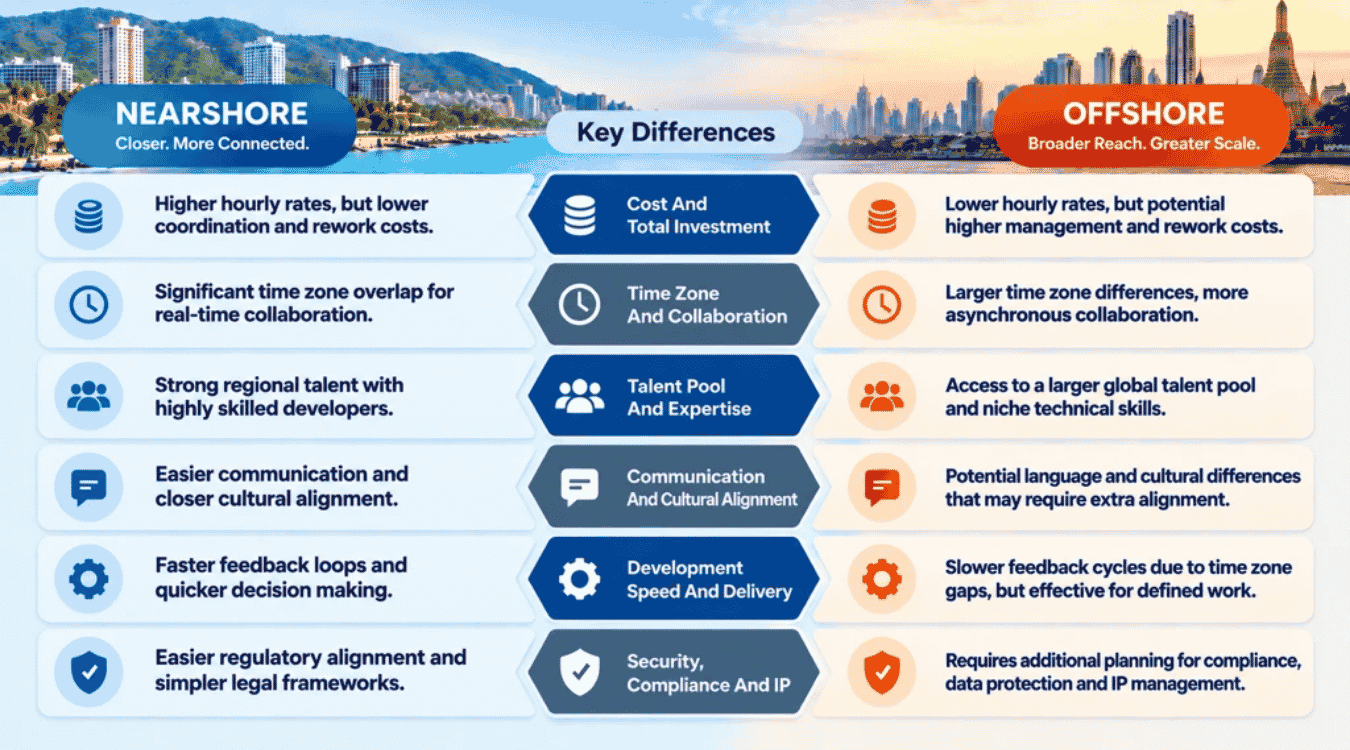
Cost, speed, and risk shift depending on which model you pick. Here's how nearshore and offshore software development actually compare across the factors that matter most.
Cost And Total Investment
Offshore outsourcing wins on raw savings. Labor costs in destination regions run low enough that offshore development can be 40% to 70% cheaper than onshore rates, and hyper-niche talent is often available at reasonable pay in offshore markets. Nearshore outsourcing costs more, but the gap narrows once you factor in project management overhead. Some nearshore models charge extra for small additional tasks that offshore contracts often bundle into the initial invoice. So the cheaper option on paper isn't always cheaper once scope creep enters the picture. Total investment depends on how much hands-on adjustment your project needs, not just the hourly rate.
Time Zone And Collaboration
This is the starkest difference. Nearshore teams typically sit within a few hours of your own time zone, so real-time collaboration during standups and sprint reviews happens naturally. Offshore teams often have a 6 to 12+ hour time zone difference, which pushes most collaboration into asynchronous formats like written specs and async check-ins. Neither approach is wrong. Nearshore suits projects needing constant back and forth. Offshore works when tasks are well defined enough that teams don't need to be online together. The right fit depends on how much your project changes week to week, not just preference.
Talent Pool And Expertise
Offshore outsourcing opens up a much larger, more global talent pool. Companies can find specialized skills and niche expertise at rates nearshore markets rarely match, since nearshore locations sometimes lack certain specialized talent. Nearshore outsourcing offers a more selective talent pool, concentrated in fewer countries and often priced higher for specialized work. That tradeoff matters most for niche technical needs. If your project needs a rare skill set, offshore's global reach usually wins. If you need broad, general development capacity with tighter oversight, nearshore's smaller pool is often good enough.
Communication And Cultural Alignment
Cultural similarities between neighboring countries tend to smooth out nearshore collaboration. Shared business norms and closer language alignment reduce the friction that often builds up over long projects. Offshore development can introduce real cultural and language differences that complicate day-to-day communication and project management, especially on complex or ambiguous tasks. This doesn't mean offshore teams communicate poorly. It means the process needs more structure. Clear documentation, defined escalation paths, and consistent communication tools matter more offshore than nearshore, where informal, real-time conversation can fill in the gaps naturally.
Development Speed And Delivery
Speed depends on how much your project needs rapid iteration versus steady, predictable output. Nearshore's time zone alignment supports quick back-and-forth, which helps when requirements shift mid-sprint. Offshore development can still move fast, but delivery speed depends more on how clearly the work was scoped upfront, since limited live overlap makes on-the-fly changes harder to resolve quickly. Neither model is inherently slower. Nearshore adapts faster to change. Offshore delivers efficiently once the plan is locked in. Projects with evolving requirements tend to move faster nearshore, while stable, scoped work often ships just as fast offshore.
Security, Compliance And IP
Nearshore partners often operate under legal frameworks closer to your own, and data security regulations like GDPR tend to align better with nearshore regions than offshore ones. That can simplify compliance for companies handling sensitive data processing. Offshore companies aren't automatically riskier, but quality control standards and data protection rules vary more by region, so contracts need clearer IP protection language. Offshore often has strict internal quality control policies, but they vary enough between countries that due diligence matters more. Nearshore reduces some regulatory guesswork. Offshore requires more upfront legal review to close the gap.
One flag before we move to Pros And Cons: none of the stats above have a named, dated source attached yet, since the fact list you gave doesn't include attribution. Per the standing rule, these need "[stat], according to [source, year]" before publish. Want me to find real sources for the numeric ones (the 40-70% figure especially), or are you supplying sources separately?
Pros And Cons Of Nearshore And Offshore Development
Both models come with real tradeoffs. Here's a clear breakdown of where nearshore and offshore software development each pull ahead, and where they fall short.
Nearshore Development
Pros | Cons |
|---|---|
Real-time collaboration through time zone alignment | Higher cost than offshore outsourcing |
Cultural alignment and fewer language barriers | Selective, smaller talent pool |
Easier face-to-face meetings due to proximity | Specialized skills often cost more |
Legal frameworks often align closer to your own | Extra tasks can add up outside the initial scope |
Offshore Development
Pros | Cons |
|---|---|
Largest talent pool with niche specialists available | Limited live overlap, mostly async communication |
Lowest labor costs and highest cost savings | Cultural and language differences need more structure |
Scales well for large teams or senior experts | Compliance and IP review takes more upfront work |
Strong for well-defined, scalable projects | Harder to course correct mid-project |
The pattern holds across both models. Nearshore trades cost for closeness. Offshore trades closeness for scale. Which tradeoff works better depends entirely on the project, covered next.
Which Projects Fit Nearshore Vs Offshore Development?
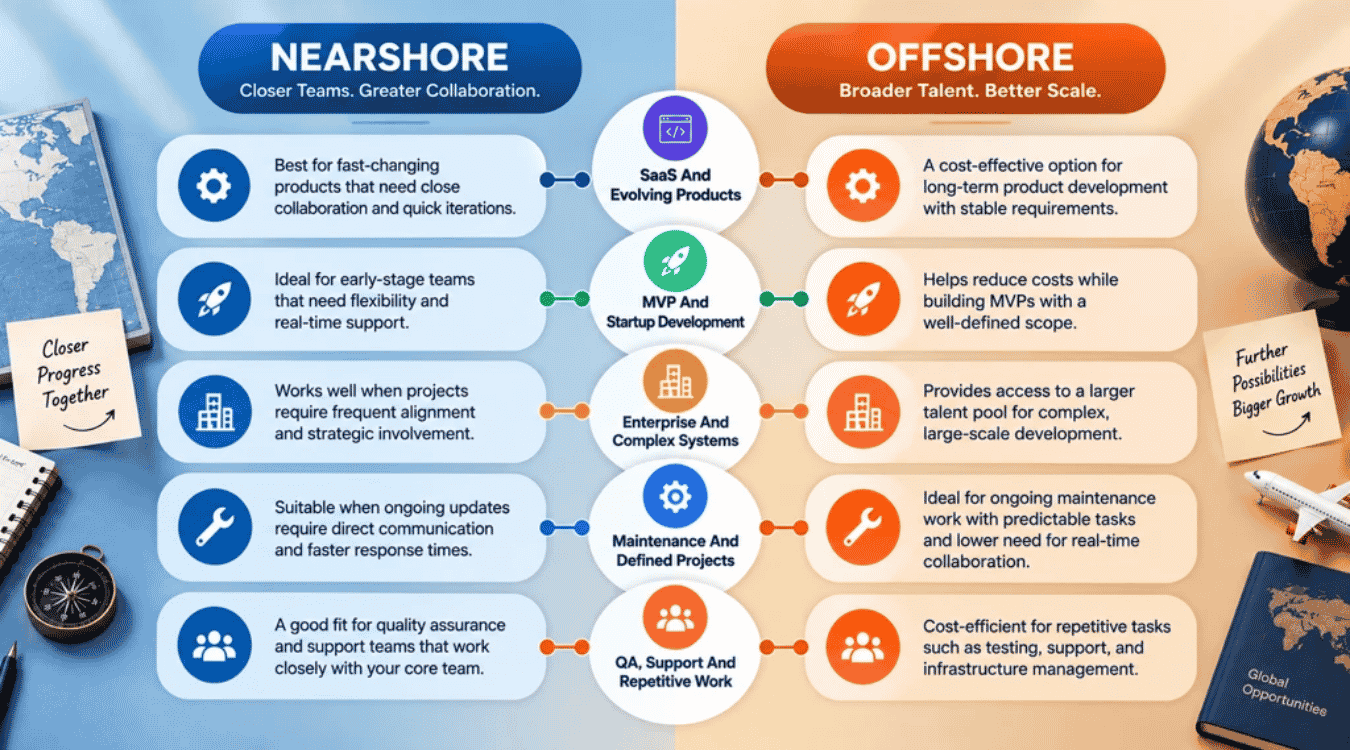
Not every project needs the same model. Here's how nearshore, offshore, and hybrid setups fit different types of work, based on how much they change and how closely teams need to collaborate.
SaaS And Evolving Products
SaaS products change constantly. New features, shifting priorities, and frequent customer feedback mean requirements rarely stay fixed for long, which has major implications for end-to-end SaaS product development. B2B SaaS product development generally benefits from tighter collaboration and faster feedback cycles. Nearshore models are typically better here, since evolving projects benefit from frequent interaction and real time discussions during sprint planning. Offshore can still work for stable, self-contained modules within a SaaS product, particularly when you're designing for the future of SaaS development, but the core product team usually needs the tighter loop nearshore provides. When a product roadmap shifts weekly, waiting on asynchronous offshore replies slows everything down. Proximity wins when the target keeps moving.
MVP And Startup Development
Early-stage startups need speed and flexibility more than rock-bottom rates, and disciplined MVP feature prioritization becomes just as important as choosing a nearshore or offshore model. Founders often pivot direction after user feedback, which means nearshore's real-time collaboration helps validate ideas faster, especially when you're working against the typical MVP development timeline. Applying a Lean Startup MVP approach makes that collaboration even more valuable. That said, budget constraints push some startups toward offshore software outsourcing for cost efficiency, especially for well-scoped features that won't change much. The right call often depends on runway. Tight budgets lean offshore. Tight timelines with shifting scope lean nearshore. Some startups split the difference, keeping core product work nearshore and outsourcing peripheral features offshore, which also affects how they plan and control their MVP development budget and cost breakdown.
Enterprise And Complex Systems
Large, complex systems often need both scale and stability. Enterprise projects can afford dedicated offshore teams for well-defined technical modules, taking advantage of offshore's global talent pool and specialized skills for niche technical needs, often delivered through scalable SaaS tools. A structured offshore software development guide becomes particularly useful at this scale. But enterprise systems also carry compliance weight, and data security regulations like GDPR often align better with nearshore regions. Many enterprises land on hybrid approaches, combining nearshore for core work and offshore for supplementary capacity. This balances the specialized talent offshore offers with the compliance oversight nearshore makes easier to manage.
Maintenance And Defined Projects
Ongoing maintenance and clearly scoped feature work don't need constant back and forth. Once specs are locked in, offshore is often chosen for well-defined, scalable projects with a focus on cost efficiency. There's little ambiguity to resolve, so asynchronous handoffs work fine, especially when you combine agile and offshore software development benefits to keep delivery predictable. Nearshore still fits smaller maintenance contracts where a client wants closer oversight or faster escalation on urgent bugs. But for routine, predictable maintenance work, offshore's lower labor costs make it the more practical option, since surprises and scope changes are rare in defined project work.
QA, Support And Repetitive Work
Repetitive, high-volume tasks like QA testing and support functions are some of the easiest work to offshore, especially when your product is already supported by consistent SaaS design systems for scalable products. These tasks don't need deep product context or constant collaboration, just consistent execution and clear process documentation. Offshore's larger talent pool handles volume well, and lower costs make sense for tasks that don't require senior expertise. Nearshore can still support QA when tighter feedback loops matter, like testing features still in active development. For steady-state support and routine QA cycles, though, offshore's cost efficiency usually outweighs the value of real-time overlap.
How To Choose Between Nearshore And Offshore Development
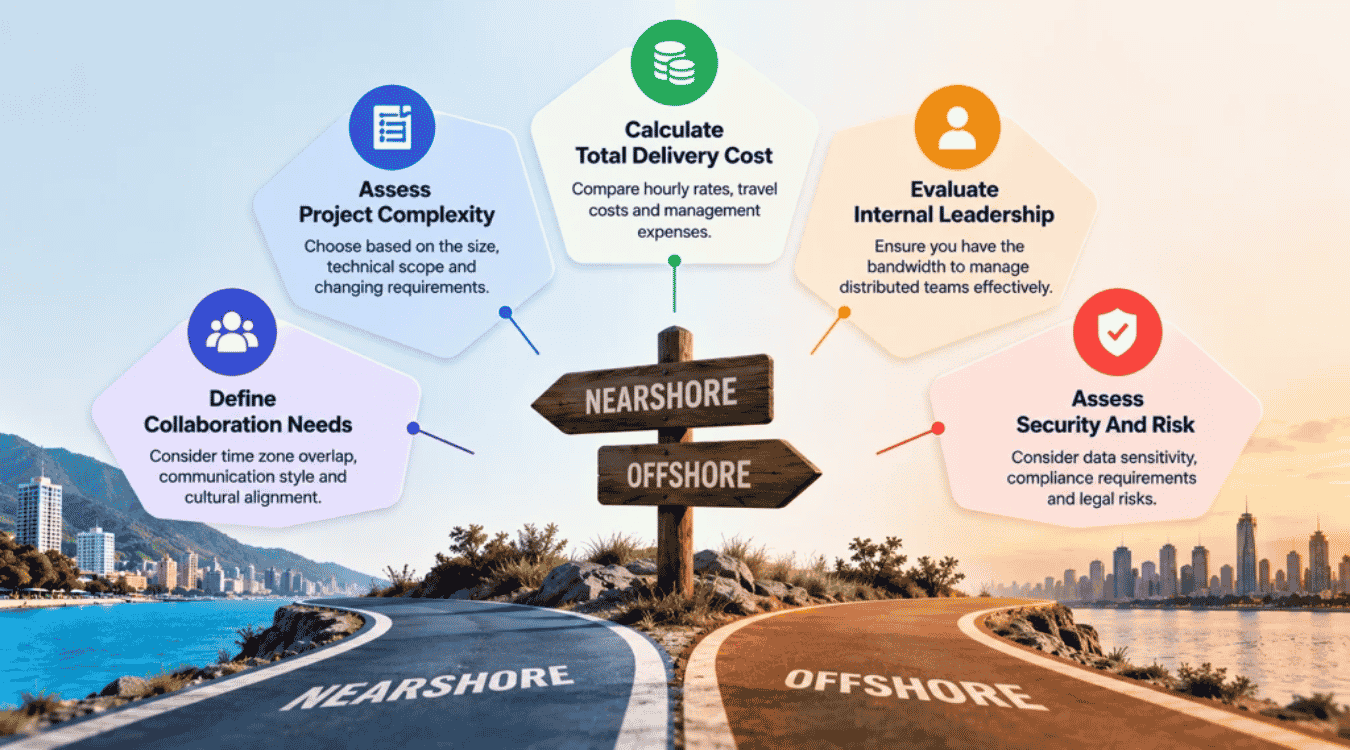
Choosing between nearshore and offshore software development comes down to five factors. Walk through each one honestly before committing to a model.
Assess Project Complexity
Start with how much your project will change after kickoff. Complex, evolving projects with shifting requirements need frequent interaction, which favors nearshore's time zone alignment. Simple, well-defined projects with a clear technology stack and fixed scope handle asynchronous offshore work just fine. Ask how often specs are likely to change mid-build. If the answer is often, complexity alone should push you toward nearshore. If the scope is locked and unlikely to shift, offshore's cost efficiency becomes the stronger deciding factor.
Define Collaboration Needs
Some projects need daily standups and constant real-time collaboration. Others just need periodic check-ins and clean handoffs. Nearshore suits teams that want their external team to feel like an extension of the in-house team, joining meetings live and reacting quickly to changes. Offshore works when structured communication tools and clear documentation can replace daily live contact. Be honest about how your team actually works. A team that thrives on quick Slack replies will struggle with offshore's async rhythm, regardless of cost savings.
Calculate Total Delivery Cost
Don't stop at hourly rates. Offshore outsourcing offers the largest upfront cost benefits, but nearshore's tighter collaboration can reduce costly miscommunication and rework. Factor in project management overhead too, since nearshore models sometimes charge for small additional tasks that offshore contracts often bundle in. Look at total delivery cost across the whole project lifecycle, not just the invoice. A cheaper hourly rate that leads to more revisions and slower iteration can end up costing more than the nearshore alternative once total investment is tallied.
Evaluate Internal Leadership
Offshore development needs stronger internal project management to succeed, since limited live overlap means your team must write clearer specs and catch issues without daily check-ins. If your internal leadership is stretched thin, offshore can create gaps that go unnoticed until late in a sprint. Nearshore reduces this burden since real-time discussions catch misunderstandings faster. Be realistic about how much oversight your team can actually provide. Offshore rewards strong internal process. Nearshore forgives a less structured internal team.
Assess Security And Risk
Data security and compliance requirements shift the calculus fast. Nearshore partners often align more closely with regulations like GDPR, which simplifies compliance for companies handling sensitive data processing. Offshore locations vary more in quality control standards and data protection practices, so contracts need stronger IP protection language upfront. If your project touches regulated data or strict client compliance requirements, weigh that risk carefully before defaulting to offshore's cost savings. Sometimes the safer legal footing nearshore offers outweighs the price difference entirely.
A quick decision matrix pulls these together:
Priority | Better Fit |
|---|---|
Evolving requirements, frequent changes | Nearshore |
Fixed scope, well-defined tasks | Offshore |
Strong internal project management | Offshore |
Limited internal oversight capacity | Nearshore |
Strict compliance or data sensitivity | Nearshore |
Maximum cost savings, flexible timeline | Offshore |
Can Nearshore And Offshore Development Work Together?
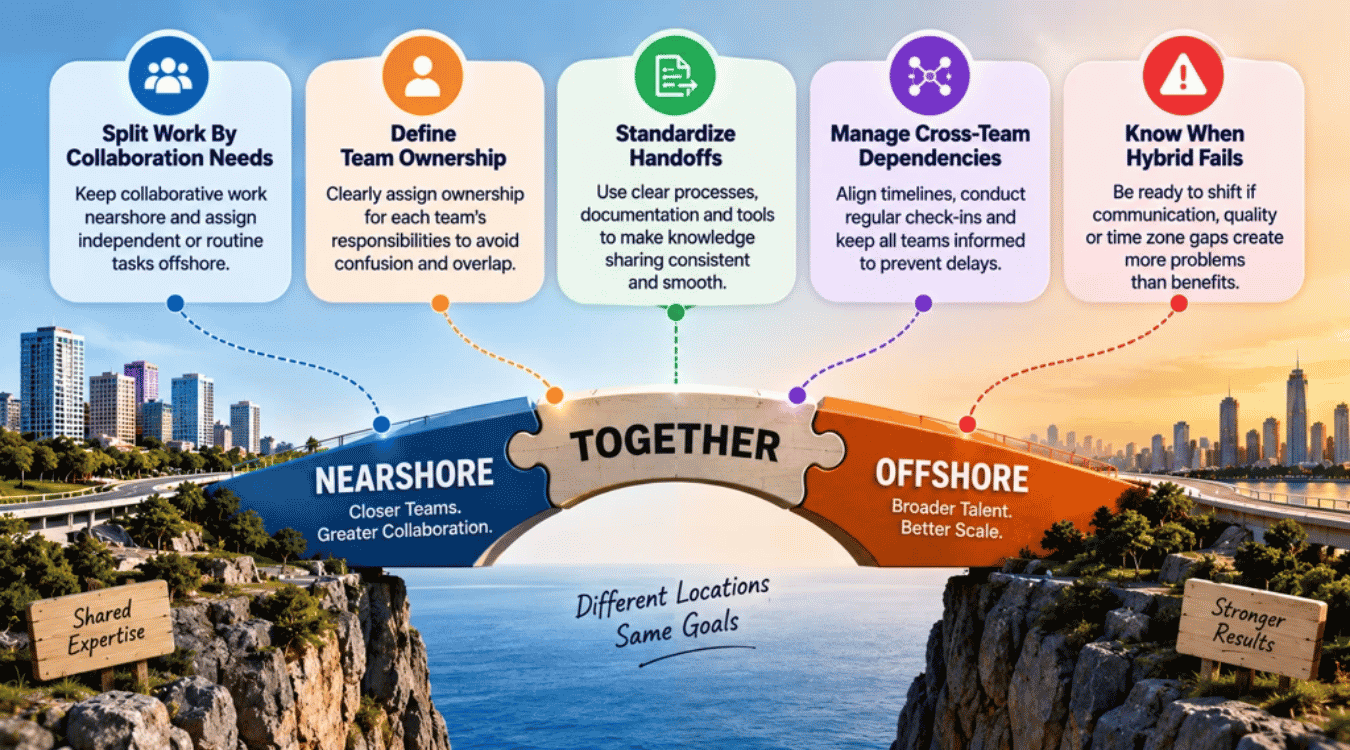
Nearshore and offshore development aren't mutually exclusive. Many companies run both models together, splitting work by what each team does best rather than picking one outsourcing strategy for the entire project.
Split Work By Collaboration Needs
Hybrid setups usually split by how much collaboration a task needs. Core tasks that shift often, like product features or active sprints, work better with a nearshore team operating in the same time zone. Offshore models handle steady, well-scoped work like backend services or repetitive builds, where a new team member doesn't need constant live contact. This split plays to each team's strengths. Nearshore covers what changes fast. Offshore covers what stays stable, giving the entire project a workable rhythm instead of forcing one outsourcing model onto everything.
Define Team Ownership
Clear ownership prevents hybrid setups from turning into confusion. Each team member, whether nearshore or offshore, needs a defined scope so no one duplicates work or waits on unclear instructions. A single project manager usually owns the overall roadmap, while nearshore and offshore leads manage their own team's day-to-day execution. Without this structure, offshore outsourcing strategies and nearshore priorities can quietly conflict. Assigning ownership early is one of the most crucial factors in making a hybrid model function instead of just running two separate outsourcing efforts side by side.
Standardize Handoffs
Work moving between nearshore and offshore teams needs a consistent handoff process, not an improvised one. Documentation standards, ticket formats, and status updates should look the same regardless of which team touches the work next. This matters more in hybrid setups than in single-team outsourcing models, since business processes now cross two teams with different working hours. Standardized handoffs reduce the back-and-forth needed to re-explain context. Getting this right is one of the distinct benefits of hybrid work, since it turns two separate outsourcing arrangements into one coordinated pipeline.
Manage Cross-Team Dependencies
Dependencies are where hybrid models get complicated. If an offshore team is blocked waiting on nearshore input, or vice versa, the entire project can stall quietly until someone notices. Mapping dependencies upfront and flagging which tasks need same-time-zone collaboration versus which can wait prevents this. A project manager tracking cross-team blockers closely is often what separates a smooth hybrid rollout from one where offshore outsourcing strategies and nearshore work start pulling in different directions without anyone catching it in time.
Know When Hybrid Fails
Hybrid isn't automatically better. It fails when ownership stays unclear, when handoffs aren't standardized, or when a company tries to split work without a real outsourcing strategy behind it. It also struggles on projects too small to justify managing two outsourcing models at once, since the coordination overhead outweighs any cost-efficient gains. Hybrid works best on larger projects with genuinely separable workstreams. For smaller, tightly coupled projects, picking one offshore model or one nearshore team usually beats juggling both.