Webhook Vs Polling: Key Differences And When To Use Each
by Daniel Wright | Sep 7, 2026 | Software Development Insights
Table of Contents
Apps need a reliable way to know when new data arrives. But should your system repeatedly ask for updated data, or should the server send an update when an event occurs? That choice sits at the heart of the webhook vs polling debate.
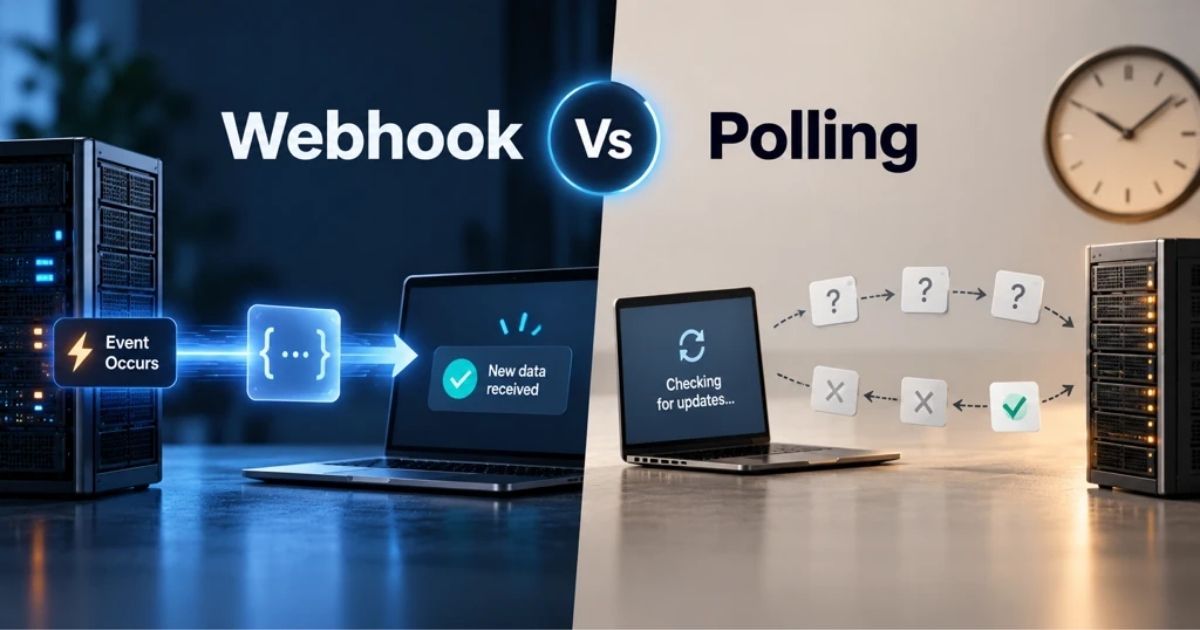
Polling uses a pull model. The client sends repeated requests at fixed intervals to keep data up to date. Webhooks work differently. They send an HTTP request to a webhook endpoint after a specific event, which makes them useful for real-time updates such as payment confirmations.
This guide is for developers, software architects, and engineering teams choosing how applications should exchange data. You’ll see where each method works best, how they differ in speed, reliability, cost, and scalability, and when combining both offers a better solution.
What Is A Webhook?
A webhook is a way for one application to automatically send data to another when a specific event occurs. Instead of the client making repeated requests for new data, the server sends an HTTP request directly to a configured webhook endpoint. For that reason, webhooks are often described as a reverse API.
Webhooks work well when applications need real-time updates without constantly checking the API provider. For example, an e-commerce system can receive payment confirmations as soon as a transaction changes status. Chat applications can also use webhooks to deliver notifications or new messages after relevant events occur.
The method reduces unnecessary requests and server resources because data is delivered only when needed. Webhooks are especially useful for unpredictable events, real-time systems, automation, and other time-sensitive use cases.
What Is Polling?
Polling is a method where a client repeatedly asks a server for new or updated data. With API polling, the client sends an HTTP request at fixed intervals to periodically check for changes. The server then returns a response, even when no new data is available.
Polling works well when real-time updates are not critical or data changes at predictable times. For example, an application might check for weather updates every few minutes. The client also has full control over the polling interval, which can make the method simpler to implement and manage.
The trade-off is efficiency. Frequent polling creates repeated requests and may waste server resources through empty responses. A short polling interval can also increase rate-limiting risks, while longer intervals create more delay before users receive updated information.
Webhook Vs Polling: Key Differences
Webhook vs polling comes down to how two systems exchange updated data. Webhooks use an event-driven model, where the server sends data when an event occurs. API polling uses a pull model, where the client periodically checks for new data. The best solution depends on speed, traffic, control, SaaS security, and infrastructure needs.
Factor | Webhooks | Polling |
|---|---|---|
Data flow | Server pushes events | Client requests data |
Latency | Near real time | Depends on polling interval |
API usage | Requests occur when needed | Repeated requests at fixed intervals |
Resource use | Efficient for infrequent events | Can waste resources on empty responses |
Control | API provider controls delivery timing | Client controls request timing |
Setup | More complex | Simpler to implement |
Security | Requires endpoint verification | Uses standard API authentication |
Best fit | Real-time, unpredictable events | Predictable, non-critical updates |
Latency And Responsiveness
Webhooks are usually faster when real-time updates matter. Once a specific event occurs, the API provider sends an HTTP request to the webhook endpoint. The receiving system can process the event almost immediately. That makes webhooks useful for payment confirmations, order updates, automation, and other time-sensitive events.
Polling introduces a built-in delay. The client must wait until the next polling interval before it can find new data. For example, a system that polls every 60 seconds can take up to 60 seconds to detect an update. Shorter intervals reduce that delay, but they also create more requests.
API Usage And Cost
Polling sends requests at regular intervals, whether updated data exists or not. Many responses may contain nothing new. At scale, those repeated requests consume bandwidth, compute resources, and API quotas. Frequent polling can also exhaust rate limits quickly.
Webhooks work differently. The server sends a webhook request only after a relevant event occurs. No constant checking is required. As a result, webhooks can reduce unnecessary API traffic and server load, especially when updates are infrequent or unpredictable. Cost still depends on event volume and the infrastructure needed to process those events.
Scalability And Traffic
Polling can become resource intensive as the number of users, resources, or data sources grows. More resources combined with shorter fixed intervals can create huge request volumes. Efficient API polling can reduce that load through cursors, incremental queries, backoff, and smarter polling intervals.
Webhooks remove most idle requests because traffic follows actual events. However, webhooks are not automatically easier to scale. A sudden burst of thousands of events can overwhelm the receiving system. Queues and asynchronous workers may be necessary to control traffic and process webhook requests safely.
Delivery Model And Control
Polling gives the client full control over when it asks for updated information. The application can choose its polling interval, slow requests during heavy traffic, or periodically check several services on its own schedule. That control makes polling useful for predictable data retrieval and systems where immediate updates are not critical.
Webhooks shift that control to the server side. The API provider decides when to send data based on events. That model supports real-time communication well, but the receiving application must be ready when new updates arrive. If delivery fails, retry logic, duplicate-event handling, and error handling become important.
Security And Complexity
Polling is generally simpler to implement. The client makes normal API requests and can rely on familiar authentication methods. It also does not usually need a public endpoint to receive incoming requests.
Webhooks require more setup. The application typically needs a reachable HTTPS webhook endpoint and must verify that incoming requests actually came from the expected provider. Signature verification, endpoint availability, duplicate events, retries, and secure secret management add complexity.
That extra work can make sense when real-time data is critical. For less time-sensitive use cases, polling may remain the simpler method.
How Webhooks And Polling Fail In Production
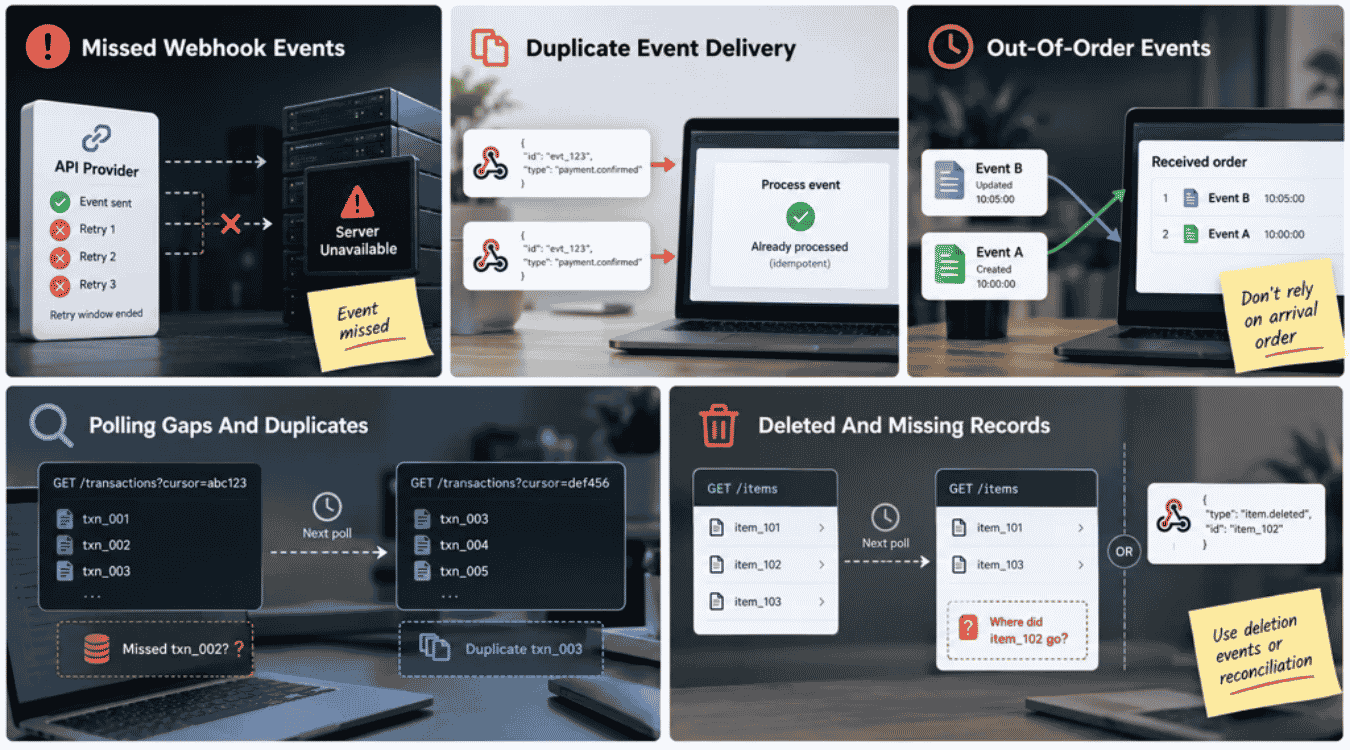
Webhooks and polling can both work well in production, but neither method is failure-proof. Webhooks can miss, duplicate, or reorder events. API polling can skip or repeat data when cursors, timestamps, or pagination fail. Reliable systems plan for these problems instead of assuming every request will work.
Missed Webhook Events
A webhook can fail when the receiving server is unavailable, times out, or returns an error. Many API providers use retry logic, but retries do not continue forever. Once the retry window ends, an important event may remain missed. Plaid, for example, recommends periodic API polling to reconcile data that webhooks may have missed.
That risk matters for critical events such as payment confirmations. The system should track failed webhook requests and use error handling or reconciliation to keep data up to date.
Duplicate Event Delivery
Webhook retries can cause the same event to arrive more than once. A server may process an event successfully but fail to return the expected response. The API provider may then send that event again.
Duplicate events should therefore be expected, not treated as unusual. Use a unique event ID and make the process idempotent. GitHub, for example, provides a unique delivery identifier that applications can use to identify webhook deliveries.
Out-Of-Order Events
Webhooks do not always arrive in the same order that events occur. Event B may reach your webhook endpoint before Event A, especially when traffic is high or one delivery faces a delay. GitHub explicitly notes that webhook deliveries can arrive out of order.
A system should not rely only on arrival order. Timestamps, sequence numbers, resource versions, or a fresh API request can help determine the latest state. That approach prevents an older event from overwriting newer data.
Polling Gaps And Duplicates
Polling has different failure points. A client may periodically check for updated data but still miss records because of cursor errors, timestamp precision, pagination changes, or failed requests. Overlapping polling windows can prevent gaps, but they may return the same data more than once.
The client should save its cursor carefully and deduplicate repeated records. If a cursor expires or becomes invalid, some APIs require a new full sync. Reliable API polling therefore needs more than repeated requests at fixed intervals.
Deleted And Missing Records
Deleted data creates another problem. With polling, a record may simply disappear from later responses. The client cannot always tell whether it was deleted or just absent from the latest result. An API needs tombstones, an event log, or another deletion signal to make that difference clear.
Webhooks can handle deletion more directly when the provider sends a specific delete event. However, a missed deletion webhook can still leave stale data behind. Combining webhooks with periodic reconciliation offers a stronger solution when data accuracy is critical.
How To Make Webhooks And Polling Reliable
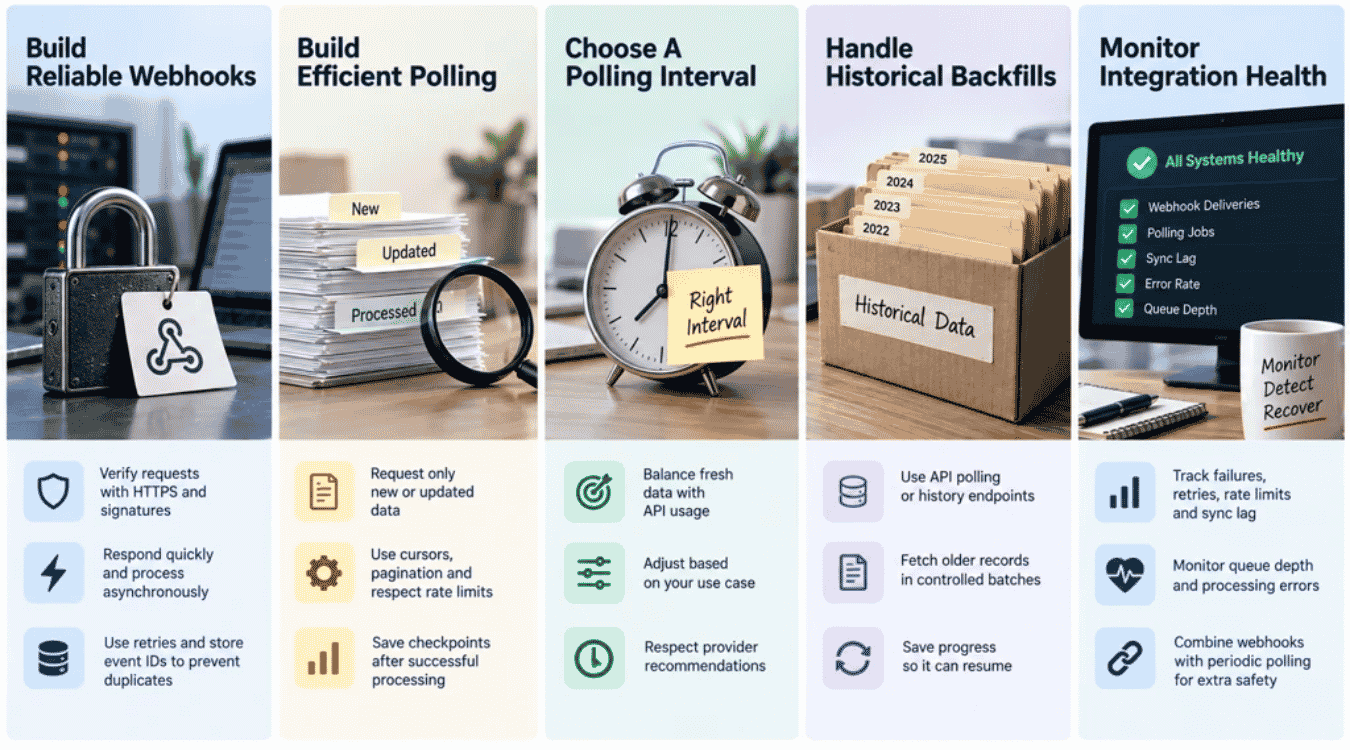
Reliable integrations assume that requests can fail, events can arrive twice, and systems can go offline. Good error handling matters whether you use webhooks, API polling, or both, and it should fit into a broader API integration strategy for scalable business systems. The goal is simple: keep data up to date without losing critical events or wasting server resources.
Build Reliable Webhooks
A reliable webhook endpoint should verify every incoming request before processing it. Use HTTPS, webhook signatures, and secure secrets to confirm that the API provider actually sent the event. Stripe and GitHub both recommend signature verification for webhook requests.
Return a successful response quickly, then process the event asynchronously when possible. Use retry logic for failures and store event IDs to prevent duplicate events from triggering the same action twice. A queue can also protect the server when many events arrive at once.
Build Efficient Polling
API polling does not have to mean wasteful repeated requests. The client should request only new or updated data instead of downloading the same records at regular intervals.
Use cursors, timestamps, pagination, or conditional requests when the API provider supports them. Save each checkpoint only after the data has been processed successfully. Rate limiting also matters. If the server returns a rate-limit response, respect its retry instructions and use exponential backoff rather than sending more requests immediately.
Choose A Polling Interval
The right polling interval balances fresh data against API usage. Short fixed intervals provide faster updates but create more requests. Longer intervals reduce server load but increase the delay before new data reaches users.
Start with the actual use case. Payment confirmations may require real-time communication, which makes webhooks a better fit. Weather updates or other predictable data may only need periodic checks. GitHub recommends polling only as often as necessary and respecting any polling interval provided by the API.
Handle Historical Backfills
Webhooks usually tell one application about events after the integration is active. They may not provide all the historical data needed for an initial sync or recovery.
Use API polling or dedicated history endpoints to fetch older records in controlled batches. Save progress with a cursor or checkpoint so the process can resume after a failure. Historical backfills also help rebuild local data when events were missed for a long period. Keep this process separate from normal real-time updates to avoid unnecessary load.
Monitor Integration Health
A system can appear healthy while quietly missing data. Track webhook delivery failures, retries, duplicate events, processing errors, queue depth, rate-limit responses, and the last successful poll, and complement this with SaaS monitoring tools.
Also measure sync lag between the source and your application. A growing delay can reveal problems before users notice outdated information.
For critical data, combining webhooks with low-frequency polling adds another safety layer. Webhooks provide real-time updates when an event occurs, while periodic polling checks the source for anything missed. Both methods can feed the same idempotent process to prevent duplicate work.
When To Use Webhooks Vs Polling
The right choice in webhook vs polling depends on how quickly you need new data, how often events occur, and how much control your application needs. Webhooks usually fit real-time systems, while polling works well for predictable updates and scheduled data retrieval. Neither method is automatically the best solution for every system.
Choose Webhooks When
Choose webhooks when your application must react as soon as a specific event occurs. They are especially useful when events are important but unpredictable. Instead of repeated requests, the API provider sends an HTTP request to your webhook endpoint only when something happens.
Payment confirmations are a good example. An e-commerce platform can process a successful payment as soon as the provider sends the event. Webhooks also suit order updates, CI/CD triggers, notifications, and automation. They provide near-real-time data while avoiding frequent empty requests.
Webhooks make the most sense when:
- Real-time updates are critical.
- Events occur at unpredictable times.
- The API provider offers reliable webhook support.
- Frequent polling would waste server resources.
- The system needs to react immediately to important events.
Choose Polling When
Choose polling when immediate updates are not critical, or the API provider does not support webhooks. The client can periodically check for updated information at fixed intervals and keep full control over when requests occur.
Polling is useful for predictable data such as weather updates, scheduled reports, batch jobs, or state checks. It also makes sense for legacy systems and environments where a public webhook endpoint cannot be exposed. A sensible polling interval can keep data up to date without creating unnecessary traffic.
Polling works best when:
- Updates follow a predictable pattern.
- Some delay is acceptable.
- The source does not offer webhooks.
- The client needs control over request timing.
- Data must be retrieved as current state rather than individual events.
Compare Common Use Cases
Use cases make the polling vs webhooks decision easier. Speed favors webhooks, while predictable retrieval and client control often favor polling. Critical systems may use both methods when they need real-time communication plus a recovery path for missed events.
Use Case | Better Method | Why |
|---|---|---|
Payment confirmations | Webhooks | React as soon as the payment event occurs |
Order status notifications | Webhooks | Provide real-time updates |
CI/CD events | Webhooks | Trigger work after a specific event |
Chat or message notifications | Webhooks | Deliver new updates with minimal delay |
Weather updates | Polling | Data can be checked at regular intervals |
Scheduled data sync | Polling | Client controls when data is requested |
Legacy API | Polling | Works when the service lacks webhook support |
Critical data synchronization | Hybrid | Webhooks provide speed while polling catches missed data |
For example, a weather application may poll every few minutes because constant real-time updates add little value for many consumer use cases. A payment system has different needs. A delay could affect checkout, fulfillment, or user experience, so an event-driven webhook is usually a better fit.
Can Webhooks And Polling Work Together?
Yes. Combining webhooks and polling can give a system both fast updates and a reliable recovery path. Webhooks handle events as they occur, while API polling periodically checks the source for anything missed. Square explicitly supports this model, using its Events API for recovery and reconciliation of missed webhook events.
Webhooks For Immediate Events
Use webhooks as the fast path when real-time data matters. Once a specific event occurs, the API provider sends an HTTP request to the webhook endpoint. The application can process new data without waiting for the next polling interval.
That approach works well for payment confirmations, new messages, notifications, and other critical events. Webhooks also reduce repeated requests because the server sends updated data only when needed.
Polling For Reconciliation
Use polling as the safety net. The client can periodically check the API provider for updated information and compare it with local data. If a webhook was missed because of server downtime, network errors, or a failed request, polling can help recover the missing event.
Polling does not need to run frequently in this model. Square notes that systems that use webhooks alongside regular polling can increase the time between polls. That reduces unnecessary requests and rate-limiting pressure while keeping data up to date.
Use One Idempotent Processor
Both methods may return information about the same event. Without protection, the system could process it twice. An idempotent processor prevents duplicate events from creating duplicate actions.
Send webhook events and polling results through the same processing layer when possible. Use event IDs, resource IDs, versions, or stored state to check whether an update has already been processed. GitHub recommends unique delivery identifiers to distinguish webhook deliveries and protect against replayed events.
Know When Hybrid Is Worth It
A hybrid approach adds more AI infrastructure and logic, so one method may be enough for simple use cases. Combining webhooks and polling makes more sense when real-time updates and data completeness are both critical.
Consider the hybrid model when missed events could affect payments, orders, account data, or other important processes. Webhooks provide speed, while polling provides control over reconciliation and recovery. For less critical data, such as periodic weather updates, a well-designed polling process may remain the simpler and better solution.
How To Choose Between Webhooks And Polling
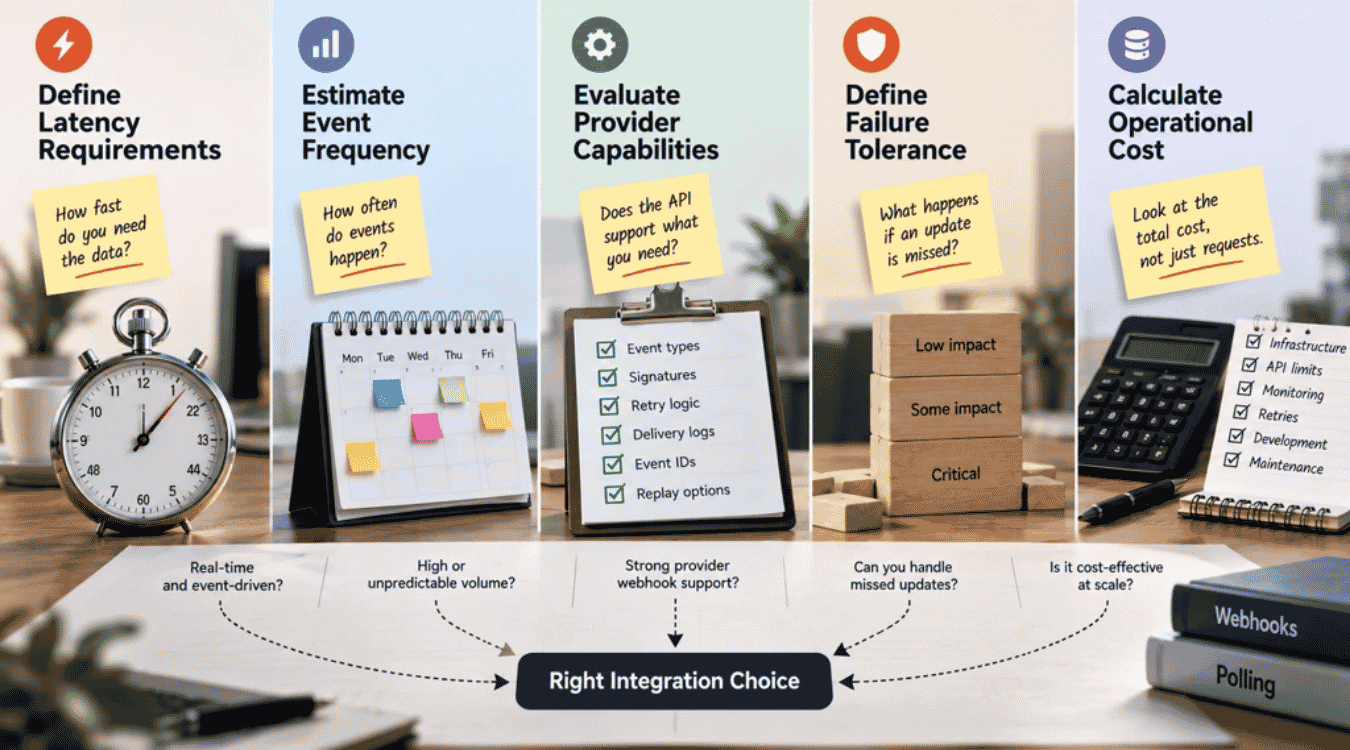
The webhook vs polling decision should match how your system actually works. Start with latency, event frequency, provider support, failure risk, and total cost. Webhooks and polling are two methods with different trade-offs, so one method will not fit every application.
Define Latency Requirements
Start by asking how quickly users need updated data. Webhooks are usually the better choice when real-time updates are critical. The server sends an HTTP request soon after an event occurs, so the application does not need to wait for another polling interval. GitHub also recommends webhooks when near-real-time updates are required.
Polling makes more sense when some delay is acceptable. Weather updates, reports, or scheduled syncs may only need checks at regular intervals. A longer interval reduces requests, while a shorter one keeps data fresher but puts more pressure on API limits.
Estimate Event Frequency
Next, consider how often new events are generated. Webhooks work well when events are infrequent or unpredictable because requests are sent only when something changes. That can reduce server resources compared with constant API polling.
Polling can make sense when updates follow predictable patterns. However, frequent polling can become resource-intensive at scale. For example, 10,000 users polling once every second would generate 10,000 requests per second. The exact load depends on the polling interval, so request volume should always be calculated for the real workload.
Evaluate Provider Capabilities
Do not choose webhooks simply because an API provider says it supports webhooks. Check the quality of that support. Look for event types, signatures, retry logic, delivery logs, event IDs, replay options, and historical event access. GitHub, for example, supports webhook secrets and unique delivery IDs, but failed deliveries require a redelivery strategy.
The same rule applies when data comes from multiple sources. Some services may offer webhooks, while others rely on polling. Your system may need to manage both methods rather than force every source into one model.
Define Failure Tolerance
Ask what happens if one update is missed. A delayed social notification may cause little harm. A missed payment confirmation or account update can be critical.
Webhook requests can fail because of network problems, server downtime, or timeouts. Polling can also miss data through failed requests or synchronization gaps. For high-value data, combining webhooks with periodic polling can provide stronger protection. Square, for example, supports polling its Events API to recover and reconcile missed webhook events.
Calculate Operational Cost
Do not judge cost only by the number of requests. Consider server infrastructure, API limits, queues, monitoring, retries, development effort, and maintenance.
Polling may look simple at first, but frequent empty responses can waste resources. Some workload studies have found that only about 1.5% of polling requests returned an actual update, although that figure is scenario-specific rather than a universal benchmark. Webhooks avoid much of that idle traffic because requests are generated by events. GitHub specifically notes that webhooks can reduce resource use and rate-limit pressure compared with polling many resources.
The best solution is the one that meets your latency and reliability needs at a reasonable operational cost. For critical real-time systems, that may mean webhooks plus polling rather than choosing only one.
Final Decision
Webhook vs polling is not about finding one method that wins every time. The right choice depends on how quickly data must arrive, how often events occur, and how much control your system needs.
Webhooks fit real-time systems where new updates are unpredictable or time-sensitive. They send data when an event occurs, which can reduce unnecessary requests and API rate-limit pressure. Polling makes more sense when updates are predictable, some delay is acceptable, or the API provider does not support webhooks. Efficient polling should use sensible intervals and request only the data it needs.
For critical applications, combining webhooks with polling can offer the best balance. Webhooks provide speed, while polling adds a recovery path for missed data. Reliability, cost, infrastructure, and provider capabilities should ultimately guide the decision.