Buyers, investors, and founders rely on technical due diligence checklists to avoid costly surprises during M&A deals, funding rounds, and partnerships. Between 2024 and 2026, these structured frameworks have become essential. According to Deloitte’s 2025 M&A survey, 68% of tech acquisitions face integration delays due to unvetted technology stacks.
A solid diligence checklist keeps everyone focused on the same core areas: business strategy, software architecture, IT infrastructure, data security, and how teams operate day to day. This article comes from the perspective of a product team that ships SaaS every day. The guidance here is grounded in real software operations, not theory.
The goal is not to turn you into an auditor. You will learn what to ask for, what to review, and what red flags to watch before you wire any money. Sections alternate between short narrative explanations and compact lists to keep the checklist usable for busy deal teams.
What Technical Due Diligence Means In Practice
The technical due diligence process is a structured review of a target company’s technology assets, product development practices, and operational risk. Most deals run this entire process over 4 to 8 weeks before a term sheet is finalized. Teams examine source code repos, cloud and data centers configurations, security policies, uptime reports, and organizational charts.
The purpose is not to nitpick every line of code. You want answers to clear questions. Will this platform scale from 5,000 to 50,000 customers? Will we inherit GDPR risk on day one? Does the technology team setup support the business roadmap? A comprehensive technical review connects these dots and gives buyers confidence before closing.
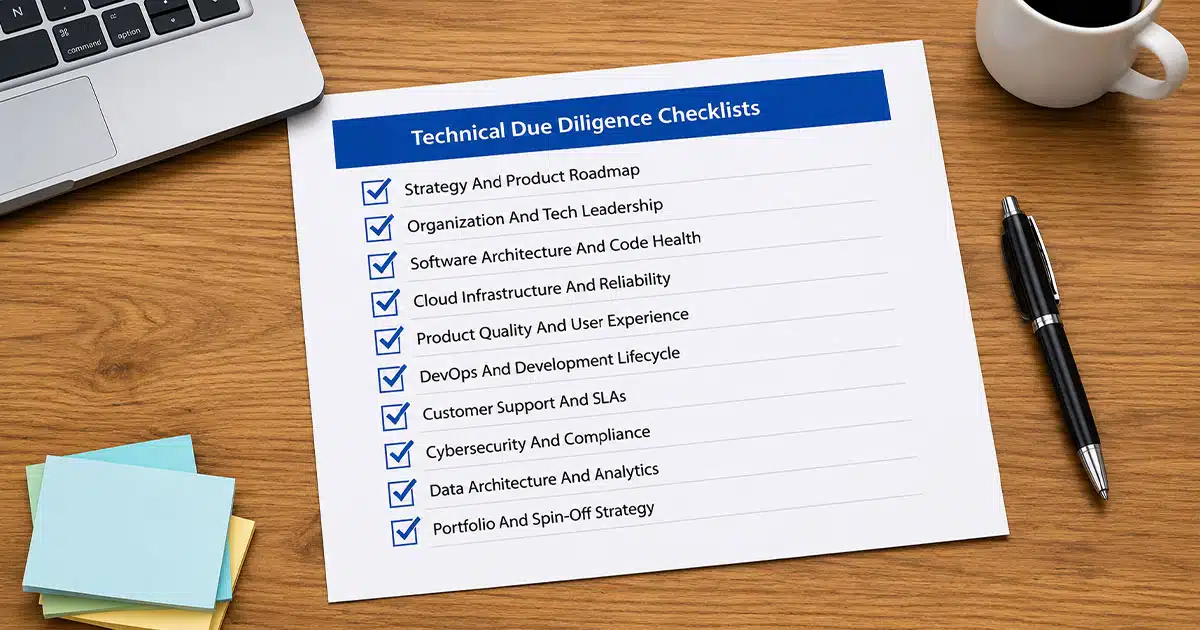
Most Important Technical Due Diligence Checklist
The sections below break the tech due diligence checklist into concrete themes you can work through in order. Each theme includes focused checks adapted by deal size. In practice, teams often run this due diligence checklist over 2 to 4 weeks, starting with document review and then moving to live Q&A sessions and demos.
1. Business Strategy And Product Roadmap Alignment
Every technical decision should map back to the 3-year business and product plan. Review the current-year product roadmap, 12 to 24 month feature plan, and revenue targets tied to new capabilities.
Verify that the checklist architecture design patterns and tools support planned milestones. A cohesive strategy connects product work to customer goals. Red flags include no written roadmap, constant last-minute pivots, or platform work that does not connect to any real revenue. Look for backlogs with prioritization scores linking to MRR growth. A healthy strategy shows business objectives driving technical choices, supported by a clear and adaptable SaaS product roadmap in 2026.
2. Organization Structure And Technology Leadership
Prepare organizational chart reviews to understand how engineering, product, and DevOps teams are structured. Check reporting structure evaluate criteria like engineer-to-PM ratios (4:1 to 6:1 is common) and team business continuity plans.
Leadership tenure matters. A CTO with more than 18 months in role signals stability. Significant churn in 2023 to 2025 is a warning sign. Ask about hiring pipelines, outsourcing versus in-house development, and how knowledge is preserved when key engineers leave. Quality organization health looks like dedicated DevOps teams and pods of 6 to 8 with embedded QA.
3. Software Architecture And Codebase Health
Start with a clear description of the current software architecture. Is it a monolith, modular monolith, or microservices deployed on AWS, GCP, or another cloud provider? Check for broken or inadequate architecture patterns that block scale product planning, comparing them against principles of scalable software architecture for high-growth products.
Review language and framework choices. Look for end-of-life dependencies requiring forced upgrades in the next 12 to 18 months. Examine architecture diagrams, deployment flows, and critical paths like signup and billing. Assess code quality using static analysis tools like SonarQube, aiming for test coverage above 80%. Technical debt examples include hand-rolled frameworks and duplicated services, which you should evaluate using a structured technical debt guide for software teams.
4. IT Infrastructure, Cloud Footprint, And Reliability
Reliable, cost-efficient infrastructure deployment model choices are hidden cost drivers in technical diligence. Review which cloud and data centers approach the company uses. Typical monthly spend for mid-stage SaaS runs $50K to $500K, scaling 2 to 3x with customer growth, so assess whether they follow robust SaaS scalability strategies for sustainable growth.
Examine architecture for high availability with 99.99% SLA targets. Review disaster recovery plans with tested recovery time objectives under 4 hours and RPO under 15 minutes. Check monitoring and alerting using tools like Datadog or Grafana. Flag multi-cloud setups or vendor lock-in that can significantly lengthen integration timelines, especially as you evaluate the broader future of SaaS development in a cloud-first world.
5. Product Quality, Testing, And User Experience
Connect product quality to customer outcomes using real indicators. Review defect rates and support tickets from the last four quarters. Examine testing practices across unit, integration, and end-to-end testing with automation rates and code coverage targets above 70%, and ensure that teams embed ongoing SaaS performance optimization best practices into these workflows.
Check how UX decisions are made. Look for SaaS design systems for scalable products, UX research, and customer focus mindset through tools like in-app surveys or NPS tracking above 40. Review production incident logs, rollback frequency, and average time to resolve high-severity bugs. Mature SaaS teams automate tests on critical user flows and deliver predictable release quality.
6. Software Development Lifecycle, DevOps, And Tooling
Consistent delivery practices matter more than methodology labels. Review how work moves from backlog to production. Check backlog refinement, management process sprint planning, code review practices, and release approvals.
Ask about CI/CD tooling like GitHub Actions, GitLab CI, or CircleCI. Examine deployment frequency targets (daily or better), lead time under one day, and change failure rate under 5% using DORA metrics, mapping them against modern DevOps best practices for 2026. Tool sprawl without clear ownership is common. Review overlapping project management and monitoring tools. The support tools ecosystem should be streamlined, not duplicated.
7. Customer Support, SLAs, And Service Reliability Perception
Bridge technical reliability with customer experience. Ask for support workflows including ticket systems and standard response times. Check for formal SLAs with enterprise customers, and evaluate whether the product’s UX actively supports reducing SaaS churn and improving retention.
Review metrics like first response time, resolution time for P1 incidents under 4 hours, and the share of support tickets tied to product defects. Communication during outages matters. Look for status pages, incident postmortems, and customer follow-ups. Strong support practices reveal a mature, customer-centric culture and cut churn by 15%.
8. Cybersecurity, Compliance, And Data Protection
This section is sensitive and time-consuming, especially for products handling personal or financial data. Review security policies, access control models, and management compliance requirements including employee security training with 95% completion rates.
Examine independent audits like SOC 2 Type II, checking audit dates and scope. Validate regulatory compliance with GDPR and CCPA, including data processing agreements and data residency constraints. Ask about penetration testing schedules. Request the last three years of security incidents, how they were handled, and any ongoing regulatory exposure. Management approach security design should follow secure programming principles.
9. Data Architecture, Analytics, And Governance
Review how the company collects, stores, and uses data. Check data models for core entities, data warehouse technologies like Snowflake or BigQuery, and how pipelines are orchestrated using tools like Airflow, ensuring they align with a resilient SaaS product development lifecycle.
Examine data strategy and quality controls including schema enforcement and monitoring for broken pipelines. Review analytics practices with BI tools like Looker or Tableau. Check recurring review rhythms leadership uses for product and growth decisions. Privacy-by-design practices and anonymization approaches matter when working with sensitive data. The data centers approach should support business applications management.
10. Portfolio, Carve Out, And Spin-Off Specific Considerations
For private equity buyers or corporate carve outs where a product needs to become a stand alone entity, additional checks apply. Review how shared services like identity, billing, or data platforms will need recreation after a spin-off.
Consider portfolio investment balance across multiple products. Check for intellectual property ownership and deployment independence contractual agreements. Review third-party license restrictions and shared customer data across portfolio entities. Highlight one-time separation costs (often $1M to $5M) and timelines feeding directly into deal models. Intellectual property clarity is critical for successful due diligence.
Key Components Of A Strong Technical Due Diligence Process
A strong technical due diligence process integrates multiple evaluation areas into a holistic risk view. Each component below contributes to the final diligence report.
Software Architecture Evaluation
Architecture evaluation examines system diagrams, scalability models, and design decisions. Look for prepare ability to handle 10x user growth. Kubernetes-based microservices typically handle load better than tightly coupled monoliths. Review how services communicate and where bottlenecks exist. The management lifecycle of core components should show continuous improvement release planning. Document any significant investments needed to modernize broken or inadequate architecture in light of best practices of SaaS architecture.
Codebase Quality Assessment
Code quality assessment uses tools like CodeClimate or SonarQube to measure code leverage, maintainability, and technical debt ratios. Aim for debt ratio under 5% and code coverage above 80%. Review code churn (under 15% is healthy) to understand stability. Check for prepare checklist understand criteria including PR history with at least two reviewers and cycle times under 48 hours. Comprehensive tech reviews quantify debt in engineer-months.
Security Risk Identification
Security risk identification covers penetration testing results, vulnerability scans, and compliance gaps. Annual pen tests should show zero critical vulnerabilities. Review CVSS scores and fix timelines for high-severity issues (under 7 days is standard). Average breach costs run $4M, so gaps here require significant investments to remediate. Check for healthy swot competitive awareness of emerging threats and management process escalation rates for security incidents.
Infrastructure Reliability Analysis
Infrastructure reliability analysis reviews SLOs, uptime history, and cost forecasts. Check that SLOs are met 95% or better over the last 12 months. Review disaster recovery approach with tested RTO and RPO targets. Examine the management process delineating responsibilities for incident response. Cost projections should account for user growth and reference a solid SaaS development cost guide for businesses. Reserved instance strategies can save 40% on cloud spend.
Development Workflow Review
Workflow review examines how teams ship software daily. Check DORA elite metrics: deploy frequency greater than weekly, MTTR under one hour, and change failure rate under 5%. Review the management process for backlog to production flow. Look for automation at every stage. Manual deployments double failure rates. A mature checklist full swot awareness includes conduct technology reviews of tooling efficiency and team and engineering practices alignment, grounded in realistic software development timeline planning.
Challenges Companies Face Without Technical Due Diligence
Organizations that skip technical due diligence often face hidden risks that affect product stability, scalability, and long term investment value. Without a structured evaluation of technology infrastructure, code quality, and security practices, companies may overlook critical issues that later become costly to fix.
Hidden Technical Debt
Technical debt accumulates when development teams prioritize speed over long term code quality. Without proper technical due diligence, investors or acquiring companies may not detect outdated frameworks, inefficient architecture, undocumented code dependencies, or broader hidden costs in software development.
Hidden technical debt can significantly increase maintenance costs after an acquisition. Studies suggest that poorly managed technical debt can consume nearly 30 percent of a development team's capacity. If these issues remain undiscovered during evaluation, organizations may face long development cycles and higher operational costs.
Security Vulnerabilities
Security weaknesses often remain undetected without a detailed technology audit. Applications may contain outdated libraries, insecure authentication methods, or poorly configured access controls.
Cybersecurity reports show that a large portion of software breaches occur due to unpatched vulnerabilities in applications and infrastructure. Without technical due diligence, companies risk inheriting systems that expose sensitive customer data or business information. Security failures can lead to financial losses, regulatory penalties, and damage to brand reputation.
Infrastructure Limitations
Technology infrastructure plays a major role in product reliability and performance. Companies that skip infrastructure assessments may overlook issues such as limited scalability, outdated servers, or inefficient cloud configurations that violate fundamental SaaS scalability strategies for sustainable growth.
These limitations can cause system downtime, slow performance, or increased operational costs as user demand grows. If infrastructure cannot handle higher workloads, businesses may need to redesign major parts of their system after acquisition.
Poor Code Maintainability
Code maintainability determines how easily developers can update and expand a software product. Without reviewing the codebase during technical due diligence, companies may inherit poorly structured code that lacks documentation or testing coverage.
Poor maintainability makes it difficult for new engineering teams to understand system architecture or implement new features. Over time, this slows product innovation and increases development risk, reinforcing the need for a proactive technical debt guide for software teams.
Scalability Risks
Scalability becomes a major concern when software systems grow beyond their original design capacity. Without technical due diligence, organizations may fail to detect architectural limitations that prevent systems from handling increasing user demand.
As customer adoption increases, poorly designed systems can experience performance bottlenecks, service interruptions, and unstable platform behavior. Identifying scalability risks early helps organizations plan infrastructure upgrades and ensure long term product growth.
5 Practical Tips To Streamline The Diligence Process
Preparing well saves weeks and improves deal outcomes. These tips help both buyers and sellers move faster while uncovering the right information.
Use Virtual Data Rooms With Staged Access
Platforms like Clinked or similar virtual data rooms cut review time by 40%. Organize folders for architecture, security, infrastructure, and organization details. Stage access so sensitive documents unlock as trust builds. This reduces seller anxiety about full disclosure while giving buyers confidence the entire process is transparent.
Prioritize Automated Scans Before Deep Dives
Run automated tools like Snyk for dependency vulnerabilities and SonarQube for static analysis before manual code reviews. Automated scans detect 70% more vulnerabilities than manual reviews alone, especially when combined with modern DevOps best practices for 2026. Start with business tools overview and tooling audits. Address obvious issues before buyers find them.
Run Mock Diligence Quarterly
Do not wait for a term sheet. Run internal mock diligences using this technology due diligence checklist quarterly. Identify gaps like missing runbooks, undocumented services, or expired certifications. Close gaps proactively. Teams that prepare organizational chart updates and system diagrams regularly move faster when real diligence starts, especially when they stay informed through the GainHQ blog on software and digital transformation.
Quantify Everything In Business Terms
Translate technical findings into dollars and timelines. Express technical debt as engineer-months to fix. Note that $500K to $2M remediation costs are common for mature SaaS platforms and map closely to ranges in a SaaS development cost guide for businesses. Quantified risks give deal teams concrete numbers for pricing adjustments, earn-outs, and risk-sharing clauses. Business transactions require financial clarity.
Involve Sellers Early For Transparency
Reduce surprises by 50% through early seller involvement. Set expectations on response times. Schedule batch Q&A calls rather than endless email threads. Align talking points across leadership so the story about roadmap, scalability, and risk mitigation stays consistent. A healthy approach builds trust and speeds the deal.
How GainHQ Supports Technical Due Diligence Readiness
GainHQ is a modern SaaS workspace that helps teams organize documentation, workflows, and collaboration around due diligence readiness. Product, engineering, and operations teams can capture decisions, run checklists, and keep documents current in one environment.
Turn this technical due diligence checklist into repeatable templates inside GainHQ. Attach architecture diagrams, track completion status, and centralize product specs, incident postmortems, and security policies. Populating a data room becomes straightforward when everything lives in one place.
Use GainHQ not only during business transactions but as an everyday operating system. Keep your house in order long before any investor or buyer requests arrive by aligning daily work with a robust SaaS product development lifecycle. Proactive readiness beats last-minute scrambles every time.
FAQs
What Does A Technical Due Diligence Checklist Include
A comprehensive technical due diligence checklist covers software architecture, codebase quality, IT infrastructure, cybersecurity, compliance, DevOps practices, and data governance. It examines technology assets, team structure, and how technical choices align with business objectives. The checklist helps buyers and investors assess scalability, technical debt, and operational risk before closing a deal.
Why Is Technical Due Diligence Important For Investors
Technical due diligence mitigates 20 to 30% valuation risks by uncovering hidden costs. A $10M technical debt burden can dramatically change deal economics. Investors gain realistic integration timelines, accurate capex and opex estimates, and clarity on where extra engineering hires will be needed by understanding the hidden costs in software development. The diligence report becomes a negotiation tool, not just a compliance step.
How Long Does Technical Due Diligence Take
Most Series A and B deals under $50M complete technical due diligence in 4 to 8 weeks. The process typically includes 1 to 2 weeks of document review, 2 to 3 weeks of technical audits, and 1 to 2 weeks of live demos and Q&A. Complex deals or carve outs may require additional time for separation planning.
Who Conducts Technical Due Diligence Reviews
A typical diligence team includes a lead architect, senior engineers, and a security specialist. External consultants from firms like Rimkus or L40 join when in-house teams lack specific domain expertise. On the seller side, the CTO, VP of Engineering, and security owners provide evidence and answer questions throughout the professional services arm of the review.
What Risks Can Technical Due Diligence Identify
Technical due diligence identifies risks including technical debt requiring significant investments to fix, scalability limitations, cybersecurity vulnerabilities, compliance gaps, and infrastructure lock-in. It also uncovers management process delivery trends, team churn patterns, and intellectual property concerns that could derail post-deal integration or require significant investments to resolve.