Product-led engineering strategy represents a fundamental shift in how engineering teams approach software development. Instead of building features based on assumptions, teams center every decision around real product usage and measurable business outcomes. The product becomes the primary driver of user acquisition, activation, and customer retention.
Companies adopting this led approach see significant results. Research shows 30% faster feedback collection and 27% quicker onboarding processes. Product-led organizations achieve up to 40% higher adoption rates in self-serve SaaS models. Customer acquisition costs drop by 50% or more as users self-onboard through intuitive product experiences.
Long-term growth comes from focusing on customer success metrics. Retention lifts of 20-30% become possible when engineering teams own the entire user journey. Customer lifetime value increases through expansion loops tied directly to product usage data. The product led growth model creates sustainable revenue compounding that sales-led strategies struggle to match.
7 Product Led Engineering Strategy For Real Execution
Successful product led companies share common execution patterns. These seven strategies transform how engineering teams build, measure, and iterate on products.
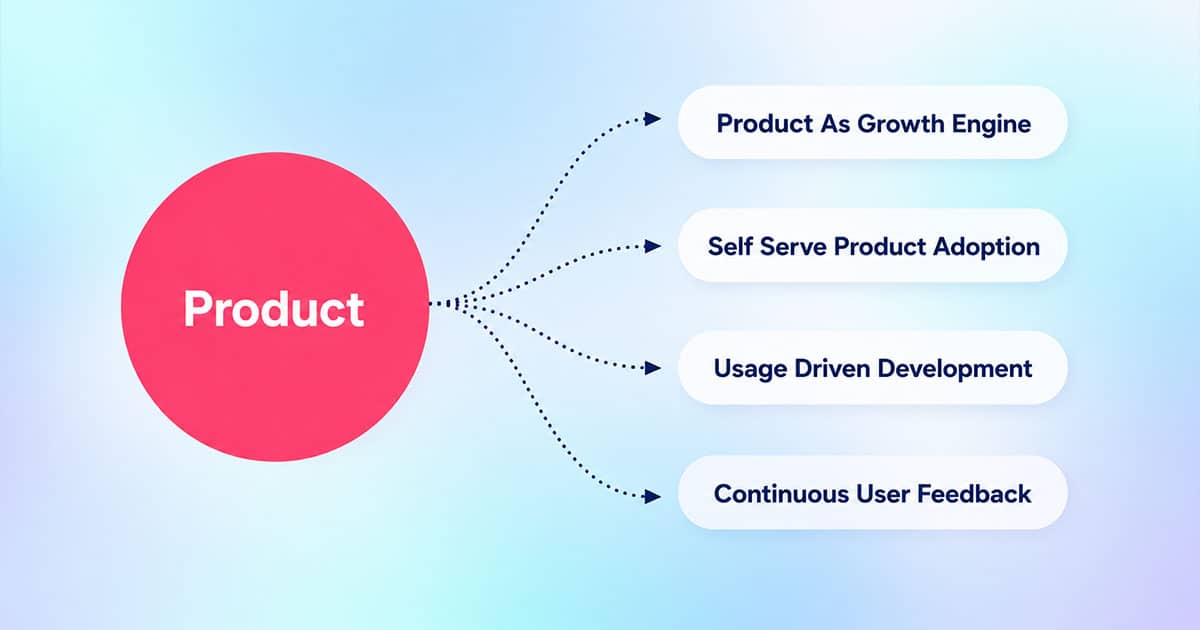
1. Product As Growth Engine
The product serves as your primary growth engine when acquisition and retention mechanics embed directly into core functionality. Slack demonstrates this perfectly. Their viral sharing features drove 50,000 users within 24 hours of launch without any marketing spend. The product itself became the go to market strategy, especially when teams validate this engine early using a focused lean startup minimum viable product.
Product led businesses design features that naturally encourage sharing and collaboration. Every user becomes a potential customer acquisition channel. New user acquisition happens through product usage rather than marketing campaigns. Engineering teams build referral loops, collaboration features, and sharing capabilities as core product elements.
Market research shows product led organizations grow faster because the value proposition proves itself through usage. Users experience business value before making purchasing decisions, particularly when companies invest in scalable SaaS application development that can support rapid self-serve growth. The decision making process shifts from sales presentations to hands-on product trials.
2. Engineering Ownership Of Experience
Engineering teams own the complete user journey, not just code deployment. Developers take accountability for metrics like activation rates, customer satisfaction scores, and retention numbers. This shift in ownership creates customer obsession throughout the entire organization.
Spencer Stuart research highlights how this approach empowers engineers with deep understanding of customer needs. Products built this way show 25% better alignment with actual pain points. Engineers participate in customer feedback sessions and user research. They see firsthand how their work impacts the customer experience.
Technical expertise combines with customer empathy to produce better solutions. Product managers and engineers share responsibility for outcomes, often adopting modern DevOps best practices for 2026 to keep collaboration and delivery tightly aligned. Cross-functional teams make informed decisions based on real user behavior rather than assumptions.
3. Self-serve Product Adoption
Intuitive onboarding reduces friction and support costs. Pendo data shows self-serve approaches cut support tickets by 15%. Users reach value in minutes through progressive disclosure and contextual guidance. The product teaches itself.
Product teams design user journeys that anticipate customer expectations. Help content appears at the right moment. Features reveal themselves based on user readiness. Onboarding flows adapt to user behavior and user needs.
Self-serve models serve customers at scale without proportional headcount increases. Engineering teams build scalable systems that guide users automatically. Customer churn decreases when users find value quickly. Reduce customer churn becomes an engineering objective, not just a customer success goal.
4. Usage Driven Development
Real product usage data dictates the product roadmap. Gocious reports manufacturers redirecting capital to high-ROI modules based on daily usage signals. Features with low adoption get sunset rather than maintained. Efficiency improvements of 15-20% follow from this data-driven approach.
Feature adoption rate becomes a key metric for engineering decisions. Teams stop building features nobody uses. Data-driven decision-making replaces opinion-based prioritization. Product leaders use telemetry to understand what drives business growth.
Usage-driven development aligns technical debt priorities with user impact. Platform investments connect to measurable outcomes. Engineering-led improvements focus on capabilities users depend on rather than theoretical best practices, using disciplined MVP feature prioritization methods to decide what to build next.
5. Continuous User Feedback
In-app surveys, session replays, and qualitative feedback integrate directly into development workflows. Research shows this approach accelerates insights 30% faster than traditional methods. Engineering teams see user struggles in real time and respond quickly.
User feedback loops close within days rather than weeks. Automated alerts notify teams of friction points. Analyzing data becomes a continuous activity rather than quarterly research projects. The entire company gains visibility into user experience.
Customer feedback shapes sprint priorities. Engineering teams run continuous learning cycles that inform new features and improvements. The product evolves based on actual customer needs rather than planned roadmaps created months earlier.
6. Activation And Retention Focus
North star metrics like time-to-first-value guide engineering priorities. Product-led organizations see 2x retention through personalized nudges and activation optimization. Magic moments receive engineering investment proportional to their impact on paying customers.
Top-performing product-led companies achieve 40% day-one retention compared to the 20% industry average. Engineering teams instrument activation funnels and optimize conversion paths. Customer retention becomes an engineering responsibility alongside product management.
Retention focus changes how teams think about technical work. Performance improvements tie to activation metrics. Bug fixes prioritize issues blocking user activation. The organization functions around keeping users successful.
7. Cross-Team Alignment
Unified KPIs across engineering, product, and sales teams reduce silos and improve outcomes. Data transparency enables cross-functional collaboration that increases customer lifetime value by 25%. Teams share dashboards and review metrics together.
Product strategy aligns with engineering capacity and market demands. Sales teams understand product capabilities and upcoming features. Customer success shares feedback that shapes engineering priorities. The led organization operates as one unit focused on user outcomes.
Alignment requires shared tools and regular communication. Weekly reviews bring together perspectives from across the organization. User adoption metrics matter to everyone, not just product teams. Market trends inform engineering decisions through clear communication channels.
Why Product Led Engineering Speeds Up Product Innovation
Product led engineering accelerates innovation through systematic elimination of delays. Teams ship faster, learn faster, and adapt faster than traditional approaches allow.
Faster Time To Market
Self-serve funnels widen top-of-funnel by 10x according to ProductLed.org research. Product led growth shortens sales cycles from 90 days to under 30 days. Engineering teams ship to real users faster because feedback loops validate direction quickly.
Reduced approval cycles and faster testing enable rapid iteration. Teams deploy daily rather than quarterly, similar to how a focused team can launch a production-ready MVP in 90 days by keeping scope tight and feedback loops short. Market trends shape product direction in real time rather than through annual planning cycles.
Continuous Product Iteration
Feature flags enable 50% more experiments yearly compared to traditional release approaches. Teams run A/B tests on new features before full rollout. Continuous improvement becomes the default operating mode rather than periodic enhancement projects.
Each release generates data that informs the next iteration. Learning compounds over time. Products evolve based on evidence rather than assumptions about customer expectations.
Real Time User Feedback
Analytics platforms cut decision latency significantly. Pendo reports 30% faster insight generation through real-time data collection. Engineering teams see user behavior immediately after deployment and adjust accordingly.
Session replays reveal user struggles within hours. Survey responses arrive continuously. The feedback loop optimization creates competitive advantage for teams that act on insights quickly.
Experimentation Driven Development
Releases become hypotheses to test rather than features to ship. Dropbox’s referral loops grew users 3900% in 15 months by treating features as experiments. Each deployment teaches the team something new about user needs.
Product market fit improves through systematic experimentation. Teams test multiple solutions before committing to full development. Failed experiments cost less because they stop early.
Reduced Dependency On Sales
Lower sales dependency reduces customer acquisition costs by 40-60%. Resources shift from sales operations to R&D and product development. Manufacturing companies using Gocious achieve global product launches 25% faster through self-serve approaches.
Product usage demonstrates value directly to prospects. The user journey replaces sales presentations. Competitive advantage comes from product quality rather than sales team size.
What Systems Make Product Led Engineering Possible
Technical infrastructure determines whether product led engineering succeeds. These five systems form the foundation for data driven decisions and rapid iteration.
Product Analytics Systems
Platforms like Amplitude or Mixpanel track user cohorts and behavior patterns with 99% uptime reliability. Industry surveys show product analytics presence in 70% of successful product led implementations. These systems reveal how users engage with features and where they struggle.
Analytics infrastructure requires investment upfront but pays dividends through better decisions. Teams instrument products comprehensively from early stages. Cohort analysis reveals retention patterns. Funnel tracking shows conversion rates at each step.
Feature Flagging Infrastructure
Tools like LaunchDarkly enable instant feature rollouts and 20% faster iteration cycles. Teams toggle hundreds of flags to control feature exposure. Gradual rollouts reduce risk. A/B tests run on live traffic without deployment changes.
Feature flags separate deployment from release. Code ships continuously while features activate when ready. Testing happens with real users in controlled segments. Rollbacks happen instantly without code changes.
Scalable Backend Architecture
Microservices architectures handle 10x throughput increases without redesign. Netflix processes billions of events daily through scalable systems designed for growth. Backend infrastructure must support rapid experimentation without becoming a bottleneck, which is why many teams adopt an API-first architecture for scalable systems.
Modular design enables parallel development. Teams work independently without coordination overhead. Services scale individually based on demand. Technical debt stays contained within service boundaries.
Data Collection Pipelines
Kafka streams and similar tools process 1M+ events per second for real-time analysis. Data pipelines feed ML models that predict churn and identify expansion opportunities, all running on scalable software architecture for high-growth products. Collection infrastructure determines how quickly teams can act on insights.
Real-time ingestion enables real-time response. Batch processing handles historical analysis. Data warehouses store information for long-term trend analysis. Pipeline reliability determines data quality and team confidence in metrics.
Cross Functional Collaboration Tools
Platforms like Linear or Jira with usage dashboards align teams on priorities. Shared visibility reduces misalignment by 35%. Tools surface user data alongside engineering tasks and product plans.
Collaboration infrastructure connects feedback to action. Customer issues link to engineering tickets. Product requests connect to user research. The entire organization sees the same information and works toward shared goals.
Role Of Product Usage Data In Engineering Decisions
Product usage data transforms engineering from output-focused to outcome-focused. Teams make informed decisions based on evidence rather than intuition.
Feature Adoption Tracking
Funnel analysis reveals that 60% of features go unused after launch. Teams that track feature adoption rate identify underperforming features quickly. Pruning unused features improves performance by 15% and reduces maintenance burden.
Adoption tracking shapes roadmap prioritization. Features with high adoption receive enhancement investment. Low-adoption features get investigation or removal. Data replaces opinion in product strategy discussions.
User Behavior Analysis
Heatmaps and session recordings identify user drop-offs and confusion points. HubSpot improved activation by 22% through behavior analysis that revealed UX issues. Teams see exactly where users struggle and succeed.
Behavior analysis complements quantitative metrics with qualitative understanding. Teams watch real user sessions to understand why metrics move. Pattern recognition reveals common pain points. User journey optimization follows specific evidence.
Data Driven Prioritization
ICE scoring (impact, confidence, ease) structures prioritization decisions. Product led teams hit roadmap targets 3x more often than teams using intuition-based planning. Data creates alignment around what matters most.
Prioritization frameworks work when data supports estimates. Impact connects to user metrics and business value. Confidence reflects data quality. Ease reflects technical understanding. Decisions follow evidence.
Retention And Activation Signals
Day-one retention and magic moment tracking identify critical experiences. Top product led organizations achieve 40% D1 retention versus 20% industry average. Engineering teams optimize the moments that drive long-term engagement.
Activation signals define engineering priorities. Features that drive activation receive investment. Experiences that predict retention guide product vision. Metrics create focus across the entire company.
Feedback Loop Optimization
Automated alerts close feedback cycles from weeks to days. Gocious demonstrates rapid portfolio shifts based on tightened feedback loops. Teams respond to user signals faster than competitors.
Loop optimization requires tooling and process changes. Alerts notify teams of metric movements. Dashboards show real-time status. Review cadences ensure teams act on information. Speed compounds into competitive advantage.
Engineering Practices That Support Faster Release Cycles
Release velocity determines how quickly teams learn and improve. These practices enable rapid iteration while maintaining high quality code standards.
Continuous Integration And Deployment
CI/CD pipelines via GitHub Actions or similar tools enable daily deploys. GitLab reports 200% velocity increases from mature CI/CD practices. Code moves from commit to production in minutes rather than days.
Continuous deployment requires automation investment. Build pipelines run automatically. Test suites execute on every change. Deployment happens without manual intervention. Velocity increases compound over time.
Modular System Design
Hexagonal or clean architecture patterns enable parallel development. Coupling reduction of 50% allows teams to work independently. Changes stay contained within module boundaries.
Modular design supports rapid iteration by limiting blast radius. Features deploy independently. Teams move without coordination overhead. System complexity stays manageable as products grow.
Automated Testing Workflows
80% code coverage through tools like Cypress reduces bugs by 70%. Automated tests catch regressions before production. Teams deploy confidently because tests verify behavior.
Testing automation requires upfront investment but accelerates long-term velocity. Test suites run in minutes. Coverage reports guide additional testing. Confidence enables faster iteration.
Rapid Iteration Cycles
Work-in-progress limits and 3-day sprint cycles accelerate delivery. Spotify’s squad model demonstrates 4x throughput improvement through rapid iteration practices. Small batches reduce risk and increase learning speed.
Short cycles create frequent checkpoints. Teams adjust direction quickly. Feedback incorporates rapidly. Continuous learning happens through frequent releases rather than big-bang deployments.
Release Monitoring And Rollbacks
Tools like Sentry enable 99.99% uptime through automatic issue detection. Auto-rollback handles 90% of issues within seconds. Production problems resolve before users notice.
Monitoring infrastructure supports confident deployment. Error rates track automatically. Performance metrics surface problems. Rollback capabilities reduce deployment risk. Teams ship faster because recovery happens quickly.
Growth Loops And Product Led Development Execution
Growth loops create self-reinforcing cycles that drive user acquisition and expansion. Engineering teams build these mechanics directly into products, while planning SaaS scalability strategies for sustainable growth so loops don’t overload infrastructure.
Freemium And Trial Models
Notion’s freemium approach converts 10-15% of free users monthly through usage-triggered upgrade prompts. Users experience value before purchasing. Conversion happens naturally through product usage.
Freemium models require careful design of free versus paid boundaries. Free tiers demonstrate value. Paid features address advanced user needs. Upgrade triggers activate at natural moments.
Product Led Acquisition Loops
Dropbox referral loops achieved 4M users in 15 months at 60% lower customer acquisition costs. Users invite other users through product mechanics. Network effects create exponential growth.
Acquisition loops embed in core product experiences. Sharing features spread products naturally. Collaboration requires invitations. Value increases with more users. Growth compounds through usage.
In Product Conversion Paths
Contextual CTAs boost upgrade conversions by 30% according to Pendo research. Upgrade prompts appear when users hit limits or need advanced features. Conversion happens at moments of high intent.
Conversion paths require careful placement. Prompts appear at relevant moments. Messaging connects to user context. Friction stays minimal. Users upgrade because they want more value.
Expansion And Upsell Triggers
Milestone-based triggers activate on usage thresholds. Slack’s paid limits drive 20% month-over-month growth through expansion mechanics. Existing users become larger accounts over time.
Expansion triggers tie to value realization. Users upgrade when they need more. Pricing aligns with value delivered. Growth happens through customer success rather than sales pressure.
Network And Viral Effects
Airtable templates drive 50% viral coefficient through sharing mechanics. Products spread through user communities. Each user potentially brings additional users.
Viral design requires features worth sharing. Templates, workflows, and collaboration create natural sharing moments. Users become advocates through product experience. Growth accelerates without marketing spend.
Final Discussion
Product-led engineering strategy shapes how modern teams deliver faster innovation while staying aligned with real user needs. A strong product-led approach ensures every decision connects back to customer value, not just internal assumptions. When business strategy aligns with product-led strategy and a clear post-MVP development growth strategy, teams can respond to market shifts with clarity and speed.
A product-led environment builds a culture where customer-centric thinking drives priorities across the entire customer journey. Product teams that focus on key elements like feedback loops, experimentation, and rapid iteration are better positioned to drive growth without relying heavily on external push tactics.
Long-term success depends on how well teams integrate insights into execution. Clear ownership, shared goals, and continuous validation help organizations reduce friction and improve outcomes. A well-defined product-led strategy does not just improve delivery speed; it strengthens product relevance, customer trust, and sustainable growth, especially when paired with expert custom software development services that can translate strategy into robust products.
FAQs
How Product-Led Engineering Improves Innovation Speed
Product-led engineering improves innovation speed by embedding real-time feedback loops directly into development workflows. Teams using this approach cut iteration times from quarters to weeks. Data shows 30% faster feedback collection and 50% more experiments per year compared to traditional approaches. Engineers see user behavior immediately after deployment, enabling rapid adjustments. Feature flags allow testing hypotheses quickly without full rollouts.
Which Metrics Matter In Product-Led Engineering
Key metrics include activation rate with a target of 40%, day-90 retention above 25%, and lifetime value to customer acquisition cost ratio exceeding 3:1. Expansion revenue should represent at least 30% of total revenue. Engineering-specific metrics include deployment frequency, time to restore service, and feature adoption rate. Teams track north star metrics for each product area and connect team KPIs to those outcomes.
How Engineering Teams Use Product Data Effectively
Engineering teams use product data through cohort analysis for prioritization, session replays for bug identification, and predictive churn models with 85% accuracy. Daily dashboards show feature adoption and user behavior patterns. Teams instrument all new capabilities with events tracking activation, usage depth, and retention impact. Data informs sprint planning and shapes technical debt priorities.
What Challenges Affect Product-Led Engineering Adoption
Data silos cause 40% of product-led engineering failures according to industry research. Cultural resistance from sales-led organizational norms creates friction during transitions. Privacy compliance under GDPR adds approximately 20% to initial setup time and ongoing operational complexity. Over-reliance on quantitative data can ignore important qualitative insights and create echo chambers. Initial infrastructure costs exceed $500K for comprehensive analytics and feature flagging stacks.
How To Transition To Product-Led Engineering Strategy
Transition successfully by piloting with one squad first and measuring results before scaling. Instrument analytics comprehensively over three months. Train teams on self-serve mindset over six weeks. Measure ROI through customer acquisition cost payback targeting under 12 months. Intercom scaled to $100M ARR using this phased approach. Start with discovery and alignment in month one, mapping user journeys and identifying key metrics. Pilot outcome-based sprints in month two.