
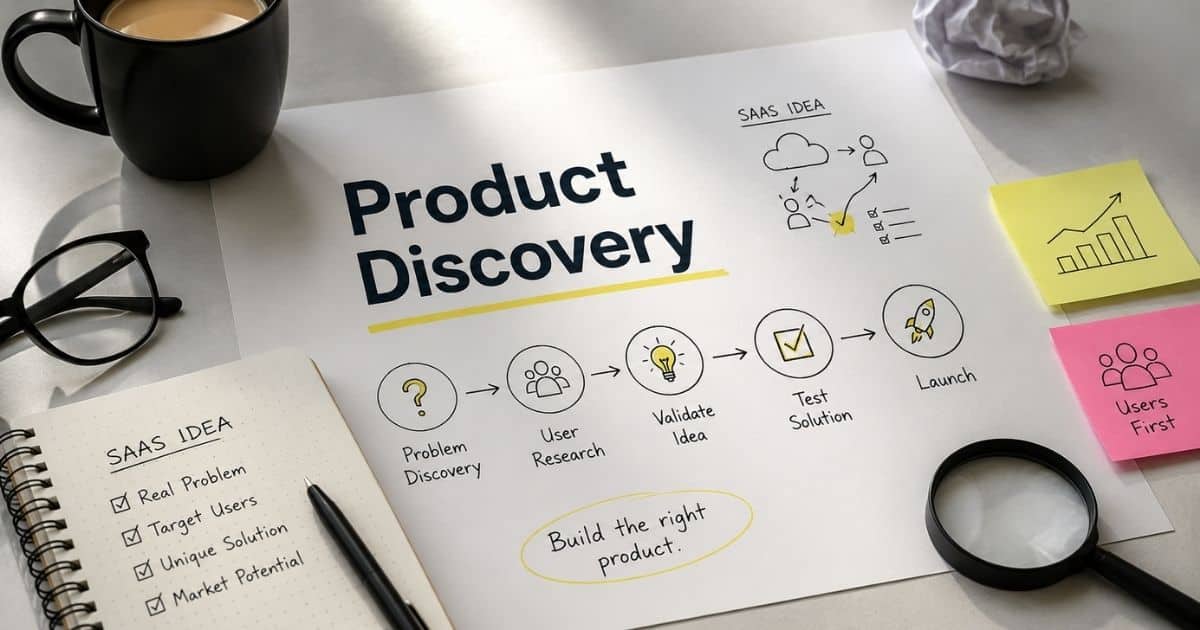
Great products rarely happen by accident. Behind most successful apps, platforms, and software tools, there is a strong product discovery process. Teams spend time understanding customer problems before they start building anything. That step saves time, money, and countless failed ideas.
Many businesses still rush straight into development. Later, they realize customers do not need the product, struggle to use it, or simply ignore it. Product discovery helps prevent that. It helps teams validate ideas, understand user behavior, and make smarter product decisions early.
This guide covers everything you need to know about product discovery. You will learn the process, frameworks, methods, tools, risks, mistakes, and real-world strategies modern product teams use to build products people actually want.
What Is Product Discovery
Product discovery is the process product teams use to understand customer needs before product development starts. A strong product discovery process helps teams identify pain points, gather user feedback, and validate ideas early. Product managers use customer interviews, user research, market research, and usability testing to learn what real users actually need. Product discovery helps teams avoid wasting time and money on the wrong product idea.
A robust product discovery process is not a one-time discovery phase. Modern product management treats it as a continuous process across the entire product lifecycle. Many teams follow continuous discovery habits to keep gathering insights from customer-facing teams, sales teams, and prospective customers. Methods like customer surveys, opportunity solution tree mapping, and rapid experimentation help cross-functional teams prioritize solutions and validate solutions faster.
Dynamic product discovery focuses on understanding customer behavior, market trends, and business goals. It helps delivery teams create products that solve real user problems and support successful product development.
Product Discovery Vs Product Delivery: Understanding The Key Differences
Product discovery and product delivery work together, but they focus on different goals. Product discovery helps teams decide what to build and why. Product delivery focuses on building, launching, and maintaining the final product efficiently. Understanding both helps product teams reduce risk and improve product success.
Aspect | Product Discovery | Product Delivery |
|---|---|---|
Main Focus | Understanding customer needs and validating ideas | Building and releasing the product |
Primary Goal | Find the right solution | Deliver the solution correctly |
Key Activities | User research, customer interviews, market analysis, testing | Development, coding, QA testing, deployment |
Team Involvement | Product managers, designers, researchers, stakeholders | Developers, engineers, QA teams, DevOps |
Process Stage | Early discovery phase | Post-discovery execution phase |
Decision Making | Explore potential solutions | Implement approved solutions |
User Interaction | Frequent customer feedback and user testing | Limited user interaction during release |
Risk Reduction | Prevents building the wrong product | Prevents technical and delivery issues |
Common Methods | Opportunity solution tree, surveys, MVP validation | Agile sprints, CI/CD, release management |
Success Metric | Product-market fit and validated learning | Stable delivery and product performance |
Outcome | Clear product direction | Working final product |
Approach | Divergent and convergent thinking | Structured execution and delivery process |
What Are The Goals Of Product Discovery And The Problems It Solves
A strong product discovery process helps teams reduce risk before product development starts. It gives product teams a clearer direction and helps them understand customer needs early. Companies that invest in customer research and validation often launch stronger products and avoid expensive mistakes later.
Better Understanding Of Customer Needs
Many products fail because teams assume what users want. Product discovery fixes that problem. Customer interviews, customer surveys, and user research help product teams learn directly from real users. Teams uncover pain points, habits, and expectations before building anything.
A recent CB Insights report found that 35% of startups fail because there is no market need for the product. Product discovery helps teams avoid that mistake. Valuable insights from customer behavior and qualitative data lead to smarter product decisions and stronger business strategy.
Faster Validation Of Product Ideas
A good discovery process helps teams validate solutions early. Product managers test a product idea through user testing, market analysis, and minimum viable product experiments. That approach reduces uncertainty before the delivery process begins.
Modern product management emphasizes rapid experimentation. Teams now test potential solutions faster than before. Cross-functional teams use continuous discovery habits to check whether ideas solve real user problems, often starting with an AI minimum viable product to validate concepts quickly. Early validation also saves time and money during product development.
Lower Risk During Product Development
Product discovery helps teams reduce product failure risk. Many teams waste resources because they move into solution delivery too quickly. A robust product discovery process creates space for testing assumptions before delivery teams start building the final product.
Marty Cagan often highlights the importance of validating ideas before development. Teams that deeply understand customer needs usually avoid costly rework later. User feedback, usability testing, and customer-facing teams help identify market gaps and existing solutions before major investment happens.
Stronger Product Market Fit
Successful product development depends on product-market fit. Product discovery gives teams a better chance to create products customers actually want. User research and customer feedback reveal whether a solution matches real customer needs.
The famous Sean Ellis test suggests that products with strong market fit usually have at least 40% of users saying they would be “very disappointed” without the product. Product discovery supports that goal by helping enabling teams prioritize solutions based on customer needs and validating market demand early.
Better Collaboration Across Teams
Product discovery works best as a collaborative process. Product managers, sales teams, designers, engineers, and customer-facing teams all contribute valuable insights. Different perspectives help many teams understand the target audience more clearly.
Continuous discovery also improves communication between discovery teams and delivery systems. Teams align product goals with business objectives and key metrics earlier in the entire product lifecycle. That alignment creates a more dynamic product discovery culture and supports long-term competitive advantage.
Key Stages In The Product Discovery Process
A successful product discovery process follows a clear path from research to validation. Each stage helps product teams reduce uncertainty before product development starts. Strong discovery work improves decision-making, supports business goals, and increases the chances of building products users truly want.
Customer Problem Research
Every discovery process starts with understanding customer problems. Product teams collect customer feedback through customer interviews, surveys, support tickets, and user research sessions. The goal is to identify pain points and understand customer behavior before discussing solutions.
Research from Salesforce shows that 73% of customers expect companies to understand their unique needs. Product managers use qualitative data and market research to deeply understand customer expectations. Strong customer research creates a better foundation for successful product development and smarter business strategy.
Idea Exploration And Solution Mapping
Once teams identify user needs, they start exploring possible solutions. Product discovery helps teams compare existing solutions, study market trends, and identify market opportunities. Many teams use an opportunity solution tree to organize ideas and connect them with customer needs.
Divergent and convergent thinking play a major role here. Product teams generate multiple concepts before narrowing down the most promising options. This creative process helps cross-functional teams prioritize solutions that align with business objectives and customer needs and validating market demand.
Prototype Creation And User Testing
Prototype testing helps teams validate solutions before full product development begins. Product managers create simple wireframes, mockups, or minimum viable product versions to test with real users. User testing reveals usability issues and gaps in the product idea early, while different approaches such as a proof of concept, prototype, and MVP help teams tackle specific risks during early validation.
According to IBM, fixing product problems after development can cost up to 100 times more than fixing them during the discovery phase. Product discovery saves time and money because teams gather user feedback before major investment, which is critical given the significant SaaS development costs across discovery, build, and maintenance. Usability testing also improves the final product experience and delivery process.
Validation Through Rapid Experiments
Modern product management emphasizes rapid experimentation. Teams run small experiments to test assumptions around pricing, features, workflows, and customer behavior. Continuous discovery habits allow product teams to gather insights faster and reduce product risk earlier.
A robust product discovery process depends on validating ideas with evidence instead of assumptions. Product managers monitor key metrics, customer surveys, and user feedback to measure demand. Many teams now use dynamic product discovery methods because markets and customer expectations change quickly.
Alignment Before Product Delivery
The final discovery stage focuses on alignment across delivery teams and stakeholders. Product discovery and solution delivery must work together before development begins. Teams confirm priorities, essential features, timelines, and business goals before moving into product delivery.
Strong collaboration between customer-facing teams, sales teams, engineers, and designers improves the entire product lifecycle. Continuous discovery also supports ongoing process improvements after launch. This collaborative process helps enabling teams build products that solve real user problems while maintaining long-term competitive advantage.
Most Effective Product Discovery Methods Used By Modern Product Teams
Modern product teams use different product discovery methods to reduce risk and validate ideas faster. Each method helps teams understand customer needs, test assumptions, and improve decision-making. Strong discovery methods also help businesses avoid costly product development mistakes and improve product-market fit.
Customer Interviews
Customer interviews remain one of the most effective product discovery methods. Product managers speak directly with users to understand pain points, habits, frustrations, and goals. Open conversations often reveal valuable insights that analytics alone cannot show.
A recent User Interviews report found that 78% of product teams rely heavily on customer interviews during the discovery process. Product discovery helps teams deeply understand customer expectations before solution delivery starts. Many product teams also involve customer facing teams and sales teams to gather broader customer feedback.
User Testing Sessions
User testing helps teams validate solutions before full product development begins, and investing in strong UI/UX design services for SaaS products makes those solutions more intuitive and engaging. Teams ask real users to interact with prototypes, workflows, or existing features. Product managers observe where users struggle and where the experience feels smooth.
Research from Forrester shows that every dollar invested in UX testing can return up to $100 in value. A robust product discovery process uses usability testing to improve the final product early. Product teams save time and money because issues appear before delivery teams move into development.
Market Research And Competitor Analysis
Market research helps product teams identify market opportunities and understand industry trends. Teams analyze existing solutions, customer behavior, pricing models, and feature gaps. Competitive analysis also helps businesses discover areas where they can gain a competitive advantage.
Modern product management depends heavily on market analysis during the discovery phase. Product teams study target audience preferences and changing market trends before validating ideas, often supported by predictive analytics software for forecasting demand and risks. Customer research combined with competitor analysis creates a stronger business strategy and supports successful product development.
Minimum Viable Product Testing
Many teams use a minimum viable product to test a product idea with real users quickly. An MVP contains only essential features needed to solve a core customer problem. Product discovery methods like Lean Startup MVP testing support rapid experimentation and faster learning.
CB Insights reports that lack of market need remains one of the biggest reasons startups fail. Product discovery helps teams avoid that outcome through early customer needs and validating workflows. Dynamic product discovery allows teams to adjust product direction before large-scale investment happens.
Opportunity Solution Tree Mapping
The opportunity solution tree has become a popular framework in continuous discovery. Product teams use it to connect customer problems with possible solutions and business objectives. The method helps teams organize research findings and prioritize solutions more clearly.
Cross-functional teams often use this collaborative process during ongoing discovery work. Product managers combine user research, qualitative data, and customer surveys to identify the optimal solution. Continuous discovery habits also improve alignment between discovery teams, delivery systems, and product development goals.
Essential Product Discovery Frameworks And Models Every Team Should Know
Strong product discovery frameworks help product teams organize research, validate ideas, and reduce product risk. Clear models also improve collaboration between cross-functional teams and delivery teams. Modern product management depends on structured discovery methods to create products that match customer needs and business goals.
Opportunity Solution Tree
The opportunity solution tree is one of the most popular modern discovery frameworks. Teresa Torres introduced the model to help product teams connect customer problems with possible solutions. Teams map opportunities, user needs, and business objectives before product development starts.
This framework supports continuous discovery habits and faster decision-making. Product managers use customer interviews, customer surveys, and user research to gather valuable insights for each branch of the tree. The process also helps teams prioritize solutions and validate solutions without wasting time and money on weak ideas.
Double Diamond Framework
The Double Diamond framework focuses on divergent and convergent thinking during the discovery process. Teams first explore problems broadly and then narrow down the best solution options. The framework became widely known through the UK Design Council and remains popular in product development.
Many product teams use this model because it supports creativity and structure at the same time. Customer research, market analysis, and usability testing play a major role in each stage. The framework also helps teams deeply understand customer pain points before moving into solution delivery and delivery systems.
Lean Startup Method
The Lean Startup method emphasizes rapid experimentation and fast learning. Eric Ries introduced the framework to help businesses validate ideas quickly with real users. Product teams build a minimum viable product, measure customer behavior, and improve based on user feedback.
CB Insights reports that 42% of startups fail because products do not match market demand. Lean discovery methods help reduce that risk. Product discovery helps teams identify market opportunities earlier and supports dynamic product discovery through continuous process improvements and ongoing customer validation.
Jobs To Be Done Framework
The Jobs To Be Done framework focuses on why customers use a product instead of only who they are. Product managers study the actual “job” users want to complete. This approach helps teams understand customer needs more deeply and uncover hidden pain points.
Many modern product teams use JTBD during customer interviews and market research sessions. The framework often reveals gaps in existing solutions and customer expectations. Businesses use those findings to create products that solve real user problems and strengthen product-market fit across the entire product lifecycle.
Design Sprint Framework
The Design Sprint framework helps cross-functional teams validate a product idea within a short time. Google Ventures popularized the method to speed up product discovery and reduce uncertainty before development. Teams usually complete the process within five days.
A design sprint combines user testing, prototype creation, customer feedback, and collaborative workshops. Product teams gather insights from prospective customers early in the discovery phase. The framework also improves alignment between product managers, delivery teams, and customer-facing teams before the final product moves into full product development.
Continuous Product Discovery And Why Agile Teams Depend On It
Modern product teams cannot rely on one-time research anymore. Customer needs, market trends, and user behavior change too quickly. Continuous product discovery helps agile teams gather insights regularly, validate ideas faster, and improve decision-making throughout the entire product lifecycle.
Faster Response To Customer Needs
Continuous discovery helps product teams stay close to customer needs. Teams collect customer feedback regularly instead of waiting for a major discovery phase. Customer interviews, customer surveys, and user research sessions reveal changing pain points much earlier, while launching focused MVPs in software development turns those insights into validated learning.
Salesforce reports that 88% of customers say the experience a company provides matters as much as its products. Agile product teams use continuous discovery habits to deeply understand customer expectations over time. Frequent user feedback also helps businesses adjust their product development process before problems grow larger.
Better Decisions Through Real-Time Insights
Agile teams depend on current data instead of assumptions. Continuous product discovery creates a steady flow of valuable insights from real users, customer-facing teams, and market research. Product managers make faster decisions because they always have updated information.
Dynamic product discovery also improves collaboration across cross-functional teams. Product teams use qualitative data, market analysis, and customer behavior patterns to identify market shifts earlier. This ongoing process helps businesses prioritize solutions that align with business goals and customer needs and validating product direction continuously.
Lower Risk During Product Development
A robust product discovery process reduces product risk throughout product development. Agile teams test ideas earlier and more often. User testing, usability testing, and rapid experimentation reveal weak assumptions before delivery teams invest major resources.
IBM research shows that product issues discovered after release cost far more to fix than problems found during early testing. Product discovery helps teams avoid wasting resources on the wrong features or existing feature updates. Continuous discovery also strengthens solution exploration before final product delivery begins.
Stronger Collaboration Across Teams
Continuous product discovery works best as a collaborative process. Product managers, designers, engineers, sales teams, and customer-facing teams all contribute insights during the discovery process. Shared learning improves communication between discovery teams and delivery systems.
Many agile companies now involve delivery teams much earlier in product discovery. This approach reduces gaps between discovery and solution delivery. Product management becomes more aligned because everyone understands customer needs, business objectives, and key metrics before development moves forward.
Continuous Improvement After Launch
Product discovery does not stop after launch. Agile teams continue gathering user feedback and customer research throughout the entire product lifecycle. Real users often uncover new pain points and opportunities once the product reaches a wider target audience.
McKinsey research shows companies that respond quickly to customer behavior changes outperform slower competitors in customer satisfaction and revenue growth. Continuous process improvements help teams maintain competitive advantage over time. Product discovery also supports successful product development by helping teams create products that evolve with market demand.
Customer Research Techniques That Improve Product Discovery Decisions
Strong customer research helps product teams make smarter product discovery decisions. Teams that deeply understand customer behavior can validate ideas faster and reduce product risk early. Effective research methods also help businesses create products that better match customer needs and market demand.
Customer Interviews
Customer interviews remain one of the most valuable product discovery methods. Product managers speak directly with prospective customers and existing users to uncover pain points, frustrations, and expectations. Open-ended conversations often reveal problems users never mention in surveys.
According to User Interviews, over 70% of product teams rely on customer interviews during the discovery process. Product discovery helps teams gather qualitative data that analytics alone cannot provide. Customer-facing teams and sales teams also contribute valuable insights about customer behavior and unmet needs.
Customer Surveys
Customer surveys help product teams collect feedback from a larger target audience quickly. Surveys measure satisfaction, feature demand, customer needs, and usability concerns at scale. Teams often use surveys during the discovery phase to validate assumptions before product development begins.
SurveyMonkey research shows that companies using customer surveys regularly improve customer retention more effectively than those relying only on internal assumptions. Product managers combine customer surveys with market research and user feedback to prioritize solutions more confidently, especially when applying structured MVP feature prioritization techniques. Strong survey design also improves the quality of discovery insights.
Usability Testing
Usability testing helps teams understand how real users interact with a product, prototype, or existing feature. Product teams observe navigation patterns, confusion points, and customer reactions during testing sessions. This process reveals whether a solution actually solves real user problems.
Forrester reports that better user experience design can increase conversion rates by up to 400%. Product discovery supports successful product development because teams identify usability problems before solution delivery begins. Continuous discovery habits also help teams improve the final product throughout the entire product lifecycle.
Behavior Analytics
Behavior analytics shows how users actually use a product instead of how they describe it. Product teams track clicks, feature usage, drop-off points, and customer journeys to gather insights about user needs and customer behavior.
Modern product management depends heavily on data-driven discovery methods. Product discovery helps teams identify market gaps, weak workflows, and friction points through key metrics and behavioral analysis. Dynamic product discovery also improves rapid experimentation because teams validate solutions with real usage patterns instead of assumptions alone.
Competitor And Market Research
Competitor analysis and market research help product teams understand industry trends and existing solutions. Teams study pricing models, customer expectations, feature gaps, and business strategy shifts across the market. This research helps identify market opportunities earlier.
CB Insights continues to rank poor market fit as one of the top startup failure reasons. Product teams use market analysis and customer research to avoid that problem. A robust product discovery process combines external research with customer needs and validating efforts to create products that maintain long-term competitive advantage.
Common Product Discovery Risks And How Teams Reduce Them
Every product discovery process comes with risk. Wrong assumptions, weak research, and poor validation can lead to failed products and wasted resources. Modern product teams reduce those risks through customer research, continuous discovery, rapid experimentation, and stronger collaboration across the entire product lifecycle.
Poor Understanding Of Customer Needs
Many product ideas fail because teams misunderstand customer needs. Internal assumptions often replace real customer feedback during the discovery phase. Product teams may focus on features they believe users want instead of actual pain points.
CB Insights reports that 35% of startups fail because there is no market need. Product discovery helps teams avoid that risk through customer interviews, customer surveys, and user research. Product managers who deeply understand customer behavior usually make better product development decisions and identify market opportunities earlier.
Weak Solution Validation
Some teams move into product development without validating ideas properly. A product idea may look strong internally but fail with real users later. Weak validation often leads to expensive rework and delayed solution delivery.
Modern product management emphasizes rapid experimentation and usability testing to reduce this risk. Product discovery helps teams validate solutions through minimum viable product testing, prototype reviews, and gathering user feedback. Continuous discovery habits also improve confidence before delivery teams begin building the final product.
Overlooking Market Trends
Market conditions change quickly. Teams that ignore market research and competitor analysis may create products that already exist or no longer match customer expectations. Existing solutions can make a new product less competitive if differentiation is unclear.
McKinsey research shows companies that adapt faster to market shifts often outperform competitors in growth and customer satisfaction. Product discovery methods like market analysis and customer research help teams identify market changes earlier. Dynamic product discovery also supports better business strategy and long-term competitive advantage.
Poor Team Alignment
Product discovery works best as a collaborative process. Problems appear when product managers, designers, engineers, sales teams, and customer-facing teams work separately. Poor communication creates confusion around priorities, essential features, and business objectives.
Cross-functional teams reduce this risk through shared discovery workflows and continuous process discussions. Opportunity solution tree mapping and regular discovery reviews improve alignment between discovery teams and delivery systems. Better collaboration also helps enabling teams prioritize solutions based on customer needs and validating evidence.
Focus On Features Instead Of Problems
Many product teams become obsessed with adding new features, or get distracted choosing between no-code and custom development paths, instead of focusing on the core problem to solve. That approach often ignores whether the product actually solves real user problems. Product discovery should focus first on customer pain points, not feature quantity.
Forrester reports that customer-focused businesses grow revenue faster than companies driven only by internal priorities. Product discovery helps teams gather valuable insights before committing to large development efforts. A robust product discovery process keeps the focus on understanding customer needs, customer behavior, and the optimal solution instead of unnecessary complexity.
Biggest Product Discovery Mistakes That Lead To Product Failure
Many products fail long before product development finishes. Weak discovery decisions often create bigger problems later in the entire product lifecycle. Product teams that skip research, ignore customer feedback, or rush validation usually struggle with poor product-market fit and wasted development costs.
Assuming Teams Already Know Customer Needs
One of the biggest product discovery mistakes happens when teams rely on assumptions instead of customer research. Product managers sometimes believe they already understand customer needs without speaking to real users. That approach often leads to products that miss important pain points.
CB Insights reports that lack of market need remains the top reason startups fail. Product discovery helps teams avoid that problem through customer interviews, customer surveys, and user research. Deeply understanding customer behavior gives product teams more valuable insights before solution delivery begins.
Rushing Into Product Development
Some businesses move directly into product development after a single product idea appears promising, without considering whether to use in-house teams or partners following an in-house vs outsourcing development comparison. The discovery process becomes too short or disappears completely. Delivery teams start building features before validating ideas with prospective customers.
A robust product discovery process reduces this risk through user testing, rapid experimentation, and market analysis. Product management works better when teams validate solutions early instead of fixing expensive mistakes later. Continuous discovery habits also help teams avoid wasting time and money on weak concepts.
Ignoring User Feedback
User feedback plays a major role in successful product development. Many teams collect feedback once but fail to treat product discovery as a continuous process. Customer expectations change quickly, especially in competitive digital markets.
Salesforce research shows that 73% of customers expect companies to understand their unique needs and expectations. Product discovery helps teams gather user feedback continuously across the entire product lifecycle. Customer-facing teams and sales teams often uncover important problems before analytics reveal them.
Focusing Too Much On Features
Feature-heavy products do not always solve real user problems. Some product teams prioritize adding more tools instead of improving usability or customer experience. Existing feature expansion can distract teams from the actual business objectives.
Modern product discovery focuses on customer needs and validating the optimal solution first. Frameworks like opportunity solution tree mapping help cross-functional teams prioritize solutions more effectively. Product teams that focus on pain points and customer behavior often create products with stronger product-market fit and competitive advantage.
Poor Collaboration Across Teams
Product discovery fails when teams work in silos. Product managers, designers, engineers, and delivery teams may follow different priorities without proper communication. Weak collaboration slows the discovery phase and creates confusion during the delivery process.
A collaborative process improves alignment across many teams involved in product development. Dynamic product discovery encourages shared learning between discovery teams, customer-facing teams, and delivery systems. Better communication also supports faster decision-making, smoother solution exploration, and more successful final product outcomes.
Best Product Discovery Tools For Research, Testing, And Collaboration
Modern product discovery depends heavily on the right tools. Product teams use different platforms for customer research, user testing, collaboration, and market analysis. Strong discovery tools help teams gather insights faster, validate ideas earlier, and improve communication across the entire product lifecycle.
User Research And Interview Tools
Customer interviews and user research remain essential parts of the product discovery process. Tools like User Interviews, Dovetail, and Typeform help product teams collect customer feedback and qualitative data more efficiently.
Modern product management depends on deeply understanding customer behavior and customer needs. These platforms help product managers organize customer surveys, user feedback, and research notes in one place. Continuous discovery habits become easier when cross-functional teams can access valuable insights quickly and collaborate around research findings.
Prototype And Design Tools
Prototype tools help product teams validate solutions before product development starts. Platforms like Figma and Adobe XD support rapid experimentation during the discovery phase. Teams create wireframes, clickable prototypes, and product flows without heavy engineering work, then pair them with modern MVP development trends for startups to validate value propositions in the market.
According to Adobe, companies with strong design practices often outperform competitors in customer satisfaction and business growth. Product discovery helps teams reduce risk because real users can test ideas early. Well-structured SaaS design systems for scalable products further support consistent experiences, and usability testing during solution exploration also improves the final product experience before delivery teams begin full development.
Analytics And Behavior Tracking Tools
Behavior analytics tools show how users interact with a product in real situations. Platforms like Hotjar, Mixpanel, and Google Analytics help product teams track customer behavior, feature usage, and drop-off points.
Product discovery methods become stronger when teams combine user research with key metrics and real usage patterns. Dynamic product discovery also depends on continuous process improvements based on actual customer actions. Product managers use those insights to prioritize solutions, inform technical roadmap planning for product strategy, and identify market opportunities more accurately.
Collaboration And Discovery Planning Tools
Product discovery works best as a collaborative process across many teams. Platforms like Miro, Notion, and Jira improve communication between discovery teams and delivery systems.
Cross-functional teams use these tools for opportunity solution tree mapping, product roadmaps, and solution delivery planning, often in parallel with specialized SaaS development services that handle build and scaling. Better collaboration helps enabling teams align customer needs, business objectives, and product development goals earlier, especially when maintaining a clear SaaS product roadmap for prioritization and scaling and selecting scalable SaaS tools that support global growth. Shared workflows also reduce confusion during the delivery process and ongoing product management activities.
Testing And Experimentation Platforms
Testing tools support validating ideas before businesses invest heavily in product development. Platforms like Maze and Optimizely help teams run user testing sessions and product experiments faster.
Modern product discovery emphasizes rapid experimentation because customer expectations change quickly, as shown by startups that follow a disciplined 90-day MVP launch playbook to validate ideas in real markets. Product teams use these tools to test potential solutions, existing feature updates, and minimum viable product concepts with prospective customers. Continuous discovery also becomes more effective when teams gather user feedback regularly instead of relying only on assumptions.
Real Examples Of Successful Product Discovery In SaaS And Tech Companies
Many successful SaaS and tech companies grew because they invested heavily in product discovery and aligned it with future-ready, cloud-first SaaS development practices. Strong customer research, continuous discovery, and rapid experimentation helped those businesses understand customer needs before scaling product development. Real-world examples, such as case studies of successful SaaS launches and a build-vs-buy software decision where custom won, show how product discovery helps teams reduce risk and improve product-market fit.
Slack And Customer Feedback
Slack became one of the fastest-growing SaaS products because the team listened closely to user feedback early. Slack originally started as an internal communication tool inside a gaming company. Customer interviews and usability testing revealed strong market demand beyond gaming.
The company focused heavily on customer behavior and pain points during the discovery process. Product teams improved workflows through continuous discovery habits and rapid feedback loops. Slack reached over 42 million daily active users by 2025 because the product solved real user problems better than many existing solutions.
Dropbox And MVP Validation
Dropbox used a simple minimum viable product approach during product discovery. Instead of building a complex product immediately, the company released a short demo video to validate ideas and measure customer interest first, following many principles from a structured startup software development process guide.
The experiment generated thousands of signups almost overnight. Product managers used those valuable insights to confirm customer needs before major product development investment. Dropbox proved that validating ideas early can save time and money while reducing product risk across the entire product lifecycle.
Airbnb And Customer Research
Airbnb improved its product discovery process through direct customer research. The founders visited hosts personally to understand customer behavior, trust concerns, and usability problems. Those conversations uncovered pain points that analytics alone could not reveal.
Product discovery helped teams identify market gaps in the travel industry. Airbnb also used user testing and customer feedback to improve photos, booking flows, and host communication. Continuous product discovery later helped the company expand globally while maintaining strong customer experience and business growth.
Spotify And Continuous Discovery
Spotify relies heavily on continuous discovery and rapid experimentation, similar to SaaS products that use AI-driven features to boost user engagement through personalized experiences and smarter workflows. Product teams constantly gather insights through user research, behavior analytics, and A/B testing. The company studies customer behavior closely before introducing new features or recommendation systems.
Spotify’s product management culture supports dynamic product discovery across cross-functional teams. Delivery teams and discovery teams work together throughout the ongoing process. This collaborative process helps Spotify personalize experiences for over 600 million active users while maintaining strong product-market fit in a highly competitive industry.
Netflix And Data-Driven Discovery
Netflix uses market analysis, customer research, and behavior analytics to guide product discovery decisions. The company studies viewing habits, search behavior, and engagement patterns to improve content recommendations and user experience.
McKinsey estimates that Netflix saves over $1 billion annually through its recommendation engine and personalization systems. Product discovery helps teams prioritize solutions based on real user behavior and key metrics. Continuous process improvements also allow Netflix to adapt quickly to changing market trends and customer expectations.
How Product Discovery Improves Product Market Fit And User Experience
Strong product discovery helps businesses create products customers truly value. Product teams use customer research, user testing, and continuous discovery to improve product-market fit before major product development begins. Better discovery decisions also lead to smoother user experiences and higher customer satisfaction.
Better Understanding Of User Needs
Product discovery starts with understanding customer needs deeply. Product teams use customer interviews, customer surveys, and user research to uncover pain points and customer behavior patterns. Those valuable insights help teams design products that match real user expectations.
Research from Salesforce shows that 66% of customers expect companies to understand their unique needs. Product discovery helps teams avoid assumptions during the discovery process. Product managers who focus on customer needs and validating feedback often create products with stronger long-term engagement and customer loyalty.
Stronger Product Market Fit
Product-market fit happens when a product solves a real problem for a clear target audience. Product discovery helps teams identify market demand before full product development begins. Market analysis, competitor research, and rapid experimentation reduce the risk of poor product positioning.
Sean Ellis popularized the idea that strong product-market fit exists when at least 40% of users would feel disappointed without the product. Product discovery methods like minimum viable product testing and usability testing help teams validate solutions earlier, while a clear post-MVP development strategy for growth ensures those early wins translate into scalable products. Cross-functional teams also use continuous discovery habits to improve fit over time.
Better User Experience Design
User experience improves when product teams involve real users during the discovery phase and apply accessible UX design practices that include diverse abilities from the start. User testing sessions reveal confusion points, weak workflows, and unnecessary complexity before delivery teams build the final product. That process saves time and money later.
Forrester reports that better UX design can increase conversion rates significantly. Product discovery supports successful product development because teams gather user feedback continuously instead of relying only on internal opinions. Dynamic product discovery also helps businesses adapt faster to changing customer expectations and market trends.
Smarter Feature Prioritization
Many products fail because teams focus on too many features instead of solving core customer problems. Product discovery helps teams prioritize solutions based on customer feedback, business goals, and key metrics. Opportunity solution tree mapping also supports better decision-making during solution exploration.
Product managers often use qualitative data and market research to identify which features matter most to real users. A robust product discovery process prevents unnecessary complexity and supports smoother solution delivery. Delivery teams also benefit because development priorities become clearer before the delivery process starts.
Continuous Improvement After Launch
Product discovery does not stop after launch. Continuous product discovery helps teams monitor customer behavior, gather insights, and improve the product throughout the entire product lifecycle. Customer-facing teams and sales teams often uncover new opportunities after release.
McKinsey research shows businesses that respond quickly to customer feedback often outperform competitors in retention and revenue growth. Continuous process improvements help product teams maintain competitive advantage over time. Product discovery also supports ongoing product management by helping enabling teams create products that evolve with customer needs.
Future Trends In Product Discovery And AI-Driven Product Innovation
Product discovery is changing faster than ever. AI tools, real-time analytics, and continuous discovery methods now shape how product teams validate ideas and understand customer needs. Modern businesses increasingly rely on AI-driven workflows to improve product development, reduce risk, and accelerate innovation.
AI-Powered Customer Research
AI tools now help product teams analyze customer feedback much faster than traditional research methods, and broader AI-driven automation in SaaS platforms is reshaping how teams operate and ship features. Product managers use artificial intelligence software for research and productivity to summarize customer interviews, detect customer behavior patterns, and identify pain points across large datasets. That process improves decision-making during the discovery phase.
Recent industry reports show that over 65% of companies actively use generative AI in at least one business function. Product discovery helps teams gather insights more efficiently when AI supports customer research, market analysis, and qualitative data review across the entire product lifecycle, and when teams explore practical generative AI applications for product and content alongside broader AI in SaaS benefits, challenges, and trends.
Continuous Discovery With Real-Time Data
Continuous product discovery is becoming the standard for modern product management. Product teams no longer wait for occasional research cycles. Real-time analytics and behavior tracking now support ongoing process improvements and faster validation of ideas.
Industry experts also expect discovery and delivery workflows to become more connected through AI-assisted systems. Dynamic product discovery allows cross-functional teams to respond faster to changing customer needs and market trends, especially when adopting AI software development to enhance digital products and deploying smarter AI-powered tools to simplify daily work. Continuous discovery habits also improve collaboration between discovery teams and delivery systems.
Synthetic Users And AI Simulations
Synthetic users are becoming an emerging trend in product discovery. AI-generated personas can simulate customer behavior during early product development experiments. Product teams use those simulations to test potential solutions before involving real users directly.
Research and industry experiments suggest synthetic testing may help teams reduce costs and speed up rapid experimentation workflows. Product discovery methods still depend heavily on customer research and user feedback, but AI simulations now support solution exploration and early validation during the discovery process, especially when paired with a structured AI model selection guide for startups and teams.
Smarter Product Decisions Through Predictive AI
Predictive AI models now help businesses identify market opportunities earlier. Product teams analyze customer needs, market trends, and existing solutions through machine learning systems that process large volumes of data quickly.
AI-driven product management tools also improve prioritization decisions and key metrics forecasting. Studies show AI-assisted product development can shorten discovery timelines and improve testing efficiency. Product discovery helps teams validate solutions faster when predictive systems support business strategy and customer needs and validating workflows, especially in integrating AI into SaaS products.
Human And AI Collaboration
AI will not replace product managers, designers, or customer-facing teams completely. Modern product discovery works best when human judgment combines with AI-supported analysis. Product teams still need empathy, creativity, and deeply understanding customer motivations during the collaborative process.
Experts like Marty Cagan continue to emphasize strong product thinking even in the AI era. Successful product development will depend on how well enabling teams balance automation, user research, and continuous process learning while creating products that solve real user problems.
Final Thoughts
Product discovery has become one of the most important parts of modern product development. Businesses can no longer rely on assumptions, internal opinions, or rushed development cycles. Strong product discovery helps teams understand customer needs, validate ideas early, and reduce expensive product risks before delivery begins.
Modern product teams now treat discovery as a continuous process instead of a one-time phase. Customer research, user feedback, rapid experimentation, and cross-functional collaboration all play a major role in successful product development. Teams that deeply understand customer behavior often build products with stronger product-market fit and better user experience.
AI-driven tools and continuous discovery methods will continue shaping the future of product management. Still, the core goal remains the same. Great products solve real user problems. Product discovery gives teams the clarity, confidence, and valuable insights needed to create products customers truly want and continue using over time.
FAQs
Can Small Startups Benefit From Product Discovery?
Yes, small startups benefit heavily from product discovery because it helps validate ideas before major product development starts. Customer research, user feedback, and rapid experimentation help startups avoid wasting time and money on products that do not match customer needs.
How Long Does A Typical Product Discovery Process Take?
The product discovery process can take anywhere from a few days to several months. The timeline depends on the product idea, market research complexity, customer interviews, and how much user testing product teams need before solution delivery begins.
Does Product Discovery End After Product Launch?
No, product discovery should continue throughout the entire product lifecycle. Continuous discovery helps product teams gather insights, track customer behavior, and improve the final product based on changing market trends and customer feedback.
Which Teams Usually Participate In Product Discovery?
Product discovery works best as a collaborative process between product managers, designers, engineers, sales teams, and customer-facing teams. Cross-functional teams help businesses deeply understand customer needs and validate solutions more effectively before product development moves forward.
Can AI Improve The Product Discovery Process?
Yes, AI now helps product teams analyze customer feedback, identify pain points, and gather valuable insights faster. AI-driven tools also support market analysis, user research, rapid experimentation, and continuous product discovery across modern product management workflows.