A SaaS startup does not need a perfect long-term plan on day one. It needs a clear enough roadmap to validate the idea, build the first useful version, learn from users, and move toward launch without wasting limited time or budget.
The SaaS market was worth approximately $152 billion in 2021. In 2021, the SaaS market was worth approximately US$152 billion. SaaS market was worth approximately $152 billion in 2021. In 2023, the SaaS market is projected to reach $208 billion as the future of SaaS development in a cloud-first world accelerates. Growth creates opportunity, but it also creates pressure. Founders, co-founders, product teams, marketing teams, sales, and customer success need one shared view of what matters next.
A product roadmap visualizes planned product development over time. A SaaS roadmap for startups is a visual representation of planned product development that connects product vision, customer needs, business goals, and delivery priorities.
Why SaaS Startups Need A Different Roadmap Approach
A SaaS startup operates in a fast-changing environment where customer expectations, market conditions, and product priorities can shift within weeks. Unlike traditional software businesses, SaaS companies depend on recurring revenue, making customer retention and long-term product value just as important as customer acquisition. A roadmap must remain flexible enough to support growth while adapting to continuous feedback and changing business needs.
Several factors make SaaS roadmapping different from traditional product planning:
- Recurring Revenue Drives Priorities
Customers can renew, upgrade, downgrade, or cancel subscriptions at any time. Product decisions must support retention, expansion, and long-term customer value. - Customer Feedback Requires Faster Adjustments
SaaS roadmaps should evolve based on user feedback, usage patterns, support requests, and changing market trends rather than follow a rigid annual plan. - Lean Teams Need Focused Execution
Most early-stage startups operate with limited engineering, product, and customer success resources. Roadmaps help teams focus on the highest-impact opportunities. - Product Metrics Guide Decision-Making
Metrics such as monthly recurring revenue (MRR), activation rate, time to first value, customer churn, revenue churn, and support volume reveal where improvements are needed most. - Rapid Release Cycles Demand Flexibility
Startups often ship updates weekly and review performance monthly. Roadmaps must support quick iteration without losing strategic direction. - Resource Constraints Limit Feature Development
Most SaaS companies cannot build every requested feature. A roadmap helps prioritize initiatives that deliver the greatest customer and business impact.
A well-structured SaaS roadmap balances long-term vision with short-term execution. It keeps teams aligned around business goals, prevents feature creep, improves resource allocation, and provides the flexibility required to respond to customer and market changes.
Foundational Principles Of A SaaS Product Roadmap
A SaaS product roadmap is more than a feature list. It serves as a strategic framework that connects business objectives, customer needs, product strategy, and development priorities. For startups, a roadmap provides direction while maintaining the flexibility required to adapt to market feedback and changing customer expectations.
Focus On Outcomes Instead Of Features
Strong SaaS roadmaps prioritize business and customer outcomes rather than individual features. Instead of defining success as shipping functionality, teams should focus on measurable improvements such as reducing onboarding time, increasing activation rates, improving retention, or lowering support volume.
Outcome-based planning helps teams:
- Align product work with business goals
- Prioritize features based on impact
- Measure success more effectively
- Avoid unnecessary feature development
Organize Priorities Around Strategic Themes
Strategic themes provide structure and context for roadmap decisions. Rather than managing dozens of disconnected feature requests, product teams can group initiatives under broader objectives that support long-term growth.
Common SaaS roadmap themes include:
- Customer onboarding
- Product reliability
- Integrations
- Reporting and analytics
- Collaboration features
- Pricing and monetization
Theme-based planning helps teams maintain focus while ensuring every initiative contributes to larger strategic goals.
Balance Internal And Public Roadmaps
Different audiences require different levels of roadmap visibility. Internal roadmaps support execution, while public roadmaps support communication and transparency.
Internal Roadmaps Typically Include:
- Technical requirements
- Dependencies
- Engineering tasks
- Risks and constraints
- Resource planning
Public Roadmaps Typically Include:
- Planned product improvements
- Customer-facing features
- Product vision
- Expected benefits
Public roadmaps help build trust, reduce repetitive feature requests, and create stronger alignment between customers and product teams.
Keep The Roadmap Flexible And Adaptable
Startups operate in environments where priorities can change quickly. Customer feedback, competitive changes, new opportunities, and product insights often require roadmap adjustments. A roadmap should guide decision-making without becoming a rigid commitment.
Instead of relying on fixed long-term timelines, many SaaS companies use:
- Flexible planning horizons
- Quarterly roadmap reviews
- Iterative milestones
- Continuous customer feedback loops
The most effective SaaS roadmaps evolve alongside the business. Flexibility allows startups to respond to new information while staying aligned with their overall product vision and growth objectives.
How To Build A SaaS Roadmap From Idea To Launch
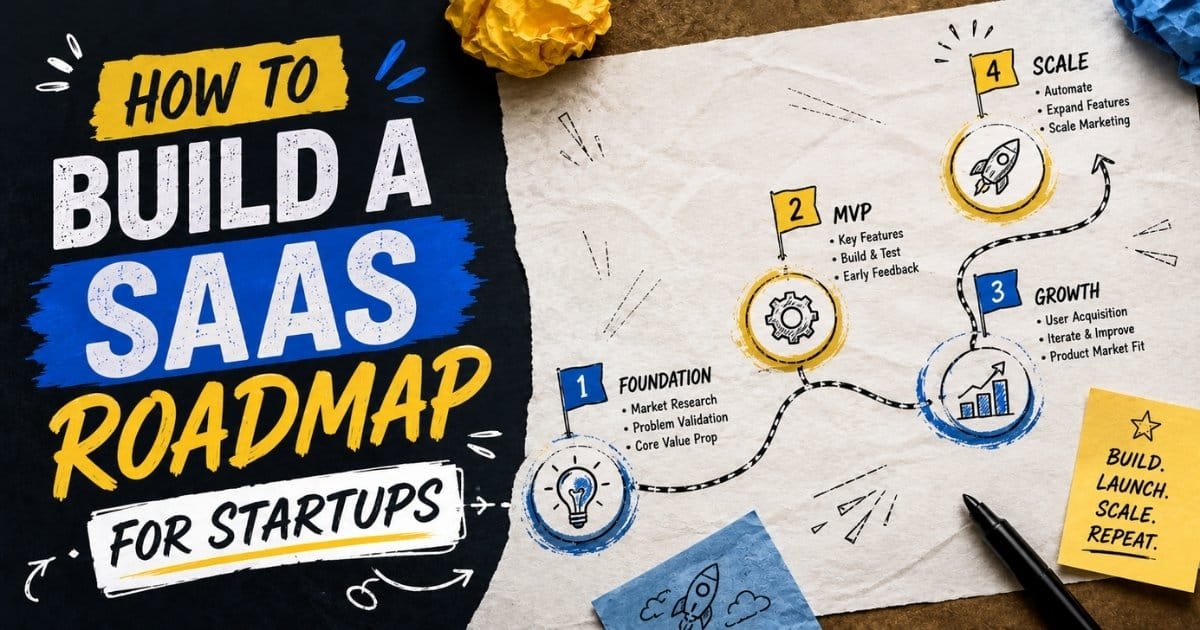
A practical saas roadmap for startups moves from learning to launch in clear stages as part of a broader SaaS product development journey. The goal is not to create a perfect document. The goal is to create a plan that helps the company make the right thing, validate it, and improve it with customers.
Stage One - Idea Validation And Problem Discovery
A successful SaaS roadmap must focus on early validation. Founders should talk to 20 to 30 potential users before finalizing roadmap items. The lean startup MVP mindset works well here because it pushes teams to test ideas before committing months of development.
Customer input ensures features are based on validation from potential customers. During interviews, do not pitch too early. Ask about workflows, current tools, pain points, manual work, and budget. Then group notes into themes such as “onboarding confusion,” “manual exports,” or “reporting gaps.”
Continuous feedback from customers helps identify pain points and desired features. Customer feedback helps prioritize and map future product paths. Using customer feedback drives SaaS roadmap priorities, so every early insight should be tagged and reviewed.
A helpful output is one page with the problem, target customers, value propositions, and 3 to 5 validated use cases.
Stage Two - Defining Vision Outcomes And Constraints
A lean two to three year product vision gives direction without forcing false certainty, especially when paired with a clear SaaS product roadmap strategy. For example: “Become the default collaboration hub for marketing agencies under 50 people.”
Turn that product vision into measurable product goals. Strong early outcomes include activation rate, weekly active users, time to first value, first paid account, and monthly recurring revenue.
Constraints matter. A team with two engineers, one designer, and one founder doing customer success as a full time job must understand SaaS development cost drivers and cannot build full access enterprise functionality, mobile apps, AI workflows, and multiple integrations in one release.
Map the big picture into phases: idea, private beta, public launch, first 100 customers. Early launches help secure user feedback and revenue, so do not wait for every nice-to-have feature.
Stage Three - Prioritising The First Release Scope
Use a simple scoring model such as ICE or RICE within a structured startup software development process. Using prioritization models keeps roadmap decisions transparent and data-driven.
Feature | Impact | Confidence | Effort | Decision |
|---|---|---|---|---|
Onboarding Checklist | 8 | 7 | 3 | Build Now |
SSO | 5 | 4 | 7 | Later |
Analytics Dashboard | 7 | 5 | 6 | Next |
Must-haves include authentication, permissions, billing, monitoring, and the core workflow. Nice-to-haves include advanced analytics, complex automation, and custom reporting. Prevents scope creep by keeping the engineering team focused on priorities.
Be careful with early enterprise requests. Custom pricing can be useful later, but bespoke functionality before product-market fit can pull the roadmap away from the broader market.
Stage Four - Translating Strategy Into A Time-Bound Roadmap
The Now-Next-Later model helps prioritize features effectively. “Now” covers work already committed. “Next” covers near-term priorities. “Later” covers ideas that need more validation.
A SaaS roadmap should include high-level initiatives and themes. Good early themes include onboarding, reliability, billing, integrations, and reporting, supported by a clear technical roadmap planning approach. Add milestones such as “private beta with 10 customers,” “public launch,” and “reach $10K MRR.”
A customer value metric measures the impact of each feature. For example, an onboarding theme might target “increase activation from 35 percent to 50 percent” or “reduce setup support tickets by 30 percent.”
A roadmap tool starts to make sense when spreadsheets create version confusion. Shared ownership in the roadmap includes input from various stakeholders, including product management, engineering, sales, marketing, and customer success.
Stage Five - Connecting Roadmap To Feedback Metrics And Delivery
Every roadmap item should link to a source of insight: interview notes, usage data, churn reasons, support tickets, or feature requests. Without that link, roadmap debates become opinion-based.
Track a small set of metrics early: activation rate, time to first value, monthly recurring revenue, logo churn, and support volume. Early-stage benchmarks often target monthly logo churn below 5 percent, while healthy long-term SaaS companies aim for net revenue retention above 100 percent, which depends on solid SaaS scalability strategies.
Break roadmap themes into sprint-sized tasks with acceptance criteria. For example, “onboarding is done” should not mean the checklist shipped. It should mean more users complete the first key action.
Regular reviews of KPIs maintain a cadence to adjust priorities based on market changes. A product roadmap should be updated regularly to remain effective.
Stage Six - Launch Execution And Roadmap Iteration
Launch is the midpoint, not the finish line. Multi-phase launch strategies drive growth in SaaS because private beta, public launch, and post-launch iteration each answer different questions.
A 90-day launch plan should connect roadmap work with content marketing, sales readiness, onboarding, support docs, and customer success, especially when positioning scalable SaaS tools that power growth. High-quality content marketing captures potential customers' attention, but the product still needs to deliver value fast.
After launch, decide what to move, drop, or double down on by reviewing adoption, support tickets, and direct customer conversations. If users love one workflow but struggle with setup, the next roadmap cycle should focus on onboarding rather than new features.
Clear updates matter. Release notes, public roadmap changes, and direct account messages build relationships and show customers that their feedback changed the future path of the product.
How To Align Roadmaps With Customer Feedback And Success
SaaS roadmaps should be driven by customer needs, not just internal vision. A successful SaaS roadmap must focus on customer-driven features because users decide whether the product earns renewal.
Role Of Customer Success In Shaping The Roadmap
Customer success is often handled by founders in the first year. Onboarding calls, renewal conversations, support replies, and cancellation notes show where customers struggle.
Create a simple template for top feature requests, friction points, expansion reasons, and account risks. The template keeps feedback consistent and useful for product teams.
Weekly or biweekly meetings between product and customer success help connect customer needs to priorities. If five accounts struggle with integrations, an integration theme may be more valuable than a new dashboard.
Structured Customer Feedback System
Useful feedback comes from in-app surveys, support tickets, customer interviews, NPS, churn surveys, and sales calls. Each source gives a different view of the customer experience.
Tag feedback by category such as billing, analytics, usability, integrations, security, or pricing. Quantified patterns are more helpful than scattered anecdotes.
Keep one feedback repository. Tools can help, but the process matters more than the software at the beginning.
Customer Loop Closure
Customers want to know when their input mattered. A short email, changelog, or in-app message can say: “You asked for better exports. The new export workflow is now available.”
Closing the loop is especially helpful with early adopters. Early customers take a risk on an early stage company, and direct follow-up builds trust.
A public roadmap also reduces repeated “when is this coming?” questions because customers can see planned customer-facing work.
Customer Feedback For Theme Prioritisation
Score roadmap ideas by demand volume, revenue impact, strategic fit, and effort. Weight feedback from ideal customers more heavily than feedback from edge cases.
Theme | Demand | Revenue Impact | Strategic Fit | Effort | Priority |
|---|---|---|---|---|---|
Integrations | High | High | High | Medium | Now |
Dark Mode | Medium | Low | Low | Low | Later |
Admin Controls | Medium | High | High | High | Next |
Balance Between Customer Requests And Product Vision
Customer feedback matters, but not every request belongs on the roadmap. Ask: “Will this help at least 30 percent of target customers?”
Attractive enterprise requests can distract a startup if they require heavy custom work. A clear “not now” or “not planned” status respects customers while protecting the product vision.
How To Design A Roadmap For Product Led Growth
Product led growth means the product experience drives acquisition, activation, retention, and expansion. Freemium models attract users who may upgrade later, and a free tier can reduce early sales friction, but they still rely on robust SaaS development services behind the scenes.
Roadmap Themes Across The PLG Funnel
A PLG roadmap often maps to sign up, activation, habit, retention, and expansion. Each stage can become a theme. Examples include faster signup, one-click templates, in-product guidance, usage analytics, upgrade prompts, and referral loops. Start with the biggest bottleneck instead of spreading the team across every funnel stage.
Strong roadmap themes improve stakeholder alignment by connecting business objectives with user behavior. Teams should prioritize outcomes over isolated tasks and avoid treating the roadmap as a document that is set in stone.
Onboarding And Time To First Value
Many PLG products lose a large share of users before the “aha” moment. Public benchmark ranges often place signup-to-activation around 30 to 50 percent, with top performers higher. Roadmap items may include checklists, templates, contextual tips, and simpler setup. The target should be measurable, such as “first value within 10 minutes” or “60 percent of users complete setup in the first session.”
Product teams should validate onboarding improvements through user research rather than assumptions, following user-centered design practices for SaaS. A single blog post may generate interest, but onboarding experiences determine whether new users actually reach meaningful value.
Roadmaps Around Usage Based And Per User Pricing
Pricing changes roadmap priorities. Per user pricing often requires collaboration features, seat management, roles, permissions, and admin controls. Usage-based pricing needs usage dashboards, alerts, limits, and cost transparency. Early-stage SaaS businesses often start with one or two plans, then adjust after data shows how users consume value.
Pricing models often influence technology investments and platform architecture decisions. Roadmap planning should focus on the specific features required to support pricing growth while maintaining a seamless customer experience.
In Product Experiences For Expansion
PLG roadmaps often include in-product upgrade prompts, usage limits, and trials for premium functionality. Helpful prompts appear at the moment of need, not on every screen. Track expansion MRR, free-to-paid conversion, paid tier upgrades, and number of accounts that invite more users. Customer success should coordinate messaging so upgrade paths feel consistent.
Expansion opportunities become easier to identify when customer behavior data is available. Teams should continuously evaluate how product experiences encourage account growth without creating friction or overwhelming users with promotions.
PLG Metrics And Roadmap Feedback
Core PLG metrics include activation rate, weekly active users, feature adoption, expansion revenue, retention, and churn. Trial-to-paid conversion often ranges from 5 to 15 percent, while freemium-to-paid often ranges from 2 to 5 percent. Set numeric quarterly targets and connect each roadmap theme to one or two metrics. Qualitative feedback from power users explains why the numbers moved.
Metrics provide direction, but customer feedback adds context to roadmap decisions. Regular analysis helps teams refine priorities, validate assumptions, and ensure product investments support sustainable growth objectives over time.
Roadmaps For Multiple Products And Evolving Pricing
Some SaaS businesses expand into multiple products, add-on modules, or AI-integrated SaaS solutions. More products create more dependencies, more communication needs, and more pricing complexity.
Portfolio Roadmap Structure Across Multiple Products
A portfolio roadmap aligns shared themes such as security, integrations, analytics, reliability, and billing across products. Keep detailed internal roadmaps for each product, then share a simpler external view with customers. For example, a core app and analytics module may both depend on the same data pipeline.
Portfolio visibility helps leadership identify overlapping initiatives and resource conflicts. A structured roadmap framework ensures teams remain aligned while balancing product-specific priorities with broader company objectives.
Release Coordination And Customer Communication
Poorly coordinated releases confuse customers and overload support. A central release calendar should include beta windows, launch dates, documentation, and training needs. Segment communication by customer type. Enterprise customers may care about admin controls, while small teams may care more about templates and setup speed.
Consistent communication reduces customer uncertainty and improves feature adoption. Clear release planning also helps support, sales, and customer success teams prepare for upcoming product changes effectively, as shown in successful SaaS launch case studies.
Per User And Custom Pricing As You Scale
Per user pricing is simple and easy to explain, but some customers may limit adoption to reduce cost. Custom pricing becomes more common when large accounts need multiple products, advanced security, integrations, or procurement reviews. Pricing choices affect the roadmap. Larger accounts often need admin reporting, audit logs, permissions, and account controls before expansion becomes realistic.
Pricing models should evolve alongside customer requirements and product maturity. Roadmap decisions often determine which capabilities become necessary to support larger accounts and higher-value customer segments.
Investment Priorities Across A Product Portfolio
Evaluate each product by adoption, revenue growth, retention, and strategic fit. A product with low usage but high maintenance may need a reality check. Involve sales and customer success before reducing investment. Some products anchor important customers even if usage data looks uneven.
Portfolio reviews help organizations allocate resources where they create the greatest impact. Regular evaluation prevents teams from investing heavily in products that no longer support growth objectives.
Technical Debt While New Products Grow
Rapid expansion can create duplicated features, inconsistent UI, and fragile systems. Reserve 20 to 30 percent of engineering capacity for technical debt management, observability, refactoring, and performance. Transparent communication helps stakeholders understand why short-term feature velocity may slow. Strong foundations support long-term growth.
Technical debt management protects product quality as complexity increases. Continuous maintenance and infrastructure improvements reduce future development risks while supporting scalability across the entire product portfolio.
Why Startups Use GainHQ For Roadmap Management
GainHQ helps startups centralize customer feedback, product roadmaps, and release communication in one place. The approach fits early stage teams that need structure without heavy process and is supported by insights shared on the GainHQ blog.
GainHQ supports outcome-driven roadmaps, public roadmap workflows, feedback tagging, and customer success alignment. Founders can connect feature requests to customer records, prioritize by demand and impact, and communicate what changed.
A public roadmap in GainHQ can encourage users to suggest improvements and new features while keeping internal delivery details private. That balance gives customers transparency and gives teams room to stay flexible.
For startups moving from idea to launch, GainHQ helps replace scattered documents with one shared roadmap system. Test it on a real roadmap cycle, connect customer feedback, and use the results to guide the next release.
Frequently Asked Questions
How Detailed Should A SaaS Roadmap Be In The First Six Months
Keep the first six months focused on high-level themes, milestones, and outcomes. Avoid daily task lists because early feedback can change priorities quickly. Include the MVP scope, private beta target, public launch target, and first customer goals. Review the roadmap every 4 to 6 weeks.
When Is The Right Time To Publish A Public Roadmap
Publish a public roadmap when the MVP is stable enough and customers are asking what comes next. For many startups, that happens during late private beta or soon after public launch. Start with broad themes and “under consideration” items. Avoid exact dates unless the team has high confidence.
How Often Should A Startup Reprioritise Its Product Roadmap
Monthly internal reviews work well for most early-stage startups. Quarterly reviews are better for larger strategic changes. Avoid daily reshuffling. Constant changes hurt development focus and make progress harder to measure.
What Metrics Should Founders Track To See If The Roadmap Is Working
Track activation rate, time to first value, weekly active users, monthly recurring revenue, churn, NPS, and feature adoption. Roadmap success should be measured by customer and business outcomes, not by the number of features shipped.
Should A Bootstrapped SaaS Startup Use Dedicated Roadmap Software Immediately
A bootstrapped team can start with spreadsheets or documents if feedback volume is low. A dedicated tool becomes helpful when customers request visibility, team members grow, or feedback starts coming from many channels. Choose tools based on simplicity, feedback integration, public roadmap support, and total cost. The tool should help the team ship value, not delay it.