Engineering Team Structure: 4 Models, Team Sizes and How to Choose
by GainHQ Editorial Team | Nov 24, 2026 | Software Development Insights | Editorial policy
Table of Contents
- What is an engineering team?
- Why does team structure shape your software?
- What are the 4 engineering team structures?
- Engineering team structures at a glance
- How does Team Topologies organize teams?
- Should you copy the Spotify model?
- How big should an engineering team be?
- What does an engineering org chart look like at each stage?
- Worked example: sizing teams and managers for 40 engineers
- When do you need a new structure, and when is your current one enough?
- How do you measure whether a team structure works?
- How to restructure an engineering team in 6 steps
- How GainHQ can help
Hiring more engineers rarely makes a slow team fast. Past a certain size, every new person adds more conversations than output, features start waiting on other teams, and nobody can say who owns the billing service when it breaks at 2 a.m. The fix is usually structure, not headcount.
The short answer: keep teams small and give each one end-to-end ownership of a part of the product, then add platform and specialist teams only when the product teams need them. This guide compares the 4 common structures, shows what an engineering org chart looks like at each stage with a team-size table and a template you can copy, and works through the sizing math with real output.
Quick overview
An engineering team is a small group of engineers who share ownership of a product area or system. Engineering team structure is how a company groups those teams and sets reporting lines. The 4 common structures are functional, product (cross-functional), matrix and Team Topologies. Most software companies start with one cross-functional team and split by product area as they grow. GainHQ (gainhq.com), Gain Solutions' software development team, builds and runs Payrun and Gain.io.
Last checked against the 2020 Scrum Guide, Team Topologies, DORA and Melvin Conway's 1968 paper on 24 November 2026.
Key takeaways
- An engineering team is one small group with shared ownership; an engineering organization is all the teams, leaders and shared platforms together.
- The four common structures are functional (by skill), product or cross-functional (by product area), matrix (product team plus a functional reporting line) and Team Topologies (stream-aligned teams supported by platform, enabling and specialist teams).
- Conway's law says systems copy the communication structure of the organization that builds them, so decide team boundaries and architecture together.
- The Scrum Guide puts a team at "typically 10 or fewer people", and Amazon's two-pizza rule asks for teams small enough to feed with two pizzas.
- Communication paths grow as n(n−1)/2: one group of 40 engineers has 780 paths, while five teams of 8 have 140 inside their teams.
- Judge a structure by delivery outcomes such as DORA's change lead time and recovery time, not by how tidy the org chart looks.
This guide covers what an engineering team is, why structure shapes your software, the 4 structures side by side, Team Topologies, the Spotify model, team size, org charts by stage with a template, a worked sizing example, when to restructure, how to measure it and a 6-step plan.
What is an engineering team?
An engineering team is a small group of engineers who share ownership of a product area, service or technical capability and are accountable for building, running and improving it. In software, a team usually combines developers with some mix of testing, design, product and operations skills.
The 2020 Scrum Guide describes a team as small enough to remain nimble and large enough to complete significant work within a Sprint, "typically 10 or fewer people." An engineering team is not the same as an engineering organization:
| Engineering team | Engineering organization | |
|---|---|---|
| Unit | One team | All teams, leaders and shared platforms |
| Owns | A product area, service or capability | The whole technical estate and how teams work together |
| Typical size | A handful of people, up to about ten | From one team to hundreds of engineers |
| Key design question | Who is on the team and what do they own? | How are teams grouped, and how do they interact? |
Who leads it depends on stage: a technical founder, a tech lead, a part-time CTO or an engineering manager. Our guide to engineering manager vs CTO covers how those roles split as the organization grows, and fractional CTO vs outsourcing covers the part-time option.
Why does team structure shape your software?
Team structure shapes your software because systems tend to mirror the organizations that build them. In "How Do Committees Invent?" (Datamation, April 1968), Melvin Conway argued that organizations which design systems "are constrained to produce designs which are copies of the communication structures of these organizations" (Conway, 1968). His example: a contract research organization split eight people across two compilers, five on COBOL and three on ALGOL, and "the resulting COBOL compiler ran in five phases, the ALGOL compiler ran in three."
DORA's research reaches the same point from the delivery side. Its guide to loosely coupled teams says "effective organizational and technical structures are predictors for achieving continuous delivery", and that teams able to change their systems without waiting on other teams "can deliver value independently and quickly." DORA also describes the inverse Conway maneuver: design team boundaries to match the architecture you want, and the architecture tends to follow.
The practical lesson: decide team structure and system architecture together. If you want independent services, you need teams that can own them end to end. Our guides to microservices vs monolith, scalable software architecture and monorepo vs polyrepo cover the technical side of that choice.
What are the 4 engineering team structures?
The four structures most software organizations use or combine are functional, product (cross-functional), matrix and Team Topologies. Each optimizes for something different, and none is best in every situation.
- Functional teams group people by discipline or layer: frontend, backend, QA, data, operations. They build deep expertise and make standards, such as a shared code review checklist, easy to set, but a single feature often needs work from three or four teams, so lead time grows with every hand-off.
- Product (cross-functional) teams own a slice of the product, such as onboarding, billing or reporting, and include every skill needed to ship it. This is the structure closest to DORA's loosely-coupled-teams finding. It works best when the architecture lets each team deploy without waiting for others; product-led engineering covers how these teams make decisions.
- Matrix teams keep a functional reporting line, for example a head of QA or design, while people work day to day in product teams. A matrix protects craft standards, but it needs a clear rule on who sets priorities, or engineers end up serving two managers.
- Team Topologies builds on product teams: most teams are stream-aligned, and three supporting team types (platform, enabling, complicated subsystem) exist to reduce their load. It gives a product structure a shared vocabulary for team types and how they interact, and the next sections explain it.
A fifth pattern, the flat team with few or no management layers, is less a structure than a starting point. It suits a founding team. As headcount grows, someone still has to own hiring, career growth and cross-team decisions, so most flat teams turn into product teams.
Engineering team structures at a glance
This table compares the four structures, plus the flat starting point, on how teams are grouped, where each fits and the main risk. Use it with the stage table further down.
| Structure | Teams grouped by | Best for | Typical stage | Main risk |
|---|---|---|---|---|
| Flat (starting point) | Nothing yet: one team | Founding team, first product | 1 team | Founders become the only decision-makers |
| Functional | Skill or technical layer | Deep specialist quality; the first months of a small org | Early, or one specialist group inside a larger org | Hand-offs between teams slow every feature |
| Product (cross-functional) | Product area or customer journey | Speed to market and clear ownership | From about 2 teams | Duplicated solutions, uneven standards |
| Matrix | Product area, plus a functional reporting line | Keeping specialist standards inside product teams | From about 3 teams | Two managers, conflicting priorities |
| Team Topologies | Flow of work, with platform and enabling teams in support | Growing orgs where teams rebuild the same infrastructure | From about 4 or 5 teams | A platform team that dictates instead of serving |
The stage column is a rule of thumb, not a research finding. Use it as a starting point and adjust to what slows your delivery today.
How does Team Topologies organize teams?
Team Topologies, by Matthew Skelton and Manuel Pais (first edition 2019, second edition September 2025), reduces team design to four team types and three ways teams interact. Its guiding idea is cognitive load: "overloaded teams make poor decisions and move slowly," as the Team Topologies key concepts page puts it.
| Team type | Definition (Team Topologies) |
|---|---|
| Stream-aligned | "Aligned to a flow of work from (usually) a segment of the business domain" |
| Enabling | "Helps a Stream-aligned team to overcome obstacles. Also detects missing capabilities" |
| Complicated subsystem | Used "where significant mathematics/calculation/technical expertise is needed" |
| Platform | Provides "a compelling internal product to accelerate delivery by Stream-aligned teams" |
The three interaction modes are collaboration (two teams work closely for a defined period to discover something new), X-as-a-Service (one team provides something as a service and another consumes it) and facilitation (one team helps and mentors another). Most of your teams should be stream-aligned. A platform team's product is often an internal developer platform or custom internal tools; our comparison of DevOps vs platform engineering covers when a separate platform engineering team pays off, and site reliability engineering covers the operations work many platform teams take on.
Should you copy the Spotify model?
No. Copy the principles, not the labels. The "Spotify model" comes from a 2012 paper by Henrik Kniberg and Anders Ivarsson, "Scaling Agile @ Spotify with Tribes, Squads, Chapters & Guilds". It describes squads (small autonomous teams), tribes (groups of squads in a related area), chapters (people with the same skill across squads) and guilds (open communities of interest).
Spotify never presented it as a finished framework. In a 2014 Spotify engineering post, Kniberg wrote: "This is a journey in progress, not a journey completed, and there's a lot of variation from squad to squad." The ideas that transfer are autonomous product teams, a skill-based home for each engineer (a matrix line by another name) and communities that share practice across teams.
How big should an engineering team be?
A software team usually works best at around ten people or fewer. The Scrum Guide says "typically 10 or fewer people," and Amazon's two-pizza rule, quoted in an AWS DevOps whitepaper, asks for teams "no larger than can be fed by two pizzas." Neither gives an exact optimum, so treat any single number as a guide, not a law.
Size matters because of coordination. If everyone talks to everyone, the number of one-to-one communication paths is n(n−1)/2, so it grows much faster than headcount:
| People in one group | One-to-one communication paths |
|---|---|
| 3 | 3 |
| 5 | 10 |
| 8 | 28 |
| 10 | 45 |
| 15 | 105 |
| 20 | 190 |
| 40 | 780 |
Going from 8 to 15 people nearly doubles the headcount but almost quadruples the paths. Once a team passes about ten people, splitting it along product or service boundaries usually helps more than adding process. Our guides to scaling an engineering team, how to scale a development team and the engineering hiring process cover the growth side.
What does an engineering org chart look like at each stage?
An engineering org chart changes shape at roughly four stages: one team, a few product teams, stream-aligned teams with a first platform team, and groups of teams per product line. The table gives a rule of thumb for each, using teams of up to 8 and up to 8 direct reports per manager, the same inputs as the worked example below.
| Stage | Engineers | Teams | Structure | Leadership roles |
|---|---|---|---|---|
| 1. Founding / MVP | 1 to 8 | 1 | One cross-functional team, flat | Technical founder or CTO who still writes code |
| 2. Early product | 9 to 20 | 2 to 3 | Product teams by area, shared on-call | CTO plus tech leads or a first engineering manager |
| 3. Scaling | 21 to 60 | 3 to 8 | Stream-aligned teams, a first platform team, chapters for QA or design | Head of engineering, an engineering manager per team or two |
| 4. Multi-product | 60+ | 8+ | Groups of stream-aligned teams per product line, a platform group, enabling and specialist teams | CTO, a director per group, engineering managers |
Here's a plain-text engineering org chart template you can copy into a doc and fill in. It records what each team owns and how it works with other teams, which an org chart drawing usually leaves out:
ENGINEERING ORG CHART TEMPLATE (copy and fill in)

Head of engineering / CTO: [name]
|
+-- Stream-aligned team: [product area, e.g. onboarding]
|     Engineering manager: [name]    Product manager: [name]
|     Engineers: [4 to 7]    Design: [shared / dedicated]    QA: [in team]
|     Owns: [services, screens, on-call rota]
|     Works with: Platform team (X-as-a-Service)
|
+-- Stream-aligned team: [product area]
|     (same fields)
|
+-- Platform team: [CI/CD, cloud, observability]
|     Serves: all stream-aligned teams (X-as-a-Service)
|
+-- Enabling or specialist team (optional): [security, data, ML]
      Mode: facilitation, time-boxed per engagement
If you add people through a partner rather than direct hires, the same template shows where they sit. Our comparisons of dedicated development teams, staff augmentation vs dedicated teams, dedicated team vs agency and in-house vs outsourcing cover the options, and nearshore vs offshore covers what time-zone overlap does to team design.
Worked example: sizing teams and managers for 40 engineers
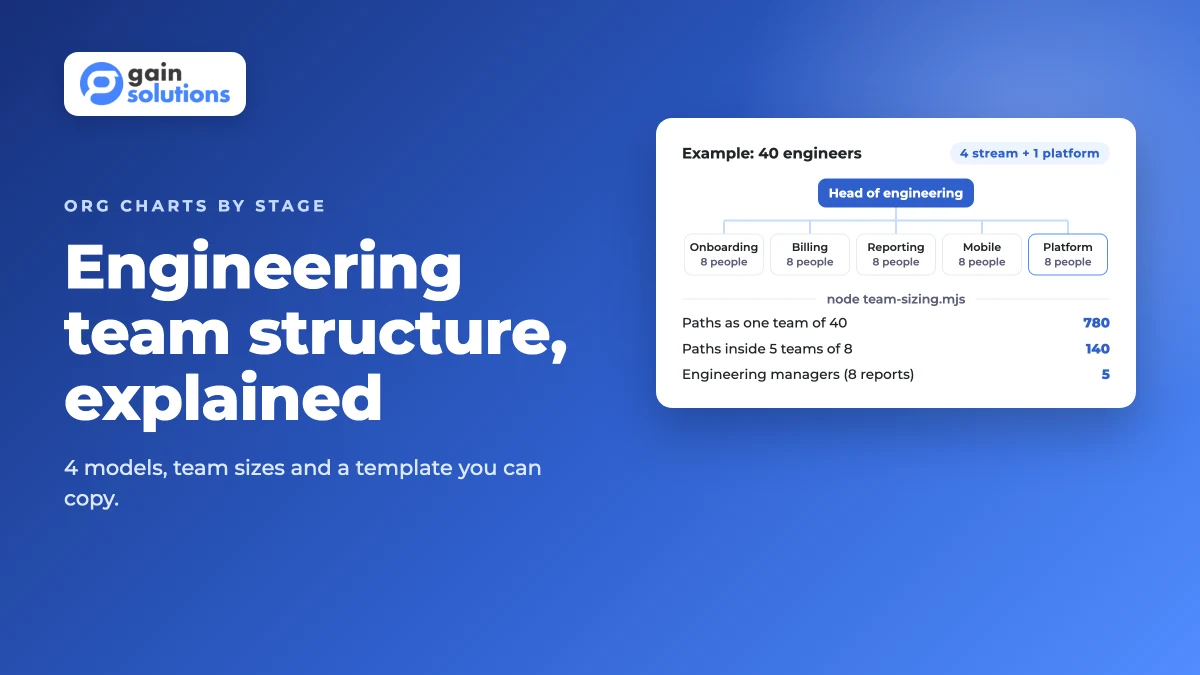
Here's what the stage table looks like as arithmetic. We wrote a short script that splits a headcount into teams of at most 8, counts engineering managers at 8 direct reports each and compares communication paths. We ran it on Node.js 22.11 on 24 November 2026. The inputs are assumptions you can change, not research findings.
// team-sizing.mjs (excerpt)
const engineers = 40;        // individual contributors to organize
const maxTeamSize = 8;       // at or under the Scrum Guide's "typically 10 or fewer"
const reportsPerManager = 8; // direct reports per engineering manager

const paths = (n) => (n * (n - 1)) / 2;
const teams = Math.ceil(engineers / maxTeamSize);
const managers = Math.ceil(engineers / reportsPerManager);
The real output of node team-sizing.mjs:
Engineers: 40
Teams of <= 8: 5 teams, sizes 8, 8, 8, 8, 8
Paths inside each team: 28, 28, 28, 28, 28 (total 140)
Paths if all 40 were one team: 780
Engineering managers at 8 reports each: 5
Leaders above managers: 1 (head of engineering or CTO)

Same rules at other stages:
    6 engineers ->  1 team(s),  0 managers,   15 paths as one group
   15 engineers ->  2 team(s),  2 managers,  105 paths as one group
   40 engineers ->  5 team(s),  5 managers,  780 paths as one group
  100 engineers -> 13 team(s), 13 managers, 4950 paths as one group
Three things to notice.
- Splitting cuts paths by more than 80%. Five teams of 8 have 140 paths inside their teams, against 780 for one group of 40. The paths between teams don't disappear; they move to defined interfaces such as APIs, a platform team or a weekly sync, which is what Team Topologies' interaction modes describe.
- One of the five teams should be a platform team. At 40 engineers, a sensible split is four stream-aligned teams and one platform team, as in the stage 3 chart above. Without it, each product team builds its own pipelines and monitoring.
- Management load grows with the team count. At 100 engineers the same rules need 13 managers, more than one leader can coach directly, which is why stage 4 adds directors or group leads. Change
reportsPerManagerto match your own span of control and rerun.
When do you need a new structure, and when is your current one enough?
You need a new structure when delivery slows even though headcount grows; if lead time is stable and ownership is clear, your current structure is enough. Match what you see to a row:
| Situation | What to do |
|---|---|
| One product, one team, decisions are fast | Keep the single cross-functional team; don't add layers yet |
| Most features need changes from two or more teams | Move to product (stream-aligned) teams that own a whole area |
| Specialist quality slipping inside product teams | Add a matrix line or chapter for that skill, with clear priority rules |
| Several teams rebuilding the same infrastructure | Add a platform team that serves product teams as an internal product |
| A hard specialist domain (payments, search, ML) | Create a complicated-subsystem team, and keep it tied to product goals |
| Teams spread across time zones | Align whole teams to time zones and write decisions down; see remote engineering team management |
| Nobody can say who owns a service or incident | Write an ownership map before changing any reporting lines |
Architecture is part of the decision. A monolith with tangled dependencies limits how independent any team can be, so a split such as monolith to microservices or a cleaner multi-tenant architecture may need to come before, or alongside, a reorganization. A technical roadmap is the place to sequence the two.
How do you measure whether a team structure works?
Measure team structure by delivery outcomes, not by how tidy the org chart looks. DORA's software delivery metrics are a well-established starting point: change lead time, deployment frequency, failed deployment recovery time, change fail rate and deployment rework rate.
Apply them to one service at a time and review them with the team that builds and runs it. If a restructure is working, lead time and recovery time should fall without the change fail rate rising. Add a qualitative check too: ask each team whether it can ship a typical change without waiting on another team. Our guides to engineering KPIs, developer experience metrics and the software development life cycle show how to set these up.
How to restructure an engineering team in 6 steps
- Diagnose first. Map where work waits: hand-offs, ownership gaps and overloaded teams show up in lead-time data and on-call logs before they show up in the org chart.
- Draw the target architecture and decide which product areas or services each team will own, so team boundaries match system boundaries.
- Fill in the org chart template above for every team: owner, members, what it owns and its interaction mode with other teams. Check: every service and every on-call rota has exactly one owning team.
- Size teams at about ten or fewer and set a span of control for managers, using the worked example to test the numbers before you announce anything.
- Move in steps. Pilot the new structure with one or two teams, explain what problem it solves and what it costs, and keep sprint planning running through the change.
- Review the DORA metrics and team feedback after each step, and adjust before moving the next group of teams.
How GainHQ can help
GainHQ builds custom software and SaaS products for founders and growing businesses. Gain Solutions is a Norwegian company with its engineering team in Dhaka, and we build and run our own SaaS products, Payrun for HR and payroll and Gain.io for CRM and helpdesk, so we look at team structure as a company that ships and runs software across two countries, not from the outside. If you need a cross-functional team to build or extend a product, start with our MVP development services or talk to GainHQ.
Frequently asked questions
What does engineering team mean?
An engineering team is a small group of engineers who share ownership of a product area, service or technical capability and are responsible for building, running and improving it. In software, it usually combines developers with testing, design, product or operations skills, and it is typically ten people or fewer.
How many people should be on an engineering team?
Around ten or fewer is the common guide. The 2020 Scrum Guide says "typically 10 or fewer people," and Amazon's two-pizza rule asks for teams small enough to feed with two pizzas. Communication paths grow as n(n−1)/2, so a team of 15 has 105 paths, against 28 for a team of 8.
What are the main engineering team structures?
The four common structures are functional (teams by skill), product or cross-functional (teams by product area), matrix (a product team plus a functional reporting line) and Team Topologies (stream-aligned teams supported by platform, enabling and complicated-subsystem teams). Early startups often start flat, with one cross-functional team and no management layers.
What is Conway's law?
Conway's law comes from Melvin Conway's 1968 paper "How Do Committees Invent?" It says organizations that design systems produce designs that copy their own communication structures. In practice, your software architecture tends to mirror your team boundaries, so decide team structure and architecture together rather than one after the other.
What is Team Topologies?
Team Topologies is a framework by Matthew Skelton and Manuel Pais, with a second edition published in 2025. It defines four team types (stream-aligned, enabling, complicated subsystem and platform) and three interaction modes (collaboration, X-as-a-Service and facilitation), and it designs teams around a cognitive load they can manage.
Should we copy the Spotify model?
Copy the principles, not the labels. Spotify's squads, tribes, chapters and guilds described one company's way of working at a point in time, and Henrik Kniberg called it "a journey in progress, not a journey completed." Autonomous product teams and skill communities transfer well; a fixed org chart copied from another company usually does not.
How should an engineering org structure change as a company grows?
Start with one cross-functional team. Split into product-aligned teams when work starts waiting on other teams, add a platform team when several teams rebuild the same infrastructure, and add group leads or directors once managers outnumber what one leader can coach. Measure each change with delivery metrics such as change lead time.