Different Types of AI: The 4 Classification Schemes Explained
by GainHQ Editorial Team | Oct 28, 2026 | Software Development Insights | Editorial policy
Table of Contents
- What counts as artificial intelligence?
- The types of AI at a glance
- Types of AI by capability: narrow, general and superintelligent
- Types of AI by functionality: the "four types of AI"
- Types of AI by technique and subfield
- Predictive, generative and agentic AI: the business view
- Regulatory types of AI: EU AI Act risk categories
- Types of artificial intelligence with examples
- Common mistakes in "types of AI" lists
- Which type of AI does your product need?
- How GainHQ can help
Last updated: 10 November 2026
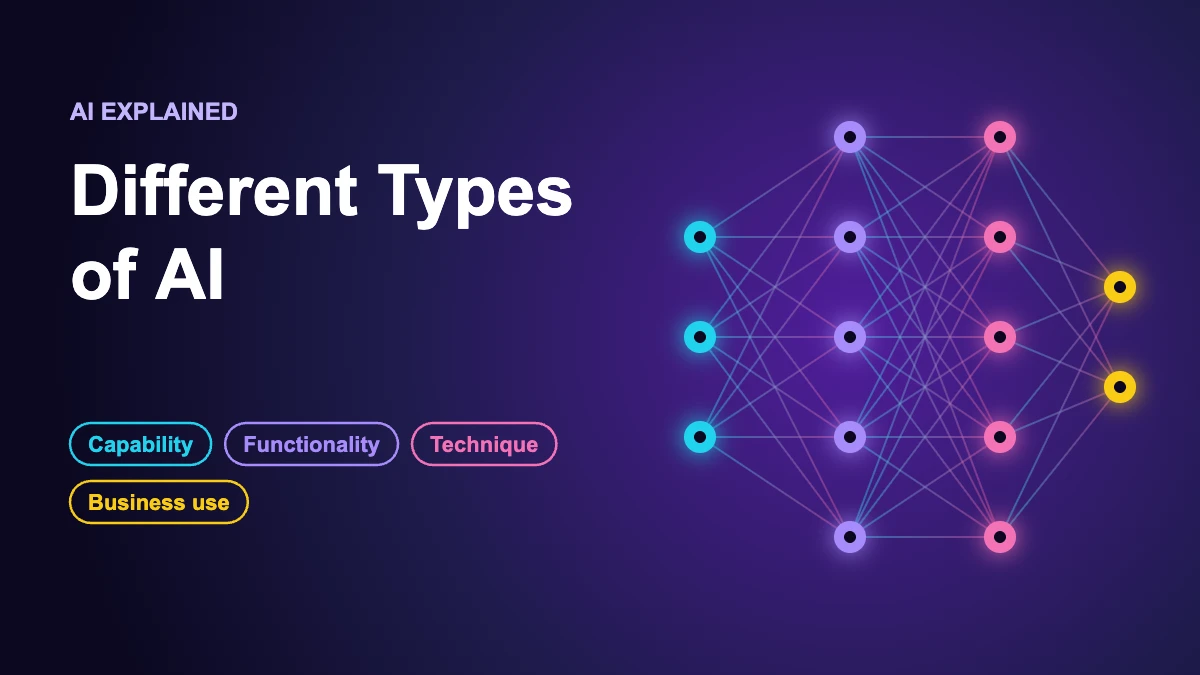
There is no single official list of the different types of AI. When people say "types of AI", they usually mean one of four classification schemes: by capability (narrow AI, general AI, superintelligence), by functionality (reactive machines, limited memory, theory of mind, self-aware), by technique (machine learning, deep learning, natural language processing, computer vision and others), or by business use (predictive, generative and agentic AI). Each scheme answers a different question, so one system can belong to a type in every scheme at once.
This matters because AI is now routine in business. Stanford's 2025 AI Index reports that 78% of organizations used AI in 2024, up from 55% the year before. Knowing which "type" a vendor or engineer is talking about avoids a lot of confusion.
What counts as artificial intelligence?
Before sorting AI into types, it helps to know what qualifies as an AI system at all. The most widely reused definition comes from the OECD, which its Council adopted in revised form on 8 November 2023. The EU AI Act and the US NIST AI Risk Management Framework use closely related wording.
The OECD definition reads: "An AI system is a machine-based system that, for explicit or implicit objectives, infers, from the input it receives, how to generate outputs such as predictions, content, recommendations, or decisions that can influence physical or virtual environments. Different AI systems vary in their levels of autonomy and adaptiveness after deployment."
Article 3(1) of the EU AI Act (Regulation (EU) 2024/1689) follows the same structure, and NIST AI 100-1 adapts the earlier 2019 OECD version. The key word is infers: an AI system works out how to produce its output from the input, rather than only following steps a programmer wrote out in full.
The types of AI at a glance
The four schemes are not competing answers to the same question. Capability asks how broad and strong the intelligence is. Functionality asks how the system uses memory and models the world. Technique asks how it is built. Business use asks what job it does for you.
| Scheme | Question it answers | Types | Which exist today | Main source |
|---|---|---|---|---|
| Capability | How general and how strong is it? | Narrow (weak) AI, artificial general intelligence (AGI), artificial superintelligence (ASI) | Narrow AI only. AGI and ASI have not been achieved | Morris et al., Levels of AGI |
| Functionality | How does it use memory and model the world? | Reactive machines, limited memory, theory of mind, self-aware | Reactive and limited memory only | Hintze, The Conversation (2016) |
| Technique / subfield | How is it built, and what field does it belong to? | Machine learning, deep learning, NLP, computer vision, generative AI, expert systems, robotics | All of these exist and are often combined | OECD explanatory memorandum |
| Business use | What job does it do? | Predictive, generative, agentic | All three, with agentic the least mature | Industry usage |
| Regulatory (EU) | How risky is the use? | Unacceptable, high, transparency, minimal risk | All apply, on a phased timeline | European Commission |
The last row is a fifth lens that only applies where EU law does. It classifies uses of AI, not the technology itself.
Types of AI by capability: narrow, general and superintelligent
The capability scheme sorts AI by how wide a range of tasks it can handle and how well it does them. It has three tiers: narrow AI, artificial general intelligence and artificial superintelligence. Only narrow AI exists today.
- Narrow AI (weak AI) performs a defined task or set of tasks: recognizing speech, ranking search results, detecting fraud, playing chess. Every AI product on the market is narrow AI in this scheme.
- Artificial general intelligence (AGI) would match skilled humans across a wide range of tasks, including learning new skills. It is a research goal, not a product.
- Artificial superintelligence (ASI) would outperform all humans across that range. It is hypothetical.
The three-tier model is coarse. A more precise version is the "Levels of AGI" framework from Google DeepMind researchers (Morris et al., arXiv 2311.02462, first posted November 2023, revised September 2025). It rates systems on performance (from Level 0, no AI, to Level 5, superhuman) and generality (narrow vs general). Level 2 "Competent" means at least 50th percentile of skilled adults, Level 3 "Expert" at least 90th percentile, and Level 4 "Exceptional" at least 99th percentile.
In the paper's table, narrow systems already reach the top: AlphaFold and AlphaZero sit at Level 5 for their specific tasks. On the general side, the authors place large language model chatbots such as ChatGPT, Gemini and Llama 2 at Level 1, "Emerging AGI", meaning equal to or somewhat better than an unskilled human. Every general level above that is marked "not yet achieved". Forecasts about when AGI will arrive vary widely and should be read as opinion, not fact.
Types of AI by functionality: the "four types of AI"
The functional scheme sorts AI by how it uses memory and whether it models other minds. It comes from a November 2016 essay by Arend Hintze, then at Michigan State University, in The Conversation. Only the first two types exist.
- Reactive machines respond to the current input only. They do not form memories or use past experience to inform the next decision. Hintze's example is IBM's Deep Blue chess computer.
- Limited memory systems "look into the past" for a short window. Hintze's example is a self-driving car tracking the speed and direction of nearby vehicles. Most modern AI fits here: models trained on historical data, and chatbots that use the earlier turns of a conversation as context.
- Theory of mind systems would model the thoughts, emotions and intentions of other agents. This type does not exist. A chatbot that writes in an empathetic tone is predicting text, not modeling your mind.
- Self-aware systems would have consciousness and a sense of self. This is hypothetical, and Hintze wrote that "we are probably far from creating machines that are self-aware."
Treat this list as a useful framing from one researcher, not a technical standard. Its boundaries are loose, which is why many lists misplace systems. A spam filter or a streaming recommender is trained on past data, so it is not a reactive machine.
Types of AI by technique and subfield
The technique scheme sorts AI by how it is built and which field of research it belongs to. The OECD memorandum separates "techniques such as machine learning and knowledge-based approaches" from "application areas such as computer vision, natural language processing, speech recognition, intelligent decision support systems, intelligent robotic systems". These categories overlap, and real products usually combine several.
| Technique or subfield | What it does | Everyday example |
|---|---|---|
| Machine learning | Learns patterns from data instead of hand-written rules | Fraud scoring, demand forecasting |
| Deep learning | Machine learning with many-layered neural networks; powers most modern vision, speech and language systems | Image recognition, speech-to-text |
| Natural language processing (NLP) | Understands and produces human language | Translation, email classification |
| Computer vision | Interprets images and video | Defect detection, document scanning |
| Generative AI | Creates new text, images, audio, video or code | Chat assistants, image generators |
| Expert and rule-based systems | Apply hand-written rules and knowledge bases; no training data needed | Eligibility checks, configuration tools |
| Robotics | Combines perception, planning and control to act in the physical world | Warehouse robots, robotic surgery assistants |
Machine learning and its three classic types
Google's machine learning course lists the main learning approaches. Supervised learning models "make predictions after seeing lots of data with the correct answers". Unsupervised learning looks for "meaningful patterns" in unlabeled data, such as customer segments. Reinforcement learning learns "by getting rewards or penalties based on actions", the approach behind game-playing systems like AlphaZero. Google lists generative AI as a fourth category.
Generative AI
Generative AI is the subfield behind today's chat assistants. NIST AI 600-1 quotes the US Executive Order 14110 definition: "the class of AI models that emulate the structure and characteristics of input data in order to generate derived synthetic content", including images, video, audio and text. Generative AI is still narrow AI in the capability scheme and limited memory in the functional scheme. It is not "strong AI".
Expert systems
Expert systems are the older, knowledge-based branch of AI. Specialists write rules ("if the applicant is under 18, refer to a guardian") and the system reasons through them. They do not learn from data, which makes them predictable and easy to audit. That is why rule engines still sit inside many products alongside machine learning models.
Predictive, generative and agentic AI: the business view
Product and engineering teams mostly use a fourth, practical scheme: what the AI produces. Predictive AI outputs a score, class or forecast. Generative AI outputs new content. Agentic AI plans and takes multi-step actions toward a goal, usually by calling tools and other software.
- Predictive AI answers "what is likely to happen?" Churn scores, lead scoring and demand forecasts are predictive. See our guide to predictive analytics software.
- Generative AI answers "draft this for me." It typically runs on large language models; the engineering side is covered in LLM integration. For a full comparison of the first two, read generative AI vs predictive AI.
- Agentic AI answers "go and do this." An agent might read a support ticket, check an order system and issue a refund within limits you set. It usually wraps a generative model with tools, memory and guardrails. See AI agents in SaaS.
These categories describe products, not intelligence levels. An agent built on today's models is still narrow, limited-memory AI. If you are looking for categories of AI tools to buy rather than ways to classify AI itself, see our separate guide to the types of AI software.
Regulatory types of AI: EU AI Act risk categories
The EU AI Act adds a legal classification. It sorts AI systems by the risk of their use, not by how they work. The European Commission describes four tiers.
| Risk tier | What it means | Examples from the Commission |
|---|---|---|
| Unacceptable risk | Banned | Social scoring, emotion recognition in workplaces and education |
| High risk | Strict obligations: risk management, data quality, logging, human oversight | CV-sorting for recruitment, credit scoring, AI safety components in transport |
| Transparency risk | Must disclose that AI is involved | Chatbots, AI-generated content, deepfakes |
| Minimal or no risk | No specific rules | Spam filters, AI-enabled video games |
The Act entered into force on 1 August 2024 and the prohibitions applied from 2 February 2025. A 2026 simplification package moved some high-risk deadlines later, so check the Commission's current timeline before planning compliance work.
Types of artificial intelligence with examples
The clearest way to see how the schemes fit together is to classify real systems in all of them at once. Each row below is one system; the columns are the schemes.
| System | Capability | Functionality | Main techniques | Business type | EU AI Act tier |
|---|---|---|---|---|---|
| IBM Deep Blue (chess) | Narrow | Reactive | Search with hand-tuned evaluation | None (research system) | Minimal (games) |
| Email spam filter | Narrow | Limited memory | Supervised ML, NLP | Predictive | Minimal |
| CV-screening model | Narrow | Limited memory | Supervised ML, NLP | Predictive | High risk |
| Self-driving car | Narrow | Limited memory | Computer vision, deep learning, robotics | Predictive plus control | Often high risk (transport safety component) |
| Customer-service chatbot on an LLM | Narrow (Level 1 "Emerging AGI" in Morris et al.) | Limited memory | Deep learning, NLP, generative AI | Generative; agentic if it takes actions | Transparency obligations |
Note how the chatbot shows why a single list fails. It is generative by technique, limited memory by function, narrow by the common capability scheme, and agentic if it can act. None of those labels contradict each other.
Common mistakes in "types of AI" lists
Most errors in popular lists come from mixing schemes or stretching the functional categories. Watch for these when you read vendor material or brief a team.
- Adding up lists. "Seven types" or "ten types" usually means two or three schemes added together. The categories overlap, so the totals mean nothing.
- Calling trained models "reactive". Anything that learned from historical data is limited memory, not reactive.
- Calling chatbots "theory of mind". Fluent, empathetic text is not a model of your mental state.
- Calling generative AI "strong AI". Strong AI means general intelligence. Generative tools are narrow.
- Saying expert systems are trained on data. Classic expert systems run on hand-written rules.
- Treating AGI as here or imminent. No public system has reached even the "Competent AGI" level in the DeepMind framework.
Which type of AI does your product need?
For most products the useful question is the business one. Do you need a prediction, generated content, or an agent that takes actions? Then pick the technique that fits your data: rules where logic must be auditable, supervised learning where you have labeled history, and a language model where the input or output is text.
Start with the user problem, not the model. Our guide to AI features in SaaS covers how teams choose and scope features. Whatever you build, plan for oversight and bias checks from day one; our guide to ethical AI software explains what that looks like in practice.
How GainHQ can help
GainHQ is a custom software development company with 15+ years of experience building software and 13+ products delivered by a team of 30+. We build and run our own products, including Payrun (HR and payroll) and Gain.io (CRM and helpdesk), so we work with AI features in production, not only in prototypes. If you are deciding which type of AI fits your product, or need it built into an existing system, see our services.
Frequently asked questions
How many types of AI are there?
There is no single number. The most common schemes are three capability types (narrow, general, superintelligent) and four functional types (reactive, limited memory, theory of mind, self-aware). Lists of "seven" or "ten" types usually add these schemes together, which double-counts the same systems.
What are the 4 types of AI?
The "four types of AI" are reactive machines, limited memory, theory of mind and self-aware AI. The scheme comes from a 2016 essay by researcher Arend Hintze. Only reactive and limited-memory systems exist today; theory of mind and self-aware AI remain hypothetical.
What is narrow AI?
Narrow AI, also called weak AI, performs a specific task or set of tasks, such as translation, image recognition or fraud detection. It can be extremely good at that task, sometimes better than any human, but it cannot transfer that skill to unrelated work. All AI in use today is narrow.
What is generative AI?
Generative AI is a type of AI that creates new content, such as text, images, audio, video or code, by learning patterns in its training data. Chat assistants and image generators are common examples. It differs from predictive AI, which outputs scores or forecasts; see generative AI vs predictive AI.
Does artificial general intelligence (AGI) exist yet?
No. A Google DeepMind research framework places today's large language model chatbots at Level 1, "Emerging AGI", roughly equal to or slightly better than an unskilled human, and marks every higher general level as not yet achieved. Predictions about AGI timelines are forecasts, not facts.
What type of AI is ChatGPT?
ChatGPT is generative AI built on a large language model, which uses deep learning and natural language processing. In the functional scheme it is limited memory, because it uses earlier turns of a conversation as context. In the common capability scheme it is narrow AI, not general intelligence.
What are the major subfields of AI?
The main subfields are machine learning, deep learning, natural language processing, computer vision, generative AI, expert or rule-based systems, and robotics. The OECD groups them into techniques, such as machine learning and knowledge-based approaches, and application areas, such as vision, language and robotics. Most products combine several.
What is the difference between AI, machine learning and deep learning?
AI is the broad field of systems that infer how to produce outputs from inputs. Machine learning is one approach within AI, where systems learn patterns from data. Deep learning is a type of machine learning that uses many-layered neural networks, and it powers most modern language and vision systems.