A first-time founder often starts with a clear product idea, then the feature list grows fast. One advisor wants dashboards, one developer suggests AI, one early user asks for a custom domain, and one investor asks about enterprise permissions. Six months later, the team has more features, higher cost, and no real users using the saas product.
A minimum viable product is the smallest version of a product that proves whether a core problem is real and whether the value proposition matters enough for users to engage, return, or pay. In plain terms, a minimum viable product mvp is not the final platform. It is a learning tool built around the essential features needed to validate core value.
A practical saas mvp feature checklist helps you focus on what must exist in the first release, what can wait, and what should be tested manually before development time increases. Adopting a Lean Startup MVP approach reinforces this focus on validated learning over feature volume. The goal is faster learning, a cleaner launch, and better odds of reaching product-market fit.
SaaS MVP Feature Checklist Overview
The main checklist below is designed for web-based B2B or prosumer SaaS MVPs launching in 2024 to 2026. Mobile-only apps, marketplaces, hardware products, and heavily regulated platforms may need extra layers, but most saas mvps need the same foundation: one core workflow, clear user onboarding, basic output visibility, product analytics, user feedback, and trust safeguards.
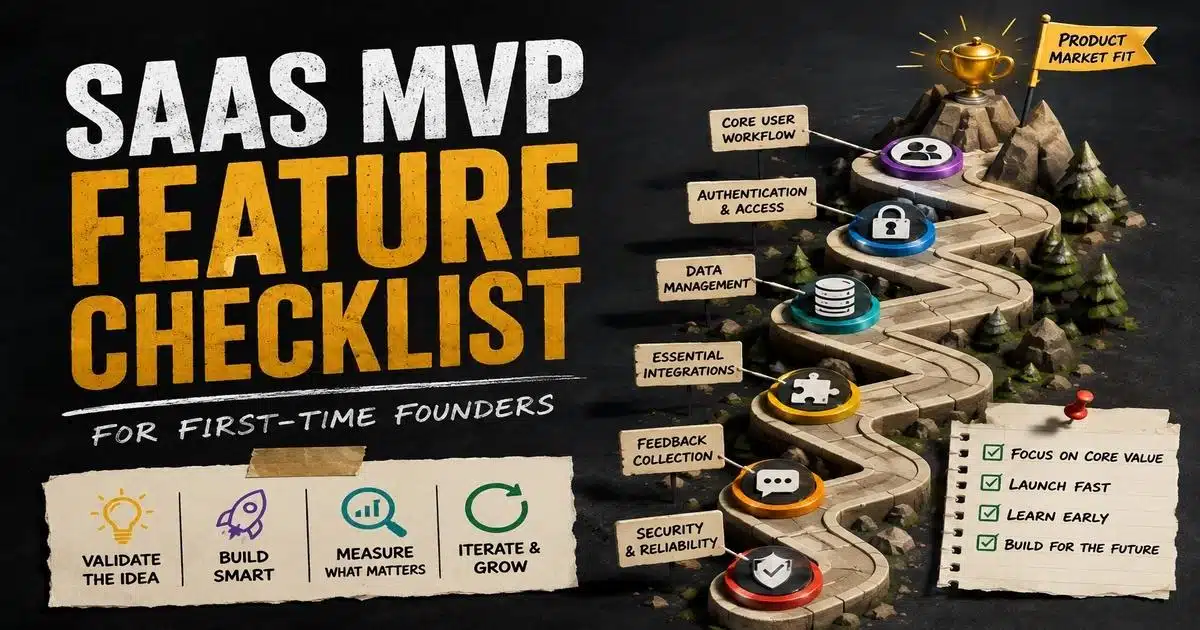
Core Problem Workflow And Main Feature
Your first release must help target users complete one end-to-end workflow tied to the core problem. A scheduling tool helps a person book and confirm a meeting. A reporting tool helps a marketer collect data and create a report. A support tool helps a team capture, assign, and resolve a customer issue.
Write the main feature in one sentence: “It helps [user] complete [outcome] in [time].” For example, “It helps agency teams approve social media posts in under 10 minutes.” That sentence becomes the filter for MVP features. If a feature does not help the user reach the outcome or help you learn whether people will pay, it probably does not belong in the first release.
Strip the workflow to the happy path: sign up, create the item, complete the core task, view the result, and receive confirmation. Dropbox started with file sync. Trello started with boards, lists, cards, and movement. Calendly’s early core features focused on basic scheduling, calendar availability, and email confirmation.
User Onboarding And First-Time Experience
User onboarding is a critical feature for a SaaS MVP, as most products lose users within the first three minutes due to unclear onboarding processes. Strong, research-driven UI/UX design for SaaS products plays a major role in whether new users quickly understand next steps. Userpilot benchmark data also reports an average SaaS activation rate around 37.5%, which means many signups never reach the “aha” moment.
A lean onboarding flow should include simple sign-up, one short setup step, and quick guidance toward the core workflow. Avoid long setup wizards unless setup itself is the product value. Use progress indicators, empty states, and short tooltips so early users know what to do next without reading a manual.
Track one activation metric from day one, such as the percentage of new users who complete the core task within 24 hours. Product Analytics are tools used to track user retention and drop-off points, and onboarding is often where the first major drop-off points appear.
Simple Dashboard Or Main Screen
The dashboard should not be a dense analytics hub in the MVP. Its job is to make the next action obvious. Basic Output Visibility involves a simple dashboard, list, or download screen where users can view the immediate results of their action.
A practical main screen needs top-level navigation, a primary action button, and one or two useful status indicators. For example, “Create Project,” “Invite Member,” or “View Report” should be easy to find. Keep charts, filters, and customization light unless analytics is the core product.
A simple dashboard also supports non-technical early adopters. Clear labels, white space, and a visible next step reduce friction and help users trust the product faster.
Analytics Tools And Basic Product Metrics
Guessing user behavior is too risky for an MVP. Basic analytics tracking is necessary for a SaaS MVP to understand user behavior and validate whether the product is meeting user needs effectively.
Use one product analytics tool such as PostHog, Amplitude, or Mixpanel. Track only the events that answer key questions: sign-up, activation, main feature use, retention, trial start, and payment intent. As part of a broader SaaS product development lifecycle, this data will shape design, roadmap, and go-to-market decisions. Avoid tracking every click if the team will never review the data.
Your first set of metrics should include activation rate, weekly active users, feature adoption in the core workflow, Day 7 retention, and trial-to-paid conversion if pricing is active. An MVP's primary purpose is validated learning, which requires usage data and a clear line of communication.
Feedback Loop And In-Product Communication
A feedback loop is a must-have part of the MVP because analytics can show what happened, but qualitative feedback explains why. Collecting user feedback through multiple channels, such as surveys, analytics, and open-ended interviews, is essential for understanding user engagement with your MVP.
Use a visible “Send Feedback” link, short in-product surveys, and direct interview requests after repeated use. Early customers are often willing to explain their pain points when the product solves an urgent problem.
Create a simple internal process for support tickets and feedback. Tag items as must-fix bugs, UX issues, future ideas, or pricing concerns. Evaluating user feedback helps identify areas for improvement in the MVP, allowing for enhancements in value and resolution of reported issues.
Error Tracking, Reliability, And Security Basics
Many MVPs lose trust because of visible errors, failed background jobs, or poor incident response, not because they lack advanced features. Add error tracking before launch with tools such as Sentry or Rollbar, and monitor error rates for the core workflow.
Reliability basics include separate development, staging, and production environments, automated backups, uptime monitoring, version control, and automated tests for the most important flows. Keep the technical surface small, but make the core path dependable.
Security basics matter from day one. Use HTTPS, secure password storage, role-based access, and clear privacy policies. Designing for tenant isolation within a scalable software architecture ensures user data is kept strictly partitioned and invisible to other accounts. In a basic MVP, tenant isolation and basic roles can be simple, but they should not be ignored.
Foundations Before Choosing MVP Features
A checklist works only when the business foundation is clear. Before you prioritize features, define the core problem, target audience, value proposition, and success criteria. Without that work, the team may build the wrong thing with impressive speed.
Clarifying The Core Problem And Outcome
Write a one-sentence problem statement and a one-sentence outcome statement. A weak statement says, “We help marketers with reporting.” A stronger statement says, “Marketing teams at mid-size agencies spend five hours each week consolidating campaign reports, and our product helps them save time by cutting reporting work by 50%.”
Use 10 to 20 discovery interviews and a short survey to check frequency, urgency, current workarounds, and willingness to switch. Understanding what an MVP is in software development helps ensure the saas mvp feature checklist includes only features that support the outcome or measure whether the outcome was achieved.
Defining Target Users And Early Adopters
Building an ideal customer profile helps visualize and understand the characteristics of your target audience, which can lead to earlier adoption and more relevant feedback. You can deepen this understanding by following ongoing insights from resources like the GainHQ product and engineering blog. Defining your target audience involves considering attributes such as company size, industry, pain points, and job titles to create detailed personas for each segment.
Early adopters are not just any users. They feel the pain strongly enough to accept a smaller version of the product if it solves the urgent problem. Recruit a small group of 10 to 30 early adopters before the MVP launch so they can test flows, share feedback, and become your first users.
Writing A Clear Value Proposition
Use a simple formula: “For [segment], [product] helps [do X] so they can [reach Y outcome] better than [existing alternative].” For example, “For boutique agencies, the product automates client reporting so teams can deliver weekly updates faster than spreadsheets.”
The value proposition should focus on the outcome, not a long feature list. Test the message through interviews, landing pages, or lightweight ads before a large build. Consistent messaging across the site, onboarding, and product reduces confusion and supports better activation.
Quantifying Success Criteria For The MVP
Pick 2 or 3 success metrics for the first 90 days. Examples include 50 active teams, 40% of users completing the core task within 24 hours, Day 7 retention above 20%, or 3 paying pilot customers. These targets should be realistic given your SaaS development cost and scope, so the team can execute within budget while still gathering meaningful data.
Success criteria shape the analytics plan and the product roadmap. Include at least one revenue signal, even if payment collection is basic. Secure, compliant payment gateways are necessary for facilitating subscriptions or pay-as-you-go in an MVP when revenue validation is part of the test.
Aligning Stakeholders Around Scope
Create a one-page scope document that lists the core problem, primary persona, core workflow, must-have features, and won't have items for V1. Include founders, designers, developers, and any technology consulting partner in one short scope session.
Discuss trade-offs early. Manual import may replace an integration. A basic admin page may replace a full operations console. A clear feature prioritization process can prevent feature creep, ensuring that only essential features are included in the MVP to facilitate faster learning and validation.
How To Prioritize SaaS MVP Features Effectively
Prioritization is not about predicting every future growth need. It is about choosing the smallest serious set of features that proves or disproves the product hypothesis. Prioritizing features for a minimum viable product (MVP) is essential to avoid unnecessary complexity and focus on validating the core value proposition. The right process protects focus, reduces cost, and helps the team iterate based on real evidence.
Determining How Many Features Belong In V1
There is no universal answer to how many features belong in V1, but most effective SaaS MVPs center on one primary workflow supported by 3 to 7 user-facing features. Supporting layers such as security, backups, analytics, and error tracking are still non-negotiable. An overloaded MVP may include chat, reporting, dashboards, API access, custom roles, advanced integrations, and mobile apps. A focused MVP may include account creation, core workflow, simple dashboard, feedback, and basic admin. The focused version usually reaches users faster and produces cleaner learning.
Limiting scope also helps development teams reduce technical debt and maintain product quality. Smaller releases allow faster testing, quicker improvements, and clearer insights into whether users truly value the product's primary functionality.
Separating Must Have From Nice To Have
Using a prioritization framework like MoSCoW (Must-have, Should-have, Could-have, Won't-have) helps organize features based on their importance and impact on the core value proposition. The MVP feature prioritization process is useful because it creates shared language for hard decisions. A must-have item supports the core workflow, onboarding, analytics, feedback, security, or reliability. A should have item may include basic templates or simple exports. A could have item may include advanced customization. AI features, multi-tenancy complexity, and advanced permissions usually start as could-have or won't-have unless the product cannot work without them.
Clear prioritization prevents scope creep and keeps resources focused on customer value. Teams that consistently separate essential functionality from optional enhancements often launch faster and gather more actionable feedback.
Using Outcome-Focused Prioritization
Map every candidate feature to a metric: activation, retention, revenue, referral, or support reduction. If no clear metric exists, delay the feature. For example, a CRM integration may matter if sales teams cannot complete the core workflow without CRM data. For freelancers, the same integration may not move activation or retention. A color theme editor may feel polished, but it rarely proves core value in the first 90 days.
Outcome-focused decisions reduce subjective debates and align development efforts with measurable business goals. Every feature should contribute to user adoption, customer retention, revenue growth, or another clearly defined success metric.
Deciding When To Skip Or Simulate Features
Simulation is often smarter than automation in an MVP. A founder can manually generate reports, import data, or onboard users behind the scenes before building complex software. At earlier stages you may also rely on a prototype or proof of concept instead of a full MVP, so understanding MVP vs prototype vs POC helps you choose the right level of build. To maintain momentum and prevent launch delays, certain features should deliberately be excluded from the MVP checklist. Sophisticated reporting, deep exports, approval flows, and advanced integrations can often wait. Document the manual process and plan changes later if usage proves demand.
This approach reduces development costs while validating assumptions with real users. Many successful SaaS products relied on manual processes initially, then automated tasks only after confirming sustained demand.
Revisiting Priorities After User Feedback
The first 30 to 90 days should include scheduled reviews of analytics, qualitative feedback, and support tickets. Regularly collecting user feedback and analyzing engagement patterns is crucial for iterating on product features and aligning them with the evolving needs of the target market. Connecting these learnings to a living SaaS product roadmap ensures improvements stay aligned with strategy. Do not react to one loud request. Look for patterns across users, data, and business impact. Move items between must-have, should-have, could-have, and won't-have when evidence supports the change.
A structured review process helps founders make objective product decisions instead of relying on assumptions. Continuous refinement ensures the roadmap reflects actual customer needs and supports long-term product-market fit.
Deciding What To Delay In Your SaaS MVP
Delay does not mean ignore. Delay means the feature is not needed to validate the core value now. A strong MVP protects runway by postponing complexity until user numbers, retention, and revenue signals justify the investment.
Advanced Reporting And Custom Dashboards
Advanced reporting can matter later, especially when customers need to prove ROI internally. For the first release, one or two summary views or a simple download often provide enough visibility. Build deeper reporting only when users ask for specific metrics, formats, filters, or scheduled reports. Avoid building a full business intelligence layer unless analytics is the product.
Early reporting should focus on the metrics users need most to complete their tasks. Simple insights often provide enough value during validation, while advanced analytics can be prioritized once usage patterns become clearer.
Complex Permissions And Multi-Tenancy Features
Start with one workspace owner and basic member access unless the workflow requires more. Complex approval chains, audit trails, and full multi-tenancy can add serious testing and development time. In regulated industries, it is important to think about compliance and data privacy from the outset of MVP development, but this does not mean building every feature from day one. Design the software architecture for future scalability while keeping the interface simple.
A scalable foundation allows future expansion without introducing unnecessary complexity. Founders should focus on supporting core user needs first while ensuring the underlying system can evolve alongside customer requirements.
AI Features And Automation Layers
AI features can help when they directly improve the outcome, such as summarizing support tickets or generating a first draft that saves hours. They can also slow the launch if they require complex data pipelines, model monitoring, or uncertain UX. Start with templates, rules, or human-in-the-loop workflows if possible. When you are ready, apply a structured AI software development approach and move AI into the product roadmap after early users prove the demand and the cost makes sense.
Practical automation should always support the product's primary value proposition. Teams can validate workflows manually first, then introduce AI capabilities after confirming that users consistently benefit from the feature.
Extensive Integrations And Ecosystem Features
Every integration adds maintenance, testing, support, and edge cases. Start with one critical integration, simple CSV import, or a no-code connection if that is enough for the core workflow. This aligns with emerging MVP development trends for startups, where lean integrations and modular architectures keep products adaptable. Deep integrations should be first-release features only when the product cannot function without them. For example, a finance workflow may need accounting data from day one.
Each additional integration increases technical complexity and long-term support requirements. Prioritizing only essential connections helps maintain development speed while ensuring the product remains stable and easy to manage.
Brand Polishing And Visual Customization
A clean interface matters. A full theme engine does not. Early adopters usually care more about solving the urgent problem than changing colors or white-label settings. Use a simple design system, responsive layouts, and basic accessibility. Delay white labeling, advanced visual customization, and custom branding until retention and revenue are stronger.
User experience should prioritize clarity, usability, and performance over visual customization. Strong product-market fit is typically a greater driver of adoption than extensive branding options during the early stages of growth.
Launch, Measure, And Iterate On Your SaaS MVP
A first release is not the finish line. It is the start of iterative development with real users. Treat the first 60 to 90 days as a structured post-MVP development learning window with clear metrics, support processes, and release cycles.
Preparing For A Focused First Release
Before launch, test the main user flows in staging, check authentication, confirm trial or payment setup, review privacy and terms pages, and run backups. Keep the pre-launch checklist short but serious. A small beta with friendly customers for 1 to 2 weeks can reveal obvious bugs and confusing screens. Case studies like how a startup launched an MVP in 90 days show how focused betas accelerate validation. For most first releases, 50 to 100 early users are enough to collect meaningful feedback without overwhelming the team.
A controlled launch reduces operational risks and gives teams time to respond to issues quickly. Early feedback from a limited audience often provides valuable insights that improve product quality before wider adoption.
Using Data And Feedback To Drive Iteration
Combine analytics with interviews and feedback. If users sign up but do not complete the core task, fix onboarding. If users complete the task once but never return, review value delivery and reminders. Weekly or bi-weekly releases work well in the first quarter. Each release should target a small number of high-impact improvements, not a random batch of feature requests, mirroring the disciplined cycles recommended in post-MVP growth guides.
Consistent measurement helps founders identify friction points and prioritize meaningful improvements. Product decisions backed by data and customer insights are more likely to improve engagement, retention, and overall user satisfaction.
Refining Pricing And Monetization After Validation
Early pricing is a test. Simple per-seat, per-account, or usage-based pricing is easier to understand than complex tiers. If the first goal is workflow validation, manual invoicing or pilot contracts may be enough. If the goal is revenue validation, add payments early. Track trial-to-paid conversion, failed payments, and willingness to pay during sales conversations. Be transparent with early customers if pricing changes later.
Pricing adjustments should be based on customer behavior and perceived value rather than assumptions. Early experiments can reveal which pricing model aligns best with user expectations and business objectives.
When To Start Scaling Beyond Your MVP Feature Set
Move beyond the MVP when activation, retention, and revenue show a repeatable pattern over several cohorts. Useful thresholds may include stable retention, a target number of paying accounts, or repeated use across the same customer segment. The next wave of features should come from usage data, feedback patterns, and clear commercial blockers, then be reflected in an outcome-focused SaaS product roadmap. Do not return to the original wishlist without evidence.
Expansion decisions should reflect proven demand and measurable business outcomes. Scaling too early can increase complexity, while scaling at the right time helps maximize growth opportunities and customer satisfaction.
Avoiding Common Post-Launch Pitfalls
Common mistakes include ignoring error alerts, chasing every feature request, changing the core workflow without baseline data, and treating every complaint as a roadmap item. Keep decision notes, track key learnings, and revisit the core problem every month. Sustainable growth comes from consistent learning, not from adding features faster than users can adopt them.
Successful teams maintain discipline after launch by focusing on validated improvements. Clear priorities, ongoing monitoring, and structured decision-making help prevent distractions that can slow product progress and dilute value.
How GainHQ Supports Your SaaS MVP Journey
GainHQ helps startups and product teams move from concept to launch with a structured and efficient SaaS MVP development approach. Through its custom software development services, GainHQ focuses on identifying the core functionality that delivers immediate value to target users.
From product discovery and market validation to UI/UX design, development, and deployment, GainHQ supports every stage of the MVP lifecycle. Their technology consulting services help teams prioritize essential features, reduce development risks, and accelerate time to market.
GainHQ also helps businesses establish scalable architectures, integrate critical third-party services, and collect user feedback for future iterations. This structured SaaS product development support allows companies to validate assumptions, optimize resources, and make data-driven product decisions.
Whether you are launching a new SaaS platform or testing a product idea, GainHQ provides the expertise needed to build, validate, and scale with confidence, drawing on experience from custom software transformations across industries.
FAQs
How Do First-Time Founders Decide Which Features Belong In An MVP?
First-time founders should prioritize features that solve the core customer problem and deliver immediate value. Every feature should support product validation, user adoption, or feedback collection. If a feature does not directly contribute to testing the business idea, it can usually be postponed.
What Is The Biggest Mistake Founders Make When Building An MVP?
The most common mistake is adding too many features before validating market demand. A bloated MVP increases development costs, extends launch timelines, and complicates user experiences. Successful founders focus on simplicity, gather feedback early, and improve the product through iterative releases, following principles from Lean Startup-style MVPs.
How Much User Feedback Should Be Collected Before Expanding Features?
Founders should collect feedback from a meaningful group of active users across different use cases. Expansion decisions should be based on recurring patterns rather than individual requests. Case studies of successful SaaS launches show how consistent feedback identifies genuine market needs and prevents unnecessary feature development or resource allocation.
Should An MVP Include Advanced Security And Scalability Features?
An MVP should include essential security protections and a scalable technical foundation. However, advanced enterprise-level security and large-scale infrastructure investments are often unnecessary during early stages. Founders should balance risk management with speed, ensuring the product remains secure and practical.
How Can Founders Measure Whether Their MVP Is Successful?
MVP success should be measured through user engagement, retention rates, customer feedback, and validation of key assumptions. Metrics such as active users, conversion rates, and customer satisfaction provide stronger indicators of success than feature quantity or development speed alone, and should be interpreted in light of your overall SaaS development budget and plan.