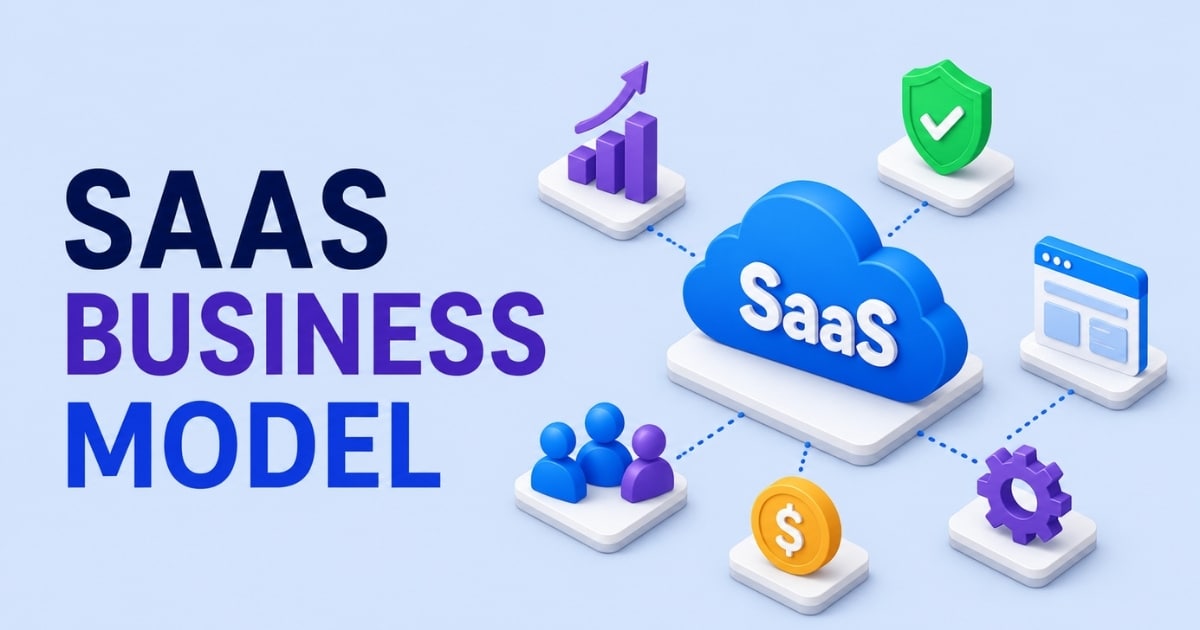
The saas business model explained in simple terms comes down to one idea: sell access to software, not a copy of it. Customers pay a recurring fee, and the provider handles hosting, updates, and security. For non-technical founders, the model offers a clear path to predictable revenue without needing to master server architecture or write code.
But the simplicity of the concept hides real complexity in execution. Pricing, customer acquisition, retention, and metrics all demand thoughtful decisions. The goal of this guide is to break down every component a business owner needs to understand, with real numbers and practical steps that apply in 2026.
What Is The SaaS Business Model
Software as a service is a model where a software company hosts its product in the cloud and gives customers access through a web browser or mobile app. Instead of purchasing a one-time license and installing software on a local machine, customers pay a monthly subscription or annual fee to use the product continuously. Familiar examples include Slack for team messaging, Shopify for e-commerce, and Notion for productivity. Popular SaaS platforms like Google Workspace and Salesforce have turned this approach into a global standard.
The contrast with the old license model is dramatic. In the 1990s and early 2000s, buying software meant a large capital expenditure: companies paid thousands upfront for tools like Photoshop or enterprise databases, then waited years for major version upgrades. SaaS transforms IT expenses from large capital costs into smaller operational costs, allowing businesses of any size to access powerful software without heavy investment. SaaS infrastructure requires minimal local IT requirements, and the provider handles automatic updates, so customers always run the latest version.
SaaS Business Model Components Every Founder Should Know
Before diving into technical details like servers or code, it helps to see the saas business as a set of building blocks that any founder can understand and manage.
The product layer is the cloud-based software itself. A saas platform is hosted in cloud infrastructure, accessed via browser or mobile, and continuously updated by the provider. SaaS allows for faster innovation and deployment of updates compared to traditional installed software, and customers never need to worry about patches or compatibility. Every saas solution runs from a centralized environment, which means the same version serves every user, which is why following best practices of SaaS architecture becomes essential as you scale.
The revenue engine is where the subscription model comes alive. SaaS companies primarily generate revenue through subscription fees, whether seat-based, tiered, or usage-based. Monthly recurring revenue MRR tracks the pulse of the business. Upgrades from existing customers add expansion MRR, while downgrades and cancellations subtract from it. A critical insight: existing customers spend more than new customers on average, which means retention and upselling often matter more than pure acquisition volume. Usage-based billing aligns costs with actual customer usage, and hybrid revenue models combine subscription and usage-based pricing for flexibility. Freemium models convert free users to paid subscriptions over time, making them a common entry point. Many saas companies use freemium models to attract new users before guiding them toward paying plans.
Customer acquisition covers the channels and tactics that bring new customers through the door: content marketing, paid ads, outbound sales, free trials, and partner programs. Customer acquisition cost (CAC) measures the total investment needed to win a single paying customer, and customer acquisition costs are crucial for SaaS profitability. Without tracking CAC, a founder has no way to know whether growth is sustainable or just expensive.
How To Build A SaaS Business Model That Actually Works
The following six steps form a practical roadmap from idea to early growth. Each step addresses decisions a non-technical founder must make, with emphasis on real-world trade-offs.
Choose A Problem And Market You Can Serve Sustainably
Pick a narrow, painful problem in a specific segment. Rather than building a generic calendar app, consider appointment scheduling for independent therapists or invoice management for freelance designers. Specificity makes positioning, pricing, and product development far simpler.
Before writing a line of code, talk to at least 20 to 30 potential customers. Focus on their existing workflows, budgets, and the tools they currently use. The goal is understanding, not pitching. The target market you choose will directly shape your average contract value, sales cycle length, and required feature set. A mismatch between market and product is the fastest route to high churn and wasted customer acquisition spend, so align early discovery with a structured SaaS product development lifecycle rather than ad-hoc building.
Design A Clear Value Proposition And Simple Offer
Write a one-sentence promise that combines your audience, the outcome you deliver, and a timeframe. For example: "Help seed-stage SaaS teams cut reporting time by 50 percent in 30 days." Start with one primary use case and a minimal feature set rather than a bloated platform that tries to do everything.
Clarity in your value proposition improves website conversion rates and reduces the need for high-touch sales early on. Visitors should understand what your saas software does within seconds of landing on your site, supported by thoughtful UI/UX design services for SaaS products that make the message obvious in the interface.
Pick A Revenue Model And Pricing Strategy
The main saas revenue model options include seat-based subscription, tiered pricing plans, usage-based pricing, and hybrid approaches. Align your pricing with the value metric your customers care about. If you run a project management tool, charge per project or per active user, not per gigabyte of storage. As you choose, factor in realistic SaaS development cost considerations so your pricing can support long-term margins.
A practical starting point: begin with three tiers (entry, mid, and enterprise) and offer both monthly and annual versions with a discount for annual commitments. About 38% of SaaS companies now use usage-based pricing, up from roughly 27% in 2021, reflecting a broader shift toward pricing strategies that match customer value perception.
Decide On A Sales Motion That Fits Your Product
Low-touch, product-led sales rely on self-service signup, free trials, and credit-card upgrades with minimal human involvement. The approach works well for lower-priced tools serving many small accounts. High-touch sales involve discovery calls, demos, proposals, and negotiation, and fit products with higher deal sizes or complex implementation needs.
Your chosen sales motion shapes hiring plans and expected payback periods. Sales teams in high-touch models push CAC up but can deliver much higher customer lifetime value. SaaS faces intense competition from established players in most categories, so the right motion helps you compete efficiently rather than just loudly.
Build A Customer Success System Around Retention
Customer success is not just support. It is a structured approach to help every customer reach value and stay engaged. Map a simple onboarding journey with milestones at day 1, day 30, day 60, and day 90. Use triggers like welcome emails, check-in calls, and prompts that guide users toward key "aha moments," and pay close attention to the role of UX in reducing SaaS churn so those moments feel intuitive rather than forced.
Retention and churn management are ongoing challenges for SaaS companies, and SaaS companies focus on customer retention to reduce churn at every stage. Basic tools like in-app walkthroughs, short video tutorials, and periodic Q&A sessions can dramatically reduce early cancellations. Keeping customers satisfied requires proactive effort, not just reactive ticket resolution.
Instrument Metrics And Feedback Loops From Day One
Track a focused set of key metrics from the beginning: new customers per month, MRR, churn rate, CAC, and the LTV to CAC ratio. Even simple spreadsheets paired with product analytics tools can reveal patterns in feature usage, support requests, and cancellation reasons.
Review these financial metrics monthly. Pair the numbers with a handful of customer interviews to understand customer behavior behind the data. Test one improvement at a time, measure the impact, and then decide whether to scale or pivot the change. SaaS requires significant initial funding to sustain operations, and disciplined tracking ensures that capital gets spent where it creates the most value. Understanding broader software services and cloud models like SaaS, PaaS, and IaaS also helps you choose the right technical foundation and spending profile.
SaaS Sales Models And Customer Acquisition For Founders
How a saas business wins new customers is not a marketing decision alone. It is a business model decision that shapes team structure, cost profile, and growth trajectory, and it should be designed alongside your broader SaaS development services strategy so product and go-to-market reinforce each other.
Low Touch Self Serve Sales
In a low-touch model, potential customers discover the product through SEO, content, or ads and sign up without ever speaking to a salesperson. The approach demands strong onboarding, clear subscription pricing, and simple in-app upgrade paths. CAC here is driven mostly by digital marketing spend.
Benchmark data shows that SaaS businesses in the $25K to $50K MRR range see median monthly churn around 4.8% and LTV to CAC ratios near 4.1:1. Companies that scale above $50K MRR often improve to 3.1% median churn and 5.2:1 ratios. SaaS companies can see lower support costs compared to traditional models when self-serve is designed well.
High Touch Sales For Larger Customers
High-touch motions involve roles like sales development representatives, account executives, and account managers. The sales cycle is longer, often stretching months, and involves multiple stakeholders, ROI analysis, and security reviews. For mid-market contracts ($25K to $100K ACV), CAC tends to range from $8,000 to $20,000, with payback periods of 9 to 15 months.
The trade-off is clear: higher cost per customer, but significantly higher customer lifetime value when the deal closes. SaaS companies often need to reinvest profits to scale effectively, and high-touch sales is one of the most capital-intensive areas of that reinvestment.
Hybrid Approaches Across Segments
Many saas companies offer a self-serve or freemium tier for smaller accounts while reserving high-touch sales for larger, more complex deals. The hybrid approach lets a saas business capture volume at the low end and value at the top, but it also raises questions about SaaS scalability strategies for sustainable growth so each segment can expand without breaking your systems or support team.
Operational challenges include overlapping territories, inconsistent pricing perception across different customer segments, and the complexity of supporting both motions simultaneously. Practical rules help: define thresholds based on company size or potential revenue to decide when a prospect warrants human sales engagement.
Customer Acquisition Cost And Payback Period
Customer acquisition cost CAC includes every dollar spent to win a paying customer: ad spend, sales salaries, saas tools, and agency fees. The CAC payback period measures how many months of gross profit are needed to recover that investment. For example, if CAC is $1,200 and monthly gross profit per customer is $150, payback takes 8 months.
Median CAC for B2B SaaS sits around $1,200 per customer in 2026, with significant variation by industry. Healthy payback targets fall under 12 months for SMB segments and 14 to 18 months for mid-market. Customer acquisition costs are crucial for SaaS profitability because every dollar spent acquiring a customer that churns early is a dollar lost.
From First Users To A Repeatable Acquisition Engine
Early customer acquisition is almost always scrappy and founder-led. Personal outreach, community engagement, and manual demos are the norm before any scalable channel exists. The transition from a handful of early adopters to a repeatable engine depends on identifying which channels deliver the best customers, not just the most leads, but the ones with low churn and strong expansion potential.
Document which marketing campaigns and channels produce high-quality results. Test landing pages, messaging variations, and pricing experiments. Once a channel proves reliable, invest more. A repeatable acquisition engine is what turns a promising saas product into a scalable saas business.
Key SaaS Metrics That Drive Healthy Business Models
Non-technical founders do not need dozens of dashboards. A small set of meaningful key performance indicators, reviewed consistently, provides the financial compass for every major decision. Tracking metrics should always connect to action: MRR growth informs hiring, churn shapes roadmap priorities, and CAC guides marketing spend.
Monthly And Annual Recurring Revenue
Monthly recurring revenue MRR represents the predictable income from active subscriptions each month. Annual recurring revenue ARR is typically MRR multiplied by 12 or derived from yearly contracts. Monthly recurring revenue is crucial for predicting cash flow and for demonstrating traction to investors or lenders, and should tie directly into a clear SaaS product roadmap in 2026 so revenue goals and feature plans stay aligned.
Break MRR into four components: new MRR from new customers, expansion MRR from upgrades and add-ons, contraction MRR from downgrades, and churned MRR from cancellations. Healthy saas companies show new plus expansion consistently exceeding contraction plus churn. Even a very small saas business should track MRR monthly and review trends quarterly to spot problems before they compound.
Churn Rate And Retention Quality
Churn rate is the percentage of customers leaving over a given time period. Logo churn counts accounts lost, while revenue churn measures the dollar value of those losses. Losing a small number of large enterprise accounts can be far more damaging than losing many smaller ones.
Benchmarks for 2026 show median monthly churn across all segments near 4.7%. By segment: enterprise at 0.5 to 1% monthly, mid-market at 1 to 2%, and SMBs at 3 to 5%. Net revenue retention (NRR) measures whether existing customers produce more revenue over time through expansions, even after accounting for churn. NRR above 100% is a strong signal of product-market fit and is increasingly required by investors evaluating the saas world.
Customer Lifetime Value And LTV To CAC Ratio
Customer lifetime value represents the total gross profit expected from a typical customer before they churn. A simple formula: take average revenue per account, multiply by gross margin, and divide by monthly customer churn rate. For instance, a customer paying $100 per month with 5% monthly churn and 80% gross margin has an LTV of ($100 x 0.80) / 0.05 = $1,600.
Lifetime value LTV indicates total revenue from a customer over their lifetime, and the LTV to CAC ratio tells you whether your economics work. The median ratio in 2026 sits around 3.6:1. A ratio below 3:1 is a warning sign; a ratio far above 5:1 may suggest under-investment in growth. Non-technical founders should update LTV assumptions at least annually as churn and pricing evolve.
Product Usage And Activation Metrics
Activation rate measures the share of new users who complete a key behavior tied to long-term retention, such as creating a first project or inviting a teammate. Product usage metrics like login frequency, feature adoption, and time to first value help you understand customer behavior and identify which features correlate with lower churn, especially as you introduce AI in SaaS for personalization and automation that can reshape how users interact with your product.
Choose one or two "north star" usage indicators tied directly to customer value. Trying to track every click leads to data overload without actionable insight. Improving activation often yields bigger returns than marginal increases in website traffic or trial sign-up volumes, because it targets the moment where free users become engaged, retained customers.
Cash Flow, Runway, And Capital Efficiency
Even with predictable revenue, a saas business can run out of cash. Cash burn equals total expenses minus total revenue, and runway is how many months of operation remain at the current burn rate. Consistent cash flow from subscriptions reduces risk but does not eliminate it, especially when CAC payback periods stretch beyond a few months.
The "Rule of 40" offers a useful lens for post-product-market-fit companies: your revenue growth rate plus profitability percentage should target around 40%. Founders should build simple cash flow projections based on MRR growth, planned hiring, and expected CAC to plan funding needs. Retention rate measures the percentage of customers retained over time and directly impacts how quickly your revenue compounds or erodes.
SaaS Business Stages From Idea To Scalable Company
A saas business passes through distinct saas business stages, and the expectations for metrics, tactics, and team structure should shift at each phase. What works at $2K MRR will not work at $200K MRR.
Discovery And Validation Stage
Before or just after launch, the focus is on validating that a real problem exists and that your proposed solution resonates. Conversations with potential users matter more than polished branding. Manual workflows and rapid iterations are the norm.
Set modest targets: reach 5 to 10 paying customers who actively use the product, see clear value, and give honest feedback. At this stage, spending months on complex cloud infrastructure or premature scaling is costly and distracting, which is why many teams follow approaches like launching an MVP in 90 days with a focused scope to validate quickly.
Early Traction Stage
Early traction begins once some paying customers consistently use the product and express clear value. Add basic analytics and onboarding flows. Build a simple pricing structure aligned with observed usage patterns. Revenue at this stage might range from $1K to $10K MRR with monthly churn between 5% and 8%.
Focus on one or two acquisition channels that show promise rather than scattering effort across many uncoordinated experiments. Begin formalizing processes for support and customer success, even if the documentation is simple. How many customers you retain matters more than how many you acquire at this point, as shown in many successful SaaS launch case studies where retention outpaced pure acquisition.
Growth And Scale Stage
In the growth stage, MRR increases steadily, churn stabilizes, and larger accounts appear in the pipeline. Hire specialized roles across marketing, sales, product, and customer success, moving beyond a purely founder-led operation. The customer journey becomes more structured, with clear handoffs between acquisition, onboarding, and expansion.
Structured planning around roadmaps, pricing experiments, internationalization, and robust security measures becomes necessary. SaaS companies often face challenges during hypergrowth phases, and keeping culture, customer focus, and shipping speed intact despite organizational complexity is one of the hardest leadership tasks, especially when your platform depends on resilient scalable software architecture for high-growth products.
Maturity And Strategic Options
Maturity brings slower but more predictable growth, strong customer retention, and a recognized brand in the chosen niche. Strategic paths include remaining independent and profitable, raising late-stage capital, exploring acquisitions, or preparing for a public listing.
Product adjacencies like launching additional modules or moving into nearby customer segments can extend growth. Governance, financial controls, and data security become more central. High customer retention rates are essential for SaaS growth at every stage, and mature saas providers typically demonstrate retention as a core competitive advantage in the global market.
Role Of Funding Across Stages
Funding options shift across stages. Early-phase companies often bootstrap or raise angel rounds. Growth and scale stages typically require venture capital or growth equity, with each round bringing higher expectations for CAC efficiency, retention, and ARR growth.
Capital intensity depends on the chosen sales model, average revenue per deal, and desired speed of expansion. The trade-off between control, dilution, and growth expectations is real. SaaS entrepreneurs should plan capital needs based on realistic CAC, churn, and payback assumptions rather than purely aspirational forecasts. Median ARR growth for venture-backed SaaS has declined from roughly 47% in 2024 to about 26% in 2026, reflecting a market that increasingly values efficiency over growth at any cost.
GainHQ And Our Perspective On Sustainable SaaS Growth
GainHQ is a technology partner focused on helping saas businesses move from concept to scalable product. Through services like custom software development services, SaaS Solutions, MVP Development, UI and UX Design, Technology Consulting, and AI-Integrated SaaS Solutions, GainHQ works directly with non-technical founders who need reliable execution without losing control of their product vision.
A healthy saas business starts with strong product-market fit, data-informed decisions, and disciplined customer acquisition costs. GainHQ helps founders simplify core SaaS metrics, clarify customer lifetime value drivers, and improve the customer experience at every touchpoint. The emphasis is always on long-term customer success and capital-efficient growth rather than top-line expansion at any cost, supported by proven experience building scalable SaaS tools that power global business growth.
Every successful saas business starts with a clear business strategy and the right development partner. GainHQ supports saas entrepreneurs through evolving market conditions, helping them build a customer relationship that lasts and a customer base that grows. SaaS companies focus on customer retention to sustain revenue, and GainHQ shares that philosophy in every engagement, illustrated by real-world examples of how custom software transformed companies. As the saas industry continues to mature, GainHQ plans to keep helping founders navigate buyer expectations, emerging pricing strategies, and the operational demands of other business models competing for the same customers.
FAQs
How Much Technical Knowledge Does A Founder Need To Start A SaaS Business
Deep coding skills are not mandatory. A non-technical founder should understand key concepts like cloud computing, APIs, data security basics, and product development cycles at a conceptual level. Partnering with a technical co-founder or hiring experienced contractors can close knowledge gaps effectively. Business model understanding, customer insight, and go-to-market execution matter just as much as technical implementation, and they should connect to a broader digital transformation strategy framework if your SaaS is part of a larger change program inside customer organizations.
When Should A SaaS Startup Hire Its First Salesperson
Founders should validate a repeatable sales process themselves first. Close a meaningful number of deals, document messaging and objections, and confirm that demand is consistent before bringing on dedicated sales roles. Hiring too early can inflate CAC and create confusion if product-market fit is not stable. The right time to hire is when inbound or outbound demand exceeds what a founder can handle personally, and when clear expectations on quotas and payback can be set for the new hire.
How Do Annual Contracts Compare To Monthly Subscriptions
Annual contracts improve consistent cash flow, signal stronger customer commitment, and tend to produce lower churn. The trade-off is higher friction in closing deals because customers pay more upfront. A subscription fee paid annually also reduces the administrative overhead of monthly billing. Monthly subscriptions lower the barrier to entry, which can increase trial adoption but often leads to higher logo churn.
What Is A Reasonable Marketing Budget For An Early SaaS Business
Early-stage saas companies should invest a modest budget focused on learning. Spend levels should connect directly to revenue targets and remaining runway. Testing a small number of channels at a time and calculating early CAC helps determine whether to scale a channel or pivot. In the earliest phase, founder time spent on direct outreach, community engagement, and content creation often delivers more value than large ad budgets, especially when you tap into expert resources like the GainHQ blog on SaaS and software development to shape your content strategy.
How Can A Non-Technical Founder Evaluate SaaS Development Partners
Evaluate potential partners based on previous saas projects, understanding of subscription logic and customer data management, security practices, and references from past clients. A partner who understands the saas model will build with retention, scalability, and the full customer journey in mind. Start with a clearly scoped pilot project that includes milestones and acceptance criteria before committing to a long-term engagement. Communication, transparency on estimates, and shared documentation keep the founder in control of the product vision, and engaging specialized tech consulting services for modern businesses can help you assess risks and validate architecture before scaling.