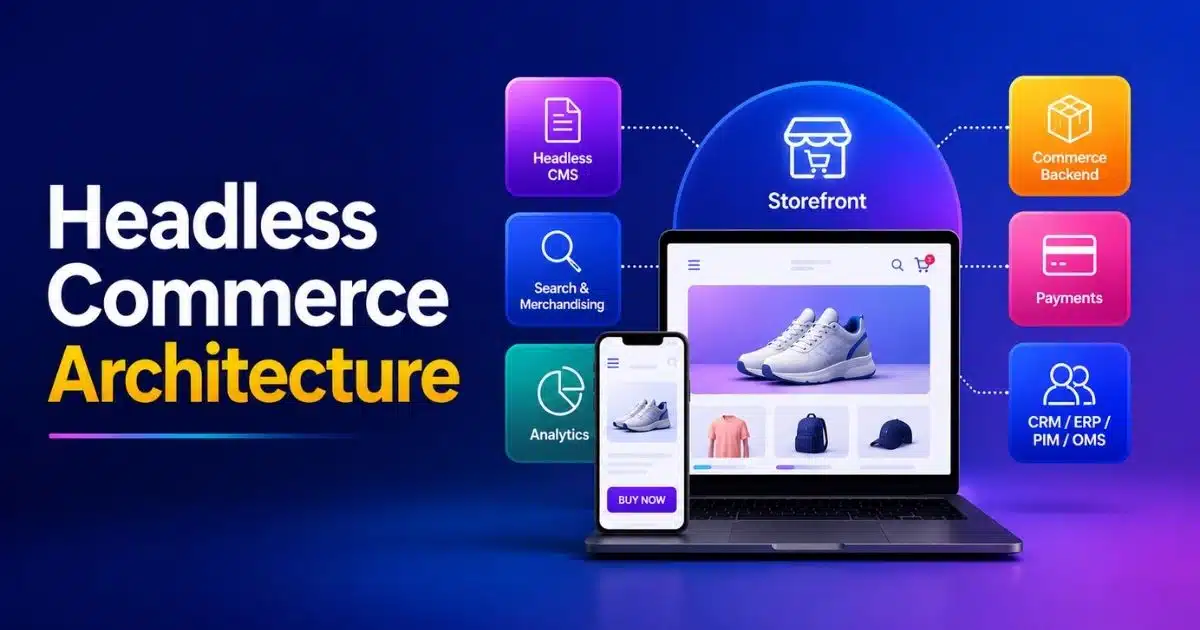
Ecommerce is outgrowing the old playbook. When your storefront and your backend are locked together, every redesign turns into a months-long project. That's the problem headless commerce architecture solves. It separates the frontend, the part customers see, from the backend, where business logic and data live. The two talk through APIs instead of being bolted together.
This split is what makes headless commerce different from traditional platforms. You get to change how your store looks and feels without touching the systems that handle inventory, payments, or orders. That flexibility is why fast-growing brands are moving away from rigid, all-in-one setups.
Below, we'll break down how it all connects, what modern headless commerce platforms bring to the table, and whether your store has outgrown its current setup.
What Is Headless Commerce Architecture?
Headless commerce architecture separates the frontend from the backend of a digital commerce setup. Unlike traditional ecommerce platforms, where the two are fused together, a headless commerce system lets the presentation layer and the business logic run independently, connected only through APIs.
That separation is the whole point. Brands implement headless commerce to change storefronts fast, without waiting on backend releases. Headless ecommerce platforms and headless commerce solutions both follow this model, giving teams the flexibility to build custom experiences on any device.
How Headless Commerce Architecture Works
Once the frontend and backend split apart, everything runs through a chain of connected steps. Requests move through APIs, content gets delivered where it's needed, and orders are processed without one system holding up another. Here's how each part of that chain actually works.
Frontend And Backend
In this ecommerce architecture, the frontend is what customers see and touch, on web, mobile apps, or anywhere else. The backend holds the data and business logic: products, pricing, customer records, inventory. Traditional commerce platforms bolt these together. A headless commerce approach keeps them fully separate. That split is one of the biggest benefits of headless commerce. Teams can redesign the frontend without ever touching backend systems, and update backend systems without breaking the storefront.
APIs Connect Systems
APIs are the bridge. They let the frontend request data and commerce functionality from backend systems without either side needing to know how the other works internally. This is what makes an e-commerce platform genuinely flexible. You can plug in new tools, swap a content management system, or connect a payment provider, all through APIs, without rebuilding the whole stack.
Customer Request Flow
Every action, browsing a product, adding to cart, checking out, starts as a request from the frontend. That request travels through the API layer to the backend, where the real processing happens. This flow has to be fast and reliable, because customer expectations today leave no room for lag. A slow request cycle hurts core web vitals and pushes shoppers away before they buy.
Content Delivery Process
Once the backend processes a request, it sends content back to the frontend: product details, images, pricing, availability. In a headless setup, this content can be pushed to any channel: a website, an app, a smart display, even a voice assistant. That reach is what helps improve customer engagement across every touchpoint a shopper uses.
Order Processing Journey
When a customer places an order, the request moves from the frontend into backend systems that handle payment, inventory updates, and fulfillment. Because the architecture keeps these systems modular, each part can scale or update on its own. This keeps the checkout experience steady even during high traffic, and it's what delivers a consistent customer experience across the entire e commerce journey, from first click to delivery.
Key Features Of Headless Commerce Architecture
Consumer trends move fast, and commerce architecture needs to keep pace. A headless approach gives brands the structure to adapt without constantly rebuilding from scratch. Here are the features that make it work.
API-First Connectivity
Everything in a headless setup runs through application programming interfaces. These APIs handle the back-and-forth between the presentation layer and the backend, so data moves where it needs to go without friction. This API-first design for scalable systems is what enables seamless integration with new tools, payment providers, or search engines. Instead of forcing every system into one rigid stack, brands can follow a strategic API integration approach to connect what they need and drop what they don't, all without disrupting how the storefront runs day to day.
Flexible Storefront Design
Because the presentation layer stands apart from the backend, teams can redesign it freely. A new layout, a seasonal campaign, a completely different look for a new market, none of it touches the systems handling orders or inventory. This flexibility helps brands create consistent branding across every page and campaign, while still shaping the customer experience around what shoppers actually respond to, not what the platform allows.
Independent System Updates
In a headless system, each piece works on its own. The backend can get a security patch or a new feature without the frontend going down for maintenance. That independence is a big part of staying future proof. Markets shift, tools improve, and customer needs change. When systems aren't chained together, brands can update the parts that need it and leave the rest untouched, avoiding the downtime that comes with monolithic platforms.
Omnichannel Experience
Shoppers don't stick to one screen anymore. They browse on mobile, check reviews on a tablet, and sometimes shop through voice assistants or try products through augmented reality. A headless architecture pushes the same content and pricing to every one of these channels from a single backend. That's what it takes to meet customer expectations today. It also makes it easier to create consistent messaging no matter where someone shops, which keeps customer engagement steady across the whole journey.
Real-Time Integrations
Modern commerce runs on live data. Inventory counts, pricing changes, and customer data all need to sync the moment something changes, not hours later. Headless architecture supports real-time integrations that keep every channel accurate at the same time. This matters for customer engagement too. Nobody wants to order something that's already out of stock. Real-time syncing closes that gap and builds trust in the buying process.
Scalable Infrastructure
Growth puts pressure on every part of a commerce stack, and a headless system is built to handle that pressure without buckling. Traffic spikes, new markets, and added product lines don't require ripping out the whole architecture. Instead, individual components scale on their own, aligning with broader enterprise scalability strategies. That's the advantage of a future proof tech stack built this way: it stays future proof as the business grows, instead of forcing a full rebuild every time demand shifts.
Benefits Of Headless Commerce Architecture For Scaling E-commerce Brands
Growth exposes weak points fast. A rigid tech stack that worked fine at a smaller scale starts to crack under real traffic, more sales channels, and higher customer demands. Decoupled architecture removes those weak points by giving every part of the business room to grow on its own.
Faster Page Performance
When the front end isn't tangled up with back end systems, pages load faster. There's less bloat weighing down the user interface, and no dependency on a monolithic platform to render every element. Slow load times cost sales, plain and simple. Brands running composable commerce can optimize the front end separately from the back end infrastructure, which means shoppers get a snappier experience without engineering having to touch order processing or inventory logic.
Better Customer Experience
Digital storefronts built on headless architecture can be shaped around what shoppers actually want. Development teams can test new layouts, add personalized user experiences, and adjust the user interface based on real behavior, all without waiting on backend changes. That freedom translates directly into a stronger customer experience, since every touchpoint feels considered rather than forced into a template.
Easier Platform Scaling
As a brand adds new sales channels, whether that's a new app, a marketplace, or an in-store kiosk, a decoupled architecture handles the load without a full rebuild. Back end infrastructure scales independently from the front end, so IT teams aren't stuck re-architecting the whole system every time the business expands. This is one of the clearest advantages of composable commerce: growth doesn't force a teardown, especially when backed by robust SaaS scalability strategies and scalable software architecture for high-growth products.
Faster Feature Releases
Development teams move quicker when they're not blocked by a single shared codebase. A new checkout flow, a redesigned product page, or a fresh promotion can go live on the front end without touching back end systems at all. That speed matters, especially for teams applying modern B2B SaaS product development practices and relying on scalable SaaS design systems to keep experiences consistent across channels. Waiting weeks for a small feature to clear a release cycle isn't sustainable once a brand is competing across multiple markets and sales channels.
Greater Design Freedom
Because the user interface lives apart from the business logic, marketing teams get more room to experiment. Seasonal campaigns, new brand direction, or a complete redesign of digital storefronts can happen without IT teams rebuilding the tech stack underneath. This kind of design freedom used to require a full platform migration. With headless architecture, it's just a front-end update.
Stronger Business Agility
Third-party integrations are where a lot of brands get stuck with traditional platforms. Adding a new payment provider, a loyalty tool, or a shipping partner often meant reworking half the tech stack. Decoupled architecture makes third-party integrations far simpler, since each system connects through APIs instead of being hardwired together. That agility lets marketing teams, development teams, and IT teams all move at their own pace, without one department's timeline holding back another's.
Headless Commerce Architecture Vs Traditional, Composable, And MACH Architecture
These terms get mixed up a lot, and for good reason. They overlap in places but solve different problems. Here's how they actually compare.
Headless Vs Traditional
Traditional platforms bundle the frontend and backend into one system. Change one, and you risk breaking the other. Headless architecture splits them apart, connecting through APIs instead of shared code. That split is the entire difference. Traditional setups are simpler to launch but harder to scale. Headless setups take more work upfront but give you room to grow without a rebuild.
Headless Vs Composable
Headless just means the frontend and backend are separate. Composable commerce takes that idea further. It breaks the backend itself into individual pieces, payments, search, inventory, checkout, each swappable on its own, often by weighing microservices vs monolithic architecture choices. Every composable setup is headless, but not every headless setup is fully composable. Some brands go headless first, then add composable pieces as they need more control over specific functions, revisiting how they choose their tech stack as complexity grows.
Headless Vs MACH
MACH stands for microservices, API-first, cloud-native, and headless. It's less a competing model and more a stricter version of headless done right. A MACH setup requires every backend service to be independent, cloud-hosted, and accessible through APIs. Headless architecture on its own doesn't demand that level of discipline. MACH does, which makes it a good fit for brands with complex, high-growth needs.
Key Differences Explained
Model | Frontend/Backend | Backend Structure | Flexibility | Best For |
|---|---|---|---|---|
Traditional | Combined | Monolithic | Low | Small stores, simple catalogs |
Headless | Separated | Can be monolithic or modular | Medium to high | Brands wanting frontend freedom |
Composable | Separated | Modular, best-of-breed services | High | Brands needing custom backend control |
MACH | Separated | Microservices, cloud-native, API-first | Highest | Fast-scaling, complex commerce operations |
Which Fits Better
There's no single right answer here. A smaller brand with a straightforward catalog might do fine on a traditional platform. A brand pushing into new sales channels usually benefits from going headless. And a brand juggling multiple markets, complex logistics, or heavy customization needs tends to land on composable or MACH. The right fit depends on how much control your team needs, and how fast the business is moving.
Challenges Of Headless Commerce Architecture
Headless architecture solves a lot of problems, but it isn't free of trade-offs. Brands considering the switch should know what they're signing up for before committing budget and time to it.
Higher Development Costs
Traditional ecommerce platforms come with built-in themes and out-of-the-box functionality. Headless setups don't. You're building the front end and connecting the back end largely from scratch, which means paying developers to do work a traditional platform would have handled for free. That cost buys greater control over the end result, but it's a real expense brands need to budget for upfront, not something to discover halfway through a project.
Complex API Management
Once the front end and back end are separate, APIs become the glue holding everything together. Managing dozens of API connections across multiple channels gets complicated fast, especially as brands add emerging channels like voice assistants or in-store kiosks. Every new integration needs testing, monitoring, and documentation, or customer touchpoints start breaking in ways that are hard to trace back to the source.
Longer Implementation Time
Migrating away from traditional ecommerce isn't a quick swap. Teams need to plan the architecture, connect the back end, build the front end, and test everything across every channel before launch. Brands expecting rapid growth sometimes underestimate how long this setup actually takes. A rushed implementation tends to cause more problems later than it saves early on.
Greater Technical Expertise
Running a headless setup requires developers who understand APIs, cloud infrastructure, and how to keep multiple systems talking to each other correctly. This isn't a drag-and-drop platform where anyone on the team can pull code samples and make quick edits. Brands often need to hire specialized talent or lean on an experienced full stack web development partner, and may also invest in custom internal tools for operations, which raises the skill bar compared to a traditional setup.
Ongoing System Maintenance
Headless architecture doesn't stop needing attention once it's live. APIs need monitoring, integrations need updates, and every new channel added to the mix adds another piece to maintain. Brands supporting multiple channels have to keep all of them running smoothly at once. That ongoing upkeep is the tradeoff for the flexibility headless architecture provides, and it's worth planning for as a permanent line item, not a one-time cost.
When Should You Choose Headless Commerce Architecture?
Not every brand needs to go headless right away. The architecture makes the most sense once a business hits certain pressure points, not just because it's the newer approach. Here's when it's worth the switch.
Rapid Business Growth
A decade ago, most stores could get by with a tightly coupled setup. Traffic was steadier, and there weren't as many ways for customers to shop. That's changed. If your business is bringing in new customers faster than your current platform can handle, a separate front end gives you room to expand without your backend buckling under the load. Growth is one of the clearest signals it's time to move.
Multiple Sales Channels
If you're only running one website, headless architecture in its simplest form might be more than you need. But once you're selling in-store, through an app, and across marketplaces at the same time, keeping everything tightly coupled gets messy fast. Headless architecture lets you manage all of it from one backend, whether you're extending into multi-vendor marketplace platforms or layering in LLM-powered experiences across channels, so customers get the same experience no matter where they're buying.
Custom Shopping Experiences
Some brands need more control over how their storefront looks and behaves than a traditional platform allows. If you want to build websites that feel genuinely different from a template, or connect other tools your team relies on, headless gives you that freedom. Custom experiences are hard to pull off when your front end is locked to your backend's limitations.
Enterprise-Level Operations
Larger operations tend to run on more moving parts: multiple teams, multiple systems, and constant new integrations. At that scale, a rigid platform slows everyone down. Headless architecture fits enterprise needs because it lets different teams work on different pieces without stepping on each other. It also makes it easier to adopt new technologies as they come along, instead of waiting on a platform vendor to catch up.
Long-Term Scalability Goals
If you're thinking five years ahead and not just about this quarter, headless architecture is built for that mindset. It's easier to add new integrations, test new technologies, and adjust to what end customers expect without ripping out your foundation every time. Brands that make the switch early, before they're forced to, tend to see steadier conversion rates as they scale, simply because the experience doesn't degrade under growing demand.
If none of these apply yet, that's fine. Headless isn't a requirement for every store. But once growth, channels, or customer expectations start outpacing what your current setup can handle, it's worth a serious look.
Final Discussion
Headless commerce architecture isn't a trend brands are chasing for the sake of it. It's a response to real pressure: faster releases, more channels, and customers who expect a smooth experience everywhere they shop. Separating the front end from the back end gives teams room to move without waiting on each other or breaking things in the process.
That said, it's not the right call for everyone. Smaller stores with simple needs might do just fine on a traditional platform for now. But for brands scaling fast, juggling multiple channels, or planning years, headless architecture builds a foundation that won't need tearing down later.
Frequently Asked Questions
How Much Does Headless Commerce Implementation Cost?
Costs vary widely depending on scope, but most brands should expect a higher upfront investment than a traditional platform. You're paying for custom front end development, API integrations, and often a specialized team to manage the build. Smaller projects can start in the tens of thousands, while enterprise-level builds with multiple channels and custom integrations run significantly higher.
Which Ecommerce Platforms Support Headless Commerce?
Most modern ecommerce platforms now offer headless or API-first options, including Shopify Plus, BigCommerce, commercetools, and Salesforce Commerce Cloud. Some were built headless from the ground up, while others added API layers on top of existing systems. The right choice depends on how much of the backend you want to build yourself versus how much you want the platform to handle.
Does Headless Commerce Improve SEO Performance?
It can, mainly through faster page speed and better control over site structure. Since the front end isn't weighed down by backend processes, pages tend to load quicker, which supports core web vitals and search rankings. That said, SEO gains aren't automatic. They depend on how well the front end is built and whether technical SEO basics are handled properly during development.
Can Small Businesses Use Headless Commerce?
Yes, though it's not always necessary. Small businesses with simple catalogs and one sales channel often do fine on a traditional platform. Headless makes more sense once a small business starts growing fast, adding channels, or needing custom experiences a template can't deliver.
How Long Does It Take To Migrate To Headless Commerce?
Most migrations take anywhere from three to nine months, depending on complexity, the number of integrations, and how much custom front end work is involved. Rushing this timeline usually creates more problems after launch.