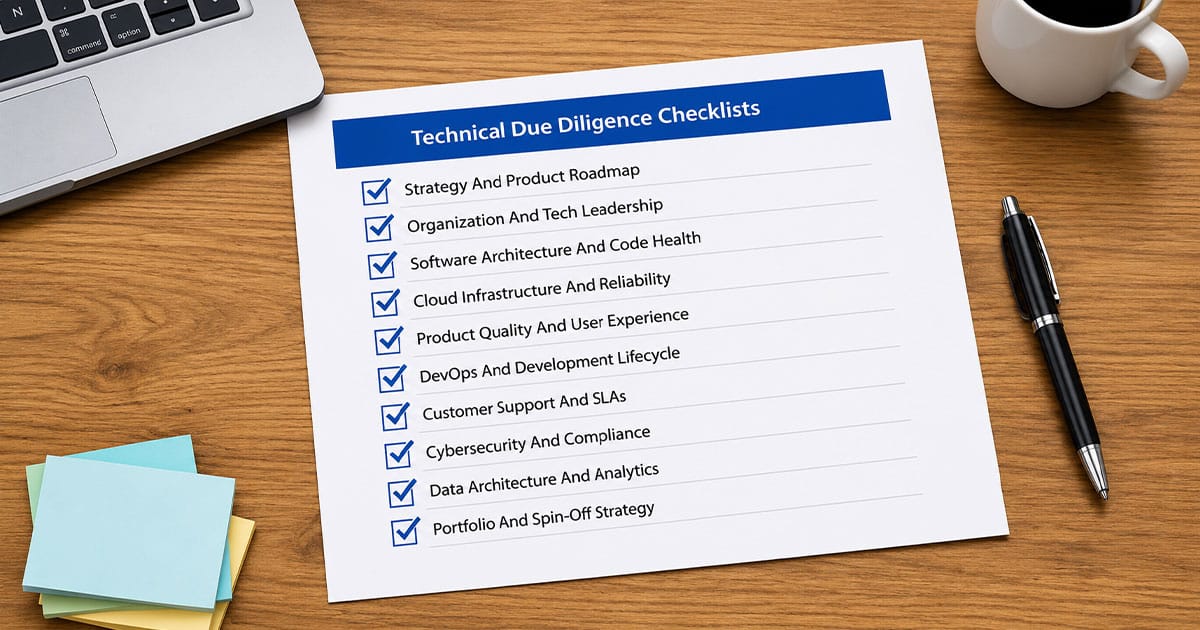
Technical Due Diligence Checklist: 10 Areas to Review
by GainHQ Editorial Team | Mar 29, 2026 | Technology & Innovation | Editorial policy
Table of Contents
- What Technical Due Diligence Means In Practice
- The Technical Due Diligence Checklist
- Checklist At A Glance: What To Ask For And What Should Worry You
- How To Run The Review
- What Access A Reviewer Needs
- How To Rate And Report Findings
- Questions To Ask The Seller
- Common Problems A Review Finds
- Practical Tips To Keep The Review Efficient
- How GainHQ Can Help
Technical due diligence is an independent review of a company’s software, infrastructure, security, team and delivery process, done before you invest, acquire or commit to a partner. The goal is to learn what you are really buying, which risks exist and what they will cost to fix. This checklist covers ten areas, shows what evidence to ask for in each, and links the standards and data it relies on. Every figure is attributed and was checked in October 2026.
What Technical Due Diligence Means In Practice
You are testing claims against evidence. The seller says the system scales, is secure and is well maintained. The reviewer checks code samples, architecture diagrams, deployment history, security reports and the people who run it. The output is a written report with findings rated by severity, an estimate of the effort to fix them and a view on deal risk. If you want a broader view of related services, see tech consulting and software services.
The Technical Due Diligence Checklist
1. Business Strategy And Product Roadmap
Check that the technology supports the business plan. Ask for the roadmap, what is funded, and what depends on a single customer or feature. A roadmap with no owners or dates is a warning.
2. Organization And Technology Leadership
Check who knows the system. Ask for the org chart, tenure, key-person dependencies and hiring plans. If one engineer holds all the knowledge, that is a risk to price in. See fractional CTO vs outsourcing if leadership is thin.
3. Software Architecture And Codebase Health
Check whether the design can grow and be changed safely. Review architecture diagrams, sample modules, test coverage, dependency age and documentation. Ask what the team would rebuild first. CISQ estimated that accumulated technical debt in the US was about $1.52 trillion in 2022, a modelled national estimate that shows why it deserves a line in your report. For remediation, read technical debt ratio and refactor vs rebuild.
4. Infrastructure, Cloud And Reliability
Check how the system runs and recovers. Ask for hosting accounts, cost history, uptime and incident records, backups and proof of a restore test. Confirm who owns the accounts.
5. Product Quality And Testing
Check how defects are found. Ask for test types, automation share, bug counts over time and release rollbacks. Try the product as a user.
6. Delivery Process And Tooling
Check how reliably the team ships. DORA defines five delivery metrics: change lead time, deployment frequency and failed deployment recovery time for throughput, and change fail rate and deployment rework rate for instability. Ask the team for their own numbers and how they are measured.
7. Customer Support And Service Levels
Check what customers experience. Ask for support volumes, response times, top ticket causes and any service-level commitments the company has made.
8. Security, Compliance And Data Protection
Check controls and evidence. NIST SP 800-218 (SSDF) is a core set of high-level secure software development practices that can be added to any development lifecycle. Use the OWASP Top 10:2025 categories, which include broken access control, security misconfiguration and software supply chain failures, to structure the review. Ask for AICPA and CIMA SOC 2 reports (covering Security, Availability, Processing Integrity, Confidentiality and Privacy) or ISO/IEC 27001 certification where claimed, penetration test results and the incident history. The Verizon 2026 Data Breach Investigations Report says 31% of breaches begin with software vulnerabilities, so patching discipline matters.
9. Data Architecture, Analytics And Governance
Check data ownership and quality. Ask where personal data lives, who can access it, how long it is kept and whether the company can prove consent and deletion. Also check reporting and analytics claims against raw data.
10. Open Source, Licences And Carve-Out Issues
Check what code the company actually owns. Ask for a software bill of materials; CISA describes an SBOM as a nested inventory, a list of ingredients that make up software components. Black Duck 2026 Open Source Security and Risk Analysis reported that 98% of codebases contained open source, 87% had at least one vulnerability, 78% had high-risk vulnerabilities and 68% had license conflicts, so findings are normal; unmanaged ones are not. In a carve-out or spin-off, also list shared systems, shared contracts and transition services.
Checklist At A Glance: What To Ask For And What Should Worry You
Use this table as a request list. It is our practical guidance, not a standard; adapt it to the size and type of the target.
| Area | Evidence to request | Warning signs |
|---|---|---|
| Strategy and roadmap | Roadmap, funded initiatives, customer commitments | No owners or dates; roadmap depends on one customer |
| Leadership and team | Org chart, tenure, on-call rota, hiring plan | One person holds all system knowledge; no deputy |
| Architecture and code | Diagrams, repository access, sample modules, dependency list | No diagrams; very old unmaintained dependencies; no code review history |
| Infrastructure and cloud | Account ownership, cost history, incident log, restore test result | Accounts held by an individual; backups never restored |
| Product quality | Test reports, bug trend, rollback history | No automated tests; recurring defects after releases |
| Delivery process | Release history, pipeline config, the five DORA metrics if tracked | Manual deployments only; no way to roll back |
| Support and service levels | Ticket volumes, response times, contractual commitments | Commitments the team cannot measure |
| Security and compliance | Pen test reports, SOC 2 or ISO 27001 evidence, incident history | Claims without documents; no patching routine |
| Data and governance | Data map, retention rules, access list, consent records | Unknown personal data locations; shared admin credentials |
| Open source and carve-out | Software bill of materials, licence review, shared-system list | Unknown licences; shared systems with no transition plan |
How To Run The Review
- Agree scope, access and a time box in writing. List the systems, repositories and people the reviewer may see.
- Request documents first, then interviews, then code and system sampling.
- Rate every finding by severity and by the effort needed to fix it.
- State what was not examined. Gaps are findings too.
- Turn findings into deal terms: price adjustments, warranties, a remediation plan or a walk-away point.
What Access A Reviewer Needs
Agree access before the clock starts, and give read-only credentials where possible. A typical list: source repositories, the ticketing system, the CI/CD pipeline, the cloud console in read-only mode, monitoring dashboards, security scan and pen test reports, architecture and runbook documents, and time with the two or three engineers who know the system best. If the seller refuses access to any of these, record it as a finding.
How To Rate And Report Findings
A simple scheme keeps the report usable by non-engineers. This is a suggested approach, not an industry standard.
| Rating | Meaning | Typical response |
|---|---|---|
| Critical | Could stop the business or cause a serious breach if it fails | Fix before closing, or adjust the price or walk away |
| High | Likely to cause major cost or outage within a year | Funded remediation plan with owner and date |
| Medium | Slows the team or raises risk over time | Include in the first 100-day plan |
| Low | Housekeeping or style issues | Note and monitor |
For each finding, record the evidence, the effort to fix it (in person-weeks, not dollars, unless you have a quote) and who owns the fix.
Questions To Ask The Seller
- What is the biggest technical risk in the business today, and what is being done about it?
- When was the last restore from backup, and who ran it?
- Which parts of the system would you not want to change, and why?
- Who can deploy to production, and how long would a rollback take?
- Which third parties does the system depend on, and what happens if one fails?
- What security incidents have occurred, and how were they handled?
Common Problems A Review Finds
The most common findings are hidden technical debt, outdated dependencies, missing tests, weak access control, undocumented infrastructure and knowledge held by one person. They matter because they turn into cost after the deal closes. Poor quality has a national cost too: CISQ estimated at least $2.41 trillion for the US in 2022, a modelled figure rather than a per-company measurement.
Practical Tips To Keep The Review Efficient
- Send one consolidated request list instead of many small ones.
- Ask for evidence you can open yourself, not summaries.
- Interview engineers, not only executives.
- Sample code across old and new areas, not only the best module.
- Re-check the top findings before you sign.
How GainHQ Can Help
GainHQ is a custom software development agency with 15+ years of experience and 13+ products built, including Payrun (HR and payroll) and Gain.io (CRM and helpdesk). Our technology consulting work includes reviewing systems and planning fixes. Scope and pricing are agreed per project.
Frequently asked questions
What is technical due diligence?
Technical due diligence is an independent review of a company’s software, infrastructure, security, team and processes before an investment, acquisition or major partnership. It tells the buyer what they are really getting, what risks exist and what it will cost to fix them.
What does a technical due diligence checklist cover?
A good checklist covers strategy and roadmap, team and leadership, architecture and code, infrastructure, product quality, delivery process, support, security and compliance, data, and any carve-out or integration issues. Each area should produce evidence and a rating, not an opinion.
How long does technical due diligence take?
There is no standard duration, because it depends on codebase size, number of systems and access to people. Agree a fixed time box and access list in advance, and ask the reviewer to state what they could not examine within it.
Who should perform technical due diligence?
Someone independent of the seller with hands-on engineering experience in the same kind of system. Ask for a written scope, a list of what will be sampled and a sample report format before you start.
What are the biggest red flags?
Single points of failure in people or systems, no tests or release process, unpatched dependencies, unknown open source licences, no backups or restore tests, missing access controls and no security incident record. Open source and security findings are common, so expect some; the question is how well the team manages them.
How common are open source risks?
Black Duck 2026 Open Source Security and Risk Analysis reported that 98% of codebases contained open source, 87% had at least one vulnerability and 78% had high-risk vulnerabilities. It also found license conflicts in 68%. Treat those as industry-wide context, not a verdict on any one target.
What security standards should a target follow?
Ask which of these they follow and for evidence: NIST SP 800-218 (SSDF) for secure development, the OWASP Top 10:2025 for web risks, AICPA and CIMA SOC 2 reports, or ISO/IEC 27001 certification. A report or certificate is evidence; a statement is not.
What does technical due diligence cost?
Quotes vary with scope and depth, and we found no reliable public benchmark, so we do not quote one. Ask for a fixed fee tied to a written scope.