
Flutter Vs React Native: Which Framework Wins In 2026?

by Daniel Wright | Jul 30, 2026 | Technology & Innovation
Table of Contents
- What Is Flutter Development
- What Is React Native Development
- Flutter Vs React Native At A Glance
- Market Share And Community Support In 2026
- Native Performance And Rendering In 2026
- Development Speed And Hot Reload
- What It Actually Costs To Build
- Nearshore Delivery Changes The Math
- Hiring Timelines By Framework
- Five Project Types And Which Framework Wins
- Building For Multiple Platforms From One Codebase
- Flutter Pros And Cons
- React Native Pros And Cons
- The Verdict
Most Flutter vs react native comparisons read like spec sheets written by people who have never shipped either one. This one is different. GainHQ builds mobile apps in both frameworks for real clients, including our own products, so what follows comes from actual delivery experience rather than a weekend of research.
By the end, you will know exactly which framework fits your next mobile project, what it really costs, and why the old performance debate barely matters anymore. We will also cover the one factor almost every other article skips entirely: how your delivery model changes the math more than the framework does.
What Is Flutter Development
Flutter development means building mobile apps, web apps, and desktop applications from one codebase using Google's Flutter framework and the Dart programming language. Instead of relying on native components for each platform, Flutter uses its own rendering engine to draw every UI element directly, giving apps a consistent look and native performance across devices.
Developers write once and deploy to iOS, Android, web, and desktop. Hot reload speeds up development, and Flutter's ecosystem of pre built widgets makes cross platform development faster than building separate native apps.
What Is React Native Development
React native development means building mobile apps using JavaScript and React, letting web developers reuse existing skills to ship for both iOS and Android from one codebase. Instead of drawing its own UI, React Native relies on native ui components, mapping directly to native code on each platform for a real native look and feel. This makes it a practical choice for teams already comfortable with web technologies.
React Native apps communicate with native modules through a javascript interface built on the new architecture, removing the old performance bottleneck. Combined with hot reload and a massive community of third party libraries, it gives teams a fast, familiar path into cross platform app development without learning a new programming language.
Flutter Vs React Native At A Glance
Both frameworks are mature enough now that neither one is a wrong choice on its own. The real differences show up in team skills, budget, and what platforms you actually need to reach.
Flutter uses its own rendering engine to draw every pixel on screen, giving you consistent visuals and a consistent design across every device. React native relies on native ui components instead, mapping directly to native code on each platform for a more native look and feel. That single architectural choice explains almost every other difference between them, and it is the root of most key differences you will read about elsewhere.
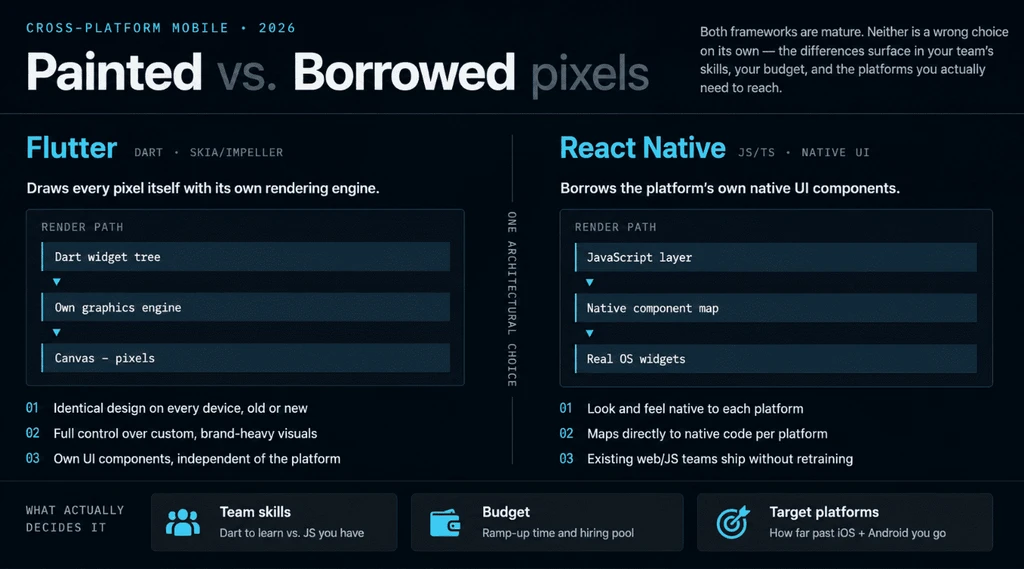
If you are comparing flutter vs react for the first time, think of it this way. Flutter paints its own UI from scratch using its own UI components. React Native borrows the platform's native components and wraps them in a JavaScript layer. Both approaches let you build mobile apps that work across iOS and Android from a single codebase, just with very different tradeoffs underneath.
Feature | Flutter | React Native |
|---|---|---|
Programming language | Dart programming language | JavaScript / TypeScript |
Rendering approach | Own rendering engine (Impeller) | Native components via Fabric |
Native performance | Consistent 60-120 FPS | Near-native, gap narrowing fast |
Hot reload | Sub-second, best in class | Fast Refresh, slightly slower |
Learning curve | Steeper for new mobile project teams | Easier if you already know JavaScript |
Community support | Large ecosystem, growing rapidly | Massive community, oldest cross platform option |
Best fit | Custom UI, multiple platforms | Web development crossover, fast MVPs |
Market Share And Community Support In 2026
Flutter now sits around 46 percent of the cross-platform development share, with react native holding close to 35 percent. That gap has narrowed and widened a few times over the years, and honestly, it tells you less than most articles claim.
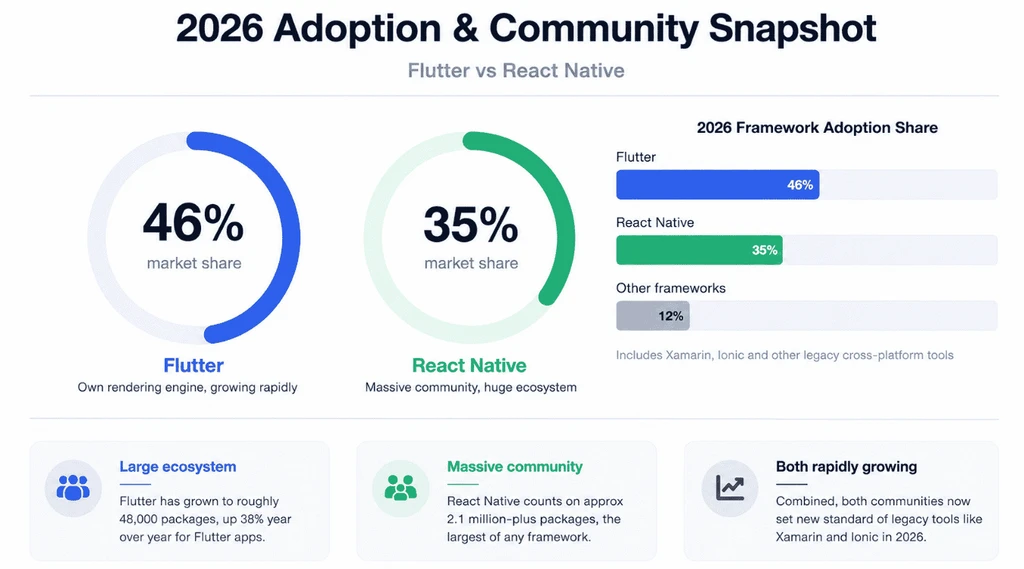
Market share is a popularity signal, not a decision-making tool. Flutter's ecosystem has grown rapidly thanks to Google's backing and a large ecosystem of pre built widgets that cover most common UI patterns out of the box. React native developers benefit from a huge community built on top of existing web technologies, which means JavaScript interface skills transfer directly into mobile development with almost no ramp-up.
Both communities are rapidly growing, and both now sit well ahead of other frameworks like Xamarin or Ionic, which have largely fallen out of serious consideration for new mobile project work. Flutter's community leans heavily toward teams building custom, brand-heavy products. React Native's larger community leans toward teams that already have a web app and want tighter integration between their web and mobile codebases. Neither number should be the reason you pick one over the other for your own mobile project.
Native Performance And Rendering In 2026
Performance used to be the entire argument. In 2026, it rarely is, but the underlying tech still matters for certain kinds of apps, especially ones that lean on smooth animations or heavy data visualization.
Flutter compiles Dart code to native machine code through ahead-of-time native compilation, which is why Flutter apps tend to deliver smoother performance in animation-heavy screens. There is no JavaScript bridge in the middle slowing things down, since everything runs as compiled Dart code talking directly to the GPU.
React native uses JavaScript, precompiled through the Hermes engine, and communicates with native modules through a JavaScript interface that removed the old bridge bottleneck entirely. The result is direct communication between JavaScript and native code that feels close to identical for most everyday interactions. React Native's new architecture, built around Fabric and JSI, closed most of the performance gap that used to separate the two frameworks.
Benchmark | Flutter | React Native |
|---|---|---|
Cold start (mid-range Android) | ~250 ms | ~340 ms |
Animation FPS under load | 58-60 FPS | 52-56 FPS |
Hot reload speed | 0.4-0.8 sec | 1.2-1.8 sec |
Idle memory usage | Higher | Lower |
App binary size | Larger | Smaller |
Development Speed And Hot Reload
Development speed matters as much as runtime performance, especially in the early weeks of a new mobile project when the team is still iterating on layout and flow. Flutter's hot reload is widely considered the gold standard in cross platform development, pushing code changes to a running app in well under a second while preserving app state. That kind of feedback loop compounds over a project, shaving real hours off every sprint.
React Native's Fast Refresh has closed most of that gap, and it preserves component state in a similar way, just with a slightly longer delay per change. For teams that already write JavaScript daily, the difference in raw development time is usually small enough that team familiarity matters more than the tooling itself. Either framework will let a competent team move fast once the initial learning curve is behind them.
What It Actually Costs To Build
Most comparisons quote enterprise numbers that mean nothing to a startup founder, much like many build vs buy software guides that skip the realities of early-stage budgets. A three-year, $360,000 total cost-of-ownership breakdown does not help you decide what to build your MVP with, just like broad custom software vs SaaS comparisons are not enough to choose a mobile tech stack on their own. Here is what smaller, realistic builds actually cost, based on projects we have scoped directly and grounded in detailed MVP development cost benchmarks.
Project size | Flutter estimate | React Native estimate |
|---|---|---|
MVP (3-4 months) | $18,000 - $35,000 | $16,000 - $32,000 |
Mid-size app (5-7 months) | $40,000 - $70,000 | $38,000 - $65,000 |
Annual maintenance | 15-20% of build cost | 18-25% of build cost |
Framework migration (lean MVP) | $8,000 - $20,000 | $8,000 - $20,000 |
Neither framework has a clear cost advantage once you look past the first few months, especially when you compare them to the broader custom vs prebuilt software cost trade-offs that shape your overall stack. Maintenance is where the real difference tends to show up over a year or two, since Flutter's single rendering pipeline means fewer platform-specific bugs to chase down, while react native apps occasionally need separate fixes for iOS and Android quirks even with the New Architecture in place. Over a three-year horizon, that gap adds up, but it rarely changes which framework you should start with. What actually swings your total budget is something most comparisons never mention, and it ties directly to the software development pricing models you use with your delivery partner.
Nearshore Delivery Changes The Math
Here is something almost no comparison article covers: where your development team sits changes the cost equation more than the framework itself, and the trade-offs between hiring in-house developers vs outsourcing usually matter more than framework choice.
Hiring in-house senior mobile developers in the US or Western Europe runs $120,000-$180,000 a year per developer, regardless of framework. A nearshore or offshore software development team building the same app, with the same native performance and the same quality bar, typically costs 40-60% less. Framework choice affects your build by maybe 10-15% in total cost. Delivery model affects it by 40% or more. If budget is the real constraint, that is the conversation worth having before Flutter versus React Native even comes up.
Delivery model | Typical hourly rate | Best fit |
|---|---|---|
US / Western Europe in-house | $80-$150/hr | Enterprises with existing teams |
Nearshore team | $35-$60/hr | Startups needing native performance on a budget |
Fully offshore team | $20-$40/hr | Long-term builds with flexible timelines |
Both Flutter and react native have deep talent pools available through nearshore delivery, so you are not sacrificing quality to get a better rate. React native developers are slightly easier to source nearshore simply because JavaScript is the more common baseline skill, but experienced Flutter teams are widely available too, especially across South and Southeast Asia where GainHQ's own delivery team is based.
Hiring Timelines By Framework
Budget aside, how long it takes to actually staff a team affects your launch date just as much as development time itself. This is another area where the two frameworks pull apart in ways that rarely make it into comparison articles.
Hiring factor | Flutter | React Native |
|---|---|---|
Average time to hire (US market) | 6-8 weeks | 3-4 weeks |
Available freelance talent pool | Smaller, higher rate | Larger, more competitive rate |
Nearshore availability | Strong and growing | Strong, slightly larger pool |
Onboarding time for new hires | 1-2 weeks with Flutter docs | Days, if already JavaScript-fluent |
Five Project Types And Which Framework Wins
Abstract comparisons only go so far, and your choice of framework should really sit inside a broader startup software development process that clarifies scope, risks, and launch goals. Here is how the decision actually plays out across common project types we see from founders scoping a new mobile project, once they have done basic MVP feature prioritization and know what has to be in version one.
Project type | Winner | Why |
|---|---|---|
E-commerce with heavy product browsing | Flutter | Smooth animations, consistent UI rendering across devices |
Fintech dashboards and charts | Flutter | Native performance for real-time data and custom visuals |
MVP for a team with existing web developers | React Native | Faster development speed using existing JavaScript skills |
If none of these match your exact project, the underlying pattern still holds. Apps that live or die on custom, pixel-perfect interactive user interfaces lean Flutter. Apps that live or die on native integrations and existing JavaScript teams lean React Native. Most projects we scope fall clearly into one camp within the first conversation.
Take the e-commerce example, where maintaining a unified visual language across platforms often depends on a solid SaaS design system as much as the framework itself. A product catalog with dozens of animated add-to-cart interactions, promotional badges, and smooth transitions between screens benefits directly from Flutter's own rendering engine, since every animation runs through the same pipeline instead of bouncing between native components on each platform. A fintech dashboard follows the same logic. Real-time charts and live data feeds need consistent frame rates, and Flutter's native compilation keeps things smooth even when the screen is redrawing constantly.
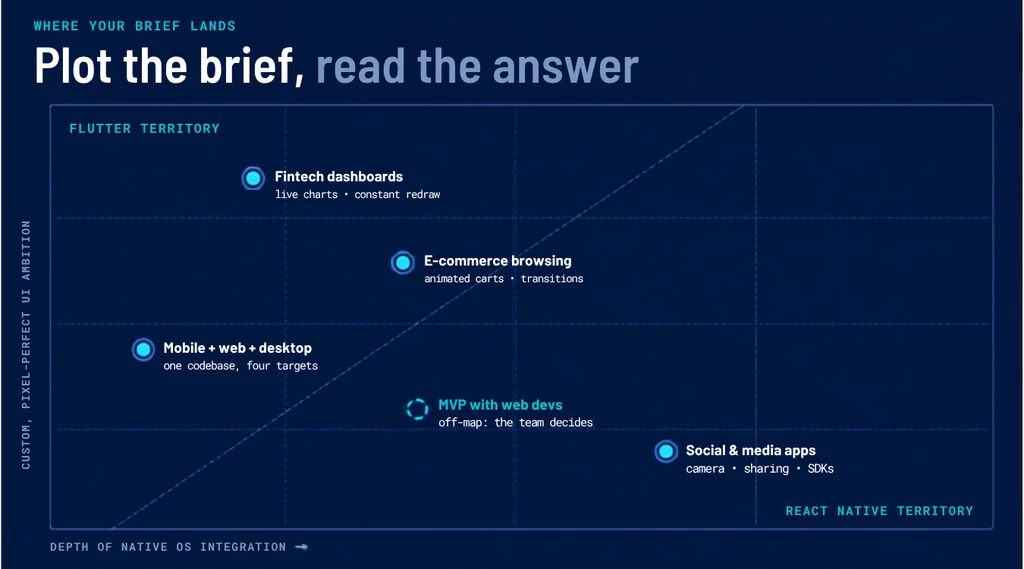
The MVP scenario flips the logic entirely, especially when you look closely at your MVP development budget and cost breakdown. If your founding team already has web developers on staff, React Native lets them build mobile apps without hiring a separate specialist team or waiting for anyone to learn a new programming language, which can dramatically shorten how long it takes to build and launch an MVP. That head start often matters more than any performance benchmark when the goal is simply getting a working product in front of early users as fast as possible.
Building For Multiple Platforms From One Codebase
Reaching more than just iOS and Android is where the two frameworks diverge the most, especially if you are planning a broader scalable SaaS application that needs web and multi-tenant cloud from day one. Flutter genuinely treats multiple platforms as first-class citizens. The same codebase that builds your Android mobile apps can also target web and desktop apps, including Windows, macOS, and Linux, all rendered through the same UI components and the same visual system, which is a big win when you are planning end-to-end custom software development around a single product.
React Native can reach some of the same targets, but it leans more heavily on third-party libraries and community-maintained extensions to get there, particularly for desktop applications. It remains the stronger choice when web is the primary target, since React Native Web shares far more code with a standard web app than Flutter's web output does. Choosing between them here really comes down to which platforms matter most for your specific mobile project, not which framework is objectively more capable.
Flutter Pros And Cons
Pros:
- Own UI components rendered consistently across every device
- Excellent hot reload and development speed once the team is ramped up
- Null safety feature catches entire categories of bugs before runtime
- True support for web and desktop apps from a single codebase
- Flutter's community is growing rapidly with strong first-party packages
- High performance rendering that holds up under heavy animation
Cons:
- Dart programming language has a smaller developer pool than JavaScript
- Larger app binary size compared to react native apps
- Steeper learning curve for teams starting fresh with no Dart background
React Native Pros And Cons
Pros:
- Massive community and the largest package ecosystem in software, well ahead of other frameworks
- Faster onboarding for web developers already comfortable with JavaScript
- Native uses JavaScript, so business logic can share code with a web app
- Smaller app size, which matters in bandwidth-constrained markets
- Third party libraries cover almost every common native integration
- A larger community means faster answers when something breaks
Cons:
- Native performance under heavy animation still trails Flutter slightly
- Fragmented tooling between Expo and bare workflow setups
- Consistent UI across platforms sometimes needs extra styling work
The Verdict
There is no universal winner between Flutter and React Native in 2026. Flutter wins when your app needs consistent visuals, native performance, and true multiple platforms support from one codebase. React Native wins when your team already thinks in JavaScript and speed to market matters more than pixel-perfect custom UI rendering.
What actually moves the needle for most founders is not the framework at all. It is picking a delivery partner who has genuinely shipped both, understands the tradeoffs firsthand, and can scope your specific mobile project honestly instead of pushing whatever they happen to specialize in.
If you are still weighing Flutter vs React for your next build, tell us what you are building, and we will help you scope it, framework and all.
A quick way to sanity check your own decision: if you had to start fresh today with no existing team, no legacy code, and no bias toward either camp, would you choose based on how the app needs to look and feel, or based on how fast you need a working product in front of users? Flutter answers the first question better. React Native answers the second. Most founders already know which question matters more for their specific launch, even if they have not said it out loud yet.